EasyManual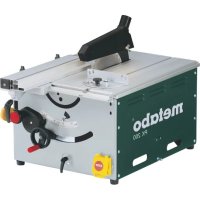
PK 200 - Saw METABO - Free user manual and instructions
Find the device manual for free PK 200 METABO in PDF.



User questions about PK 200 METABO
0 question about this device. Answer the ones you know or ask your own.
Ask a new question about this device
Download the instructions for your Saw in PDF format for free! Find your manual PK 200 - METABO and take your electronic device back in hand. On this page are published all the documents necessary for the use of your device. PK 200 by METABO.
USER MANUAL PK 200 METABO
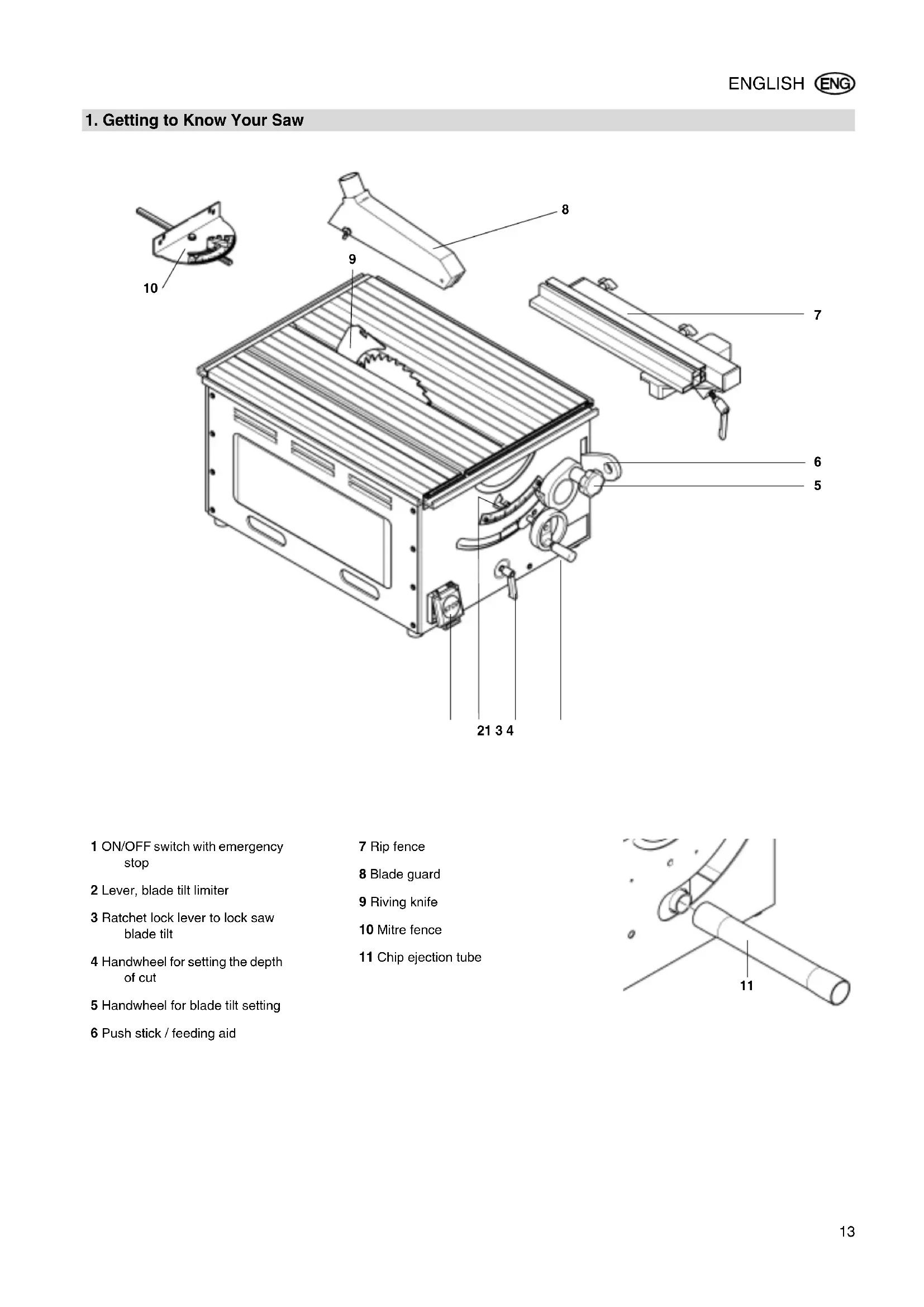
1 ON/OFF switch with emergency stop 2 Lever, blade tilt limiter 3 Ratchet lock lever to lock saw blade tilt 4 Handwheel for setting the depth of cut 5 Handwheel for blade tilt setting 6 Push stick / feeding aid 7 Rip fence 8 Blade guard 9 Riving knife 10 Mitre fence 11 Chip ejection tube
3.1 Specified conditions of use .........14
3.2 General safety instructions..........14
3.4 Symbols used throughout
7.2 Riving knife alignment and
blade guard installation. ..............17
- Read these instructions before use. Pay special attention to the safety instructions.
- If you notice transport damage while unpacking, notify your supplier immediately. Do not operate the saw!
- Dispose of the packing in an envi- ronmentally friendly manner. Take to a proper collecting point.
- Keep these instructions for refer- ence on any issues you may be uncertain about.
- If you lend or sell this machine be sure to have the instructions go with it.
3.1 Specified conditions of
use This machine is intended to rip and crosscut grown timber, faced boards, chip board and wood-core plywood sheets, and similar wood-derived materi
als. Metals can only be cut with the following restrictions: − with suitable saw blade only (see "Available Accessories") − non-ferrous metals only (no hard or hardened metals) Do not cut round stock without suitable jigs or fixtures. The rotating saw blade could turn the workpiece. When sawing thin stock layed on edge, a suitable guide must be used for firm support. Use of wobble saw blades is not permit- ted on this machine.
Danger! Any other use is not as speci- fied. Use not as specified, alteration of the electric tool or use of parts that are not approved by the equipment manufac
turer can cause unforeseeable damage!
3.2 General safety instruc-
- When using this tool observe the fol- lowing safety instructions, to exclude the risk of personal injury or material damage.
- Please also observe the special safety instructions in the respective chapters.
- Where applicable, follow the legal directives or regulations for the pre
vention of accidents pertaining to the use of circular saws.
- Keep your work area tidy – a messy work area invites accidents.
- Be alert. Know what you are doing. Set out to work with reason. Do not operate tool while under the influence of drugs, alcohol or medication.
- Consider environmental conditions: keep work area well lighted.
- Prevent adverse body positions. Ensure firm footing and keep your balance at all times.
- Use suitable workpiece supports when cutting long stock.
- Do not operate the tool near inflam- mable liquids or gases.
- The saw shall only be started and operated by persons familiar with circular saws and who are at any time aware of the dangers associ
ated with the operation of such tool. Persons under 18 years of age shall use this tool only in the course of their vocational training, under the supervision of an instructor.
- Keep bystanders, particularly chil- dren, out of the danger zone. Do not permit other persons to touch the tool or power cable while it is run
- Do not overload tool – use it only within the performance range it was designed for (see “Technical Speci
Danger! Risk of electric shock!
- Do not expose tool to rain. Do not operate tool in damp or wet environment. Prevent body contact with earthed objects such as radiators, pipes, cooking stoves, refrigerators when operating this tool.
- Do not use the power cable for pur- poses it is not intended for.
Risk of personal injury and crushing by moving parts!
- Do not operate the tool without installed guards.
- Always keep sufficient distance to the saw blade. Use suitable feeding aids, if necessary. Keep sufficient distance to driven components when operating the electric tool.
- Wait for the saw blade to come to a complete stop before removing cut- offs, scrap, etc. from the work area.
- Do not attempt to stop the saw blade by pushing the workpiece against its side.
- Ensure the tool is disconnected from power before servicing.
- Ensure that when switching on (e.g. after servicing) no tools or loose parts are left on or in the tool.
- Turn power off if the tool is not used.
Cutting hazard, even with the cutting tool at standstill!
- Wear gloves when changing cutting tools.
- Store saw blade in such manner that nobody will get hurt.
Risk of kickback (workpiece is caught by the saw blade and thrown against the operator):
- Always work with a properly set riv- ing knife.
- The riving knife and the saw blade used must match: the riving knife Table of Contents
2. Please Read First!
ENGLISH should be thinner than the kerf, but thicker than the saw blade body.
- Do not jam workpieces.
- Make sure the saw blade is suitable for the workpiece material.
- Cut thin or thin-walled workpieces only with fine-toothed saw blades.
- Always use sharp saw blades.
- If in doubt, check workpiece for inclusion of foreign matter (e.g. nails or screws).
- Cut only stock of dimensions that allow for safe and secure holding while cutting.
- Never cut several workpieces at the same time – and also no bundles containing several individual pieces. Risk of personal injury if individual pieces are caught by the saw blade uncontrolled.
- Remove small cutoffs, scrap, etc. from the work area – when doing so the saw blade must be at a com
Drawing-in/trapping hazard!
- Ensure that no parts of the body or clothing can be caught and drawn in by rotating components (no neck- ties, no gloves, no loose-fitting clothes; contain long hair with hair- net).
- Never attempt to cut any workpieces which contain − ropes, − strings, − cords, − cables or − wires, or to which any of the above are attached.
Hazard generated by insuffi- cient personal protection gear!
- Wear hearing protection.
- Wear safety glasses.
- Wear suitable work clothes.
- When working outdoors wearing of non-slip shoes is recommended.
Risk of injury by inhaled wood dust!
- Dust of certain timber species (e.g. beech, oak, ash) can cause cancer when inhaled. Work only with a suit
able dust collector attached to the saw. The dust collector must comply with the data stated in the technical specifications.
- Ensure that as little as possible wood dust will get into the environ- ment: − remove wood dust deposit in the work area (do not blow away!); − fix any leakages on the dust col- lector; − ensure good ventilation.
Hazard generated by modifica- tion of the machine or use of parts not tested and approved by the equip- ment manufacturer!
- Assemble tool in strict accordance with these instructions.
- Use only parts approved by the equipment manufacturer. This applies especially for: − saw blades (see “Technical Specifications” for stock nos.); − safety devices (see “Technical Specifications” for stock nos.).
- Do not change any parts.
Hazard generated by tool defects!
- Keep tool and accessories in good repair. Observe the maintenance instructions.
- Before every use check tool for pos- sible damage: before operating the tool all safety devices, protective guards or slightly damaged parts need to be checked for proper func
tion as specified. Check to see that all moving parts work properly and do not jam. All parts must be cor
rectly installed and meet all condi- tions necessary for the proper oper- ation of the tool.
- Damaged protection devices or parts must be repaired or replaced by a qualified specialist. Have dam
aged switches replaced by a service centre. Do not operate tool if the switch cannot be turned ON or OFF.
- Keep handles free of oil and grease.
Risk of injury by noise!
- Wear hearing protection.
- Make sure the riving knife is not bend. A bent riving knife will push the workpiece against the side of the saw blade, causing noise.
Danger from blocking work- pieces or workpiece parts! If blockage occurs:
Danger! Disregard of the following warnings can lead to severe personal injury or material damage. Read instructions. Do not reach into the revolving saw blade.
Wear hearing protection. Use push stick if distance between saw blade and rip fence is ≤ 120 mm. Cut round stock only with a suitable holding device. Use table exten- sion, if otherwise workpiece would fall off the table after cutting.
3.4 Symbols used through-
out these instructions
Danger! Indicates risk of personal injury or severe material dam- age.
Risk of electric shock! Risk of personal injury by elec- tric shock.
Drawing-in/trapping hazard! Risk of personal injury by body parts or clothing being drawn into the rotating saw blade.
Caution! Risk of material damage
Note: Supplementary information
Blade guard The blade guard (12) protects against unintentional contact with the saw blade and from chips flying about. Always have blade guard installed dur- ing operation. Riving knife The riving knife (13) prevents the work- piece from being caught by the rising
ENGLISH teeth of the saw blade and being thrown against the operator. Always have riving knife installed during operation. Push stick The push stick (14) serves as an exten- sion of the hand and protects against accidental contact with the saw blade. Use push stick if distance rip fence – saw blade is ≤ 120 mm. In order for the push stick to be always at hand, it can be stored in a sheath inside the machine's housing.
- Precisely adjustable bevel tilt from – 1.5° through 46.5°.
- Steplessly adjustable depth of cut 0 – 65 mm.
- All operating elements are located at the machine's front.
- Electronic speed control: − motor soft start; − low mains supply load; − constant saw blade speed irre- spective of load provides for con- sistent cut quality; − extended service life of the car- bon brushes; − low no-load speed results in less annoyance by noise.
- An electronic motor protection by overcurrent detection shuts the motor off when it is locked (e.g. by a blocked saw blade).
- An undervoltage relay prevents the machine from starting up when power is restored after a power fail- ure.
- Compact design for quick and easy transportation.
- Mitre fence and rip fence are stand- ard delivery.
- Lower saw blade fully.
Caution! For carrying use the handle holes at the sides of the machine. Do not carry the machine holding it by any of the safety devices or operating elements! ON/OFF switch with emergency stop
- To switch ON = depress upper but- ton (15).
- To switch OFF = push lower button (16) or on switch cover.
Note: Upon power failure an undervolt- age relay is activated. This prevents the starting of the machine when the power is restored. To restart the saw after a power failure the green switch button (15) needs to be actuated again. The ON/OFF switch can be blocked by a padlock. Handwheel for setting the depth of cut The depth of cut can be adjusted by turning the handwheel (17). Handwheel for blade tilt setting With the handwheel (18) the saw blade can be steplessly tilted to the right from 0° (vertical) through 45°. The centre of motion is at saw table level, so the depth of cut remains the same regardless of the bevel angle. Ratchet lock lever The set bevel angle can be locked with a ratchet lock lever (19), so it does not change during sawing.
Note: There are several ratchet lock levers on the saw. If the swivelling range is not sufficient, the lever position can be shifted: pull lever up, turn and let engage again. Lever, blade tilt limiter The blade tilt setting has end stops at 0° and 45°. For special bevel cuts (under
cutting) the bevel angle can be increased by 1.5° in both directions.
- Blade tilt limiter (20) left (down) = saw blade bevel angle adjustable between 0° and 45°.
- Blade tilt limiter (20) right (up) = saw blade bevel angle adjustable between –1.5° and 46.5°.
ENGLISH Rip fence The rip fence (21) slides into the saw table's front extrusion. The auxiliary fence extrusion can be taken off and reversed after loosening the two screws (22).
- Wide edge = for cutting thick work- pieces (max. 65 mm).
- Small edge = − for cutting thin stock; − when the saw blade is tilted. Mitre fence The mitre fence (23) is inserted into the table slot from the table’s front edge. For mitre cuts the mitre fence can be adjusted after loosening the lock lever (24) (±47°).
There are two ways to ensure a firm stand of the machine:
- Installation on workstand (optional accessory);
- Installation on a solid table or work- bench with solid top.
7.2 Riving knife alignment
and blade guard installa
1. Raise saw blade fully.
2. Loosen removable table section (25)
and remove from table.
3. Loosen screws (26) of the riving
4. Pull riving knife (27) up against the
5. Tighten screws (26) of the riving
screw (28) (to do so, turn hexagon socket head cap screw counter- clockwise!) and adjust riving knife position. The distance between the saw blade's outer edge and the riv
Danger! The riving knife is one of the safety devices and has to be correctly installed for a safe operation.
7. Tighten hexagon socket head cap
screw (to do so, turn hexagon socket head cap screw (28) clock- wise!)
8. Fasten removable table section.
9. Install blade guard (30) on riving
7.3 Connection of dust col-
Danger! Dust of certain timber species (e.g. oak and ash) can cause cancer when inhaled: always use a dust col- lector when working in enclosed spaces (air speed at the saw's dust collection port ≥ 20 m/s).
Caution! Operation without a dust col- lector is only possible: − outdoors; − for short-term operation (up to max. 30 minutes); − with dust respirator. If no dust collector is used, saw dust and chips accumulate inside the machine housing. These remains have to be removed after 30 minutes at the latest. Dust collection ports are located on the chip case and blade guard.
- Fit the chip ejection tube (31) onto suction port of saw housing as illus- trated.
7. Initial Operation
Danger! By the revolving motion of the saw blade the saw dust is blown from the chip ejection tube. Watch where the jet of saw dust is aimed at.
Caution! In order for the saw dust to be effectively led off, the chip ejection tube supplied has to be installed even if no dust collector is hooked up. The chip ejection tube shall not be blocked by other objects.
7.4 Mains connection
Danger! Electrical Hazard Operate saw in dry environ- ment only. Operate saw only on a power source matching the following requirements (see also "Technical Specifications"): − mains voltage and system fre- quency conform to the voltage and frequency shown on the saw's name plate; − fuse protection by a residual cur- rent operated device (RCD) of 30 mA sensitivity; − outlets properly installed, earthed and tested. Position power supply cable so it does not interfere with the work and is not damaged. Protect power supply cable from heat, aggressive liquids and sharp edges. Use only rubber-jacketed extension cables with sufficient lead cross-sec- tion (3 x 1.5 mm
Do not pull on power supply cable to unplug.
Risk of injury! This saw may only be operated by one person at a time. Other per
sons may stay only at a distance from the saw for the purpose of feeding or removing stock. Before starting work check to see that the following are in proper working order: − power cable and plug; − ON/OFF switch; − riving knife; − blade guard; − push stick. Use personal protection gear: − dust respirator; − hearing protection; − safety goggles. Assume proper operating position: − at the front of the saw; − in front of the saw; − to the left of the line of cut. − If working with two persons the second person should stand at a rear table extension. If the type of work requires, use the following: − table extension (accessory) if working with two persons or if otherwise workpieces would fall off the saw table; − sliding carriage (accessory); − dust collector. Avoid typical operator mistakes: − Do not attempt to stop the saw blade by pushing the workpiece against its side. Risk of kickback. − Always hold the workpiece down on the table and do not jam it. Risk of kickback. − Never cut several workpieces at the same time – and also no bun
dles containing several individual pieces. Risk of personal injury if individual pieces are caught by the saw blade uncontrolled.
Drawing-in/trapping hazard! Never cut stock to which ropes, cords, strings, cables or wires are attached or which contain such materials.
For cutting the workpiece is evenly fed against the saw blade towards the rear of the table:
1. Set depth of cut. The blade guard
must rest with its front edge on the workpiece.
2. Set blade tilt and lock in position.
3. Mount rip fence, if required.
5. Cut workpiece in a single pass.
6. Switch machine off if no further cut-
ting is to be done immediately after- wards. Mitre cuts
fence to desired angle and tighten ratchet lock lever again.
3. Hold workpiece firmly against mitre
4. Cut workpiece by pushing the mitre
Danger! Prior to all servicing: − switch machine OFF; − unplug power cable; − wait until the saw has come to a complete stop.
- Check that all safety devices are operational again after each service.
- Repair and maintenance work other than described in this section should only be carried out by qualified spe
Danger! With a damaged table insert there is a risk of small parts getting stuck between table insert and saw blade, blocking the saw blade. Replace damaged table inserts imme
Danger! Risk of injury by cuts from the saw blade's teeth. Wear gloves when changing blades.
and remove from table.
3. Loosen screw fitting (34) at the bot-
tom of the chip case and remove cover plate (35) by pulling it upward.
9. Care and Maintenance
4. Hold saw spindle with 13 mm open
jaw wrench and loosen arbor bolt (36) with Allen key (L.H. thread!).
5. Take blade off the saw spindle.
6. Clean clamping surfaces of saw
spindle and saw blade.
Danger! Do not use cleaning agents (e.g. for removing resin residue) that could corrode the light metal compo
nents of the saw; the stability of the saw would be adversely affected.
7. Put on a fresh saw blade (observe
Danger! Use only suitable saw blades according to EN 847-1 (see "Techni
cal Specifications" – when using unsuitable or damaged blades parts could be explosive-like hurled from it by centrifugal force. Do not use: − saw blades which permissible maximum speed is below the rated no-load speed of the saw spindle (see "Technical Specifica
Danger! − Mount saw blade only using gen- uine parts. − Do not use loose-fitting reducing rings; the saw blade could work loose. − Saw blades have to be mounted in such way that they do not wob- ble or run out of balance, and can not work loose during operation.
and tighten fingertight with the Allen wrench supplied.
Danger! − Do not extend arbor bolt tighten- ing wrench. − Do not tighten arbor bolt by hit- ting the Allen key.
10. Fasten cover plate to chip case.
The scale can be set to correspond with the saw blade thickness:
1. Loosen fixing screws and adjust
scale as required (37).
2. Tighten fixing screws and verify set-
ting by making a trial cut.
9.3 Mitre fence adjustment
1. Use try square to check if mitre
fence is at ringht angle to the saw blade.
2. Loosen fixing screws (38) and
adjust graduated arc scale, if neces- sary.
3. Tighten fixing screws.
− 0° = square with the saw table − 45° with separate mitre square. If these angles are not exactly matched:
3. Remove removable table section.
4. Adjust setting screws (40) of stops
until the blade tilt against the saw table at the end positions is exactly 0° (= square) and 45°, respectively.
5. After adjusting the stops the angle
scale at the machine front may need readjustment.
6. Fasten removable table section.
1. Lay machine on its side.
2. Remove chips and saw dust with
vacuum cleaner or brush: − from saw blade setting guide ele- ments; − from motor vent slots.
Danger! Store saw so that − it can not be started by unauthor- ized persons and − nobody can get hurt.
Caution! Do not store saw unprotected outdoors or in damp environment.
Note: The ON/OFF buttons can be blocked by a padlock.
Before switching on Visual check if distance saw blade – riv- ing knife is 3...5 mm. Visual check of power cable and power cable plug for damage; if necessary have damaged parts replaced by a qual
ified electrician. Monthly (if used daily) remove saw dust and chips with vacuum or brush; apply light coat of oil to guide elements: − threaded rod and guide rods of blade rise and fall mechanism: − swivel segments. Every 300 hours of operation Check all screwed joints, retighten if necessary.
- Before cutting a workpiece to size make trial cuts with pieces of scrap.
- Always place a workpiece on the saw table in such way that it can not tilt or rock (e.g. always place a curved board on the table with the convex side up).
- When working long stock use suita- ble supports, such as table rear or side extensions (optional accesso- ries).
- To simplify repetitive cut-off work use a stock stop (optional acces- sory).
- Keep surfaces of saw table and saw base clean – in particular, remove resin residue with a suitable clean
ing and maintenance spray (optional accessory). For special tasks the following accesso- ries are available at your specialized dealer – see back cover for illustrations: A Workstand Provides for a secure machine stand and optimal working height; ideal in mobile use, folds up for sav- ing space. B Base System Rail Required for the installation of Slid- ing Carriage, Table Side or Table Rear Extension. C Base System Rail Extension To extend the Base System Rail to
mm. The enclosed support leg provides for a firm stand. D Support leg for Base System Rail Extension Provides extra support for the Base System Rail Extension. E Sliding Carriage with Mitre Fence For installation on the Base System Rail. Capacity before the blade up to 600 mm. F Table Side Extension For installation on the Base System Rail. Extends the saw table to the left or right. G Rear Table Extension with support leg For installation on the Base System Rail. Extends the saw table at front and/or rear by 1000 mm. H Dust Collection Attachment Helps to protect your health and to keep the shop clean. I Suction Adapter To connect a shop vacuum to the dust collection attachment. J Roller/Ball Transfer Stand For accurate guiding of long stock. K Care and Maintenance Spray To remove resin residue and pre- serve metal surfaces. L TCT Saw Blade 210x2.4/1.6x30 30 ATB For rip and cross cuts in grown tim- ber and particle board. M TCT Saw Blade 210x2.4/1.6x30 42 ATB For rip and cross cuts in panels; plastic, aluminium, copper extru- sions and high-grade veneered sheets. N TCT Saw Blade 210x2.4/1.6x30 64 ATB General purpose blade for plastics and metals.
Danger! Repairs to electric tools must be carried out by qualified electri
cians only! Electric tools in need of repair can be sent to the service centre of your coun- try. Refer to the spare parts list for the address. Please attach a description of the fault to the electric tool. The saw's packaging can be 100% recy- cled. Worn out electric tools and accessories contain considerable amounts of valua
ble raw and plastic materials, which can be recycled. These instructions are printed on chlo- rine-free bleached paper.
Danger! Before carrying out any fault service or maintenance work always:
1. switch machine OFF;
2. unplug power cable;
3. wait for saw blade to come to
standstill. Check to see that all safety devices are operational after each fault serv- ice. Motor does not run Undervoltage relay tripped by power fail- ure: − switch on again. No mains voltage: − check cables, plug, outlet and mains fuse. Motor overheated, e.g. by a blunt saw blade or chip build-up in the chip case: − eliminate cause for overheating, wait for a few minutes, then start saw again. Stated top speed is not reached Motor supply voltage too low: − use a shorter extension cable or extension cable with larger lead cross section (≥ 1.5 mm
− Have power supply checked by a qualified electrician. Loss of cutting performance Saw blade blunt (possibly tempering marks on blade body): − replace saw blade (see section "Maintenance"). Chip ejection tube blocked No dust collector hooked up or suction capacity insufficient: − connect dust collector or − increase suction capacity (air speed ≥ 20 m/sec at chip ejection tube).
4500 ± 10% Cutting speed (at 230V) m/s 49.5 ± 10% Saw blade diameter (outer) mm 210 Saw blade arbor bore diameter (inner) mm 30 Kerf width mm 2.5 Depth of cut with saw blade vertical at 45 ° saw blade tilt
Dimensions length of saw table width of saw table height (with blade guard)
Sound power level A L
Uncertainty K dB (A) dB (A) dB (A)
Noise emission value during sawing operation, (EN 61029-1 *) dust collection on Sound pressure level A L
Sound power level A L
Uncertainty K dB (A) dB (A) dB (A)
- The values stated are emission values and as such do not necessarily constitute values which are safe for the workplace. Although there is a correlation between emission levels and environmental impact levels, whether further precautions are neces- sary cannot be derived from this. Factors influencing the actually present environmental impact level in the workplace include the characteristics of the work area and other noise sources, i.e. the number of machines and other neighbouring work processes. Also, permissible workplace values may vary from country to country. This information is intended to assist the user in his estimate of hazards and risks.22 FRANÇAIS
Incertezza K dB (A) dB (A) dB (A) 88,3 100,0 4,0