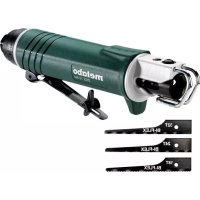
DKS 10 Set - Screwdriver METABO - Free user manual and instructions
Find the device manual for free DKS 10 Set METABO in PDF.


| Product type | Pneumatic body saw |
| Brand | Metabo |
| Model | DKS 10 Set |
| Power supply | Compressed air |
| Maximum admissible service pressure | 6.3 bar (to be confirmed on the manual) |
| Minimum inner diameter of hose | 10 mm |
| Maximum hose length | 10 m |
| Lubrication | Pneumatic oil (3-5 drops every 15 minutes) |
| No-load speed | See technical data page |
| Blade stroke | See technical data page |
| Intended use | Sawing of body sheets, pillars, cross members, plastics, fiberglass, aluminum, wood |
| Start-up lock | Yes (safety device) |
| On/off switch | Yes, with release stop |
| Adjustable stop | Yes, for cutting depth |
| Change blade | Tool-free (locking screw) |
| Routine maintenance | Cleaning of pneumatic filter, regular lubrication |
| Spare parts available | Saw blades, hose, clamp, hex key |
| Noise level | Wear hearing protection (value in manual) |
| Vibrations | Vibration emission value (manual) |
| Repairability | Repair by Metabo technician using original parts |
| Warranty | See manual |
Frequently Asked Questions - DKS 10 Set METABO
User questions about DKS 10 Set METABO
0 question about this device. Answer the ones you know or ask your own.
Ask a new question about this device
Download the instructions for your Screwdriver in PDF format for free! Find your manual DKS 10 Set - METABO and take your electronic device back in hand. On this page are published all the documents necessary for the use of your device. DKS 10 Set by METABO.
USER MANUAL DKS 10 Set METABO
Original instructions
1. Declaration of Conformity
Under our sole responsibility, we hereby declare that these compressed air large diameter saws, identified by type and serial number 1 ), meet all relevant requirements of directives 2 and standards 3 . Technical documents for 4 - see Page 3.
2. Specified Use
This air tool is suitable for work on auto body sheets, for precise sawing of rails, beams, sectional sheets, plastics, fibre glass, aluminium and wood in professional applications.
The air tool must only ever be operated with a compressed air supply. The maximum supply pressure specified on the air tool must never be exceeded. The tool must not be operated using explosive, inflammable or hazardous gases. It must not be used as a lever, crushing tool or striking tool.
Any other use does not comply with the intended purpose. Unspecified use, modification of the air tool or use of parts that have not been tested and approved by the manufacturer can cause unforeseeable damage.
The user bears sole responsibility for any damage caused by improper use.
Generally accepted accident prevention regulations and the enclosed safety information must be observed.
3. General Safety Instructions

For your own protection and for the protection of your air tool, carefully observe all parts of the text that are marked with this symbol!

WARNING - Reading the operating instructions will reduce the risk of injury.

WARNING Read all safety warnings and instructions. Failure to follow all safety warn
ings and instructions may result in electric shock, fire and/or serious injury.
Keep all safety instructions and information for future reference.
Pass on your air tool only together with these documents.
- The user or user's employer must evaluate the specific risks associated with each application of the tool.
- You must read and understand the safety instructions before installing, operating, repairing or maintaining the tool, and also before replacing any accessory parts or carrying out any work in the vicinity of the air tool. Failure to read and follow the instructions may lead to serious injury.
-
Only qualified, trained operators are authorised to install, adjust or use the air tool.
-
The air tool must not be modified. Any modifications implemented may reduce the efficiency of the safety measures and increase risks for the operator.
- Never use air tools that have been damaged. Look after your air tools carefully. Regularly check that all moving parts are functioning correctly without jamming. Also regularly ensure that no parts are broken or damaged to an extent that they affect the operation of the air tool. Check that all signs and labels are legible and intelligible. Have damaged parts repaired or replaced before using the tool. Many accidents are caused by poorly maintained air tools.
4. Special Safety Instructions
4.1 Risks associated with ejected parts
- Disconnect the air tool from the compressed air supply before replacing the mounted tool or accessory parts, and also before carrying out repairs or settings.
- If either the workpiece, accessory parts or the air tool breaks, parts may be ejected at high speed.
- While operating, maintaining or repairing the air tool, or replacing accessory parts, you must always wear impact-resistant safety goggles. The degree of protection required for each individual task must be evaluated separately in each case.
- Ensure that sparks and swarf generated during use are deflected to prevent any hazards.
- Ensure that the workpiece is securely attached.
- Ensure that the mounted tool is securely attached.
4.2 Risks associated with items catching
- Wear suitable clothing. Do not wear loose clothing or jewellery. Keep hair, clothing and gloves at a safe distance from the air tool and moving parts. Loose clothing, jewellery or long hair may possibly be caught in moving parts. There is a risk of injury in this case.
4.3 Risks during operation
- Avoid any contact with the mounted tool to prevent cutting your hands and other body parts.
- When using the air tool, the operator's hands may be exposed to potential risk of cuts, abrasions and heat damage. To protect your hands, wear suitable gloves.
- The operator and maintenance staff must be physically capable of handling the size, weight and power output of the air tool.
- Make sure you hold the air tool correctly: be prepared to counter both routine and unexpected movements, so keep both hands ready.
- Ensure you stand in a safe position and keep your balance at all times.
-
To avoid injuries caused by cutting or chopping, do not touch the mounted tool until the compressed air supply has been disconnected from the air tool. Wear protective equipment such as gloves, protective clothing and a safety helmet.
-
Uncontrolled machine movements can cause injury. Always press the machine with the limit stop (1) firmly against the workpiece.
- Sawing with this machine produces very sharp edges. Wear protective gloves. Deburr the edges.
- Avoid accidental operation. If the air supply is interrupted, switch off the air tool using the On/Off switch.
- Only use lubricants that have been recommended by the manufacturer.
- Wear personal protective equipment and always wear safety glasses. By wearing personal protective equipment such as gloves, protective clothing, a dust mask, non-skid safety shoes, a safety helmet or ear protectors, to suit the type of machine and its use, you reduce the risk of injury. Wearing this equipment is recommended.
- Remember that the machine starts up when you press the On/Off switch and also that the moving mounted tool is dangerous.
4.4 Risks associated with recurring movements
- When working with the air tool, you may experience an uncomfortable sensation in your hands, arms, shoulders, neck or other body parts.
- Make sure you are in a comfortable position to carry out work with the air tool, check that the tool is held securely, and avoid any awkward positions that make it difficult, for example, to keep your balance. If carrying out work over an extended period, you/the operator should change position occasionally. This should help to avoid fatigue and any unpleasant sensation.
- If the operator experiences persistent symptoms such as feeling unwell, aches, pains or throbbing, a prickling or burning sensation, loss of hearing, or joint stiffening, these warning signs must not be ignored. The operator should advise the employer of these symptoms and consult a qualified doctor.
4.5 Risks associated with accessory parts
- Disconnect the air tool from the air supply before attaching or replacing the mounted tool or accessory part.
- Only use accessories that are designed for this device and that fulfil the requirements and the specifications listed in these operating instructions.
- Avoid any direct contact with the mounted tool both during and after use because it may be hot or have sharp edges.
- Check the mounted tool before use. Do not use accessories that may have fallen or that have chipped, cracked or otherwise damaged parts.
4.6 Risks in the workplace
- Slipping, tripping and falling are the main reasons for accidents in the workplace. Pay attention to surfaces that may have become slippery as a result of using the air tool, and also be careful that the air hose does not cause someone to trip.
-
Proceed carefully when working in unfamiliar environments. Power cables and other supply lines may represent a hidden risk.
-
The air tool is not designed for use in explosive environments and is not insulated against contact with sources of electric power.
- Ensure that the area where you wish to work is free of power cables, gas lines or water pipes (e.g. by using a metal detector).
4.7 Risks associated with dust and vapours
- The dust and vapours generated when the air tool is used may carry health risks (e.g. cancer, birth defects, asthma and/or dermatitis); it is therefore imperative that a risk assessment is carried out in relation to these risks and that suitable controls are then implemented.
- The risk assessment should take into account both the dust generated while the air tool is used and any existing dust that may be raised during operation.
- The air tool must be operated in accordance with the recommendations set forth in these instructions and must be maintained in order to minimise the release of dust and vapours.
- The extracted air must be discharged in such a way that, in a dust-filled environment, the minimum of dust is raised.
- If dust or vapours are generated, the main priority is to control these at the point where they are released.
- All integral or accessory parts on the air tool that are designed to collect, extract or prevent airborne dust or vapours must be used and maintained in accordance with the manufacturer's instructions.
- To avoid increasing the amount of dust or vapours generated unnecessarily, the consumables and the mounted tool must be selected, maintained and replaced in accordance with these instructions.
- Ensure the sparks emitted during use do not pose any risk. Explosive or flammable dust may be generated while you work on workpieces. There is therefore a risk of explosion or fire.
- Use protective breathing apparatus in accordance with your employer instructions or in accordance with health and safety regulations.
- Working with certain materials causes emissions of dust and vapours that can give rise to potentially explosive conditions.
4.8 Risks associated with noise
- Failure to use adequate ear protectors when the noise level is high can result in lasting damage to hearing, hearing loss and other problems, such as tinnitus (ringing, whistling or buzzing in the ear).
- It is vital to carry out a risk assessment in relation to these risks and to implement appropriate control measures that take the risks into account.
- Appropriate risk control measures may include, for example, the use of sound-insulating materials to prevent the knocking sounds that occur on the workpieces.
- Use ear protection in accordance with your employer instructions or in accordance with health and safety regulations.
- The air tool must be operated in accordance with the recommendations provided in these instructions and must be maintained in order to avoid unnecessarily raising the noise level.
ENGLISHen
- To avoid increasing the noise level unnecessarily, the consumables and the mounted tool must be selected, maintained and replaced in accordance with these instructions.
- The integrated sound absorber must not be removed. You must ensure the sound absorber is in good working order.
4.9 Risks associated with vibration
- The effects of vibrations can damage nerves and impair blood circulation in the hands and arms.
- When working in cold environments, you must wear warm clothing and keep your hands warm and dry.
- If you notice that the skin on your fingers or hands is numb, prickling or turning white, stop working with the air tool immediately, notify your employer and consult a doctor.
- The air tool must be operated in accordance with the recommendations provided in these instructions and must be maintained in order to avoid unnecessarily raising the level of vibration.
- To avoid increasing the level of vibration unnecessarily, the consumables and the mounted tool must be selected, maintained and replaced in accordance with these instructions.
- To support the weight of the air tool, use a stand, a clamp or an equaliser whenever possible.
- Hold the air tool firmly but not too tightly using the required manual torque reaction: the risk of vibration is increased when the grip force is higher.
- A mounted tool that is either damaged or incorrectly mounted can cause excessive vibration.
4.10 Additional safety instructions
- Compressed air can cause serious injury.
- Whenever the air tool is not in use, and before replacing accessory parts or when carrying out repairs, you must ensure that air supply is shut off, that the air hose is depressurised and that the air tool is disconnected from the compressed air supply.
- Never direct the air jet at yourself or other people.
- Whiplashing hoses can cause serious injury. Therefore always check that the hoses and their fixtures are in good condition and that they have not become loose.
- Do not use quick-lock couplings on the tool inlet. For threaded hose connections, only use those made with hardened steel (or a material with similar shock resistance).
- If universal swivel couplings (claw couplings) are being used, locking pins are also required. You should also use whip check hose restraints in case there is a problem with the connection between the hose and air tool or between the hoses themselves.
- Ensure that the maximum pressure specified on the air tool is not exceeded.
- Never carry air tools by the hose.
4.11 Additional safety instructions
-
If applicable, observe any particular health and safety or accident prevention regulations governing the use of compressors and compressed air tools.
-
Ensure that the maximum supply pressure specified in the Technical Specifications is not exceeded.
- Do not overload the tool - use it only within the performance range for which it was designed (see "Technical Specifications").
- Use non-hazardous lubricants. Ensure the workplace is adequately ventilated. If there is a large amount of discharge: check the air tool and have it repaired if necessary.
- Do not operate the tool unless you are completely focused. You must be alert, pay attention to what you are doing and proceed cautiously when working with an air tool. Never use a tool when you are tired or under the influence of drugs, alcohol or medication. Just one moment's carelessness when using the tool can cause serious injury.
- Make sure your workplace is clean and well lit. Untidy or poorly lit workplaces can cause accidents.
- Keep air tools away from children.
- Do not store the tool outdoors or in damp conditions without protection.
- Protect the air tool, especially the compressed air connection and the control elements from dust and dirt.
Information in these operating instructions is categorised as shown below:

Danger! Risk of personal injury or environmental damage.

Caution. Risk of material damage
4.12 Symbols on the air tool

Read the Operating Instructions before starting to use the machine.

Wear safety goggles.

Wear ear protectors.
5. Overview
See Page 2.
1 Limit stop
2 Clamp screw (for adjusting the limit stop)
3 Air outlet (rotatable))
4 Compressed air connection
5 Hose connection
6 Saw b l a de
7 Clamp screws (for securing the saw blade)
8 Switch (on/off)
9 Switch-onlock
10 Hexagon spanner
11 Double ear hose clamp
* depending on equipment/not in scope of delivery
6. Operation
6.1 Before using the tool for the first time
Prepare the compressed air connection.
Danger! Do not fit quick-lock couplings directly to the compressed air connection. (4)
Never screw connection pieces for quick-lock couplings directly onto the compressed air connection (4) - simply screw the hose connection (5) onto the device and then connect the compressed air hose to this. The compressed air hose between the compressed air connection (4) and a quick-lock coupling must be at least 20cm in length. If fitted too close to the device, a quick-lock coupling may fail: whiplashing hoses can cause serious injury as a result.
- Screw the enclosed hose connection (5) on the compressed air connection (4): using an open-end spanner, secure the compressed air connection against twisting and then screw on the hose connection (5) with another open-end spanner. See Page 2, Fig. A.
- Fit the enclosed double ear hose clamp onto the compressed air hose that you want to connect.
- Push the compressed air hose onto the hose connection as far as it will go.
- Slide the double ear hose clamp onto the hose connection. Using a suitable pliers, pinch the two ears together (see Page 2, Fig. B).
6.2 Fitting the saw blade
Use a saw blade geared to the material to be sawn.
- Disconnect the air tool from the air supply.
- Release both clamp screws (7).
- Insert or replace the saw blade (6).
- Tighten both clamp screws (7) again.
- Check that the saw blade is securely positioned.
6.3 Setting the limit stop
- Disconnect the air tool from the air supply.
- Release the clamp screw (2).
- Adjust the limit stop (1) by pushing it to the required cutting depth.
- Tighten the clamp screw (2) again.
6.4 Using the air tool
To maximise the air tool's performance, always use compressed air hoses with an inner diameter of at least 10mm and a maximum length of 10m . Tool performance can be significantly impaired if the inner hose diameter is too small or if the hose is too long.

Caution. The compressed air line must not contain any water condensation.

Caution. To preserve and extend the service life of this tool, you must ensure that it is regu-. maintained with pneumatic oil lubricator. You do this as follows:
- Use oiled compressed air by fitting an oil-fog lubricator.
- Without an oil-fog lubricator: manually apply oil every day via the compressed air connection.
Use approx. 3-5 drops of pneumatic oil lubricator for each 15 minutes of continuous operation.
If the tool has not been in use for several days, you should manually apply about 5 drops of pneumatic oil lubricator into the compressed air connection.

Caution. Only allow the tool to run at idle speed for a brief period.
- Fit a suitable saw blade (6) (see Section 6.2).
- Adjust the limit stop (1) (see Section 6.3).
- Adjust the supply pressure (this is measured at the air outlet while the air tool is switched on). For details of the maximum permissible supply pressure, see the section on "Technical Specifications".
- Connect the air tool to the compressed air supply.
- Always press the machine firmly with the limit stop (1) against the workpiece. Switch on the machine, and only then guide the saw blade (6) against the workpiece.
- To switch on: push the switch-on lock (9) in the direction of the arrow (see Fig., Page 2) and press switch (8). To switch off: release switch (8)
Working instructions:
Place the saw at right angles to the workpiece and start sawing, applying gentle pressure.

Caution. Applying too much pressure on the saw blade during sawing can cause the saw to overheat and break. Applying too little pressure results in poor sawing performance and causes the saw blade to overheat.
If the saw blade jams during sawing: immediately release switch (8). Eliminate the cause of the jamming. Do not continue sawing until the saw blade is entirely free again.

Danger! Do not touch the saw blade immediately following tool operation, as it can be demely hot and can lead to skin burns.

Danger! Do not make contact with any objects or with the ground with the moving saw blade of recoil or of breaking the saw blade).
7. Care and Maintenance

Danger! Disconnect the compressed air connection before carrying out any work.

Danger! Repair and maintenance work other than the work described in this section should be carried out by qualified specialists.
- Carry out regular maintenance to ensure the safety of the air tool.
- Check that all screw fittings are seated securely, and tighten if necessary.
- Clean the filter in the compressed air connection at least once a week.
- It is recommended that you install a pressure reducer with an air-water separator and lubricator upstream of the air tool.
ENGLISHen
- If a large amount of air or oil is escaping, check the air tool and have it maintained if necessary. (See Section 9.)
- Check the rotational speed regularly and after every use. Also carry out a simple check on vibration emission.
- Avoid contact with dangerous substances that have accumulated on the tool. Wear suitable personal protective equipment and take appropriate measures to remove any dangerous substances before maintenance.
8. Accessories
Use only genuine Metabo accessories.
Only use accessories that are designed for this air tool and that fulfil the requirements and the specifications listed in these operating instructions.
For a complete range of accessories, see www.metabo.com or the catalogue.
9. Repairs

Danger! Repairs to air tools must only be carried out by qualified specialists, using orig-Metabo spare parts!
If you have Metabo air tools that require repairs, please contact your Metabo service centre. For addresses see www.metabo.com.
You can download spare parts lists from www.metabo.com.
10. Environmental Protection
Observe national regulations on environmentally compatible disposal and on the recycling of disused air tools, packaging and accessories. You must not cause risks to people or the environment.
11. Technical Specifications
Explanatory notes on the specifications on Page 3.
Subject to change in line with technological advances.
V_1 = Air requirement
p_max. = Maximum permissible supply pressure
n_0 = Stroke rate at idle speed
I = S t r o k e Tsteel = Max. cutting thickness for steel
T_alu = Max. cutting thickness for aluminium
d_j = Hose diameter (inner)
C = Connecting thread
A = Dimensions:
Length x Width x Height m = W e i g h t
The technical specifications quoted are subject to tolerances (in compliance with the relevant valid standards).

Emission values
Using these values, you can estimate the dimensions from this tool and compare these with the ones emitted by other tools. The actual values
may be higher or lower, depending on the particular application and the condition of the tool or mounted tool. In estimating the values, you should also include work breaks and periods of low use. Based on the estimated emission values, specify protective measures for the user - for example, any organisational steps that must be put in place.
Vibration (acceleration value, frequency-weighted according to EN 28927):
a_h =Vibration emission level
K_h = Measurement uncertainty (vibration)
Sound level (EN ISO 15744):
LpA =Sound pressure level
Lw =Acoustic power level
K_PA K_WA = Measurement uncertainty
Wear ear protectors!

e n g t h
4.5 Risques inherents aux accessoires
Programa completeness of accessories véase www.metabo.com o CATALOGO.
9. Reparación

4.3 Farer under drift
4.6 Onachoctn Ha pa6ooyem MeCTe
- OCKaJIb3bIbAHHe, CNOTbIbAHHe n PaJeHHe YBJIOTcOCHOBHbIMN PnUHAmN TpaBMnPOBaHnHa pa6ooyem MeCTe. ObpaaJte BnHMaHne Ha NOBepxHOCTn, KOTOpBIE B pe3yIbTaTe NcNoJIb30BAHN IHEBMOnHCTpyMeHTa MOrYT CTaTb CHOJIb3KIMn, a TaKHe Ha ONaCHOCTb CNOTKHHTbcra O BO3dYuHbI WlaHr.
-Пи ВьлОЛнHeHn pa6OT B He3HaKOMbIX yCNoBnIX CO6JIHOaIte OCTOpOxHOCtB: BO3MOxHOn HaJIuHne CkpyIToI npOBoDn IOD 3JIeKTPnuEcknM HApJxKeHnEM.
-ПпсьнHCTpymEnHT He npedHa3HaueHДЯ ИСПОЛБ3OBAHЯ BO B3рьIBOONaCHO B03dUshOH СрдЕ И He n3OJIupOBaH OT KOHTaKTA C NCTOCHN- Ками элктчecKOTo TOKa. - Y6eIntecb, yTO B TOM MeCTe, rIe 6ydyT npOn3BOdHTbcra pa6Otbl, He npoxoJrnnn 3JeKTPo-, BOIO-Nra3OCha6xKeHn, (HaNPmep, c NOMOuBIO MetaIIIOuCKaTeJI).
PYCCHNIRu
4.7 Onachoctb BCleCTBne nbIIN napOB
-Bo3HnKaUüne B XOe pa6oTbIC IHeBMOHCTpyMeHTOM NbIbN NaPbIMoYr PnUHHITb BpeD BaWemy 3dOpOBbIO (HaNPmEp, CNOcO6CTBOBaTb pa3BHTIO pKa, PnpOaHbIX HeOcTaKOB, aCTMbI N/INI NOBJIeHNIO KOHbIX BOcNaJIeHN); B O6raTeJIbHO NOPaJKe OueHNTe BO3MOXHbIE pNCnC yUeTOM 3TNx ONaCHOCTe N PpIMtE COOTBeTCTByUOUIme Mepbl npeOcTOPOXHOCTN.
-Пи OцЕнke риСКOB, CBЯЗАHHbIX C BO3HKNKHOBEHnEM ПылIN B XOIDE BBINOJIHHeHЯ pa6OT C ПHEBMOnHCTpyMeHToM, CLEdYe TaKKe yuHTbIbA Tb I Tyпь, KOTOPa YxE BO3MOxHNo IMeJaCb B MecTe npOBeDEHnPa6OT N 6bla NOdHrTa B BO3dYpa6OtaIOUzIM HcTpyMeHToM.
-ПНЕВМОИСHTРМЕNTСLEДYEТ3KСЛУАТИРОВАТБ
ИОБСЛУЖИВАТБСOOTВETCTBИN C peKOMEнДa-
цЯМи,уКаЗAHьIMN B HAcTOrIeM pyKOBODCTBE,
ДЯ СBEДЕHЯ K MINHIMMy BbICBO6OJDEHЯ
ОпаСыХДЯ 3ДОРOBЯ ПьИN И napOB.
- OTPa60TaHHbI BO3dYx CJIeDyET OTBODHT TaKIM O6pa3OM, YTO6bI CBECTN K MHNIMMy 3aBHXpeHnE NblIN B yCIOBnX CNlBHOJ 3aNbJIeHHOCTN B MeCTe PPOBeDEHnRA pa6OT.
-При BO3нКHOBEHIN nbIIN nI IN napOB OCHOBHON 3aIaYeJbJIeTcKOHtpOJIb IX BbICBO60- JDeHn.
- Heo6xOJIMo npaBnIbHO nCNoJIb3OBaTb N O6cLyKINBaTb BCIO Heo6xOJIMyIO JIa C6Opa, BCaCbIBAHNr YdaJIeHNAI TeUyeN PbIINr IIN napOB OCHACTKY INHeBMOnIHCTpymEHTa COrJaCHO yKa3aAHNAM N3ROTOBNTeJI.
- Pacxodhie MaTepeHaJIbI n CMeHHbI INHCTpyMeHT CLeDyET Bbl6HpTaB, 06CnyKINBaTb N3aMeHrTb corlaCHO yKa3aHnIeM n3 HAcToIeRo pyKOBOdCTBa BO n36eKaHHe HeHyKHO rBeJIuYeHn IbIle- nIi Napoo6pa3ObaHn.
- P03a60bTbTeCb O TOM,чTO6bI BO3HnKaIOUe Ne pIn BbINOJIHeHn pa6OT NcKpbI He npeIcTaBIAJn ONaCHOCTN.Пи O6pa6OtKe KOHCTpyKuHOHHbIX MaTePnaIOB BO3MOXHo NOBLeHne B3pbIBOONaCHOn IIN rOpOe Nbln. B pe3yIbTaTe 3TOrO cyueCTByeT pNCH B3pbIBa NII BO3rOpAHHa.
IcnoJIb3yIte 3aunTHbIe pecnnpaTOpbl COJIaCHO IPOUN3BOIDCTBEHHbIM INHCTpyKUJm HIN B COOTBeTCTBnC Tpe6OBaHNrMn NO OxpaHe TpyJa n TexHnke 6e3OnacHOCTn.
- 06pa6oTKa onpeJeHbIX MaTePnaIIOB cOprrHeHa C BblJeHem Nbln I npap, KOTopbIeMOryTco3daTb NOTeHuaJIbHO B3pbIBOONaCHyIO BO3dyuHyo CpeDy.
4.8 OnacHocTb BCJeCDTBne Wyma
-
BbICOKn yPoBeH bMyOBbIX Harpy3OK npn OTCyTCTBn D0JIHKHO 3aUHTbI CnyXa MoKET npNBecTN K pOdoJKNTeJIbHbIM HApUWeHNM Clyxa, NTope Cnyxa n HbIM npo6IeMaM, HApPImep yShOMy (3BeHraUeMy, CBNCTraUeMy IIN JyKKaUeMy) UyMy.
CneIyET HeIpeMeHHO OeHHTb BO3MOKHBie pNcH C yUeTOM 3TNX ONaCHOCTe N IpNHrTb COOTBETCTBYOUJNE Mepbl npedocTOPOKHOCTHN.
B KaueCTBe TaKnx Mep npedocToPOxHOCTH MoKeT BbICTyNaTb, HApnpMeR, npImeHHeN E3OJIaIOHOHHbIX MaTePnaIOB B ueJx yCTpa- HeHn 3BEHnX IyMoB, BO3HNKaIOuNX Ha 3aTOBKe. -
NcnoIb3yIte 3aunTHbIe HayuHnKn COrJaCHO pON3BODCTBeHHbIM HNCTpyKUm INB COOTBETCTBnC Tpe6oBaHnMn PO OxpAe Tpyda nTexHnke 6e3ONaCHOCTn.
-ПИЕВМОИНСТРУМЕNTСLEДYEET3KСПЛУАТИРОВАБТ ИОБСЛУЖИВАТБСOOTВЕТСВИС ПИВОДИМБIM ВHACTOЯЦЕМPyKOBOДСТBEуKaЗAHЯМN BO ИЗБЕЖAHNE HeHyЖHOrO NOBblSeHnY yPOBHЯ шУMa.
Pacxodhie MaTepeHnbln CMeHHbIn HNCTpyMeHT CJeDyET BbIbnpaTb, OcClyKINBaTb N 3aMeHrTb COIaCHO yKa3aHnM n3 HaCTOJIeRO pyKOBOd-CTBa BO n36eKaHHe HeHyHKHO IOBbIWeHn yPOBHa Wyma.
-3anpeaetcyaJdaJIaTb BCTpoEHbI rIyuHTeJIb. OHdoJIKeH haoDiNTbcR B TEXHnueckn NCnpabHOM COCTOHHN.
4.9 Onachoctn BCleIcTBne Bn6paun
-ДиTeBHOE BO3DeIcTBNE Bn6paun MoKeT CTaTb npuHOn HepBhBix paccPoIcTB n HapyUWeHn B cnpKpyLauu KpOBn B KnCTax n IpeDnIeYbAx pyK.
-Прии Вылолнени пабов в услобихников Temператypы HOСИТЕ TEПЛУTO OДЕЖДУ IN DeржITE pyKN B TeПЛЕ N cyxIMN.
- EcIn Bbl NouyBCTByeTe/YBnI NTe, YTO KOJa Ha NaIbux NIN KNCTx PYK CTaNA HeUyBCTBNTEbHO, NOBUNICb «MypaIKN», OHa6OJI NT IN NObeJeA, PpeKpaTne Pa6OTy C NHeBMOnHCTpyMeHTOM, yBeDOMNTe 06 3TOM CBOero pa6OTaTeJN INPpOKOHcyIbTHnpYITecb C BpaHOM.
-ПневMonHCTpyMeHT CJIeMyeT 3KcIpyaTnpOBaTb N O6CJyKNBaTb B COOTBETCTBnC PnIBOdIMMbIMN B HAcTOJaEM pyKOBOdCTBe yKa3aHnA M N BO I36eKaHne HeHyKHOro NOBblSeHnYpOBHn Bn6paqn.
Pacxodhle MaTepeHnbln CMeHHbINHCTpyMeHT CJeDyET BbIbnpaTb,ObCnyKHBaTbN3aMeHrTb COIaCHO yKa3aHnM n3 HAcToIeRo pyKOBOdCTBa BO n36eKaHHe HeHyXHO rOBblSeHnYpOBHr BN6paun.
-ДяудерханнпневMonHCTpyMeHTa,KOrda3TO BO3MOXHO,HCNoJIb3yIteCTOIKy,HaTJHKHO npncnoc6JIeHne nIIb6aJIaHcnpoBOHoe yCTpOInCTBO.
- Kpenko DepeKHTe PHeBMOHcTpyMeHT C yUeTOM Heo6xOdMbIX ycNlne peakun, Ho He 3a6blBaIte npn 3Tom O TOM, YTO pNCK Bn6paun, KaN npaBnIO, Bo3pactaET npn yBelenueHnn ycNlny XBata.
- HenpaBnIbHO CMOHTnpoBaHHbI HJIIOBpeKJDeHHbI CMeHHbI INHCTpyMeHT MOKeT npINBeCTN K NOBbIeHHbIM Bn6paCnM.
4.10 DoonHnTeIbHbIe yKa3aHnNo TeXHnKe Ge3OnaCHOCTn
- CkaTbI B03dyx MOKeT CTaTb npuHOn cepbe3-Horo TpaBMnOBAHn.
-
Ecni nHEBMOnHCTpyMeHT He nCNoJIb3yETcA, a TaKHe nepeJ 3aMeHoi npHaIeHHoCTe Hnnp BbIOJIHeHn peMOHTbIX pa6OT BCERda 6IIOHpyIte NODaUy BO3dyxa, pa3rpyKaIte OT DaBJeHn BA3dyuHbI WlaHr N OTCOEHNHraTe PHEBMOnHCTpyMeHT OT CnCTeMbI (NCTOCHNa) NODaUc cKaTOrO BO3dyxa.
-
HnkOrJa He HanpaBJIe Bo3dUHbI NOTOK Ha ce6r nn dpynX nIu.
-OTIetaIOUneBCTOPOHyIJIaHnMOrYT CtaTb npuHHoCepbe3HOrTOpaBMnPOBaHnR.BcBra3N C 3TNM Bcerda IPOBepaTe,He NOBpeKJdeHbI JIN IJI WJIaHnI He NOBpeKJdeHbI/pacfHKcnpOBAHbI JIN IX KpePeKHbIe 3JIemEHTbl.
-He nCnoJb3yIte 6bICTpopa3bEmHbIe MyΦTbI Ha BxOJe IHCTpyMeHTA. IcNoJb3yIte TaKHe MyΦTbI TOJIbKO IJIpe3b6OBbIX WtUcEpOB, I3rTOOBJIeHHbIX N3 3aKaJIeHHoN CTaIN (IIIN KOHCTpyKuON OHHO MaTePnAna C CONOCTaBmOu YdApHO INPOOHOCbIO).
-Пи ИСЮЛБЗОВАHи yнИВЕрсальНы IX NOBOpOTbIx (KулачКOBbIX) MyФТ HeOБхODIMOИСПОЛБ3ОВaTb CTONOPHьe WTHФТы I XOMyTbI Whipckeck ДЯ 3aцNTb I WlaHROB OT BOLOЧЕнЯ (3axJIeCTbIBaHnR) B ueJx OBeCneueHnЯ 6e3OnaCHOCTn Ha CJIyau pa3beDINHeHnЯ WlaHROBbIX COeДиHeHn.
-103a60bTbTEcB O TOM,чTO6bl HeДOnyCTnTB npeBbIWeHnI NHeBMOnHCTpyMeHTOM yKa3aHHORo MaKcImaJIbHOrO DaBJIeHnI. - KaTeROpHueeCKn 3aIpeucaetc npepHoCHTb nHeBMOHnCTpyMeHT 3a WJHaHr.
4.11 DoonHnTeIbHbIe yHa3aHnNo TeXnKe 6e3OnaCHOCTN:
- Pn Heo6xOaMocTn Co6IouaIte Oc06bIe npednncaHnno 6e3OnacHocTn Tpyda nI npdeynpeJXDeHnIO pON3BOdCTBeHHoro TpaBMaTHMa npnObpaueHnC KOMPpeCCopamn INHeBMOHcTpymeHTaMn.
- Y6eIITecb B TOM, YTO He IpeBbIaTcYKa3aHHoe B TexHnuecknX XapaKTePncTHkax MaHC. DOnyCTmOe pa6Ooee DaBHeHne.
- He neperpykaIte HNCTpyMeHT, INcNoJIb3yIte erO ToIbKO B TOM dHaNa3OHe MOUHOCTH, KOToPbI yKa3aH B TexHnueCkNx XapaKTePnICTHKax.
- HcnoJb3yIte donyuueHHbIe CMa3OuHbIe MaTePnAbl/COH. N03a6oTbTeCb O DocTaTOUHOBBeHTnJIaIpa6Oe 3OHbI. PnIOBbIWeHHompacXOJe cKaTOrO Bo3dyxa: IPOBepbTe INHeBMOnHCTpyMeHT, Pn Heo6xOdImocTn OTpeMOHTpyIte.
- Ppekpnte pa60Ty c3TNm INHCTpyMeHTOM,ecnBac yTO-ln6o OTBLeKaeT! BydTe BHNMaTeJbHbI, CNeDNTe 3a CBOHM DeiCTBnAIM N cepBe3HO OTHOCHTecb K pa6Ote C nHEBMOnHCTpyMeHTOM. He noJIb3yInTEcb INHCTpyMeHTOM,ecn BblYcTaJIH, HaxODHTecb NOD DeiCTBnEhem HapKO-TNKOB, aIKOROI IIN IeKApCTB. HeBHnMaTeJb-HOCTb npN pa6Ote C INHCTpyMeHTOM MOKeT npNBecTI K cepBe3HbIM TpaBMam.
- CneInte 3a YnCTOTOn I NOpAIDOM Ha CBOEM pa6oem MeCTe. BeCnOpiAOK Ha pa6ooyem MeCTe IN PLOXoe OCBWeHHe MOyT PnIBecTH K HeCuaCTHBIM CnyaM.
-ДеркHTe ПНЕВМОнHCTpyMeHT B HeДОCTYПНOMДЯ DeTeN MeCTe.
-3anpeaetcXpaHHeHnHCTpyMeHTa BHe NOMeHn Hn BO BnKHBIX NOMEeHNx 6e3 COOTBETCTBYUOe 3aUNtbl.
-3aunuainTe nHEBMOnHCTpyMeHT,OCo6eHHO uTyucep noaun CxKaTOro BO3dyxa N OpraHbI ynpabLeHn OT nonaDaHn PbInn rpr3n.
HOpMaunO6o3NaeHaB DaHHOM pyKOBODTBeNo 3KcNpyatauCJeDyUOUM O6pa30M:
Onachoctb! PpeDynpEeHene 66 onachocCTn TpaBMPOBaHnI NJI BpeDe IJIg OkpyKaIOUe Cpebl.
BHHMaHHe!PpeDynpEeHneO BO3MOHOM MaTePnaJIbHOM yUepe6e.
4.12 CnMBoJbI Ha nHeBMOHcTpyMeHTe

IpeB BBOOM B3KcNlyaTaUHIO npoHTTe pyKOBOCTBO NO 3KcNlyaTaUH.

IcnoJIb3yIe 3aunTHbIe OCHN

HaedeBaIte 3aunTHbIe HayuHnKu
5.0630p
CM.c.2.
1 Ynop
2 3aKHMHOB BnHT (ДЯ рergyларовиура)
3 BbIXoB03dyxa (noBopoTHoe nCNoJIHeHne)
4 57tuape npdaun cKaTOro Bo3dyxa CnIbTpom
5UtpuepnlaHa
6Пиьhoe NOIOTHO
7 3aKHMbIe BnHTbI (dJIa KpeIneHnI NJIbHOrO nIoTHa)
8 BbIKIOuataJIb (BKn/BlKnl)
9 BLOKnpaTOp BKJIUOeHnA
10KJIou-WeCTnIgpaHnHK
11 3aJIMc2 npoyuHAmn
*B 3aBNCHMOCTN OT KOMJIeKTAuIN/HE BXOJNT B KOMJIeKT NOCTaBKN
6.Зкплуataцnia
6.1 Ipeep npBbIM HcnoJb3ObaHneM
IodroTOBbTe wTucep noaun cKaToRo Bo3dyxa.
Onachoctb! He MOHTnpyIte 6bICTpOa3b-EMHbIe MyfTb I npRAHO Ha WTyUepe NODaun CKaTOro BO3dyxa (4). KaTEROpHuecN 3anPeuaETcR MoHTnpOBaTb CoEINHITeIN DnA 6bICTpOpa3bEmhBix MyfT npRAHO Ha WTyUepe NODaun CKaTOro BO3dyxa (4) -Ha INCTpymEnTe pa3peWaaTcR BBOpaUNBaTB TOJbKO WTyUeP (5), K KOTOPOMy NOcEOHNHeTcR INHEBMATNUeCKN WLaHr.ДИнHA INHEMOUHaRa MeKdY WTyUePOM NODaun CKaTOro BO3dyxa (4) IN 6bICTpOpa3bEmHOMyfTOI DOJIHHa COCTABJIaTb HE MeHee 20 cm. BbICTpOpa3bEMHAR MyfTa, yCTaHOBJIeHHAR CInuHOM 6nI3KO K INCTpymEnTy, MOKeT paCKpbITbcr N OTJeTaIOUne B CTOpOHy WlaHr MOry T CTAb PnUHON CEpbE3HOrO TpaBMnPOBaHn.
- HabnHTte BXOJaH N B KOMJIeK T NOCTaBKn 5) Ha 5Tuep I Odaun CHaTOro Bo3dyxa (4): npu 3tOM yIepKbAaTe 5Tuep RaeyhbIM KIOUcOM dJa 3aUnTbI OT nPoBOpaUNBaHn I HABINHcNBAIte 5Tuep (5) BTOpbIM raeHbIM KIOUcOM. Cm. c. 2, pnc. A.
PYCCHNIRu
- HaBnHbTe BXOJaN B KOMPJIeKT NocTaBHn 3aJHM C 2 npoyuHaMn Ha NOdCOeDINHReMbI INHeBMoWlaHr.
- HacaHTe nHeBMOwlaHr do ynpa Ha wTucep.
- HaDbHbTe 3aKHM C 2 npoyuHaAMn Ha StTyep nIIOTHO COXMMTE C NOMOcBMOHTaXHHbIX OCTpoRy6ueB o6e npoyuHbI (cm. c. 2, pnc. B).
6.2 YctaHOBka NnIbHOro NOJOTHa
IcnoJb3yIte nIbHoe noIOTHO, npEHa3Ha-ueHHoe dIy o6pa6aTbIbAemOro MaTePnAna.
- OTCOeHnHTe NHeBMOHCTpymeHT OT NCTOuHnKa NOaHu CxAToRo BO3Dyxa.
- Ocna6bTe 06a 3aHIMhBIX BnHTa (7).
- YctaHOBNTe HJIN CMeHNTe NJIbHOE NOJIoTHO (6).
- CHOBA 3aTAHnTe 06a 3aXIMMbIX BnHTa (7).
-Проверп,наджнолзафксрвано Пильhoe NOJOTHO.
6.3 Perylnipobka ynopa
- OToCoeHInHTe INHeBMOHnHCTpyMeHT OT NCTOCHNKA NOdaHcKaTOro BO3dYxa.
- Ocna6bTe 3aXHMHOB BVHT (2).
- CdBnHbTe ynp (1) Ha hyKHyIO rIy6bHy pe3a.
- CHOBA 3aTaNHTe 3aKHMbI BnHT (2).
6.4 IcnoIb3OBAHne nHeBMOHCTpyMeHTa
Дя obecneueHЯ NOHOM MOUHCTN NHEBMONHCTpyMeHTa Bcerda HcnoJb3yTe NHEBMATUeCKHe WlaHn C BHyTpeHHm DnaMeTpOM He MeHee 10 MM n c MaKcHMaJIbHOH dInHOH 10 M. CInuKOM MaIbI BHyTpeHHn DnaMeTp INn CInuKOM dInHHbI NHEBMATUeCKn WlaHr MoJcET 3aMetHO IOHN3NTb MOUHOCtB.

BHMMaHHe! B WlaHre nOdauN Bo3dyXa He DOJIHHo 6bITb KOHDeHCata.

BhImaHne! YTo6bI 3OT INHCTpyMeHT OCTaBaICr FyHKUHOHaJIbHbIM B TeueHne DOJrOMeHN,ero Heo6XoHMo Cma3bIBaTb DoCTaTOKOLnueCTbOM Cma3Kn. BapnaHTbl Cma3Kn:
- YctaHOBHTe MacNoapcNbIInTeJIb IJIra NODaHIN pOMacJIeHHORO CxATOrO BO3dyXa.
-Be3 maclopacbIInTeJIa: eKeIHeBHO CMa3blBaIte BpyHyIO uTyuep NOaun CHaTOrO Bo3Dyxa. PnM. 3-5 KaIeIb Macla IJn PHeBMOnHCTpyMeHTOB uepe3 KaXdIbe 15 MmHyT pa60TbIB HeIpepbIBHom peKIMe.
EcnHnCTpyMeHT He NcNoJIb3OBAIcR B TeueHne HeCKoJIbKHX DHei, Do6aBbTe BpyHyIO B WtTyep IOnaHi CxAtoro BO3DyXa npM. 5 KaIeJIb MaCJa DIAI INHEBMOnHCTpyMeHTa.

BHHMaHHe! DaIte npa6oTaTb HnCTpyMeHTy B TeueHne KOpOTKOrO BpeMeHN HaOCtOM XOdy.
- YcTaHOBnTE NOxOJaUe ee NIIbHoe NoIOTHO (6) (cm. rnaBy 6.2).
- OTPeryu npyte ynp (1) (cM. rnaBy 6.3).
-
Otperynpyte pa6ooye daBleHne (n3MepeHHoe Ha BXOe BO3dyxa npn BKNIOUeHHOM nHeBMOnHCTpyMeHTe).MaKc. donyctmoe pa6ooye daBleHne -cm. rIaby "TexHueckne xapaKTepnCTnKn".
-
Пдклioчnte пhevьmonнсгрмент К систeme пдачи сжатою ВОзdyxa.
- Bcerda npnKmMaTe nHEBMOnHCTpyMeHT ynpom (1) K 3aROTObKe. BkIouaTe nHEBMOnHCTpyMeHT TOJbKO NocJe TORO, KaK NOdBedeTe NIIbHOe NIOToHO K 3aROTObKe (6).
- BkIIOueHHe: cBnHbTe 6IoKnapaTOp BkIIOueHn (9) B HanpaBJIeHHN CTepeJKN (CM. pnc., c. 2) n HaKMnTe BbIKIOUoHaTeJb (8).
BbIKIOUeHHe:OTnycTnTe BbIKIOUaTeIb (8)
Yka3aHnno 3KcNlyatauH:
npiCTaBbTe NnIy NOd nprMbIM yIOM K 3aROTOBKe HauHHaTe BblOJIHrTb pe3 C JIeKIM HaJHMOM.

BHMaHne!PnCNIuKOM CINbHOM HaHMe NIIbHOE NOIOTHO MOKeT nepepeTbcraN
CLOMaTbCn. Pn CInuKOM Cna6om HaKHe Me npOn3-BOINTeJIbHOCTb pe3aHn8 BydET CInuKOM Hn3KoN n 3TO TaKHe npBEdet K nepePepBy NnIbHoro NOJOTHa.
EcIn NIIbHoe NOJIoTHO 3aeIIO BO BpeMpa60Tb: HEmeJeHNO OTNcyTnTe BbIKIouaTeIb (8). YcTaHnTe npuHy 3aeJaHn. PpOdoJIkaIte pe3Ky TOIbKO nocne pONHOrO OCBO6OxJdeHn NIIbHO r OJIoTHa.

Onachoctb! HenocpeDCTBeHHo nocJe pa60tI He npKacaiTecb K NJIbHOMy
NOIOTHY, T. K. OHO MOKET 6bITb OueHb TOPAHM N Bbl3bBAtB OKOHN KOHN.

Onachoctb! He KacaITecb DnKyuMCMr INHbHIM NOJOTHom HnKaHX npEiMeTOB HIN
3eMn (ONaCHOCb OTdauN, Oblom NJIbHOro nolOTHa!)
7. TexHHuechoe o6cIyHnBaHne n yXoI

Onachoctb! Npeed IIO6bIMn pa6oTaMH Ha HNCTpyMeHTe OTcoEINHЯITe WTyuep NOdaH NOrO Bo3dyxa.

Onachoctb! OnncaHHbIe B HacToIeM pa3-DeIe pa6Otbl NO Texo6cnyKnBaHnIO n pe
MOHTy DOJIHHbI BbINOJHrTbcr TOnbKO CneuaNCTaMn.
-PytempernyarphoroTexHueckoro 06cIyBbAHnObeCneYte 6e3OpaCHOCTb INHeBMOnHCTpyMeHTa.
- PpOBepaTe HaDeXHoCTb pe3b6OBoBix CoeINHeHn, pPr Heo6xOJIMoCTn 3aTARuBaIte Hx.
-Пкайнел Мерета3В HeДeЛIO OчиаNTeФИьТВ WHTyUepe NODaHn CKaTOrO B03dYxa.
- Ha BXOe cKaTOro BO3aYxa NHeBMOHnCTpyMeHTa peKOMeHNyTeCra yCTaHOBnTB peDyKUNOHbI KlaNaH C BnaFOOTdEnlTeJEM MAcLeHKy.
-ПиИЗББΙTOΥΗМБΙΧΟΥΕ Macla ИЛΝΙΒΟЗДуxa CJIeДуET ПОВЕРΤБ ΠΗΕΜΟΥΗСТPyMeHTИ ПИΝ ΚeoXODIΗΟΥΤΗΟΥΑΤБ. (CM.ΓΙΑBy 9.)
PerylaHNO n noCle KaKDoRo IcNoIb3OBAHN npOBepaHTe YactOTy BpaueHn ypoBeHb BN6paun.
-He donyckaIte KOHTaKTA C ONaCHbIMN BeueCTBAMN, KOTOpbIE MOrIN OTIOJHnTbCRA Ha IHCTpyMeHTe. NcNoJIb3yIte NOxOJaUne CpeIcTba
HINHBNDAyBHO3aHTbI N yCTpaHNTe ONaCHbIE BeueCTBa NyTEM npnHrTn IoXoJxMep NepeTdTexHnueckm O6cLyKnBaHNem.
8. Пинадлжноctn
IcnoJb3yIe ToJIbKO opnHnHaJIbHbIe npHaJaJIeK-HocTn Metabo.
HcnoIb3yIte TOLbKO Te npHaJNeKHOCTN, KOToPbIe PpeHa3HaueHbI dJa 3TOrO pHeBMOnHCTpyMeHTa H COOTBETCTByIOT Tpe6OBaHNm I napametpam, PpNBODMbIM B HactoJsem pykoBODCTBE NO 3KcIIyatauN.
Полны accopTmEHT npHaIeXHOCTeM CM.на calte www.metabo.com ИИВ кataIore.
9. PemoHT

Onachoctb! PEmoHT INHEBMONHCTpymeHTOB DOJIHHbI NPOBOIDnTB TOJbKO KBaJIHΦNcIPOBIE CNEUAnlncTbICNCIOJIb3OBAHNEM OPHINHBIX 3anacte Metabo!
CnHcN 3aNaChbIX YacTeM MoKHo cKaHaTb Ha caIte www.metabo.com.
10. 3auntata OKpyhaioe cpebl
BbInonHnTe HaunOHaIbHbIe npaBnla yTnIIN3aunn npepea60TN OTCnyKHBwero NHeBMOnHCtpymeHTa, ynaKOBKn n pinaJaeKHOCTeN. B XoJe yTnIIN3aunn He doJIHKHO BO3HNKaTb HNKAnx Yrpo3 dIy IIODei N OkpykaIoUe Cpebl.
11. Texhnuechne xapaKTepeNCTHKn
PoncheHnK daHHbIM, yKa3aHHbIM Ha c. 3.
OcTaBnaEm 3a co6oI npaBO Ha TexHnueckne n3MeHeHH.
V1 =pacxoD Bo3dyxa
pmax = MaKc. DOnyCTnMoepa6Ouee daBHeHne
n0 = yactota xOdaHaXoIOCTbIXOBOPOTAX
1 = ⅡIINHaXOda
Tsteel = MaKc. rIy6nHa pe3a B cTaJIH
Talu = MaKc. rIy6nHa pe3a B aIIOMHHN
d =Диametpшлангa(BHHTpeHHn)
C = coeHnHtBnape3b6a
A = pa3Mepbl:
ДИннахширнахВьICOTa
m = macca
Ha yka3aHHbIe TexHnueckne XapaKTepeNtIKn pacnpoctpaHryOTc DOnyCKn, npdeYCMOTpeHHbIe DeiCTByIOUIMN CTaHdApTaMn.

3haeHnIyMaN Bn6paun
3TN 3NaHEnn N03BOJIAOT OceHNBaTbN CpaB
HnBaTb Wym N Bn6paqNIO, CO3DaBAeMbIe np pa6oTe pa3InuHbIX HnCTpyMeHTOB. B 3aBnCmOCTN OT yCNOBNI EKcnNyataQIN, COCTOHN
HNCTpymeHTa INI CMEHHbIX INHCTpymeHTOB aKTHUeCKa HArpy3Ka MOKeT 6bITb BblSe INI HnKe. Pn ONpeDeJIeHNn PnIMepHO rOyOBHa Wyma N Bn6paun yuHTbIBaHTe nepepbBbI B pa6oTe n Faa3bI pa60tbc NOHKeHNo (WymoBO) Harpy3KoN. OnpedeJIte nepeueHb opraHn3aUNOHbIX MEP NO 3aUnTE NOJb3ObaTeIc c yYeToM Tex INI INhBX 3NaueHIn Wyma INB6paun.
Bn6pauny (ycpeHHeHHoe 3o0fKeTnBHOe 3HaueHne yckopeHn; EN 28927):
ah =3NaueHnE Bn6paun
K =Ko3ΦΦnUneHT nOprpeuHocTN (Bn6paun)
YpOBeHb Wyma (EN ISO 15744):
LpA =ypoBENb 3ByKOBOrO DaBJIeHnI
LWA =yPOBENb 3BYKOBO MOUHOCTH
K0A,KWA= KO3ΦΦnUeHNTnOprpeHOCTN
HaedeBaIte 3auntHbIe HayuHnKn!

HΦopMaunI Jn IOKynataTeIa:
CTpHa n3rOToBJeHn: TaBaHb
Пожибовитуль: "Metabowerke GmbH",
Metaboallee 1, D-72622 Nuertingen, Германь
3aBOD-n3rTOBNTeJIb:
'Metabowerke', No. 103 Chung King N. Road Sec. 4, RC - TAIPE, Ta'BaHb
HmnpTeB Poccn:
OOO "MeTa6o EBypa3n"
Pocn,127273,MockBa
yI. Bepe3oBaA aIleA, 5 a, cTp 7, oΦnc 106
Tei.: +7 495 980 78 41
CpOK cIyJx6bI HNCTpyMeHTa: 5 JeT C DaTbI N3rTOBJIeHn