KC600H - Screwdriver BLACK & DECKER - Free user manual and instructions
Find the device manual for free KC600H BLACK & DECKER in PDF.



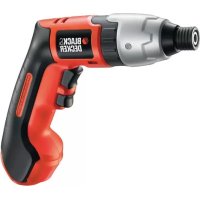
| Product type | Cordless impact screwdriver |
| Brand | Black & Decker |
| Model | KC600H |
| Rated voltage | 6 V |
| No-load speed | 2100 min⁻¹ |
| No-load impacts | 5600 min⁻¹ |
| Max torque | 35 Nm |
| Bit holder | 1/4\" (6.35 mm) hexagonal |
| Max drilling capacity | 6 mm |
| Tool weight | 0.9 kg |
| Charger weight | 0.2 kg |
| Charger mains voltage | 230 V AC |
| Charging time | 6 to 8 h |
| Battery type | NiCd / NiMH rechargeable |
| Power source | Cordless (battery) |
| Rotation direction | Reversible (forward/reverse) |
| Double insulation | Yes (no earth required) |
| Acoustic pressure level (LpA) | 73.7 dB(A) |
| Vibration level (hand/arm) | 1.72 m/s² |
| Maintenance | Clean the ventilation slots with a soft brush |
Frequently Asked Questions - KC600H BLACK & DECKER
User questions about KC600H BLACK & DECKER
0 question about this device. Answer the ones you know or ask your own.
Ask a new question about this device
Download the instructions for your Screwdriver in PDF format for free! Find your manual KC600H - BLACK & DECKER and take your electronic device back in hand. On this page are published all the documents necessary for the use of your device. KC600H by BLACK & DECKER.
USER MANUAL KC600H BLACK & DECKER
text_image
Technical line drawing of a handheld electric drill with labeled parts 1 and 2English 3
Deutsch 8
Français 14
Italiano 20
Nederlands 25
Español 31
Português 37
Svenska 43
Norsk 48
Dansk 53
Suomi 58
Ελληνικα
text_image
A 3 5 4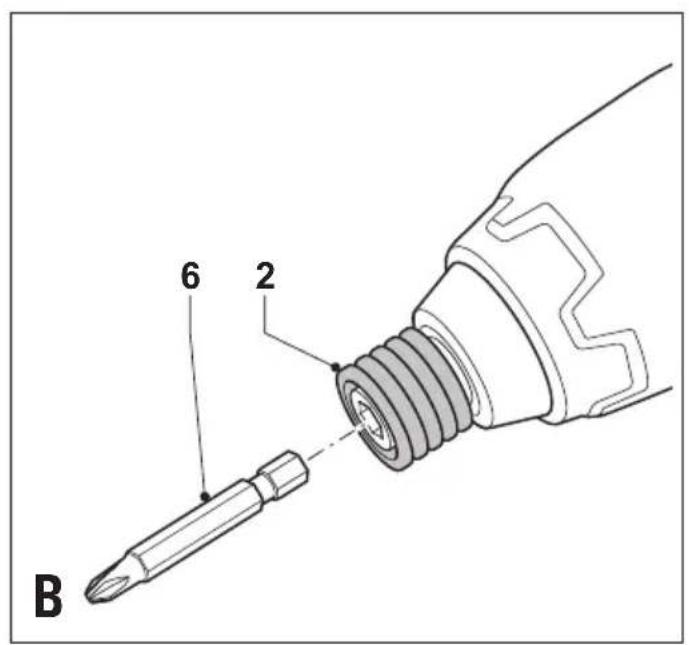
text_image
6 2 B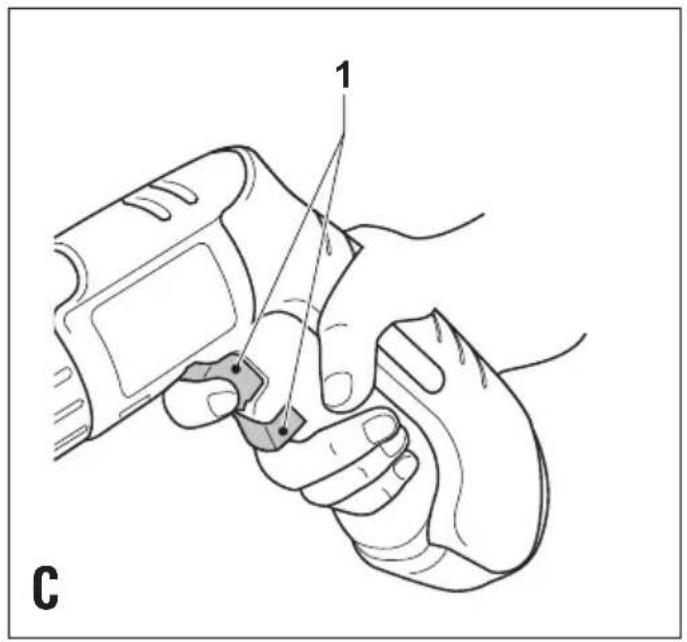
text_image
1 CIntended use
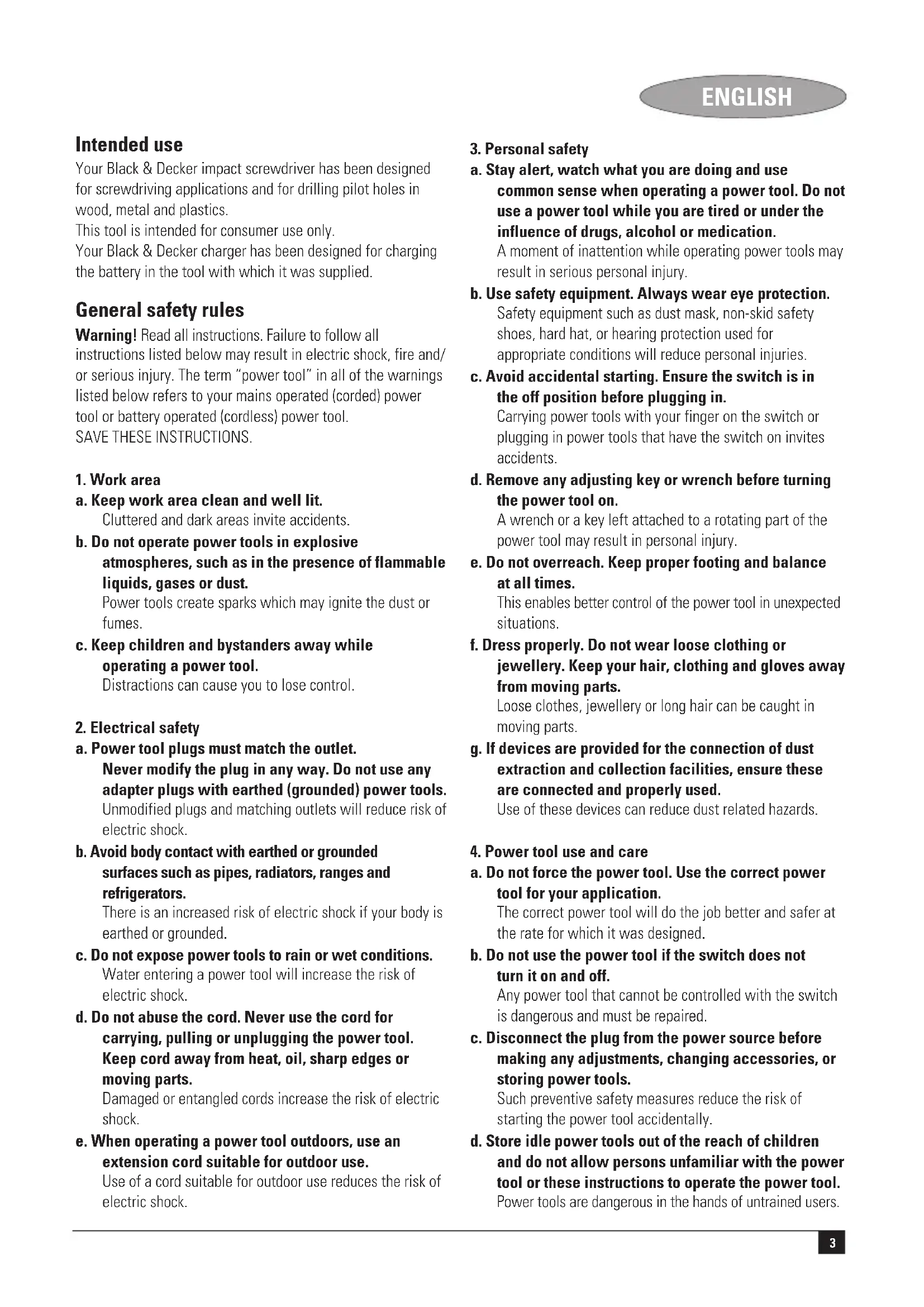
Your Black & Decker impact screwdriver has been designed for screwdriving applications and for drilling pilot holes in wood, metal and plastics.
This tool is intended for consumer use only.
Your Black & Decker charger has been designed for charging the battery in the tool with which it was supplied.
General safety rules
Warning! Read all instructions. Failure to follow all instructions listed below may result in electric shock, fire and/or serious injury. The term "power tool" in all of the warnings listed below refers to your mains operated (corded) power tool or battery operated (cordless) power tool. SAVE THESE INSTRUCTIONS.
1. Work area
a. Keep work area clean and well lit.
Cluttered and dark areas invite accidents
b. Do not operate power tools in explosive atmospheres, such as in the presence of flammable liquids, gases or dust.
Power tools create sparks which may ignite the dust or fumes.
c. Keep children and bystanders away while operating a power tool.
Distractions can cause you to lose control.
2. Electrical safety
a. Power tool plugs must match the outlet.
Never modify the plug in any way. Do not use any adapter plugs with earthed (grounded) power tools.
Unmodified plugs and matching outlets will reduce risk of electric shock.
b. Avoid body contact with earthed or grounded surfaces such as pipes, radiators, ranges and refrigerators.
There is an increased risk of electric shock if your body is earthed or grounded.
c. Do not expose power tools to rain or wet conditions.
Water entering a power tool will increase the risk of electric shock.
d. Do not abuse the cord. Never use the cord for carrying, pulling or unplugging the power tool. Keep cord away from heat, oil, sharp edges or moving parts.
Damaged or entangled cords increase the risk of electric shock.
e. When operating a power tool outdoors, use an extension cord suitable for outdoor use.
Use of a cord suitable for outdoor use reduces the risk of electric shock.
3. Personal safety
a. Stay alert, watch what you are doing and use common sense when operating a power tool. Do not use a power tool while you are tired or under the influence of drugs, alcohol or medication.
A moment of inattention while operating power tools may result in serious personal injury.
b. Use safety equipment. Always wear eye protection.
Safety equipment such as dust mask, non-skid safety shoes, hard hat, or hearing protection used for appropriate conditions will reduce personal injuries.
c. Avoid accidental starting. Ensure the switch is in the off position before plugging in.
Carrying power tools with your finger on the switch or plugging in power tools that have the switch on invites accidents.
d. Remove any adjusting key or wrench before turning the power tool on.
A wrench or a key left attached to a rotating part of the power tool may result in personal injury.
e. Do not overreach. Keep proper footing and balance at all times.
This enables better control of the power tool in unexpected situations.
f. Dress properly. Do not wear loose clothing or jewellery. Keep your hair, clothing and gloves away from moving parts.
Loose clothes, jewellery or long hair can be caught in moving parts.
g. If devices are provided for the connection of dust extraction and collection facilities, ensure these are connected and properly used.
Use of these devices can reduce dust related hazards.
4. Power tool use and care
a. Do not force the power tool. Use the correct power tool for your application.
The correct power tool will do the job better and safer at the rate for which it was designed.
b. Do not use the power tool if the switch does not turn it on and off.
Any power tool that cannot be controlled with the switch is dangerous and must be repaired.
c. Disconnect the plug from the power source before making any adjustments, changing accessories, or storing power tools.
Such preventive safety measures reduce the risk of starting the power tool accidentally.
d. Store idle power tools out of the reach of children and do not allow persons unfamiliar with the power tool or these instructions to operate the power tool.
Power tools are dangerous in the hands of untrained users.
ENGLISH
e. Maintain power tools. Check for misalignment or binding of moving parts, breakage of parts and any other condition that may affect the power tools operation. If damaged, have the power tool repaired before use.
Many accidents are caused by poorly maintained power tools.
f. Keep cutting tools sharp and clean.
Properly maintained cutting tools with sharp cutting edges are less likely to bind and are easier to control.
g. Use the power tool, accessories and tool bits etc., in accordance with these instructions and in the manner intended for the particular type of power tool, taking into account the working conditions and the work to be performed.
Use of the power tool for operations different from those intended could result in a hazardous situation.
- Battery tool use and care
a. Ensure the switch is in the off position before inserting battery pack.
Inserting the battery pack into power tools that have the switch on invites accidents.
b. Recharge only with the charger specified by the manufacturer.
A charger that is suitable for one type of battery pack may create a risk of fire when used with another battery pack.
c. Use power tools only with specifically designated battery packs.
Use of any other battery packs may create a risk of injury and fire.
d. When battery pack is not in use, keep it away from other metal objects like paper clips, coins, keys, nails, screws, or other small metal objects that can make a connection from one terminal to another.
Shorting the battery terminals together may cause burns or a fire.
e. Under abusive conditions, liquid may be ejected from the battery; avoid contact. If contact accidentally occurs, flush with water. If liquid contacts eyes, additionally seek medical help.
Liquid ejected from the battery may cause irritation or burns.
- Service
a. Have your power tool serviced by a qualified repair person using only identical replacement parts.
This will ensure that the safety of the power tool is maintained.
Additional safety instructions for impact drills
◆Wear ear protectors with impact drills. Exposure to noise can cause hearing loss.
◆Use auxiliary handles supplied with the tool. Loss of control can cause personal injury.
Additional safety instructions for drill/screwdrivers
◆Hold tool by insulated gripping surfaces when performing an operation where the cutting tool may contact hidden wiring or its own cord. Contact with a "live" wire will make exposed metal parts of the tool "live" and shock the operator.
◆Use clamps or another practical way to secure and support the work piece to a stable platform. Holding the work by hand or against your body leaves it unstable and may lead to loss of control.
Before drilling into walls, floors or ceilings, check for the location of wiring and pipes.
◆Avoid touching the tip of a drill bit just after drilling, as it may be hot.
Additional safety instructions for batteries and chargers
Batteries
◆Never attempt to open for any reason.
◆Do not expose the battery to water.
◆Do not store in locations where the temperature may exceed 40 °C.
◆Charge only at ambient temperatures between 10 °C and 40 °C.
◆Charge only using the charger provided with the tool.
- When disposing of batteries, follow the instructions given in the section "Protecting the environment".
Chargers
◆Use your Black & Decker charger only to charge the battery in the tool with which it was supplied. Other batteries could burst, causing personal injury and damage.
◆Never attempt to charge non-rechargeable batteries.
◆Have defective cords replaced immediately.
◆Do not expose the charger to water.
◆Do not open the charger.
◆Do not probe the charger.

The charger is intended for indoor use only.

Read the instruction manual before use.

Fail safe isolating transformer. The mains supply is electrically separated from the transformer output.

The charger automatically shuts off if the ambient temperature becomes too high. As a consequence the charger will be inoperable. The unit must be disconnected from the mains supply and taken to an authorised service centre for repair.
Electrical safety

Your charger is double insulated; therefore no earth wire is required. Always check that the mains voltage corresponds to the voltage on the rating plate. Never attempt to replace the charger unit with a regular mains plug.
- This appliance is not intended for use by young or infirm persons without supervision. Children must be supervised to ensure they do not play with the appliance.
◆If the supply cord is damaged, it must be replaced by the manufacturer or an authorised Black & Decker Service Centre in order to avoid a hazard.
Overview
- Forward/reverse switch
- Bit holder sleeve
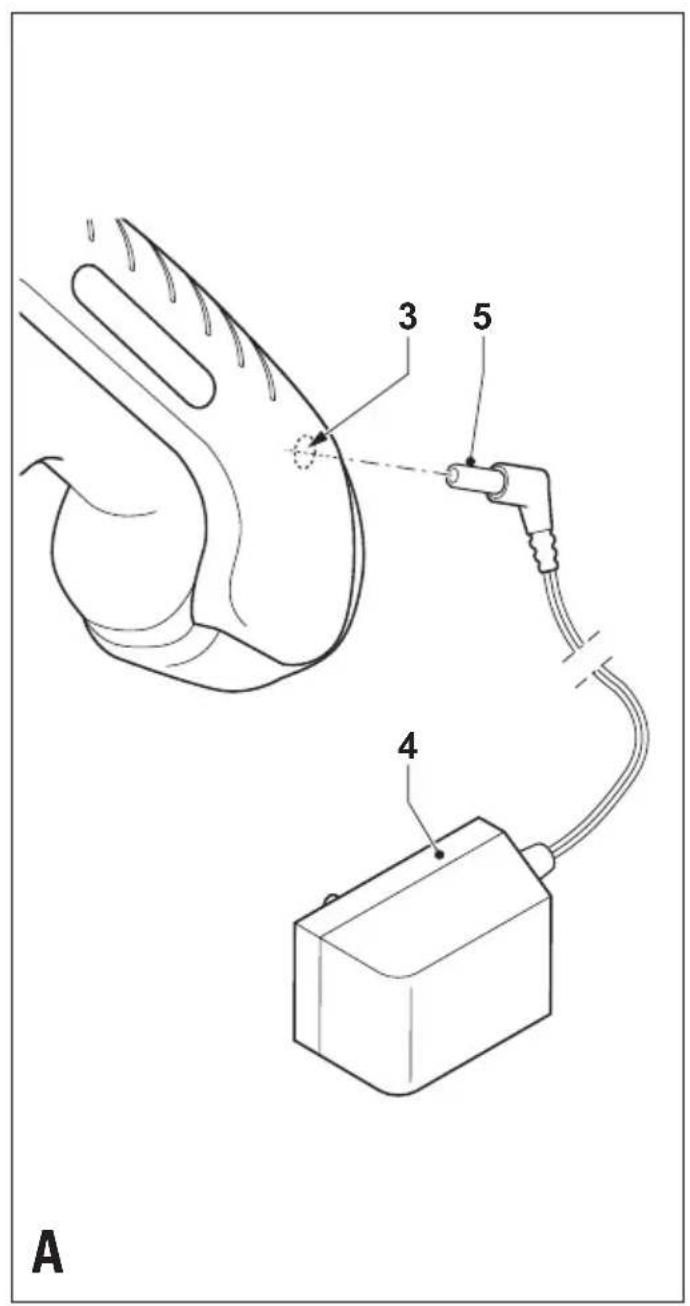
Fig. A
- Charger connector
- Charger
- Charger plug
Assembly
Fitting and removing a drill bit, socket driver bit or screwdriver bit (fig. B)
This tool uses socket driver bits, screwdriver bits and drill bits with a 1/4" (6.35 mm) hexagonal shank.
◆Pull back the bit holder sleeve (2).
◆Insert the bit shaft (6) into the bit holder.
◆Release the bit holder sleeve.
Use
Charging the battery (fig. A)
The battery needs to be charged before first use and whenever it fails to produce sufficient power on jobs that were easily done before. When charging the battery for the first time, or after prolonged storage, it will only accept an 80% charge. After several charge and discharge cycles, the battery will attain full capacity. The battery may become warm while charging; this is normal and does not indicate a problem.
Warning! Do not charge the battery at ambient temperatures below 4 °C or above 40 °C. Recommended charging temperature: approx. 24 °C.
◆To charge the battery, insert the charger plug (5) into the connector (3). Make sure that the head is in straight position.
◆Plug in the charger (4). Switch on at the mains.
Leave the tool connected to the charger for 6-8 hours. The charger may hum and become warm while charging; this is normal and does not indicate a problem.
Generally, a charging time of 6 hours will enable the tool to operate at an effective power level for most tasks. However, further charging for up to 8 hours could significantly increase the run time, depending on the battery and charging conditions.
Before using the tool, unplug the charger and disconnect the tool from the charger.
Warning! Do not use the tool while it is connected to the charger.
Drilling/screwdriving (fig. C)
For drilling and for tightening screws, use forward (clockwise) rotation. For loosening screws or removing a jammed drill bit, use reverse (counterclockwise) rotation.
◆To switch the tool on in forward rotation press the upper button on the forward/reverse switch (1).
◆To switch the tool on in reverse rotation press the lower button on the forward/reverse switch (1).
◆To switch the tool off, release the switch.
Hints for optimum use
Drilling
◆Always apply a light pressure in a straight line with the drill bit.
- Just before the drill tip breaks through the other side of the workpiece, decrease pressure on the tool.
◆Use a block of wood to back up workpieces that may splinter.
◆Use HSS drill bits when drilling in metal.
◆Use a lubricant when drilling metals other than cast iron and brass.
Make an indentation using a centre punch at the centre of the hole to be drilled in order to improve accuracy.
Screwdriving
◆Always use the correct type and size of screwdriver bit.
◆If screws are difficult to tighten, try applying a small amount of washing liquid or soap as a lubricant.
◆Always hold the tool and screwdriver bit in a straight line with the screw.
ENGLISH
When screwing in wood, it is recommended to drill a pilot hole with a depth equal to the length of the screw. A pilot hole guides the screw and prevents splintering or distortion of the wood. For the optimum size of the pilot hole, refer to the table below.
When screwing in hardwood, also drill a clearance hole with a depth equal to half the length of the screw. For the optimum size of the clearance hole, refer to the table below.
Screw size Pilot hole ∅ Pilot hole ∅ Clearance (softwood) (hardwood) hole
No. 6 (3.5 mm) 2.0 mm 2.5 mm 3.6 mm
No. 8 (4 mm) 2.5 mm 3.0 mm 4.5mm
No. 10 (5 mm) 3.0 mm 3.5 mm 5.0 mm
No. 12 (5.5 mm) 3.5 mm 4.0 mm 5.5 mm
Note: When the impact mechanism engages, a ratcheting sound is produced. This is normal and does not indicate a problem.
Accessories
The performance of your tool depends on the accessory used. Black & Decker and Piranha accessories are engineered to high quality standards and designed to enhance the performance of your tool. By using these accessories you will get the very best from your tool.
This tool uses socket driver bits, screwdriver bits and drill bits with a 1/4" (6.35 mm) hexagonal shank. Piranha Super-lok accessories are designed for use with this tool.
Warning! Use only dedicated impact accessories with your tool. Screwdriver bits shorter than 50 mm are not suitable for use with this tool.
Maintenance
Your Black & Decker tool has been designed to operate over a long period of time with a minimum of maintenance.
Continuous satisfactory operation depends upon proper tool care and regular cleaning.
Your charger does not require any maintenance apart from regular cleaning.
Warning! Unplug the charger before cleaning it.
◆Regularly clean the ventilation slots in your tool and charger using a soft brush or dry cloth.
◆Regularly clean the motor housing using a damp cloth. Do not use any abrasive or solvent-based cleaner.
Protecting the environment
Separate collection. This product must not be disposed of with normal household waste.
Should you find one day that your Black & Decker product needs replacement, or if it is of no further use to you, do not dispose of it with household waste. Make this product available for separate collection.

Separate collection of used products and packaging allows materials to be recycled and used again. Re-use of recycled materials helps prevent environmental pollution and reduces the demand for raw materials.
Local regulations may provide for separate collection of electrical products from the household, at municipal waste sites or by the retailer when you purchase a new product.
Black & Decker provides a facility for the collection and recycling of Black & Decker products once they have reached the end of their working life. To take advantage of this service please return your product to any authorised repair agent who will collect them on our behalf.
You can check the location of your nearest authorised repair agent by contacting your local Black & Decker office at the address indicated in this manual. Alternatively, a list of authorised Black & Decker repair agents and full details of our after-sales service and contacts are available on the Internet at: www.2helpU.com
Batteries

Black & Decker batteries can be recharged many times. At the end of their useful life, discard batteries with due care for our environment:
◆Run the battery down completely, then remove it from the tool.
◆NiCd and NiMH batteries are recyclable. Take them to any authorised repair agent or a local recycling station.
Technical data
| KC600H | |
| Voltage V | DC 6 |
| No-load speed min | -1 2,100 |
| No-load impact min | -1 5,600 |
| Max. torque Nm 35 | |
| Bit holder | 1/4" (6.35 mm hex) |
| Max. drilling capacity | mm 6 |
| Weight | kg 0.9 |
Charger
Input voltage V
AC 230
Approx. charging time h 6-8
Weight kg 0.2
EC declaration of conformity
KC600H
Black & Decker declares that these products conform to: 98/37/EC, 89/336/EEC, 73/23/EEC, EN 60745, EN 60335, EN 55014, EN 61000
L_pA (sound pressure) 73.7 dB(A), L_WA (acoustic power) 84.7 dB(A), hand/arm weighted vibration 1.72 m/s²
K_pA (sound pressure uncertainty) 3 dB(A), K_wA (acoustic power uncertainty) 3 dB(A)
Kevin Hewitt
Director of Consumer Engineering
Spennymoor, County Durham DL16 6JG,
United Kingdom
1-6-2006
Guarantee
Black & Decker is confident of the quality of its products and offers an outstanding guarantee. This guarantee statement is in addition to and in no way prejudices your statutory rights. The guarantee is valid within the territories of the Member States of the European Union and the European Free Trade Area.
If a Black & Decker product becomes defective due to faulty materials, workmanship or lack of conformity, within 24 months from the date of purchase, Black & Decker guarantees to replace defective parts, repair products subjected to fair wear and tear or replace such products to ensure minimum inconvenience to the customer unless:
◆The product has been used for trade, professional or hire purposes;
◆The product has been subjected to misuse or neglect;
◆The product has sustained damage through foreign objects, substances or accidents;
◆Repairs have been attempted by persons other than authorised repair agents or Black & Decker service staff.
To claim on the guarantee, you will need to submit proof of purchase to the seller or an authorised repair agent. You can check the location of your nearest authorised repair agent by contacting your local Black & Decker office at the address indicated in this manual. Alternatively, a list of authorised Black & Decker repair agents and full details of our after-sales service and contacts are available on the Internet at:
www.2helpU.com
Please visit our website www.blackanddecker.co.uk to register your new Black & Decker product and to be kept up to date on new products and special offers. Further information on the Black & Decker brand and our range of products is available at www.blackanddecker.co.uk
Director of Consumer Engineering
Spennymoor, County Durham DL16 6JG,
No. 8 (4 mm) 2,5 mm 3,0 mm 4,5mm
No. 10 (5 mm) 3,0 mm 3,5 mm 5,0 mm
No. 12 (5,5 mm) 3,5 mm 4,0 mm 5,5 mm
Spennymoor, County Durham DL16 6JG,
Royaume Uni
1-6-2006
Garantie
Director of Consumer Engineering
Spennymoor, County Durham DL16 6JG,
Verenigd Koninkrijk
1-6-2006
Garantie
No. 8 (4 mm) 2,5 mm 3,0 mm 4,5mm
No. 10 (5 mm) 3,0 mm 3,5 mm 5,0 mm
No. 12 (5,5 mm) 3,5 mm 4,0 mm 5,5 mm
N.° 10 (5 mm) 3,0 mm 3,5 mm 5,0 mm
Director of Consumer Engineering
Spennymoor, County Durham DL16 6JG,
Storbrittannien
1-6-2006
Reservdelar / reparationer
Spennymoor, County Durham DL16 6JG,
Storbritannia
1-6-2006
Director of Consumer Engineering
Spennymoor, County Durham DL16 6JG,
Storbritannien
1-6-2006
Reservedele / reparationer
Director of Consumer Engineering
Spennymoor, County Durham DL16 6JG, Iso-Britannia
1-6-2006
Aρ. 10 (5 mm) 3,0 mm 3,5 mm 5,0 mm
other
| Component | Number | |-----------|--------| | Top Section | 1 | | Inner Ring | 2 | | Middle Ring | 3 | | Outer Ring | 4 | | Inner Ring | 5 | | Middle Ring | 6 | | Outer Ring | 7 | | Inner Ring | 8 | | Middle Ring | 9 | The image contains no text labels in the diagram itself. The label 'www.2helpU.com24-07-06E14783' appears to be a watermark or annotation at the bottom left. The diagram contains multiple lines representing different components or parts of the device.| Australia Black & Decker (Australia) Pty. Ltd. Tel. 03-8720 510020 Fletcher Road, Mooroolbark, Victoria, 3138 Fax 03-9727 5940 | ||
| België/Belgique Black & Decker (Belgium) N.V. Tel. 016 68 91 00Nieuwlandlaan 321 Fax 016 68 91 113200 Aarschot | ||
| Danmark Black & Decker Tel. 70 20 15 10Sluseholmen 2-4, 2450 København SV Fax 70 22 49 10Internet: www.blackanddecker.dk | ||
| Deutschland Black & Decker GmbH Tel. 06126/21 - 0Black & Decker Str. 40, D - 65510 Idstein Fax 06126/21 29 80 | ||
| Ελλάδα Black & Decker (Ελλας) A.E. Τηλ. 210 8981616Στράβωνος 7 & Λεωφ. Βουλιαγμένης 159 Φαξ 210 8983285166 74 Γλυφάδα - Αθήναwww.blackanddecker.gr | ||
| España | Black & Decker Ibérica, S.C.A.Parc de Negocis “Mas Blau”Edificio Muntadas, c/Bergadá, 1, Of. A608820 El Prat de Llobregat (Barcelona) | Tel. 934 797 400Fax 934 797 419 |
| France | Black & Decker (France) S.A.S.B.P. 21, 69571 Dardilly Cédex | Tel. 04 72 20 39 20Fax 04 72 20 39 00 |
| Helvetia | ROFO AGGewerbezone Seeblick3213 Kleinbösingen | Tel. 026-6749391Fax 026-6749394 |
| Italia | Black & Decker Italia SpAViale Elvezia 220052 Monza (MI) | Tel. 039-23871Fax 039-2387592/2387594Numero verde 800-213935 |
| Nederland | Black & Decker BeneluxJoulehof 12, 4622 RG Bergen op Zoom | Tel. 0164 - 283000Fax 0164 - 283100 |
| New Zealand | Black & Decker Tel. 09 579 760081 Hugo Johnston DrivePenrose, Auckland, New Zealand | Fax 09 579 8200 |
| Norge | Black & Decker (Norge) A/SPostboks 4814, Nydalen, 0422 OsloInternet: www.blackanddecker.no | Tlf. 22 90 99 00Fax 22 90 99 01 |
| Österreich | Black & Decker Vertriebsges.m.b.HOberlaaerstraße 246, A1100 Wien | Tel. 01 66116-0Fax 01 66116-14 |
| Portugal | Black & Decker Tel. 214667500Rua Egas Moniz 173S. João do Estoril2766-651 Estoril | Fax 214667580 |
| Suomi | Black & Decker OyKeilasatama 3, 02150 Espoo | Puh.: 010 400 430Faksi: (09) 2510 7100 |
| Black & Decker Oy,Kägelhamnen 3, 02150 Esbo | Tel: 010 400 430Fax: (09) 2510 7100 | |
| Sverige | Black & Decker ABFabriksg. 7, 412 50 Göteborg | Tel: 031-68 60 60Fax: 031-68 60 80 |
| United Kingdom | Black & Decker Tel. 01753 511234210 Bath RoadSlough, Berkshire SL1 3YD | Fax 01753 551155Helpline 01753 574277 |
| Middle East & Africa | Black & Decker (Overseas) A.G.PB 5420, Dubai, United Arab Emirates Fax +971 4 2826466 | Tel. +971 4 2826464 |
Cat. no.:
verktöl? ♦ Unko tama ensimmainen B&U-

:Saidofodlivu 21adnu pa
va nápríte triápropícs.
information ▼ Ventilast seat kinds ruled
The following table provides the information in the image:
Zniu pian wao caiwun, 'I' and I to let it
◆ Data protection act: Tick the box if you prefer
konesei ♦ Elevat to evaporatio auto in Trump cars apyoda?
[Non-Text]
Cat. no.:
◆ |s this tool your first purchase? ◆ |st dieses
[Non-Text]
a1 = 3,b1 = 4,·s + 4
:EN :EN :EN :EN :EN
-
-
-
-
-
-
-
-
-
-
-
-
-
-
-
-
-
-
-
-
-
-
-
-
-
-
-
-
-
-
-
-
-
-
-
-
-
-
-
-
-
-
-
-
-
-
-
-
-
-
-
-
-
-
-
-
-
-
-
-
-
-
-
-
-
-
-
-
-
-
-
-
-
-
-
-
-
-
-
-
-
-
-
-
-
-
-
-
-
-
-
-
-
-
-
-
-
- 99.
-
-
-
-
-
-
-
-
-
-
-
-
-
-
-
-
-
-
-
-
-
-
-
-
-
-
-
-
-
-
-
-
-
-
-
-
-
-
-
-
-
-
-
-
-
-
-
-
-
-
-
-
-
-
-
-
-
-
-
-
-
-
-
-
-
-
-
-
-
-
-
-
-
-
-
-
-
-
-
-
-
-
-
-
-
-
-
-
-
-
-
-
-
-
-
-
◆ Sim Ja Ja Ja Kylla Na
■ Yes Ja Qui Si Ja Si
♦ TO expalicto activ grupo?
• Orko kore labi:
presente? ♦ Ar verkenyget en gava?
^2 ^c ^d ^e
di un regaloi? ◆ Kreal y de machine als caedeau?
- If this tool is exciting + let decrease forest size
[Non-Text]
[EMPTY]
Aizulevon avtropocinou Hlucopiniva avojos
Jalleennylyan osote Ostpariva
Forwarder adresse indikóbsdato
Dealer addresses Date of purchase
Dealer addresses Date of purchase
Dealer addresses Date of purchase

English Please complete this section immediately after the purchase of your
tool and send it to Black & Decker in your country. If you live in Australia or New Zealand, please register by using the alternative
guarantee card supplied.
Black & Decker in uw land.
guarantee card supplied.