
WL 36 AHA - Wine cellar HOTPOINT - Free user manual and instructions
Find the device manual for free WL 36 AHA HOTPOINT in PDF.
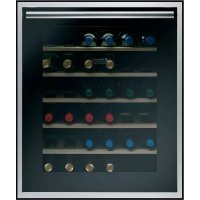



| Product type | Wine cellar |
| Brand | Hotpoint |
| Model | WL 36 AHA |
| Standard storage capacity | 36 bottles (Bordeaux type) |
| Maximum capacity | 46 bottles |
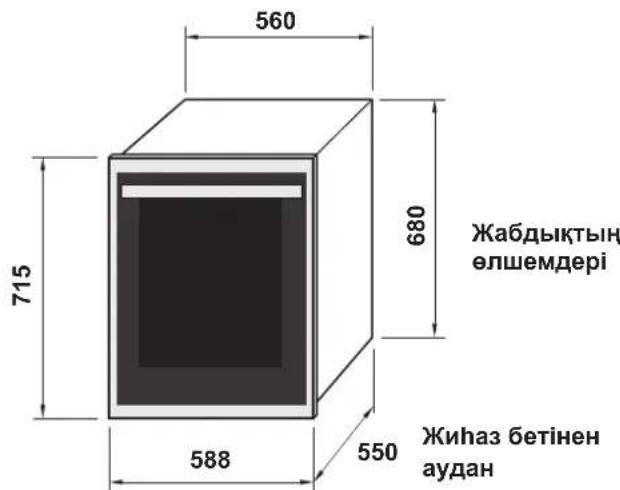
| Dimensions (W x H x D) | 56 x 68 x 55 cm |
| Net weight | 76 kg |
| Power supply | 220-240 V, 50 Hz |
| Electrical power | 65 W |
| Energy consumption | 0.39 kWh/24h |
| Rated current | 0.3 A |
| Number of temperature zones | 1 |
| Preset storage temperature | 15 °C |
| Lighting type | 3 W bulb |
| Shelf material | Wood |
| Number of shelves | 5 (plus bottom) |
| Main functions | Manual temperature adjustment, interior lighting, optimized storage |
| Safety | Mandatory grounding, do not obstruct ventilation |
| Maintenance and cleaning | Unplug before cleaning; use a soft cloth |
| Repairability | Original spare parts, authorized technical assistance |
| Standards | Complies with EC directives (73/23/EEC, 89/336/EEC, 2002/96/EC) |
Frequently Asked Questions - WL 36 AHA HOTPOINT
User questions about WL 36 AHA HOTPOINT
0 question about this device. Answer the ones you know or ask your own.
Ask a new question about this device
Download the instructions for your Wine cellar in PDF format for free! Find your manual WL 36 AHA - HOTPOINT and take your electronic device back in hand. On this page are published all the documents necessary for the use of your device. WL 36 AHA by HOTPOINT.
USER MANUAL WL 36 AHA HOTPOINT
Location and power connection
Technical information
Product Description, 14
Interior Parts
Control Panel
Using the Wine Cellar 15-16
Bottle ageing compartment
Manual temperature control
Taking out the wooden shelves
Table of ideal wine temperatures
Stocking the wine bottles, 17-18
How to stock the bottles
Maintenance and troubleshooting, 19
Care and Maintenance
Troubleshooting
Assistance, 20
EN
Notices
! Remember to keep this booklet so you can refer to it at any time. In case of sale, transfer or should you move, remember to keep it together with the device. ! Read the instructions carefully: there is important information about installation, use and safety. ! To prevent danger stemming from instability of the device, you must fasten it in place, following the assembly instructions strictly. ! Whenever moving or transporting the device, keep it in a vertical position. ! The beverage centre must not be used by children or invalids, without supervision by an adult or a tutor, in order to prevent the cellar from being used improperly. ! Children may use the beverage centre only if supervised by an adult, in order to prevent them from playing with the cellar. ! After installing the device, the power cable and socket must be easy to reach. ! Keep the ventilation openings on the casing of the device free. ! Do not use mechanical devices, or any means not suggested by the manufacturer, to speed up defrosting. ! Do not damage the coolant circuit. ! Contact the after sales service to replace the neon. ! The cable must not be bent or crushed.
! The cable must be checked on a routine basis and replaced only by authorised technicians. ! The power supply cable is of a Y type. Contact the after sales service to replace it. ! Do not use electrical equipment inside the food compartments, unless they are of a kind suggested by the manufacturer. ! The Manufacturer shall not be liable if any of the above rules are not complied with.
| DATA SHEET | |
| Model | WL 36 A/HA |
| Temperatures | 1 Zone |
| Dimensions | width cm 56 length cm 68 depth cm 55 |
| Weight** Weight | 76 Kg 97 Kg |
| Power | 65 W |
| Current | 0,3 A |
| Lamp | 3 W |
| Consumption | 0,39 kWh / 24h |
| Voltage* | 220-240 V |
| Frequency Hz* | 50 |
| * These values may change in different countries. In order to find the specific features of your device, check the product features plate. ** When the device is empty. | |
This appliance is intended to be used exclusively for the storage of wine.
Positioning and connection
Unpacking
1 Unpack the device immediately and make sure it has not been damaged during transport. Should it be damaged, do not connect, and get in touch with the Dealer. 2 Carefully remove the protections and the adhesives, open the door and make sure all the components are present. 3 Take out the power supply cable.
Positioning
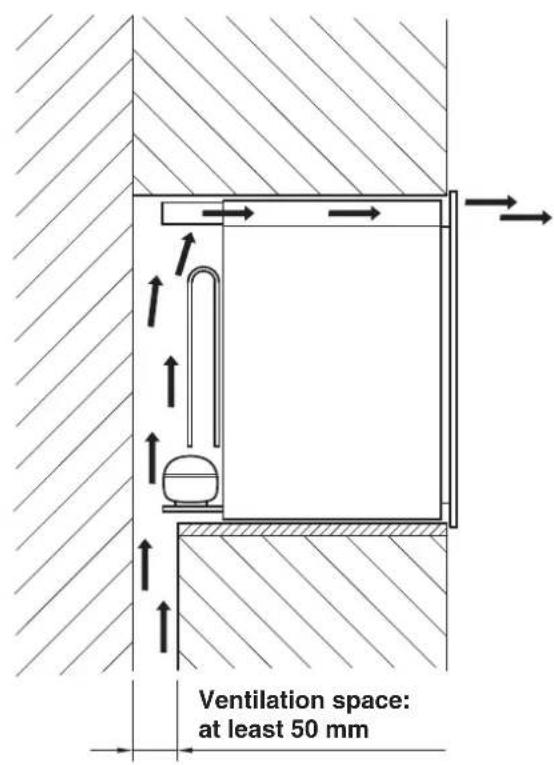
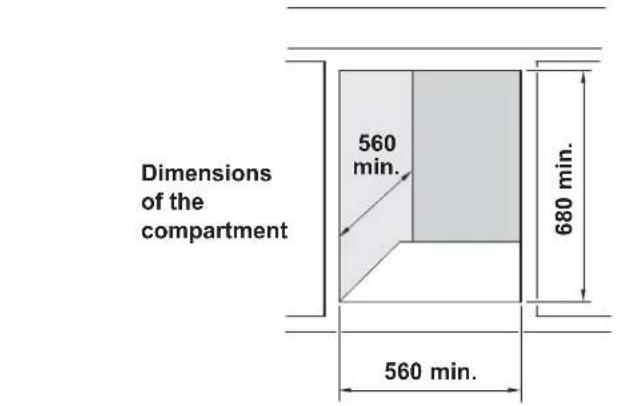
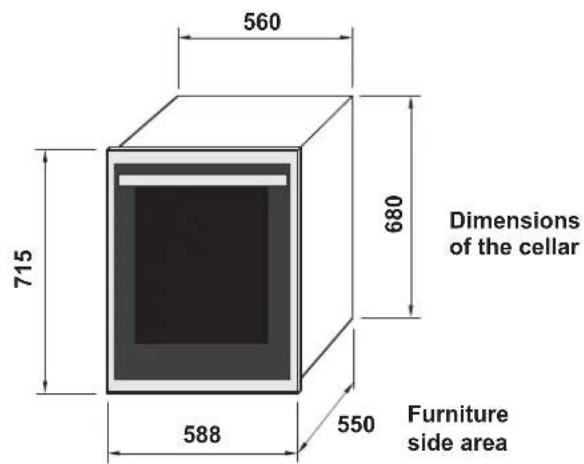
1 Position the device in a well ventilated area, not damp and free (avoid cabinets with closed walls). 2 Keep the device away from heat sources. 3 Make sure the minimum distances between the device and the walls of the room where it is placed are kept, in order to ensure perfect ventilation of the device.
See figure.
Wiring connection
After transport, stand the device vertically, and wait for at least 3 hours before connecting it to the wiring system. Before putting the plug into the power socket, make sure that:
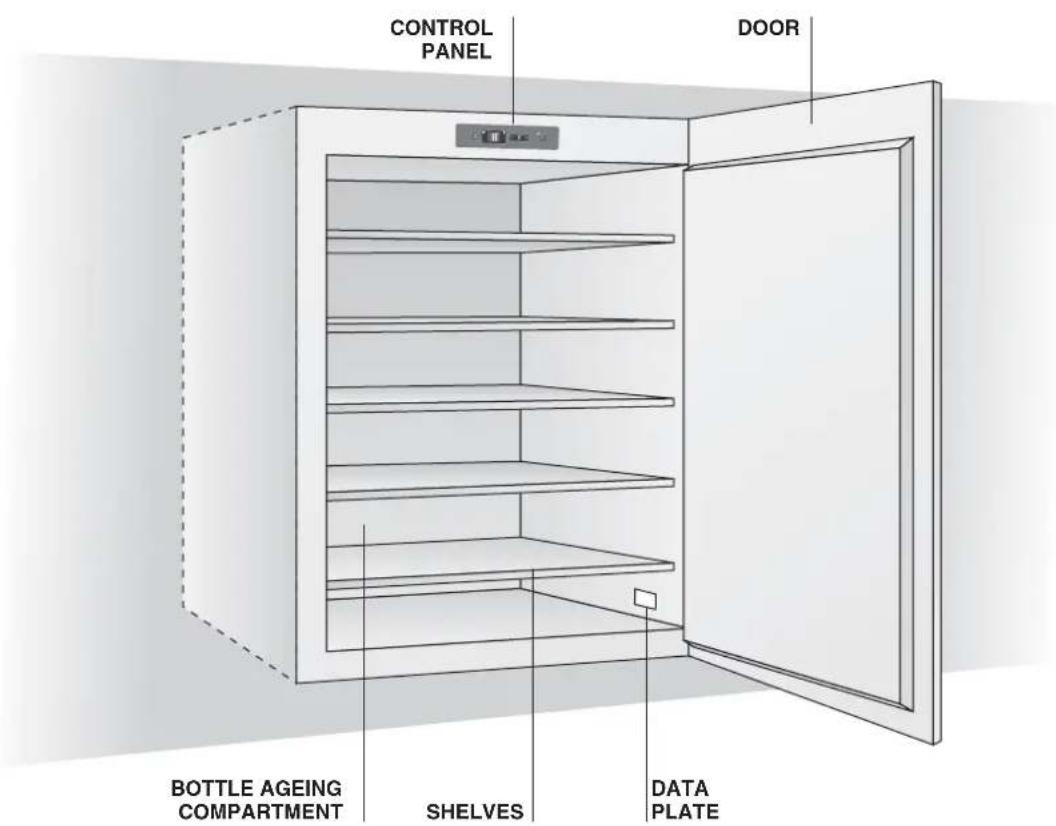
The socket must be earthed and comply with legal regulations; it must be able to handle the maximum power load of the machine, as indicated on the data sheet or on the rating plate at the bottom right (see Description of the device). The power supply voltage must fall within the range indicated on the data sheet or on the rating plate at the bottom right (see Description of the device). The power socket must be compatible with the plug of the device. Otherwise, replace the socket or the plug; do not use extension cords or multiple sockets.
Product Description

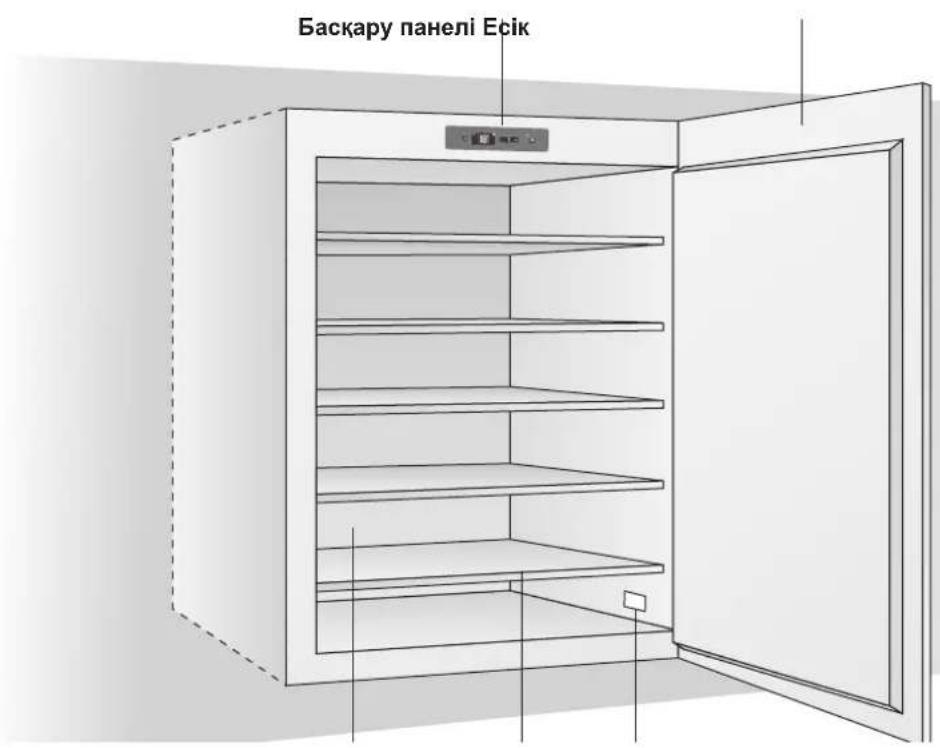
Interior Parts
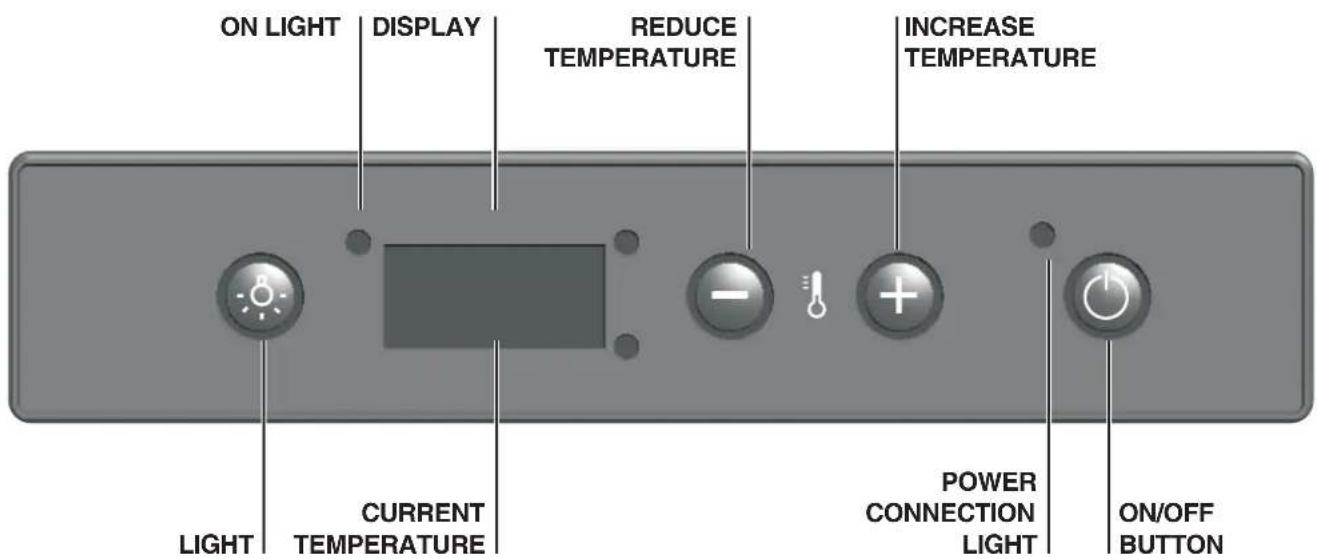
Control Panel
Bottle Ageing Compartment
The ageing compartment's main function is to guarantee that your wines are preserved in optimal conditions.
The temperature has been set at the factory to a value considered excellent in most cases, which is 15°C in the upper compartment.
Wine has a complex nature and results from a long, slow process. To best express its attributes, very specific conditions are necessary. All wines are preserved at the same temperature, but depending on their different characteristics, wines are served and tasted at very different temperatures (see the Table of Ideal Wine Temperatures).
Therefore, just as in manufacturers' wine cellars, for your new appliance, the absolute temperature value is not important for preserving your wine. Rather, the constancy of temperature over time is important. Wine preservation is ideal at any temperature, as long as that temperature does not vary.
Manual Temperature Control
When you plug in your wine cellar, the display shows the temperature inside the cellar: it has been set to reach 15°C and become steady at that value. Should you need to adjust it, follow the instructions below:
- When you plug in your wine cellar, the display shows the temperature that has been set.
- Press the button for one second (see the Control Panel). The temperature will begin to blink.
- Press the + or - buttons until you reach the desired temperature.
- Wait 5 seconds for the temperature to stop blinking.
- Wait until the wine cellar reaches its temperature before you place the wine bottles inside.
The inside light does not go on (or it goes off temporarily) when the inside temperature goes over 24°C. This allows you to reach the pre-set temperature more quickly.

Table of ideal wine temperatures
This table indicates the approximate temperatures at which wine should be served. Should one of your wines need to be served at a temperature that is greater than the temperature inside your wine cellar, we suggest that you leave it out for the time that is necessary before you serve it.
| Amarone | 17°C |
| Barbaresco | 17°C |
| Barolo | 17°C |
| Beaujolais | 13°C |
| White liquered Bordeaux | 6°C |
| Dry White Bordeaux | 8°C |
| Red Bordeaux | 17°C |
| White Bourgogne | 11°C |
| Red Bourgogne | 18°C |
| Brunello | 17°C |
| Champagne | 6°C |
| Chianti Classico | 16°C |
| Languedoc-Roussillon | 13°C |
| Passito di Pantelleria | 6°C |
| Rosé Provence | 12°C |
| Dry and Sweet Sparkling Wines | |
| Verdicchio di Matelica e dei Castelli di Jesi | 8°C |
| White wines from Trentino Alto Adige | 11°C |
| Franciacorta White Wines | 11°C |
| Dry aromatic white wines | 10°C |
| Dry, young, and fruity white wines | 8°C |
| White wines from Friuli Venezia Giulia | 11°C |
| Rodano wines | 15°C |
| Dry white wines from the Loire | 10°C |
| Liquered wines from the Loire | 7°C |
| Red wines from the Loire | 14°C |
| Liquered Passito wines | 8-18°C |
| Rosè Wines, New Wines | 12°C |
| Light red wines with mild tannic | 14°C |
| Red, rather tannic wines with medium structure | 16°C |
Standard 36-bottle stock
The 36-bottle stock (for standard, mixed, and renana bottles) is recommended for wines that need to be visible and easily removed.
STANDARD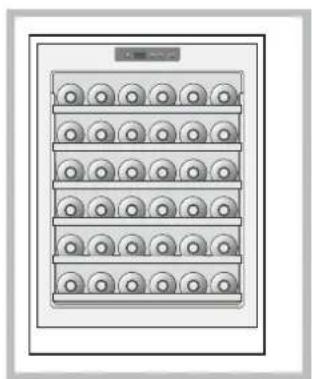
36 Bottles
(100% lying down)
5 shelves
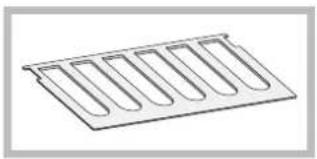
Position each bottle into the slots on the 5 wooden shelves. 6 bottles can be placed on the bottom of the wine cellar.
! The wooden shelves have a special blocking system so that your bottles do not accidentally fall and break.
We suggest you place the Renana bottles onto the lower shelf and the bottom of the wine cellar because they have been specially designed to hold larger bottles.
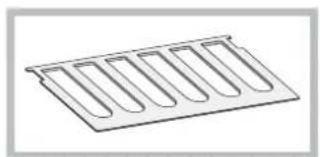
! The wooden shelf can safely hold up to 22 bottles.
Champagne bottle stock
Champagne bottles are larger than standard bottles. They must be placed onto the base of the wine cellar, which can hold up to 5.
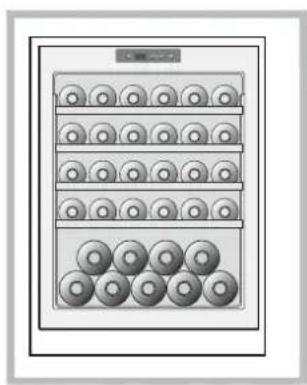
If you want to stock more than 5 Champagne bottles in your wine cellar, remove the 5th shelf and stock the bottles in two rows (placing the bottles in the second row between those on the bottom row). This will hold up to 9 bottles.
Some stocking configurations
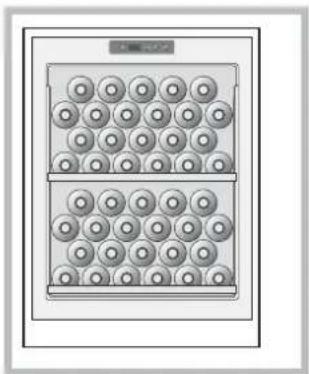
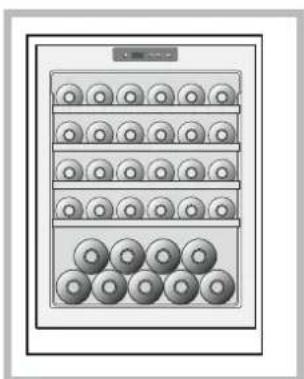
PRESERVATION 44 Bottles (100% lying down) 1 shelf
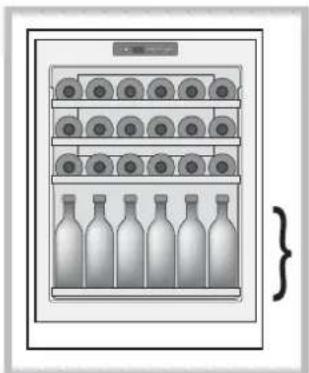
SERVICE 42 Bottles (50% lying down, 50% standing) 3 shelves
4 rows
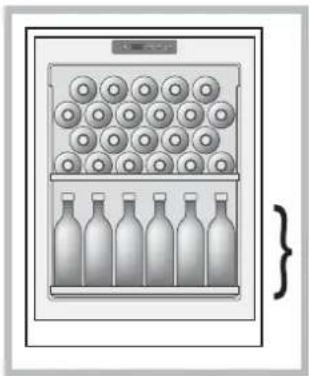
MAXIMUM STOCK 46 Bottles (48% lying down, 52% standing) 1 shelf
4 rows

Removing the wooden shelves
Follow the instructions below to remove the wooden shelves:
- Hold the front part of the shelf with one hand.
- Slowly remove the shelf by pulling it toward you. Pull out the shelf by 1/3 of the way if you need to remove or replace bottles.
- Remove or replace the bottles you need and push the shelf back, making sure it locks into place.
- Make sure the shelf is in place by trying to pull it out once again. If it moves, push it back in again until it is securely in place.
To completely remove the shelf, follow step 1 and 2 and remove all bottles that on the shelf. Slowly pull the shelf toward you until you remove it from its slots.
! Do not, under any circumstances, remove more than one shelf at a time.
For a small number of bottles
If you do not need to store enough bottles to fill the entire wine cellar, we suggest that you divide them up between the available shelves and that you do not place them all on top or on the bottom.
Place the bottles in the centre of the shelves to see them better from the outside.
Care and maintenance
Disconnecting the wine cellar
During cleaning and maintenance, it is imperative that you unplug the wine cellar
Troubleshooting
If you notice that your wine cellar is not working properly, check with the following list before you call your Service Centre.
Problem
The compressor does not work
Possible causes/solutions
The plug is not plugged into the wall-outlet or not enough to make contact. Or, there could be a power failure in your home. - The wall-outlet is not in working order. Plug the wine cellar into another wall-outlet to check.
The compressor never stops
- Contact the Service Centre
Any work that is done to the wine cellar should be performed by your authorized local Service Centre. Short term faults, such as power failure, will not compromise the wines. It is only when working faults are left unsettled for a long time that the wine may suffer.
The appliance was designed and manufactured in compliance with international safety standards. The following warnings are provided for safety reasons and must be read carefully.
This appliance complies with the following Community Directives:

- 73/23/EEC of 19/02/73 (Low Voltage) and subsequent amendments;
- 89/336/EEC of 03.05.89 (Electromagnetic Compatibility) and subsequent amendments; -2002/96/CE.
Disposal

- Observe local environmental standards when disposing packaging material for recycling purposes.
- The European Directive 2002/96/EC on Waste Electrical and Electronic Equipment (WEEE), requires that old household electrical appliances must not be disposed of in the normal unsorted municipal waste stream. Old appliances must be collected separately in order to optimise the recovery and recycling of the materials they contain and reduce the impact on human health and the environment. The crossed out "wheeled bin" symbol on the product reminds you of your obligation, that when you dispose of the appliance it must be separately collected.
Consumers should contact their local authority or retailer for information concerning the correct disposal of their old appliance.
Before calling for Assistance:
- Check if the malfunction can be solved on your own (see Troubleshooting).
- If after all the checks, the appliance still does not operate or the problem persists, call the nearest Service Centre
Communicating:
- type of malfunction
- appliance model (Mod.)
- serial number (S/N)
This information can be found on the data plate located on the bottom left side of the refrigerator compartment.
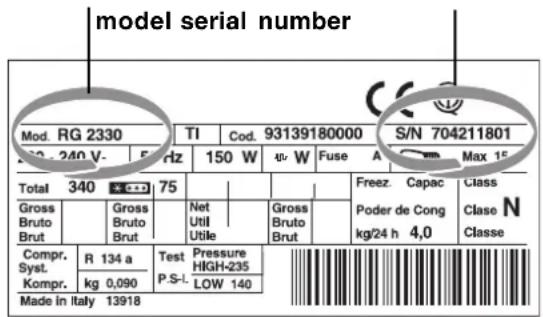
Never call on unauthorized technicians and always refuse spare parts which are not originals.

Italian, 1

English, 11

French, 21

Spanish, 31

German, 41

Portuguese, 51

Russian,

61 Kazakh, 73
WL 36 A/HA
Table of contents
FR
Aging compartment
Storing bottles, 57-58
Storage modes
If there are few bottles
How to place bottles
Maintenance and troubleshooting, 70-71
Maintenance and troubleshooting
Technical maintenance, 72
AI 77
Warnings
Keep this manual as a source of reference information about the equipment. It must accompany the refrigerator in case of sale / transfer or moving. Read this manual carefully: it contains important information on installation, safe operation and maintenance of the equipment. To avoid instability of the equipment, secure it in place, following the installation instructions exactly. When moving or transporting the equipment, keep it upright. To prevent unsafe use, children or persons with limited physical capabilities should not use the equipment without supervision of adults or guardians. Do not allow children to play with the equipment. After installation of the equipment, free access to the power cord and socket must be ensured. Do not block the ventilation openings on the equipment housing. Do not use starting devices for rapid defrosting or any other methods not recommended by the manufacturer. Do not damage the cooling circuit.
If damaged, contact an authorized service center. The cord must not be kinked or pinched.
The cord should be checked regularly; its replacement must be carried out only by authorized personnel. The power cord has a plug. For its replacement, contact an authorized service center. The manufacturer is not responsible in case of non-compliance with the specified safety measures.
Bottle placed lying down)
Place each bottle on the 3 wooden shelves. A bottle can also be placed on the bottom of the "wine cellar".
The wooden shelves have a special construction that protects the bottle from accidental falls and breakage.
We recommend placing "Rhenish" bottles on the lower shelf of the wine cellar, as they are specially designed for larger bottles.
On a wooden shelf, you can safely hold up to 22 bottles.
Placement of champagne bottles
Champagne bottles are larger than standard ones. They should be placed on the bottom of the "wine cellar", where you can store up to 5 bottles.
If you want to store
more than 5 champagne bottles in the "wine cellar", remove the 3rd shelf and place the bottles in two rows (the size of the bottles in the second row between the bottles of the lower row). This way, you can store up to 9 bottles.
A few examples of bottle placement
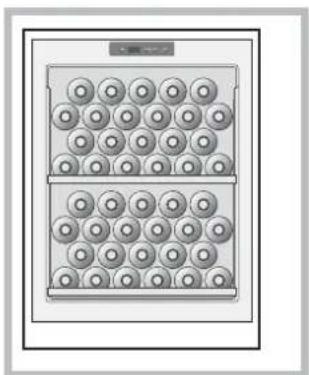
STORAGE
44 bottles
(100% of bottles placed lying down)
1 shelf
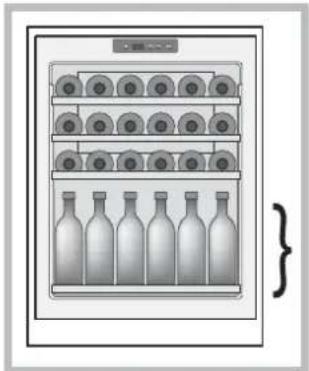
FOR SERVING
__SUPPIMER__
3 shelves
4 rows
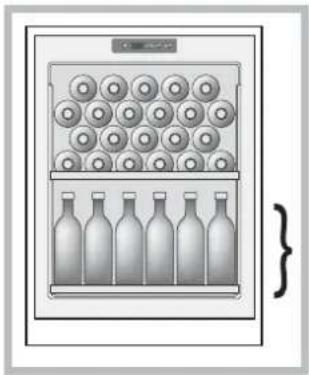
MAXIMUM CAPACITY
46 bottles
(48% of bottles placed on shelf, 52% - in box)
1 shelf
4 rows
How to remove wooden shelves
To remove the wooden shelves, do the following:
1. Hold the shelf with one hand. 2. With the other hand, lift the back part of the shelf up. 3. Slowly pull the shelf towards you, sliding it out. Pull the shelf out by 1/3 if you need to remove or replace the bottles. 4. Remove or replace the bottles and push the shelf back, making sure it is locked in place. 5. Make sure the shelf is firmly in place by trying to pull it out again. If the shelf moves, push it back in again.
To completely remove the shelf, perform steps 1 and
2, after first removing all bottles from the shelf.
Remove the tank from the stand until you have taken it out of the grooves.
Never remove more than one shelf at a time.
Placement of a small number of bottles
If the number of bottles is insufficient to completely fill the "wine cellar", we recommend distributing the bottles evenly on the available shelves, rather than placing all the bottles at the top or bottom.
To make the bottles more visible from the outside, place them in the middle of the shelf.
Place the INB and the center of the shelf on the outside.
These inserts must be inserted in accordance with the operating instructions and are part of them.
The compressor does not work
The compressor operates continuously
Possible causes / Solutions
- The appliance is not connected to the power supply, or the plug is not properly inserted into the socket, not ensuring contact, or there is a power outage in the home. - The socket is faulty; to check, connect the appliance to another socket.
- Contact the authorized service center. When calling, provide:
Date of purchase; warranty document number (service book, service certificate, etc.); description of the malfunction; model (Mod.) and serial number (S/N) of the equipment, as indicated in the technical data table of the equipment (see Description) or in the warranty document.
- Any repairs and technical maintenance of the equipment must be carried out only by specialists of the authorized service center.
Short-term power supply interruptions do not affect the safety of the appliance. Damage can only occur if problems in the operation of the equipment remain unresolved for a long time.
Service life: 10 years

ARISTON
Hotpoint ARISTON
(i) INDESIT
STINOL
The manufacturer reserves the right
to make changes to the design and configuration without prior notice,
which do not impair the efficiency of the equipment.
Some parameters given in this instruction
are approximate. The manufacturer is not responsible
for insignificant deviations from the specified values.
Manufacturer:
Indesit Company S.p.A.
Legal address:
Moscow, 47
60044 Fabiano (AH), Italy
Tel. (0732) 6611
Importer:
LLC "Indesit Rus"
Legal address:
Russia 127018, Moscow, st. Dvintsev,
12, bldg. 1, business center «Vysota»
(Building «V»)
Address and phone for contacts:
Russia 127018, Moscow, st. Dvintsev,
12, bldg. 1, business center Dvintsev
(Building «V»)
Tel.: (495) 961-29-00
Fax (495) 961-29-19
http://www.Hotpoint-Ariston.ru
This appliance is designed and manufactured in accordance with international safety standards. It is necessary to carefully read the following warnings, compiled for your safety.
This appliance complies with the following European Community Directives:

-73/23/EEC of 19/02/73 (Low Voltage) with subsequent amendments;
-89/336/EEC of 03/05/89 (Electromagnetic Compatibility) with subsequent amendments; -2002/96/EC.
Disposal

- Disposal of packaging materials: follow local regulations for the disposal of packaging materials.
- The European Directive 2002/96/EC on Waste Electrical and Electronic Equipment (WEEE) establishes the rules for the disposal of household appliances that have reached the end of their life.
In order to minimize the negative impact of disposed appliances on the environment, reduce risks to human health, and optimize the process of recycling and reuse of materials, the collection of used equipment must be carried out outside the general municipal waste collection and disposal systems.
The symbol of a crossed-out wheeled bin, affixed to the product, reminds you of the obligation to use a special disposal procedure for household appliances.
Consumers can take the used
equipment to special collection points or, if permitted by national legislation, return it to the company when purchasing a new, similar product.
Today, all leading manufacturers of household appliances are actively working on creating systems for the collection and disposal of used household appliances.
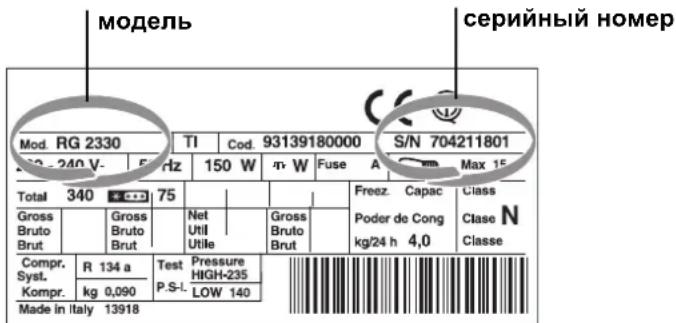
Before contacting the Technical Assistance Centre:
- check whether the fault can be resolved independently (see Faults and remedies).
- If after checking the refrigerator still does not work, or problems remain, contact a service center.
When contacting the technical support center,
it is necessary to report:
type of malfunction, model of the product (model), serial number (series)
All this data you will find on the plate with technical characteristics, located in the lower left corner of the refrigerator compartment.
Do not use services of persons not authorized by the manufacturer. For repairs, use only original spare parts.
KZ
IT
ENFR
Italiano, 1
English, 11

Français, 21
ES DE

Espanol, 31 Deutsch, 41
PT
Portuguese, 51
RU
Russian, 61

Kazakh, 73
Contents
Chapter titles, 74
And so on
Technical specifications
Schematics, 75
Connection diagrams
Safety instructions, 76
Basic elements
Power supply
Safety instructions, 77-78
Chapter 6: Safety precautions
Temperature controller
For heating systems
Room temperature controller
Installation of controllers, 79-80
Instructions for installing controllers
Maintenance and operation, 81
Maintenance and care
Operation
WL 36 A/HA

KZ.O.02.0361
Warranty
! This instruction manual must be read carefully. If it is lost or damaged, it should be replaced. The manufacturer is not responsible for any damage caused by failure to follow the instructions.
! Do not use the device if it is damaged. Contact the manufacturer for repair or replacement.
! To avoid electric shock, do not open the device. Refer all servicing to qualified personnel.
! If the device is damaged or malfunctioning, do not use it.
If the device is used in a way not specified by the manufacturer, its safety protection may be impaired. If the device is damaged, it must not be used until it has been repaired by qualified personnel.
Children must be supervised to ensure they do not play with the device.
The plug must be connected to a suitable socket outlet. The plug must be removed from the socket before cleaning or maintenance.
The device must not be used by persons (including children) with reduced physical, sensory or mental capabilities, or lack of experience and knowledge, unless they have been given supervision or instruction concerning use of the device by a person responsible for their safety.
Do not block the ventilation openings.
For repair, contact the authorized service center. The device must be disconnected from the power supply. For repair, contact the authorized service center. If the power cord is damaged, it must be replaced by the manufacturer or a qualified person.
| TEXHÍKÁLbÍK CYNATTAMACbI | |
| Moděni | WL 36 A/HA |
| TempepatypacbI | 1 aɪmák |
| eʌlsemī | EHI -56 cm; Биіktīrì - 68 cm; Tepeşdīrì - 55 cm. |
| Çaʌmáfþi** Çaʌmáfþi | 76 kr 97 kr |
| KyaTbI | 65 AT |
| ToK | 0,3 A |
| Πamna | 3 Bt |
| Энegrпяны ТутblHybI | 0,39 kBt*c/24 c |
| Kephey* | 220-240 B |
| ToK xhiinirì* | 50 Γι |
The device is intended for household use only. The device must be used in accordance with the technical specifications. **Read the instructions carefully.**
This device is intended for household use only.
KZ
Installation and connection
Connection
- When connecting, make sure that the device is switched off. If the device is switched on, disconnect it immediately.
- When connecting, use the appropriate cables and components. If you use other cables and components, make sure they are suitable.
- Connect the plug.
Cleaning
- The cable must be connected to the mains supply in accordance with the requirements of the local standards (the cable must be grounded and connected to the mains supply).
- The cable must be connected to the mains supply only after all other connections have been made. To avoid the risk of electric shock, the cable must be connected to the mains supply only after the minimum distance between the cable and the ground has been ensured.
Connection to the mains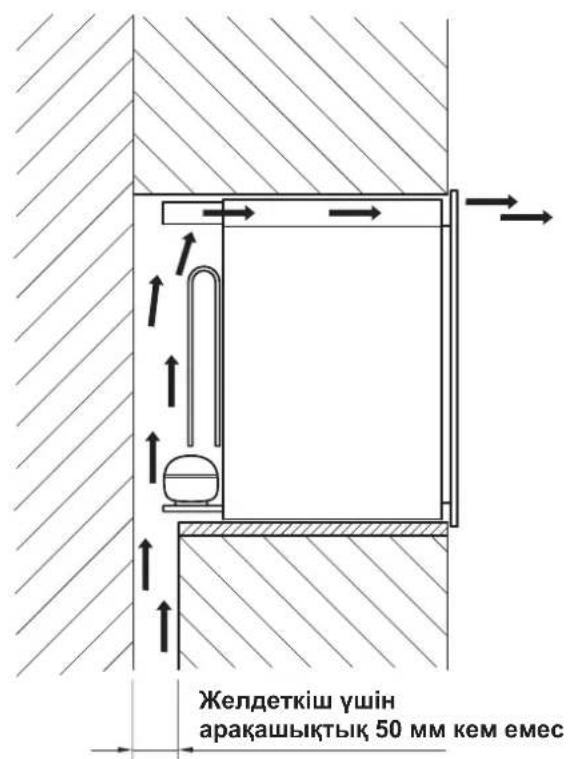
Connecting to the mains supply
After removing the cable from the packaging, check it for damage and connect it to the mains supply only after at least three hours have passed since the device was turned off. Before connecting the cable to the socket, check the following:
- The socket must be grounded and comply with the standards;
- The socket must be located in a dry place, and the technical specifications of the device must be indicated on the nameplate (see the device's nameplate);
- The technical specifications must comply with the local standards (see the device's nameplate) and the instructions for use (see the device's nameplate);
- The socket must be compatible with the cable's plug. If not, the plug or the socket must be replaced. Do not use adapters or extension cords.
Additional installation elements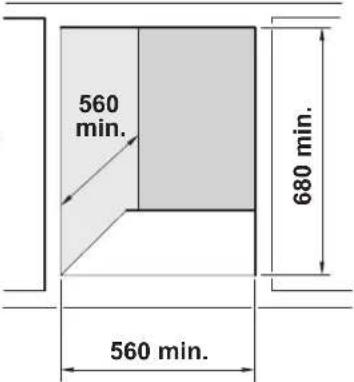
Heating elements
KZ
Control panel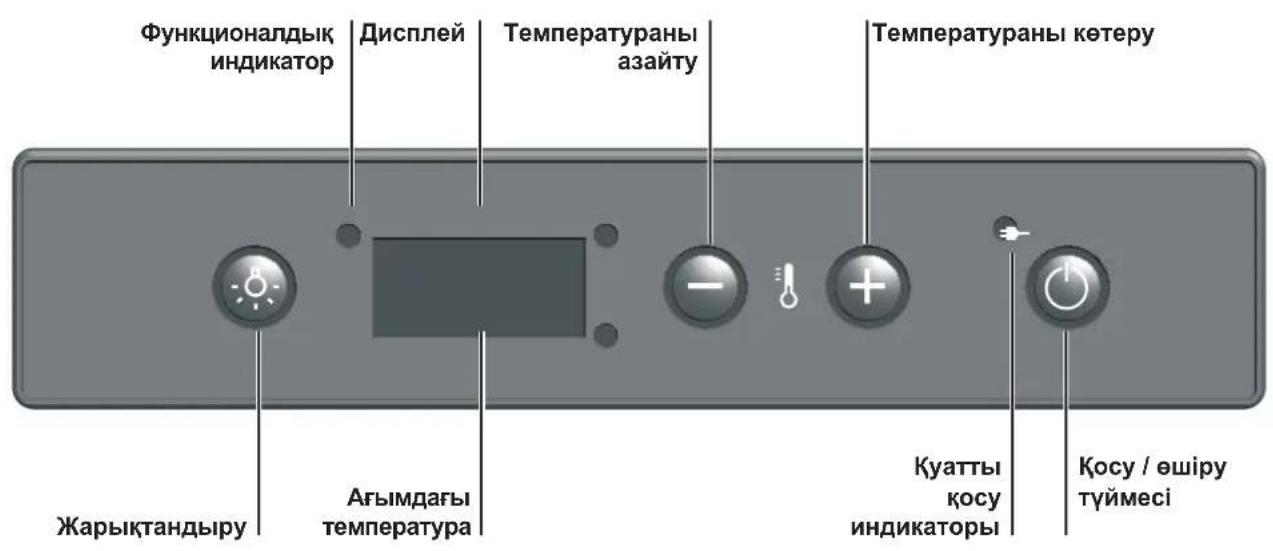
KZ
Safety devices for protection against overvoltage
Before ironing, sort the laundry by type. The recommended temperature is 150°C. This temperature is sufficient for ironing most items. To determine the ironing temperature, refer to the label on the garment. To avoid damaging the fabric, iron the items in the correct order. All items are ironed at the same temperature, but depending on the characteristics of the fabrics, they may be ironed at different temperatures (see the temperature table below). After ironing, the iron should be unplugged and the water tank emptied. The lowest temperature is the absolute minimum for ironing. The lowest temperature is the recommended temperature for all fabrics. The iron can be used at any temperature setting.
Adjusting the temperature
After plugging in the iron, the temperature indicator light will turn on. It will take about 150 seconds to heat up, and then you can start ironing. If you adjust the temperature, wait for the indicator light to turn off before ironing.
- After plugging in the iron, the temperature indicator light will turn on.
- Wait a few seconds (see the indicator light). The temperature indicator will change accordingly.
- When the iron reaches the set temperature, the indicator light will turn off. 4. To adjust the temperature, turn the temperature dial to the desired setting. Wait for the indicator light to turn on again before ironing.
If the temperature inside the iron exceeds 240°C, the thermostat will cut off (or the fuse will blow). This provides protection against overheating.
Ironing with steam
CAUTION:
Do not iron clothes that are damp. If the clothes are too wet, wring them out before ironing. You can also use a dry iron for slightly damp clothes.
Temperature table for ironing
This table shows the recommended temperatures for ironing different fabrics. If you need to iron clothes at a higher temperature than the recommended one, set the temperature dial to a higher setting.
| Amarone della Valpolicella | 17°C |
| Barbaresco | 17°C |
| Barolo | 17°C |
| Божке | 13°C |
| Борido пиker ak | 6°C |
| БорIDO курак ak | 8°C |
| Борido Кызлы | 17°C |
| Бургундък ak | 11°C |
| Бургундък Кызлы | 18°C |
| Brunello | 17°C |
| Шamпанскoe | 6°C |
| КъяNTи Клашкальik | 16°C |
| Languedoc-Roussillon | 13°C |
| Passito di Panteleria | 6°C |
| Пробданък Кызлы | 12°C |
| Куррак жени тетті кебіktі shapan 6°C | |
| Verdicchio di Matelica e dei Castelli di Jesi | 8°C |
| Trentino Alto Adige ak shapabbl | 11°C |
| Fraciacorta ak shapabbl | 11°C |
| КурракхочиICTIak shapanTap | 10°C |
| Куррак,балгынжөнжөmictiak shapanTap | 8°C |
| Friuli Venezia Giulia ak shapabbl | 11°C |
| Rodano shapabbl | 15°C |
| Луара Курракak shapabbl | 10°C |
| Луара лникшарabbl | 7°C |
| Луара кызbl shapabbl | 14°C |
| Passito лникшарabbl | 8-18°C |
| КызblтшарanTap,ЖаншарanTap | 12°C |
| Орташасктallanakшыл-ksblshapanTap | 14°C |
| Кызbl,жeteкпіkti tугde сактallanrashoptaшаMbiktsbl shapan | 16°C |
IRON MAINTENANCE
CLEANING
KZ
Standard fittings - 36 fittings
36 fittings (standard, type "Fren" [flanged]) are intended for connecting pipes and fittings to the corresponding flanges of the equipment.
STANDARD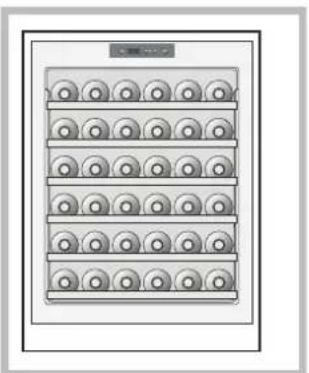
36 fittings (100%)
factory-made
fitted)
5 pcs
Before installing the fittings, check that the standard fittings are correctly matched to the flanges of the "Uapan Komas" equipment.
! Before installation, check the fittings for mechanical damage and corrosion.
If the "Fren" fittings do not fit the flanges, do not force them; instead, select the appropriate fittings for the installation.
fittings for installation.
! Before installation, 22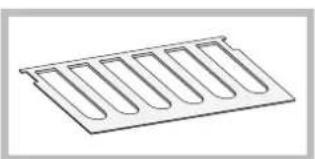
fittings must be kept clean and free from dirt.
Installation of fittings
The fittings must be installed according to the standard fittings. They must be installed on the flanges of the "Uapan Komas" equipment.
Each of the three "Uapan KOnMaCbHa" WAmNaHHbIH 5 6eTeJIkeciHeH apTbIK CaTafBbHb3 KeNce, 3 cepeciH
anbihbi3XHe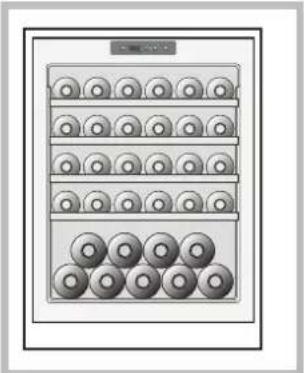
6eTeKepdi eki KaTapFa opHaJnactbipHb3
(6eTeKeJepdi
ekihui KaTapra
TEmeHderi KaTapdbIH
6eTeKepeHin apacbHa opHaJactbpa Otbpbn).
OcbIaH 96TeJIkere deIH opHaJAcTbIpyra 6oJaBl.
BTeKeIepi opHaIacTbIpydbH 6ipHeWeMbicaJI
CAKTAY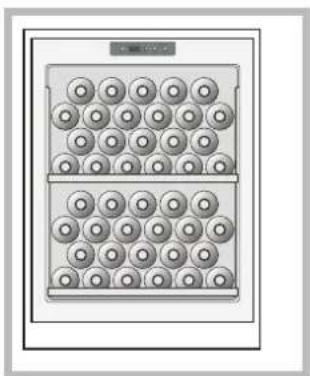
44 BETENKE (100% 6ETENKE KaTbI3bINbIN opHaJaackaH)
1 cope
CTOJFAYCbIHYUJIH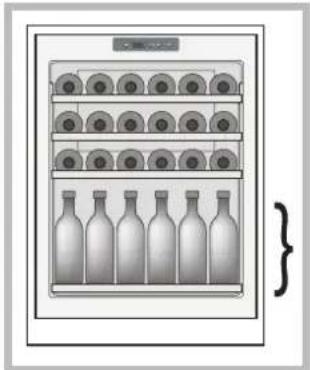
426eTeIke (50% 6eTeIke KaTbI3blBn 50% Typrbl3blBn opHaJaackaH)
3 cpe 4katap
Belt (48% belt made of Kazakh and 52% Turkish origin)
1 row of 4 layers
WOODEN PULLEY INSTALLATION
To install the wooden pulley, you will need:
- First, place the belt on the pulley.
- Then, pull the belt upward over the top of the pulley.
- Pull the belt towards you. If the belt needs to be removed or adjusted, loosen the belt by 1/3. 4. Remove or adjust the necessary belts and then pull the pulley upward and replace it.
- If the belt is stuck, pull it out with a sharp turn. If the belt is tight, pull it upward with force.
To remove the belt completely, first remove all the belts from the pulley, then remove 1 and 2. Pull the belt towards you from the pulley.
! Never remove more than one pulley at a time.
INSTALLING BELTS FOR SMALL PULLEYS
If the belts are too tight to install, we will install them one by one. The belts should not be forced or installed only by hand. To make the belts fit well, install them in the middle of the pulley.
Cabinet device
The cabinet is designed for electrical connection in accordance with the requirements of the technical specifications.
If a malfunction occurs during operation, contact the service organization, having previously identified and recorded the following data:
Actions
Compressor cooling system
Compressor without cooling system
Possible causes / Solutions
The cabinet is not connected to the mains, or the plug is not inserted into the socket, or there is no voltage in the electrical network. - Check the socket, plug, and power cord.
- To contact the authorized service organization, provide the following information:
- Purchase receipt; warranty card (service book, service certificate, etc.);
- Device type;
- The model (Mod.) and serial number (S/N) of the device indicated in the technical data plate or in the warranty card (see label).
Repair work must be carried out only by qualified specialists and technical service personnel of the authorized service organization. Short-term voltage interruptions in the electrical network do not affect the operation of the device. Violation of the warranty may lead to problems that cannot be resolved within a short time.
Kb3Mem Kepcemy Mep3imi 10 xbin
ARISTON
Hotpoint
ARISTON
(i) INDESIT STINOL
This appliance is intended for expert use. For any repairs, contact qualified personnel.
Some parameters may vary depending on the model.
For safety, keep children away from the appliance.
Manufacturer:
Indesit Company S.p.A
Registered office:
Viale A. Merloni, 47
60044 Fabriano (AN), Italy.
Tel.: (0732) 6611
Fax:
Indesit Company International
Business S.A.
Заводские данные:
Таннерпортабы, 2, Влакантонале
6928, Майно, Швейцария
Вайхайсу уйин Мекенкайб Метелеоны:
Ресен 129233 Москва
Мир данных, ВВУ (быв. ВДНХ)
Набальон, 46
Тел.: (495) 974-6280
Факс (495) 961-2919
974-6279
KZ
KZ
KZ

- EN
- NOTICES
- POSITIONING AND CONNECTION
- UNPACKING
- POSITIONING
- WIRING CONNECTION
- PRODUCT DESCRIPTION
- INTERIOR PARTS
- CONTROL PANEL
- BOTTLE AGEING COMPARTMENT
- MANUAL TEMPERATURE CONTROL
- TABLE OF IDEAL WINE TEMPERATURES
- STANDARD 36-BOTTLE STOCK
- CHAMPAGNE BOTTLE STOCK
- SOME STOCKING CONFIGURATIONS
- REMOVING THE WOODEN SHELVES
- FOR A SMALL NUMBER OF BOTTLES
- CARE AND MAINTENANCE
- DISCONNECTING THE WINE CELLAR
- TROUBLESHOOTING
- PROBLEM
- THE COMPRESSOR DOES NOT WORK
- POSSIBLE CAUSES/SOLUTIONS
- THE COMPRESSOR NEVER STOPS
- DISPOSAL
- BEFORE CALLING FOR ASSISTANCE
- COMMUNICATING
- TABLE OF CONTENTS
- AGING COMPARTMENT
- IF THERE ARE FEW BOTTLES
- WARNINGS
- PLACEMENT OF CHAMPAGNE BOTTLES
- A FEW EXAMPLES OF BOTTLE PLACEMENT
- HOW TO REMOVE WOODEN SHELVES
- IF THE NUMBER OF BOTTLES IS INSUFFICIENT TO COMPLETELY FILL THE "WINE CELLAR", WE RECOMMEND DISTRIBUTING THE BOTTLES EVENLY ON THE AVAILABLE SHELVES, RATHER THAN PLACING ALL THE BOTTLES AT THE TOP OR BOTTOM
- THE COMPRESSOR OPERATES CONTINUOUSLY
- POSSIBLE CAUSES / SOLUTIONS
- THE APPLIANCE IS NOT CONNECTED TO THE POWER SUPPLY, OR THE PLUG IS NOT PROPERLY INSERTED INTO THE SOCKET, NOT ENSURING CONTACT, OR THERE IS A POWER OUTAGE IN THE HOME. - THE SOCKET IS FAULTY; TO CHECK, CONNECT THE APPLIANCE TO ANOTHER SOCKET
- BEFORE CONTACTING THE TECHNICAL ASSISTANCE CENTRE
- WHEN CONTACTING THE TECHNICAL SUPPORT CENTER
- CONTENTS
- CHAPTER TITLES
- SCHEMATICS
- SAFETY INSTRUCTIONS
- INSTALLATION OF CONTROLLERS
- MAINTENANCE AND OPERATION
- WARRANTY
- KZ
- INSTALLATION AND CONNECTION
- CONNECTION
- CLEANING
- CONNECTING TO THE MAINS SUPPLY
- SAFETY DEVICES FOR PROTECTION AGAINST OVERVOLTAGE
- ADJUSTING THE TEMPERATURE
- IRONING WITH STEAM
- CAUTION
- TEMPERATURE TABLE FOR IRONING
- IRON MAINTENANCE
- STANDARD FITTINGS - 36 FITTINGS
- INSTALLATION OF FITTINGS
- BTEKEIEPI OPHAIACTBIPYDBH 6IPHEWEMBICAJI
- WOODEN PULLEY INSTALLATION
- INSTALLING BELTS FOR SMALL PULLEYS
- ACTIONS
Brand : HOTPOINT
Model : WL 36 AHA
Category : Wine cellar