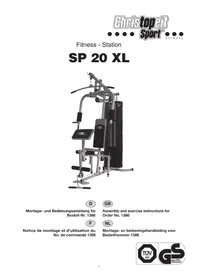
SP 20 XL - Fitness Equipment Christopeit - Free user manual and instructions
Find the device manual for free SP 20 XL Christopeit in PDF.



| Product type | Complete strength training station |
| Brand | Christopeit |
| Model | SP 20 XL |
| Number of exercises | Up to 30 different exercises |
| Maximum user weight | 120 kg |
| Standard weight stack weight | 45 kg (8 plates of 5.6 kg) |
| Maximum stack weight (expandable) | 56 kg (with 2 optional additional plates of 5.6 kg) |
| Working load per exercise | From 5 kg to 70 kg depending on exercise |
| Frame material | Round steel tube 50 mm in diameter |
| Safety standards | Certified according to EN ISO 20957-1:2013 + EN 957-2:2003 class H |
| Adjustments | Height-adjustable seat, leg rest, curl pad |
| Included equipment | Latissimus bar, curl bar, rope, handles, carabiners, chains |
| Pulleys | 12 coated pulleys |
| Spare parts | Available from the manufacturer (ref. 1386) |
| Maintenance | Regularly check screw tightness, clean with a damp cloth, lubricate guide rods |
| Warranty | Not specified, refer to manufacturer |
Frequently Asked Questions - SP 20 XL Christopeit
User questions about SP 20 XL Christopeit
0 question about this device. Answer the ones you know or ask your own.
Ask a new question about this device
Download the instructions for your Fitness Equipment in PDF format for free! Find your manual SP 20 XL - Christopeit and take your electronic device back in hand. On this page are published all the documents necessary for the use of your device. SP 20 XL by Christopeit.
USER MANUAL SP 20 XL Christopeit
Assembly and exercise instructions for Order No. 1386
Überzug, Pull over, Pull over, Trekoefening
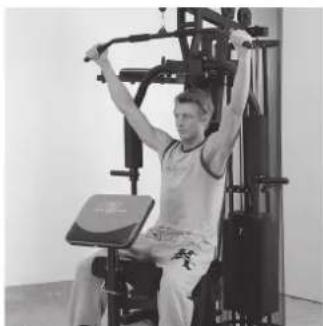
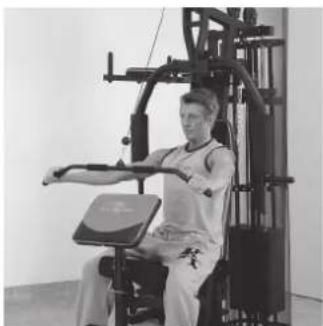
Ubung 5
Arm curl, Arm curl, Bras curl, Arm curl
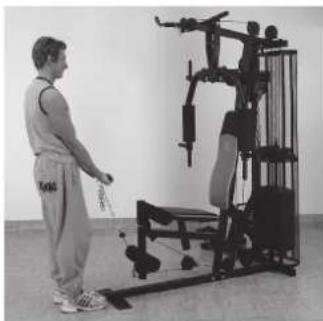
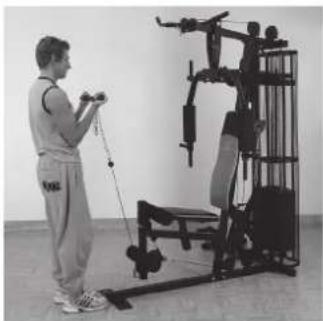
Ubung 7
Butterfly, Butterfly, Butterfly, Butterfly
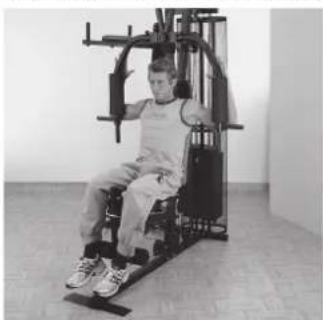
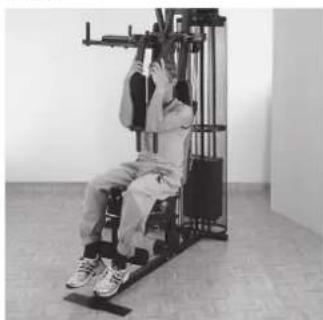
- Important Recommendations and Safety Information Page 16
- Parts List Page 17 - 19
- Assembly Instructions With Exploded Diagrams Page 20 - 25
- Training Instructions / Pulsratemeasurementtable Page 26
- Descriptions of the forms of training Page 15
Dear customer,
We congratulate you on your purchase of this home training sports unit and hope that we will have a great deal of pleasure with it. Please take heed of the enclosed notes and instructions and follow them closely concerning assembly and use.
Please do not hesitate to contact us at any time if you should have any questions.
Important Recommendations and Safety Information
Our product has been tested by TÜV-GS and meets the latest and toughest safety standards. This fact does not however mean that you can fail to closely observe the following basic points:
- Assemble the equipment according to the assembly instructions and only use the individual parts enclosed for assembly of the equipment and which are listed as being specifically for this equipment. Before you start assembly, check against the delivery to make sure that everything has been delivered, and check against the packing list to make sure all the parts have been enclosed.
- Check before the equipment is first used, and again at regular intervals, that all screws, bolts, nuts and other connections have been done up tightly, to ensure that your training equipment is in a safe operating condition at all times. This is especially true for the cable system. Before each workout should ropes, carbine hook and train accessories are checked for proper mounting and any signs of wear. If misaligned, wear and tear is to be immediately recognizable traces of an exchange the affected parts are required. This is especially true for the cable system. Before each workout should ropes, carbine hook and train accessories are checked for proper mounting and any signs of wear. If misaligned, wear and tear is to be immediately recognizable traces of an exchange the affected parts are required.
- Place the equipment on a dry, level surface and protect it against damp and wetness. If you wish to protect the area underneath the equipment against damage from pressure or from becoming dirty or the like, we recommend that you place a suitable non-slip item under the equipment (such as a rubber mat or sheet of wood).
- Always wear training clothing and shoes that are suitable for fitness training when you are doing training work on the equipment. The clothing must be of a type that will not hang down during training due to its shape (e.g., length). Shoes should be selected for their suitability when using the training equipment, primarily so that they provide a secure grip for the foot and have a non-slip sole.
- Remove any objects from a vicinity of 2 meters avound the equipment before you start any training work.
-
In general, you should consult your doctor before starting targeted training work. He can make a definitive statement as to the maximum exertion (pulse rate, wattage, duration of training, etc.) you can set for yourself and can also give you detailed information with respect to the correct body position during training, your training target, and questions of diet. It is to take care that this item is not useable for therapeutic purpose. Exercise never after heavy meals.
-
Only carry out training work on the equipment when it is in perfect working order. Only use original spare parts in the event of a repair.
- If it has not been explicitly stated otherwise in the instructions, the equipment may only be used by one person for training.
- If you experience giddiness, nausea, chest pains or other abnormal symptoms, stop the training at once and see a doctor.
- In general, sports training equipment is not a toy. It may only be used in an appropriate manner and by persons who have been suitably informed or instructed.
- Children, invalids and the handicapped should only use the equipment in the presence of another person who can provide assistance and instruction.
- Always pay attention that you or any other persons never bring parts of the body in close proximity to any parts of the equipment that are still moving.
- When making settings for any adjustable parts, check that they are in the right position and also check the marked maximum setting.
- Do not use strong solvents for cleaning, and only use the tools supplied, or suitable ones of your own, for any repairs that may be required.
- Please dispose of the packaging and any parts that have to be replaced subsequently (all parts for the unit) at suitable collecting points or containers with a view to saving the environment.
- This machine has been tested and certified in compliance with EN ISO 20957-1:2013 + EN 957-2:2003 "H". The maximum permissible load (=body weight) is specified as 120kg .
Parts List - Spare Parts List SP 20 XL - Order No. 1386
Technical data: Stand: 01.09.2015
The small fitness studio for cardio training at home
- Complete Work-out in a small space
Over 30 exercise possibilities for shoulder, breast, back, legs, abdomen and arms - Upholstered comfort seat with several times height adjustable seat
- Combined bench press and butterfly unit
- Latissimus and Curl bar
Leg curler - Arm curl console
Metal step for standing Curl exercises - 8 push-on weights approx 5,6kg = approx 45kg weights
- Suitable for weights up to max. 56kg
- Training Tension resistance approx. 5kg till 70kg
- Steel tubes approx. 50mm
- Load max. 120 kg (Body weight)
Space requirement approx. L 145 x W 115 x H 200 cm
Please check after opening the packing that all the parts shown in the following assembly steps are there. Once you are sure that this is the case, you can start assembly.
Please contact us if any components are defective or missing, or if you need any spare parts or replacements in future:
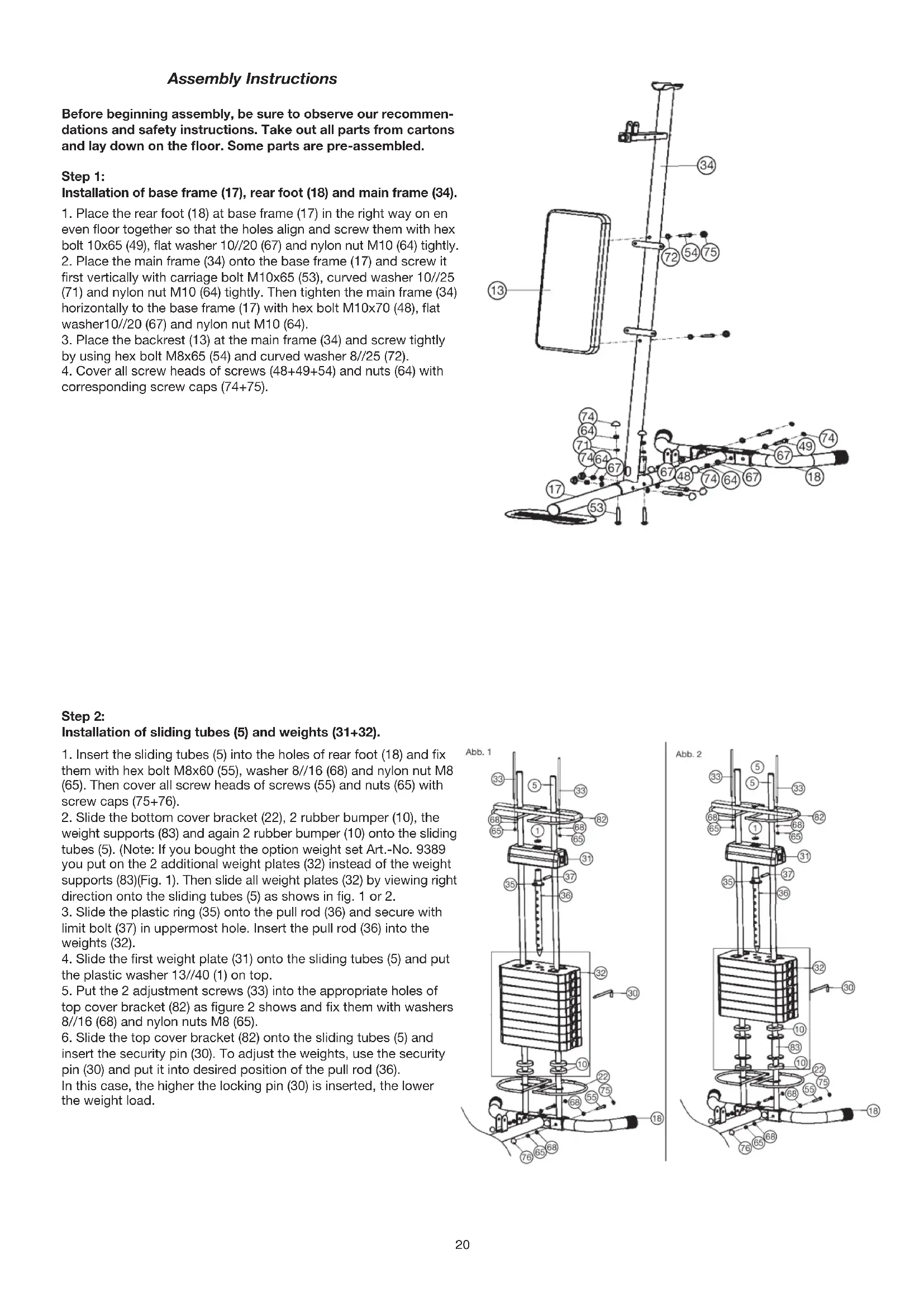
Assembly Instructions
Before beginning assembly, be sure to observe our recommendations and safety instructions. Take out all parts from cartons and lay down on the floor. Some parts are pre-assembled.
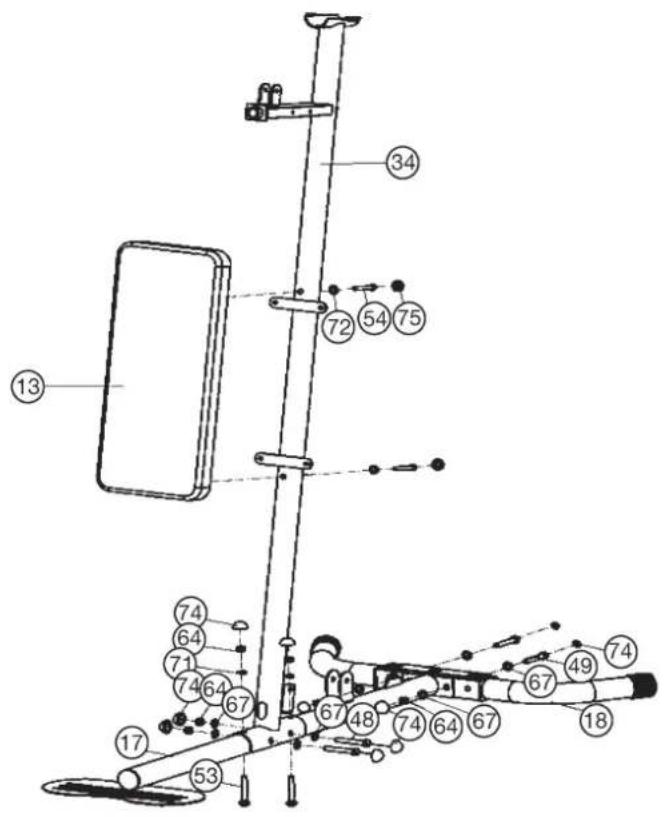
Step 1: Installation of base frame (17), rear foot (18) and main frame (34).
- Place the rear foot (18) at base frame (17) in the right way on an even floor together so that the holes align and screw them with hex bolt 10x65 (49), flat washer 10//20 (67) and nylon nut M10 (64) tightly.
- Place the main frame (34) onto the base frame (17) and screw it first vertically with carriage bolt M10x65 (53), curved washer 10//25 (71) and nylon nut M10 (64) tightly. Then tighten the main frame (34) horizontally to the base frame (17) with hex bolt M10x70 (48), flat washer10//20 (67) and nylon nut M10 (64).
- Place the backrest (13) at the main frame (34) and screw tightly by using hex bolt M8x65 (54) and curved washer 8//25 (72).
- Cover all screw heads of screws (48 + 49 + 54) and nuts (64) with corresponding screw caps (74 + 75) .
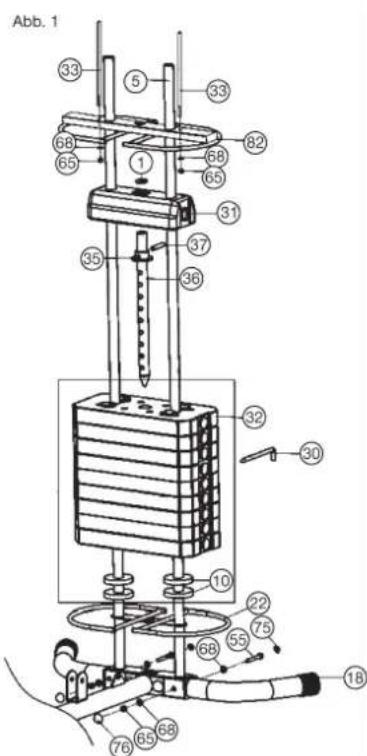
Step 2: Installation of sliding tubes (5) and weights (31 + 32)
- Insert the sliding tubes (5) into the holes of rear foot (18) and fix them with hex bolt M8x60 (55), washer 8//16 (68) and nylon nut M8 (65). Then cover all screw heads of screws (55) and nuts (65) with screw caps (75+76).
- Slide the bottom cover bracket (22), 2 rubber bumper (10), the weight supports (83) and again 2 rubber bumper (10) onto the sliding tubes (5). (Note: If you bought the option weight set Art.-No. 9389 you put on the 2 additional weight plates (32) instead of the weight supports (83)(Fig. 1). Then slide all weight plates (32) by viewing right direction onto the sliding tubes (5) as shows in fig. 1 or 2.
- Slide the plastic ring (35) onto the pull rod (36) and secure with limit bolt (37) in uppermost hole. Insert the pull rod (36) into the weights (32).
- Slide the first weight plate (31) onto the sliding tubes (5) and put the plastic washer 13//40 (1) on top.
- Put the 2 adjustment screws (33) into the appropriate holes of top cover bracket (82) as figure 2 shows and fix them with washers 8/16 (68) and nylon nuts M8 (65).
- Slide the top cover bracket (82) onto the sliding tubes (5) and insert the security pin (30). To adjust the weights, use the security pin (30) and put it into desired position of the pull rod (36).
In this case, the higher the locking pin (30) is inserted, the lower the weight load.
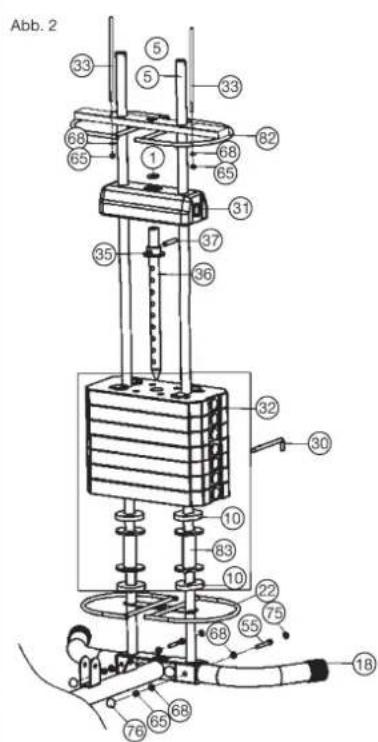
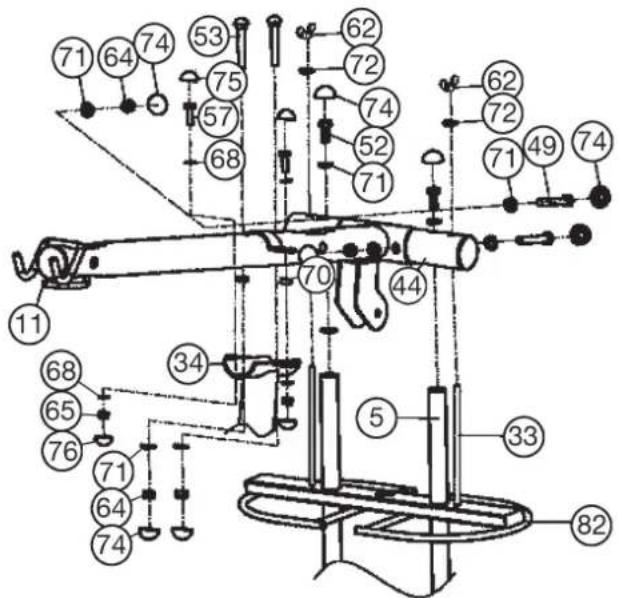
Step 3: Installation of top frame (11) and end tube (44).
- Insert the end tube (44) in right direction on top of the sliding tubes (5) and screw tightly with hex bolt M10x25 (52) and curved washer 10//25 (71).
- Place the top frame (11) onto the main frame (34) and screw it loosely together by using carriage bolt M10x65 (53), washer 10//25 (71) and nylon nut M10 (64). Additional secure this point loosely with screws M8x25 (57), washers 8//16 (68), bushing (70) and nylon nut M8 (65). Then put the holder of top frame (11) and end tube (44) together and screw tightly with screws M10x65 (49) curved washers 10//25 (71) and nylon nuts M10 (64). Also tighten now the screws (53 + 57) .
- Push the adjustment screws (33) (with top cover bracket (82)) through the holes of end tube (44) and secure on top with curved washer 8//25 (72) and butterfly nut (62).
- Cover all screw heads of screws (49 + 52 + 57) and nuts (64 + 65) with corresponding screw caps (74 + 75 + 76) .
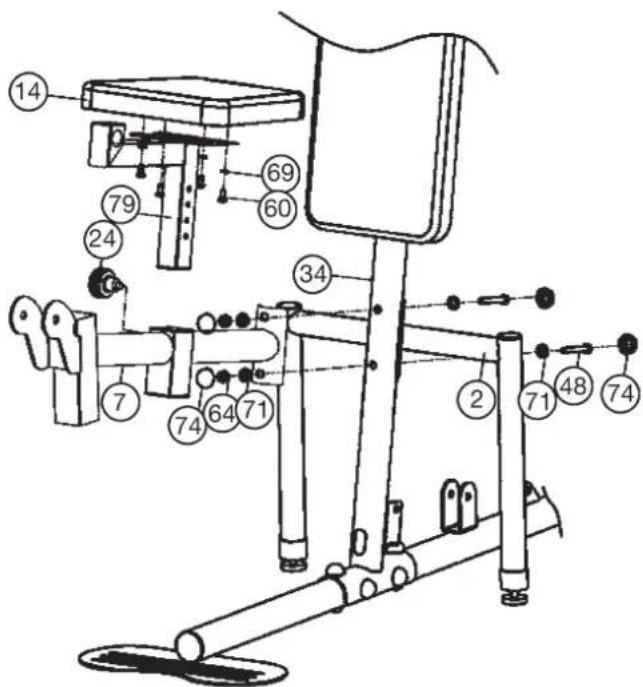
Step 4: Installation of leg curl frame (7),seat (14) and seat support (79).
- Place the leg curl frame (7) with holder in front of the main frame (34) and the balance frame (2) on rear side of main frame (34) and screw tightly by using bolt M10x70 (48), curved washer 10//25 (71) and nylon nut M10 (64).
- Adjust the seat (14) on seat support (79) so that the threaded holes in the rear of seat (14) are align with the seat support (79) and screw it tightly by using washers 6//16 (69) and screws M6x15 (60).
- Slide the seat support (79) into the appropriate holder of leg curl frame (7) and secure it into desired position by using the quick lock knob (24). (Note: To screw in the quick lock knob (24), the treaded hole in the leg curl frame (7) and one of the holes in the seat support (79) must be aligned. The setting of the seat can be adjusted as desired later. For this, the quick lock knob (24) must be loosened by only a few revolutions, the cap of the lock must be pulled away and the seat adjusted. Then secure the new setting by tightening the quick lock knob (24).)
- Cover all screw heads of screws (48) and nuts (64) with screw caps (74).
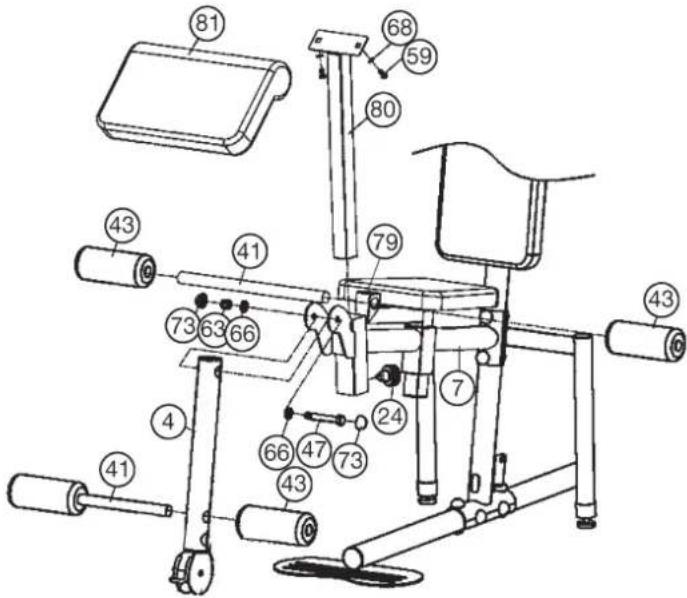
Step 5: Installation of leg curler (4), leg foams (43) and arm curl pad (81).
- Put the leg curler (4) into the holder of leg curl frame (7) and secure with bolt M12x85 (47), washer 12//24 (66) and nylon nut M12 (63). (Note: Don't tighten the screw for leg curler too much. The leg curler should turn easy after assembly.)
- Insert the leg foam holder (41) into the leg curler (4) and seat support (7) and put the leg foams (43) onto the ends of leg foam holder (41).
- Adjust the arm curl pad (81) onto arm curl holder (80) so that the threaded holes in the rear of arm curl pad (81) are align with the arm curl holder (80) and screw it tightly by using hex screws M8x16 (59) and washers 8//16 (68).
- Slide the leg curl holder (80) into the appropriate holder of leg curl frame (7) and secure it into desired position by using the quick lock knob (24). (Note: Same procedure as quick lock knob for seat support.)
- Cover the screw head of screw (47) and nut (63) with corresponding screw cap (73).
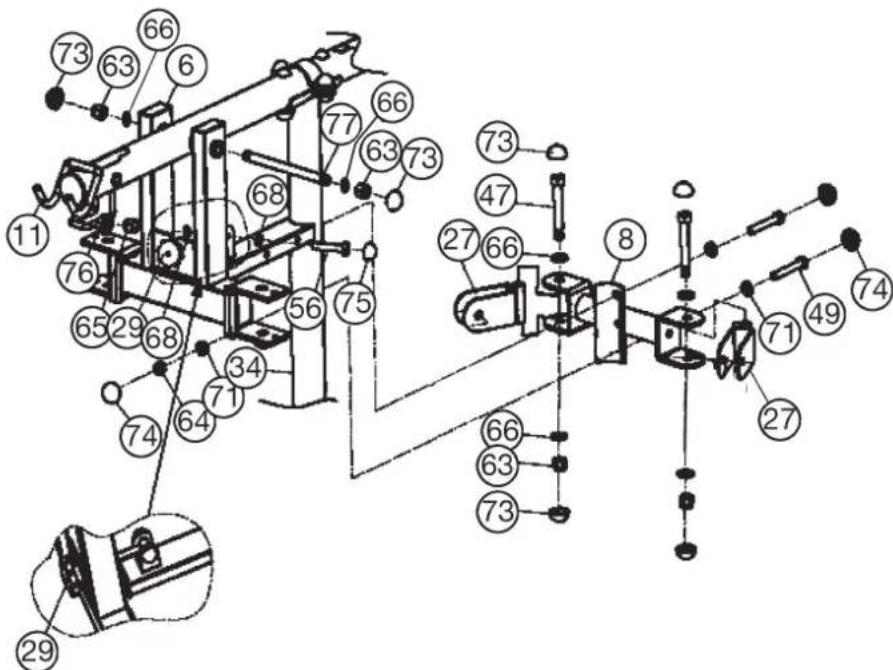
Step 6: Installation of butterfly arm support (6), pulley support (8) and pulley holder (27).
- Place the butterfly arm holder (6) at appropriate position of top frame (11), push axle (77) through all holes and secure with nylon nuts M12 (63) and washer 12/24 (66). (Pay attention to the correct installation position of the butterfly arm holder (6) on top frame (11)).
- Assemble the hand grip nut with screw (29) to the main frame (34) and secure with bolt M8x45 (56), washer 8//16 (68) and nylon nut M8 (65).
- Place the pulley support (8) to the main frame (34) and screw it on bottom area tightly with hex bolt M10x65 (49), curved washer 10//25 (71) and nylon nut M10 (64) and on top only with screw (49) and washer (71).
- Insert the pulley holder (27) into the pulley support (8) and secure with bolt M12x85 (47), washer 12/24 (66) and nylon nut M12 (63).
- Cover all screw heads of screws (47 + 53 + 56) and nuts (63 + 64 + 65) with corresponding screw caps (73 + 74 + 75) .
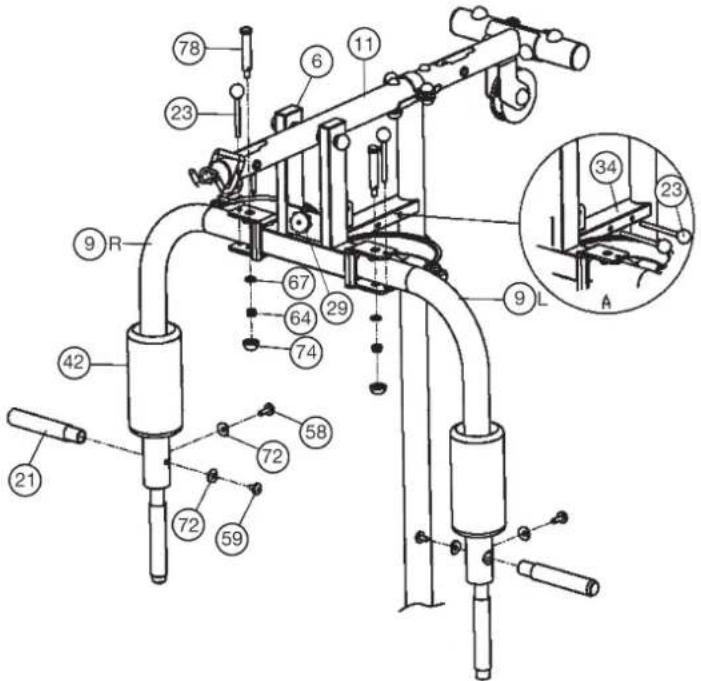
Step 7: Installation of butterfly arm left and right (9L + 9R) hand grip (21) and arm foam (42).
- Put the left and right butterfly arms (9L/R) into the Butterfly arm support (6) and secure with bolt M10x90 (78), washer 10//20 (67) and nylon nut M10 (64). Insert the locking pins (23) to secure butterfly arm position and cover the nuts (64) with screw cap (74). 2. Slide the arm foams (42) onto the butterfly arms left and right (9L + 9R) (perhaps by help of a little bit soap water) and tighten hand grips (21) at butterfly arms (9L/R) with screws M8x25 (59), screws M8x16 (58) and curved washer 8//25 (72).
Note: For bench press exercising secure the butterfly arms left and right (9L+9R) with locking pins (23) at butterfly arm support (6) and screw loosely and fold back the handgrip nut (29). For butterfly exercising secure position of butterfly arm support (6) with hand grip nut (29) und take out the locking pins (23) from butterfly arms (9L+9R). If no use of locking pins you can storage at main frame (34) as figure A shows.
Step 8: Installation of cable 1 for butterfly (38) with pulleys (19). (Note: The assembling of cables needs a simultaneously assembling of pulleys. So please insert the cable each time before you assemble a pulley and don't tighten the screws for pulleys too much. The pulley should turn easy after assembly.)
-
Screw one end of the cable 1 (38) at the holder of the butterfly arm left (9L) with bolt M10x35 (51), washer 10//20 (67) and nylon nut M10 (64).
-
Attach one pulley (19) with cable 1 (38) and pulley covers (20) into 1st pulley holder (27) and secure with hex bolt M10x50 (50), washer 10//20 (67) and nylon nut M10 (64).
-
Attach one pulley (19) with cable 1 (38) and pulley covers (20) into twisted pulley holder (26) and secure with hex bolt M10x50 (50), washer 10//20 (67) and nylon nut M10 (64).
-
Attach one pulley (19) with cable 1 (38) and pulley covers (20) into 2nd pulley holder (27) and secure with Hex bolt M10x50 (50), washer 10//20 (67) and nylon nut M10 (64).
-
Screw the other end of the cable 1 (38) at the holder of the butterfly arm right (9R) with bolt M10x35 (51), washer 10//20 (67) and nylon nut M10 (64).
-
Cover all screw heads of screws (50 + 51) and nuts (64) with corresponding screw caps (74).
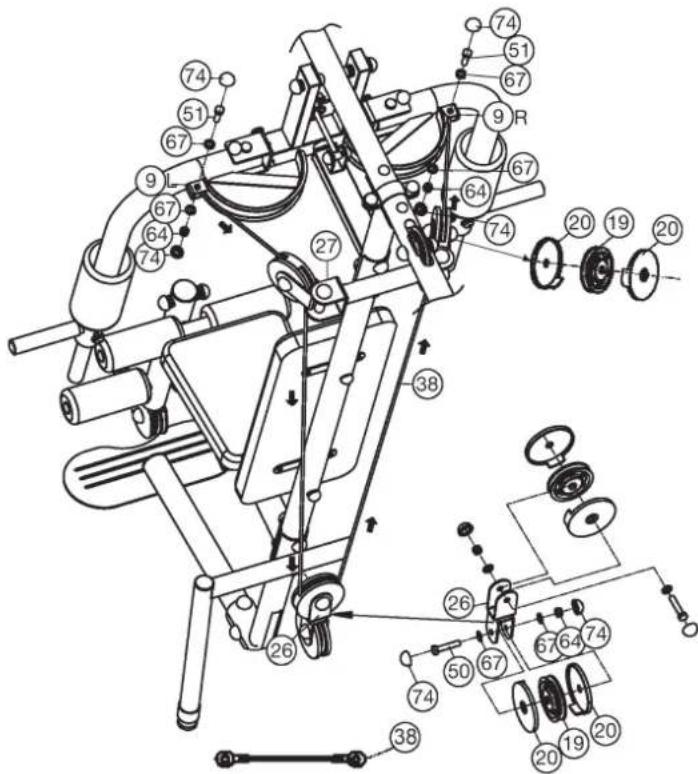
Step 9: Installation of cable 2 for lattissimus (40) with pulleys (19).
- Put the cable 2 for latissimus (40) with screw end from bottom side through the front big hole of top frame (11) so that the ball of cable 2 (40) is below of top frame (11). Then put the cable (40) from top side through the second big hole of top frame (11) and finally through top cover bracket (82). Finally screw I into the pull rod (36) as arrows shows on figure.
- Attach the two pulleys (19) with cable 2 (40) into the top frame (11) and secure with hex bolts M10x70 (48), washers (67) and nylon nuts M10 (64). Ensure that the cable (40) lead over the pulleys on top of the to frame (11).
- Attach two pulleys (19) with cable 2 (40) and pulley covers (20) into double pulley holder (25) and secure with hex bolt M10x50 (50), washer 10//20 (67) and nylon nut M10 (64)
- Attach one pulley (19) with cable 2 (40) and pulley cover (20) into pulley holder at top frame (11) and secure with hex bolt M10x50 (50), washer 10//20 (67) and nylon nut M10 (64).
- Cover all screw heads of screws (48+50) and nuts (64) with corresponding screw caps (74).
- Connect the latissimus bar (15) at cable 2 (40) by using carbine hook (3) after assembly complete. To storage the long bar (15) you can put it on the appropriate holder in front of the top fame (11).
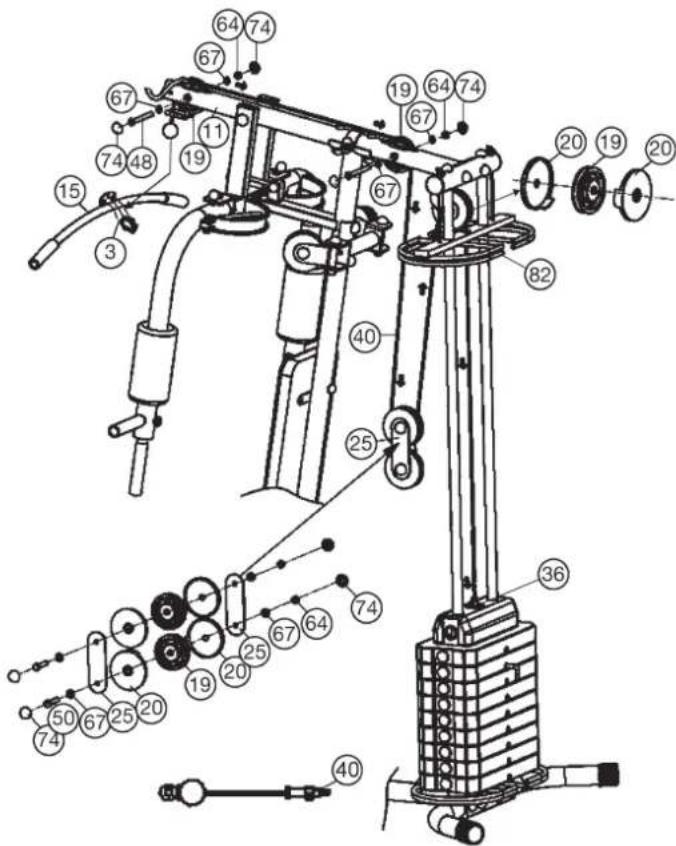
Step 10: Installation of cable 3 for leg curler (39) with pulleys (19).
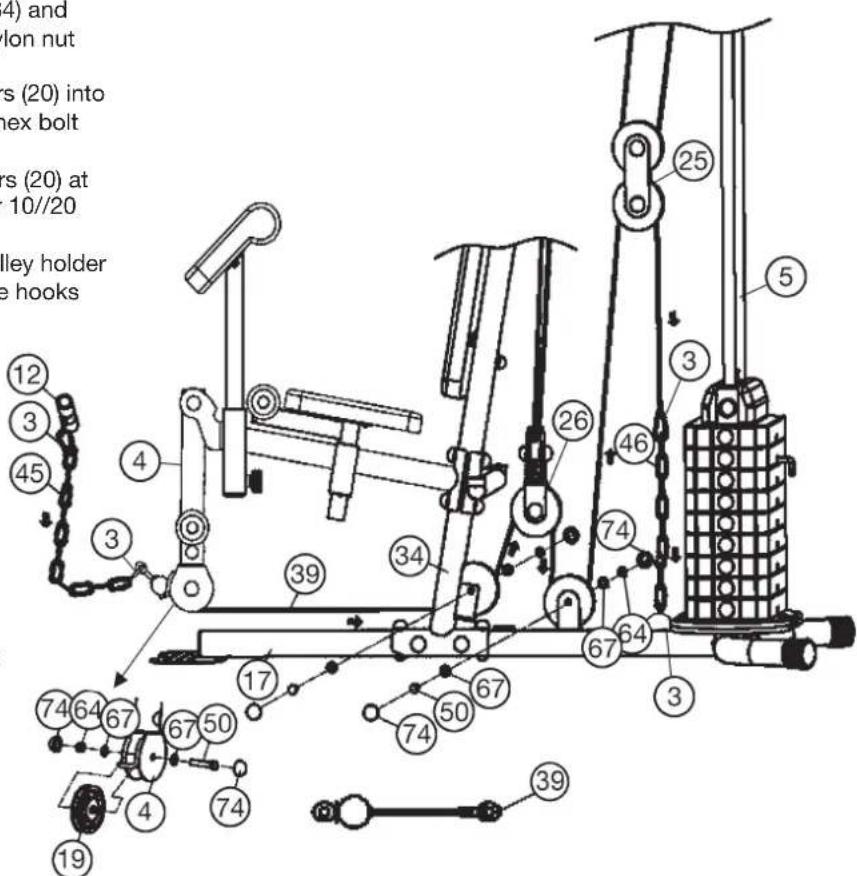
- Put the cable 3 for leg curler (39) with eye end through the leg curler (4) so that the ball of cable 3 (39) is in front of the leg curl (4) and put the cable 3 (39) with eye end through and big hole of main frame (34).
- Attach one pulley (19) with cable 3 (39) into the leg curler (4) and secure with bolt M10x50 (50), washer 10//20 (67) and nylon nut M10 (64).
- Attach one pulley (19) with cable 3 (39) at main frame (34) and secure with bolt M10x50 (50), washer 10//20 (67) and nylon nut M10 (64).
- Attach one pulley (19) with cable 3 (39) and pulley covers (20) into bottom part of twisted pulley holder (26) and secure with hex bolt M10x50 (50), washer 10//20 (67) and nylon nut M10 (64).
- Attach one pulley (19) with cable 3 (39) and pulley covers (20) at base frame (17) and secure with bolt M10x50 (50), washer 10//20 (67) and nylon nut M10 (64).
- Put the cable 3 (39) with eye end through the double pulley holder (25) and enlarge the length of cable 3 (39) with two carbine hooks (3) and short chain (46) to connect it finally at appropriate position of base frame (17).
- Cover all screw heads of screws (50) and nuts (64) with corresponding screw caps (74).
- Connect the curl bar (12) at cable 3 (39) by using the long chain (45) and carbine hooks (3).
(Note: When you use leg curler for exercising you should disconnect the curl bar (12) with chain (45).
To get a smooth sliding cable system, you may adjust the cable system roughly at short chain (46) with carbine hooks (3) through setting them into another position. For smaller adjustments you can use the screw end of cable 1 at pull rod. Always fix the position of this screw with nut and take care that this screw is minimum 12mm inside the threat. For an easier sliding of the weights at sliding tubes (5) you can put a little bit lubrication oil at sliding tubes.)
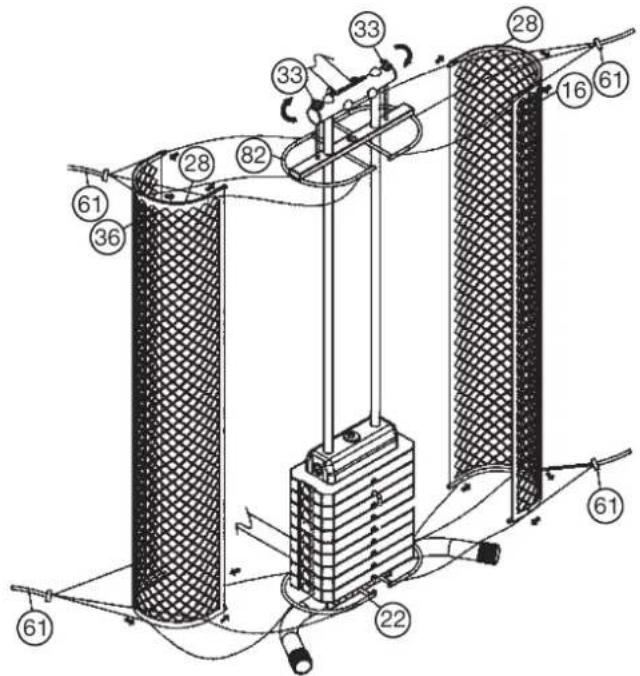
Step 11: Installation of weight cover (16).
- Insert the weight cover holder (28) into ends of weight covers (16). Place the weight cover (16) to top and bottom cover bracket (22 + 82) and fix each weight cover end with cable ties (61).
- Use the butterfly nut (33) to adjust the tightness of cover (16) so that the weight don't touch the cover during Lift up and down. Turn clockwise to tighten and turn anticlockwise for loosen the weight cover.
Step 12:
Checks:
- Check the correct installation and function of all screwed and plug connections. Installation is thereby complete.
- Before starting training, ensure that the recommended safety clearances are maintained to other objects.
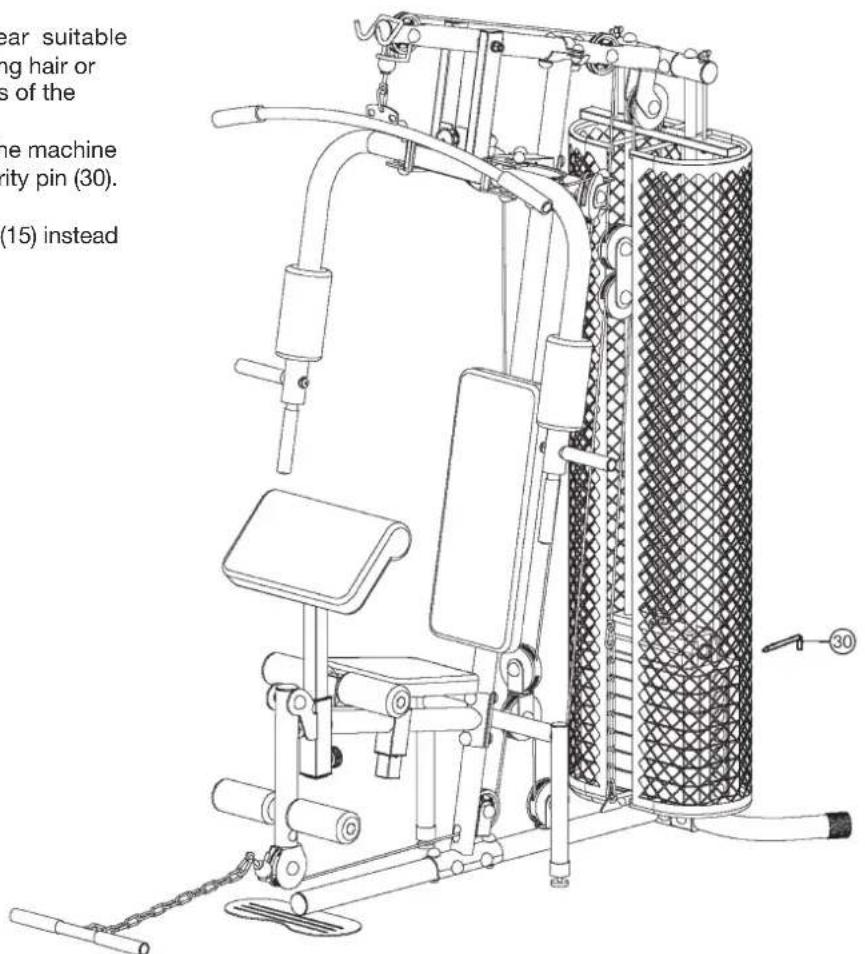
- When using the machine, always be sure to wear suitable headwear and clothes. This must protect against catching hair or clothing and trapping hair or clothing in the moving parts of the machine.
- When everything is in order, familiarise yourself with the machine with light weights. The weights have to secure with security pin (30). Maximum load of weight: 67Kg.
Note: Depends on exercising you can use latissimus bar (15) instead of curl bar (12) at both cable connections points.
Training Instructions
You must consider the following factors in determining the amount of training effort required in order to attain tangible physical and health benefits:
1. Intensity:
The level of physical exertion in training must exceed the level of normal exertion without reaching the point of breathlessness and / or exhaustion. A suitable guideline for effective training can be taken from the pulse rate. During training this should rise to the region of between 70% to 85% of the maximum pulse rate (see the table and formula for determination and calculation of this).
During the first weeks, the pulse rate should remain at the lower end of this region, at around 70% of the maximum pulse rate. In the course of the following weeks and months, the pulse rate should be slowly raised to the upper limit of 85% of the maximum pulse rate. The better the physical condition of the person doing the exercise, the more the level of training should be increased to remain in the region of between 70% to 85% of the maximum pulse rate. This should be done by lengthening the time for the training and / or increasing the level of difficulty.
If the pulse rate is not shown on the computer display or if for safety reasons you wish to check your pulse rate, which could have been displayed wrongly due to error in use, etc., you can do the following:
a. Pulse rate measurement in the conventional way (feeling the pulse at the wrist, for example, and counting the number of beats in one minute).
b. Pulse rate measurement with a suitable specialised device (available from dealers specialising in health-related equipment).
2. Frequency
Most experts recommend a combination of health-conscious nutrition, which must be determined on the basis of your training goal, and physical training three times a week. A normal adult must train twice a week to maintain his current level of condition. At least three training sessions a week are required to improve one's condition and reduce one's weight. Of course the ideal frequency of training is five sessions a week.
3. Planning the training
Each training session should consist of three phases: the warm-up phase, the training phase, and the cool-down phase. The body temperature and oxygen intake should be raised slowly in the warm-up phase. This can be done with gymnastic exercises lasting five to ten minutes.
Then the actual training (training phase) should begin. The training exertion should be relatively low for the first few minutes and then raised over a period of 15 to 30 minutes such that the pulse rate reaches the region of between 70% to 85% of the maximum pulse rate.
In order to support the circulation after the training phase and to prevent aching or strained muscles later, it is necessary to follow the training phase with a cool-down phase. This should be consist of stretching exercises and / or light gymnastic exercises for a period of five to ten minutes.
You find further information on the subject warm-up exercises, stretch exercises or general gymnastics exercises in our download area under www.christopeit-sport.com
4. Motivation
The key to a successful program is regular training. You should set a fixed time and place for each day of training and prepare yourself mentally for the training. Only train when you are in the mood for it and always have your goal in view. With continuous training you will be able to see how you are progressing day by day and are approaching your personal training goal bit by bit.
Pulse Rate Measurement Table
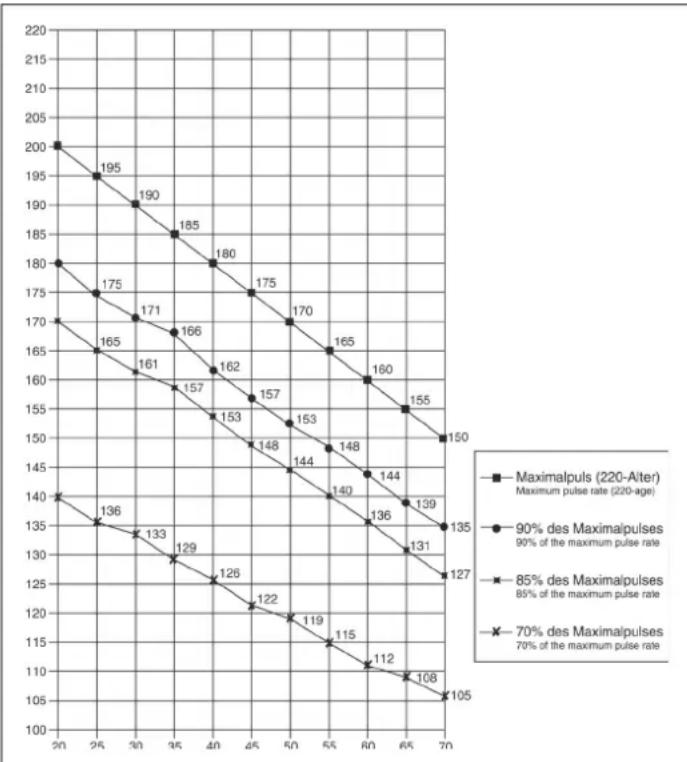
Calculation formula: Maximum pulse rate = 220 - age (220 minus your age)
90% of the maximum pulse rate = (220 - age) x 0.9
85% of the maximum pulse rate = (220 - age) x 0.85
70% of the maximum pulse rate = (220 - age) x 0.7

Sommaire
Chere cliente, cher client,
Espace approximativement requisite: L 145, W 115, H 200 centimetres.
05101520253035405060708090100mm
3. Planning van de training
© by Top-Sports Gilles GmbH
D-42551 Velbert (Germany)
Service:

- Ubung 5
- Ubung 7
- Important Recommendations and Safety Information
- Parts List - Spare Parts List SP 20 XL - Order No. 1386
- The small fitness studio for cardio training at home
- Assembly Instructions
- Step 1: Installation of base frame (17), rear foot (18) and main frame (34).
- Step 2: Installation of sliding tubes (5) and weights (31 + 32)
- Step 3: Installation of top frame (11) and end tube (44).
- Step 4: Installation of leg curl frame (7),seat (14) and seat support (79).
- Step 5: Installation of leg curler (4), leg foams (43) and arm curl pad (81).
- Step 6: Installation of butterfly arm support (6), pulley support (8) and pulley holder (27).
- Step 7: Installation of butterfly arm left and right (9L + 9R) hand grip (21) and arm foam (42).
- Step 8: Installation of cable 1 for butterfly (38) with pulleys (19). (Note: The assembling of cables needs a simultaneously assembling of pulleys. So please insert the cable each time before you assemble a pulley and don't tighten the screws for pulleys too much. The pulley should turn easy after assembly.)
- Step 9: Installation of cable 2 for lattissimus (40) with pulleys (19).
- Step 10: Installation of cable 3 for leg curler (39) with pulleys (19).
- Step 11: Installation of weight cover (16).
- Step 12:
- Checks:
- Training Instructions
- Intensity:
- Frequency
- Planning the training
- Motivation
- Pulse Rate Measurement Table
- Sommaire
- Planning van de training
Brand : Christopeit
Model : SP 20 XL
Category : Fitness Equipment