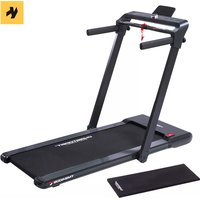
TM 600S - Treadmills Christopeit - Free user manual and instructions
Find the device manual for free TM 600S Christopeit in PDF.


User questions about TM 600S Christopeit
0 question about this device. Answer the ones you know or ask your own.
Ask a new question about this device
Download the instructions for your Treadmills in PDF format for free! Find your manual TM 600S - Christopeit and take your electronic device back in hand. On this page are published all the documents necessary for the use of your device. TM 600S by Christopeit.
USER MANUAL TM 600S Christopeit
Assembly and exercise instructions
for Order No. 1640
NL
F
km/h-Display (Speed):
Zeit-Display (Time):
Kalorien-Display (Calories):
Kalorien-Programm (C):
- Summary of Parts Page 3
- Important Recommendations and Safety Information Page 16
- Technical data Page 17 - 19
- Assembly Instructions With Exploded Diagrams Page 20 - 23
- Console Key pad functions Page 24-27
- Training Instructions, Warm up exercises (Warm Up) Page 28
Dear customer,
We congratulate you on your purchase of this home training sports unit and hope that we will have a great deal of pleasure with it. Please take heed of the enclosed notes and instructions and follow them closely concerning assembly and use.
Please do not hesitate to contact us at any time if you should have any questions.
Important Recommendations and Safety Instructions
Our products are all TUV-GS tested and therefore represent the highest current safety standards. However, this fact does not make it unnecessary to observe the following principles strictly.
- Assembly the machine exactly as described in the installation instructions and use only the enclosed, specific parts of the machine contained in the assembly. Before assembling, verify the completeness of the delivery against the delivery notice and the completeness of the carton against the parts list in the installation and operating instructions.
- Check the firm seating off all screws, nuts and other connections before using the machine for the first time and at regular intervals (every 1-2 months) to ensure that the trainer is in a safe condition. Replace defective components immediately and/or keep the equipment put of the use until repair.
- Set up the machine in a dry, level place and protect it from moisture and water. Uneven parts of the floor must be compensated by suitable measures and by the provided adjustable parts of the machine if such are installed. Ensure that no contact occurs with moisture or water.
- Place a suitable base (e.g. rubber mat, wooden board etc.) beneath the machine if the area of the machine must be specially protected against indentations, dirt etc.
- Before beginning training, remove all objects within a radius of 2 metres from the machine.
- Do not use aggressive cleaning agents to clean the machine and employ only the supplied tools or suitable tools of your own to assemble the machine and for any necessary repairs. Remove drops of sweat from the machine immediately after finishing training.
- WARNING! Systems of the heart frequency supervision can be inexact. Excessive training can lead to serious health damage or to the death. Consult a doctor before beginning a planned training programme. He can define the maximum exertion (pulse, Watts, duration of training etc.) to which you may expose yourself and can give you precise information on the correct posture during training, the targets of your training and your diet. Never train after eating large meals.
- Only train on the machine when it is in correct working order. Use original spare parts only for any necessary repairs. WARNING: Replace the worm parts immediately and keep this equipment out of use until repaired.
- When setting the adjustable parts, observe the correct position and the marked, maximum setting positions and ensure that the newly adjusted position is correctly secured. Please remove the Tools you need to adjust after adjusting a new position.
-
Unless otherwise described in the instructions, the machine must only be used for training by one person at a time. The exercise time should not overtake 60 min./daily.
-
Wear training clothes and shoes which are suitable for fitness training with the machine. Your clothes must be such that they cannot catch during training due to their shape (e.g. length). Your training shoes should be appropriate for the trainer, must support your feet firmly and must have non-slip soles.
- WARNING! If you notice a feeling of dizziness, sickness, chest pain or other abnormal symptoms, stop training and consult a doctor.
- Never forget that sports machines are not toys. They must therefore only be used according to their purpose and by suitably informed and instructed persons.
- People such as children, invalids and handicapped persons should only use the machine in the presence of another person who can give aid and advice. Take suitable measures to ensure that children never use the machine without supervision.
- Ensure that the person conducting training and other people never move or hold any parts of their body into the vicinity of moving parts.
- At the end of its life span this product is not allowed to dispose over the normal household waste, but it must be given to an assembly point for the recycling of electric and electronic components. You may find the symbol on the product, on the instructions or on the packing. The materials are reusable in accordance with their marking. With the re-use, the material utilization or the protection of our environment. Please ask the local administration for the responsible disposal place.
- To protect the environment, do not dispose of the packaging materials, used batteries or parts of the machine as household waste. Put these in the appropriate collection bins or bring them to a suitable collection point.
- The maximum permissible load (=body weight) is specified as 110kg . Evaluate your body weight before you starting the exercise.
- If the connecting cable of this item is damaged, this must be replaced by the manufacturer or the customer service or with an electrically certified person.
- This machine has been tested and certified in compliance with EN 957-1:2005, EN 957-6:2010 + EMC Directive 2004/108/EC.
Part-List + Spare-Part List
TM 600S Order No. 1640
Technical data: Issue: 01. 10. 2016
100% pre-assembled, no annoying and time consuming assembly
1,25 HP Motor continuous (0,92Kw), maximum 2,5 HP Motor Peak (1,8Kw)
- Speed from 1km / h - 16km / h (adjustable in 0,1km / h steps)
12 installed programs with different speed
1 manually program
3 individual programs (U01-U03)
- 3 heart rate programs (Pulse guided)
- Quick speed buttons for 3, 6, 9, 12, 14 and 16 km/h
- Incline 0-15steps electronically adjustable
- Quick incline buttons for 2, 4, 6, 8, 12 and 15 level incline
- Speed and incline adjustable at handrail
- Hand pulse measurement
Vibration absorbing running surface (Cushion System)
- Safety pin for emergency stop
- Foldable for save space
- Transport rollers for an easy and comfortable move to location
- Foldable computer (Laptop-function), protect the LCD display against dust and scratches
- Blue Back Light LCD Display showing: Time, Speed, Distance, approx. Calories consumption, 400m round track, pulse and inc
- Inputs of limits at individual programs: Time, Speed and approx. Calories
Body fat analysis (BMI)
- Receiver for wireless pulse belt
Possible connection for MP 3 player and build in speaker
- Electrical data: 220-240V/50-60Hz /950 Watt
- Walking surface approx. L 128 x W 42 cm
- Load max. 110kg (Body weight)
Space requirement approx: L 172 x W 73 x H 133 cm
Space requirement foldable approx: L 27 x W 73 x H 172 cm
Treadmill weight approx. 62Kg
Exercise space approx.: min. 6m^2
Please check after opening the packing that all the parts shown in the following assembly steps are there. Once you are sure that this is the case, you can start assembly.
Please contact us if any components are defective or missing, or if you need any spare parts or replacements in future:
Internet service- and spare parts data base:
www.christopeit-service.de
This treadmill is created only for private Home sports activity
and not allowed to us in a commercial or professional area.
Home Sport use class H/C
1
05101520253035405060708090100mm
| Illustr. No. | Designation | Dimension mm | Quantity | Attached to Illustr. No. | ET-Number |
| 1 | Main frame | 1 | 33-1640-01-SI | ||
| 2L | Support left | 1 | 1+3 | 33-1640-02-SI | |
| 2R | Support right | 1 | 1+3 | 33-1640-03-SI | |
| 3 | Computer frame | 1 | 2 | 33-1640-04-SI | |
| 4 | Lift frame | 1 | 1 | 33-1640-05-SI | |
| 5 | Front roller | 1 | 1 | 33-1640-06-SI | |
| 6 | Rear roller | 1 | 1 | 33-1640-07-SI | |
| 7 | Foot screw | 2 | 1 | 36-1640-37-BT | |
| 8 | Upright knob | 2 | 2 | 36-1640-08-BT | |
| 9 | Pull pin knob | 2 | 2 | 36-1640-09-BT | |
| 10 | Pressure spring | 2 | 8 | 36-1640-10-BT | |
| 11 | Edgings fixture | 8 | 31 | 36-1640-11-BT | |
| 12 | Bearing | 4 | 2 | 36-1640-12-BT | |
| 13 | Motor upper cover | 1 | 1 | 36-1640-01-BT | |
| 14 | Foldable pad | 2 | 56 | 36-1640-13-BT | |
| 15 | Main frame bottom cover | 1 | 1 | 36-1640-14-BT | |
| 16L | Frame cover left | 1 | 1 | 36-1640-15-BT | |
| 16R | Frame cover right | 1 | 1 | 36-1640-16-BT | |
| 17 | Side step | 2 | 31 | 36-1570-02-BT | |
| 18 | End cover | 1 | 1 | 36-1640-02-BT | |
| 19L | Upright cover left | 1 | 2L+21L | 36-1640-17-BT | |
| 19R | Upright cover right | 1 | 2R+21R | 36-1640-18-BT | |
| 20L | Knob handle left | 1 | 22L | 36-1640-19-BT | |
| 20R | Knob handle right | 1 | 22R | 36-1640-20-BT | |
| 21L | Inner cover left | 1 | 19L | 36-1640-21-BT | |
| 21R | Inner cover right | 1 | 19R | 36-1640-22-BT | |
| Illustr. No. | Designation Dimension mm Quantity Attached to Illus- | tr. No. | ET-Number | ||
| 22L Knob fixture left 1 19L 36-1640-23-BT | |||||
| 22R Knob fixture right 1 19R 36-1640-24-BT | |||||
| 23 Computer key 1 3+24 36-1640-05-BT | |||||
| 24 Computer key bottom cover | 1 3+23 36-1640-06-BT | ||||
| 25 Computer display cover | 1 3+26 36-1640-03-BT | ||||
| 26 Computer display rear cover | 1 3+25 36-1640-04-BT | ||||
| 27L Handlebar cover left | 1 | 3+28L | 36-1640-25-BT | ||
| 27R Handlebar cover right | 1 | 3+28R | 36-1640-26-BT | ||
| 28L Handlebar bottom cover left | 1 | 3+27L | 36-1640-27-BT | ||
| 28R Handlebar bottom cover right | 1 | 3+27R | 36-1640-28-BT | ||
| 29L Pulse hand grip left | 1 | 3 | 36-1640-29-BT | ||
| 29R Pulse hand grip right | 1 | 3 | 36-1640-30-BT | ||
| 30 Running belt | 1 5+36-1640-31-BT | ||||
| 31 Running board | 1 | 36-1640-32-BT | |||
| 32 Transport roller | 2 | 4 | 36-1640-40-BT | ||
| 33 Tighten block | 4 | 3, 23-26 | 36-1640-33-BT | ||
| 34 Silicon cushion | 2 1+31 36-1352-31-BT | ||||
| 35 Cushion | 4 1+31 36-1352-18-BT | ||||
| 36 Ferrite ring | 1 | 1 | 36-1241-19-BT | ||
| 37 Square cap 1 | 2 | 4 | 36-1640-34-BT | ||
| 38 Square cap 2 | 2 | 3 | 36-1640-35-BT | ||
| 39 Belt | 1 5+91 36-1640-36-BT | ||||
| 40 Plastic pad | 2 | 1 | 36-1350-17-BT | ||
| 41 Allen bolt | 1 4+92 39-10502 | ||||
| 42 Allen bolt | 2 1+4 39-9976 | ||||
| 43 Allen bolt | 1 1+92 39-10131 | ||||
| 44 Allen bolt | 2 4+32 39-10158 | ||||
| 45 Allen bolt | M8x40 | 2 | 2+3 | 39-10000 | |
| 46 Hexagon bolt | M8x80 | 1 | 91 | 39-9956 | |
| 47 Hexagon bolt | M8x55 | 1 | 91 | 36-9841208-BT | |
| 48 Hexagon bolt | M8x35 | 2 | 91 | 39-9912-SW | |
| 49 Allen bolt | 4 1+91 39-9823-CR | ||||
| 50 Allen bolt | M6x55 | 2 | 1+6 | 39-10141 | |
| 51 Allen bolt | 1 1+5 39-9976 | ||||
| 52 Allen bolt | M6x35 | 2 | 14 | 39-9979-VC | |
| 53 Allen bolt | M6x15 | 2 | 12 | 39-9911 | |
| 54 Allen bolt | 2 1+31 39-9970-SW | ||||
| 55 Allen bolt | 4 1+35 36-9836-19-BT | ||||
| 56 Fixed part | 2 1+14 33-1640-08-SI | ||||
| 57 Cross head screw | M6x15 | 6 | 1+56 | 39-10120-VC | |
| 58 Cross head screw | M5x8 | 15 | 13, 20, 22+29 | 39-9903-SW | |
| 59 Cross head screw | M4x8 | 2 | 1+83 | 39-10188 | |
| 60 Cross head screw | 4x12 | 13 | 15,16+18 | 39-10187 | |
| 61 Cross head screw | 4x16 | 8 | 31 | 39-10187 | |
| 62 Cross head screw | 4x12 | 35 | 23-26+103 | 39-10188 | |
| 63 Cross head screw | 4x16 | 19 | 15,16,19,21+27 | 39-10187 | |
| 64 Cross head screw | 4x20 | 4 | 29 | 36-9210-31-BT | |
| 65 Cross head screw | 3x10 | 4 | 28 | 39-10078 | |
| 66 Cross head screw | 2,5x8 | 4 | 99 | 39-10127-SW | |
| 67 Cross head screw | M4x8 | 4 | 97+98 | 39-10188 | |
| 68 Serrated lock washer | 10//19 | 6 | 41-44 | 39-10206-CR | |
| 69 Serrated lock washer | 6//16 | 3 | 50+51 | 39-10007-SW | |
| 70 Washer | 8/16 | 8 | 45, 48+49 | 39-9862-CR | |
| Illustr. No. | Designation Dimension mm Quantity Attached to | Illustr. | No. | ET-Number | |
| 71 Washer 6//12 6 57 39-10007-CR | |||||
| 72 Spring washer for M8 6 48+49 39-9864-VC | |||||
| 73 Spring washer for M6 6 57 39-9868 | |||||
| 74 Washer 6//22 2 53 39-10065-SW | |||||
| 75 Nylon nut | M10 | 6 | 41-44 | 39-9981 | |
| 76 Nylon nut | M8 | 2 | 45 | 39-9818 | |
| 77 Nylon nut | M6 | 8 | 35, 52+54 | 39-9891-CR | |
| 78 Hexagon nut | M12 | 2 | 7 | 39-9898 | |
| 79 Cross head screw 3x6 | 2 89 39-10076-SW | ||||
| 80 Cross head screw M4x8 | 2 90 36-9210-30-BT | ||||
| 81 Washer 4/8 | 2 80 39-10097 | ||||
| 82 Spring washer for M4 2 80 39-10058 | |||||
| 83 Motor controller board | 1 | 1 | 36-1640-07-BT | ||
| 84L Remote key left +/- incline, pulse | 1 29 36-1340-38-BT | ||||
| 84R Remote key right +/- speed, pulse | 1 29 36-1340-39-BT | ||||
| 85 Display cable | 1 25+86 | 36-1571-09-BT | |||
| 86 Connection cable | 1 85+87 | 36-1571-10-BT | |||
| 87 Controller cable | 1 83+86 | 36-1571-11-BT | |||
| 88 Safety key | 1 23 36-1352-31-BT | ||||
| 89 Light sensor | 1 90 36-1350-26-BT | ||||
| 90 Light sensor bracket | 1 91 36-1570-28-BT | ||||
| 91 Motor | 1 | 1 | 33-1570-15-SI | ||
| 92 Incline motor | 1 | 1+4 | 33-1571-06-SI | ||
| 93 Main switch | 1 | 1 | 36-1352-29-BT | ||
| 94 Overload breaker | 1 | 1 | 36-1352-30-BT | ||
| 95 Power cord | 1 +93 | 36-1352-22-BT | |||
| 96 Protective plug | 2 | 1+3 | 36-1241-19-BT | ||
| 97 Filter | 1 | 1 | 36-1570-32-BT | ||
| 98 Inductance | 1 | 1 | 36-1570-31-BT | ||
| 99 Amplifier board | 1 26 | 36-1571-14-BT | |||
| 100 Audio connecting cable | 1 | 101 | 36-1142-30-BT | ||
| 101 Audio jack | 1 25 | 36-1352-47-BT | |||
| 102 Speaker | 2 25 | 36-1640-41-BT | |||
| 103 Speaker holder | 2 | 102 | 36-1640-42-BT | ||
| 104 Tool set | 1 | 36-1640-43-BT | |||
| 105 Assembly and exercise instructions | 1 | 36-1640-44-BT | |||
Assembly Instructions
Before beginning assembly, be sure to observe our recommendations and safety instructions.
Step 1:
Remove the treadmill
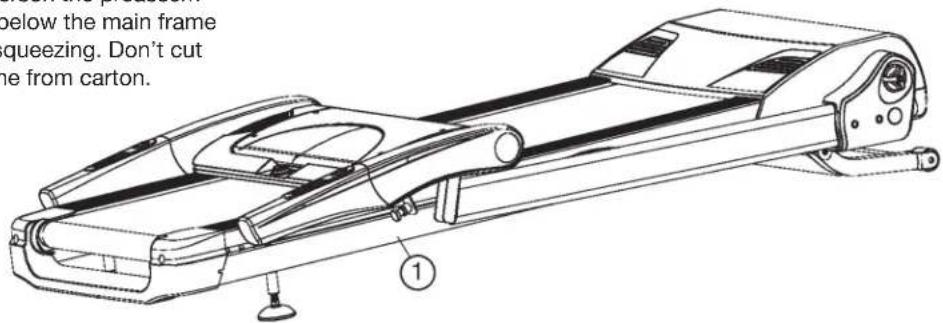
- Remove all small parts, loose packing material out of the box and then take out with help of a second person the preassembled frame of packaging. Put your hands below the main frame to take out of carton and take care of no squeezing. Don't cut the nylon strap for removing the main frame from carton.
Step 2:
Assembly of the treadmill part 1
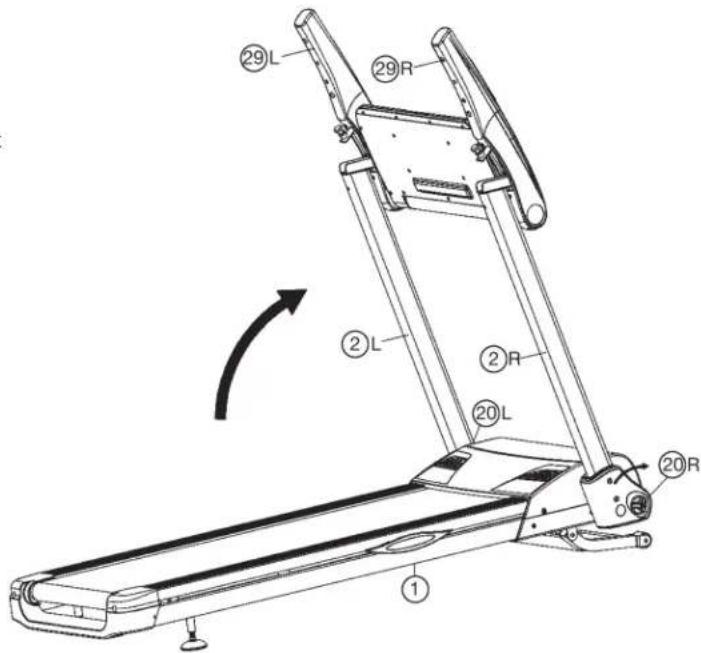
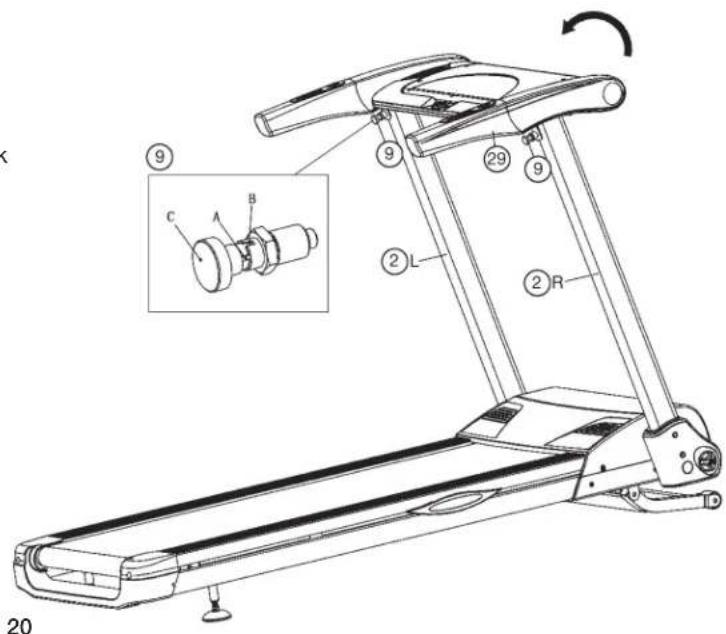
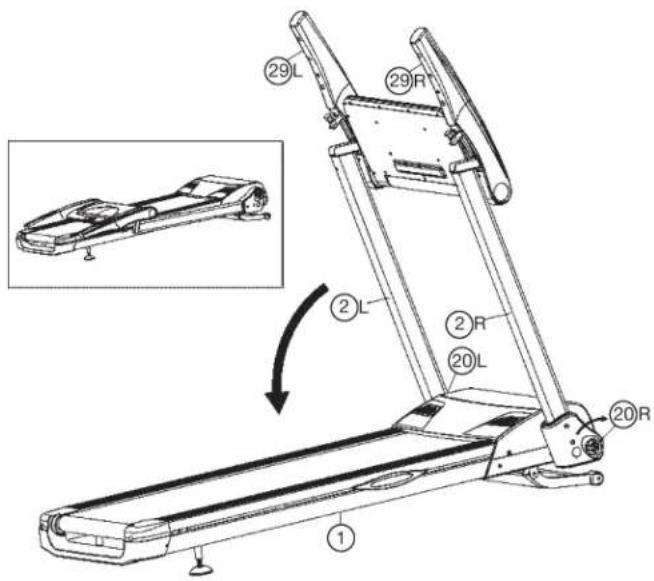
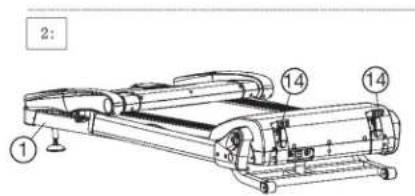
- Cut the nylon strap with care and unlock the left and right supports (2L + 2R) by turning the handle knob left and right (20L + 20R) in un-lock position.
- Fold up the supports left and right side (2L+2R) with care and lock up the upright position of supports (2L+2R) by turning the handle knob left and right (20L+20R) into lock position.
Step 3:
Installation of treadmill part 2
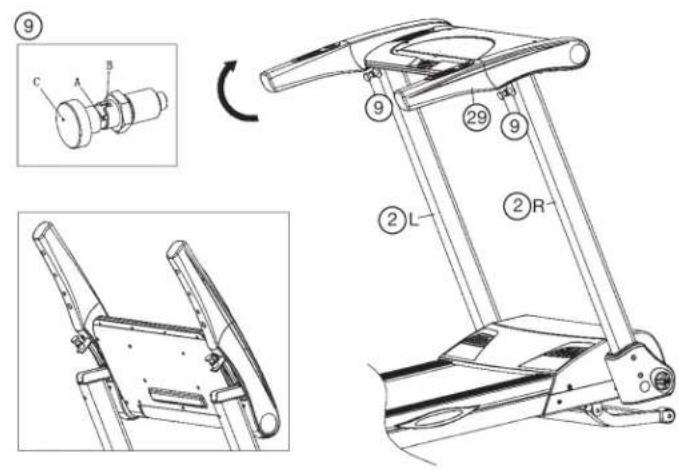
- Carefully fold down the handgrips (29L+29R) into correct position onto the support tubes left and right (2L+2R). Use the pull pin knobs (9) which you can pull and turn at the head (C) to lock the hand grips (29). The pull pin knobs (9) need right positions on both sides (See drawing 9, A + B) so that the handgrip cannot fold upright anymore.
Step 4: Fold up the computer display
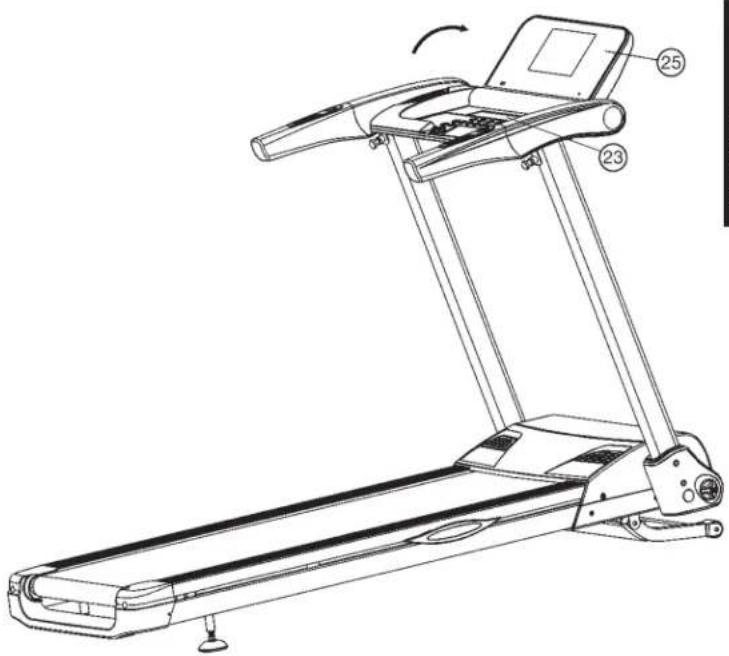
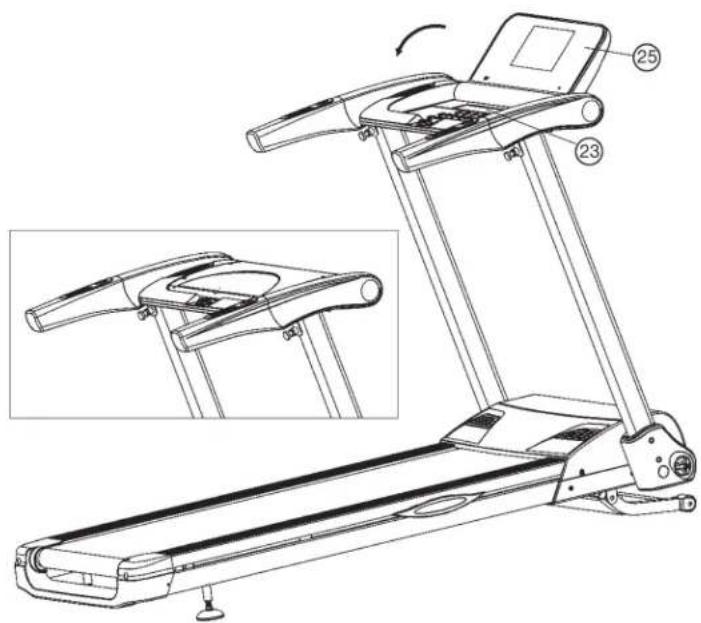
- Fold the computer display (25) from the computer control panel (23) and set it in the desired inclination, so that you have a good readability is given. Remove any protective film from the computer display (25) and the control panel (23).
Step 5: Checks and How to start
- Check the correct installation and function of all screwed and plug connections.
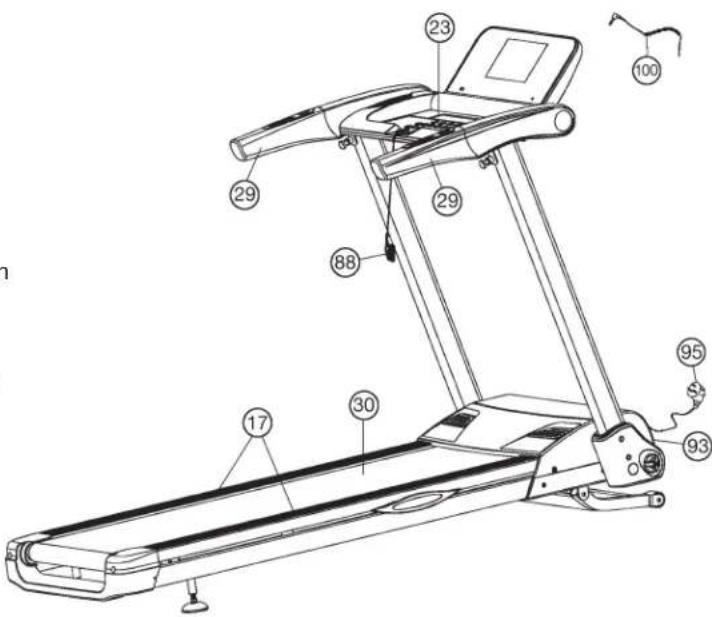
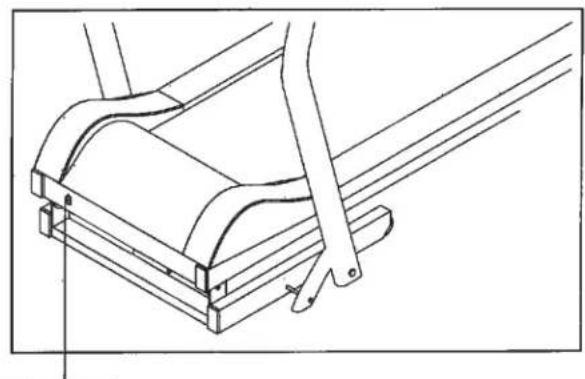
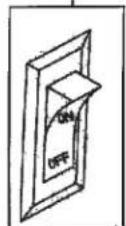
- When everything is in order, connect the power supply cable (95) with wall power (220-240V~50-60Hz) and switch on the main switch (93) below the front frame.
- Put the safety key (88) onto the computer key board (23) and the computer will show normal manual mode. Put the safety clip (88) at your exercising cloth and stand on the side rails (17). Press Start-Button and after a Count Down the treadmill start moving. Start walking onto the walk surface (30) when speed is slowly and follow the speed. Familiarize yourself with the machine at a low speed settings.
- Run in the middle of the running surface (30) and hold yourself tight at handgrips (29) if you feel insecure and don't step on the side foot rails (17). Only run with look at the Computer on the treadmill during the running. In emergency case, step of the treadmill lateral and hold onto the handgrips (29).
- If you like to use an external MP3 player for example, connect with cable (100) and computer (23).
Note: Please keep the tool set and the instructions in a safe place as these may be required for repairs or spare parts orders becoming necessary later.
How to move/store your treadmill:
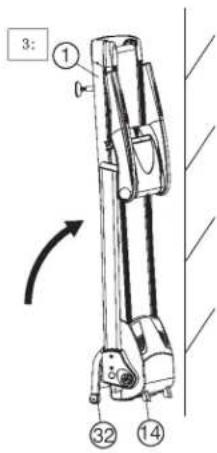
Before folding up the treadmill switch off at main switch, plug out from wall power and wait until the running surface totally stopped. Don't start the treadmill in fold up position!
-
Fold down the computer display (25) onto the computer key panel (23).
-
Use the pull pin knobs (9) and un-lock the handgrips (29) into upright position.
-
Unlock the left and right supports (2L + 2R) by turning the handle knob left and right (20L + 20R) in un-lock position. Fold down the supports left and right side (2L + 2R) with care and lock up the horizontally position of supports (2L + 2R) by turning the handle knob left and right (20L + 20R) into lock position.
-
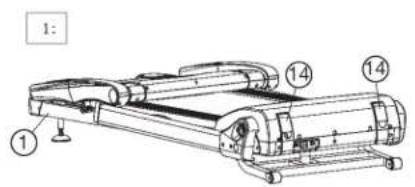
Fold out both foldable pads (14) and put your hands at the end caps to lift up the treadmill. Push it on transportation rollers (32) to desired location and place it vertically. Take care for every move that the foldable pads (14) are definitely fold out.
Maintenance and adjusting
1. Lubrication for the running belt:
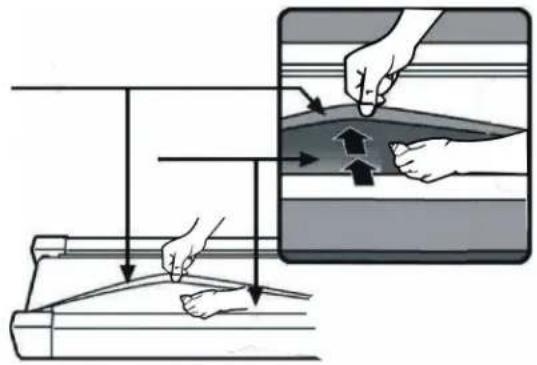
In order to keep the machine in the best condition, please add some Silicone oil between the running belt and the running board after 50 hours or 1 to 2 month of use. But the running belt may slip, if you lubricate too much. To lubricate the belt please pull the walking belt up and injection the silicone oil into the gap between belt and walking deck.
2. Adjusting running belt:
You need to adjust the walking belt to the normal position, per the following steps if it is off.
- Set speed at 3-5km.
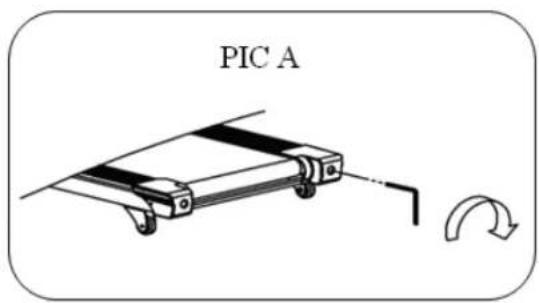
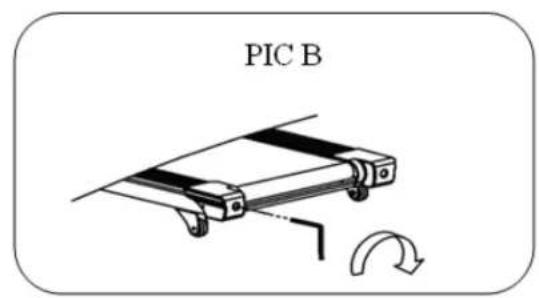
- Using the Allen key to adjust the belt tension bolt on the end cap of the system frame.
- If you want to move the belt towards left, turn the right tension bolt clockwise.
- If you want to move the belt towards right, turn the left tension bolt clockwise.
- If you have already done according to the steps above and it is still not at the good range, then the running belt should be damaged already, please contact your local dealer for replacement.
Note: Make sure that the running surface is as centered as possible. Once these moves too far from the center, (about 10mm ) it should be readjusted into the center.
3. Running belt slips:
- Make sure the walking belt is not too loose.
- Make sure the motor belt is not too loose.
4. No light on the Display:
- Check if the power plug is properly connected.
- Check if the safety key on the computer is in place.
- Check if the wire in the right post is properly connected.
Remind! Before you inspect any wire or electrician part, please ensure that the Power supply has been turned off.
5. Abnormal noise from the machine
- Check if any screw of machine is loose.
- Check if the motor belt is off.
- Check if the running belt is off.
Note:
Please contact your local dealer if you have checked all the above listed things but the problem is still there.
User manual of Computer
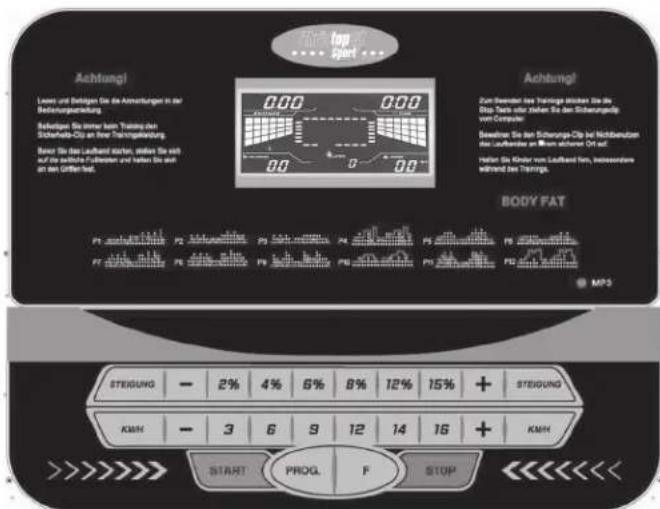
Function of Displays:
Pulse-Display:
Shows actually heart rate data.
Speed-Display:
Shows actually speed in km/h.
Distance-Display:
Shows actually distance in KM.
Time-Display:
Shows actually time of exercising in minutes and seconds.
Calories-Display:
Shows actually calories in kcal.
Program-No. Display and Incline Display:
Shows actually exercise programs P1~P12 or incline level 1-15.
Program-profile Display:
Shows the exercise profile of exercise programs P1~P12.
Function of keys:
Prog-key:
PROGRAM key: On the stop status, press Prog-key to select exercising speed programs P1-P12 / U01-U03 / HR1-HR3 / FAT
F-key:
Select key of time-program H-1 (T), distance program H-2 (D) or calories program H-3 (C).
Start-key:
Press Start-key to start exercise program (motor starts running).
Stop -Key:
Press Stop-key to stop exercise program (motor stops running).
Pre-values can set by pressing the Stop-key to zero.
“+”-key:
Press speed up key increase settings or motor speed.
“-”-key:
Press speed down key decrease settings or motor speed.
Quick Speed- keys 3,6,9,12,14 and 16km / h
Press one of these keys and the speed changes direct into 3, 6, 9, 12, 14 and 16km / h
Quick incline- keys 2,4,6,8,12 + 15%
Press one of these keys and the inclination changes direct into 2, 4, 6, 8, 12 and 15% .
MANUAL MODE:
How to start manual mode:
Put in the AC plug in wall power 230V - 50Hz and put on the power switch (93). Put safety clip (88) onto the computer and it will show normal manual mode. Stand your feet on both side rails. Put the safety key at you exercise cloth and press start-key to start with exercising. After a 3 sec. count down, the motor begin to run slowly and you can step on the running belt and follow the speed. Adjust the speed with "+" and "-" -keys into desired speed. If put off the safety clip from computer at any time, the motor stop slowly and the display will show ,----". After put on the safety key on computer the normal manually program will show. Press "+" or "-" -key to adjust value of speed. Press quick speed -key to adjust speed quickly. All values of the displays will counter up.
Setting Programs Time-Distance-Calories:
Time Program (T):
On the normal manual mode, press F-key, to enter time program H-1. The time display will flash and the initial value is 30:00. Press "+"-key or "--"-key to set value. The range is: 5:00-99:00. If set a value the display counts up till zero and then stops running motor.
Distance-Program (D):
On the normal manual mode, press F-key, to enter distance program H-2. The distance display will flash and the initial value is 1,00KM. Press "+"-key or "-"-key to set value. The range is: 0,50-99:00KM. If set a value the display counts up till zero and then stops running motor.
Calories-Program (C):
On the normal manual mode, press F-key, to enter calories program H-3. The calories display will flash and the initial value is 50,0 kcal. Press "+"-key or "-"-key to set value. The range is: 10-990kcal. If set a value the display counts up till zero and then stops running motor.
RANGE OF ALL FUNCTIONS:
| INITIAL INITIAL SETTING VALUE RANGE DISPLAY TIME(MIN:SEC) 0:00 30:00 5:00 -99:00 0:00-99:59 | ||||
| SPEED(KM/H) | 0.0 | N/A | N/A | 1.0-18.0 |
| DISTANCE(KM) 0.00 1.00 0.50 -99.00 0.00-99.99 | ||||
| PULSE(BPM) | P | N/A | N/A | 50-200 |
| CALORIES(KCAL) | 0 | 50.0 10-990 0-999.0 | ||
Pulse measurement function
Embrace with both hands, the hand pulse sensors on the computer to order a pulse measurement can be performed. Alternatively use a compatible chest belt (un-coded with transmission frequency from 5.0-5,5kHz). The measured pulse value is flashing simultaneously with a heart symbol appear in the pulse display. Caution: The pulse measurement is not suitable for medical purposes.
Body Fat Analysis
In standby state, press PROG-key until enter FAT (Physical fitness test) program. Press F-key to enter the data of F—1:gender (01=man/02=woman), F—2:age, F—3:weight, F—4:height, , F—5: measurement, Press +/- key to set the parameter of 01-04 (see below detailed table). After entered data the display show F—5 for physical test. At this state, hold the handle pulse board for 6-8 seconds and it will display which % of FAT you have. Check if the weight matches with your height. FAT is to measure the relevance between height and weight, not the body proportion. FAT is suitable for every man and woman, it provide the important grounds for adjusting the weight with other health indicators.
The perfect FAT is between 20-24, which means if less than 19 is too thin, and if between 25-29 is overweight and if more than 30 is obesity.
| F--1 Gender 01(man) 02(woman) | ||
| F--2 Age 10-99 | ||
| F--3 Height 100-200 | ||
| F--4 Weight 20-200 | ||
| F--5 | FAT ≤ 19 lownweight | |
| FAT=(20-24) normalweight | ||
| FAT=25-29) overweight | ||
| FAT≥30 obesity | ||
Exercise programs P1-P12:
On the normal manual mode, press Prog-key to chose one of the exercise speed programs P1-P12. Each program is divided into 10 intervals of time and the speed changes as following program list shows. Initial setting time is 30min set a time for training session and press Start to start the program. Pressing Stop to have a break or finish earlier the program. Press speed "+" or "-"key to adjust speed during the program if it is to quick or slow. With next intervals of time the speed level will change back to program mode. If the program runs till end of time the motor will stop running after the display counts down time to zero.
PROGRAM SPEED TABLE P1 - P12
| No. | Programs in 20 intervals of time | ||||||||||||||||||||
| 1 | 2 | 3 | 4 | 5 | 6 | 7 | 8 | 9 | 10 | 11 | 12 | 13 | 14 | 15 | 16 | 17 | 18 | 19 | 20 | ||
| P01 | Speed | 2 | 4 | 3 | 4 | 3 | 5 | 4 | 2 | 5 | 2 | 6 | 2 | 7 | 2 | 8 | 3 | 7 | 3 | 9 | 3 |
| Incline | 1 | 2 | 3 | 3 | 1 | 2 | 2 | 3 | 2 | 5 | 4 | 5 | 6 | 6 | 4 | 5 | 5 | 6 | 5 | 2 | |
| P02 | Speed | 2 | 5 | 4 | 6 | 4 | 6 | 4 | 2 | 4 | 3 | 3 | 6 | 5 | 7 | 5 | 7 | 5 | 3 | 5 | 2 |
| Incline | 1 | 2 | 3 | 3 | 2 | 2 | 3 | 4 | 2 | 3 | 2 | 3 | 4 | 4 | 3 | 3 | 4 | 5 | 3 | 2 | |
| P03 | Speed | 2 | 5 | 4 | 5 | 4 | 5 | 4 | 2 | 3 | 3 | 3 | 6 | 5 | 6 | 5 | 6 | 5 | 3 | 4 | 2 |
| Incline | 1 | 2 | 2 | 3 | 1 | 2 | 2 | 2 | 2 | 2 | 2 | 3 | 3 | 4 | 2 | 3 | 3 | 3 | 3 | 1 | |
| P04 | Speed | 2 | 6 | 7 | 4 | 4 | 7 | 4 | 2 | 4 | 3 | 3 | 7 | 8 | 5 | 5 | 8 | 5 | 3 | 5 | 2 |
| Incline | 4 | 5 | 6 | 6 | 9 | 9 | 1 | 12 | 6 | 4 | 5 | 6 | 7 | 7 | 10 | 10 | 2 | 12 | 7 | 3 | |
| P05 | Speed | 2 | 4 | 6 | 8 | 7 | 8 | 6 | 2 | 3 | 3 | 3 | 5 | 7 | 9 | 8 | 9 | 7 | 3 | 4 | 2 |
| Incline | 3 | 5 | 4 | 4 | 3 | 4 | 4 | 3 | 3 | 3 | 4 | 6 | 5 | 5 | 4 | 5 | 5 | 4 | 4 | 2 | |
| P06 | Speed | 2 | 4 | 5 | 5 | 6 | 5 | 6 | 3 | 3 | 3 | 3 | 5 | 6 | 6 | 7 | 6 | 7 | 4 | 4 | 2 |
| Incline | 3 | 5 | 3 | 4 | 2 | 3 | 4 | 2 | 3 | 3 | 4 | 6 | 4 | 5 | 3 | 4 | 5 | 3 | 4 | 2 | |
| P07 | Speed | 3 | 6 | 7 | 5 | 8 | 5 | 9 | 6 | 4 | 2 | 4 | 7 | 8 | 6 | 9 | 6 | 10 | 7 | 4 | 3 |
| Incline | 2 | 2 | 3 | 3 | 2 | 2 | 4 | 6 | 2 | 3 | 3 | 3 | 4 | 4 | 3 | 3 | 5 | 7 | 3 | 2 | |
| P08 | Speed | 3 | 6 | 7 | 5 | 8 | 6 | 7 | 6 | 4 | 4 | 4 | 7 | 8 | 6 | 9 | 7 | 8 | 7 | 5 | 3 |
| Incline | 1 | 2 | 4 | 3 | 2 | 2 | 4 | 5 | 2 | 2 | 2 | 3 | 5 | 4 | 3 | 3 | 5 | 6 | 3 | 1 | |
| P09 | Speed | 2 | 8 | 6 | 4 | 5 | 9 | 7 | 5 | 4 | 4 | 3 | 9 | 7 | 5 | 6 | 10 | 8 | 6 | 5 | 3 |
| Incline | 2 | 2 | 6 | 2 | 3 | 4 | 2 | 2 | 2 | 2 | 3 | 3 | 7 | 3 | 4 | 5 | 3 | 3 | 3 | 1 | |
| P10 | Speed | 2 | 3 | 5 | 3 | 3 | 5 | 3 | 6 | 3 | 4 | 3 | 4 | 6 | 4 | 4 | 6 | 4 | 7 | 4 | 3 |
| Incline | 4 | 4 | 3 | 6 | 7 | 8 | 8 | 6 | 3 | 4 | 5 | 5 | 4 | 7 | 8 | 9 | 9 | 7 | 4 | 3 | |
| P11 | Speed | 2 | 5 | 8 | 10 | 6 | 9 | 5 | 3 | 2 | 3 | 3 | 6 | 9 | 10 | 7 | 10 | 6 | 4 | 3 | 2 |
| Incline | 1 | 3 | 5 | 8 | 1 | 7 | 6 | 3 | 2 | 4 | 2 | 4 | 6 | 9 | 2 | 8 | 7 | 4 | 3 | 3 | |
| P12 | Speed | 2 | 5 | 5 | 4 | 4 | 6 | 4 | 2 | 3 | 5 | 3 | 6 | 6 | 5 | 5 | 7 | 5 | 3 | 4 | 4 |
| Incline | 3 | 5 | 6 | 7 | 12 | 9 | 11 | 11 | 6 | 4 | 4 | 6 | 7 | 8 | 12 | 10 | 11 | 11 | 7 | 3 | |
User-setting programs U01-U03:
Beside the 12 preset programs, the treadmill setup 3 user-defined programs: U01, U02, U03.
Press "Prog." key continuously until the expected program (U01/U02/U03) display in the standby condition, while the "time" window flash, display the setting time, press key for "Steigung + / - or, km / h + / - to set up expected running time, press ^ key to enter program parameter, then set up the at first time section parameter by KM / H + / - -key or shortcut km/h -key to set the speed and by , STEIGUNG + / - -key or shortcut % -key to set incline; press ^ key to finish the first time period setting, and entering the next time section setting, until all 20 time sections are set. The parameter will be kept permanently until resetting, and all pa-rameters will not be lost when power off. You can change parameters through set new data.
Selection and start the user-defined program:
- Switch on power on main switch and put on the safety clip at Computer and exercise cloth.
- In the standby condition, continuously press „program“ key until the ex-pressed user-defined program U01/U02/U03 display,
- Set up the running time and press „start“ -key to begin exercise. After a countdown with 3 seconds the engine of treadmill starts.
Programs with heart rate control HRC1-HRC3:
- There are 3 HRC programs (HRC 1, HRC 2 und HRC 3) with different max. speed.
HRC 1 max. speed 8km/h
HRC 2 max. speed 9km/h
HRC 3 max. speed 12km / h
These programs you can pre-enter your own target heart rate (H.R.)
Adjusting the HRC programs:
Press program -key to select one of the target H.R. programs HRC 1, HRC 2 or HRC 3. Then press F-key to enter this program and adjust with + / - km / h speed or + / - % incline keys the age and target H.R.
- Age: adjustable 13 - 80 years, the default age is 30 years.
- Target H.R.: adjustable 0.45 (45%) - 0.75 (75%) of the max. H.R. (220-Age), the default value is 0.6 (60%) of max. H.R.
- The maximum pulse is: (220-Alter)
Speed variation in the pulse programs:
After start a warm up phases with lower speed for 1 Min. begin. Then the measured pulse rate is every 30 seconds for the Pulse program used to control the speed.
a) If the measured pulse rate is lower than the speed increases by 0.5km / h or incline one level.
b) If the measured pulse rate is higher than the speed reduces by 0.5km / h or incline one level.
c) If the measured pulse rate is less than 5 beats + / - from the default value, the speed keeps the same.
Before end of program (2-3Min.) turns off the treadmill, the cool down phase and reduce the speed until the treadmill then at end of program stops.
In following situations, the treadmill reduces after 15Sekunden the speed into 1km / h and a signal sounds every second.
- If more than 1 minute no pulse measurement will appear.
- When the pulse measuring a maximum pulse of 220 age-determined.
The Pulse programs work only with continuous pulse measurement!
Please note that the use of the audio port during chest belt function may cause disturb the pulse measurement.
Function of safety key
The safety clip (88) has an emergency function. In fear or danger or if you fall down or jumped from it, the safety clip will lose position at computer and stops the motor with break system.
Put the safety key out from computer on any status, the display is "---", the buzzer beep each second. Put the safety key on computer, then the display will enter normal manual mode. All parameter reset to zero.
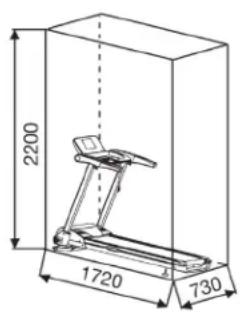
Training area in mm (for home trainer and user)
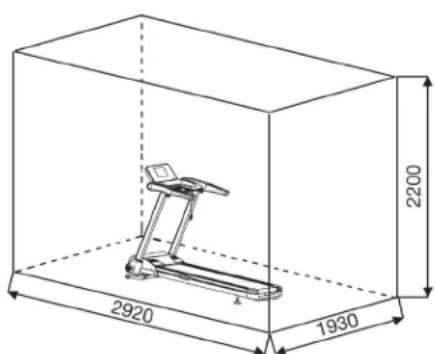
Free area in mm (Training area and security area (rotating 60cm))
Meanings of error message codes
In case of malfunctions may adjoining list of error messages help for people to get function back. Basically, electrical repairs only in compliance with the relevant safety rules which exists. For more information and assistance in case of malfunctions with our service department (contact details see last page.)
| Problem Potentiational reasons Solutions | ||
| ----- Safe lock falls down 1. Place back the safe lock;2. Replace safe lock switch or magnetic sensor in the electronic meter; if the problem still fails to be solved, replace the electronic meter; | ||
| E01 After power eering on, the electronic meter displays E01 Communication failure from the electronic meter to the driver, The electronic meter displays E01 in the operating process Communication failure from the driver to the electronic meter | 1. Check whether the connecting joint between the electronic meter and the core wire of the controller is loose; whether wires are damaged; whether the core wires are in correct connecting order.2. The controller may be defective. Check and replace a good one.3. The electronic controller's IC may not be plugged to the place. Check and ensure good plugging4. The transformer may be damaged. Check and replace a good one. | |
| E02 Explosion-proof protection or motor abnormality | 1. Check whether the power supply voltage is less than 50% of the normal value; please ensure correct voltage and test again;2. Check whether motor wires are well connected; re-connect motor wires, or, if the problem still fails to be solved, replace the motor;3. Check whether there is peculiar odor generated by the controller; if yes, it means that IGBT has been broken down to cause short circuit; then, replace the controller. | |
| E03 No sensory check whether the photoelectric sensor directs to the hole on CD; check whether wires of photoelectric sensor are damaged and whether terminals of the photoelectric sensor and speed termi-nals on the controller are firmly connected. | ||
| E04 Lifting learning or self-inspection fails | 1. Check whether motor signal wires are well inserted; re-insert the signal wire joint to ensure that it is reliable;2. Check whether lifting motor's AC wires are properly connected; lifting motor shall be correctly plugged according to marks on its AC controller;3. Check whether motor wiring is damaged to form open circuit; if yes, replace wires or replace the lifting motor;4. Replace the controller;5. After all of these inspections, press the learning key for learning again. | |
| E05 Over-current protection | 1. It may be the system's self-protection against excessive current when the load exceeds the rated value; restart the machine;2. Some part of the treadmill is jammed so that the motor can not rotate, thus triggering the self-protection of the system against excessive current under excessive load; adjust the treadmill and restart it, or add lubricant.3. Check whether there is over-current sound or burning odor when the motor is running; replace the motor;4. Check whether the controller emits the odor of burning; if yes, replace the controller. | |
| E06 Lifting sensor has no signal 1. Check whether lifting signal wires are damaged.2. Check whether lifting signal terminals and the controller's lifting terminals are firmly connected.3. Check whether lifting power cords are damaged.4. Check whether lifting power cord terminals and the controller's lifting terminals are firmly con- nected. | ||
| No display The controller is not powered on or is damaged | 1. First of all, check whether the over-load protector has tripped off; if yes, press it;2. Check the power supply switch, over-load protector and the controller's power cord and trans-former to ensure well connection;3. Check whether the power cords from the electronic meter to the controller are well collected; dismantle the pillar to check connecting joints on each section of the wiring from the electronic me-ter to the controller; ensure that each wire core is well connected; or the reason may be the com-munication power cord defect (damaged or broke down); in such case, re-connect or replace wires.4. The transformer is damaged; replace the transformer | |
Note:
Please contact your local dealer if you have checked all the above listed things but the problem is still there.
Training instructions
You must consider the following factors in determining the amount of training effort required in order to attain tangible physical and health benefits:
1. Intensity:
The level of physical exertion in training must exceed the level of normal exertion without reaching the point of breathlessness and / or exhaustion. A suitable guideline for effective training can be taken from the pulse rate. During training this should rise to the region of between 70% to 85% of the maximum pulse rate (see the table and formular for determination and calculation of this).
During the first weeks, the pulse rate should remain at the lower end of this region, at around 70% of the maximum pulse rate. In the course of the following weeks and months, the pulse rate should be slowly raised to the upper limit of 85% of the maximum pulse rate. The better the physical condition of the person doing the exercise, the more the level of training should be increased to remain in the region of between 70% to 85% of the maximum pulse rate. This should be done by lengthening the time for the training and / or increasing the level of difficulty.
If the pulse rate is not shown on the computer display or if for safety reasons you wish to check your pulse rate, which could have been displayed wrongly due to error in use, etc., you can do the following:
a. Pulse rate measurement in the conventional way (feeling the pulse at the wrist, for example, and counting the number of beats in one minute).
b. Pulse rate measurement with a suitable specialised device (available from dealers specialising in health-related equipment).
2.Frequency
Most experts recommend a combination of health-conscious nutrition, which must be determined on the basis of your training goal, and physical training three times a week. A normal adult must train twice a week to maintain his current level of condition. At least three training sessions a week are required to improve one's condition and reduce one's weight. Of course the ideal frequency of training is five sessions a week.
3. Planning the training
Each training session should consist of three phases: the warm-up phase, the training phase, and the cool-down phase. The body temperature and oxygen intake should be raised slowly in the warm-up phase. This can be done with gymnastic exercises lasting five to ten minutes.
Then the actual training (training phase) should begin. The training exertion should be relatively low for the first few minutes and then raised over a period of 15 to 30 minutes such that the pulse rate reaches the region of between 70% to 85% of the maximum pulse rate.
In order to support the circulation after the training phase and to prevent aching or strained muscles later, it is necessary to follow the training phase with a cool-down phase. This should be consist of stretching exercises and / or light gymnastic exercises for a period of five to ten minutes.
You find further information on the subject warm-up exercises, stretch exercises or general gymnastics exercises in our download area under www.christopeit-sport.com
4. Motivation
The key to a successful program is regular training. You should set a fixed time and place for each day of training and prepare yourself mentally for the training. Only train when you are in the mood for it and always have your goal in view. With continuous training you will be able to see how you are progressing day by day and are approaching your personal training goal bit by bit.
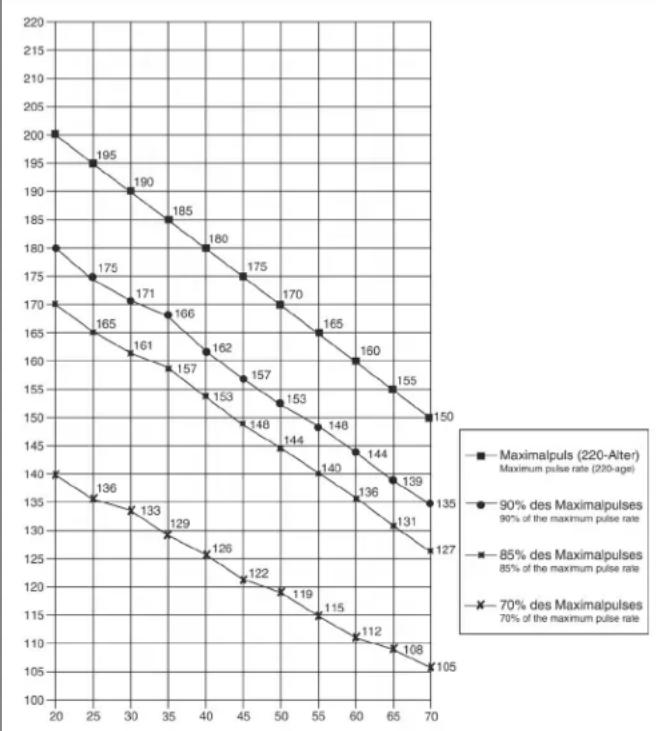
Calculation formula: Maximum pulse rate = 220 - age (220 minus your age)
90% of the maximum pulse rate = (220 - age) x 0.9
85% of the maximum pulse rate = (220 - age) x 0.85
70% of the maximum pulse rate = (220 - age) x 0.7
Warm up exercises (Warm Up)
Start your warm up by walking on the spot for at least 3 minutes and then perform the following gymnastic exercises to the body for the training phase to prepare accordingly. The exercises do not overdo it and only as far run until a slight drag felt. This position will hold a while.
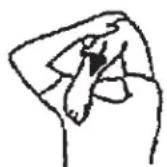
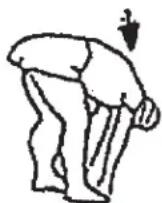
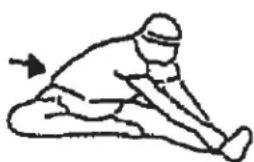
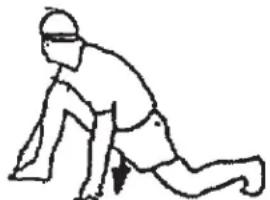
Reach with your left hand behind your head to the right shoulder and pull with the right hand slightly to the left elbow. After 20sec. switch arm.
Bend forward as far forward as possible and let your legs almost stretched. Show it with your fingers in the direction of toe. 2 x 20sec.
Sit down with one leg stretched out on the floor and bend forward and try to reach the foot with your hands. 2 x 20sec.
Kneel in a wide lunge forward and support yourself with your hands on the floor. Press the pelvis down. Change after 20 sec leg.
After the warm-up exercises by some arms and legs shake loose.
Don't finish the exercise phase abruptly, but will cycle leisurely something without resistance from to return to the normal pulse-zone. (Cool down) We recommend the warm-up exercises at the end of the training be conducted and to end your workout with shaking of the extremities.
F
Sommaire
Chere cliente, cher client,
Ecran Pulse (Pulsation):
Touches 2,4,6,8,12 et 15%
Programme Distance (D):
Programme Calories (C):
Warming-up oefingen (Warm Up)
Geachte klant
Calorieenprogramma (C):
3. Planning van de training
Warming-up oefingen (Warm Up)
© by Top-Sports Gilles GmbH
D-42551 Velbert (Germany)
Service: