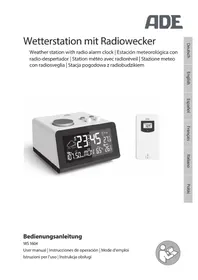
WS 1604 - Weather Station ADE - Free user manual and instructions
Find the device manual for free WS 1604 ADE in PDF.



| Product type | Weather station with radio alarm clock |
| Brand | ADE |
| Model | WS 1604 |
| Base station power supply | 5 V / 2 A mains adapter (type HX12-0502000-AG) and CR2032 backup battery (3 V) |
| Outdoor sensor power supply | 2 LR03 (AAA) 1.5 V batteries |
| Display | Large LCD screen with white text |
| Weather forecast | Yes (symbols: sunny, slightly cloudy, cloudy, rainy, very rainy, snowfall) – range 30–50 km, 8 hours |
| Indoor temperature | -10 °C to 50 °C (14.2 °F to 122 °F) |
| Outdoor temperature | -25 °C to 50 °C (-13 °F to 122 °F) |
| Indoor humidity | 20% to 95% |
| FM radio | 87.5 – 108 MHz, auto scan, station memory, audio power 3 W RMS |
| Alarm | Dual alarm (A1 and A2) with buzzer or radio choice, snooze function (8 minutes) |
| USB charging | Yes, for smartphones, MP3 players (cable not included) |
| Frost alarm | Yes, between -1 °C and 3 °C (30 °F to 37 °F) |
| Temperature trend | Arrows indicating rise, fall, or stability |
| Min/max recording | Over 24 h (temperature and humidity) via MEM button |
| Outdoor sensor range | Up to 60 meters in open field |
| Sensor transmission frequency | 433.92 MHz |
| Calendar | Perpetual, with date and day (multiple languages) |
| Time format | 12 h or 24 h, adjustable |
| Screen brightness | Adjustable (ON/OFF switch for automatic adaptation) |
| Maintenance and cleaning | Clean with a slightly damp cloth, dry completely before reconnecting |
| Safety | Do not immerse, use supplied adapter, keep out of reach of children under 8 years |
| Mains adapter | HX12-0502000-AG, input 100-240 V~ 50/60 Hz, output 5 V / 2 A, protection class II |
Frequently Asked Questions - WS 1604 ADE
User questions about WS 1604 ADE
0 question about this device. Answer the ones you know or ask your own.
Ask a new question about this device
Download the instructions for your Weather Station in PDF format for free! Find your manual WS 1604 - ADE and take your electronic device back in hand. On this page are published all the documents necessary for the use of your device. WS 1604 by ADE.
USER MANUAL WS 1604 ADE
Bedienungsanleitung
WS 1604
User manual | Instrucciones de operación | Mode d'emploi
natural_image
Icon of a person using a computer inside a circle (no text or symbols)1 Display
22089 Hamburg, Germany

Garantie
You have chosen to purchase a high-quality product from the brand ADE, which combines intelligent functions with an exceptional design. The many years of experience of the brand ADE ensures a high technical standard and proven quality.
We wish you much enjoyment and success while monitoring and examining your weather data.
Your ADE Team
Scope of delivery
The weather station with radio alarm clock is composed of:
- Base station with radio
- Wireless outdoor sensor
- Batteries:
-2 x LR6 (AAA)/1.5 V for wireless outdoor sensor
-1x CR2032/3 V for base station with radio - Mains adaptor for base station
- Operating Manual
Table of Contents
Scope of delivery....28
Table of Contents ......29
General information....30
Intended Use....30
Safety 31
What the weather station with radio alarm clock provides....33
At a glance....34
Base station with radio 34
Wireless outdoor sensor....37
Start-up 38
Wireless outdoor sensor....38
Base station with radio 38
Starting signal reception 39
Checklist when data is missing in the display....40
Setting the time and date manually....40
Manually starting signal reception to the time signal transmitter....41
Choosing a location....42
Use additional wireless sensors....43
About the time signal transmitter DCF77 44
Weather functions 45
Weather forecast....45
Temperature trend....45
Saved weather data ....46
Frost alert....46
Radio operation 46
Listening to the radio....46
Automatic channel search....47
Using the timer (auto off)....47
Alarm....47
Setting the alarm time....47
Being awakened....48
Charging function via USB....49
Other functions....49
Cleaning....50
Fault/Remedy....50
Technical Data 51
Declaration of Conformity 52
Guarantee 52
Disposal 53
About this manual

This operating manual describes how to safely use and care for your products. Keep this operating manual in a safe place in case you would like to refer to it later. If you pass this item on to someone else, pass on this manual as well.
Failure to observe the recommendations in this operating manual can lead to injuries or damage to your product.
Explanation of symbols

This symbol, combined with the word DANGER, warns against serious injury.

This symbol, combined with the word WARNING, warns against moderate and mild injuries.

This symbol, combined with the word NOTE, warns against material damage.

This symbol signifies additional information and general advice.
Intended Use
- The weather station with radio alarm clock - composed of a base station and a wireless outdoor sensor - displays different weather data from the surrounding area. The weather station makes a weather forecast on the basis of the measured weather data.
- The weather station is also an FM radio with integrated alarm function.
- The device is not suitable for commercial use.
Safety
- This device can be used by children 8 years of age and older, as well as by persons with reduced physical, sensory, or mental capabilities or lacking experience and/or knowledge, if they are being supervised or have been instructed in the safe use of the device and understand the dangers that may arise.
- The device and the mains adaptor must be kept away from children younger than 8 years.
- Cleaning and maintenance by the user must not be carried out by children unless they are 8 years of age or older and are being supervised.
- Children must be supervised to ensure that they do not play with the device.
- The wireless weather station and mains adaptor must not be submerged in water or other liquids. Risk of electric shock!
- You should therefore not use the base station of the wireless weather station in the vicinity of sources of moisture, such as wash basins.
- Only use the supplied mains adaptor and replace it only with one of the same type. The mains adaptor may only be used in dry indoor spaces and must be protected from moisture.
DANGER for children
- Batteries, when swallowed, can be life-threatening. You should therefore keep the weather station, wireless sensor, and batteries out of reach of small children. If a battery is swallowed, medical assistance must be sought immediately.
- Keep children away from packaging material and other small parts included in the scope of delivery. Risk of choking if swallowed.
Danger from electricity
- Connect the device to a correctly installed socket that has a voltage corresponding to that described under "Technical Data".
- Ensure that the socket is easily accessible, so that the mains adaptor can be pulled out quickly if necessary.
- Do not use the wireless weather station if the mains adaptor or mains adaptor cable are damaged.
- Do not cover the mains adaptor with curtains, newspapers, etc., and ensure sufficient ventilation. The mains adaptor can become hot.
- Completely uncoil the mains adaptor cable before connecting it. In doing so, take care to keep the cable from being damaged by sharp corners or hot objects.
- Pull the mains adaptor out of the socket:
–before cleaning the wireless weather station,
-if, during operation, there appears to be interference,
-during a storm.
When doing so, always pull on the plug, not on the cable.
- Do not make any modifications to the item or to the connection cable. Only allow repairs to be carried out at a specialist workshop, since inexpertly repaired devices can present hazards to the user.
- Do not replace the mains adaptor cable. When the cable or mains adaptor is damaged, it must be scrapped and replaced with a mains adaptor of the same type.
Risk of injuries
- Attention: Risk of explosion if batteries are improperly used. Batteries must not be recharged, reactivated by other means, dismantled, thrown into fire, or short-circuited.
- Avoid contact of the battery fluid with skin, eyes, and mucosa. If you do come into contact with the fluid, you must immediately flush the affected areas thoroughly with clean water and promptly see a doctor.
Note on material damage
- Protect the base station and outdoor sensor from dust, impacts, extreme temperatures and direct sunlight.
- Protect the base station from moisture. Position the base station exclusively in a dry, closed room.
- The wireless sensor is protected against moisture, but must be protected from direct exposure to moisture, e.g. rain.
- Remove the batteries from the base station and outdoor sensor once they have been consumed or when you are no longer using the weather station. You will thus avoid damage that may result from the leakage of battery acid.
- Do not expose the batteries to any extreme conditions, e.g. by storing them on heaters or under direct sunlight. Increased risk of leakage!
- Clean the battery and device contacts, as needed, before inserting the battery.
- Always exchange all of the batteries in the base station or in the outdoor sensor at the same time.
- Only insert batteries of the same type; do not use different types or used and new batteries with each other.
- Do not make any modifications to the device. Only allow repairs to be carried out at a specialist workshop and pay attention to the guarantee conditions.
- Do not connect the wire antenna to any other antenna. Also, do not try to connect the clock radio to your house antenna.
- There are feet on the underside of the weather station. Since furniture surfaces are made of various materials and are treated with various care products, it cannot be completely ruled out that some of these substances contain ingredients that attack and soften the feet of the device. If necessary, place a non-slip pad underneath the device.
- Do not under any circumstances use hard, scratching, or abrasive cleaning agents or the like in order to clean the weather station. Doing so may scratch the surfaces.
What the weather station with radio alarm clock provides
Base station with radio
- Large LCD display with white characters
- Weather forecast
- Display of indoor and outdoor temperature
- Display of humidity (indoor)
- FM radio with presets
- Alarm function with snooze function
- Perpetual calendar with date and time indicator
- USB charging function for smartphones, MP3 players, and the like
Wireless outdoor sensor
- Range of up to 60 metres (on open ground)
Base station with radio

1 Display
2 Battery compartment for CR2032/3 V battery (backup battery)
3 SET button: Activate settings mode
4 MEM button: Show highest or lowest saved weather data
5 Button Setting the alarm time
6 Button ▶ |◀◀▶▶ Turn the radio on and off Select radio station
7 Speaker
8 ON/OFF switch Set display brightness
9 BZ/FM/ switch Select alarm source
10 USB port Connection socket for charging external devices (smartphones, MP3 players, etc.) via USB
11 FM wire antenna
12 5V 2A socket Connection socket for mains adaptor
13 °C/°F button Change temperature measuring unit
14 CH button - Display outdoor temperatures values (only if several wireless outdoor sensors are in use) - Manually start or interrupt signal reception to the outdoor sensor
15 WAVE button Start/interrupt signal reception to the time signal transmitter
16 Multi-function knob - Select values
- Confirm settings
- Enable snooze function
- Timer function (auto off) during radio operation - Adjust volume
Not depicted: Mains adaptor
Display

17 Weather symbol
18 Ice warning symbol
19 Signal reception symbol
20 Time
21 Alarm symbol (2x)
22 Symbol for outdoor sensor

Number of the outdoor sensor whose temperature is displayed
Outdoor sensor data is automatically queried and displayed one after another

Charge level of the outdoor sensor battery

Current weather trend
23 Outdoor temperature in °C or °F
24 Indoor temperature in °C or °F
25 Humidity in percent (indoor)
26 Current day abbreviation in set language
27 Set radio frequency
Wireless outdoor sensor
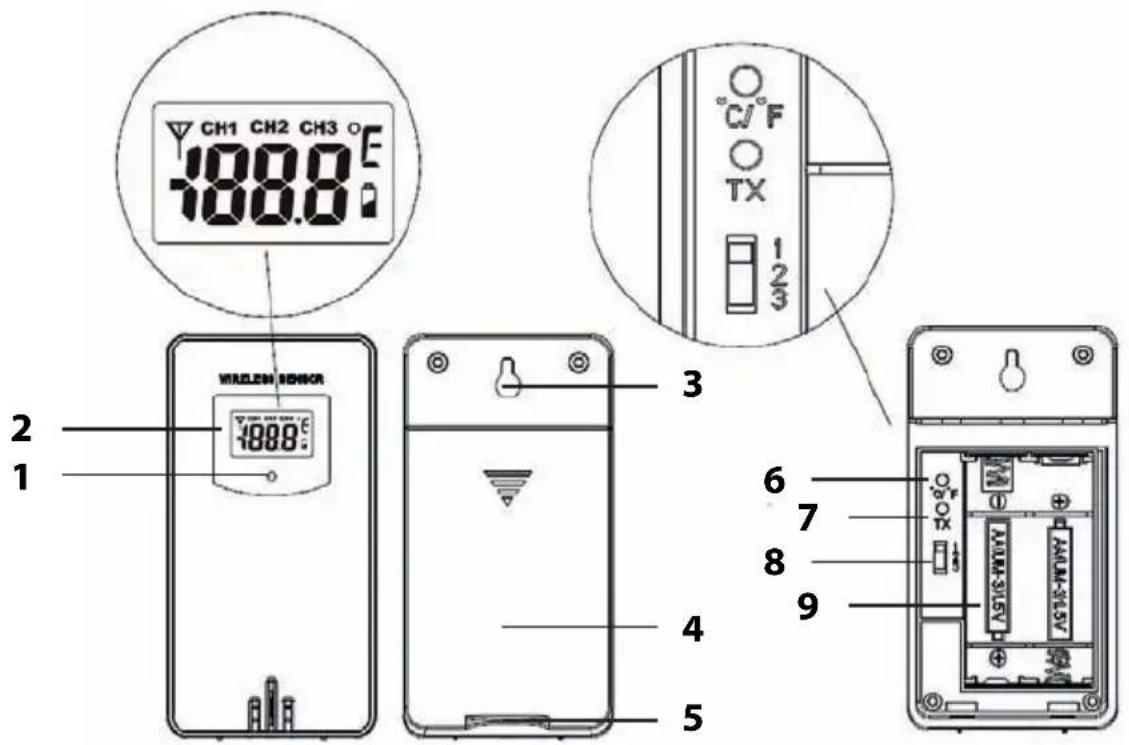
1 Indicator light, lights up during data transmission
2 Display with the following indicators (from left to right):
Transmission symbol, channel, temperature in °C or °F, battery charge level
3 Hanging eyelet
4 Battery compartment cover
5 Mounting foot
6 °C/°F switch: Change temperature measuring unit
7 TX switch: Weather data immediately transmitted by the push of a button
8 1, 2, 3 switch: Select the number of the transmission channel
9 Battery compartment

- Proceed according to the order listed below and first insert the batteries into the wireless outdoor sensor. Only then can the weather station function without flaws.
- Do not use rechargeable batteries, since their voltage is too low (only 1.2 V instead of 1.5 V). This affects, among other things, the precision of the measurements.
- Where possible, use alkaline rather than zinc-carbon batteries. Alkaline batteries last longer, especially at low outdoor temperatures.
Wireless outdoor sensor
- Remove the battery compartment cover on the rear side of the outdoor sensor by pressing with a little force on the imprinted arrow. Slide the battery compartment cover in the direction of the arrow, away from the outdoor sensor.
- Insert 2 batteries of type LR03 (AAA)/1.5 V as depicted on the bottom of the battery compartment. Pay attention to the correct polarity of the batteries (+/-).
- Slide the battery compartment cover back into place on the outdoor sensor.
Base station with radio

NOTE on material damage
-Use only the supplied mains adapter.

You can also operate the base station without a backup battery. Operation with only the battery - without connecting to the mains - is not possible.
In the event of a power outage, a 3 V CR2032 battery ensures that settings made (e.g. alarm times) remain stored for several hours. Upon delivery, the backup battery is already inserted and is provided with an iso strip to protect against premature discharge.
- Loosen the screw on the battery compartment cover on the underside using a fine Phillips screwdriver.
- Remove the battery compartment cover.
- Pull out the iso-strips.
- Replace the battery compartment cover and secure it in place using the fastening screw.
-
Unwind the FM wire antenna and attach the end as high as possible to a wall or a shelf, e.g. with adhesive tape.
-
Insert the plug of the supplied mains adaptor into the connection socket of the base station.
-
Plug the mains adaptor into a socket that has a voltage corresponding to that described under "Technical Data".
Starting signal reception

It can take up to 30 minutes for the base station to collect all weather data and receive the wireless signals from the time signal transmitter.
As soon as the base station is powered, all available data is shown in the display. The device switches to reception at the same time and searches for the wireless signals of the time signal transmitter and the wireless outdoor sensor.

The number of radio waves in the display indicates the quality of reception to the time signal transmitter: The more radio waves shown on the display, the better is the reception.
As soon as the signals from the time signal transmitter and wireless outdoor sensor have been received in sufficient strength, the respective data is permanently shown in the display.
| Time signal transmitter: · Time and Date · Radio tower symbol | |
| Wireless outdoor sensor | · Outdoor temperature |
The base station immediately and automatically switches to reception several times each night. During this process, the displayed time is compared with that received from the time signal transmitter and, if necessary, corrected.
If no sufficiently strong signal has been received, the base station aborts the receiving process after a few minutes and the radio-tower symbol goes out. The receiving process is started again at a later point in time.
In this case, the time proceeds as usual (beginning with the start time of "00:00").
Checklist when data is missing in the display
| No data display from the time signal transmitter | |
| 1. Check whether the location of the base station is suitable, see "Choosing a location". | |
| 2. Restart reception manually, see "Manually starting signal reception". | |
| 3. Wait until the base station automatically switches back to reception at a later time. The reception is usually better at night. | |
| 4. Manually perform the settings if reception is not possible at your location, see "Setting the time and date manually". |
| No data display from the wireless outdoor sensor | |
| 1. Check whether you have inserted the batteries correctly. | |
| 2. Check whether the location of the wireless outdoor sensor is suitable, see "Choosing a location". | |
| 3. Press and hold CH to manually start signal reception to the outdoor sensor. | |
| 4. When using a single wireless outdoor sensor (standard), transmission channel 1 is usually used for data transmission.Press the CH button repeatedly until is shown in the display.Then, if necessary, check whether the sliding switch on the wireless outdoor sensor is also set to "1".Note: You can also use any other transmission channel. However, it must be identical for the base station and the outdoor sensor. |
Setting the time and date manually

- If there is more than approx. 20 seconds between two pushes of a button, the setting process automatically ends and you will have to repeat it. Settings you have already made remain saved.
- The settings are made via the multi-function knob:
Rotate: select setting,
Push: confirm the selected setting.
- Press and hold the SET button until "24 Hr" or "12 Hr" flashes in the display.
- Set the desired time format using the multi-function knob.

If you select the 12-hour time format, morning hours are marked with "AM" and afternoon hours with "PM" in the display.
- Push the multi-function knob to confirm the setting. "00" flashes in the display.
- Select the time zone you are in (for most countries in Europe, "00" is the correct setting) using the rotary knob.
-
Push the multi-function knob to confirm the setting.
-
Carry out the following settings:
-Hours
-Minutes
-Date format (Day/Month or Month/Day)
-Year
-Month
-Day
-Language of the weekday abbreviation "DAY"
-Weather symbol
- Finally, push the multi-function knob to complete the operation.
Manually starting signal reception to the time signal transmitter

If the radio signal symbol to the left is no longer displayed, the radio signals from the time signal transmitter are no longer being received. The time indicator nevertheless continues precisely.
- Press and hold the WAVE button until the radio signal symbol is displayed again. The signal reception is thus started manually.
Pay attention to the following:
- If the reception was not successful, the reception symbol fades out after a few minutes and the time on the display continues normally.
- Upon successful signal reception, the radio-controlled alarm clock adjusts itself to the time of the time signal transmitter. If you have already made manual settings, these are automatically adjusted.
Choosing a location

NOTE on material damage
- Protect the base station and wireless sensor from dust, impacts, extreme temperatures and direct sunlight.
- Protect the base station from moisture. Position the base station exclusively in a dry, closed room. The wireless sensor is protected against moisture, but must be protected from direct exposure to moisture, e.g. rain.
Signal reception between the base station and wireless outdoor sensor
- The maximum distance between the base station and the outdoor sensor is 60 metres. This range is, however, only possible with "direct line of sight".
- Protective construction materials such as reinforced concrete reduce or inhibit signal reception between the base station and outdoor sensor.
- Devices such as TVs, cordless phones, computers, and fluorescent tubes can likewise disrupt signal reception.
- Do not place the base station and the outdoor sensor directly on the ground. This limits the range.
- At low temperatures in winter, the performance of the outdoor sensor batteries can markedly decrease. This reduces the transmission range.
Signal reception between the base station and time signal transmitter
- Maintain distance from TV sets, computers, and monitors. Base stations of wireless phones should also not be located in the immediate vicinity of the base station.
- The reception is generally better at night. If the base station did not have reception during the day, it may well be that the signal will be immediately and fully received at night.
- Depending on your location, it can infrequently happen that the base station receives signals from another time signal transmitter or even alternately from two time signal transmitters. This is not a fault in the device. In this case you should change the location of the base station.
- The weather, e.g. a heavy storm, can cause interference with the reception.
- Temporary shutoffs of the transmitter can sometimes happen, e.g. because of maintenance work.
Setting up the base station
- Set up the base station as close to a window as possible. Here, the reception will generally be best.
Setting up the wireless outdoor sensor

DANGER of severe injuries
- During wall installation, there must be no electrical cables, gas or water pipes installed in the walls at the mounting site. Otherwise, when drilling holes, there is a risk of electric shock!
The wireless outdoor sensor has a hanging eyelet on the back, as well as a mounting foot.
- Place or hang the outdoor sensor at a position where it is protected from the direct influence of the weather (rain, sun, wind, etc.). Suitable locations are, for example, under an awning or in a carport.
Use additional wireless sensors
The base station is supplied with a wireless sensor. However, you can operate it with up to three outdoor sensors. Please contact service@ade-germany.de for more information or a paid order.
- The outdoor sensors can be situated in different spaces or outdoors.
- Every sensor must be allocated its own number (= no. of the transmission channel).
Procedure:
- Place the base station and the outdoor sensor close to each other.
- Remove the battery compartment cover on the rear side of the outdoor sensor.
- For each outdoor sensor, set a unique channel using the switches. The sensor delivered with the weather station uses channel 1 by default; for the second sensor you should thus choose channel 2.
- Insert two batteries of the type indicated on the base. Pay attention to the correct polarity (+/-).
- Replace the battery compartment cover.
- Using the CH button, select the corresponding outdoor sensor (1, 2 or 3) in order to have its data displayed.

- You can also press the CH button repeatedly until it appears in the display above the outdoor temperature. This is a sign that the data from the outdoor sensors will automatically be called up and displayed in succession.
- If the channel number is not displayed after inserting the batteries, press the TX button for the respective wireless sensor. This way, the weather data is transmitted directly to the base station.
You can then set up the new outdoor sensor at its own installation site.
About the time signal transmitter DCF77
The radio clock integrated into the base station receives its radio signals from the time signal transmitter DCF77. This broadcasts the precise and official time of the Federal Republic of Germany on the long-wave frequency of 77.5 kHz.
The transmitter is located in Mainflingen near Frankfurt am Main and, with its range of up to 2000 km, supplies the majority of radio-controlled clocks in western Europe with the necessary radio signals.
As soon as the base station is supplied with current, it switches to receiving mode and searches for the signal from the DCF77 transmitter. If the time signal has been received in sufficient strength via the ferrite rod antenna installed in the radio alarm, the time is shown in the display.
The base station switches on multiple times daily and synchronises the time with the radio signal from the DCF77 transmitter. In the event the signal is not received, e.g. during a strong storm, the device continues to run precisely and then switches to receiving mode again at the next scheduled time.
Weather functions
Weather forecast
After startup, the weather forecast information cannot be used for about 12 hours, since the base station uses this time to collect and evaluate the weather data.
The weather forecast is based on the collected data and the measured air pressure changes.
The forecast applies to the area around the base station with a radius of about 30 to 50km for a period of the next 8 hours. The accuracy of the weather forecast lies around 75% .
The weather symbols indicate the weather developing in the next 8 hours, not the current weather.

Temperature trend
The temperature trend of the outdoor temperature is indicated by arrows:

The temperature is rising

The temperature is dropping
If no arrow is displayed, the temperature trend is constant.
Saved weather data
Using the MEM button, you will get the highest and lowest temperature and humidity values for the last 24 hours displayed.
-Press 1x: MAX values are displayed
-Press 2x: MIN values are displayed
-Press 3x: normal display indicator
In order to delete the saved values:
- Press and hold the MEM button for approx. 3 seconds until the displayed values are deleted.
Frost alert
If the frost symbol is shown on the display, the measured outdoor temperature lies in the range from -1^ to 3^ ( 30^ to 37^ ).
Even if the frost symbol is not being displayed, there is essentially always a risk of frost at temperatures around the freezing point.

If you are using multiple outdoor sensors, each sensor displays its own frost warning.
Radio operation
Listening to the radio

- Press the 🔒 button to turn on the radio.
"FM" mode (FM radio operation) and the received frequency are shown in the display.
- Set the desired radio station by briefly turning the 🔊 button (counterclockwise or clockwise). If a station is received in stereo quality, "ST" is also shown in the display.
- Adjust the desired volume with the multi-function knob.
- If necessary, improve the radio reception by first setting a different frequency. If this does not work, change the position of the wire antenna.
- To stop radio playback, press the 🔒 button again.
Automatic channel search
- Turn on the radio (press the 🔊 button).
- Press SET to start automatic station search.
- Once a station with good reception is found, it is stored (P 01, P 02) etc.
- After the channel search has been completed, the first station stored is displayed.
-You can select the individually stored stations by briefly turning 🔊
Using the timer (auto off)
- While the radio is playing, press and hold the multi-function knob until a digit is set in the display, e.g. "30" (standard preset).
- Set the desired time value in minutes (01 to 90) using the multi-function knob. After the set time has elapsed, the device switches off automatically.

- If the timer is active, flashes in the display.
- If you want to deactivate the function again, select the option "OFF" instead of a time value (01 - 90).
Alarm

Set the BZ/FM/6 button to the desired alarm source:
- BZ setting: You are awakened by the buzzer.
- FM setting: You are awakened by the last radio station you listened to.
You can set two different alarm times with the base station: A1 and A2. The procedure is identical in each case.
Setting the alarm time

If there is more than approx. 20 seconds between two pushes of a button, the setting process automatically ends and you will have to repeat it. Settings you have already made remain saved.
- Briefly press the 📊 button once. "A1" is shown on the display. If you would like to choose the alarm time "A2", press the 🔔 button again.
- Press and hold the 🔒 button for a few seconds until the hour indication of the alarm time flashes.
- Set the desired alarm hour with the multi-function knob.
-
Push the multi-function knob to confirm the setting. The minute indicator flashes in the display.
-
Set the desired alarm minute with the multi-function knob.
- Push the multi-function knob to confirm the setting.
"L20" or the value of the last set volume level flashes in the display.
- Set the desired alarm volume with the multi-function knob.
- Push the multi-function knob to confirm the setting.
The setting operation is completed.

When setting an alarm time, the alarm function is activated automatically. It indicated by the symbols or . 2
Being awakened
At the set time, you will be awakened by the selected alarm source (buzzer or radio), where the alarm volume becomes more intense as the alarm duration increases.
Switching off the alarm for 24 hours
- Press any button (except the multi-function knob) to stop the alarm. After 24 hours, the alarm will be triggered again.
Auto-stop function
If you do not press a button, the alarm switches off automatically after 30 minutes. After 24 hours, the alarm will be triggered again.
Snooze function
-Press the multi-function knob 1x when the alarm sounds.
The alarm signal stops and the alarm symbol ① or ② and Z ^2 flashes in the display. After 8 minutes, the device switches on again and wakes you up again.
This procedure can be repeated multiple times.
Turning the alarm off completely
Deactivate and activate the respective alarm function by repeatedly pressing the SET button.
Press SET 1x: ① is displayed: Alarm 1 is active, Alarm 2 is deactivated
Press SET 2x: ② is displayed: Alarm 1 is deactivated, Alarm 2 is active
Press SET 3x: ① and ② are displayed: Alarm 1 and 2 are active
Press SET 4x: Alarm symbols are no longer displayed: Alarm 1 and 2 are deactivated
Charging function via USB
Via the USB socket on the rear side of the base station, you can charge devices such as smartphones or MP3 players when the base station is being operated via mains power.

- Pay attention to the manufacturer's instructions for the device you are connecting.
- Do not use the charging function during radio operation, as this may result in noise interference.
- Connect the USB socket and the external device using a USB cable (not included).
Other functions
Setting the display lighting
You can control the brightness of the display using the ON/OFF switch at the back:
- OFF - maximum and lasting brightness.
- ON - the brightness of the display lighting automatically adjusts to the ambient light.
Change temperature measuring unit
- Press the °C/°F button to display the temperature in the respective units of measure °Celsius or °Fahrenheit.
Switching between summer and winter time
Switching between summer and winter time, or vice versa, takes place automatically with good time signal reception. When daylight saving time is active, the display shows "DST" (Daylight Saving Time).
Replacing the backup battery
- Open the battery compartment on the underside using a fine Phillips screwdriver.
- Remove the battery compartment cover and remove the old battery.
- Slide the new battery under the two retaining tabs and then push them down with a little force so that the battery is firmly under the retaining tab and audibly clicks into place. Pay attention to the correct polarity (+/-). The plus pole (+) must be pointing upwards.
-
Replace the battery compartment cover and secure the battery compartment cover with the Phillips screw.
-
Pull the mains adaptor plug out of the base station.
- As necessary, wipe the base station and the outdoor sensor clean with a lightly-dampened cloth.
- Dry the device completely before you reconnect it with the mains adaptor.
Fault/Remedy
| Fault Possible Cause | |
| The DCF77 signal for the time cannot be received. | · Check the chosen location.· Start the signal reception manually, if necessary.· Adjust the time manually. |
| The temperature information of the sensor seems too high. | · Check whether the sensor has been exposed to direct sunlight. |
| Instead of showing the measured values for temperature or humidity, the display shows H.HH or LL.L. | · The values lie above or below the measurement range. |
| The display shows "--." instead of the outdoor temperature. | · Press and hold the CH button to manually start signal reception to the outdoor sensor. In addition, you can press the TX button in the battery compartment of the wireless sensor to transmit data faster to the base station.· Select an available outdoor sensor via the CH button. |
| The indicator is illegible, the function is unclear, or the values are obviously false. | · Disconnect the base station for a few moments from the current supply. |
| The base station is not receiving signals from the wireless sensor. | · Ensure that no electrical sources of interference are located in the vicinity of the wireless sensor or of the base station.· Check the batteries in the sensor.· Move the base station closer to the sensor, or vice versa. |
| The time differs by exactly one, two, three, etc. hours. | · You have probably set an incorrect time zone. |
Base station
Model: Weather station with radio alarm clock WS 1604
Input:
5V
Battery:
1x CR2032 (AA)/3 V——(backup battery)
Max. power consumption: approx. 10 W
Standby: max. 0,4 W
Measuring range
- Temperature: -10 °C - 50 °C (14.2 °F - 122 °F)
- Humidity: 20% - 95%
Wireless outdoor sensor
Batteries:
2x L06 (AA)/1.5 V
Measuring range:
- Temperature: -25 °C - 50 °C (-13 °F - 122 °F)
Transmission frequency: 433.92 MHz
Range: approx. 60 metres (open terrain)
Mains adaptor
Type: HX12-0502000-AG
Input: 100-240 V\~, 50/60 Hz
Output:
5 V ____/2 A
Protection class:
|||
Radio
Frequency range: 87.5 -108 MHz
Audio output power 3 W RMS
Distributor: Waagen-Schmitt GmbH
Hammer Steindamm 27-29
22089 Hamburg, Germany
Our products are constantly being developed and improved. For this reason, design and technical modifications are possible at any time.
Declaration of Conformity
Waagen-Schmitt GmbH hereby declares that the weather station with radio alarm clock WS1604 complies with the directives 2014/53/EU, 2014/30/EU, 2014/35/EU and 2011/65/EU. The full text of the EU Declaration of Conformity is available at the following Internet address:
The declaration loses its validity if modifications have been made to the device without our approval.
Hamburg, January 2017 Waagen-Schmitt GmbH Hammer Steindamm 27-29 22089 Hamburg, Germany

Guarantee
The company Waagen-Schmitt GmbH guarantees for 3 years from the purchase date the cost-free rectification of defects on the basis of material or fabrication errors through repair or exchange.
In the event of a guarantee claim, please return the product with the proof of purchase (stipulating the reason for claim) to your dealer.
Disposing of the packaging

Dispose of the packaging with similar materials. Put cardboard with waste paper, films with recyclable materials.
Disposing of the product
Dispose of the product in accordance with the regulations that apply in your country.
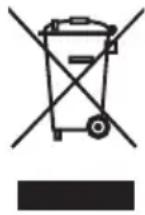
Devices must not be disposed of in normal household waste.
At the end of its life, the product must be disposed of in an appropriate way. In this way, valuable materials contained in the device will be recycled and the burden on the environment avoided. Hand in the old device at a collection point for electronic waste or at a recycling depot.
For more information, contact your local waste disposal firm or your local administrative body.

Recyclable and disposable batteries do not belong in household waste.
All batteries must be handed in at a collection point in your community, suburb, or at the retailer. Such batteries can thus be disposed of in an environmentally friendly way.
1 Pantalla
1 Écran
1 Wyświetlacz
22089 Hamburg, Germany
- Bedienungsanleitung
- Garantie
- Scope of delivery
- Table of Contents
- About this manual
- Explanation of symbols
- Intended Use
- Safety
- DANGER for children
- Danger from electricity
- Risk of injuries
- Note on material damage
- What the weather station with radio alarm clock provides
- Base station with radio
- Wireless outdoor sensor
- Display
- Starting signal reception
- Setting the time and date manually
- Manually starting signal reception to the time signal transmitter
- Choosing a location
- Signal reception between the base station and wireless outdoor sensor
- Signal reception between the base station and time signal transmitter
- Setting up the base station
- Setting up the wireless outdoor sensor
- DANGER of severe injuries
- Use additional wireless sensors
- Procedure:
- About the time signal transmitter DCF77
- Weather functions
- Weather forecast
- Temperature trend
- Saved weather data
- Frost alert
- Radio operation
- Listening to the radio
- Automatic channel search
- Using the timer (auto off)
- Alarm
- Setting the alarm time
- Being awakened
- Switching off the alarm for 24 hours
- Auto-stop function
- Snooze function
- Turning the alarm off completely
- Charging function via USB
- Other functions
- Setting the display lighting
- Change temperature measuring unit
- Switching between summer and winter time
- Replacing the backup battery
- Base station
- Mains adaptor
- Radio
- Declaration of Conformity
- Guarantee
- Disposing of the packaging
- Disposing of the product
- Devices must not be disposed of in normal household waste.
- Recyclable and disposable batteries do not belong in household waste.
Brand : ADE
Model : WS 1604
Category : Weather Station