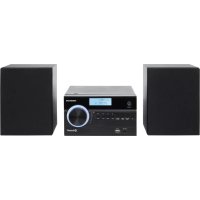
LIFE P64187 (MD 44087) - Hi-fi system MEDION - Free user manual and instructions
Find the device manual for free LIFE P64187 (MD 44087) MEDION in PDF.



| Product type | Micro audio system with DAB+/FM radio and CD/MP3 player |
| Brand | MEDION |
| Model | LIFE P64187 (MD 44087) |
| Dimensions of main unit (W x H x D) | 18.0 × 10.3 × 19.5 cm |
| Dimensions of speakers (W x H x D) | 13.3 × 17.3 × 12.3 cm |
| Weight of main unit | Approximately 924 g |
| Weight of speakers (per pair) | Approximately 688 g |
| Power supply | 100 - 240 V ~ 50/60 Hz |
| Power consumption in operation | Approximately 28 watts |
| Output power | 2 x 5 watts RMS |
| CD compatibility | CD-R, CD-RW, audio CD, MP3 CD |
| Radio | DAB (174.928 – 239.200 MHz) and FM (87.5 – 108 MHz) with 30 memory presets each |
| Bluetooth | Version 2.1+EDR, class II, range up to 10 meters, profiles A2DP and AVRCP |
| Connectivity | AUX input (3.5 mm jack), USB port (max. 32 GB FAT32), headphone jack (3.5 mm jack) |
| Audio functions | Equalizer (Flat, Classic, Rock, Pop, Jazz), bass boost (X-Bass), mute |
| Programmable functions | Programmable playback (20 CD tracks, 99 MP3 tracks), repeat, random playback |
| Timers | Sleep timer (up to 90 min) and daily alarm timer |
| Backup batteries | 2 LR03/AAA batteries (not included) to preserve settings |
| Remote control | With CR2025 button cell battery included |
| Protection class | Class II (double insulation) |
| Package contents | Micro system, 2 speakers, remote control, documentation |
| Cleaning and maintenance | Unplug before cleaning; use a soft, dry cloth; avoid solvents and chemicals |
| Safety | Class 1 laser (CD player); automatic shutdown after 15 minutes of inactivity |
| Repairability and spare parts | Contact MEDION customer service (address in manual); do not open or repair yourself |
Frequently Asked Questions - LIFE P64187 (MD 44087) MEDION
User questions about LIFE P64187 (MD 44087) MEDION
0 question about this device. Answer the ones you know or ask your own.
Ask a new question about this device
Download the instructions for your Hi-fi system in PDF format for free! Find your manual LIFE P64187 (MD 44087) - MEDION and take your electronic device back in hand. On this page are published all the documents necessary for the use of your device. LIFE P64187 (MD 44087) by MEDION.
USER MANUAL LIFE P64187 (MD 44087) MEDION
natural_image
Black electronic audio workstation with two speakers and a digital display (no visible text or symbols on main components)1. Information about this user manual....45
1.1. Explanation of symbols ....45
2. Proper use
3. EU Declaration of Conformity......47
4. Trademark information ......ES
5. Safety information
5.1. Restricted group of people 47 IT
5.2. Operating safety 48
5.3. Power supply 49 NL
5.4. Installation location/surroundings 5
5.5. Repairs....51
5.6. CD player....51
5.7. Drivers and connections ....51
5.8. Handling batteries 5
5.9. Cleaning the device ....53
6. Package contents
7. Device overview
7.1. Front....55
7.2. Rear ....56
7.3. Remote control 57
8. Getting started
8.1. Inserting/replacing the battery in the remote control ....58
8.2. Inserting/replacing backup batteries ....59
9. Setting up the device 59
9.1. Connecting the supplied loudspeakers....60
9.2. Mains connection 6
9.3. Connecting an external device....61
9.4. Connecting headphones 6
9.5. Adjusting the aerial 62
10. Operating the device....62
10.1. Switching on the device/standby 62
10.2. Selecting the operating mode 62
10.3. Audio functions ......62
10.4. Setting the time....63
10.5. Sleep timer....63
10.6. Setting/switching off the timer....64
11. Radio....65
11.1. Storing stations automatically....65
11.2. Tuning the stations....65
11.3. Station search (FM mode only) 65
EN
11.4. Storing a radio station 65
11.5. Stereo/mono reception (FM mode only) 66
11.6. Station information 66
11.7. Radio menu....66
11.8. Playing back CDs and USB storage media 68
11.9. Inserting a CD....68
11.10. Connecting USB devices 68
11.11. Start/pause/stop playback 68
11.12. Track selection, rewind/fast forward .....69
11.13. Folder selection ....69
11.14. Programming the track playing order 69
11.15. Repeat....69
11.16. Random playback 69
11.17. Bluetooth mode....70
11.18. Connecting an external playback device ....71
- Cleaning 71
- Troubleshooting 71
- End of operation....73
- Disposal....73
- Technical specifications 74
16.1. Symbols on the type plate 75 - Legal Notice 76
- Privacy statement....76
1. Information about this user manual

Thank you for choosing our product. We hope you enjoy using this device.
Please read the safety instructions and the user manual carefully before using the device for the first time. Note the warnings on the device and in the user manual.
Always keep the user manual close to hand. If you sell the device or give it away, please ensure that you also pass on this user manual. It is an essential component of the product.
1.1. Explanation of symbols
If a block of text is marked with one of the warning symbols listed below, the hazard described in that text must be avoided to prevent the potential consequences described there from occurring.

DANGER!
Warning: risk of fatal injury!

WARNING!
Warning: risk of possible fatal injury and/or serious irreversible injuries!

CAUTION!
Warning: risk of minor and/or moderate injuries!

NOTICE!
Follow these instructions to prevent damage to the device!

More detailed information about using the device!

Follow the instructions in the user manual!
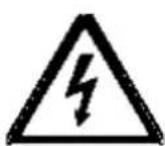
WARNING!
Warning: risk of electric shock!
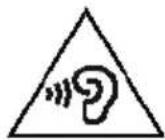
WARNING!
Warning: danger due to loud volume!
- Bullet point/information on steps during operation
▶ Instruction to be carried out
■ Safety instructions to be performed
2. Proper use
Your device can be used in a range of ways:
The device is intended for playing sound media (Bluetooth, CDs, MP3 data media, USB devices), as well as for radio reception.
- The device is only intended for private use and not for industrial/commercial use.
Please note that we shall not be liable in cases of improper use:
- Do not modify the device without our consent and do not use any auxiliary equipment that we have not approved or supplied.
- Only use replacement parts or accessories that we have supplied or approved.
- Comply with all the information in this user manual, especially the safety information. Any other use is considered improper and can cause personal injury or property damage.
- Do not use the device in potentially explosive atmospheres. This includes petrol stations, fuel storage areas and areas where solvents are processed. This device must also not be used in areas with particle-laden air (for example, flour or wood dust).
- Do not use the device outdoors.
- Do not expose the device to extreme conditions. Avoid:
– high humidity and moisture
- extremely high or low temperatures
- direct sunlight
- open flames.
3. EU Declaration of Conformity

MEDION AG hereby declares that this device complies with the fundamental requirements and the other relevant provisions of:
• Radio Equipment Directive 2014/53/EU
• Ecodesign Directive 2009/125/EC
• RoHS Directive 2011/65/EU.
You can download the complete EU Declaration of Conformity at www.medion.com/conformity.
4. Trademark information
The Bluetooth ® word mark and logos are registered trademarks of Bluetooth SIG, Inc. and are used by Lenovo/Medion under license.
5. Safety information
5.1. Restricted group of people
- This device is not intended for use by people (including children) with reduced physical, sensory or mental abilities or by those without experience and/or knowledge, unless they are supervised by a person responsible for their safety or they have been instructed in its use by that person. Children must be supervised to ensure they do not play with this device.
- Keep the device and its accessories out of the reach of children.
- Cleaning and user maintenance on the device must not be carried out by children.

DANGER!
Risk of choking and suffocation!
The packaging material is not a toy! Packaging film can be swallowed or used improperly, creating a risk of choking and suffocation.
- Keep packaging material such as plastic film or plastic bags away from children.
5.2. Operating safety
■ Before using the device for the first time, check the device for damage. A defective or damaged device may not be used.
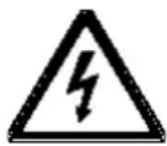
DANGER!
Risk of electric shock!
Risk of injury from electric shock due to live parts. They pose a risk of electric shock or fire if an unintentional short circuit occurs.
■ Do not place containers filled with liquid, e.g. vases, on or near the product, and protect all the parts from drips or splashes. Such containers may tip over and the liquid may impair the electrical safety of the device.
■ Never open the product housing and do not push objects inside the product through the slots and openings.
If the device or connection cable is damaged, remove the plug from the mains socket immediately. This also applies if liquids or foreign objects have penetrated inside the device.
■ Unplug the mains plug from the socket if you are away for a long period or there is a thunder storm.
5.3. Power supply
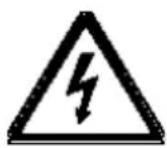
DANGER!
Risk of electric shock!
Risk of injury from electric shock due to live parts.
■ Only connect the device to a properly installed earthed mains socket (230 V \~ 50 Hz) that is easy to reach and close to the place where you have set up the device. Always keep the power socket free of obstructions so that the plug can be pulled out easily. Even when the device is switched off, some components are live.
In order to disconnect the power to your device or to completely isolate the device from voltage sources, remove the mains plug from the socket.
■ When disconnecting the connection cable from the mains supply, always pull on the plug rather than on the cable.
- In an emergency, for example, if you see smoke coming out of the device, or if it makes unusual noises, remove the connection cable and/or batteries.
- The plug must always be easily accessible, so the device can be unplugged in an emergency. For this reason, it is important that the power socket is always easily accessible.
- The device uses a small amount of electricity, even when it is switched off. To completely switch off the device, unplug the mains cable from the power socket.
- Only connect devices that comply with the requirements of the Low Voltage Directive.
5.4. Installation location/surroundings

DANGER!
Risk of electric shock!
Major changes in temperature or fluctuations in humidity can cause moisture to build up within the device due to condensation – this can cause an electrical short circuit.
■ After transporting the device, wait until it has reached ambient temperature before switching it on.

NOTICE!
Risk of damage to the device!
Unsuitable environmental conditions could cause damage to the device.
■ Use the device only in dry rooms.
■ To prevent the device from falling, only install and operate it and its components on a sturdy, level and vibration-free surface.
■ When setting up the device:
- Leave a sufficient gap in relation to other objects, and that the ventilation slots are not covered in order to ensure that there is always sufficient ventilation
- Do not expose the device to direct sources of heat (e.g. heaters)
- Do not leave the device in direct sunlight
- Avoid contact with moisture, droplets or splashes, and no liquid-filled objects – for example, vases – are placed on or near the device
- Do not place the device close to magnetic fields (e.g. television sets or other loudspeakers)
- Do not place naked flames, such as lit candles, near the device
- Ensure that the connection cable is not taut or bent.
5.5. Repairs
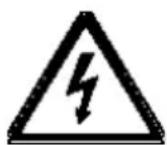
DANGER!
Risk of electric shock!
There is a risk of electric shock due to live parts.
■ Check the device and the connection cable for damage before using the device for the first time, and after each use.
■ Do not use the device if the device shows visible signs of damage.
■ If you discover any damage or experience any technical problems, have the device repaired exclusively by a qualified technician.
5.6. CD player
- The CD player is a Class 1 laser product. The device has a safety system that prevents dangerous laser beams from escaping during normal use. To avoid eye inju-
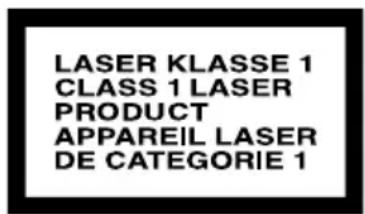
ries, never tamper with or damage the device's safety system.
5.7. Drivers and connections
- Do not insert any foreign objects into the openings on the CD player. This can damage the device.
- Always place a CD in the disc tray with the labelled side facing upwards. Never use excessive force when inserting a CD or connecting an external device. If you feel resistance, try a different way or another medium.
5.8. Handling batteries
The device is operated with two batteries for backup. The remote control for this device is operated with a button cell battery. Please note the following:
- Keep new and used batteries out of the reach of children. Do not swallow batteries as they can cause chemical burns.

WARNING!
Risk of chemical burns!
The remote control supplied with the product contains a button cell battery. If this battery is swallowed, it can cause serious internal chemical burns within 2 hours, which may prove fatal.
- Seek medical help immediately if you think that batteries may have been swallowed or secreted in any part of the body.
- Stop using the remote control if you cannot close the battery compartment securely, and keep it well away from children.
- Keep batteries and the remote control away from children to avoid any hazards/misuse.
- Before inserting the batteries, check that the contacts in the device and on the batteries are clean and, if necessary, clean them.
• Always use new batteries of the same type. Never use old and new batteries together. - Pay attention to the polarity (+/−) when inserting the batteries.
- There is a risk of explosion if batteries are replaced incorrectly! Only replace batteries with those of the same or an equivalent type.
- Never try to recharge non-rechargeable batteries. Risk of explosion!
-
Never expose the batteries to excessive heat (such as direct sunlight, fire or similar).
-
Store batteries in a cool, dry place. Strong direct heat can damage batteries. Do not expose the device to sources of intense heat.
- Never short circuit or dismantle batteries.
- Never throw batteries into a fire. Risk of explosion!
- Remove leaking batteries from the device immediately. Clean the contacts before inserting a new battery. Risk of chemical burns from battery acid! In the event of contact with battery acid, rinse the affected areas immediately with plenty of clean water and consult a doctor immediately.
• Always remove flat batteries from the device. - If the device is not going to be used for long periods, remove the batteries.
5.9. Cleaning the device
DANGER!
Risk of electric shock!
Risk of injury from electric shock due to live parts.
■ Before cleaning, pull the mains adapter out of the socket.

NOTICE!
Possible material damage
Improper handling of sensitive surfaces can damage the device.
■ Use a soft, dry cloth to clean the device.
■ Avoid the use of chemical solutions and cleaning products because these may damage the device surface and/or the labels on it.
6. Package contents

DANGER!
Risk of choking and suffocation!
There is a risk of choking and suffocation due to swallowing or inhaling small parts or plastic wrap.
- Keep the plastic packaging out of the reach of children.
Remove the product from the packaging and remove all packaging material.
▶ Please check your purchase to ensure that all items are included. If anything is missing, please contact us within 14 days of purchase.
The following items are supplied with your product:
• 1 micro audio system incl. 2 loudspeakers
• 1 remote control incl. button cell battery, type CR2025
- Documentation
7. Device overview
7.1. Front
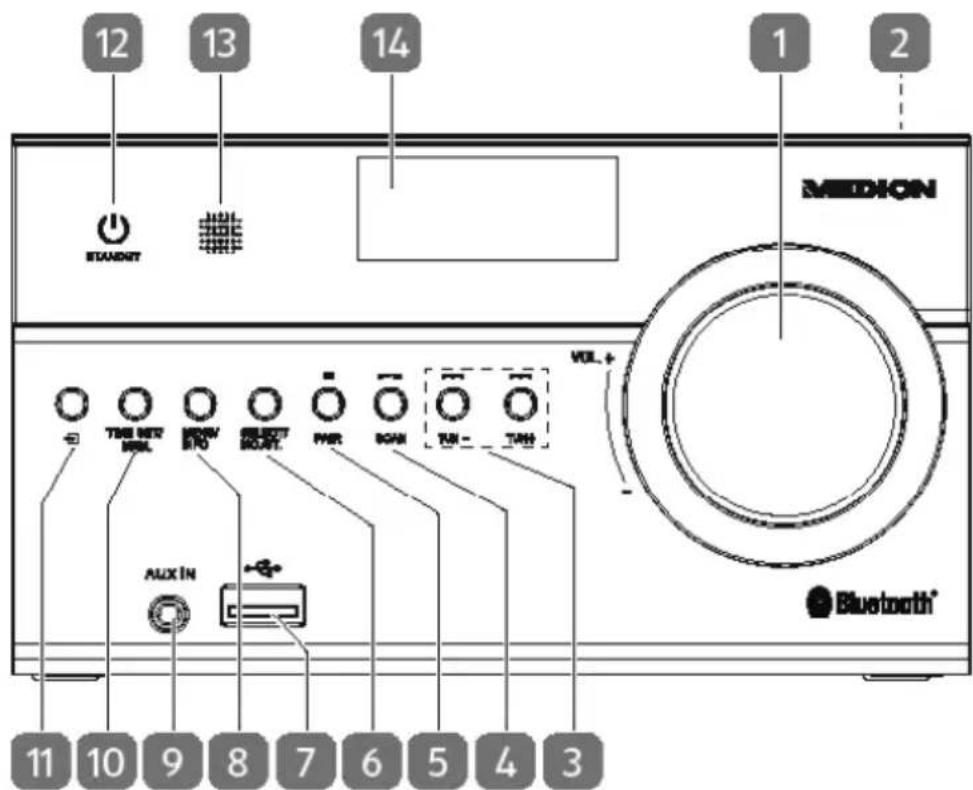
1) Volume control
2) CD compartment / - Open/close CD compartment (on the top)
3) ◀◀ / ▶▶ – Fast forward/rewind / previous/next track TUN-/+ – Previous/next frequency / previous/next station
4) ▶ II – Start/pause playback / automatically store stations SCAN – Perform station search
5) ■ – Stop playback PAIR – Pair a Bluetooth device
6) SELECT – Confirm menu selection MO./ST. – Playback radio station in mono/stereo
7) - Connection port for USB storage media
8) MENU – Open/close menu INFO – Display station information
9) AUX IN – Jack for external device
10) TIME SET – Display/set clock time MEM – Save button
11) - Select operating mode
12) - Switch device on / switch to standby mode
13) Infrared receiver for the remote control
14) Display
7.2. Rear
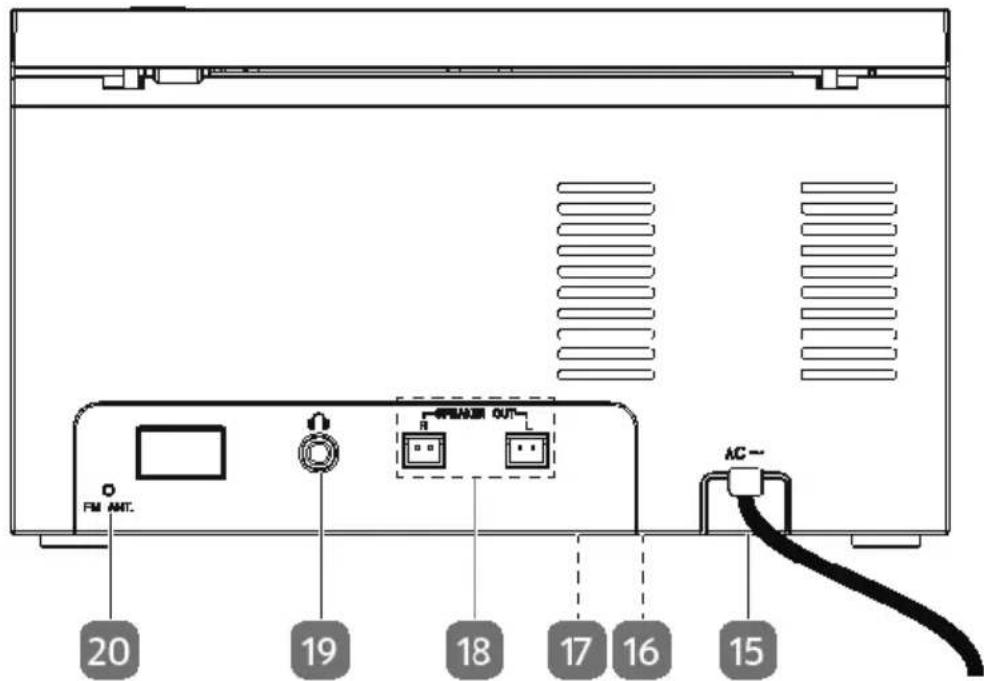
15) AC\~ - Connection socket for mains cable
16) Battery compartment (on the underside)
17) Type plate (on the underside)
18) SPEAKER OUT L/R – Speaker terminals
19) - Headset connection
20) FM ANT. - FM wire aerial
7.3. Remote control
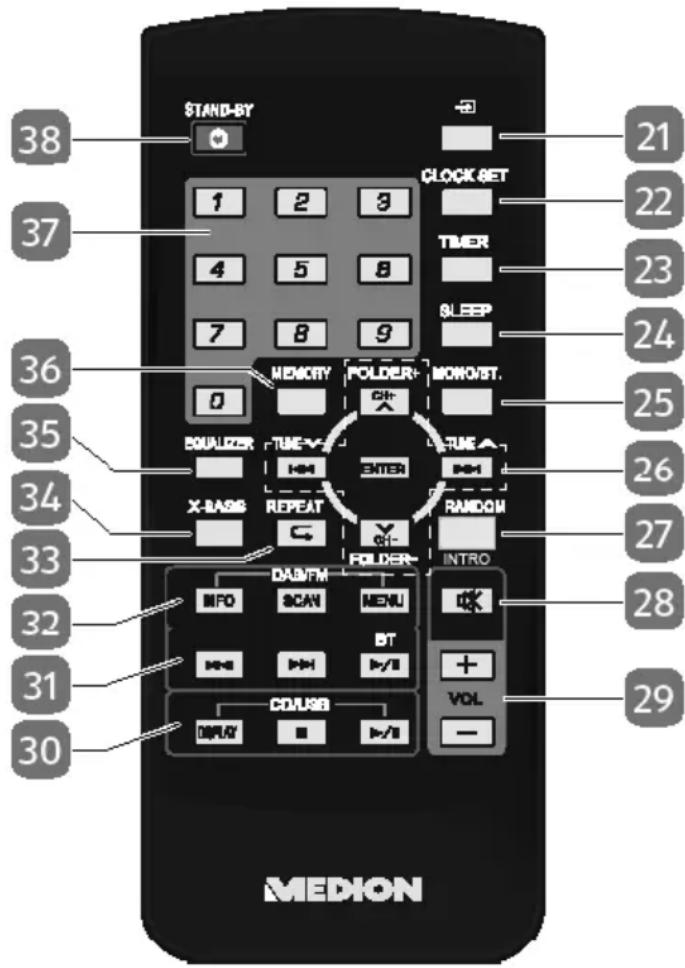
21) - Select operating mode
22) CLOCK SET – Display/set clock time
23) TIMER – Set switch-on timer (in standby mode)
24) SLEEP – Set sleep mode
25) MONO/ST. - Switch between mono/stereo (radio mode)
26) ◀◀/▶◀ – Fast forward/rewind /previous/next track / set the time
TUN ▼ / ▲ – Select radio station ▼ / ▲
FOLDER-/+ – One folder back/forwards in USB/MP3 CD mode
ENTER – Start/pause playback / confirm selection
INTRO – Play track
DISPLAY – Display track information
■ – Stop playback
▶ II – Start/pause playback
31) Bluetooth
◀◀/▶◀ – Fast forward/rewind / previous/next track
▶ II – Start/pause playback / pair Bluetooth device
32) DAB/FM
INFO – Display station information
SCAN – Perform station search
MENU – Open/close menu
33) REPEAT - Repeat function
34) X-BASS – Switch on/off bass amplification
35) EQUALIZER – Select equaliser mode
36) MEMORY – Programming function
37) 0-9 - Number buttons
38) STANDBY – Switch on the device / switch to standby mode
8. Getting started
8.1. Inserting/replacing the battery in the remote control
The remote control contains a CR2025 3V lithium battery.

When you use the remote control for the first time, pull out the transparent strip marked "Remove before use" without opening the battery compartment.
Replace the battery if the device fails to react to commands from the remote control properly. Then follow these steps:

WARNING!
Risk of explosion!
Risk of explosion if battery is replaced incorrectly.
■ Replace batteries only with the same or equivalent type.
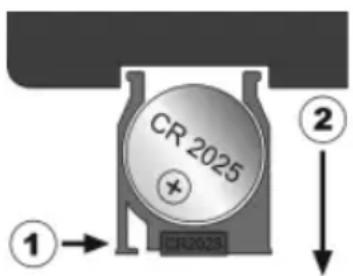
▶ Press the catch (1) and remove the battery holder complete with battery (2) from the remote control. Dispose of the old battery in accordance with legal regulations.
Place a new CR2025-type 3 V battery in the holder. Check the battery polarity is correct.
▶ Push the battery holder complete with battery back into the remote control as far as it will go.
8.2. Inserting/replacing backup batteries
If you disconnect the device from the mains, insert two high quality LR03/R03/AAA batteries (not included in package contents) to enable the time to continue to run in the background and to retain your device settings. Replace the batteries after two years at the latest.
▶ Open the battery cover on the underside of the device.
Insert the batteries into the battery compartment as shown.
▶ Then close the battery cover.

If the device is not going to be used for a longer period of time, remove the batteries from the device.

WARNING!
Risk of explosion!
Risk of explosion if battery is replaced incorrectly.
■ Replace batteries only with the same or equivalent type.
9. Setting up the device
Place the device and speaker on a sturdy, level surface. Some aggressive varnishes can corrode the rubber feet on the device. If necessary, place the device on a suitable underlay.

Before connecting an external device, unplug the mains plug from the device!
9.1. Connecting the supplied loudspeakers
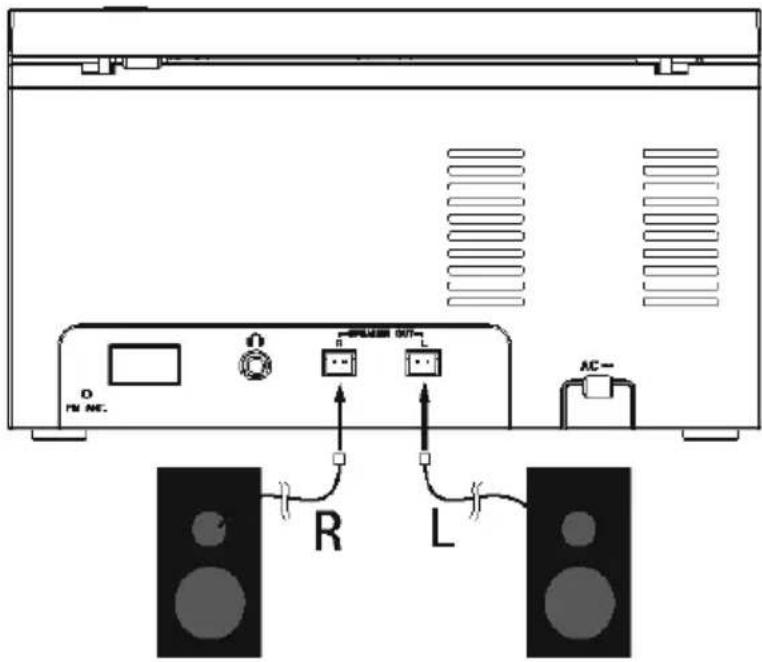
Connect the speaker cable connectors to the speaker sockets L and R on the back of the device. R (right) is for the cable pair for the right-hand loudspeaker. L (left) is for the cable pair for the left-hand loudspeaker.
9.2. Mains connection
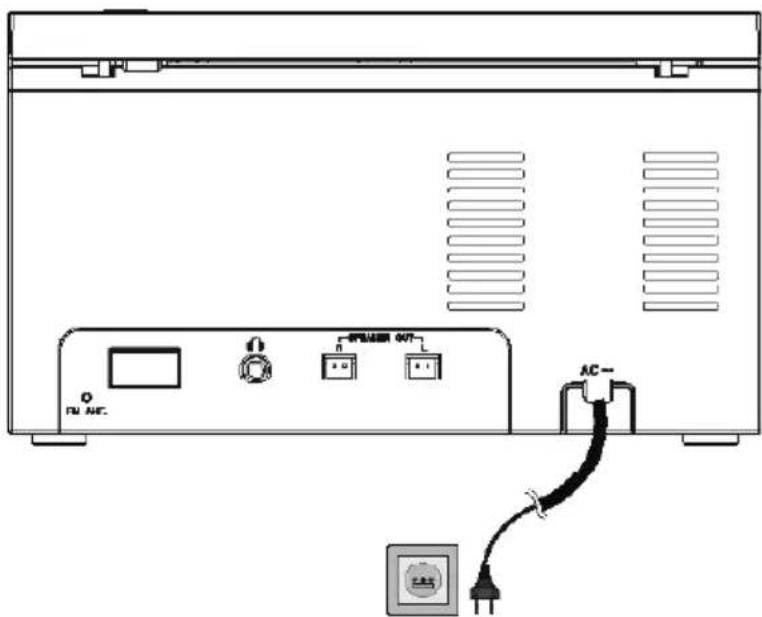
Once the loudspeakers are connected, connect the power cable.
Plug the AC\~ mains cable into a properly installed 100 V–240 V \~ 50/60 Hz earthed power socket that is always easy to access.
9.3. Connecting an external device
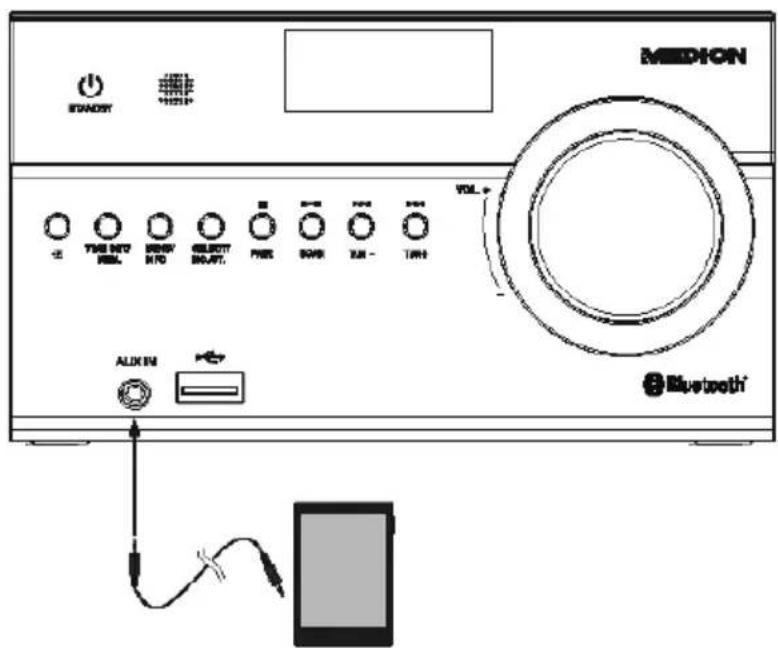
There is a 3.5 mm jack labelled AUX IN on the front of the device.
Plug the connection cable with a 3.5 mm jack plug into the jack connection.
9.4. Connecting headphones
You will find a 3.5 mm headphone socket on the back of the device.
Insert headphones with a 3.5 mm jack plug into the headphone socket 🔒.
When headphones are connected the speakers are disabled. Volume adjustment is still possible to change the headphone volume.
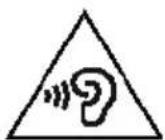
WARNING!
Risk of hearing damage!
Using headphones/earphones to listen to a device at high volumes for an extended period can damage your hearing.
■ Before pressing play, set the volume to the lowest setting.
■ Start playback and increase the volume to a comfortable level.
9.5. Adjusting the aerial
A wire aerial has already been connected to the device for radio reception. Fully unwind the aerial and arrange it for optimum reception.
10. Operating the device
You can activate the main play functions on your audio system using the buttons on the device. In addition to the basic controls, the remote control also provides numerous other options for using all functions of your device.
In this user manual, we refer to the remote control buttons. If reference is made to the controls on the device itself, this will be clearly indicated.
10.1. Switching on the device/standby
▶ Press the button to switch on the device.
▶ Press the ⏻ button again to switch the device back into standby mode. The time will be displayed.
10.2. Selecting the operating mode
▶ Press the ➕ button once or several times to run through the operating modes. The selected operating mode appears in the display:
- DAB - DAB radio mode
- FM - FM radio mode
- CD - CD mode
- USB - USB mode
- BT - Bluetooth mode
- AUX - AUX mode
10.3. Audio functions
10.3.1. Volume/mute
To adjust the volume, use the VOL- and VOL+ buttons on the remote control or the VOL-/+ controller on the device.
▶ Press ☑ to mute the sound. MUTE appears on the display. Press the button again to cancel the mute setting. MUTE disappears from the display.

If a device is connected via Bluetooth or if a device is connected to the AUX IN jack you can also adjust the volume on the devices directly.
10.3.2. Equaliser/bass amplification
▶ Press the EQUALIZER button once or several times to select one of the various sound presets: FLAT, CLASSIC, ROCK, POP, JAZZ.
▶ Press the X-BASS button to switch on the bass amplification. X-BASS ON will appear briefly on the display. Press the button again to switch the function off. X-BASS OFF will appear briefly on the display.
10.4. Setting the time
The time is automatically set through the DAB radio. However, you can also set the time manually:
▶ Press the button to switch the device to standby mode.
▶ Press and hold the CLOCK SET button until TIME SETUP is shown on the display.
▶ Press the CLOCK SET button to set 12 or 24 hour format.
▶ Use the ◀ or ▶ buttons to select the desired format and press CLOCK SET to confirm.
▶ Then use the ◀ or ▶ buttons to select SET CLOCK on the display.
▶ Press the CLOCK SET button to confirm.
The hour display flashes. Press the ◀ or ▶ buttons to set the hour.
▶ Press the CLOCK SET button to confirm.
The minute display flashes. Press the ◀◀ or ▶▶ buttons to set the minutes.
▶ Press the CLOCK SET button to confirm.
10.5. Sleep timer
If you select the sleep timer function, the device switches off automatically after a defined period of up to 90 minutes.
▶ Press the SLEEP button once or several times and select the duration of the sleep timer (in 10 minute intervals).
After the selected duration, the device switches itself off automatically.
If a sleep timer is activated, you can query the remaining time at any time:
▶ Press SLEEP. The remaining time is shown.
If you wish to cancel the sleep timer, proceed as follows:
To switch off the sleep timer, press SLEEP until OFF appears on the display.
10.6. Setting/switching off the timer
You can set a time when the device will switch on and off automatically every day.
▶ Press the button to switch the device to standby mode.
▶ Press and hold the TIMER button until ON TIMER is shown on the display. The hour display then flashes with the switch-on time.
▶ Use the ◀ or ▶ buttons to set the required switch-on time. Select the hours first and confirm by pressing ENTER.
▶ Then use the ◀ or ▶ buttons to set the minutes and confirm again by pressing ENTER.
▶ OFF TIMER appears in the display followed by the switch-off time. The hour display then flashes with the switch-off time.
▶ Use the ◀ or ▶ buttons to set the required switch-off time. Select the hours first and confirm by pressing TIMER.
▶ Then use the ◀ or ▶ buttons to set the minutes and confirm again by pressing the TIMER button.
▶ Then use the ◀ or ▶ buttons to select the operating mode to be used when device is switched on: DAB, FM, CD, USB, BUZZER (buzzer = alarm tone) and press ENTER to confirm.
▶ Use the ◀ or ▶ buttons to set the required volume and press ENTER to confirm.
The settings are complete. When the timer is switched on, the ⏻ symbol is shown on the display. To switch off the timer, proceed as follows:
In standby mode, briefly press the TIMER button. The ⏻ symbol on the display turns off.
▶ You can activate the timer with the previously configured settings at any time by briefly pressing TIMER again.
11. Radio
You can receive both analogue FM radio and digital DAB radio with this device.
▶ Press the → button once or several times until FM MODE or DAB MODE is shown on the display.
▶ If necessary, adjust the wire aerial for optimal FM reception.
11.1. Storing stations automatically
Press the SCAN button to start a station search. All the stations found by the search are now stored automatically, one after the other. The previous station slots are overwritten.

This function must be performed in DAB mode before the device is used for the first time in order to create a station list including all stations that can be received. The stations must then be stored manually for the station buttons.
11.2. Tuning the stations
11.2.1. In FM mode
▶ Press the TUN ▲/▼ buttons on the remote control or TUN-/+ on the device to set a frequency manually.
11.2.2. In DAB mode
▶ Press the TUN ▲/▼ buttons on the remote control or TUN-/+ on the device once or several times to run through the station list.
▶ Press ENTER to play the selected station.
11.3. Station search (FM mode only)
▶ Press and hold the TUN ▲ /▼ buttons on the remote control or TUN-/+ on the device to perform an automatic station search forwards/backwards.
11.4. Storing a radio station
11.4.1. Storing stations manually
The radio has 30 memory slots in both DAB and FM mode respectively where you can save your favourite stations.
▶ First, set a station as described above.
▶ Press and hold the MEMORY button until PRESET STORE is shown on the display.
▶ Press the ◀ or ▶ button and select the desired programme position.
▶ Press the ENTER button again to complete the process.
11.4.2. Retrieving stored stations
▶ You can retrieve stations by pressing the CH+ or CH- button to select the desired memory slot. You can also use the number buttons to enter the memory slot directly. The station position is shown on the right of the display.
11.5. Stereo/mono reception (FM mode only)
If the stereo reception is weak, you can achieve interference-free reception with the mono setting in certain circumstances.
Press MONO/ST. to switch between stereo and mono reception. The ST ● symbol will appear/disappear on the display.
11.6. Station information
Additional information is available for some stations. This can be used to display station information such as frequency, information about the current track/artist or the reception strength.
▶ Press the INFO button once or several times to display additional information on the display:
11.7. Radio menu
Proceed as follows to navigate in the menu and make settings:
▶ Press the MENU button to display the menu.
▶ Press ◀◀ or ▶◀ to select a specific menu or item.
▶ Press the ENTER button on the remote control or SELECT on the device to open a specific menu or to confirm a setting.
▶ Press MENU to exit the menu completely. The last radio station set appears in the display.
11.7.1. Overview of the menus in the FM and DAB operating modes
| Menu name Description | ||
| SCAN SETTING (FM operating mode only) | ||
| ALL STATIONS | Select whether to search for all (even weak) or only strong stations. | |
| STRONG STATIONS | ||
| AUDIO SETTING (FM mode only) | ||
| FORCED MONO | Choose whether mono or stereo sound is played. | |
| STEREO ALLOWED | ||
| Menu name Description | ||
| FULL SCAN (DAB operating mode only) | ||
| Automatic search in DAB mode | ||
| MANUAL TUNE (DAB operating mode only) | ||
| Manual selection of radio frequency | ||
| DRC (DAB operating mode only) | ||
| OFF | Dynamic Range Control (DRC): Com-pression selection; default setting: off | |
| HIGH | ||
| LOW | ||
| PRUNE (DAB operating mode only) | ||
| YES | Delete all DAB stations that cannot be received in the current region. | |
| NO | ||
| SYSTEM | ||
| TIME SET TIME/DATE | Manually set the time and date. | |
| AUTO UPDATE | Choose whether or not the date and time are set automatically via the DAB or FM signal. | |
| SET 12/24 HOUR | Set the 12-hour or 24-hour time format. | |
| SET DATE FOR-MAT | Set the date format. | |
| LANGUAGE Select the desired menu language. | ||
| FACTORY RESET Reset to factory settings | ||
| SW VERSION Display of software version | ||
11.8. Playing back CDs and USB storage media
Note the following:
- Due to the numerous different file systems and file formats, connected USB memory sticks cannot be guaranteed to function.
- Depending on the size of the data medium, it may take some time for the system to be detected.
- Supported file systems are FAT16 and FAT32. The supported file format is MP3.
- Depending on the medium, certain functions may not be supported: For example, on an audio CD you might not be able to select a folder or the track information.
- External hard disks are not supported.
11.9. Inserting a CD
Make sure that there is about 15 cm of space above the device so that the lid of the CD compartment can open without hindrance.
When the device is switched on, press the OPEN ▲ button to open the CD compartment. OPEN will appear on the display.
Place a CD with the label side up on the support and make sure it is seated securely in the recess.
▶ Close the CD compartment by pressing the cover until it clicks into place. During the read process, CD READING is shown on the display. The first track then starts playing automatically.
If no disc is inserted, or if the disc cannot be read, the display reads NO DISC.
11.10. Connecting USB devices
USB memory sticks can be connected to the USB port. This enables music tracks to be played from a USB memory stick. The USB port does not support video playback.
▶ Plug a USB device into the ✉ USB port.
11.11. Start/pause/stop playback
▶ Use the ▶ II button in the CD/USB section on the remote control or ▶ II on the device to start track playback. To pause playback, press the button again. Press the button again to resume playback.
▶ Use the ■ button in the CD/USB section on the remote control or ■ on the device to completely stop playback.
11.12. Track selection, rewind/fast forward
▶ Press the ◀ button to go back to the start of the track that is currently being played. Press the button again to skip to the previous track. Use the ▶ button to switch to the next track.
▶ Hold down the ◀ button to fast rewind within a track or hold down the ▶ button to fast forward.
11.13. Folder selection
If you are playing MP3 files, you can store them in different folders to make it easier to keep an overview of the tracks.
▶ Press either the FOLDER- button or FOLDER+ button to change folder on an MP3 data medium.
11.14. Programming the track playing order
Use the programme function to create your own music playlist by selecting which specific tracks you want to play. You can specify the order in which the list is played yourself. Proceed as follows:
▶ Press ■ to stop playback.
▶ Press the MEMORY button. Programme position P01 is shown on the display, followed by the selected track T--001.
▶ Now press ◀◀ or ▶▶ to select a track.
▶ Confirm with the MEMORY button and save more tracks in the same way.
▶ When all tracks have been added, start the programmed playback with ▶ II.
▶ You can delete a programmed track playing order by pressing ■ for a second time.
11.15. Repeat
▶ Press the REPEAT button once or several times to run through the repeat modes. The device supports three modes:
– Repeat individual track (REP 1 is shown on the display)
- Repeat all tracks (REP ALL is shown on the display)
▶ Press the REPEAT button again to switch off the repeat function.
11.16. Random playback
▶ Press the RANDOM button to switch on random playback. RANDOM will appear on the display.
▶ Press the RANDOM button again to switch off random playback. RANDOM no longer appears on the display.
11.17. Bluetooth mode
You can use Bluetooth to play tracks wirelessly from external devices such as MP3 players or mobile phones with Bluetooth on this micro audio system.
11.17.1. Connecting Bluetooth devices for the first time
▶ Switch to Bluetooth mode. Enable the Bluetooth function on your external device as well.
▶ PAIRING flashes in the display. The micro audio system is in pairing mode.
▶ Perform pairing on the external device. Refer to the user manual for your external device for more information. The name of the audio system is "MD 44087".
▶ CONNECTED appears on the display and the pairing process is now complete; the external device can now be used with the micro audio system.
11.17.2. Disconnecting the connection
If you want to stop data transfer via Bluetooth, switch off the Bluetooth function on the external device or press to switch to a different mode.
To cancel the connection to a currently connected device, press and hold the ▶ II button in the BLUETOOTH section on the remote control or press the PAIR button on the device. PAIRING flashes in the display.
Known external devices, which have already been paired once, will be connected again automatically in the future. It is not necessary to pair the devices again. To reconnect, simply activate Bluetooth mode on both devices.
11.17.3. Control
You can control how tracks are played, the volume and a range of special functions on your external device and on the micro audio system. What functions are available is dependent on your external device and the software that you use. In principle, these buttons on the device are intended for control via Bluetooth:
| Press VOL-/+ | Reduce/increase volume |
| ▸ II(in the BLUETOOTH section on the remote control or on the device) | Start/pause playback |
| |◄ or ►|(in the BLUETOOTH section on the remote control or on the device) | Previous track/next track |
11.18. Connecting an external playback device
You can use the AUX IN jack to connect an external playback device (for example a CD player or MP3 player).
▶ Switch the micro audio system to standby mode.
▶ Switch off your external device.
Plug the end of a 3.5 mm jack cable (not supplied with the device) into the AUX IN socket on the back of the micro audio system.
Connect the other end of the cable to your external device.
▶ Switch on your external device and, if necessary, the micro audio system.
▶ Press the button once or several times until you see AUX on the display. The audio signal from your external device will now be played back.
12. Cleaning
- Before cleaning, pull the plug out of the mains socket. Clean the external surfaces of the device with a soft, dry cloth. Do not use chemical solutions or cleaning agents because these may damage the device's surface or the labels on it.
- Never allow liquids to get inside the device.
13. Troubleshooting
If a fault occurs, first see whether you can resolve the problem yourself. You might find this overview useful.
| Fault Possible cause Corrective action | ||
| No function | The device is disrupted by a thunderstorm, static charge or another external factor. | Pull the mains plug out of the outlet and then plug it in again. |
| No sound | The current volume is set too low. | Increase the volume. |
| Mute setting is activated. Switch | off the mute setting. | |
| When the device is connected via AUX IN or Bluetooth: The volume of the external device is too low. | Increase the volume on the external device. | |
| CD is not played. | Condensation has formed. | Pull the mains plug out of the mains outlet and wait until the device and the CD has adapted to the environmental conditions. |
| Incorrect CD format. | The device only supports the CD formats specified in the technical data. | |
| The CD is dirty or incorrectly inserted. | Clean the CD and insert it into the CD compartment with the label facing upwards. | |
| Timer does not switch on | The timer is not set correctly. | Check whether the correct timer time has been set.Check whether the timer has been activated. |

CAUTION!
Risk of injury!
Opening the device can cause injuries.
■ Never attempt to repair the device yourself. If a repair is necessary, please contact our Service Centre or a suitable authorised repair workshop.
14. End of operation
If you do not need to use the device for a relatively long time, please take it out of operation.
To do this, unplug the mains cable and take out the batteries.
The device also switches off after 15 minutes of inactivity. You can switch it back on again by pressing the ⏻ button.
The device continues using electricity, even when it is switched off. Unplug the device from the power socket to switch if off completely.
15. Disposal

PACKAGING
Your device has been packaged to protect it from damage in transit. The packaging is made of materials that can be recycled in an environmentally friendly manner.
DEVICE
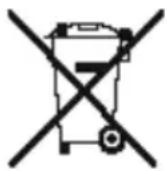
Old devices that carry the symbol illustrated may not be disposed of in ordinary household waste.
In accordance with Directive 2012/19/EU, these devices must be disposed of correctly at the end of their service life.
This involves separating the materials in the devices for the purpose of recycling and minimising the environmental impact.
Take old devices to a collection point for electrical scrap or a recycling centre. Before doing so, remove the batteries from the device and take them to a separate collection point for used batteries.
Contact your local waste disposal company or your local authority for more information on this subject.
BATTERIES
Do not dispose of used batteries with normal household rubbish. Batteries must be disposed of correctly. For this purpose, retailers that sell batteries and local collection points provide containers in which you can dispose of them. Contact your local waste disposal company or your local authority for more information.
In connection with the sale of batteries or the supply of devices containing batteries, we are obliged to draw your attention to the following:
As the end user, you are legally required to return used batteries.
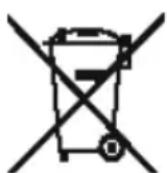
The crossed-out wheelie bin symbol means that the battery must not be disposed of with household rubbish.
16. Technical specifications
| Device | |
| Input voltage 100–240 V ~ 50/60 Hz | |
| Power consumption during operation | Approx. 28 W |
| Output power 2 x 5 watt RMS | |
| Protection class Protection class II | |
| Laser output Class 1 laser product | |
| Supported formats CD-R, CD-RW, audio CD | |
| Number of memory slots of the programmable playback | 20 tracks (CD), 99 tracks (MP3) |
| Backup batteries 2 x 1.5 V R03/LR03/AAA | |
| Radio | |
| DAB radio frequency range 174.928–239.200 MHz | |
| FM radio frequency range 87.5–108 MHz | |
| Station memory 30 | |
| Aerial Wire aerial | |
| Connections | |
| Aux In 3.5 mm jack | |
| USB | DC 5 V—— max. 100mA, standard USB host, version 2.0, up to 32 GB (FAT32), no charging functionality |
| Environmental conditions | |
| Temperatures | In operation: 10°C to +25°CNot in operation (in packaging):-5°C to +30°C |
| Humidity(non-condensing) | In operation: < 25-70%Not in operation (in packaging): 20%~75% |
| Dimensions / weight | |
| Device dimensions (W × H × D) Approx. 18 × 10.3 × 19.5 cm | |
| Loudspeaker dimensions (W×H×D) | Approx. 13.3 × 17.3 × 12.3 cm |
| Device weight Approx. 924 g | |
| Loudspeaker weight Approx. 688 g | |
| Remote control | |
| Battery 1x 3 V CR2025 | |
| Bluetooth® | |
| Frequency 2402 to 2480 MHz | |
| Maximum transmission power 8.82 dBm | |
| Version 2.1+EDR | |
| Profile A2DP 1.2; AVRCP 1.2, 1.4; Class II | |
| Range Up to 10 metres (without obstacles) | |
| Operating frequency 2.4 GHz | |
16.1. Symbols on the type plate

Protection class II
Electrical devices in protection class II are devices that have double and/or reinforced insulation throughout and do not have the option of connecting a protective earth. The housing of an electrical device in protection class II, with surrounding insulating material, might either form all of the additional or reinforced insulation, or part of it.

CE labelling
Products that feature this symbol meet the requirements of the EU directives (see chapter entitled "Declaration of conformity").
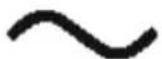
Symbol for alternating current (AC)
17. Legal Notice
Copyright © 2020
Date: 27. May 2020
All rights reserved.
These operating instructions are protected by copyright.
Mechanical, electronic and any other forms of reproduction are prohibited without the written permission of the manufacturer.
Copyright is owned by the company:
MEDION AG
Am Zehnthof 77
45307 Essen
Germany
Please note that you cannot use the address above for returns. Please always contact our Customer Service team first.
18. Privacy statement
Dear Customer,
We wish to inform you that we, MEDION AG, Am Zehnthof 77, 45307 Essen, Germany process your personal data as a data controller.
For matters regarding data protection, we are supported by our company data protection officer, who can be contacted at MEDION AG, Datenschutz, Am Zehnthof 77, D – 45307 Essen; datenschutz@medion.com. We process your data for the purpose of warranty processing and associated processes (e.g. repairs) and rely on the sales contract concluded with us when processing your data.
Your data will be provided to repair service providers contracted by us for the purpose of warranty processing and associated processes (e.g. repairs). We generally store your personal data for a period of three years in order to fulfil your legal warranty rights.
You have the right to be informed of the personal data concerned as well as the right to rectification, erasure, restriction of processing, the right to object to processing and the right to data portability.
In the case of the right to be informed and the right to erasure, restrictions apply according to paragraphs 34 and 35 of the BDSG (Federal Data Protection Act) (Art. 23 of the GDPR). In addition, there is a right of appeal to a competent data protection supervisory authority (Article 77 of the GDPR in conjunction with paragraph 19 of the BDSG). For MEDION AG, this is the state official for data protection and freedom of information North Rhine-Westphalia, PO box 200444, 40212 Düsseldorf, Germany, www.ldi.nrw.de.
The processing of your data is necessary for warranty processing: it is not possible to process the warranty without the provision of the required data.
Sommaire
- Information about this user manual....45
- Proper use
- EU Declaration of Conformity......47
- Trademark information ......ES
- Safety information
- Package contents
- Device overview
- Getting started
- Setting up the device 59
- Operating the device....62
- Radio....65
- Information about this user manual
- Explanation of symbols
- DANGER!
- WARNING!
- CAUTION!
- NOTICE!
- EU Declaration of Conformity
- Trademark information
- Restricted group of people
- Risk of choking and suffocation!
- Operating safety
- Risk of electric shock!
- Power supply
- Installation location/surroundings
- Risk of damage to the device!
- Repairs
- CD player
- Drivers and connections
- Handling batteries
- Risk of chemical burns!
- Cleaning the device
- Possible material damage
- Front
- Rear
- Remote control
- 32) DAB/FM
- Inserting/replacing the battery in the remote control
- Risk of explosion!
- Inserting/replacing backup batteries
- Setting up the device
- Connecting the supplied loudspeakers
- Mains connection
- Connecting an external device
- Connecting headphones
- Risk of hearing damage!
- Adjusting the aerial
- Operating the device
- Switching on the device/standby
- Selecting the operating mode
- Audio functions
- Volume/mute
- Equaliser/bass amplification
- Setting the time
- Sleep timer
- Setting/switching off the timer
- Radio
- Storing stations automatically
- Tuning the stations
- In FM mode
- In DAB mode
- Station search (FM mode only)
- Storing a radio station
- Storing stations manually
- Retrieving stored stations
- Stereo/mono reception (FM mode only)
- Station information
- Radio menu
- Overview of the menus in the FM and DAB operating modes
- Playing back CDs and USB storage media
- Note the following:
- Inserting a CD
- Connecting USB devices
- Start/pause/stop playback
- Track selection, rewind/fast forward
- Folder selection
- Programming the track playing order
- Repeat
- Random playback
- Bluetooth mode
- Connecting Bluetooth devices for the first time
- Disconnecting the connection
- Control
- Connecting an external playback device
- Cleaning
- Troubleshooting
- Risk of injury!
- End of operation
- Disposal
- PACKAGING
- DEVICE
- BATTERIES
- Technical specifications
- Symbols on the type plate
- Protection class II
- CE labelling
- Legal Notice
- MEDION AG
- Am Zehnthof 77
- Essen
- Germany
- Privacy statement
- Sommaire
Brand : MEDION
Model : LIFE P64187 (MD 44087)
Category : Hi-fi system