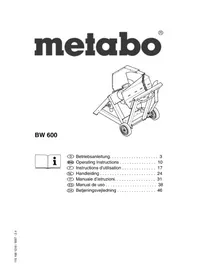
USER MANUAL BW 600 METABO
We herewith declare in our sole responsibility that this product complies with the following standards" in accordance with the regulations of the undermentioned Directives** testreport *** issuing test office ***
98/37/EG,89/366/EWG,2006/95/EG,93/68/EWG
B-EG 2001/019
1 Blade guard
2 Feed rocker
3 Wheel set
4 Mains connection
5 ON/OFF switch
6 Motor
7 Assembly wrench (2x)
Table of Contents
- Parts identification (standard delivery) 10
- Please Read First! 11
- Safety 11
3.1 Specified conditions of use 11
3.2 General safety instructions 11
3.3 Safety devices 12
3.4 Symbols on the machine 12
- Special Product Features....12
- Transportation and installation. 12
5.1 Machine installation 12
5.2 Mains connection.. 13
- Operation 13
6.1 Cutting 13
- Care and Maintenance..14
7.1 Saw blade change 14
7.2 Saw storage. 15
7.3 Maintenance 15
- Available accessories 15
- Repairs. 15
- Environmetal protection 15
- Trouble shooting 15
- Technical Specifications....16
- Available saw blades.. 16/53
2. Please Read First!
These instruction have been written in a way which facilitates learning of how to safely operate your saw. Here is a guide on how you should read these instructions:
- Read these instructions before use. Pay special attention to the safety instructions.
These instructions are intended for persons having a basic technical knowledge of the operation of machines such as the one described herein. If you have no experience whatsoever, we strongly recommend to seek the advise of an experienced person.
- Keep all documents supplied with this machine for future reference. Retain proof of purchase in case of warranty claims.
If you lend or sell this machine be sure to have all machine documents supplied go with it.
- The equipment manufacturer is not liable for any damage resulting from neglect of these operating instructions.
Information in these instructions is denoted as under:
Danger! Risk of personal injury or environmental damage.
Risk of electric shock! Risk of personal injury by electric shock.
Caution! Risk of material damage.

Note: Additional information.
Numbers in illustrations (1, 2, 3, ...)
- denote component parts;
are consecutively numbered;
-
relate to the corresponding number(s) in brackets (1), (2), (3) ... in the neighbouring text.
-
Instructions to be carried out in a certain sequence are numbered.
- Instructions which can be carried out in any sequence are indicated by a bullet () .
- Listings are indicated by an En Dash (-).
3. Safety
3.1 Specified conditions of use
This machine is only intended for cutting firewood as described in these instructions. Any other use is not as specified. Unspecified use, modifications to the machine, or use of parts not tested and approved by the manufacturer may cause unforeseeable damage!
This machine is intended for operation by one person. Other persons shall keep a sufficient distance to the machine.
Do not use logs larger than the dimensions the saw can handle safely (see "Technical Specifications").
Never cut several workpieces at the same time - and also no bundles containing several individual pieces. Risk of personal injury if individual pieces are caught by the saw blade uncontrolled. Never cut logs containing the following:
- ropes
strings
- cords
- cables
- wires.
Do not overload machine - use it only within the performance range it was
designed for (see "Technical specifications").
Use this machine out of doors only.
3.2 General safety instructions
When using this machine observe the following safety instructions, to exclude the risk of personal injury or material damage.
Please also observe the special safety instructions in the respective chapters; where applicable, follow the legal directives or regulations for the prevention of accidents pertaining to the use of circular saws.

General hazards!
Be alert. Know what you are doing. Set out to work with reason. Do not operate machine while under the influence of drugs, alcohol or medication.
Keep your work area tidy - a messy work area invites accidents.
Regularly clear the work area of the cut logs.
Store logs to be cut and the cut logs near the workplace.
Prevent adverse body positions. Ensure firm footing and keep your balance at all times.
Consider environmental effects:
Provide proper lighting.
Do not operate machine near inflammable liquids or gases.
This machine shall only be started and operated by a person familiar with circular saws and who is at all times aware of the dangers associated with the use of such machine.
Keep bystanders, particularly children, out of the danger zone. Persons under 18 years of age shall use this machine only in the course of their vocational training, under the supervision of an instructor.
Do not permit other persons to touch the machine or power cable while it is running.

Danger! Risk of electric shock!
To ensure the machine remains weatherproof, before any use check to see that the switch, power cable or plug are not damaged (no cracks, etc.)
Do not use the power cable for any purpose it is not intended for.

Risk of personal injury and crushing by moving parts!
Do not operate the machine without installed guards.
Keep sufficient distance to driven components when operating the machine.
Ensure the machine is disconnected from power supply before servicing.
Ensure that when switching on (e.g. after servicing), no tools or loose parts are left on or in the machine.
Turn power OFF if the machine is not used.

3.Hazard generated by modifica
tion of the machine or use of parts not tested and approved by the equipment manufacturer!
Use only parts approved by the equipment manufacturer. This applies particularly to:
- saw blades (see "Technical Specifications" for stock numbers);
- safety devices (see "Spare Parts List" for stock numbers).
Do not change any parts.

Hazard generated by machine defects!
Keep machine and accessories in good repair. Observe the maintenance instructions.
Prior to any use check the machine for possible damage: before operating the machine all safety devices, protective guards or slightly damaged parts need to be checked for proper function as specified. Check to see that all moving parts work properly and do not jam. All parts must be correctly installed and meet all conditions necessary for the proper operation of the machine.
Damaged protection devices or parts must be repaired or replaced by a qualified specialist. Have damaged switches replaced by a service centre. Do not use this machine if the switch can not be turned ON or OFF.
Keep handles free of oil, grease and resin.
3.3 Safety devices
Motor protection
The electronic motor protection stops the motor by overcurrent detection, should the motor be locked (e.g. by a jamming saw blade)
No-voltage release
The no-voltage release feature prevents the machine from starting up when the power is restored after a power failure.
Motor brake
The motor brake brakes the saw blades after the machine has been turned OFF. With an intact motor brake the post-running of the saw blade shall not exceed 10 seconds.
Feed rocker
The feed rocker allows for a safe feeding of the logs to be cut. When the feed rocker is released it must automatically return to its starting position.
Blade guard
During operation the blade guard must always be installed. It must not show any signs of damage. The blade guard's extension arm must automatically return to its starting position.
3.4 Symbols on the machine

Danger!
Disregard of the following warnings could lead to severe personal injury or material damage.

Wear hearing protection.
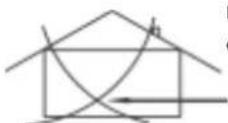
Use this machine out of doors only.
SP 600× 2.8× 30
Max saw blade: 600 mm
Saw blade thickness: 2.8 mm
Sawblade arbor bore: 30 mm
n max. 2500 rpm Max. saw blade speed
Z=56 KV Number and con-figuration of teeth: 56 combination multiple teeth
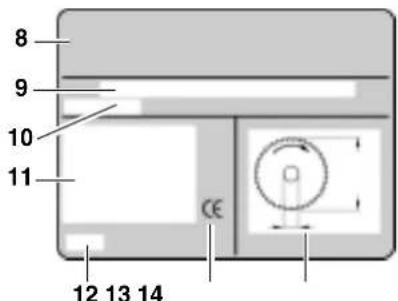
(8) Manufacturer
(9) Serial number
(10) Machine designation
(11) Motor specifications (see also "Technical Specifications")
(12) Date of manufacture
(13) CE mark - this machine meets the EC directives as per declaration of conformity
(14) Dimensions of permissible saw blades
4. Special Product Features
- Robust, powder-coated welded steel construction for maximum torsional resistance at low weight.
- Hinged wheel set for unproblematic relocating.
Powerful, splash-proof three-phase motor.
5. Transportation and installation
5.1 Machine installation

Danger!
This machine shall only be operated at a location meeting the following conditions:
outdoors
level, non-slip ground
- all four of the machine's legs must be able to stand firmly on the ground.
- Transport the machine on the pallet to a suitable location.
- Remove packing and enclosed parts.
- Remove the screws holding the machine on the pallet.
- Lift machine off the pallet.
- Remove transport brace (15).
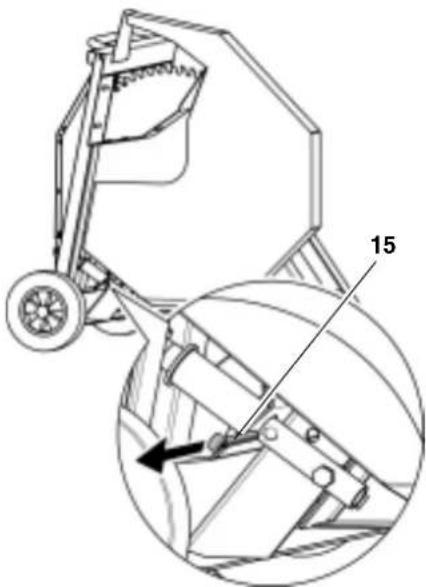

Note:
Always install the transport brace before transporting the saw.
5.2 Mains connection

Danger! High voltage
Operate the saw only on a power source matching the following requirements (see also "Technical Specifications"):
- Outlets with neutral wire, being properly installed, earthed and tested.
- Mains voltage and frequency must conform with the data stated on the machine's nameplate.
- Fuse protection by a residual current device (RCD) of 30mA fault current sensitivity.
System impedance Z_max at the interconnection point (house service connection) 0.35 Ohm maximum.

Note:
Check with your local Electricity Board or electrician if in doubt whether your house service connection meets these requirements.
Position power supply cable in a way that it does not interfere with the work and is not damaged.
Protect power supply cable from heat, aggressive liquids and sharp edges.
Use only rubber-jacketed cable of sufficient lead cross section as extension cable.
Do not pull on power supply cable to unplug.

Changing the direction of rotation!
Depending on the phase sequence it is possible that the motor will turn in the wrong direction. This can lead to the log being hurled away when attempting to make a cut. Therefore the rotational direction must be checked every time the machine is connected to a different outlet. With an incorrect direction of rotation the phase changer in the machine's CEE plug needs to be changed-over:
- Install machine ready for work and connect it to the power mains.
- Start machine and immediately turn OFF again.
- Check the saw blade's direction of rotation from the left-hand side of the saw. The saw blade must rotate clockwise.
-
If the saw blade rotates counterclockwise, unplug the power cable at the saw.
-
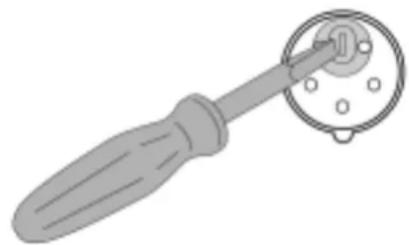
Using a flat blade screwdriver, push the phase changer inside the machine's plug down and turn it by 180^ .

Caution!
Do not attempt to turn the phase changer at the contact pins!
6. Operation
Please take note of the following safety information before operating the machine!
Also follow the safety instructions given at the beginning of this manual!

Hazard generated by machine defects!
Before starting any work, check to see that the following are in proper working order:
- Saw blade (firmly mounted? undamaged? sharp? sufficient distance to other parts?)
- Blade guard (undamaged? distance to saw blade sufficient? does extension arm return to starting position automatically?)
- Feed rocker (must automatically return to the starting position)
- Power cable, power cable plug and switch (if damaged, have replaced by a qualified electrician)
- Motor brake (after switching OFF, no more than 10 seconds post-running of saw blade)

Risk of injury by inhaling wood dust!
Dust of certain timber species (e.g. oak, beech, ash) can cause cancer when inhaled:
Work only out of doors.
- When working, take care that as little wood dust as possible will get into the surroundings:
- Remove wood dust depositions in the work area (do not blow away!).

Hazard generated by insufficient personal protection gear!
- Wear suitable work clothing, providing protection against falling logs.
-
Wear hearing protection.
-
Wear safety glasses.
- Wear dust mask.
- Wear non-slip safety shoes.
Take care that no parts of your body or clothing are caught by rotating components (do not wear neckties or loose fitting garments; contain long hair with a hairnet).

Risk of personal injury and crushing by moving parts!
- Do not operate the machine without installed guards.
- Keep sufficient distance to driven components when operating the machine.
-
Remove small cutoffs, splinters, etc. near the rotating saw blade only with the blade at standstill.
Always use the feed rocker to feed the logs to be cut.
Always hold the feed rocker with both hands at its handle.
Assume proper operating position:
-
at the front of the saw;
in front of the saw;
- offset to the line of cut.
After each cut return the feed rocker completely to its starting position.

Hazard generated by pieces of wood being hurled away!
Always place curved logs on the feed rocker with the curved side facing the handle.
- Do not jam the log to be cut.
- Do not attempt to stop the saw blade by pushing the workpiece against its side.
- Avoid cutting workpieces or cuts, which may result in several small pieces that may be hurled away or could get stuck.
Always use sharp saw blades.
- If in doubt, inspect the logs for foreign matter (e.g. nails or screws).
- Never cut several logs at the same time - and also no bundles containing several individual pieces. Risk of personal injury if individual pieces are caught by the saw blade uncontrolled.
- Avoid making cuts that will cause the position of the workpiece to change uncontrolled.
- Cut only logs of permissible dimensions (see "Technical Specifications").
6.1 Cutting
- Start machine and let the motor reach full speed.
ENG ENGLISH
-
Place a log on the feed rocker.
-
To make the cut, push the feed rocker (16) with both hands at the handle towards the saw blade:
exert only so much pressure that the motor speed does not fall off
push feed rocker forward until it hits the stop
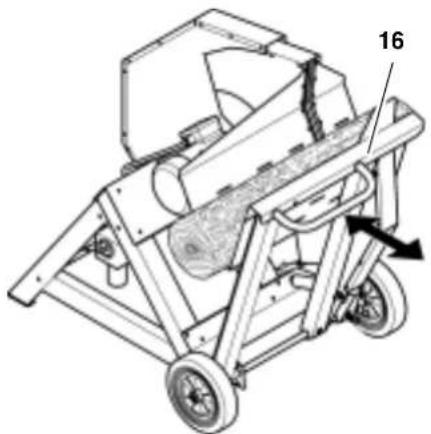
- Return feed rocker completely to the starting position.

Note:
If the log was not completely separated, turn it over and repeat the cutting operation from the opposite side (reversing cut).
- Remove the cut-off section from the feed rocker.
- Clean the feed rocker, to provide secure holding for the next log to be cut.
- Now the next log can be cut.
- If no further cutting is to be done immediately afterwards, turn machine OFF.
7. Care and Maintenance

Danger!
Prior to all servicing:
- Switch machine OFF
- Wait for saw blade to stop
-
unplug power cable
-
Check that all safety devices are operational again after each service.
- Replace damaged parts, especially safety devices, with genuine replacement parts only, since parts not tested and approved by the manufacturer can cause unforeseeable damage.
Repair and maintenance work other than described in this section should only be carried out by qualified specialists.
7.1 Saw blade change
Danger!
Directly after cutting the saw blade can be very hot - burning hazard! Let a hot saw blade cool down. Do not clean the saw blade with combustible liquids.
Risk of injury, even with the blade at standstill. Wear gloves when changing blades.
When assembling, observe the direction of rotation of saw blade and outer blade flange!
- Loosen screw fitting (17) of the stop limiter and lower the feed rocker (18) carefully.
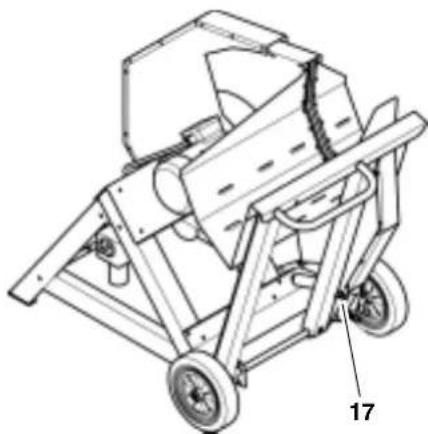
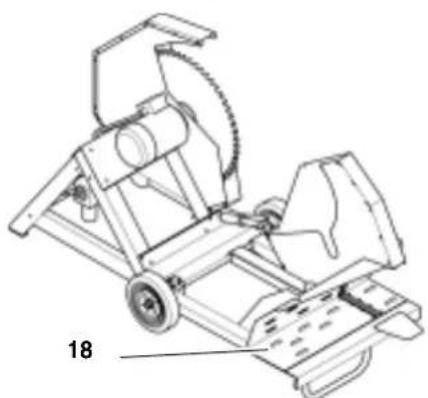
- Hold outer blade flange (19) with assembly wrench and loosen the arbor bolt (23) (R.H. thread!).
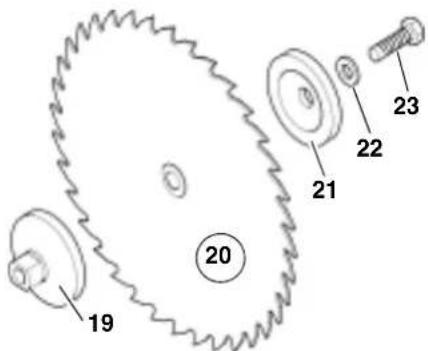
- Remove arbor bolt (23), spring lock washer (22) and outer blade flange (21) from the saw spindle (20).
-
Take the saw blade (20) off the saw spindle.
-
Clean clamping surfaces of:
-
saw spindle,
innerbladeflange,
- saw blade,
- outer blade flange,
washer,
- arbor bolt.
Danger!
Do not use cleaning agents (e.g. to remove resin residue) which could corrode the light alloy components; this can have an adverse effect on the machine's stability.
Do not clean the saw blade with combustible liquids.
- Install inner blade flange (19) and fresh saw blade (20), observing the direction of rotation.
Danger!
Use only saw blades conforming to the technical specifications and EN 847-1 - parts of unsuitable or damaged saw blades may be hurled away explosive-like.
Do not use:
- saw blades made of high speed steel (HS or HSS);
- saw blades with visible damage;
cut-off wheel blades.
Danger!
- Mount saw blade only using genuine parts.
- Do not use loose-fitting reducing rings; the saw blade could work loose.
Saw blades have to be mounted in such way that they do not wobble or run out of balance and can not work loose during operation.
- Put on the outer blade flange - (21) the key on the saw spindle must engage in the groove of the outer blade flange!
- Put on the washer (22), then screw arbor bolt (23) in (RH thread!) and tighten fully.
Danger!
- Do not extend arbor bolt tightening wrench.
- Do not tighten arbor bolt by hitting on the assembly wrench.
After tightening the arbor bolt, remove both assembly wrenches.
- Lift the feed rocker (18) back to its starting position.
- Reinstall the screw fitting (17) of the stop limiter.
7.2 Saw storage

Danger!
Store saw so that
- it can not be started by unauthorized persons, and
- nobody can get injured.

Caution!
Do not store saw unprotected
outdoors or in damp environment.

Note:
Always install the transport brace
before transporting the saw.
To keep the saw blade from rusting, spray with Cleaning and Maintenance Spray (optional accessory) before storing it for a longer time.
7.3 Maintenance
Every 50 hours of operation
Check all screwed connections, tighten if necessary (Rocker and rocker stop must remain movable).
Check saw blade for firm seat, wear and sharpness.
Remove any deposits that may have build up inside the saw blade cover.
8. Available accessories
For special tasks the following accessories are available at your specialized dealer - see back cover for illustrations:
A Saw blade
SP 600× 2.8× 3056 KV
Standard saw blade
B Saw blade
CV 600 x 2.8 x 30 56 WZ
CV steel, for hardwoods and soft wood.
C Saw blade
HW 600× 3.9 / 2.8× 3026 WZ
Tungsten carbide tipped, especially for hardwoods and an extended edge life.
9. Repairs

Danger!
Repairs to electric tools must be carried out by qualified electricians only!
Electric tools in need of repair can be sent to the service centre of your country. Refer to the spare parts list for the address.
Please attach a description of the fault to the electric tool.
The machine's packing can be 100% recycled.
Worn out electric tools and accessories contain considerable amounts of valuable raw and plastic materials, which can be recycled.
These instructions are printed on paper produced with elemental chlorine free bleaching process.
11. Trouble shooting

Danger!
Before carrying out any fault service or maintenance work, always:
- Switch machine OFF
- unplug power cable
- Wait for saw blade to come to standstill.
Check that all safety devices are operational again after each fault service.
Motor does not run
No mains voltage:
- check cables, plug, outlet and mains fuse.
Mains voltage too low:
use power supply cable of sufficient lead cross section (see "Technical Specifications").
No-voltage release solenoid tripped by temporary power failure:
Overload protection tripped:
let motor cool down for approx. 10 minutes, then start motor again.
Motor locked, e.g. by a blocked saw blade:
- remove cause for blocking, let motor cool down if necessary, then start motor again.
Incorrect rotational direction of saw blade
Phase sequence changed at the phase changer:
- Change direction of rotation (see "Mains Connection").
Saw blade dull (burn markings on the cut edges):
have saw blade resharpened or replace it (see "Maintenance").
Set of teeth insufficient:
have teeth properly set or replace saw blade (see "Maintenance").
Saw blade soiled by resin:
clean saw blade (see "Maintenance").
Wood is too wet:
let wood dry before cutting.
- Technical Specifications
| Electrical data Voltage | V | 400 (3 ~ 50 Hz) |
| Nominal current | A | 6,5 |
| Fuse protection min. (time-lag or K-type breaker) | A | 10 |
| Protection class | | IP 54 |
| Motor | Power input P1 | kW | 4.2 kW S6 40% |
| Power output P2 | kW | 2.7 kW S6 40% |
| Speed | min-1 | 1250 |
| Saw blade Maximum diameter (outer) | mm | 600 |
| Arbor bore diameter (inner) | mm | 30 |
| Thickness | mm | 2,8 |
| Maximum cutting speed | m/s | 39 |
| Maximum dimensions of logs to be cut | | |
| Maximum diameter (reversing cut) | mm | 210 |
| Minimum diameter | mm | 25 |
| Maximum length | mm | 1000 |
| Minimum length | mm | 300 |
| Machine dimensions | | |
| Length | mm | 1225 |
| Width | mm | 795 |
| Height | mm | 1050 |
| Machine weight kg 102 | | |
| Noise emission acc. to ISO 7960, Appendix N* | | |
| Sound level idle running LWA | dB (A) | 97 |
| Sound level when cutting LWA | dB (A) | 101 |
| Included uncertainty K | dB | 0.8 |
| * The values stated are emission values and as such do not necessarily constitute values which are safe for the workplace. Even though a correlation between emission values and immission values exists, it can not be reliably derived from these values whether additional precautions are required or not. Factors having an effect on the actual immission level at the workplace include the characteristics of the workroom, as well as other sources of noise,such as the number of machines and other working processes. Also, permissible workplace values may vary from country to country. This information is intended to assist the user in his estimate of hazards and risks. |
- Available saw blades
| Description Teeth configuration Stock-no. | |
| SP 600 x 2.8 x 30 56 KV | 56 combination multiple teeth | 091 000 3380 |
| CV 600 x 2.8 x 30 56 WZ | 56 alternate bevel teeth | 091 000 3445 |
| HW 600 x 3.9/2.8 x 30 26 WZ | 26 alternate bevel teeth | 091 000 3470 |
Overbelastingsbeveiling is ingekomen: