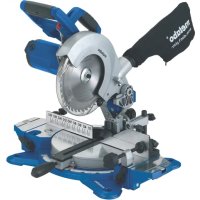
KS 216 Lasercut - Saw METABO - Free user manual and instructions
Find the device manual for free KS 216 Lasercut METABO in PDF.



| Product Type | Miter Saw |
| Brand | Metabo |
| Model | KS 216 Lasercut |
| Dimensions (device ready for use) | 480 × 543 × 325 mm |
| Weight | 9.0 kg |
| Power Supply | 220-240 V ~ 50/60 Hz, 6 A |
| Motor Power (S6 20% 5 min) | 1.35 kW |
| No-load Speed | 5000 min⁻¹ |
| Blade Diameter | 216 mm |
| Blade Bore | 30 mm |
| Cutting Capacity (0°/0°) | 120 × 60 mm (W × H) |
| Bevel Range | 0° to 45° left |
| Table Rotation Range | 47° left and right |
| Guide Laser | Class 2, 1.0 mW, 650 nm |
| Sound Power Level (LWA) | 86.8 dB(A) |
| Sound Pressure Level (LPA) | 99.8 dB(A) |
| Vibrations (handle) | < 2.5 m/s² |
| Safety Devices | Pendulum protective hood, safety lock, workpiece stop |
| Included Accessories | Chip collection bag, clamping device, side table extensions |
| Maintenance | Regular chip cleaning, blade change, laser adjustment |
Frequently Asked Questions - KS 216 Lasercut METABO
User questions about KS 216 Lasercut METABO
0 question about this device. Answer the ones you know or ask your own.
Ask a new question about this device
Download the instructions for your Saw in PDF format for free! Find your manual KS 216 Lasercut - METABO and take your electronic device back in hand. On this page are published all the documents necessary for the use of your device. KS 216 Lasercut by METABO.
USER MANUAL KS 216 Lasercut METABO
Director Innovation, Research and Development
Responsible Person for Documentation
© 2011 Metabowerke GmbH, 72622 Nürtingen, Germany
Inhaltsverzeichnis
- Declaration of Conformity ....11
- Components in the layout diagram 11
- Please Read First! 11
- Safety 11
- Installation and Transport ....13
6.Machine Details 13 - Initial Operation.. 13
- Operation 14
- Care and Maintenance 14
- Tips and Tricks.. 16
- Available Accessories 16
- Repair 16
- Disposal 16
- Trouble Shooting.. 16
- Technical Data.. 16
1. Declaration of Conformity
We declare in full responsibility that this product conforms with the standards and directives referred to on page 3.
2. Components in the layout diagram
Figure see page 2.
1 Handle
2 Carrying handle
3 Chip bag
4 Transport locking pin
5 Laser outlet
6 Sawhead tilt lock lever
7 Fence
8 Saw base (table)
9 Table broadening + carrying handle
10 Lock screw for rotating table
11 Stop lever for table extension
12 Rotating table
13 Table insert
14 Work clamp
15 Cutting area illumination
16 Retractable blade guard
17 Saw blade stop
18 Safety lock
19 Saw ON/OFF switch
3. Please Read First!
- Read instructions before use. Pay special attention to the safety information.
-
These instructions are intended for persons with basic technical knowledge regarding the operation of a device like the one described herein. If you have no experience whatsoever, you are strongly advised to seek competent advise and guidance from an experienced person before operating this machine.
-
Preserve all documents delivered together with this device. Retain proof of purchase in case of warranty claims. If you lend or sell this machine be sure to have all machine documents supplied go with it.
- The equipment manufacturer is not liable for any damage resulting from neglect of these operating instructions.
Information in this manual is denoted as follows:
Danger!
Risk of personal injury or environmental damage.
Risk
Risk of electric shock!
Risk of personal injury by electric shock.
Drawin
Risk of personal injury by body parts or clothing being drawn into the rotating saw blade.
Caution!
Risk of material damage.
i Note:
Additional information.
- The numbers in the figures at the beginning of these instructions
-
indicate component parts;
-
are consecutively numbered;
-
relate to the corresponding number(s) in brackets (1), (2), (3) ... in the text.
-
Numbered steps must be carried out in sequence.
- Instructions which can be carried out in any sequence are marked with a bullet (•).
- Listings are indicated by an En Dash (-).
4. Safety
4.1 Specified conditions of use
This compound saw (Crosscut saw) can be used for making rip and cross cuts, bevel cuts, litre cuts and compound litre cuts.
Work only materials suitable for cutting by the saw blade fitted (see the chapter on 'Technical Specifications' for available saw blades).
The permissible dimensions of the workpieces must be adhered to (see the chapter on 'Technical Specifications).
Stock having a round or irregular cross section (such as firewood) must not be cut as it cannot be securely held during cutting. When sawing thin stock layed on edge, a suitable auxiliary fence must be used for firm support.
Any use other than the use specified above is not allowed. Unspecified use, modifications to the machine, or use of parts not tested and approved by the equipment manufacturer may cause unforeseeable damage!
4.2 General Safety Instructions
- When using this machine observe the following safety instructions, to minimize the risk of personal injury or material damage.
- Please also observe the special safety instructions in the respective sections.
- Where applicable, follow the legal directives or regulations for the prevention of accidents pertaining to the use of crosscut saws.
#
General hazards!
- Keep your work area tidy - a messy work area invites accidents. Keep the floor clean from loose particles as chips and cuttings.
- Be alert. Know what you are doing. Set out to work with reason. Do not operate tool while under the influence of drugs, alcohol or medication.
- Consider environmental conditions. Sorgen Sie für gute Beleuchtung des Arbeitsbereichs.
- Prevent adverse body positions. Ensure firm footing and keep your balance at all times.
- Do not operate the machine near in-flammable liquids or gases.
- This tool may only be started and operated by persons familiar with cross-cut saws and who are aware of the dangers associated with the operation of such tools. Persons under 18 years of age shall use this device only in the course of their vocational training, under the supervision of an instructor.
- Do not let other persons, especially children touch the tool or the cable. Keep them away from the workung area.
- Do not overload device - use it only within the performance range it was designed for (see "Technical Specifications").
- Use the correct electric tool. Do not use inefficient machines for heavy duties. Do not apply electric tools for purposes they are not intended for. Do for instance not use a circular hand saw for cutting tree branches or logs.

Danger! Risk of electric
shock!
- Do not expose device to rain. Do not operate device in damp or wet environment.
- Prevent body contact with earthed objects such as radiators, pipes, cooking stoves, refrigerators when operating this machine.
- Do not use the power cable for any purpose it is not intended for.
- Regularly check the connection line of the electric tool and have it replaced by an approved professional if it is damaged.
- Regularly check the extension lines and replace them if damaged.

Risk of injury by moving
parts!
- Do not operate the tool without installed guards.
Always keep sufficient distance to the saw blade. Use suitable feeding aids if necessary. Keep sufficient distance to driven components when operating the machine. - Wait for the saw blade to come to a complete stop before removing cut-outs, waste wood etc. from the work area.
- Cut only stock of dimensions that allow for safe and secure holding while cutting.
- Use the fastening devices or a vice in order to secure the workpiece. This is safer than holding it by hand.
- Do not attempt to stop the saw blade by pushing the workpiece against its side.
- Before setting, maintaining or repairing the device pull the plug out of the socket.
- When turning ON the machine (e.g. after servicing) ensure that no tools or loose parts are left on or in the machine.
- Unplug the tool when not in use.
- Unused electric tools should be stored in a dry, high or locked place outside the range of children.

Cutting hazard, even with the
cutting tool at standstill!
- Wear gloves when changing cutting tools.
- Store saw blades in such a manner that nobody can get hurt.

Risk of sawhead kickback (the
saw blade is caught in the workpiece and the sawhead kicked up all of a sudden)!
-
Select a saw blade suitable for the respective material.
-
Hold the handle firmly. When the saw blade enters the work piece, the kickback risk is particularly high.
- Cut thin or thin-walled workpieces only with fine-toothed saw blades.
Always use sharp saw blades. Replace blunt saw blades at once. Increased risk of kickback when a blunt tooth gets caught by the workpiece's surface. - Do not jam work pieces.
- If in doubt, check workpiece for inclusion of foreign matter (e.g. nails or screws).
- Never cut several workpieces at the same time – and also no bundles containing several individual pieces. Risk of personal injury if individual pieces are caught by the saw blade uncontrolled.

Drawing-in/trapping hazard!
- Wear suitable clothes. Be careful that no part of your body or your clothing can be caught and pulled into the device by rotating components (wear no neckties, no gloves, no clothing with loose-fitting sleeves; contain long hair with a hairnet).
- Never saw any workpieces connected with ropes, strings, bands, cables or wires or containing such materials.

Hazard generated by insuffi
cient personal protection gear!
- Use a hearing protection in order to avoid becoming deaf.
- Wear safety goggles.
- Wear dust mask.
- Wear suitable work clothes.
- Wear non-slip shoes.
- Use a breathing mask when doing work involving dust emission.
- Use gloves when handling saw blades and rough tools. Carry saw blades in a container.

Risk of injury by inhaled wood
dust!
- Some types of wood dust (e.g. oak, beech and ash) may cause cancer when inhaled. Work only with a suitable dust extractor attached to the saw. Make sure that it is connected and used correctly. The dust collector must comply with the specifications stated in the Technical Specifications.
-
Make sure that as little as possible wood dust can escape into the environment:
-
remove wood dust deposit in the work area (do not blow away!);
- fix any leakages on the dust collector;
- ensure good ventilation.

Hazard caused by modification of the machine or use of parts
not tested and approved by the manufacturer!
- Strictly follow these instructions when assembling the device.
- Use of other tools and accessories can entail danger of personal injury. Use only parts approved by the manufacturer. This applies especially for:
-saw blades (see 'Available Accessories');
- safety devices (see spare parts list).
- Do not change any parts.
- Make sure that the speed indicated on the saw blade is at least as fast as the speed indicated on the saw.
- Use only distance disks and spindlerings suitable for the purpose indicated by the manufacturer.

Hazard generated by tool de
fecs!
- Keep the machine and accessories in good repair. Keep the cutting tools sharp and clean in order to be able to work better and more securely. Adhere to the information regarding lubrication and exchange of tools.
- Prior to any use check the machine for possible damage: before operating the machine all safety devices, protective guards or slightly damaged parts need to be checked for proper function as specified. Check to see that all moving parts work properly and do not jam. Make sure that all parts and accessories are properly installed and safely secured to ensure the safe and trouble-free operation of the machine.
- Do not use damaged or warped saw blades.
- Damaged protective devices or components must be repaired or replaced expertly by an approved workshop using original spare parts; otherwise accidents may occur. Do not operate tool if the switch cannot be turned ON or OFF.
- Keep handles free of oil and grease.
- Do not use the cable to pull the plug out of the socket. Protect the cable against heat, oil and sharp edges.

Risk of injury by noise!
- Wear hearing protection.
- For reasons of noise protection do not use warped saw blades. A warped blade is exiting vibrations to an especially large extent, e which means noise.

"Lasertediation hazard!"
Laser beams can cause serious eye injuries. Never look into the laser outlet.
Do not replace the laser with a different type laser. The laser must be repaired or replaced by the manufacturer of the laser or an authorised representative.
Danger from blocking workpieces or workpiece parts!
If blockage occurs:
- Switch machine OFF.
- Unplug mains cable.
- Wear gloves
- Clear blockage with suitable tool.
4.3 Symbols on the machine

Danger!
Disregard of the warnings could lead to severe personal injury or material damage.
Hazardous area warning
Do not reach into saw blade area.

Do not operate tool in damp or wet environment.
Read operating instructions.

Wear safety goggles and hearing protection.
4.4 Safety devices
Retractable blade guard (16)
The retractable blade guard protects against unintentional contact with the saw blade and from chips flying about.
Safety lock (18)
The safety lock blocks the retractable blade guard: the saw blade remains covered and the sawhead cannot be lowered unless the safety lock is disengaged by pushing it to the side.
Fence (7)
The fence keeps the workpiece from moving while it is cut. The fence must always be installed during sawing.
The additional extrusion (20) on the fence can be moved for cutting longer workpieces after the lock screw has been loosened (21):
5. Installation and Transport
Installing the transport handle
- Screw transport handle to sawhead. Make sure the lug in the handle fits into the recess (22) on the sawhead.
Installing the table extension
- Take right and left table extensions out of the transport packaging.
- Unscrew screws (23) on the guide rails of right and left table extensions.
- Push the guide rails of the table extensions all the way into the receptaclesMake sure the stock stop (24)
on the table extension can be swung up as illustrated.
- Lift saw at its front legs, tilt carefully to the rear and put it down on its back so that it cannot tip over.
- Screw screws back into the guide rails.
- Hold saw by its front leg, tilt carefully forward and put it down.
- Set the desired table width and stop the table extension with the stop lever (11).
Installation
For safe working the machine must be securely fastened to a sturdy support.
- This support may be a firmly attached plywood sheet or a workbench.
- The ideal height of the base is 800mm .
- The saw must remain stable, even when large workpieces are being cut.
- Long workpieces must additionally be supported using suitable accessories.
i Note:
For mobile use the device can be screwed onto a plywood or core bord 500mm× 500mm at least 19mm thick). When the machine is being used the sheet must be attached to a workbench with G-clamps.
- Firmly bolt machine to the support.
- Release transport lock: Press sawhead down lightly and hold. Pull transport locking pin (4) out of deep groove (25), rotate 90^ and engage with flat groove (26).
- Let the sawhead swing up slowly.
- Keep the packaging materials for later use or discard in an environmentally-oriented manner.
Transport
- Swing sawhead down and engage transport locking pin (4) with deep groove.
- Dismount all add-on parts projecting from the machine.
Caution!
Do not use the protective devices to transport the saw.
- Lift machine by the carrying handle.
6. Machine Details
ON/OFF switch for motor (19)
To turn the motor ON:
- Press and hold the ON/OFF switch.
To turn the motor OFF: - Release the ON/OFF switch.
ON/OFF switch for cutting area illumination (27)
Switch the lighting for the cutting area on and off.
ON/OFF switch for laser guide (28)
Switch the laser guide on and off.
Bevel tilt setting
After releasing the locking lever (7) on the rear the saw can be tilted to the left between 0^ and 45^ from vertical position (29).

Danger!
To keep the bevel angle from changing while sawing, the locking lever of the track arm holder must be tightened.
Rotating table
After the lock screw (10) has been loosened the rotating table can be adjusted. This way the cutting angle is changed against the guide edge of the work piece. Angles up to 47 left and right are possible.
The rotating table engages in positive stops at 0^ , 15^ , 22.5^ , 30^ and 45^ positions.

Danger!
To ensure that the metre angle does not change during cutting tighten the lock screw of the rotating table (also in the preset positions!).
7. Initial Operation
7.1 Installing the chip bag

Danger!
Some types of wood dust (e.g. oak, beech and ash) may cause cancer when inhaled.
- Always work with the dust bag installed or a suitable dust collector connected.
- In addition, use a dust respirator because the sawdust is not completely collected or extracted.
- Empty the chip bag periodically. Wear a dust mask when emptying the chip bag.
When operating the machine with the supplied dust bag:
-
Place the dust bag (3) on to the dust extraction port (30). Make sure the zipper (31) on the dust bag is closed. When operating the machine with a dust collector connected:
-
Use a suitable adapter for connecting the dust collector.
- Make sure the dust extractor meets the requirements specified in the section 'Technical Data'.
- Also follow the operating instructions supplied with the dust collector!
7.2 Installing the work clamp
The work clamp can be installed in two positions:
- For wide workpieces: insert the work clamp into the rear hole (33) in the table and secure with the lock bolt (34):
- For narrow workpieces: loosen the lock bolt (32) and insert the front part of the work clamp into the front hole (35) in the table:
7.3 Mains connection

Danger! High voltage
Operate the saw only on a power source matching the following requirements (see also the chapter on "Technical Specifications"):
- mains voltage and system frequency conform to the voltage and frequency shown on the machine's nameplate;
- fuse protection by a residual current operated device (RCD) of 30mA sensitivity;
-
Outlets properly installed, earthed and tested.
-
Make sure that the mains cable is out of the way so that it does not interfere with the work and cannot be damaged.
- Use only rubber cables of sufficient cross section (3 × 1.5 ~mm^2) as extension cables.
- Use an extension for outdoor areas. Only use approved and appropriately marked extension cables outdoors.
- Avoid inadvertent starting. Make sure that the switch is switched off when inserting the plug into the socket.
8. Operation
-
Before starting any work, check to see that the safety devices are in proper working order.
Assume proper operating position: - at the front of the saw: -
facing the saw;
to the side of the line of the saw blade.

Danger!
When sawing ensure that the workpiece is always clamped with the workclamp.
- Never saw workpieces which cannot be clamped with the work clamp.

Risk of crushing!
When tilting or swivelling the sawhead do not reach into the axis area of the sawhead holder or under the machine!
- Hold the sawhead securely when tilting.
- When working use the following: - work support - for long stock, which would otherwise fall off the table on completion of the cut; - chip bag or dust extractor.
- Cut only stock of dimensions that allow for safe and secure holding while cutting.
Always hold the workpiece down on the table and do not twist it. Do not attempt to stop the saw blade by exerting lateral pressure to it. Risk of injury if the saw blade is blocked.
8.1 Standard Cross Cuts
Starting position
- Transport locking pin pulled out.
Sawhead fully raised. - Rotating table in 0^ position, lock screw of the rotating table tightened.
Motorhead in vertical (90) position, bevel tilt locking lever tightened.
Cutting the workpiece
- Press the workpiece against the fence and clamp with work clamp.
- Activate the safety lock (18) and press and hold down the ON/OFF trigger switch (19).
- Slowly swing the sawhead fully down, holding the handle firmly. When sawing, exert only moderate pressure to prevent the motor speed from dropping too much.
- Cut workpiece in a single pass.
- Release the ON/OFF switch and let the sawhead slowly return to its upper starting position.
8.2 Mitre Cuts
Starting position
- Transport locking pin pulled out.
Sawhead fully raised.
Motorhead in vertical (90) position, bevel tilt locking lever tightened.
Cutting the workpiece
- Loosen the lock screw (10) of the rotating table (12).
- Set to desired angle.
- Tighten the rotating table's lock screw.
- Cut workpiece as described under "Standard Cross Cuts".
8.3 Bevel Cuts
Starting position
- Transport locking pin pulled out.
Sawhead fully raised. - Rotating table in 0^ position, lock screw of the rotating table tightened.
Cutting the workpiece
- Loosen the lock lever (6) for sawhead tilt at the rear of the saw.
- Tilt the sawhead slowly into the desired position (29).
-
Tighten the sawhead tilt lock lever.
-
Cut workpiece as described under "Standard Cross Cuts".
8.4 Compound litre cuts

The compound litre cut is a combination of litre and bevel cuts. This means the workpiece is cut at an angle other than 90^ against the rear guide edge and against its surface.

When cutting compound mitres the saw blade is much more exposed than normally - increased risk of injury. Always maintain a sufficient distance to the saw blade.
Starting position
- Transport locking pin pulled out.
Sawhead fully raised. - Rotary table locked in desired position.
- Track arm holder tilted to desired angle to the workpiece's surface and locked in place.
Cutting the workpiece
- Cut workpiece as described under "Standard Cross Cuts".
9. Care and Maintenance

Unplug before servicing.
- Repair and maintenance work other than described in this section should only be carried out by qualified specialists.
- Damaged parts, particularly safety devices, must only be replaced with genuine parts. Parts which have not been tested and released by the manufacturer can lead to unforeseen damage.
- Check that all safety devices are operational again after each service.
9.1 Saw blade change

Directly after cutting the saw blade can be very hot - burn hazard! Let a hot saw blade cool down. Do not clean a hot saw blade with combustible liquids.
During loosening and tightening of the arbor bolt, the retractable blade guard must encompass the saw blade. Wear gloves when changing blades.
-
Stop the sawhead in the upper position.
-
To keep the saw blade from turning press the lock knob (17) while at the same time turning the saw blade by hand until the blade lock engages.
- Unscrew arbor bolt (36) on saw spindle with hex key (left-hand thread!).
- Release safety lock (18), push retractable blade guard (16) up and hold.
- Carefully remove outer blade flange (37) and saw blade from saw spindle and close retractable blade guard again.
Danger!
Do not use cleaning agents (e.g. to remove resin residue) that could corrode the light metal components of the saw; the stability of the saw would be adversely affected.
- Clean clamping surfaces of:
-saw spindle (38),
-sawblade,
- outer blade flange (37) and
- inner blade flange (39).
Danger!
Fit the inner blade flange correctly! Otherwise the saw may be blocked or the saw blade could work loose! The inner blade flange is positioned correctly when the spring ring groove points to the saw blade and the flat side points to the motor.
- Put the inner blade flange (39) on the saw spindle.
- Release safety lock, push retractable blade guard up and hold.
- Mount new saw blade - observe direction of rotation: viewed from the left (open) side, the arrow on the saw blade must correspond with the direction of arrow (40) on the blade cover!
Danger!
Use only saw blades conforming to standards and which are designed for the maximum speed (see 'Technical Data') - when unsuitable or damaged saw blades are used, parts might be hurled away explosively by the centrifugal force.
Do not use:
-saw blades made of high speed steel (HSS);
-damaged saw blades;
- cutoff wheel blades.
Danger!
-
Mount saw blade using only genuine parts.
-
Do not use loose-fitting reduction rings; the saw blade could work itself loose.
- Saw blades have to be mounted in such a way that they do not wobble or run out of balance and cannot work loose during operation.
10.Close the retractable blade guard again.
11.Slide the outer blade flange on - the plain side must point towards the motor!
12.Insert the arbor bolt (left-hand thread!) and hand-tighten it. To keep the saw blade from turning press the lock knob while at the same time turning the saw blade by hand until the blade lock engages.
Danger!
- Do not extend arbor bolt spanner.
- Do not tighten arbor bolt by hitting the assembly spanner.
13.Tighten the arbor bolt.
14. Check the function. To do this release the safety lock and swing the crosscut saw down:
- The retractable blade guard must expose the saw blade without touching the saw blade or any other parts.
- When the saw is being returned to its starting position the retractable blade guard must return automatically so that the entire saw blade is covered.
- Turn the saw blade by hand. The saw blade must turn freely in all possible sawhead positions without touching other parts.
9.2 Replacing the table insert
Danger!
If the table insert is damaged there is a risk that small parts may become stuck between the table insert and the saw blade, causing the saw blade to jam. Replace damaged table inserts immediately!
- Unscrew the screws on the table insert (13). Rotate the rotary table and tilt the sawhead if necessary to reach the screws.
- Remove the table insert.
- Put in a new table insert.
- Tighten the table insert fixing screws.
9.3 Adjusting the Fence
- Loosen Allen head screws (41).
- Adjust fence (7) so that it is exactly square with the saw blade when the rotating table is locked in the 0 position.
- Tighten the Allen head screws.
9.4 Adjusting the laser guide
- Unscrew and remove the laser cover (45) and clean the outer surface of the glass if necessary.
Setting the laser to 90 degrees
- Loosen (or tighten) the right Allen screw (44) and/or the left Allen screw (42) to align the laser to 90 degrees.
Laser lateral adjustment
- Unscrew the centre Allen screw (43).
-
Slide the laser unit horizontally in the oblong hole:
-
To the right = cutting line marking is moved to the right as viewed by the operator.
-
To the left = cutting line marking is moved to the left as viewed by the operator.
-
Tighten the centre Allen screw again.
- Screw the laser cover (45) back on.
9.5 Cleaning the machine
Remove chips and sawdust with brush or vacuum cleaner from:
the setting devices;
- the operating elements;
the motor ventilation slots; - the space below the table insert; and
the area above the laser unit.
9.6 Storage
#
- Store the saw in such a way that it cannot be started by unauthorised persons.
Make sure that nobody can get injured by the stored machine.
#
- Do not store saw unprotected outdoors or in damp environments.
- Observe the permissible ambient conditions (see "Technical Data").
9.7 Maintenance
Prior to every use
- Remove sawdust with vacuum cleaner or brush.
- Check mains cable and plug for damage; if necessary have damaged parts replaced by a qualified electrician.
- Check all moving parts to see that they can move freely across their whole range of travel.
Periodically, depending on operating conditions
- Check all screwed joints, retighten if necessary.
- Check pull-back springs of the sawhead (the sawhead must return by
spring force to its upper starting position); replace if necessary.
- Apply light coat of oil to all guide elements.
10. Tips and Tricks
- For long stock use suitable supports on both sides of the saw.
- When performing bevel cuts, hold the work piece on the right side of the saw blade.
- When making cuts that will result in small cutoffs, use an auxiliary fence (this may be a suitable wooden board fixed to the machine's fence with screws).
- When sawing a distorted board (46) lay the outward bent side towards the stock fence.
- Do not cut stock standing on edge; always place it flat on the rotating table.
11. Available Accessories
For special tasks the following accessories are available at your specialised dealer - see the beginning of these instructions for illustrations:
A TCT Saw Blade 216× 2,4× 1,8 30 24 alternate bevel teeth For rip and cross cuts in solid wood.
B TCT Saw Blade 216× 2,4× 1,8 30 48 alternate bevel teeth For rip and cross cuts in solid wood and particle board.
C TCT Saw Blade 216× 2,4× 1,8 30 60 trapezoidal flat teeth For rip and cross cuts in faced and veneered sheets.
D Saw Blade Depot For safe storing of saw blades and accessories.
E Care and Maintenance Spray For removing resin residue and preserving metal surfaces.
F Suction Adapter For connecting of a dust extractor to the dust extraction port.
G Machine Stands Machine stands and table side extension with stable and robust construction. Height-adjustable.
12. Repair
Danger!
Repairs to power tools may only be carried out by qualified electricians!
Please contact your Metabo representative if you have electric tools in need of repairs. For addresses see www.metabo.com.
Spare parts lists can be downloaded under www.metabo.com.
13. Disposal
Separated collection! This product must not be disposed of together with regular household waste.
End-of-life power tools and accessories contain large amounts of valuable raw materials and plastics which must be recycled.
Only for EU countries:
Do not throw electric tools in the household waste! In accordance with European Directive 2002/96/EG regarding old electric and electronic devices
and the respective adaptation of national law, used electric tools must be collected separately and recycled in an ecologically sound manner.
14. Trouble Shooting
This section describes problems and malfunctions which you should be able to resolve yourself. If the measures described here do not solve your problem, see 'Repairs'.
Danger!
Many accidents happen particularly in connection with problems and faults. Therefore please note the following:
Always unplug before troubleshootinging.
- Check that all safety devices are operational again after each fault service.
No crosscut function
Transport locking pin engaged:
Pull transport locking pin out.
Safety lock engaged:
- Release safety lock.
Sawing performance too low
Saw blade blunt (possibly tempering marks on blade body):
Saw blade not suitable for material being cut (see section 'Technical Data');
Saw blade warped:
- Replace saw blade (see section 'Maintenance').
Saw vibrates heavily
Saw blade warped:
- Replace saw blade (see section 'Maintenance').
Saw blade incorrectly mounted: - Remove the saw blade and then mount it again correctly (see chapter 'Care and Maintenance').
Rotary table stiff
Sawdust build-up under rotary table:
- Remove saw dust.
15. Technical Data
| Voltage V 220 - 240 (1~50/60 Hz) | ||
| Current draw A 6 | ||
| Fuse protection | A 10 (time-lag) | |
| Motor capacity (S6 20% 5 min.) | kW | 1.35 |
| Protection rating | IP | 20 |
| Protection class | II | |
| Saw blade speed | min-1 | 5000 |
| Cutting speed | m/s | 55 |
| Saw blade diameter (outer) | mm | 216 |
| Arbor bore | mm | 30 |
| Dimensions Machine in packaging (length × width × height) Machine ready for operation, rotary table in 90° position (length × width × height) | mm mm | 480 × 530 × 350 480 × 543 × 325 |
| Maximum workpiece cross section: Standard cross cuts - Turntable 0°/ rocker arm 0° Mitre cuts - Turntable 15°/ rocker arm 0° - Turntable 22,5°/ rocker arm 0° - Turntable 30°/ rocker arm 0° - Turntable 45°/ rocker arm 0° Bevel cuts - Turntable 0°/ rocker arm 45° Compound litre cuts - Turntable 15°/ rocker arm 45° - Turntable 22,5°/ rocker arm 45° - Turntable 30°/ rocker arm 45° - Turntable 45°/ rocker arm 45° | mm | width / height |
| 120 / 60 | ||
| 110 / 60 | ||
| 105 / 60 | ||
| 100 / 60 | ||
| 80 / 60 | ||
| 120 / 45 | ||
| 110 / 45 | ||
| 105 / 45 | ||
| 100 / 45 | ||
| 80 / 45 | ||
| Weight Machine in packing Machine ready to work | kg | 12,6 |
| 9,0 | ||
| Permissible temperature for transport and storage °C 0 to +40 | ||
| Noise emission according to EN 61029-1 Sound power level LWA Sound pressure level at operator's ear LPA Uncertainty K | dB(A) dB (A) dB (A) | 86.8 99.8 3,0 |
| Effective value of weighted acceleration according to EN 61029-1 (Vibration on handle) Vector sum ah Uncertainty K | m/s2 m/s2 | < 2.5 1.5 |
| Dust collector (not included in standard delivery): Diameter of dust extraction port at rear of saw Minimum air volume flow Minimum vacuum at suction port Minimum air speed at suction port | mm m3/h Pa m/s | 31.6 460 530 20 |
| Laser guide: Laser product class Laser product standard Max. output power P Wave lengthλ | mW nm | 2 EN 60825-1: 1994 +A1 +A2 1.0 650 |
| * The values stated are emission values and as such do not necessarily constitute values which are safe for the workplace. Although there is a correlation between emission levels and environmental impact levels, whether further precautions are necessary cannot be derived from this. Factors influencing the actually present environmental impact level in the workplace include the characteristics of the work area and other noise sources, i.e. the number of machines and other neighbouring work processes. The permitted workplace values can likewise vary from country to country. This information is intended to assist the user in his estimate of hazards and risks. | ||
Table des matieres

- Inhaltsverzeichnis
- Declaration of Conformity
- Components in the layout diagram
- Please Read First!
- Danger!
- Risk
- Risk of electric shock!
- Drawin
- Caution!
- i Note:
- Safety
- Specified conditions of use
- General Safety Instructions
- #
- General hazards!
- Danger! Risk of electric
- shock!
- Risk of injury by moving
- parts!
- Cutting hazard, even with the
- cutting tool at standstill!
- Risk of sawhead kickback (the
- saw blade is caught in the workpiece and the sawhead kicked up all of a sudden)!
- Drawing-in/trapping hazard!
- Hazard generated by insuffi
- cient personal protection gear!
- Risk of injury by inhaled wood
- dust!
- Hazard caused by modification of the machine or use of parts
- not tested and approved by the manufacturer!
- Hazard generated by tool de
- fecs!
- Risk of injury by noise!
- "Lasertediation hazard!"
- Danger from blocking workpieces or workpiece parts!
- Symbols on the machine
- Safety devices
- Retractable blade guard (16)
- Safety lock (18)
- Fence (7)
- Installation and Transport
- Installing the transport handle
- Installing the table extension
- Installation
- Transport
- Machine Details
- ON/OFF switch for motor (19)
- ON/OFF switch for cutting area illumination (27)
- ON/OFF switch for laser guide (28)
- Bevel tilt setting
- Rotating table
- Initial Operation
- Installing the chip bag
- Installing the work clamp
- Mains connection
- Danger! High voltage
- Operation
- Risk of crushing!
- Standard Cross Cuts
- Starting position
- Cutting the workpiece
- Mitre Cuts
- Bevel Cuts
- Compound litre cuts
- Care and Maintenance
- Saw blade change
- Replacing the table insert
- Adjusting the Fence
- Adjusting the laser guide
- Setting the laser to 90 degrees
- Laser lateral adjustment
- Cleaning the machine
- Storage
- Maintenance
- Prior to every use
- Periodically, depending on operating conditions
- Tips and Tricks
- Available Accessories
- Repair
- Disposal
- Only for EU countries:
- Trouble Shooting
- No crosscut function
- Sawing performance too low
- Saw vibrates heavily
- Rotary table stiff
- Technical Data
- Table des matieres
Brand : METABO
Model : KS 216 Lasercut
Category : Saw