EasyManual
IK1264 - Cooker Pelgrim - Free user manual and instructions
Find the device manual for free IK1264 Pelgrim in PDF.


User questions about IK1264 Pelgrim
0 question about this device. Answer the ones you know or ask your own.
Ask a new question about this device
Download the instructions for your Cooker in PDF format for free! Find your manual IK1264 - Pelgrim and take your electronic device back in hand. On this page are published all the documents necessary for the use of your device. IK1264 by Pelgrim.
USER MANUAL IK1264 Pelgrim
| Introduction Description Control panel 6 | 4 5 | |
| Safety | Temperature safety 7 Cooking-time limiter 7 Healthy cooking 7 | |
| Use | Induction noises 8 Pans 8 Power level setting 9 Pan detection 9 Indications in the display 10 Hob functions table 10 Cooking settings 11 Cooking Tips 11 | |
| Operation | Start cooking 12 Finish cooking 13 Timer control 13 Lock mode | 15 |
| Maintenance | Cleaning | 16 |
| Troubleshooting | General | 17 |
| Troubleshooting table | 17 | |
| Technical specifications | ||
| Information according regulation (EU) 66/2014 | 19 | |
| Environmental aspects | ||
| Disposal of packaging and appliance | 20 | |
Introduction
This hob has been designed for the real lover of cooking. Cooking on an induction hob has a number of advantages. It is easy, because the hob reacts quickly and can also be set to a very low power level. Because, moreover, it can also be set to a high power level, it can bring dishes to the boil very quickly. The ample space between the cooking zones makes cooking comfortable.
Cooking on an induction hob is different from cooking on a traditional appliance. Induction cooking makes use of a magnetic field to generate heat. This means that you cannot use just any pan on it. The pans section gives more information about this.
For optimum safety the induction hob is equipped with several temperature protections and a residual heat indicator, which shows which cooking zones are still hot.
This manual describes how you can make the best possible use of the induction hob. In addition to information about operation, you will also find background information that can assist you in using this product. You will also find cooking tables and maintenance tips.
Read the manual thoroughly before using the appliance, and store these instructions in a safe place for future reference.
The manual also serves as reference material for service technicians. Please, therefore, stick the appliance identification card in the space provided, at the back of the manual. The appliance identification card contains all the information that the service technician will need in order to respond appropriately to your needs and questions.
The installation instructions are included separate.
Enjoy your cooking!
YOUR INDUCTION HOB
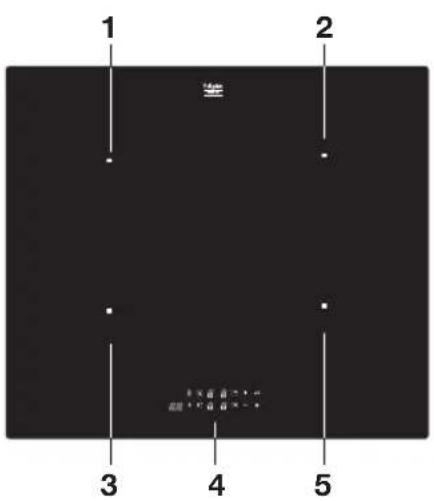
Description
- Cooking zone 21cm / 2.3kW - 2.6kW (boost)
- Cooking zone 18cm / 1.8kW - 2.0kW (boost)
- Cooking zone 16cm / 1.3kW - 1.5kW (boost)
- Control panel
- Cooking zone 18cm / 1.8kW - 2.0kW (boost)
Control panel
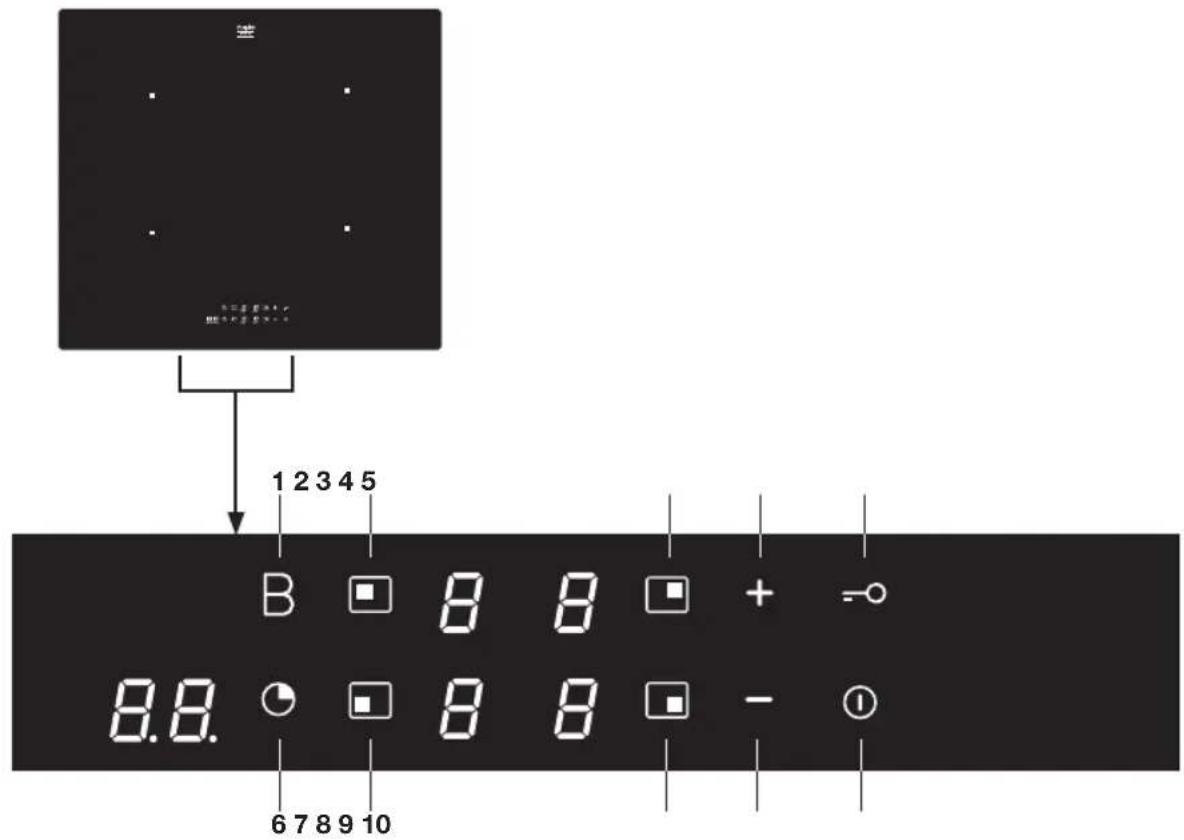
- Boost key
- Cooking zone left back selection key
- Cooking zone right back selection key
- Plus +' key
- Lock key
- Timer key
- Cooking zone left front selection key
- Cooking zone right front selection key
- Minus '-' key
- On/off key

Before use, read the separate safety instructions first!
Temperature safety
A sensor continuously measures the temperature of certain parts of the hob. Every cooking zone is equipped with a sensor that measures the temperature of the bottom of the pan to avoid any risk of overheating when a pan boils dry. In case of temperatures rising too high, the power is reduced automatically or the hob switches off automatically.
Cooking-time limiter

The cooking-time limiter is a safety function of your cooking appliance. It will operate if you forget to switch off your hob. Depending on the setting you have chosen, the cooking time will be limited as follows:
| Cooking level Maximum operating time |
| 1-2-3 8 hours |
| 4-5-6 4 hours |
| 7-8-9 2 hours |
Healthy cooking
Burning point of different types of oil
To ensure your food is fried as healthily as possible, it's recommended to choose the type of oil according to the frying temperature. Each oil has a different burning point at which toxic gasses are released. The below table shows the burning points for various types of oil.
| Oil Smoke point ℃ Oil Smoke point ℃ | ||||
| Extra virgin olive oil 160 ℃ | Sunflower oil 227 ℃ | |||
| Butter / Coconut oil 177 ℃ | Corn oil / Peanut oil | 232 ℃ | ||
| Canola oil 204 ℃ Olive oil | 242 ℃ | |||
| Virgin olive oil 216 ℃ Rice | oil 255 ℃ | |||
Induction noises
A ticking sound
- This is caused by the capacity limiter on the left and right zones. Ticking can also occur at lower settings.
Pans are making noise
- Pans can make some noise during cooking. This is caused by the energy flowing from the hob to the saucepan. At high settings this is perfectly normal for some pans. It will not damage either the pans or the hob.
The fan is making noise
- To enlarge the lifespan of the electronics, the appliance is equipped with a fan. If you use the appliance intense, the fan is activated to cool down the appliance and you will hear a buzzing sound. The fan runs on for several minutes after the hob has been switched off.
Pans
Always place a pan in the middle of a cooking zone.
- Induction cooking requires a particular quality of pan.
- Only use pans that are suitable for electric and induction cooking with:
- a thick base (minimum 2.25 mm);
- a flat base.
- The best are pans with the 'Class Induction' quality mark.

Pans that have already been used for cooking on a gas hob are no longer suitable for use on an induction hob.

You can check for yourself whether your pans are suitable using a magnet. A pan is suitable if the base of the pan is attracted by the magnet.
| Suitable Unsuitable | |
| Special stainless steel pans Earthenware | |
| Class Induction Stainless steel | |
| Hard-wearing enamelled pans Porcelain | |
| Enamelled cast-iron pans Copper /Aluminium | |
| Plastic | |

Be careful with enamelled sheet-steel pans!
The enamel may chip (the enamel comes loose from the steel), if you switch the hob on at a high setting when the pan is (too) dry; the base of the pan may warp - due, for example, to overheating or to the use of too high a power level.
USE
- Never use pans with a misshapen base. A hollow or rounded base can interfere with the operation of the overheating protection, so that the appliance becomes too hot. This may lead to the glass top cracking and the pan base melting.
- Damage arising from the use of unsuitable pans or from boiling dry is excluded from the guarantee.
Minimum pan diameter
The diameter of the bottom of the pan must be at least 14cm
- You will achieve the best results by using a pan with the same diameter as the zone. If a pan is too small the cooking zone will not work.
Pressure cookers
- Induction cooking is very suitable for cooking in pressure cookers. The cooking zone reacts very quickly, and so the pressure cooker is quickly up to pressure. As soon as you switch a cooking zone off, the cooking process stops immediately.
Power level setting
The cooking zones have 9 power levels. Beside it there is a level 'boost' (B). If you have switched on the hob the required cooking zone can be chosen within the next 60 seconds. Set the power level by touching the plus (+) or minus (-) keys (see: Operating the induction hob).
Power distribution cooking zones
- The cooking zones on the right influence each other. Also the cooking zones on the left influence each other.
The power is automatically distributed when these cooking zones are used at the same time. This does not have any consequences up to setting 9. Selecting the Boost setting for one of the cooking zones, however, automatically switches the other cooking zone to a lower setting.
- If one of the cooking zones is set to boost and you want to set the other zone to Boost, the cooking zone that is set to boost will automatically be switched to a lower setting.
- The right and left cooking zones do not influence each other. You can set both cooking zones to Boost.
Pan detection
If the hob does not detect a (ferrous) pan after the cooking power has been set, the pan detection symbol and the selected power setting will flash alternately in the display and the hob will remain cold. If a (ferrous) pan is not placed on the cooking zone within 2 minutes, the cooking zone will automatically switch off (see also chapter 'Pans').
Indications in the display
| In display | Status |
| 19 | Power setting cooking zone; 1 = low setting / 9 = high setting |
| P | Boost function active |
| 9. | Timer link indication |
| u | No (suitable) pan on cooking zone (pan detection symbol) |
| Lo | Key lock function selected |
| H | Residual heat indicator; The hob has a residual heat indicator for each cooking zone to show those which are still hot. Although the hob is switched off, the indicator ‘H’ will remain on for as long as the cooking zone is hot! Avoid touching them when this indicator is lit. Danger! Risk of burns. |
| E | Fault code; See ‘Troubleshooting table’ |
Hob functions table
| Function | Key(s) to use | Description |
| Boost | B | You can use the boost function to cook for max. 5 minutes at the highest power level. The boost function can only be activated if it is applicable with the cooking zone selected. If the boost function is active, an P is flashing alternately with the power level on the corresponding display. |
| Timer | ◎ | The timer can be set separately for each active cooking zone. Cooking times of up to 99 minutes can be programmed. The timer stops as soon as the pan is removed and resumes when the pan is put back. The timer alarm beeps after the set time has passed. The timer alarm stops automatically after 2 minutes or by touching any key. The cooking zone automatically switches off when the set time has elapsed. |
| Lock | =0 | As a key lock function during use. To lock the keys during operation. It will not be possible to make any adjustments by touching the keys. Only the On/off key will be active to be able to stop operation of the hob. |
USE
Cooking settings
Because the settings depend on the quantity and composition of the contents of the pan, the table below is intended as a guideline only.
Use setting 'boost' to:
- bring the food or liquid to the boil quickly;
- 'shrink' greens;
heat oil and fat; - wok.
Use setting 9 to:
sear meats;
cook fish;
cook omelettes;
- fry boiled potatoes;
- deep fry foods.
Use setting 7 and 8 to:
- fry thick pancakes;
- fry thick slices of breaded meat;
- fry bacon (fat);
- cook raw potatoes;
make French toast; - fry breaded fish;
cook through pasta; - fry thin slices of (breaded) meat.
Use setting 4-6 to:
complete the cooking of large quantities;
- defrost hard vegetables;
- fry thick slices of breaded meat.
Use setting 1-3 to:
simmer bouillon;
stew meats;
simmer vegetables;
- melt chocolate;
- poach;
- melt cheese.
Cooking Tips
- When food comes to the boil, reduce the temperature setting.
- Using a lid will reduce cooking times and save energy by retaining the heat.
- Minimize the amount of liquid or fat to reduce cooking times.
- Start cooking on a high setting and reduce the setting when the food has heated through.
Start cooking
Use of the touch keys
Place the tip of your finger flat on a key to achieve the best results. You do not have to apply any pressure. The touch keys only react to the light pressure of a fingertip. Do not operate the controls with any other objects.
Each key activation is followed by a sound signal.
- Touch and hold the On/Off key until you hear an audio signal.
The hob is switched on.
^ - ^ or · -· appears in all displays.

- Touch within 60 seconds a cooking zone selection key.
A short beep sounds and the corresponding display flashes.
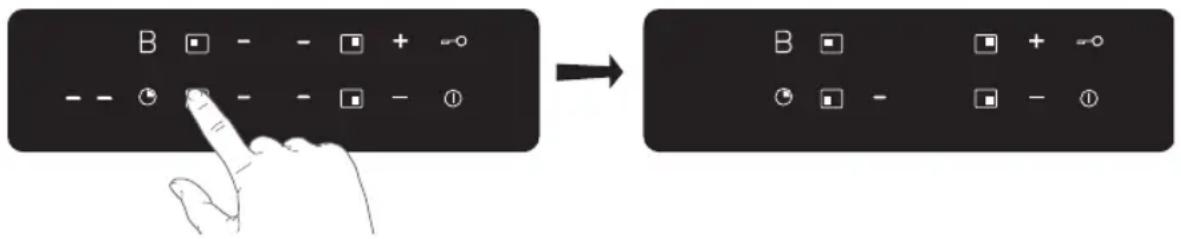
- Touch the minus (-) or plus (+) key to select a cooking power level. Touch if desired the boost key 'B' to start the boost power level.
The cooking zone starts at the set power level, visible in the display.
When boost is selected the boost indicator P and the previous power alternately flash in the display. After 5 minutes on boost level the cooking zone switches back to the previous power setting.
Touch boost again to switch off the boost setting.
Touch the selection button and use the plus (+) and minus (-) buttons to change a setting for a cooking zone.

Finish cooking
- Set the cooking power level to zero (0) to turn Off the cooking zone.
- Turn the induction hob Off by touching the On/Off key. After switching off, 'H' or a - appears on the display.

Timer control
- A cooking-timer can be set for each active cooking zone.
- The hob also has an alarm. Both the cooking-timer as well as the alarm can be set for a maximum of 99 minutes.
- The alarm works in the same way as the cooking-timer, but is not linked to a cooking zone. If the alarm has been set, it will continue counting down after the hob has been switched off.
- The alarm can only be switched off when the hob is switched on.
Using the timer
- Select the cooking zone to which you want to link a cooking timer. The display for the cooking zone will start flashing.
- Touch the timer key to start the timer.
The timer display shows '10'.
The timer indication light next to the cooking zone power level blink.
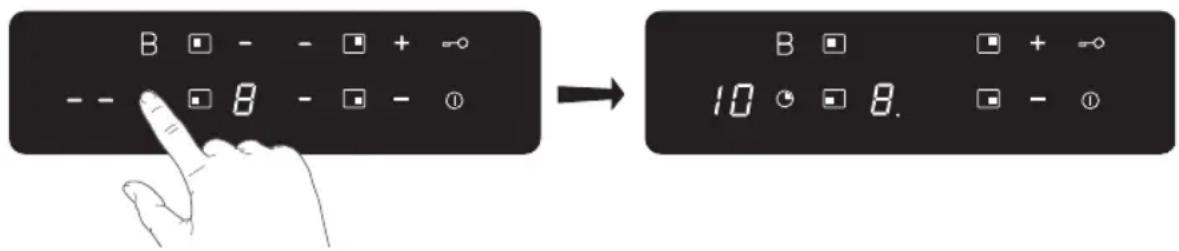
- Set a cooking time with the plus (+) and minus (-) keys.
The cooking zone will switch off after the set time has passed and the timer alarm beeps.
Using the kitchen alarm
- Touch the timer key to start the timer.
The timer display shows '10'.
-
Set the alarm time with the plus (+) and minus (-) keys.
-
When the set time has elapsed, the timer alarm sounds.
Touch the timer key to stop the alarm.
OPERATION
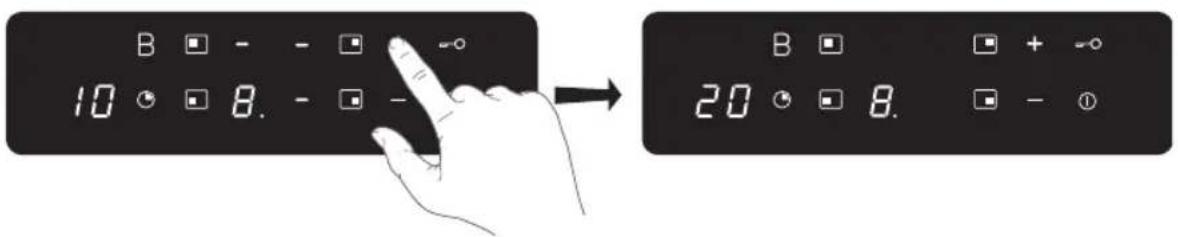
Changing preset cooking time
The cooking time can be changed anytime during the operation.
- Touch a cooking zone selection key, to select the active cooking zone for which you want to change the timer.
A flashing point next to the cooking zone power lever indicates the active cooking zone.
- Touch within 5 seconds the plus (+) and minus (-) keys to change the time.
If time is not modified in 5 seconds since touching the keys, the timer is keeping the countdown before the adjusting operation.
Checking remaining cooking time
-
The timer displays shows the remaining time from the cooking zone for which the point adjacent to the power level is flashing. When more than one cooking timers are set, the shortest time set will be visible in the display.
-
Touch a cooking zone selection key, to select the active cooking zone for which you want to check the remaining time.
The flashing point next to the cooking zone power lever indicates the active cooking zone.
The timer will display the remaining time of the selected cooking zone.
Turning the timer Off
If you want to switch Off the timer prior the end of preset time:
-
Touch the timer keys as many times as necessary, to select the zone of which you want to disable the timer.
-
Touch the minus (-) key and plus (+) key simultaneously to switch Off the timer.
The timer indication light next to the cooking zone power lever goes out.
OPERATION
Lock mode
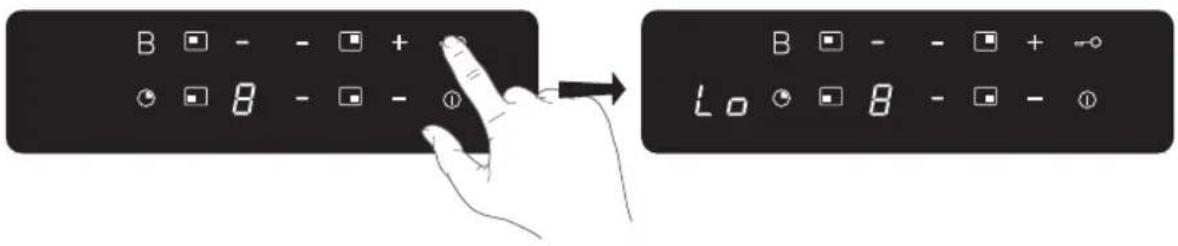
Activate the Lock mode
- The hob is in operating or stand-by mode.
- Touch the lock key until you hear a audio signal.
The timer display show 'Lo'.
The child protection/ key lock mode is activated.
Deactivate the lock mode
- Touch and hold the lock key until you hear a audio signal.
The child protection/ key lock mode is deactivated.
Cleaning

Tip! set the child protection lock before you start cleaning the hob.
Daily cleaning
- Although food spills cannot burn into the glass, we nevertheless recommend you to clean the hob immediately after use.
- Best for daily cleaning is a damp cloth with a mild cleaning agent.
- Dry with kitchen paper or a dry towel.
Stubborn stains
- Stubborn stains can also be removed with a mild cleaning agent such as washing-up liquid.
- Remove water marks and lime scale with vinegar.
- Metal marks (caused by sliding pans) can be difficult to remove. Special agents are available.
- Use a glass scraper to remove food spills. Melted plastic and sugar is also best removed with a glass scraper.

Never use
- Never use abrasives. They leave scratches in which dirt and lime scale can accumulate.
- Never use anything sharp such as steel wool or scourers.
General
If you notice a crack in the glass top (however small), switch the hob off immediately, unplug the hob or turn off the (automatic) fuse switch(es) in the meter cupboard or. In the event of a permanent connection, set the switch in the power supply lead to zero. Contact the service department.
Troubleshooting table
If the appliance does not work properly, this does not always mean that it is defective.
Try to deal with the problem yourself first by checking the points mentioned below or check for more information the website 'www.etna.nl'.
| Symptom Possible cause Solution | ||
| The display lights up when the hob is activated for the first time. | This is the standard set-up routine. | Normal operation. |
| The fan runs on for several minutes after the hob has been switched off. | The hob is cooling. Normal operation. | |
| A slight smell is noticeable the first few times the hob is used. | The new appliance is heating up. | This is normal and will disappear once it has been used a few times. Ventilate the kitchen. |
| The pans make a noise while cooking. | This is caused by the energy flowing from the hob to the saucepan. | At high settings this is perfectly normal for some pans. It will not damage either the pans or the hob. |
| You have switched on a cooking zone, but the display shows ‘u’. | The pan you are using is not suitable for induction cooking, or has a diameter of less than 12 cm. | Use a suitable pan. |
| The hob suddenly stops working. The displays show ‘--’ or ‘H’. | The control panel is dirty or there is an object on it. | Clean the control panel. Remove objects, moisture or dirt. |
| A cooking zone suddenly stops working and you hear a signal. | The preset time has ended. Switch off the bleep by touching the + key of the timer. | |
| The hob is not working and nothing appears in the display. | There is no power supply due to a defective cable or a faulty connection. | Check the fuses or the electric switch (if there is no plug). |
| A fuse blows as soon as the hob is switched on. | The hob has been wrongly connected. | Have the electrical connection checked. |
| Symptom Possible cause Solution | ||
| Symbol Lo appears in the timer display. | Key lock function is activated. | Deactivate the lock function: Switch on the hob. Touch and hold the lock key. |
| Error code E1/E2. | Supply voltage or frequency is different from the rated values. | Switch off the hob and let it cool down (H disappears from the displays). Switch on the hob. If the same error is displayed again, call an authorised service agent. |
| Error code E3. | Cooking zone temperature too high. | Switch off the hob and allow it to cool ('H' disappears from the displays). Switch on the hob. |
| Error code E4/E5. | Internal temperature sensor(s) defective. | If the same error is displayed again, call an authorised service agent. |
| Error code E6. | Internal temperature of the hob is too high. Error on fan left or right. Air exhaust blocked, for example by paper. | Check that the fan air exhaust is free. If the error does not disappear, call an authorised service agent. |
| Error code E7/E8. | The power supply voltage is incorrect. Check the connection. | Check the electrical connection. |
| Error code U1. | Communication fault between controls and generator. | Reset the appliance by briefly interrupting the electrical connection. If this does not help, contact the service department. |
| Other error codes. | Defective generator. Contact the service department. | |
Information according regulation (EU) 66/2014
Measurements according EN60350-2
| Model identification | IK1264 | |||
| Type of hob Induction hob | ||||
| Number of electric cooking zones and/or areas 4 | ||||
| Heating technology Induction cooking zones | ||||
| For circular electric cooking zones: diameter of useful surface area per electric heated cooking zone in cm | 16.0 left front | 18.0 left rear | 16.0 right rear | 18.0 right front |
| Energy consumption per cooking zone or area calculated per kg (ECeletric hob) in Wh/kg | 196.3 | 182 187.6 | 186.3 | |
| Energy consumption for the hob calculated per kg (ECeletric hob) in Wh/kg | 188.1 | |||
Tips for energy-efficient cooking with hobs
- Always use the right size of pan for the amount of food you are cooking.
- Put just enough water in the pan to cover vegetables.
- Choose the right size of zone for the pan.
Always put lids on pans to keep the heat in. - Turn down or turn off the cooking zone once the cooking temperature or state is reached.
- Use a steamer to cook vegetables, that way you can layer a number of vegetables on top of each other and still use one ring, or use a pan with a divider.
- Use a pressure cooker for cooking pulses, and even joints of meat, whole meals, or stews. It speeds up the cooking process.
Disposal of packaging and appliance
In the manufacturing of this appliance durable materials were used. Make sure to dispose of this equipment responsibly at the end of its lifecycle. Ask the authorities for more information regarding this.
The appliance packaging is recyclable. The following may have been used:
cardboard;
polythene film (PE);
CFC-free polystyrene (PS hard foam).
Dispos of these materials in a responsible manner and in accordance with government regulations.
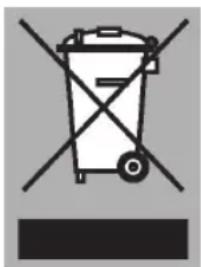
As a reminder of the need to dispose of household appliances separately, the product is marked with the symbol of a crossed-out wheeled dustbin. This means that at the end of its working life, the product must not be disposed of as urban waste. It must be taken to a special local authority differentiated waste collection centre or to a dealer providing this service.
Disposing of a household appliance separately avoids possible negative consequences for the environment and health deriving from inappropriate disposal and enables the constituent materials to be recovered to obtain significant savings in energy and resources.
Declaration of conformity

We declare that our products meet the applicable European Directives, Decisions and Regulations and the requirements listed in the standards referenced.
SOMMAIRE
The appliance identification card is located on the bottom of the appliance.
Stick the appliance identification card here.
When contacting the service department,
have the complete type number to hand.
You will find the addresses and phone numbers of the service organisation on the
guarantee card.