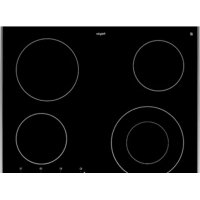
CK1064KR - Cooker Pelgrim - Free user manual and instructions
Find the device manual for free CK1064KR Pelgrim in PDF.



| Product type | Electric cooker with ceramic hob |
| Brand | Pelgrim |
| Model | CK1064KR |
| Dimensions (W x D x H) | 50 x 60 x 85 cm (estimated) |
| Weight | Approximately 45 kg |
| Power supply | 230 V / 400 V, 50/60 Hz |
| Total power | Approximately 6.4 kW |
| Front left cooking zone | Ø 145 mm, 1200 W |
| Rear left cooking zone | Ø 210/120 mm (combined), 2200/800 W |
| Rear right cooking zone | Ø 180 mm, 1800 W |
| Front right cooking zone | Ø 145 mm, 1200 W |
| Control type | Rotary knobs |
| Boost function | Yes, for rapid heating |
| Residual heat indicator | Yes, for each zone |
| Child safety | Yes |
| Cooking time limiter | Yes |
| Ceramic glass surface | Yes |
| Cleaning | Special ceramic glass cleaners, scraper for residues |
| Number of cooking zones | 4 |
| Combined cooking zone | Yes, dual circuit |
| Cooking settings | 12 positions (1-9 and Boost) |
Frequently Asked Questions - CK1064KR Pelgrim
User questions about CK1064KR Pelgrim
0 question about this device. Answer the ones you know or ask your own.
Ask a new question about this device
Download the instructions for your Cooker in PDF format for free! Find your manual CK1064KR - Pelgrim and take your electronic device back in hand. On this page are published all the documents necessary for the use of your device. CK1064KR by Pelgrim.
USER MANUAL CK1064KR Pelgrim
Pans 6
Cooking power levels 7
Operation
Switching on and off 8
Maintenance
Cleaning 9
Faults
Environmental aspects
Disposal of packaging and appliance 11
Introduction
This hob has been designed for the real lover of cooking. The hob is equipped with 'Cooklight' elements. These are very rapid-heating, radiant elements with a high efficiency, which is very favourable for heating-up times. What's more, these elements also have very good heat distribution. The ample space between the cooking zones makes cooking comfortable.
Cooking on a ceramic hob is different from cooking on a traditional appliance. Ceramic cooking makes use of heat radiation through the glass top.
For optimum safety the ceramic hob is equipped with a child lock, a cooking time limiter and a residual heat indicator, which shows which cooking zones are still hot.
This manual describes how you can make the best possible use of the ceramic hob. In addition to information about operation, you will also find background information that can assist you in using this product.
Read the manual thoroughly before using the appliance, and store these instructions in a safe place for future reference.
The manual also serves as reference material for service technicians. Please, therefore, stick the appliance identification card in the space provided, at the back of the manual. The appliance identification card contains all the information that the service technician will need in order to respond appropriately to your needs and questions.
Enjoy your cooking!
Ceramic hob
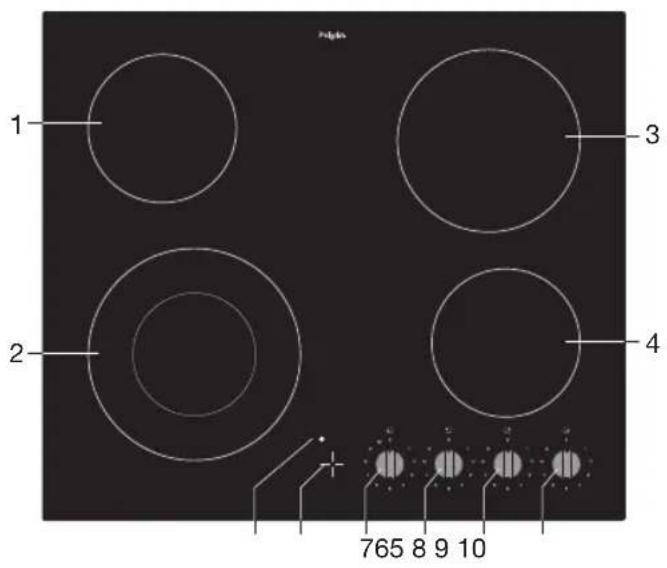
- Cooking zone Ø 145 / 1200 W
- Expandable cooking zone 口 2 1 0 - 1 2 0 / 2 2 0 0 - 8 0 0 W
- Cooking zone 180/1800 W
- Cooking zone 145 / 1200 W
- On/off Indicator hob
- Residual heat indication by zone
- Control knob cooking zone left front
- Control knob cooking zone left back
- Control knob cooking zone right back
- Control knob cooking zone right front

Before use, read the separate safety instructions first!
Pans
Always place a pan in the middle of a cooking zone.
Pans for ceramic cooking
Ceramic cooking requires a particular quality of pan.
- Only use pans that are suitable for electric cooking with:
a thick base (minimum 2.25 mm);
a flat base.

Be careful with enamelled sheet-steel pans! The enamel may chip (the enamel comes loose from the steel), if you switch the hob on at a high setting when the pan is (too) dry; the base of the pan may warp - due, for example, to overheating or to the use of too high a power level.
Minimale pandiameter

Do not use pans that are smaller than the cooking zone. This will prevent food remains ending up on the red-hot cooking zone. Burnt-on food remains are difficult to remove. In addition, the handles may become too hot and a lot of energy is lost.
- Tempered glass cookware with special ground bottom may be used on the cooking zones if its diameter fits that of the cooking zones. Cookware with larger diameter may crack due to thermal tension.
- Pans that have already been used for cooking on a gas hob are no longer suitable for use on a ceramic hob.
- Sliding pans can cause scratches that cannot be removed.
- Only place pans with clean, dry bottoms on the cooking surface. This will avoid causing stains that are difficult to remove.
- Always keep the lid on the pan when cooking, in order to avoid energy loss.
- Slide the bottom of the pan over a slightly damp cloth, before placing the pan on the cooking zone. This prevents dirt getting on to the cooking surface.
USE
Cooking power levels
Because the settings depend on the quantity and composition of the contents of the pan, the table below is intended as a guideline only.
Use level 'boost' to:
- bring the food or liquid to the boil quickly;
- 'shrink' greens;
heat oil and fat; - wok
Use level 9 to:
sear meats;
cook fish;
cook omelettes;
- fry boiled potatoes;
- deep fry foods.
Use level 7 and 8 to:
- fry thick pancakes;
- fry thick slices of breaded meat;
- fry bacon (fat);
- cook raw potatoes;
make French toast; - fry breaded fish;
cook through pasta; - fry thin slices of (breaded) meat;
Use level 4-6 to:
complete the cooking of large quantities;
- defrost hard vegetables;
- fry thick slices of breaded meat.
Use level 1-3 to:
simmer bouillon;
stew meats;
simmer vegetables;
- melt chocolate;
- poach;
- melt cheese;
Switching on and off
Switching on
- Place a pan on a cooking zone and turn the control knob to the desired setting.
The cooking zone will then heat up. The cooking zone switches on and off automatically to provide the power you have set. At lower settings the cooking zone is off for a long time and on from time to time. At higher settings the cooking zone is on for a long time and off from time to time.

Switching off
- Turn the knob to the zero position.
Residual-heat indicator
- The indicator shows that the cooking zone is still hot, and goes out as soon as the glass top reaches a safe temperature.
- Residual heat is indicated by a light for each cooking zone on the glass hob.
Using the expandable cooking zone
- Turn the control knob to the desired setting.
The 'basic' zone will switched on first (inner circuit).
- To switch on the expandable zone, turn the knob till the double circuit mark until "click" is heard.
The second zone is switched on.
- Turn the control knob back to the desired setting.
To switch off the expandable cooking zone, turn the control knob to position 0.
Cleaning
Daily cleaning
- Special cleaning agents for ceramic hobs have the advantage that a thin layer remains on the glass surface so that over-cooked food and lime scale are less likely to get burnt into the hob, making it easier to clean the next time.
- It is best to let the hob cool down before cleaning it.
- Over-cooked food containing a lot of sugar and acids, such as apple sauce, rhubarb or red cabbage are best removed immediately with a damp dish cloth to prevent them getting burnt into the hob. Be careful with the hot cooking zone!
- Best for daily cleaning is a damp cloth with a mild cleaning agent.
- Dry with kitchen paper or a dry towel.
Stubborn stains
- Stubborn stains can also be removed with a mild cleaning agent such as washing-up liquid.
- Remove water marks and lime scale with vinegar.
- Metal marks (caused by sliding pans) can be difficult to remove. Special agents are available.
- Use a glass scraper to remove food spills. Melted plastic and sugar is also best removed with a glass scraper.

Never use
- Never use abrasives. They leave scratches in which dirt and lime scale can accumulate.
- Never use anything sharp such as steel wool or scourers.
General
If you notice a crack in the glass top (however small), switch the hob off immediately, unplug the hob, turn off the (automatic) fuse switch(es) in the meter cupboard or, in the event of a permanent connection, set the switch in the power supply lead to zero.) Contact the service department.
Troubleshooting table
If the appliance does not work properly, this does not always mean that it is defective. Try to deal with the problem yourself first by checking the points mentioned below or check for more information the website 'www.pelgrim.nl'.
| Symptom Possible cause Solution | ||
| A slight smell is noticeable the first few times the hob is used. | The new appliance is heating up. | This is normal and will disappear once it has been used a few times. Ventilate the kitchen. |
| The pans make a noise while cooking. | This is caused by the energy flowing from the hob to the saucepan. | At high settings this is perfectly normal for some pans. It will not damage either the pans or the hob. |
| The hob is not working and the control light doesn’t light up. | There is no power supply due to a defective cable or a faulty connection. | Check the fuses or the electric switch (if there is no plug). |
| A fuse blows as soon as the hob is switched on. | The hob has been wrongly connected. | Check the electrical connections. |
Disposal of packaging and appliance
In the manufacturing of this appliance durable materials were used. Make sure to dispose of this equipment responsibly at the end of its lifecycle. Ask the authorities for more information regarding this.
The appliance packaging is recyclable. The following may have been used:
cardboard;
polythene film (PE);
CFC-free polystyrene (PS hard foam).
Dispos of these materials in a responsible manner and in accordance with government regulations.
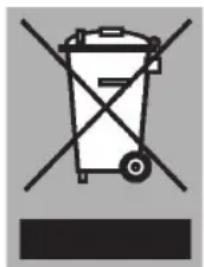
As a reminder of the need to dispose of household appliances separately, the product is marked with the symbol of a crossed-out wheeled dustbin. This means that at the end of its working life, the product must not be disposed of as urban waste. It must be taken to a special local authority differentiated waste collection centre or to a dealer providing this service.
Disposing of a household appliance separately avoids possible negative consequences for the environment and health deriving from inappropriate disposal and enables the constituent materials to be recovered to obtain significant savings in energy and resources.
Declaration of conformity
We declare that our products meet the applicable European Directives, Decisions and Regulations and the requirements listed in the standards referenced.
SOMMAIRE
- Operation
- Maintenance
- Faults
- Environmental aspects
- Introduction
- Ceramic hob
- Before use, read the separate safety instructions first!
- Pans
- Pans for ceramic cooking
- Minimale pandiameter
- USE
- Cooking power levels
- Use level 'boost' to:
- Use level 9 to:
- Use level 7 and 8 to:
- Use level 4-6 to:
- Use level 1-3 to:
- Switching on and off
- Switching on
- Switching off
- Residual-heat indicator
- Using the expandable cooking zone
- Cleaning
- Daily cleaning
- Stubborn stains
- Never use
- General
- Troubleshooting table
- Disposal of packaging and appliance
- Declaration of conformity
- SOMMAIRE
Brand : Pelgrim
Model : CK1064KR
Category : Cooker