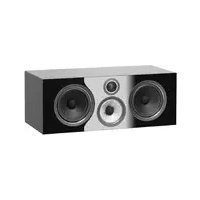
HTM71 S2 - Speaker BOWERS & WILKINS - Free user manual and instructions
Find the device manual for free HTM71 S2 BOWERS & WILKINS in PDF.



| Product Type | Center speaker (loudspeaker) for home theater system |
| Brand | Bowers & Wilkins |
| Model | HTM71 S2 |
| Dimensions (approx.) | Height: 165 mm x Width: 470 mm x Depth: 270 mm |
| Weight (approx.) | 10 kg |
| Power supply | Passive (requires external amplifier) |
| Nominal impedance | 8 ohms |
| Power handling (approx.) | 120 W |
| Sensitivity (approx.) | 88 dB (2.83 V, 1 m) |
| Main features | High-fidelity sound reproduction for center channel; carbon dome tweeter and Continuum cone driver technology; bass adjustment via foam plugs |
| Connections | Single binding post (one pair of terminals) for speaker cable; standard wiring |
| Positioning | Behind an acoustically transparent screen or above/below the screen at ear level; avoid magnetic fields near CRT (min. 50 cm) |
| Maintenance and cleaning | Dust with a dry cloth; use mild soapy water or glass cleaner on the cabinet; do not touch the drivers; avoid abrasive or ammonia-based cleaners |
| Safety | Keep away from heat sources; stray magnetic fields; respect connection polarity |
| Break-in | Break-in period of approximately 15 hours of normal use for optimal performance |
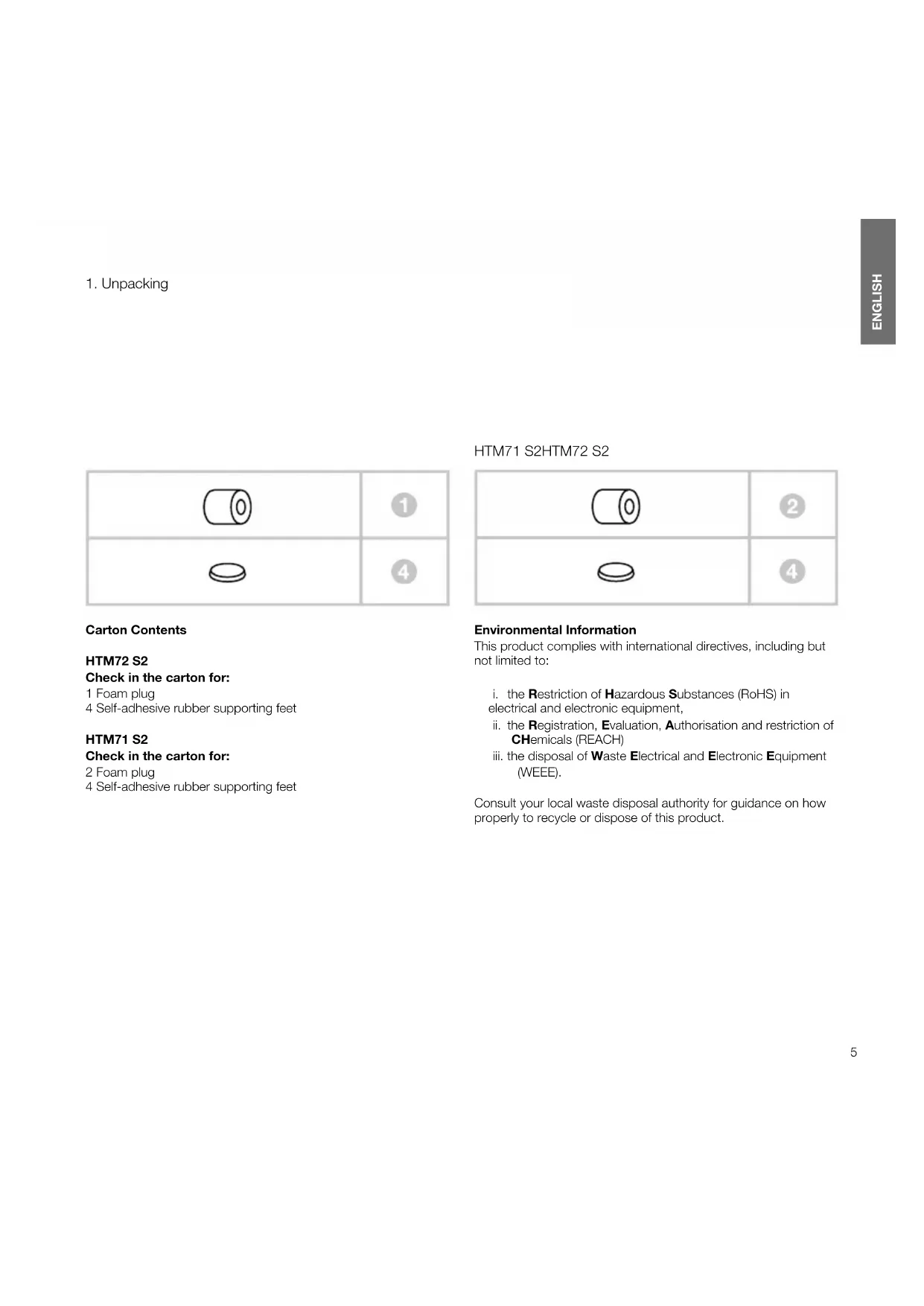
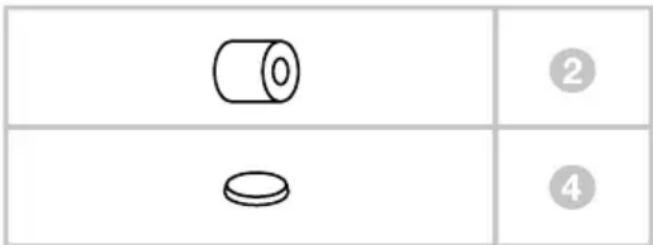
| Spare parts and accessories | 2 foam plugs for bass adjustment; 4 self-adhesive rubber feet |
| General information | Compliant with RoHS, REACH, WEEE directives |
Frequently Asked Questions - HTM71 S2 BOWERS & WILKINS
User questions about HTM71 S2 BOWERS & WILKINS
0 question about this device. Answer the ones you know or ask your own.
Ask a new question about this device
Download the instructions for your Speaker in PDF format for free! Find your manual HTM71 S2 - BOWERS & WILKINS and take your electronic device back in hand. On this page are published all the documents necessary for the use of your device. HTM71 S2 by BOWERS & WILKINS.
USER MANUAL HTM71 S2 BOWERS & WILKINS
Welcome and thank you for choosing Bowers & Wilkins. Our founder, John Bowers, believed that imaginative design, innovative engineering and advanced technology were keys that could unlock the enjoyment of audio in the home. His belief is one that we continue to share and inspires every product we design.
This is a high performance product that rewards thoughtful installation, so we suggest that you take some time to read this manual before you begin. Continue on page 5
Check in the carton for:
1 Foam plug
4 Self-adhesive rubber supporting feet
HTM71 S2
Check in the carton for:
2 Foam plug
4 Self-adhesive rubber supporting feet
HTM71 S2HTM72 S2
Environmental Information
This product complies with international directives, including but not limited to:
i. the Restriction of Hazardous Substances (RoHS) in electrical and electronic equipment,
ii. the Registration, Evaluation, Authorisation and restriction of CHemicals (REACH)
iii. the disposal of Waste Electrical and Electronic Equipment (WEEE).
Consult your local waste disposal authority for guidance on how properly to recycle or dispose of this product.
- Positioning
Speaker Installation
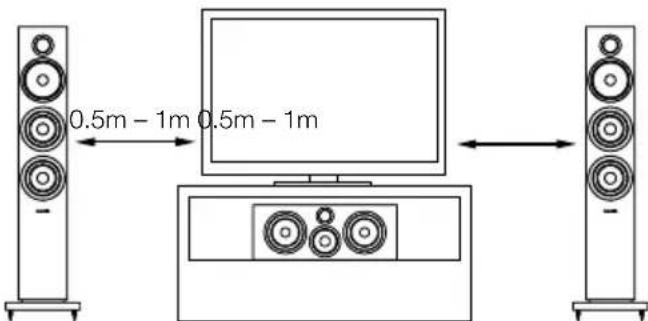
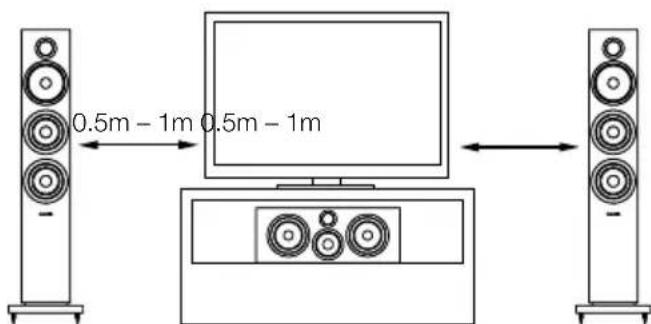
If using a projector with an acoustically transparent screen, place the speaker behind the centre of the screen. Otherwise position it directly above or below the screen, whichever is closest to ear level. Align the front of the speaker approximately level with the screen. The speaker is best used mounted on a rigid shelf or wall bracket or on a rigid floor stand. If the speaker is to be placed either on a shelf or in a rack shared with other AV equipment fix the 4 self-adhesive pads to the base of the speaker. They provide a degree of vibration isolation.
Stray magnetic fields
The speaker drive units create stray magnetic fields that extend beyond the boundaries of the cabinet. We recommend you keep magnetically sensitive articles (CRT television and computer screens, computer discs, audio and video tapes, swipe cards and the like) at least 0.5m from the speaker. LCD, OLED and plasma screens are not affected by magnetic fields.
3. Connections
HTM72 S2
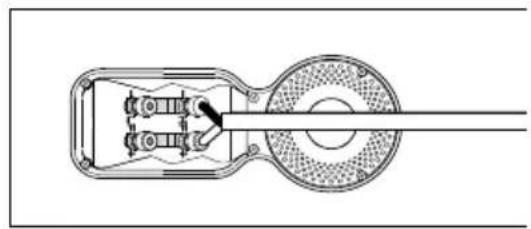
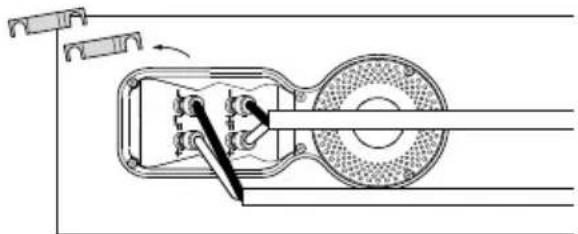
All connections should be made with the audio equipment switched off.
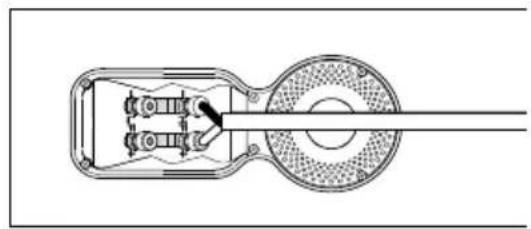
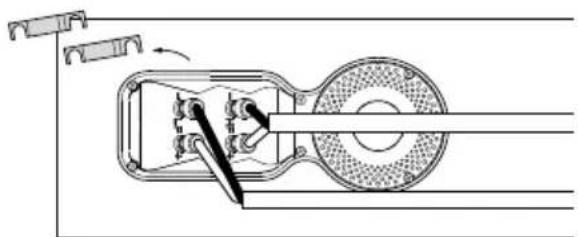
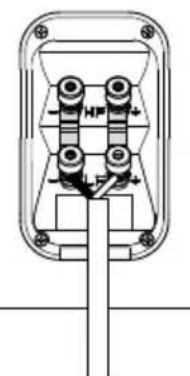
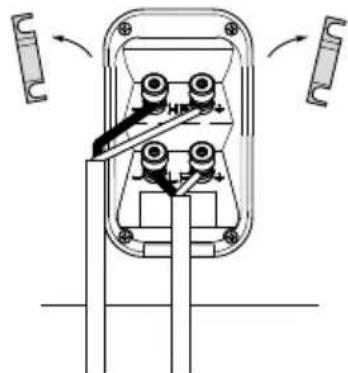
There are 2 linked pairs of terminals on the back of the speaker. For conventional connection (above left), the terminal links should remain in place (as delivered) and just one pair of terminals connected to the amplifier. For bi-wire connections or bi-amplification (above right), the terminal links should be removed and each pair of terminals connected to the amplifier or amplifiers independently. Bi-wiring can improve the resolution of low-level detail.
HTM71 S2
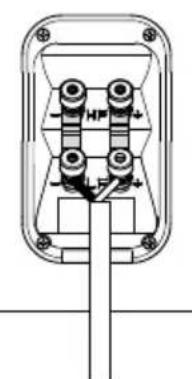
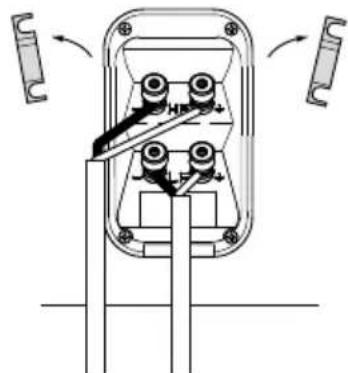
Ensure that the positive terminals on the speaker (marked + and coloured red) are connected to the positive output terminal on the amplifier and the negative terminals on the speaker (marked - and coloured black) are connected to the negative output terminal on the amplifier. Incorrect connection can result in poor imaging and loss of bass.
Ask your dealer for advice when selecting speaker cable.
4. Fine Tuning
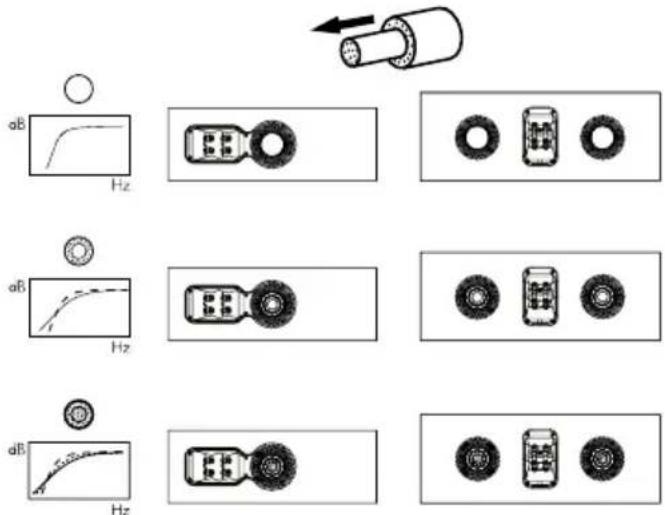
Before fine tuning, make sure that all the connections in the installation are correct and secure.
Moving the speakers further from the walls will generally reduce the volume of bass. Space behind the speakers will also help to create an aural impression of depth. Conversely, moving the speakers closer to the walls will increase the volume of bass. If you want to reduce the volume of bass without moving the speakers further from the wall, fit the foam plugs or, for less severe bass reduction, the foam rings in the port tubes (above).
If the bass seems uneven with frequency this will most probably be a consequence of the acoustic properties of your listening room. Even small changes in the position of the speakers or listening position can have a significant effect on sonic performance, especially at low frequencies. Try moving your listening position or locating your speakers along a different wall if possible.
If no alternatives exist, you can adjust your loudspeakers' low-frequency performance using the supplied foam bungs. The bungs are a two-piece part, allowing for a degree of fine-tuning using either the outer, larger-diameter piece in isolation or the two parts together. Using solely the outer, larger-diameter foam bung will deliver less bass attenuation than the complete bung assembly.
- Running In 6. Aftercare
The performance of the speaker will change subtly during the initial listening period. If the speaker has been stored in a cold environment, the damping compounds and suspension materials of the drive units will take some time to recover their correct mechanical properties. The drive unit suspensions will also loosen up during the first hours of use. The time taken for the speaker to achieve its intended performance will vary depending on previous storage conditions and how it is used. As a guide, allow up to a week for the temperature effects to stabilise and 15 hours of average use for the mechanical parts to attain their intended design characteristics.
The cabinet surfaces will usually only require dusting. If you wish to use an aerosol or other cleaner, apply the cleaner onto the cloth, not directly onto the product and test a small area first, as some cleaning products may damage some of the surfaces. Avoid products that are abrasive, or contain acid, alkali or antibacterial agents. Marks on the paint surface may be removed with a dilute perfume-free soap solution. Remove any remaining streak marks by spraying with a proprietary glass cleaner and lightly wiping dry with a microfibre cloth. Do not use cleaning agents on the drive units and avoid touching them as damage may result.
Real wood veneers are treated with an ultra-violet resistant lacquer to minimise changes in colour over time. Nevertheless, like all natural materials, a degree of colour change is to be expected. Colour differences may be rectified by exposing all the veneer surfaces equally and evenly to sunlight until the colour is uniform. This process can take a long time, but may be accelerated by careful use of an ultra-violet lamp. Keep the speakers away from direct sources of heat such as radiators and warm air vents in order to minimise the possibility of the wood veneer cracking.
- Déballage


1
4
2
4
Auto to npoiov nnpoi tic dieovic oyniec, otic onoiec ouykataaoyovtai, xupic neptopouoc:
i. ηδηγia Restriction of Hazardous Substances (RoHS - Περισμος στη χρήσι επικίνδυμων οὐμων) στα είδη ηλεκτρικόι και ηλεκτρονικόι εξοπλισμόι
ii. n obnyia Registration, Evaluation, Authorisation and restriction of CHEmicals (REACH - Kataxwpi, aioynon, aodobotn kai tepiopoiow xmuiv npovv)
iii. n odnyia oxetuká μe tvn antoppuWaste Electrical and Electronic Equipment (WEEE - Antoβλnta nλektpikou ka nλektpovikou EoiTou).
藻藻青藻藥藻藻藻藻藻藻藻藻藻藻藻藻藻藻藻藻藻藻藻藻藻藻藻藻藻藻藻藻藻藻藻藻藻藻藻藻藻藻藻藻藻藻藻藻藻藻藻藻藻藻藻藻藻藻藻藻藻藻藻藻藻藻藻藻藻藻藻藻藻藻藻藻藻藻藻藻藻藻藻
- 尔卡瓦
△Ⅲ列 曾刘
SππK DπIyB UyNqEeHcπeRbNtJfF#TgF#T#F#T#F#T#F#T#F#T#F#T#F#T#F#T#F#T#F#T#F#T#F#T#F#T#F#T#F#T#F#T#F#T#F#T#F#T#F#T#F#T#F#T#F#T#F#T#F#T#F#T #
3. 用笔
HTM72 S2
回德司机的前用到国大期
SπFJKJFJFJFJFJFJFJFJFJFJFJFJFJFJFJFJFJFJFJFJFJFJFJFJFJFJFJFJFJFJFJFJFJFJFJFJFJFJFJFJFJFJFJFJFJFJFJFJFJFJFJ
HTM71 S2
Worthing West Sussex
BN11 2BH England
T+44(0)+803.221800
F+44(0)t903.22t80t
info@bwgroup.com
www.bowers-wilkins.com
B&W Group (UK Sales)
T+44(0)1903.221500
Eukka sales@bwgroup.com
B&W Group North America
F=1978042870
E marketing@bowgroupusa.com
B&W Group Asia Ltd
T+852347293000
Einfo@bwgroup.hk
Copyright © B&W Group Ltd. E&OE
Printed in China

Brand : BOWERS & WILKINS
Model : HTM71 S2
Category : Speaker