Nikkor AFS DX 1855mm f3.55.6G VR - Camera lens NIKON - Free user manual and instructions
Find the device manual for free Nikkor AFS DX 1855mm f3.55.6G VR NIKON in PDF.


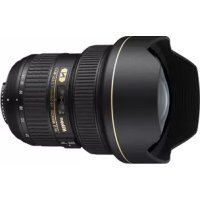
| Product type | Wide-angle to telephoto zoom lens for Nikon DX-format digital SLR cameras |
| Brand | Nikon |
| Model | Nikkor AFS DX 18-55mm f/3.5-5.6G VR |
| Focal length | 18–55 mm |
| Maximum aperture | f/3.5–5.6 |
| Optical construction | 11 elements in 8 groups (1 aspherical lens) |
| Angle of view | 76° – 28°50' |
| Minimum focus | 0.28 m (from focal plane) |
| Number of diaphragm blades | 7 (circular) |
| Filter | 52 mm (0.75 mm pitch) |
| Dimensions (diameter × length) | Approx. 73 mm × 79.5 mm |
| Weight | Approx. 265 g |
| Mount | Nikon bayonet (DX format) |
| Autofocus | Silent Wave Motor (SWM), A-M switch |
| Vibration Reduction (VR) | Yes, 3-stop shutter speed advantage, integrated panning mode |
| Power supply | Via camera body (no battery in lens) |
| Care and cleaning | Blower, soft brush, cloth slightly moistened with ethanol; do not use solvents |
| Safety | Do not disassemble, avoid flammable gases, do not look at the sun, keep out of reach of children |
| Spare parts and repairability | Repairs by authorized Nikon technicians; compatible accessories: 52 mm filters, HB-45 lens hood, CL-0815 case |
| General information | Type G lens (no aperture ring); designed for Nikon DX-format digital SLR cameras |
Frequently Asked Questions - Nikkor AFS DX 1855mm f3.55.6G VR NIKON
User questions about Nikkor AFS DX 1855mm f3.55.6G VR NIKON
0 question about this device. Answer the ones you know or ask your own.
Ask a new question about this device
Download the instructions for your Camera lens in PDF format for free! Find your manual Nikkor AFS DX 1855mm f3.55.6G VR - NIKON and take your electronic device back in hand. On this page are published all the documents necessary for the use of your device. Nikkor AFS DX 1855mm f3.55.6G VR by NIKON.
USER MANUAL Nikkor AFS DX 1855mm f3.55.6G VR NIKON
Notes on Safety Operations
CAUTION
Do not disassemble
Touching the internal parts of the camera or lens could result in injury. Repairs should be performed only by qualified technicians. Should the camera or lens break open as the result of a fall or other accident, take the product to a Nikonauthorized service representative for inspection after unplugging the product and/or removing the battery.
En
Turn off immediately in the event of malfunction
Should you notice smoke or an unusual smell coming from the camera or lens, remove the battery immediately, taking care to avoid burns. Continued operation could result in injury. After removing or disconnecting the power source, take the product to a Nikon-authorized service representative for inspection.
Do not use the camera or lens in the presence of flammable gas
Operating electronic equipment in the presence of flammable gas could result in an explosion or fire.
Do not look at the sun through the lens or viewfinder
Viewing the sun or other strong light sources through the lens or viewfinder could cause permanent visual impairment.
Keep out of reach of children
Particular care should be taken to prevent infants from putting the batteries or other small parts into their mouths.
Observe the following precautions when handling the camera and lens
- Keep the camera and lens unit dry. Failure to do so could result in fire or electric shock.
- Do not handle or touch the camera or lens unit with wet hands. Failure to do so could result in electric shock.
- When shooting with back-lighting, do not point the lens at the sun or allow sunlight to pass directly down the lens as this may cause the camera to overheat and possibly cause a fire.
- When the lens will not be used for an extended period of time, attach both front and rear lens caps and store the lens away from direct sunlight. Failure to do so could result in a fire, as the lens may focus sunlight onto a flammable object.
Nomenclature
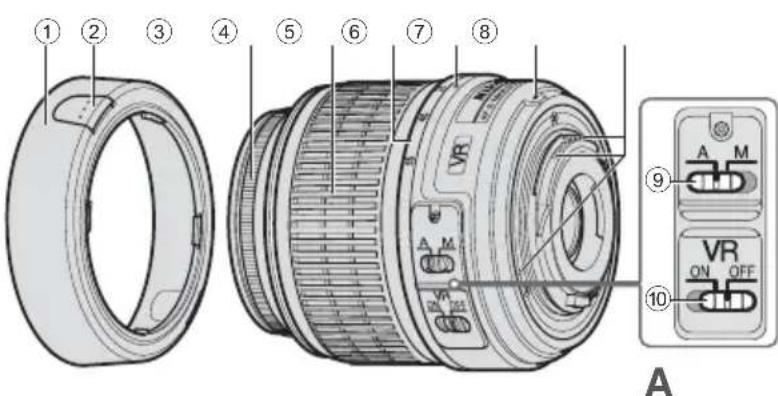
():reference page
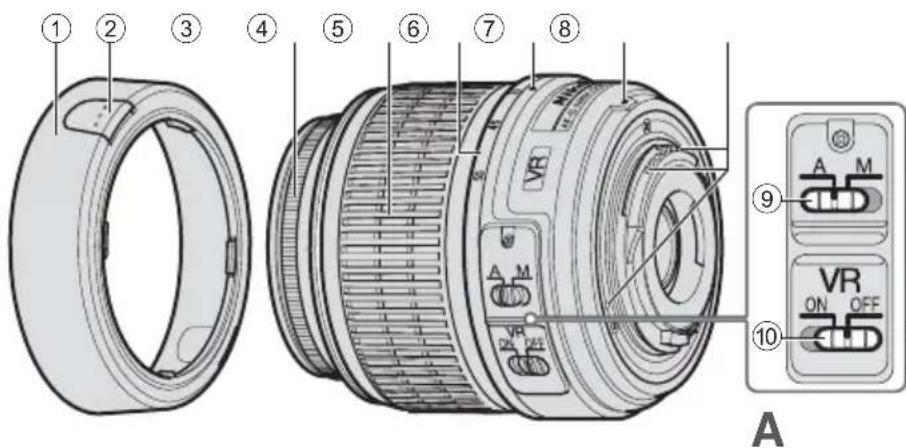
① Lens hood* (P.16)
② Lens hood attachment button (P. 16)
③Focus ring
④Zoom ring (P. 16)
⑤ Focal length scale
⑥Focal length index
⑦ Mounting index (P. 15)
⑧ CPU contacts (P.19)
⑨A-M mode switch (P. 16)
⑩ Vibration reduction ON/OFF switch (P. 17)
*Optional
Thank you for purchasing the AF-S DX NIKKOR 18-55mm f/3.5-5.6G VR lens. DX Nikkor lenses are specially designed for use with Nikon digital-SLR (Nikon DX format) cameras, such as the D300 and D90. When mounted on Nikon DX format cameras, the lens picture angle is equivalent to approximately 1.5 × the focal length in 35mm format. Before using this lens, please read these instructions and refer to your camera's User's Manual.
Major features
- By enabling vibration reduction (VR), slower shutter speeds (3.0 stops) can be used, thus increasing the range of usable shutter speeds and zoom positions, particularly when hand-holding the camera. (The effects of VR on shutter speed are measured according to Camera and Imaging Products Association (CIPA) standards; FX-format lenses are measured using FX-format digital cameras, DX-format lenses using DX-format cameras. Zoom lenses are measured at maximum zoom.)
-
This lens employs a Silent Wave Motor to drive the focusing mechanism, making autofocusing smooth, silent and almost instantaneous. The A-M mode switch 9 is provided for simple selection of autofocus (A) or manual focus (M) operation.
-
More accurate exposure control is possible because subject distance information is transferred from the lens to the camera body.
- The use of one aspherical lens element ensures sharp pictures virtually free of color fringing. Also, the seven-bladed diaphragm produces a nearly-circular aperture, a feature which causes out-of-focus areas of the picture to become soft and unobtrusive.
Mounting the lens
1 Turn the camera off.
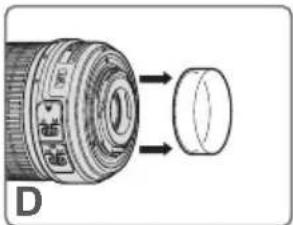
2 Remove the rear lens cap (Fig. D).
3 Align the mounting index ⑦ on the lens with the mounting mark on the camera body, and rotate the lens counterclockwise until it clicks into place. Be sure that the lens is in the correct position when the mounting index ⑦ is on the top of the lens.
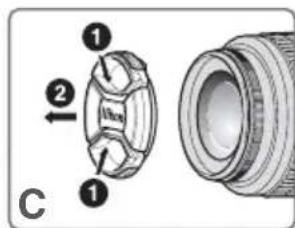
4 Remove the front lens cap. (Fig. C)
Removing the lens
Turn the camera off before removing the lens. Press and hold the lens-release button on the camera while turning the lens clockwise.
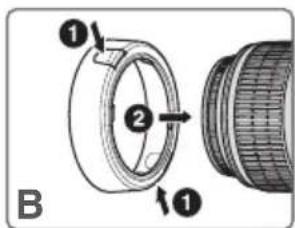
Using the Lens Hood HB-45 (1\* (Fig.B)
*Optional.
Attaching the hood
Lightly squeeze the lens hood attachment buttons ② when attaching the lens hood ① . To store the lens hood ① , attach it in the reverse position.
Removing the hood
Lightly squeeze the lens hood attachment buttons ② when removing the lens hood ①
Focusing, zooming, and depth of field
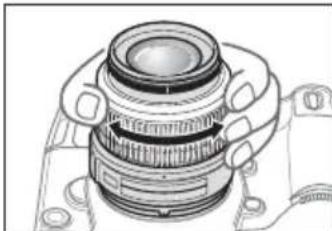
Before focusing, rotate the zoom ring 4 to adjust the focal length until the desired composition is framed in the viewfinder.
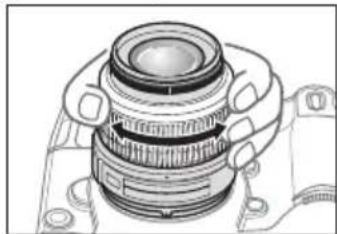
If your camera has a depth-of-field preview (stopdown) button or lever, depth of field can be previewed through the camera viewfinder.
Focusing (Fig. A)
Autofocus mode
Set the camera focus mode to AF-A, AF-S or AF-C and set the A-M mode switch 9 on the lens to A. Press the shutter-release button halfway to focus and completely to shoot.
Do not attempt to rotate the focus ring ③ while autofocus is operating.
Manual focus mode
Set the A-M mode switch ⑨ on the lens to M. Rotate the focus ring ③ manually to focus. Shooting is possible when camera focus mode is set to either AF or M.
| Lens A-M mode switch ⑨ | Camera focus mode | |
| AF | M | |
| A Autofocus — | ||
| M | Manual focus (focus assist is available) | |
For more information on camera focus modes, refer to your camera's User's Manual.
Getting good results with autofocus Refer to "Notes on using wide- or super wide-angle AF Nikkor lenses" (P. 22).
Vibration reduction mode (VR)
By enabling vibration reduction (VR), slower shutter speeds (3.0 stops) can be used. Panning is also supported. (The effects of VR on shutter speed are measured according to Camera and Imaging Products Association (CIPA) standards; FX-format lenses are measured using FX-format digital cameras, DX-format lenses using DX-format cameras. Zoom lenses are measured at maximum zoom.)
Turning vibration reduction on and off
1 Set the vibration reduction ON/OFF switch ⑩ to ON.
Note: Be sure to set the switch 10 so that the indicator is precisely aligned with ON.
2 Camera shake is reduced when the shutter-release button is pressed halfway. Autofocus and manual focusing, as well as precise framing of the subject, are simplified because camera shake visible through the viewfinder is also reduced.
3 To disable vibration reduction, set the vibration reduction ON/OFF switch 10 to OFF.
Notes on using vibration reduction
After pressing the shutter-release button halfway, wait until the image in the viewfinder stabilizes before pressing the shutter-release button the rest of the way down.
- If the camera is panned in a wide arc, compensation for camera shake in the panning direction is not performed. For example, when panning the camera in a horizontal direction, vertical camera shake is reduced. This stabilizes the image whilst allowing the desired panning effect to be realized.
- Due to the characteristics of the vibration reduction mechanism, the image in the viewfinder may be blurred after the shutter is released. This is not a malfunction.
- Do not turn the camera off or remove the lens from the camera while vibration reduction is operating. Failure to observe this note could result in the lens sounding and feeling as if an internal component is loose or broken when it is shaken. This is not a malfunction. Turn the camera on again to correct this.
- With cameras featuring a built-in flash, vibration reduction does not function while the built-in flash is charging.
- When the camera is mounted on a tripod, set the vibration reduction ON/OFF switch 10 to OFF. However, it is recommended that the switch be set to ON when using the camera on an unsecured tripod head or with monopod.
- With autofocus cameras such as D2-series and D300 models, featuring an AF-ON button, vibration reduction does not function when the AF-ON button is pressed.
Setting the aperture
Use the camera to adjust the aperture setting.
Variable maximum apertures
Zooming the lens from 18mm to 55mm decreases the maximum aperture by 1^1/3 stop. However, the camera will compensate for any change in aperture by adjusting the shutter speed so as to maintain the correct exposure value.
Flash photography using cameras with a built-in flash
Vignetting is the darkening of the corners around the image that occurs when the light emitted by the flash is obstructed by the lens hood ①, or lens barrel, depending on the focal length or shooting distance.
- To prevent vignetting, do not use the lens hood ①.
- The built-in flash cannot be used over distances of less than 0.6m (2.0 ft.).
| Digital-SLR cameras | Supported focal length/shooting distance |
| D810, D800-series, D750, D700, D610, D600, D7200, D7100, D7000, D5500, D5300, D5200, D5100, D5000, D3300, D3200, D3100, D3000, D300-series, D200, D100, D90, D80, D70-series, D60, D50, D40-series | No vignetting occurs at any focal length |
-
The built-in flash on the D100 and D70 is compatible with focal lengths of 20mm or greater. Vignetting occurs at a focal length of 18mm .
-
For the latest information on vignetting with this lens, see the camera manual.
Lens care
- Be careful not to allow the CPU contacts (8) to become dirty or damaged.
- Clean lens surfaces with a blower brush. To remove dirt and smudges, use a soft, clean cotton cloth or lens tissue moistened with ethanol (alcohol) or lens cleaner. Wipe in a circular motion from the center to the outer edge, taking care not to leave traces or touch other parts of the lens.
- Never use thinner or benzene to clean the lens, as this could cause damage, result in a fire, or cause health problems.
- NC filters are available to protect the front lens element. The lens hood ① also helps to protect the front of the lens.
-
When storing the lens in its flexible lens pouch, attach both the front and rear lens caps. The lens can also be stored with the lens hood ① attached in the reverse position.
-
When the lens is mounted on a camera, do not pick up or hold the camera and lens by the lens hood ①.
- When the lens will not be used for an extended period of time, store it in a cool, dry place to prevent mold. Be sure to store the lens away from direct sunlight or chemicals such as camphor or naphthalene.
- Do not get water on the lens or drop it in water as this will cause it to rust and malfunction.
- Reinforced plastic is used for certain parts of the lens. To avoid damage, never leave the lens in an excessively hot place.
Standard accessories
- 52-mm Snap-on Front Lens Cap LC-52
Optional accessories
- 52-mm screw-on filters
Rear Lens Cap - Flexible Lens Pouch CL-0815
Lens Hood HB-45
Incompatible accessories
-
Teleconverters (all models)
-
Auto Ring BR-4 and all models of Auto Extension Ring PK, K Ring and Bellows focusing attachment.
- Attachment Ring SX-1 Other accessories may not be suitable for use with this lens. For details, refer to the documentation provided with accessories.
Specifications
Type of lens G-type AF-S DX Zoom-NIKKOR lens with built-in CPU and Nikon bayonet mount (specially designed for use with Nikon digital-SLR—Nikon DX format—cameras)
Focal length 18mm-55mm
Maximum f/3.5-5.6 aperture
Lens 11 elements in 8 groups (1 construction aspherical lens element)
Picture angle 76^ - 28^50^
Focal length 18,24,35,45,55mm scale
Distance Output to camera body information
Zoom control Manually via separate zoom ring
Focusing Autofocus using a Silent Wave Motor; manually via separate focus ring
Vibration Lens-shift method using voice reduction coil motors (VCMs)
Closest focus 0.28 m (0.9 ft.) from focal plane at distance all zoom positions
No.of 7 pcs.(rounded) diaphragm blades
Diaphragm Fully automatic
Aperture range f/3.5 to f/22 (at 18mm), f/5.6 to f/ 36 (at 55mm)
Exposure Via full-aperture method measurement
Attachment 52 mm (P = 0.75mm) size
Dimensions Approximately 73mm dia.) × 79.5 mm (extension from the camera's lens-mount flange)
Weight Approximately 265 g (9.3 oz)
Specifications and designs are subject to change without notice or obligation on the part of the manufacturer.
Notes on using wide- or super wide-angle AF Nikkor lenses
In the following situations, autofocus may not perform as expected when shooting with wide- or super wide-angle AF Nikkor lenses.
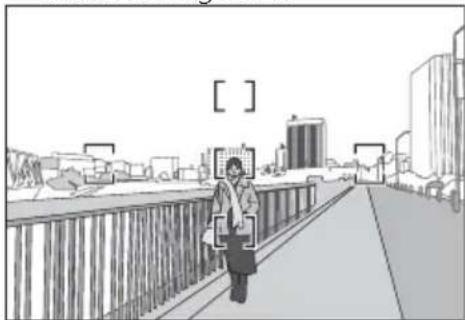
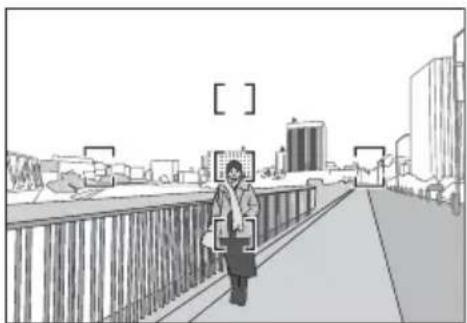
EA person standing in front of a distant background
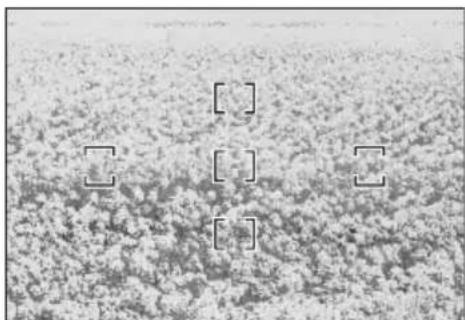
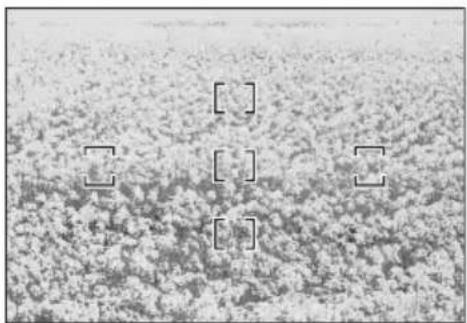
FA field filled with flowers
1. When the main subject in the focus brackets is relatively small
When a person standing in front of a distant background is positioned within the focus brackets, as shown in Fig. E, the background may be in focus, while the subject is out of focus.
2. When the main subject is a finely patterned subject or scene
When the subject is finely patterned or of low contrast, such as a field filled with flowers, as shown in Fig. F, focus may be difficult to acquire using autofocus.
Responses to these types of situations
(1) Focus on a different subject located at the same distance from the camera, apply focus lock, recompose, and shoot.
(2) Set the camera's focus mode to manual focus and focus manually on the subject.
Refer to "Getting Good Results with Autofocus" in the camera's User's Manual.
Focales 18,24,35,45,55mm
Escalade 18,24,35,45,55mm distances focales
He pa36npaIte foToKamepy
PpIKoCHOBeHHe N BHyTpEHHM YacTm fOToKamepbl IIN ObEeKTHBa MOKeT PnpBecTn K NOyueHIO TpaBM. PeMOHT DOJIKeH IPOUN3BOIDNTBCa TOIbKO KBaIIINpUPOBaHNbIM CNEUAnNCTAmN. B cIyuae IOBpeJxDeHn KOpNcya fOToKAMepbl IIN ObEeKTHBa B pe3yIbTaTe NaDeHn IIN DpyrTO pOnCwecTBn OTKnIOHTe CeTeBOI 6IOK NITAHn I/IN N3BJeKNTE 6BaTapeIO U DoCTABbTe I3JeNl E nI npOBepkn B ABTOPIN3OBAHhBI cepBnCHBI ueTp Nikon.
B clyuae HeucnpaBHOCTn HEmeIeHHo BbIKJIOHTe foToKamepy
PnnoBneHnNbIMnNHeo6bHoro 3anaxa,NCXOJaero n3ΦOTOKaMepblnnObBeKTHBa,HEMeJNeHNO 3BJIeKeNTe 6batape,CTapacbHe DOnyCTNTb OxOROB.PpOdoJXeHne pa60tbcYCTPOINCTBOM MOKET npNBecTn K NOlyueHnIO TpaBM. NocIe n3BLeueHn6batape nnOTKlOuHnR NcTOHnKa nHTAHnI DOCTabBe Tn3dJeNnE nIpyOBepKn B 6JnxKaWn ABTOPn3OBaHHbCepBnCHbI cHTp KOMNaHm Nikon.
Ru
He noIb3yItec6 foToKamepo nn 06BeKTHBOM npn HAIINH B BO3dyXe JeRKOBCnnaMeHryUxxCra3OB
Pa6oTa c 3JIeKToHHbIM O6OpyIOBaHHeM PnH aIINuB B Bo3dyXe JERKOBOcPNaMeHraUxCra3OB MoKeT npNBecTN K B3pblBy IIN NOxApY.
He cmoTpTe Ha coHnue uepe3 o6beKtNB nnBVDONCKaTeIb
Ecnn CMOTpeb Ha cOnHne nn npyIe NcTOUHNKn RPKOBCBETA uepe3 06beKTHN BINBIOONCKaTeIb, TO 3TO MOKETBb3BaTb Heo6paTmOE yxduJeHne 3peHna.
XpaHHTe B HeIOCTynHom JIaTeMeCTe
PpIMTe oO6bIe Mepbl npedocTopoxHocTn BO n36exKaHne nonaHaHna 6BaTaPeu n dpyrnx He6oJbux npedMeTOB DeTm B pot.
CobnIaIte cJeMyOuIe Mepbl npdeocTopoXHocTH BO BpeMg 3KcNpyTaunn foTOkAmepbl N obBeKTNBa
He donyckaIte nonaHaHna BoIbI Ha foToKamepu N o6BeKTHB. HecobJIODeHne 3TOrO Tpe6oBaHnRA MoKET npNBecTu K noXapuynnnpaxKeHHo 3NeKtpnueckm TOKOM.
He npikacaiTecb K foToKamepe NIN oBeKTnBy MOKpbIMn pykAMN. Hec6bIIOJeHne 3TOro Tpe6ObaHnRA MoKET npNBecTu K nopaxeHNIO 3JIeKTPnueCKnM TOKOM.
- PnCbEMKe C 3aHnHm OcBeUeHnE H HnPaBnIte oBbekTnB Ha CoHnce, a TaKke He DOnyckaIte NpNaDAnHr COJIHeuHO r CBeta B ObBeKTnB, TAK KAK 3TO MOxET nPnBeCTn K nepeRpeBy fOToKamepbI n ee BO3ropaHnIO.
- Ecnn ObkeTnB He 6yDet NcNoJb3ObaTbcra B TeueHne DInTeIbHoro BpeMeHN, PnKpeNITe NpeEHIIOu 3aDHIO KpbIiKn ObkeKTnBa n He OCTaBnJIte ObekTnB NOI pRmblMn COJIHeYhbIMn Iyamn. HecobJIODeHne 3TOr yCIOBnA MoKeT pINBeCTn K BO3ROPaHIO, NocKOBky ObkeTnB MOKeT COCpeDoToHTb CoJIHeYHbIe IyHi Ha KaKOM-JIb6o JeKOBocJIaMeHryHOUeMc rpeDMte.
06o3HaueHnHa nJIIOcTpaCm
OCHOBHbIE BO3MOXHOCTN
- PnB KluHEn HfYHKuN NoaBHeHn Bn6paun (VR) MoXHo NcNoIb3ObaT bOJIe DInIteJbHbIe BbIepKKn (3,0 CTyneHn*), TEM cAmbIM yBeINuHBaI dHaIa3OH 3HaueHn BblepKKn I 3yma (OCo6EHNO pnp pyuHO nCbeMke). (*BlnHHe VR Ha BblepKky I3MepeTcB COOTBETCTBUN CO CTAndaptAmr Camera and Imaging Products Association (CIPA; AccouNauaŋ npOn3BOUnteIe ΦOTOKaMep n yctpoiCTB o6pOToKN I3O6paKeHn); ObEeKtNBbl fOpMaTa FX I3MepeIOTc C NOMoUbIO UΦpOBbIX fOToKaMep fOpMaTa FX, ObEeKtNBbl fOpMaTa DX I3MepeIOTc fOToKaMepAMn fOpMaTa DX. 3ym-ObEeKtNBbl I3MepeIOTc rPn MaKcImaNbHom yBeJIuHem.)
JaHbI oBcKTHB NCNoJIb3yET 6ecUHMbI BOJHOBOI npBOD Silent Wave Motor nryynpaBneHn MexaHn3MOM fokycuPOBKN, UTO DeJaET npOeCC ABToDfOKCUPOBKN INaBHBIM, 6ecUHMbIM nIpaTNUeCKN MRHOBeHHbIM. NpeKNIouateNB peKIMOB A-M (9) NCNoJIb3yETcA yIObHOro nepeKIIIOueHn MEXdY ABTomATNUeCKM (A) n pyuHbIM (M) peKIMAMn fokycuPOBKN.
Bonee ToHoe ynpabHeHne 3KcNo3nueH eoCTnraeTcnaocpeDCTBOM nepaun HOpmaun OpacctOraHUNdoObekTa OT ObekTbA K fotoKaMepe.
IcnoIb3ObaHHe acpeepueecko JINH3I rapaHTnpyeT YeTKOCtB CHIMKOB IN PpaKTneCKn NOnHOCTbIO NCKNHOaET BO3MOXHOCTb NOBNEHn ZBETHORO Opeona. Kpome TOrO, 6pa3yEmoe cemIneneCTKOBo DNaparMoI OTBepCTne 6n3kO No fOpMe K OkpyKHOCTn, YTO DeNaEe 3Ohy, HaxoJaUyIOCe He B fOKyCe, BoJee MmKoN He3aMeTHoH.
YctaHObKa 06BeKTHBa
1 BbIKJIOUHTe foTOkAmepy.
2 CHIMNTE 3aHIOKpbiuKy o6beKTnBa(Pnc.D).
3 CoBmecnYyCTaHOBOHyoMeTKy 7 Ha o6bekTnBe C yka3aTeJem KpeJIeHna HA Kopnyce fOTOKaMEpbI, NOBOPaUNBaIte O6bekTnB npOTnB YacOBOc TpeJKN Do NOLHOfKcauHN. Y6eINTecb, YTO 6bekTnB yCTaHOBJeH npaBNbHO, pN 3tOM yCTaHOBOUHAR MeTKa 7 DOJXHa HAXODNTbcB B BepxHem NIOJOKeHH.
4 CHMnTe nepdHIO kpbIky o6bekTnBa (Pnc. C).
Chrtne o6bekTnBa
Ipeed ChrTneM obKeTNBa BbIKNIOHTe
fOTOKamepy. HaxMITE u ydePknBaIte KHOKNy
OTCOeINHeHn oBekTNBa Ha fOToKamepe n
NOBepHInTe obKeTnB NO YacBOB CTpeJIke.
NcNoJIb3OBAHHe 6JIeHdI OObKeKTHBa HB-45 ① ^ 水 (Pnc.B)
*Pnpno6peTaetcdoonHntelbHO.
YCTaHOBka 6JIeHdbI
Pn yctahOBke 6IeHdbIObEeKTNBa ① CJIeRka COXMITE KHOKN
IpynpKpeNHe 6IeHdbIOBcEeTNa 2. IJnxXpaHeHn
6IeHdbIOBcEeTNa ① npKpeNte ee 3aOm Hao6oPOT.
ChTne 6JeHdbI
PnCHrTN6JHbIobekTnBa ① cnerKa coXmnte KHOKNI DJI npKpEnHeNIA 6JeHdbIOBekTnBa ②
ΦokycnpOBka,yBelenueHne n rny6nHa pe3KoCTn
PpeKJe Yem
BbINOJHrTb
OOKyCnPOBky,
IOBepHnte KOJIbUo
yBeJIuYeHn ④ dIa
peYJNPOBKn
OOKyCHOrO paCCTOraHnA,
NOKa B BVIOONCKaTeNe He
6yDet BbIeJena
Heo6xOIMma KOMNo3nU
Ecnn fotokamepa ochaueHa KhoKoN nI npbIaykkom npocmotpa rnybHb pe3KoCTn (3aTeMHeHne),TO rnybHy pe3KoCTn MOxHO npOBepntb uepe3 BINOcKaTeIb fotoKamepbl.
ФokycnpoBka(Pnc.A)
Pexn m aBToDpOKycnpOBKn
YcTaHOBnTe Ha foToKaMepe pexHM fokycnPOBKn AF-A, AF-S nAn AF-C nyCtAHOBnTe nepeKnOuataEnb peXIMoB A-M ⑨ Ha obBeKTnBE B noJoxKeHne A. HaxMnTe cnYCKOByIO KHONky 3aTbOpa HanoNobHy dIg POKycnPOBKn I NOJHoCTbIO DnA CbeMKn.
He nbTaItecb NOBopauHBaT KoJIbUo fOKcHPOBKn ③ BO Bpempa60tbi FyHKnAABTOfOKyca.
PyuHoi peXnM fokycnpOBKn
YcTaHOBInTe nepeKIOUOaTeIb peKIMOB A-M ⑨ Ha
o6BeKTINBE B NOIOXeHne M. Jnra BblIOJIHeHnRA
fOKCnPOBKn BpaAaIte KOJIbO fOKCnPOBKn ③
BpyHyIO. CbeMKy MOxHO BblIOJNHaTb, ecnn
ycTaHOBIneH peKIM fOKCnPOBKn fOTOKaMEpbI AF
HmM.
CtahdapTHbIe npHaJdxKHOCTN
-Переднaya Крьшka obъektiva LC-52 Даметюm 52 MM
DOnonHnTeIbHbIe npHaJdJIeXHOCTN
BbHnBuOuNecc fNbTpblDnAmEtPOM 52 MM
-3aDnKaKpbIuKa o6bekTnBa
MärkniyexoIДЯobBeKtNbACL-0815
-Бленьда HB-45
HecOBmecTnMbIe npHaJdJIeXHoCTN
TeNeKoHBePTepbI (Bce MoeJIi)
- ABTomatnueckoe KOJbUO BR-4 n BCE moJeI naBtOMaTnueckoro KOJbUa yBeJIuYeHnRA PK, KOJbUo K n fokycnpoBOHym Mex.
- 3akpenpiauuee koIbco SX-1
Dpyrne npHaadnexHOCTN MOrY T He IOnxOAnTb DnA NCNoJIb3OBAHnC DaHHbIM ObBeKTHBOM.
DOnONHInTeIbHbIe CBeDeEHnC M. B DOKyMeHTaUH, npJnaeraMoK pnuHaADNeXHOCTaM.
TexHnueckne xapaKTepeNCTnKN
TnO6bekTHBa TngAF-S DX 3ym-06bekTNIB NIKKOR
CO BCtpoeHHbIM CPU n 6aioHeTHoI onpaBoN Nikon (pa3pa6oTaHa
CneuNbHO JnNcNoB3OBAHnC uPobbIMn PotoKamepaMn Nikon SLR fopMaTa Nikon DX)
Φokychoe 18MM-55MM
pacctoHne
MaKcHmAlbHoe f/3,5-5,6
3HaueHne DnaqparMbI
Ctpyktypa 113JIeMeHTOB8rpynnax
06bekTnBa (1acpepueeckaJIINH3a)
Yron 76^ - 28^50^
m3o6paXeHn
Kana 18,24,35,45,55mm pacctoHn
Hhopmaun O BbIXoIdoKOpnycaΦOTOKaMepbl pacCTOHHN Do 06bekta
Ynpabnene Puyhoe, c nOMOuIO OTdJIbHOro 3ymom KOJbua yBeJIuYeHnI
ФokycnpOBka ATOΦOKcnpOBKa C NcNoIb3OBAHneM 6ecuMHoro BOJHOBO rPbOda Silent Wave Motor; BpyHyIO, c nOMoUbO OTdEnbHOKOJIbua yBENEHnA
Iopablenne MeToIepeMeEeHnIIN3cNOMOIOBbBn6paunn 3NeKtpoDBnIATEeNEcNIHHeHOOBMOTK0VCM)
Han60Jee 6Jn3Koe 0,28 M OT φOKaJIbHOI pIOCKOCTN BO
pacCToHne DnBCEX NIOJOKeHHx 3yMMIpOBAHNJ
φokycnPobKn
Yncno neneCkoB 7 neeCTKOB (okpyrna) dnaaparmbl
DnaΦparma NOnHOCTbIO aBTOMaTHueckar
Ukana oT f/3,5do f/22 (npu 18MM),oT f/5,6 do dnaΦparMbI f/36 (npu 55MM)
I3mepenHe CnOmoBHO MeToa nONHO 3Kcno3nCnN DnaΦpaRmbI
Pa3mep HacaKn 52 MM (P = 0,75MM)
PazmepbI Pn6n. DnAmEtp 73 MM x 79,5 MM (BbIDBnKHeHne nO npabbl o6beKTNa)
Macca Ppi6n.265r
XapakTepeNCTKn NnI3aH MOrT 6bITbN3MeHeHbI 6e3 npEynpeJxDHeHn KaKnx-Jn6o 06raTeNbCTB CO CTOPoHbI n3rTOBtEn.
PpimeeHnno nncnoB3OBaHHIO shnpokoyroIbHbIX oBeKTHBOB AF Nikkor
B cIeNyUOuXn CNTyaUxn A BTOOfoKycuPoBka MoKeT pa6oTaTb HeHaJIeKaUm O6pa3OM npc C bEmKe C nOMouCbIO UnpOKoyrOBhIX ObBeKTINBOB AF Nikkor.
E Yenobek, cTOnuN nepeD fOHom, HaxoJauMcra Ha 60nbwom pacctoHn
F Pone, nokpbitoe UBeTaM
- Ecnn rnaBbIbOBeKT CbeMKn, HaxoJusnCBA pAMkax fOKyCa, OTHOCHTeJIbHO MaJoro pa3Mepa Ha n306paxeHn
Kak noka3aHa Ha pnc. E, npn HabeHenn paMkn okycHa Ha YeJIOBeKa, No3aN KOTOPORo NMeETc8 6wnpHbI 3aHn HOH, FOKCnpOBKa MoKet 6bITb BbINONHeHa He Ha YeJIOBeKe, a Ha 3TOM fOHe.
- Ecnn OCHOBHOJ OBeKT CbeMKn YBJIeTcR JRPKM, y3OpTaTbIM OBeKToM NIN 3KcNo3NueN
Ecnn oBjekt nmeet npKne y30pbI nnO tnnucaTcHn3kIM YPOBHEM KOHTpactHOCTN, HAnPmep NOJI cBeTOB, KAK NOKa3aHO Ha pnc.F, BO3MOxHO, ABToDfokycnPObky 6ydt CNOxHO BbINOHNHTb.
CnocobI DeiCTBn B noDobHbIX cnTyauinax
(1)BbnoJHnTeΦokCnpOBkyHa pyrom obkeTe, pacnoJoxeHHOM Ha TOM xe pacctOraHm OT oToKamepbl, 3aTeM nCNoJb3yIe 6JokpOBkyΦokCnpOBKn, NOBTOPO CKOMHOHyTe KaDpN CdeJaTc CHMOK.
(2)YcTaHOBnTe pyHOn peXmФOKyCnPOBKnΦOTOKaMEpbI N BblONHnTe ΦOKyCnPOBky Ha ObBeKTeCbEMKn BpyHyIO.
CM. «Понуунехoxopoшиpe3yЛьТаTOB cБЕМКС ИСПОЛБЗОВАнEM abTOФOKсИРОВКИ»ВPyKOBODCTBO ПОЛБЗОВАтELФOTOKaMepbl.
가에라 채的重点만만 AF-A, AF-S만 AF-C로 specytet고 펋조의 A-M모드스워지⑨를 A로 specytet hybrid hybrid hybrid hybrid hybrid hybrid hybrid hybrid hybrid hybrid hybrid hybrid hybrid hybrid hybrid hybrid hybrid hybrid hybrid hybrid hybrid hybrid hybrid hybrid hybrid hybrid hybrid hybrid hybrid hybrid hybrid hybrid hybrid hybrid hybrid hybrid hybrid hybrid hybrid hybrid hybrid hybrid hybrid hybrid hybrid hybrid hybrid hybrid hybrid hybrid hybrid hybrid hybrid hybrid hybrid hybrid hybrid hybrid hybrid hybrid hybrid hybrid hybrid hybrid hybrid hybrid hybrid HYDROGENO HYDROGENO HYDROGENO HYDROGENO HYDROGENO HYDROGENO HYDROGENO HYDROGENO HYDROGENO HYDROGENO HYDROGENO HYDROGENO HYDROGENO HYDROGENO HYDROGENO HYDROGENO HYDROGENO HYDPOGENO HYDPOGENO HYDPOGENO HYDPOGENO HYDPOGENO HYDPOGENO HYDPOGENO HYDPOGENO HYDPOGENO HYDPOGENO HYDPOGENO HYDPOGENO HYDPOGENO HYDPOGENO HYDPOGENO HYDPOGENO HYDPOGENO HYPHERMIDONOMERO HYPHERMIDONOMERO HYPHERMIDONOMERO HYPHERMIDONOMERO HYPHERMIDONOMERO
自通主函主函能已作动当在同不
个号主撮三
RanZsA-MMOnDStWJt⑨MOMoRcHgTseSiO. 3 10 10 10 10 10 10 10 10 10 10 10 10 10 10 10 10 10 10 10 10 10 10 10 10 10 10
Tr(Nikon 微机端 SLR(Nikon DX 20)
()卡蒙拉里,正常使用之一,使用完毕,
()告首的GTAJAF-SDX
Zoom-NIKKOR Lenz
主键表18mm-55mm
封大扎利开f/3.5-5.6
LanZn 8K11M (BnJnRnLanZ1
76°-28°50
18,24,35,45,55mm
丛R
首正终部之的首则同通中动正
其 _ 品 无
同,也。
半元
全部列本定贝E斯克日MO(VCM)
荷兰蘭兹equiv同
No reproduction in any form of this manual, in whole or in part (except for brief quotation in critical articles or reviews), may be made without written authorization from NIKON CORPORATION.
Printed in Thailand 7MAA44C2-11
- Notes on Safety Operations
- CAUTION
- Do not disassemble
- En
- Turn off immediately in the event of malfunction
- Do not use the camera or lens in the presence of flammable gas
- Do not look at the sun through the lens or viewfinder
- Keep out of reach of children
- Observe the following precautions when handling the camera and lens
- Nomenclature
- Major features
- Mounting the lens
- Remove the front lens cap. (Fig. C)
- Removing the lens
- Using the Lens Hood HB-45 (1\* (Fig.B)
- Attaching the hood
- Removing the hood
- Focusing, zooming, and depth of field
- Focusing (Fig. A)
- Autofocus mode
- Manual focus mode
- Vibration reduction mode (VR)
- Turning vibration reduction on and off
- Notes on using vibration reduction
- Setting the aperture
- Variable maximum apertures
- Flash photography using cameras with a built-in flash
- Lens care
- Standard accessories
- Optional accessories
- Incompatible accessories
- Specifications
- Notes on using wide- or super wide-angle AF Nikkor lenses
- When the main subject in the focus brackets is relatively small
- When the main subject is a finely patterned subject or scene
- Responses to these types of situations
- He pa36npaIte foToKamepy
- B clyuae HeucnpaBHOCTn HEmeIeHHo BbIKJIOHTe foToKamepy
- Ru
- He noIb3yItec6 foToKamepo nn 06BeKTHBOM npn HAIINH B BO3dyXe JeRKOBCnnaMeHryUxxCra3OB
- He cmoTpTe Ha coHnue uepe3 o6beKtNB nnBVDONCKaTeIb
- XpaHHTe B HeIOCTynHom JIaTeMeCTe
- CobnIaIte cJeMyOuIe Mepbl npdeocTopoXHocTH BO BpeMg 3KcNpyTaunn foTOkAmepbl N obBeKTNBa
- 06o3HaueHnHa nJIIOcTpaCm
- OCHOBHbIE BO3MOXHOCTN
- YctaHObKa 06BeKTHBa
- Chrtne o6bekTnBa
- NcNoJIb3OBAHHe 6JIeHdI OObKeKTHBa HB-45 ① ^ 水 (Pnc.B)
- YCTaHOBka 6JIeHdbI
- ChTne 6JeHdbI
- ΦokycnpOBka,yBelenueHne n rny6nHa pe3KoCTn
- ФokycnpoBka(Pnc.A)
- Pexn m aBToDpOKycnpOBKn
- PyuHoi peXnM fokycnpOBKn
- CtahdapTHbIe npHaJdxKHOCTN
- DOnonHnTeIbHbIe npHaJdJIeXHOCTN
- HecOBmecTnMbIe npHaJdJIeXHoCTN
- TexHnueckne xapaKTepeNCTnKN
- PpimeeHnno nncnoB3OBaHHIO shnpokoyroIbHbIX oBeKTHBOB AF Nikkor
- 个号主撮三
Brand : NIKON
Model : Nikkor AFS DX 1855mm f3.55.6G VR
Category : Camera lens