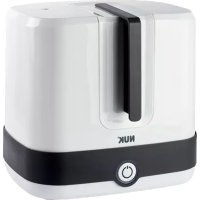
USER MANUAL Vario Express NUK
D Deutsch 3
Please see inside cover fold-out page
⑤ Français 18
B
C
D
E
F
G
H
Inhalt
1. Sicherheitshinweise .... 3
1.1 Explanation of terms 11
1.2 Special information for this appliance 11
1.3 General information 12
1.4 Protection against burning and scalding 12
1.5 Protection against electric shock 12
1.6 For the safety of your child 13
2. Description 13
2.1 Purpose 13
2.2 Model 13
2.3 Contents 13
2.4 Functional description 13
3. Sterilization of feeding bottles, teats and accessories 14
3.1 General information on sterilizing 14
3.2 Sterilization 14
3.3 Please observe the following: 15
4. Cleaning and care of the equipment 15
4.1 Cleaning 15
4.2 Descaling 15
5. Faults and their rectification .... 16
6. Technical data 16
7. Disposal 16
7.1 Equipment 16
7.2 Packaging 17
8. Warranty 17
8.1 Service Centres 17
8.2 Supplier 17
1. Safety instructions
1.1 Explanation of terms
The following signs are used in these operating instructions:

Warning!
High risk: Non-observance of the warning may result in minor or serious injury.
Caution!
Medium risk: Non-observance of the warning may result in damage.
Note:
Low risk: Information on how to handle the appliance should be observed.
- This appliance can be used by persons with reduced physical, sensory or mental capabilities or lack of experience and knowledge if they have been given supervision or instruction concerning use of the appliance in a safe way and understand the hazards involved. Children should not play with the appliance.
- This appliance should not be used by children. Keep the appliance and its cord away from children and domestic animals.
- The surfaces and heating element of the sterilizer become extremely hot during operation. Therefore, only touch the handles or switches.
- Do not immerse the appliance in water or use it outdoors.
- The appliance must not be operated with an external time switch or separate remote control system, such as a wireless remote control socket.
- Always disconnect the plug before cleaning the appliance.
- These operating instructions should be read carefully before use. They are part of this equipment and must be kept readily available at all times.
- The appliance should be used solely for the intended purpose as described (see "2.1 Purpose" on page 13).

Warning!
Non-observance of the intended purpose and the following warnings may result in injury.
- You should ensure that the mains cable is never in a position where someone can trip on it, become caught in it or step on it.
Caution! Non-observance of the following warnings may result in damage to the equipment.
- Check whether the required voltage is the same as your local voltage (see nameplate on appliance).
- The appliance must always be placed on a surface that is firm, even, dry, heat-resistant and non-flammable.
-
The appliance should never be placed in the vicinity of hot surfaces, in heated ovens or in the vicinity of gas or electrical appliances, as this may cause damage to the appliance.
-
Never operate the appliance without water, as it could overheat.
- Never leave the appliance unsupervised during operation, so that you can intervene in good time if it malfunctions.
1.4 Protection against burning and scalding

Warning! As the appliance operates at high temperatures, non-observance of the following warnings can result in burns or scalds.
- During the sterilizing process and immediately after switching off, there is still hot steam in the appliance, some escaping from steam vent 1, so take care not to scald yourself. Do not reach across steam vent 1! Allow the appliance to cool down for at least 3 minutes before opening it.
- Do not touch the heating element after opening the appliance. It remains hot after switch-off much longer than other appliance parts.
- Do not transport the steam sterilizer whilst it is in operation. If you do need to move the appliance when hot, switch it off first, remove the plug and wait until it cools down. Otherwise the surface could cause scalding.
- Bottles and accessories are very hot immediately after being sterilized and should only be removed using the bottle tongs enclosed.
1.5 Protection against electric shock

Warning! The following safety instructions should protect you against an electric shock.
- Only use the appliance if both appliance and mains cable are intact.
- If the mains cable is damaged it must be replaced by the manufacturer, his customer service engineer or a similarly
qualified person to prevent potential danger.
- Never touch the appliance, the mains cable or the plug with wet hands.
- Always remove the cable using the plug. Never pull on the cable itself.
- Ensure that the cable never becomes tangled or snagged.
- Keep the cable away from hot surfaces (e.g. cooker hobs).
- There should be no flammable items (e.g. curtains, paper etc.) in the immediate vicinity of the appliance while in operation.
- To prevent overheating the appliance should never be covered.
- Never leave the appliance unattended while in use. A strong smell of burning
will nearly always mean damage. If this occurs you should immediately unplug the appliance and have it checked over. The contact address is to be found at the end of these operating instructions.
1.6 For the safety of your child

Warning! Children do not recognize the dangers that may occur when operating electrical appliances; therefore, keep children away from such appliances.
- Always ensure that the plastic packaging does not pose a fatal risk to children (risk of choking). Packaging is not meant as a toy.
2. Description
2.1 Purpose
You can use this NUK Vario Express Steam Sterilizer to sterilize baby feeding bottles and bottle accessories.
This appliance is intended to be used at home and similar applications such as:
- staff kitchen areas in shops, offices and other working environments;
- by clients in hotels, motels and other residential type environments;
- farm houses;
- bed and breakfast type environments.
The appliance must not be used for direct commercial purposes or operated in moving vehicles - railway carriages, for example.
2.2 Model
This appliance is available in two variants:
- European model with EU shockproof plug, design to CEE 7/7, article no. 10.251.013
- British model with 3-pin plug to BS 1363 A, article no. 10.749.099
There is no difference in either the operation or function of these two models.
2.3 Contents
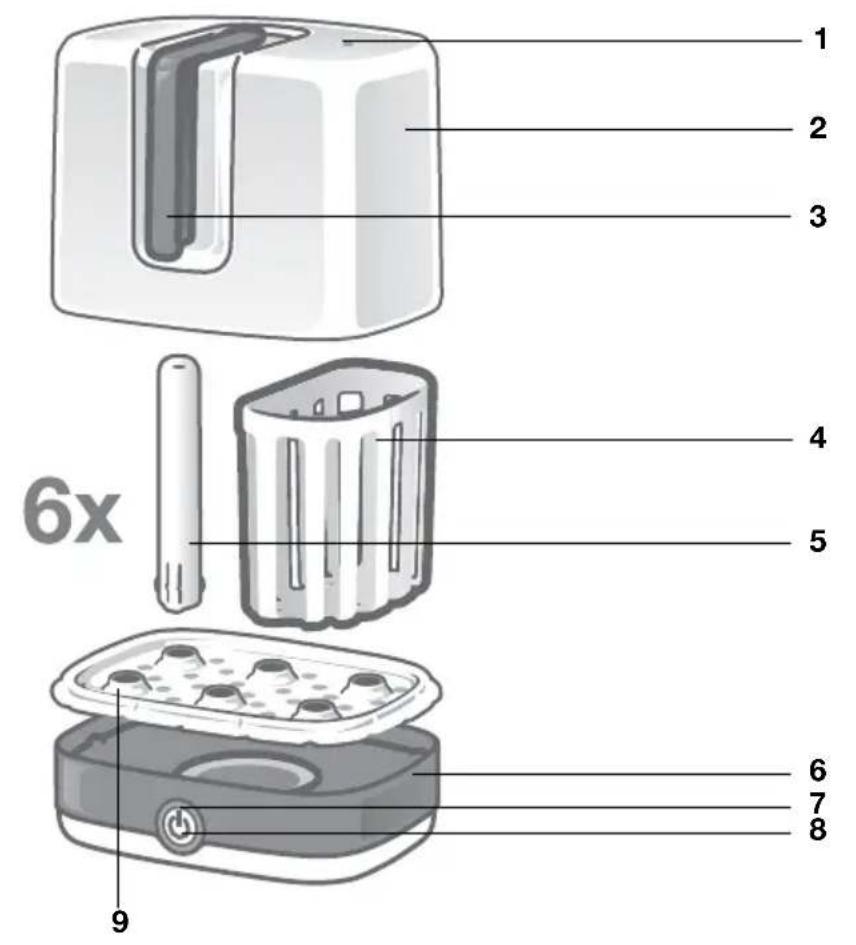
• 1 NUK Vario Express steam sterilizer
• 1 accessories basket 4
- 6 r o d s 5
• 1 drainer 9
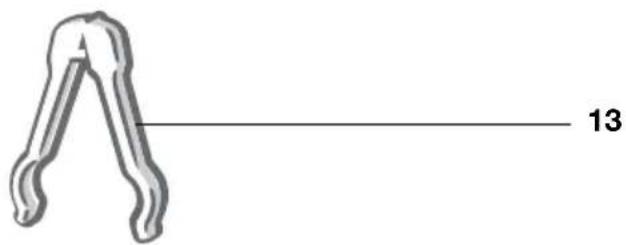
• 1 pair of bottle tongs 13
• 1 set of operating instructions
2.4 Functional description
This steam sterilizer is heated electrically. The water inside the sterilizer is heated up to boiling point. Germs are eradicated in the steam atmosphere, thus sterilizing feeding bottles and accessories.
3. Sterilization of feeding bottles, teats and accessories
Newborn babies do not initially have sufficient antibodies to be able to protect themselves from pathogenic germs.
For this reason it is vital that sterilized teats and bottles are used when preparing infant feeds.
Even tiny feed residues left on teats and bottles can easily lead to bacterial contamination (microbial growth).
The steam sterilizer works by the hot-sterilizing method. Water is converted into steam. The humid heat generated therefore sterilizes the components inside the sterilizer swiftly and reliably. This way the teats and feeding bottles only come into contact with hot steam.
At the same time, the small amount of water the steam sterilizer needs for sterilizing means that only a little power is required.
3.2 Sterilization
Caution! All component parts being sterilized must be washed thoroughly and be free of any food residues.
- Take cover 2 and drainer 9 with accessories basket 4 and rods 5 off evaporation tray 6 (Fig. A).
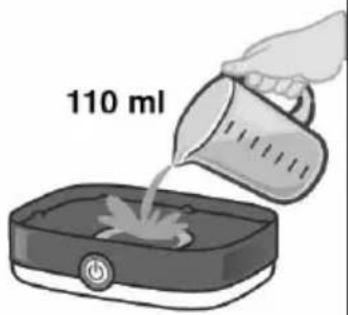
- Use a measuring beaker or a baby feeding bottle to put 110 ml of fresh tap water in evaporation tray 6 (Fig. B).
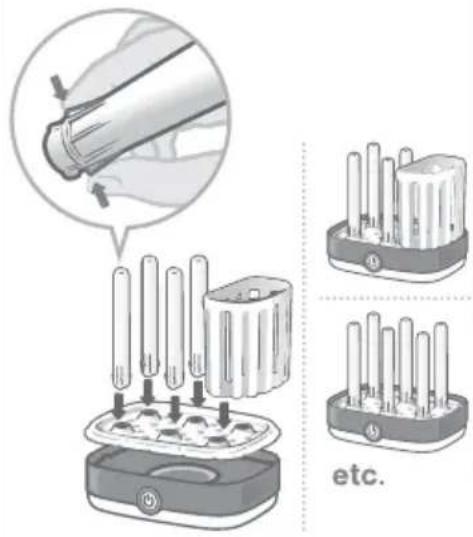
- Put in drainer 9 (Fig. C).
- Put in either accessories basket 4 and 4 rods 5 or 6 rods and no accessories basket (Fig. C).
The rods can be removed by gently squeezing the two retaining tabs to release them.
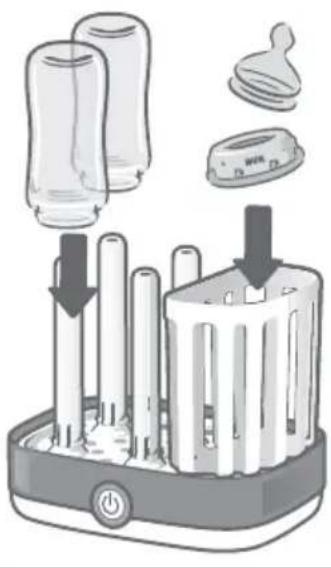
- Up-end the bottles over the rods with the opening facing downwards, so that the bottles are freely suspended (Fig. D).
Caution! Always sterilize the bottles open and dismantled into their individual parts, otherwise material deformation may occur.
- Put the accessories in accessories basket 4 (Fig. D).
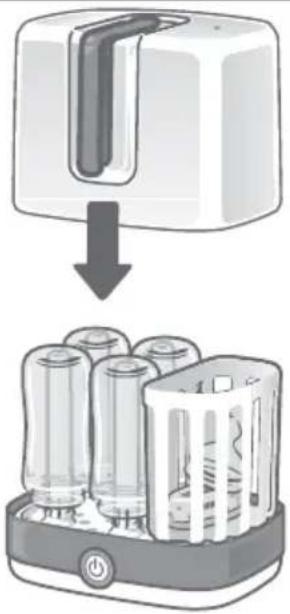
- Put on cover 2 (Fig. E).
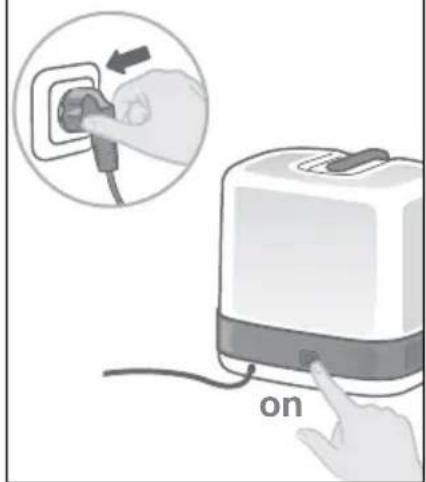
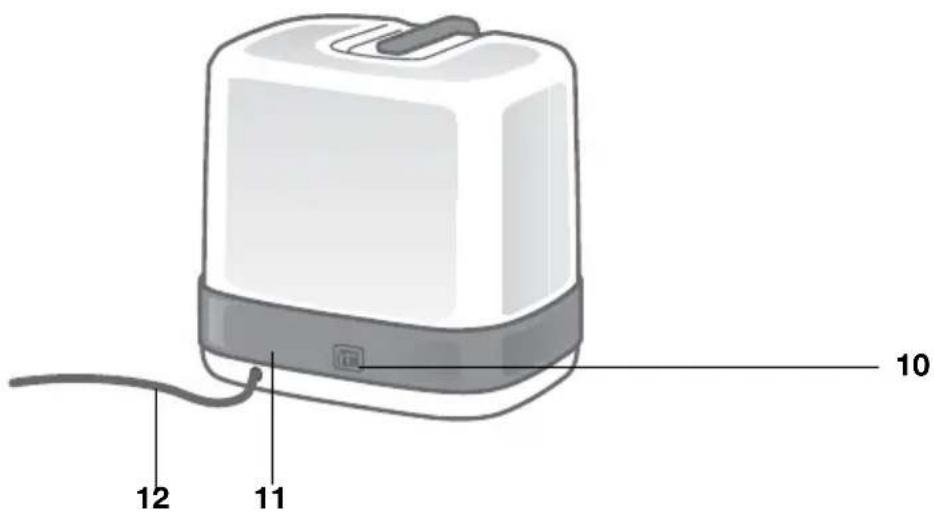
- Take the desired amount of mains cable 12 out of cable compartment 11 and insert the plug in a suitable power supply socket (Fig. F).
- Switch on the appliance at On/off switch 10 (Fig. F).
Note: If indicator light 7 is already on, start switch 8 has already been pressed accidentally.
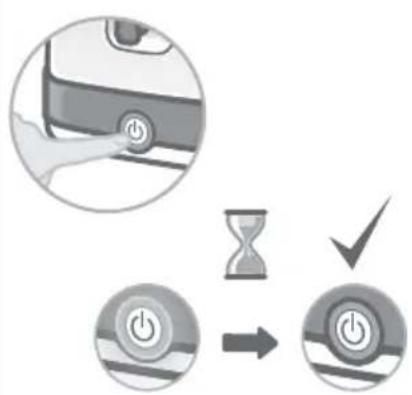
- Start sterilization by pressing start switch 8 (Fig. G).
Indicator light 7 turns on.
The steam sterilizer switches to standby automatically once sterilization is complete. The indicator light goes out.

Warning!
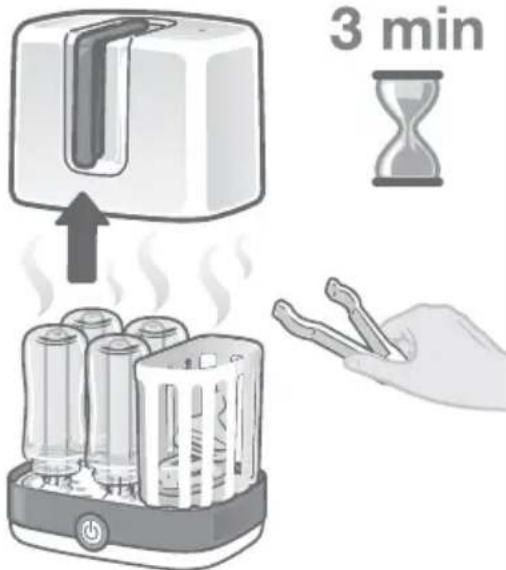
During the sterilizing process and immediately after switching off, there is still hot steam in the appliance, some escaping from steam vent 1, so take care not to scald yourself. Do not reach across steam vent 1! Allow the appliance to cool down for at least 3 minutes before opening it.
Caution! Switch off the appliance at On/off switch 10 after every sterilization process. This stops sterilization being started accidentally.
- Take off cover 2. Always use handle 3 to do this.

Warning!
Bottles are very hot immediately after being sterilized and should only be removed using bottle tongs 13 enclosed.
- Use bottle tongs 13 to remove the baby feeding bottles and the accessories (Fig. H).
- To finish sterilizing prematurely, switch off the appliance at On/off switch 10.
- To stow mains cable 12, disconnect the plug and push the mains cable back into cable compartment 11.
3.3 Please observe the following:
- With a quantity of 110 ml water, the appliance needs about 6 minutes for
heating up and another 6 minutes for sterilization.
- Sterilization is only guaranteed if the process is not interrupted and the time is not reduced.
- If the lid remains closed after sterilization, the contents remain germfree for up to 24 hours.
- You should use only normal tap water without added chemicals.
- Ensure that the equipment is descaled on a regular basis in accordance with "4.2 Descaling" to ensure the sterilizer continues to function correctly.
4. Cleaning and care of the equipment
4.1 Cleaning

Warning! To prevent the risk of an electric shock, injury or damage:
- Always detach the plug before cleaning the appliance.
- Only ever clean the appliance once it has cooled down.
- Never immerse evaporation tray 6 in water.
Caution! Under no circumstances use scouring agents or corrosive or abrasive cleaning materials, as these could damage the appliance.
- Take cover 2 and drainer 9 with accessories basket 4 and rods 5 off evaporation tray 6.
- Wipe down evaporation tray 6 with a damp cloth after every use.
- Clean cover 2, accessories basket 4, drainer 9 and rods 5 by washing up by hand or in a dishwasher.
4.2 Descaling
After some time, the boiling process will cause limescale to form in evaporation tray 6 of the steam sterilizer (this will depend on the hardness area of the tap water being used).
Caution! Do not use commercially-available descalers, pure acetic acid or vinegar essence.
- To get rid of limescale, we recommend pouring 55 ml of white vinegar and 55 ml of boiling water into the steam sterilizer and leaving it to take effect for 30 min.
N.B.: longer periods will not improve descaling but may damage the appliance in the long term.
- After this time, empty the sterilizer, rinse out twice with clean water and wipe dry.
5. Faults and their rectification
| Fault Cause Rectification measure | |
| Sterilization takes too long Too much water in receptacle | Measure exactly 110 ml for optimum sterilization |
|
|
| The appliance does not switch on, indicator light 7 does not light up | Evaporation tray has limescale | Descale evaporation tray (see “4.2 Descaling” on page 15) |
| No power supply Push plug in correctly |
|
| The appliance does not switch on again after use, indicator light 7 is lit up | Overheat protection is active | Wait 15 minutes for the appliance to cool down |
| Bottles are very hot after sterilizing | Bottles are sterilized at above 90 °C | Allow bottles to cool down |
| Use the tongs supplied |
| Bottles and accessories show white marks after sterilizing | Appliance has limescale deposits | Descale appliance (see “4.2 Descaling” on page 15) |
| A lot of steam is escaping at the edge of cover 2 | Appliance has not been assembled correctly | Assemble appliance correctly (see “3.2 Sterilization” on page 14) |
| Bottles and accessories are not suitably positioned in holder | Separate the components so that the appliance seals completely (see “3.2 Sterilization” on page 14) |
| Cover is deformed or broken | Device needs to be repaired. Contact our Service Centre (see “8.1 Service Centres” on page 17) |
| Appliance will not heat, even though the evaporation tray has cooled down | Thermal fuse has tripped or heating element is defective |
6. Technical data
European model with EU shockproof plug, design to CEE 7/7, (article no. 10.251.013):
Voltage: 220 - 240 V\~/50 Hz
Power consumption: 680 W
British model
with 3-pin plug to BS 1363 A,
(article no. 10.749.099):
Voltage: 220 - 240 V\~/50 Hz
Power consumption: 680 W
7. Disposal
7.1 Equipment
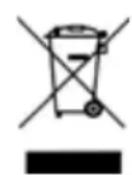
The symbol of the crossed-through wheelie bin means, within the European Union, that the product is subject to a separate waste collection. This applies to the product and all accessories marked with this symbol. Products labelled as such
must not be disposed of with the normal household waste collections; they must be taken to a recycling bank for electrical and electronic equipment. Recycling helps to reduce the use of raw materials and is eco-friendly.
7.2 Packaging
When you wish to dispose of the packaging, please observe the relevant environmental regulations for your country.
8. Warranty
In addition to your statutory warranty rights vis-à-vis the seller arising from the contract to purchase, we as the manufacturers provide a warranty of 24 months from purchase of the appliance as long as the appliance is used properly and the operating instructions are followed. Evidence of the date of purchase and the type of appliance should be provided by means of a receipt.
Your statutory rights vis-à-vis the seller are unaffected by this manufacturer warranty.
During the warranty period, we undertake to remedy any defects attributable to poor materials or workmanship. Worn parts are excluded from the warranty.
Minor deviations from specified quality which do not affect the value or usability of the appliance are not covered by the warranty. We are likewise unable to accept the warranty if the defects on the appliance are due to transport damage for which we are not responsible, if they are attributable to misuse or lack of care or if the appliance has been interfered with by persons not authorized by us to do so.
The warranty service will involve repair, replacement of parts or replacement of the appliance at our discretion. The warranty period will be neither extended nor restarted by the performance of warranty services. The warranty for any spare parts fitted will expire with the warranty for the appliance as a whole.
Extended or different claims, especially those relating to the making good of damage sustained outside the appliance, are excluded unless liability is compulsory in law.
We will not accept the costs or risks of transport.
An appliance sent in without evidence of the purchase date will be treated as a repair. The appliance will only be repaired following discussion with the customer.
Please keep the address, article number and LOT number in case of any queries.
8.1 Service Centres
Addresses for service can be found in "Contact addresses" on page 81.
8.2 Supplier
Please note that this address is not an address for service. Contact one of the service addresses on page 81.
MAPA GmbH
The appliance meets all applicable European directives, as well as the relevant national laws implementing them. These are shown in the EU declaration of conformity which can be requested from the manufacturer. The Declaration of Conformity can be found at www.nuk.com.
Contenu
Newell Rubbermaid UK Services Ltd.
Halifax Avenue, Fradley Park
Lichfield, Staffordshire, WS13 8SS
United Kingdom
www.nuk.co.uk
GE - GEORGIA
GiSi Ltd
Tsereteli 115a
Tbilis 0119
e-mail: info@gisi.ge
GR - GREECE
Intrapharma Consumer Health
Magna Business Park, Citywest Road
Dublin 24
United Drug House
+353 1 463 2424
LT - LITH UANIA
German Products Lithuania, UAB
P.Lukšio g. 32
Vilnius, LT-08222
Lithuania
(+370) 65676802
e-mail: info@gpbaltics.lv
http://www.nuk-baby.lt/
LV - LATMA
German Products Baltics SIA
Rencēnu iela 10a
Riga, LV-1073
Latvija
+371 67278532
www.nuk.lv
e-mail: info@gpbaltics.lv
P - PORTUGAL
Maresi Foodbroker SRL
Str. 9 Mai Nr. 3
310118 Arad
Tel.: 0257/281177
Fax: 0257 / 210 211
RUS - RUSSIA
A.K. Хаазе
Zrenjaninski put 121t
11211 Beograd-Borca
Srbija
+381 11 296 07 83
office@yuglob.rs
TR - TURKEY
İthalatçı Firma:
Atak DIŞ TİC. A.Ş.
Maya Akar Center K:20 Esentepe
Istanbul
0212 211 74 00
www.nuk.com.tr
UA - UKRAINE
Імпортер в Україну:
ТОВ «СМАРТИ ФЕМИЛИ»
info@artemisbrands.co.za
www.nuk.co.za