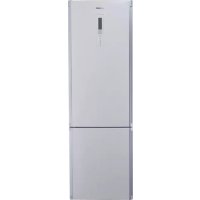
NRB30FG1 - Refrigerator PANASONIC - Free user manual and instructions
Find the device manual for free NRB30FG1 PANASONIC in PDF.



| Product type | Combined refrigerator-freezer |
| Brand | Panasonic |
| Model | NRB30FG1 |
| Climate class | SN (10°C to 32°C), N (16°C to 32°C), ST (18°C to 38°C), T (18°C to 43°C) |
| Refrigerant | R600a (flammable) |
| Electrical supply | 220-240 V, 50 Hz |
| Refrigerator capacity | Not specified (see manual) |
| Freezer capacity | Not specified (see manual) |
| Super Freeze function | Yes (quick freezing, button activation) |
| Holiday mode | Yes (keeps refrigerator at ~14°C) |
| Energy saving mode | Yes (Energy Saving) |
| Active Hygiene | Yes (antibacterial and deodorizing) |
| Vitamin preservation | Yes (Vitamin-Safe via blue and green LED) |
| Child lock | Yes (Child Lock) |
| Open door alarm | Yes (audible after 1 minute) |
| Defrost | Automatic (refrigerator and freezer) |
| Lighting | LED |
| Adjustable feet | Yes (2 front feet) |
| Door reversibility | Yes (by authorized technician) |
| Cleaning | Do not use abrasive products; clean with a soft cloth and warm water |
| Weight | Not specified |
Frequently Asked Questions - NRB30FG1 PANASONIC
User questions about NRB30FG1 PANASONIC
0 question about this device. Answer the ones you know or ask your own.
Ask a new question about this device
Download the instructions for your Refrigerator in PDF format for free! Find your manual NRB30FG1 - PANASONIC and take your electronic device back in hand. On this page are published all the documents necessary for the use of your device. NRB30FG1 by PANASONIC.
USER MANUAL NRB30FG1 PANASONIC
natural_image
Exterior view of a silver multi-door refrigerator with a digital display (no visible text or symbols)Panasonic®
Operating Instructions
Refrigerator-Freezer
Model No. NR-B30F X 1
NR-B30F G1
NR-B30FW1
ENGLISH 2-15 DEUTSCH 16-29 NEDERLANDS 30-43
Before operating the unit, read these operating instructions thoroughly and keep them for future reference.
FRANÇAIS 44-57 ITALIANO 58-71 ESPAÑOL 72-85
Caring for the environment 2
Safety instructions ....3 \~ 4
Installation....5
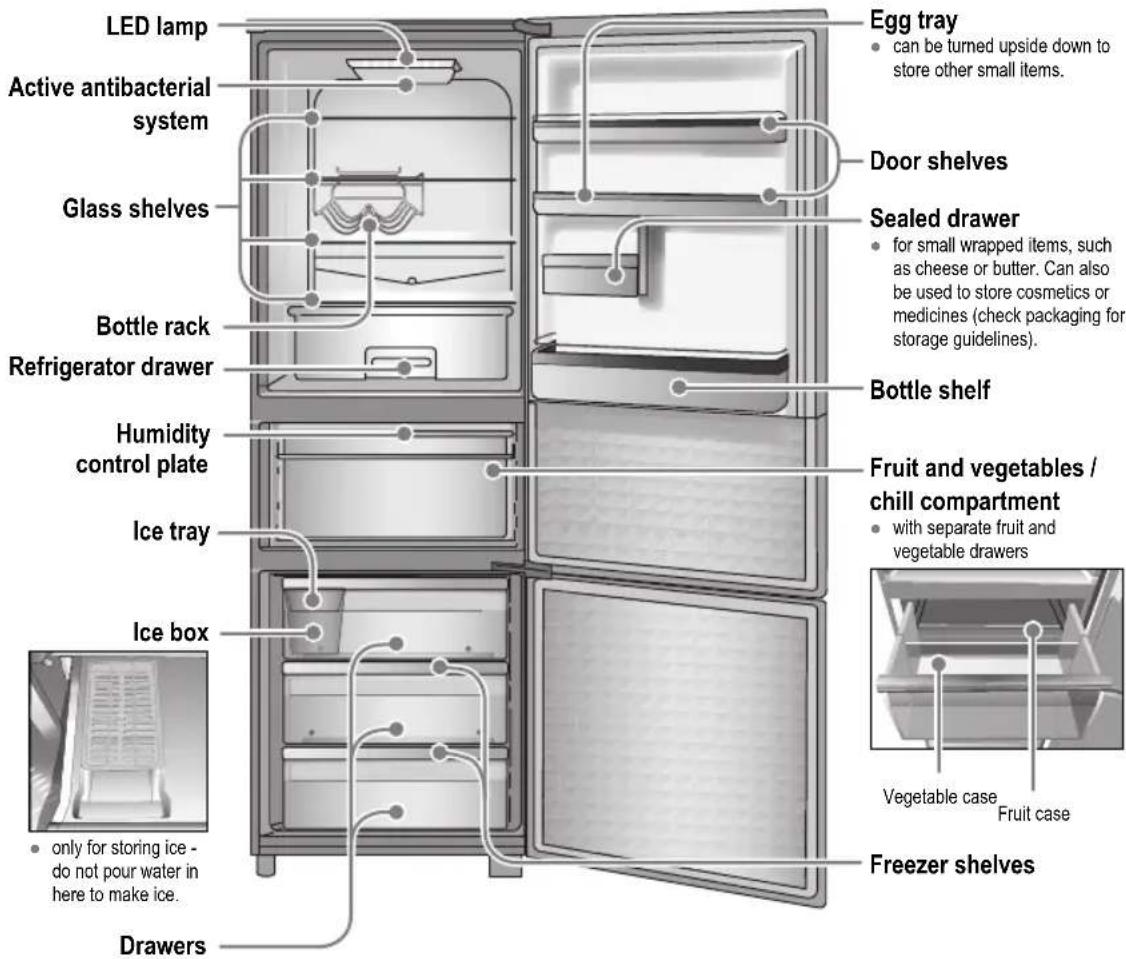
Parts....6
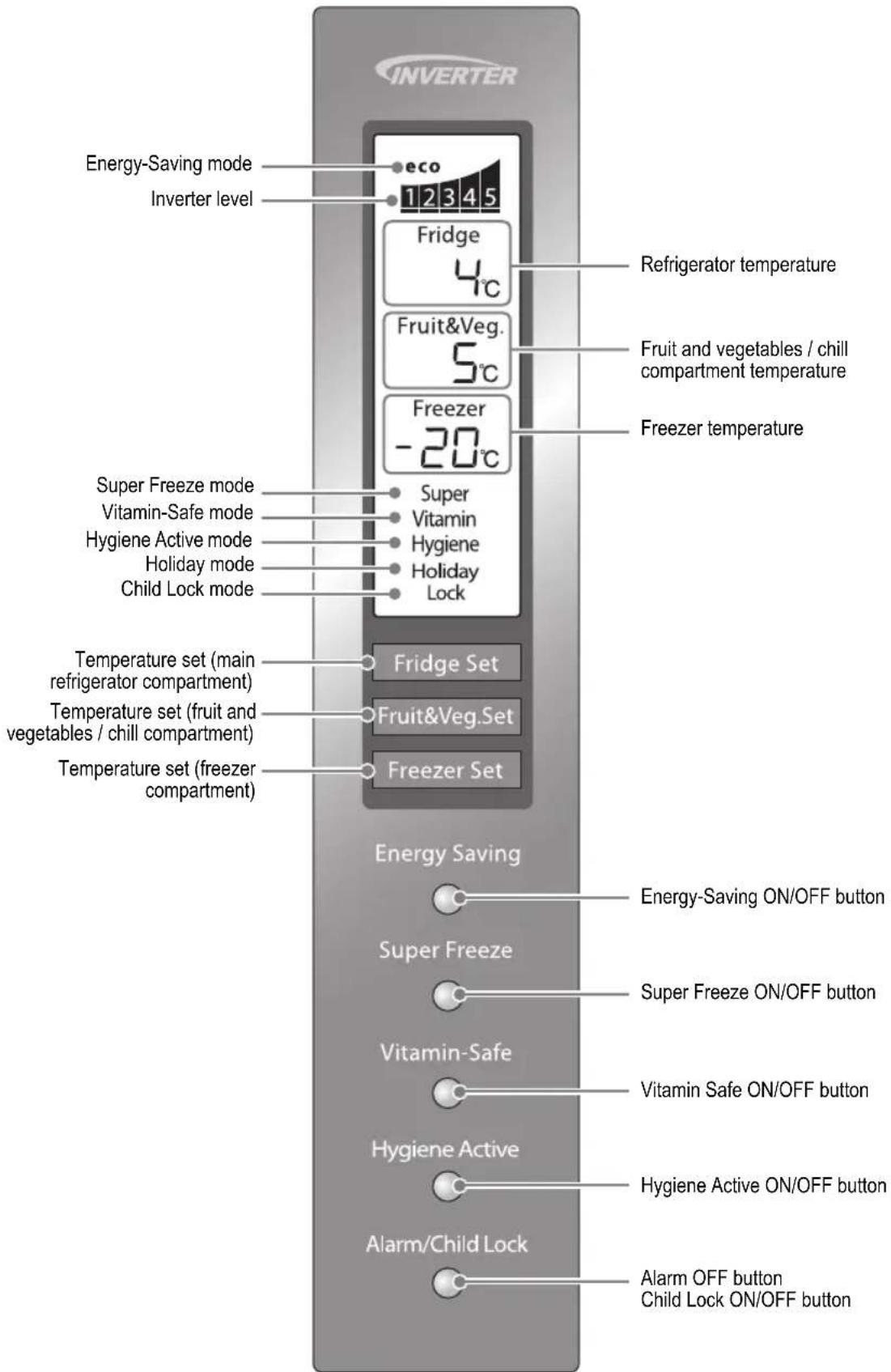
Display and control panel 7
Setting up 8 \~ 9
Features and functions 9 \~ 10
Making ice cubes 10
Automatic defrosting 11
Removing and attaching shelves ....11 \~ 12
Care and cleaning instructions ....12 \~ 13
FAQs 14 \~ 15

Caring for the environment

Disposing of the packaging
Please recycle where possible (e.g. cardboard, plastic bags, adhesive tape and polystyrene) and make sure you dispose of all other packing materials safely.
Keep the packaging out of the reach of babies and young children, to avoid injury or suffocation.
Disposing of Waste Electrical and Electronic Equipment (private households)
Whenever these symbols appear on an appliance or its documents, you should not dispose of it with general household waste.
Refrigerators contain refrigerants and gases, which must be disposed of properly.
To prevent leaks, take care not to damage pipework on the back of the unit.
Take your old, unwanted appliance to a designated collection point or recycling facility, such as your local Civic Amenity Centre or Recycling Centre. They'll dispose of it properly.
Ask your local council for details of your nearest designated collection or recycling point.
You may be able to leave your old appliance with the retailer when you buy an equivalent new appliance from them.
Disposing of your old appliances correctly can help save valuable resources, and reduce any negative impact on the environment.
In accordance with your country's legislation, you may be fined or prosecuted for not disposing of your old appliance responsibly.
For business users in the European Union
When disposing of electrical and electronic equipment, please contact your dealer or supplier for further information.
Disposing of appliances in countries outside the European Union
This symbol is only valid in the European Union.
Please contact your local authority or appliance retailer for information about how to dispose of unwanted appliances.
natural_image
Interior view of a refrigerator with open door and shelves (no text or symbols visible)Before disposing of your old appliance
Please follow the disposal instructions by the manufacturer of the old appliance. Where this is not available, please follow the three step instructions below.
-
Remove the plug from the socket.
-
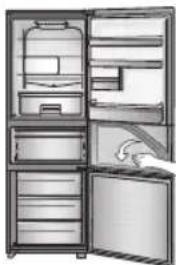
Cut the power cord off, and discard it with the mains plug still attached.
-
Until the old appliance is collected, or you take it to a Recycling Centre, make sure it's out the reach of small children.
- Remove all sealing materials from the door and leave all the shelves and drawers in place. This way, children are less likely to climb in and become trapped.
Safety instructions

What the symbols mean:
 Do not Do not touch Do not Do not touch | |
 Make sure you do this You must remove the plug from the socket Make sure you do this You must remove the plug from the socket | |
 Do not take apart Do not take apart | Indicates the appliance must be earthed to prevent electric shock |
WARNING
Indicates risk of serious injury
This appliance should not be used by individuals (including children) with reduced physical, sensory or mental capabilities, or lack of experience and knowledge of the appliance, unless under the supervision or instruction of someone responsible for their safety.
Children should be supervised when near the appliance.

Do not use a multiple socket adaptor and plug several appliances into the same socket adaptor. This can cause overheating, fire or short circuit.

Do not pinch, knot, or bend the power cord, or place heavy objects on it.
- This increases the risk of fire or electric shock. If the power cord is damaged, please consult authorized service centre.
Do not unplug the refrigerator by pulling on the power cord. This can damage to the power cord. Always grip the plug and pull firmly from the socket.

Do not place any water container on the top of the refrigerator.
• Water can damage insulation of electrical components and cause short circuit, fire or electric shock
Do not spray inflammable gas near the refrigerator.
• This can cause explosion or fire.
Do not spray water onto or into the refrigerator.
• This can cause fire or electric shock.

You must plug the refrigerator into a standard earthed mains socket to minimise the possibility of electric shock.

You must plug the refrigerator into a single mains socket that has the appropriate voltage rating. Do not use an extension cord or adapter plug.
Make sure the power cord and plug aren't squashed or damaged.
- A damaged power plug or cord can cause short-circuit, fire or electric shock.
- If the power cord is damaged, have it replaced by the manufacturer, its authorised service centre, or a qualified electrician before using the appliance.
Remove any dirt or dust from the plug's pins before connecting to the power supply.
- Dust build-up on the plug can cause insulation failure, especially in humid conditions. This can cause short circuit, fire or electric shock. Unplug the power cord and wipe it with a dry cloth. Never use a wet or damp cloth.
Plug your appliance into the socket, making sure the connection is secure. A loosely connected power plug can cause fire or electric shock.

Install the refrigerator in a well-ventilated area.
- The more refrigerant there is in an appliance, the larger the room it should be installed in. If there's a refrigerant fluid leak, and the appliance is in a small room, the build up of combustible gases is more likely. This can cause fire or explosion. As a guide, for every 8g of coolant, you'll need at least 1 cubic metre of space in the room. The data plate inside the appliance tells you how much refrigerant your refrigerator contains.
- Keep all ventilation openings clear.
The refrigerant (R600a) used in the refrigerator and the gases in the insulation material (cyclopentane) are both flammable. They also require special disposal procedures.
- Before you dispose of the appliance, make sure none of the pipes on the back are damaged. Refrigerant or gas leaks can cause fire or explosion.
• Do not damage the refrigerant circuit.

To avoid electric shock.
- Never touch the power plug with wet hands.
- Unplug the refrigerator before cleaning and servicing.

If you smell burning or see smoke coming from the refrigerator, disconnect the power immediately and please consult authorized service centre.

Safety instructions (continued)

Do not install the refrigerator in a damp place, or where it may come into contact with water. Deteriorated insulation of electrical parts can cause short circuit, electric shock or fire.
Do not store volatile or flammable substances in the refrigerator.
- Flammable substances such as benzene, thinners, alcohol, ether and Liquid Petroleum Gas (LPG) can cause explosions.
Do not store pharmaceuticals or other temperature-sensitive products in the refrigerator. You should not store products that require strict temperature controls in the refrigerator.
Do not let children climb, swing or hang on the refrigerator door. This can cause serious injury, as well as damaging the refrigerator.

Do not operate the refrigerator in the presence of explosive fumes or flammable gas. This can cause explosion or fire.
Do not store petrol or other flammable liquids and vapours in the refrigerator, or use them near the appliance. This can cause explosion or fire.
Do not place items that heat up during use, such as a microwaves or power adaptors, on top of the refrigerator. They can damage the top of the appliance.
Never use sharp tools to scrape off frost or ice in any of the refrigerator compartments. And never force solid ice from the refrigerator lining or shelves.
- Cooling plates and refrigerated freezer shelves contain channels through which the refrigerant passes. If punctured, leaking refrigerant can pose a serious fire risk and cause eye irritation.
Do not use mechanical devices or any other means to speed up the defrosting process - other than those recommended by the manufacturer. This can cause damage to the interior of the refrigerator or cause an explosion.
Do not use electrical appliances inside the food storage compartments of the appliance, other than those recommended by the manufacturer.

Do not try to disassemble, repair or modify the refrigerator yourself.
- You may injure yourself - or others - with burns or electric shock, or damage the refrigerator. If your appliance needs alterations or repair, please consult authorized service centre.
CAUTION

Indicates risk of injury or damage to property.
Do not place your hands or feet beneath the bottom of the refrigerator. The iron plate or other sharp edges can cause personal injury.
Do not put glass bottles or containers in the freezer. When the contents freeze, the glass may break.

When opening the refrigerator, be careful not to pinch your fingers at the "pinch point" areas. This can cause personal injury.
Also, be careful of the gap between the fridge and freezer doors, especially if they are both open at the same time. This may cause personal injury.
If there's a power cut, avoid opening the refrigerator frequently or putting unchilled food in it.
- This can cause the temperature in the refrigerator to rise and spoil food stored inside.
If you need to unplug the refrigerator, wait at least 10 minutes before you plug it back in again. Or you might damage the compressor.
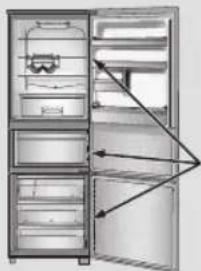
natural_image
Interior view of a refrigerator with open door and side shelves (no text or symbols visible)Potential pinch point

Do not touch the inside walls of the freezer or items stored in the freezer with wet hands. Your skin can become frozen onto the interior wall, or items stored in the freezer.

If you're not using the refrigerator, unplug it from the mains. Deterioration of the mains lead's insulation can cause fire.
This section explains how to install your appliance for the most energy-efficient, safe and quiet operation.
Unpacking your appliance
Remove all packaging and tape.
Choosing the right location
Ventilation
As the appliance gives off heat during operation, it should be installed in a well-ventilated, dry room with plenty of space above and behind it, as shown in Figure 1.
If you can hear it vibrating, it needs more space.
Temperature
The room temperature affects the refrigerator's energy-efficiency, i.e. how much electricity it uses to chill and freeze foods.
For the best results, install your refrigerator:
• away from direct sunlight
• away from radiators, cookers or other heat sources
- where the room temperature corresponds to the climate classification for which the appliance is designed. Refer to the Specifications Section for your appliance's climate classification.
Level
Install on a level floor that's strong enough to support a fully loaded refrigerator.
You can adjust the level of the refrigerator by screwing or unscrewing the two adjustable front legs as shown in Figure 2. This prevents vibration and noise.
If the appliance is to stand on a carpeted or vinyl floor, put a solid board underneath it first. This will protect your floor against possible colour change due to heat given off by the appliance.
Refrigerator door
The refrigerator's door hinges can be swapped over, from the right side to the left, so that the doors open in the opposite direction. If this is more convenient in your home, please consult authorized service centre, ask a qualified technician to do it for you.
Cleaning
After installation, wipe the appliance clean with warm water.
Plugging in
You can connect the power plug immediately after installation.
Room temperature
You'll find your refrigerator's climate classification on the rating plate in the left side of the refrigerator compartment. It shows the room temperature the appliance is designed to work in.
| Climate classification Permitted | ambient temperature | |
| SN | (Extended Temperate) +10°C to 32°C | |
| N | (Temperate) +16°C to 32°C | |
| ST | (Subtropical) +18°C to 38°C | |
| T | (Tropical) +18°C to 43°C | |
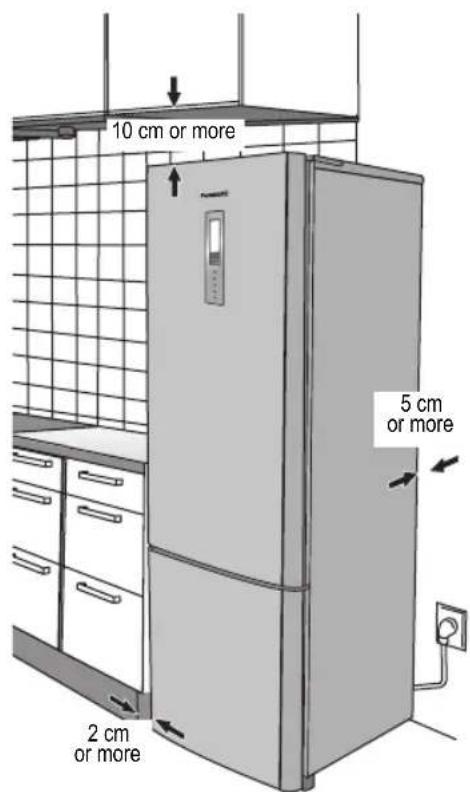
Figure 1
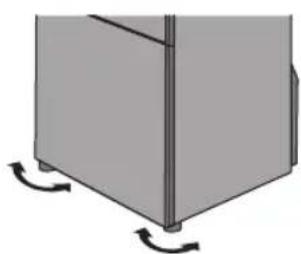
natural_image
Simple 3D diagram of a rectangular box with two side legs and curved arrows indicating rotation or movement (no text or symbols)Figure 2
The illustration below is based on model NG-B30FG1, and may be slightly different to your refrigerator.
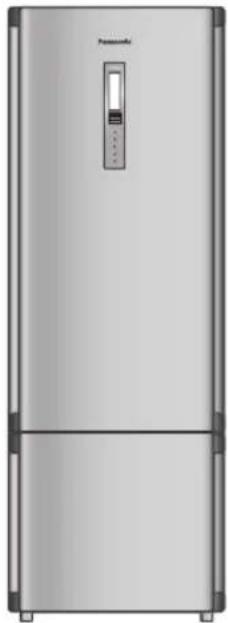
natural_image
Front view of a stainless steel refrigerator with control panel and side legs (no visible text or symbols)Refrigerator compartment
natural_image
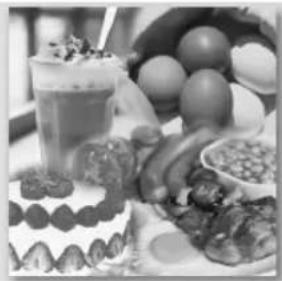
Black-and-white photo of a breakfast platter with layered toppings including cake, glasses, and fruit slices (no visible text or symbols)Cooked food, drinks, eggs, cakes, dairy products
Fruit and vegetables / chill compartment
Fruit,
fresh vegetables,
meat, fish
Freezer compartment
natural_image
Black and white photo of raw fish with a glass bowl and scattered food items (no visible text or symbols)Frozen meat, poultry, fish, ice cream

Display and control panel

ENSOLIDH

Setting up
Switching the appliance on
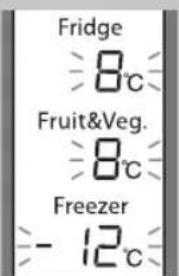
Figure 3
As soon as the machine has been installed, you can plug it into the power socket.
When connected, the light behind the display panel will come on. After about five seconds, the temperatures of the refrigerator, fruit and vegetables / chill compartment and freezer will start flashing "8°C", "8°C" and "-12°C" (figure 3).
- These aren't the actual temperatures. Because the appliance has just been turned on, the refrigerator, fruit and vegetables / chill compartment and freezer have not yet cooled down.
- When each compartment reaches the set temperature, the display stops flashing and shows the actual temperature. Assuming the room temperature is about 32^ C, no food is stored, the door is closed and the appliance runs properly, this should take three to four hours.
Note: In higher room temperatures, it may take longer for each compartment to cool down.
Selecting the temperature
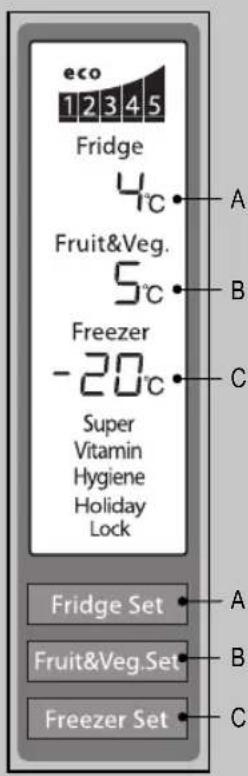
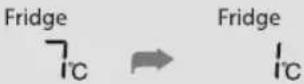
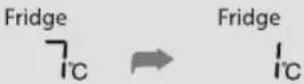
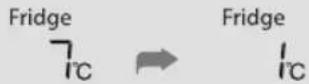
(A) Setting the main refrigerator temperature
Default temperature: 4^ C
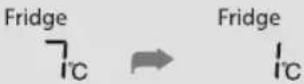
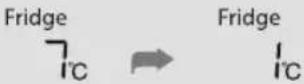
Setting range: 7°C to 1°C
To change the temperature:

flowchart
graph TD
    A["Fridge Set"] --> B["4c"]
    B --> C["Fridge Set"]
    C --> D["3c → 2c → 1c"]
    C --> E["5c ← 6c ← 7c ←"]
    style A fill:#f9f,stroke:#333
    style C fill:#f9f,stroke:#333
    style D fill:#ccf,stroke:#333
    style E fill:#ccf,stroke:#333
① Press once. ② While it is flashing, press until the desired temperature is shown.
③ After five seconds, the display reverts to the actual temperature. The unit will then adjust to the new temperature.
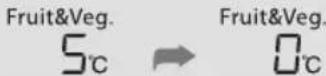
(B) Setting the vegetable compartment temperature
Default temperature: 5°C
Setting range: 5°C to 0°C
To change the temperature:

flowchart
graph TD
    A["Fruit&Veg.Set"] --> B["S_c"]
    B --> C["Fruit&Veg.Set"]
    C --> D["S_c → 4_c → 3_c → 2_c"]
    D --> E["0_c ← I_c"]
① Press once. ② While it is flashing, press until the desired temperature is shown.
③ After five seconds, the display reverts to the actual temperature. The unit will then adjust to the new temperature.
(C) Setting the freezer temperature
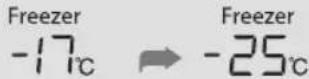
Default temperature: -20^
Setting range: -17°C to -25°C
To change the temperature:

① Press once. ② While it is flashing, press until the desired temperature is shown.
③ After five seconds, the display reverts to the actual temperature. The unit will then adjust to the new temperature.
Setting the right temperature
- If the refrigerator operates at 1^ for too long, some foods may freeze.
- The temperature in the refrigerator compartment drawer will automatically change according to the temperature set for the refrigerator.
- When the fruit and vegetables / chill compartment is set between 5°C and 2°C, the compartment is suitable for vegetables and fruit.
Try to keep fruit and vegetables separate. - When the fruit and vegetables / chill compartment is set between 1°C and 0°C, it's suitable for chilled foods (meat, fish, precooked meals).
Note: The temperature can drop below 0^ , and some food may become partially frozen. Vegetables, fruit and any produce sensitive to lower temperatures should not be stored within this temperature range. - Temperatures inside the refrigerator vary according to the room temperature, the setting, how you use the refrigerator, and the amount of food you store in it.
- The tested temperature may differ slightly from the temperature shown. This is due to different testing methods and tools.
- In the Super Freeze mode, the tested temperature of the freezer may differ from the temperature shown.
- This refrigerator controls the inside temperature using a micro processor. The temperature fluctuates along with changes in room temperature, how fast the compressor is running and how often the door is opened and closed. As a result, the temperature shown may be different from the temperature you've set.
Features and functions

Inverter Level Indicator
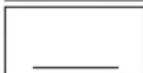
The compressor has stopped running.
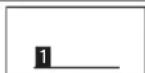
The compressor is running at the lowest speed.
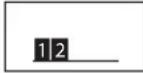
The compressor is running at low speed.
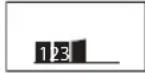
The compressor is running at medium speed.
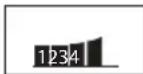
The compressor is running at high speed.
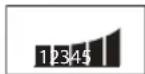
The compressor is running at the highest speed.
Super Freeze
Super Freeze

The Super Freeze function allows you to freeze fresh food quickly, or make ice cubes.
▶ To activate: Press the Super Freeze button and the Super indicator light will come on.
In Super Freeze mode:
● the compressor runs continuously;
- the freezer temperature can drop, as is it not being controlled by the temperature you set. So the temperature displayed may be different from the temperature you set.
- the refrigerator may keep running for a long time, or pause occasionally, but its temperature is still controlled by the temperature you've set.
To deactivate: When the temperature of the freezer is low enough, you can cancel the Super Freeze mode by pressing the Super Freeze button again. The Super indicator light will then switch off.
Note: If you don't deactivate the Super Freeze mode manually, it will automatically switch off after 50 hours.
Holiday
Fridge Set
To disable the refrigerator compartment function for a long period, for example during a holiday, you can use Holiday Mode.
Before using this mode, empty the refrigerator, clean it and shut the door.
To activate: Press and hold the Fridge Set button for three seconds. The Holiday indicator will light up. Meanwhile, the Fridge temperature will not display.
The LED lamp will also switch off during Holiday mode.
To deactivate: Press and hold the Fridge Set button for three seconds. The Holiday indicator will switch off and the Fridge temperature will display.
Note: For hygiene reasons, the refrigerator compartment temperature stays at around 14^ C during Holiday Mode operation.
Energy Saving
Energy Saving

You can use this mode to save electricity when you're not using the fridge as much. For example, overnight or throughout the winter.
▶ To activate: Press the Energy Saving button. The eco indicator will come on.
▶ To deactivate: Press the Energy Saving button. The eco indicator will go off.
Note: You cannot activate Super Freeze mode while this mode is activated.

Features and functions (continued)
| Hygiene ActiveHygiene Active | You can use this to operate the antibacterial function.➢To activate:Press the Hygiene Active button and the Hygiene indicator will light up.➢To deactivate:Press the Hygiene Active button. The Hygiene indicator will switch off.Tips for use:·Once you've pressed the Hygiene Active button, you may hear the deodorising fan running.If you open the refrigerator door while the Hygiene Active function is on, the fan stops.·When storing food with a strong odour, wrap it in cling film or put it in a sealed container.Otherwise, even with the Hygiene Active function on, the odour may linger.·Once you have pressed the Hygiene Active button, try not to open the fridge door. | ||
| Vitamin-SafeVitamin-Safe | The 'keep fresh' feature helps preserve the Vitamin C in fruit and vegetables, and is activated by the blue and green LED lights.➢To activate:Press the Vitamin-Safe button. The Vitamin indicator will light up, and blue and green LED lights will flash at the same time.➢To deactivate:Press the Vitamin-Safe button. The Vitamin indicator will switch off. | ||
| Alarm OffAlarm/Child Lock | This lets you know when the refrigerator or freezer door isn't closed. It also tells you if the refrigerator or freezer temperature is too high. | ||
| Door open time Buzzer | |||
| After one minute Beep beep | |||
| After three minutes Beep beep, beep beep | |||
| After five minutes Beep continuously | |||
| Temperature is too high Beep continuously | |||
| ➢To activate:Press the Alarm/Child Lock button. The buzzer will stop.Note:When the buzzer function starts, the temperature display will flash. | |||
| Child LockAlarm/Child Lock | Use this mode to lock all buttons without the Alarm off function.➢To activate:Press and hold the Alarm/Child Lock button for 3 seconds. The Lock indicator will light up and all buttons are locked.➢To deactivate:Press and hold the Alarm/Child Lock button for 3 seconds. The Lock indicator will switch off and the lock is released. | ||

Making ice cubes
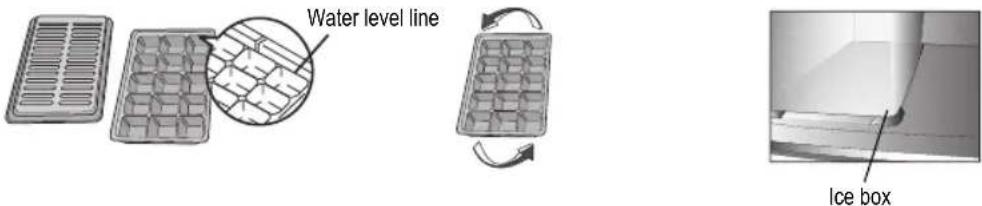
Open the freezer, pull out the upper drawer and take out the ice tray. Open the ice tray lid and fill water in the ice tray to the water level line. Then close the lid and place back the ice tray.
When ice cubes are ready, pull out the upper drawer and take out the ice tray. Open the lid and slightly twist the ice tray by holding its two sides, the ice cubes will drop into the ice tray. Then, put the ice box back into its place.
Automatic defrosting

Refrigerator
Drain hole
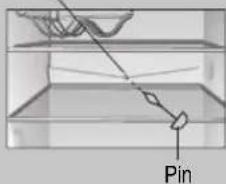
The refrigerator has an automatic defrosting function.
Melted water drains into an evaporation pan at the back of the refrigerator. When the compressor runs, the heat generated makes this water evaporate.
As a result, you will often find frost and water drops on the back wall of the refrigerator.
Make sure the drain hole is clear so that water can flow into the evaporation pan.
If it gets blocked, clear it with the pin.
If you lose the pin, please consult authorized service centre for a replacement. Do not attempt to use a needle or other sharp objects, as you may damage the refrigerator.
Freezer
Defrosting happens automatically and the frost water will run down to the evaporation pan.
Removing and attaching shelves

Refrigerator
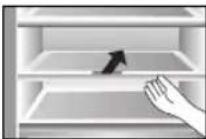
Glass shelves
Lift the inner side of the shelf slightly and pull it out.
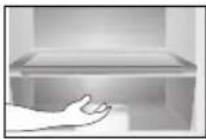
Refrigerator drawer
Pull the drawer towards you, lift the front slightly and pull it out.
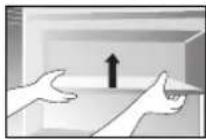
Door shelf, sealed box and bottle shelf
Lift it slightly and then remove it.
Bottle rack
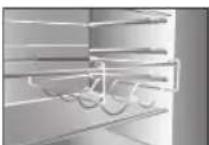
Pull the shelf out a little. Push up the front of the bottle rack.

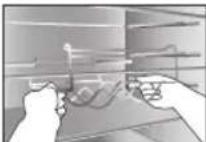

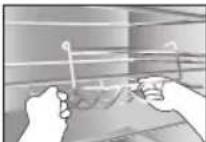
Then push up the back of the bottle rack to disengage the hook. Then pull it out.
Fruit and Vegetables/Chill compartment


Fruit and vegetables drawer
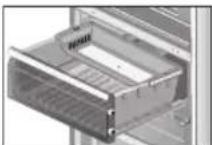
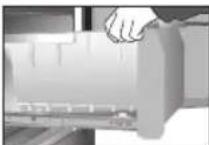
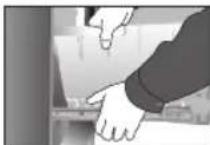
Pull out the drawer and lift up the front to remove it from the left and right hooks. Then push the left and right hooks at the rear down to remove the drawer.
Humidity control plate
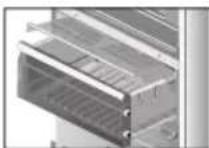
Pull the vegetable drawer towards you. Then pull the plate of the humidity control plate towards you.
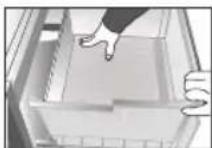
To put the drawer back, press it down until it fits into the hooks at all four corners.
If the case fails to engage into any of the hooks, you cannot slide in the case because that will hit the humidity control plate.

Removing and attaching shelves (continued)
Freezer
Pull the drawer towards you, lift the front slightly, and pull it out.
Having removed the drawer, you can store food in the empty compartment.
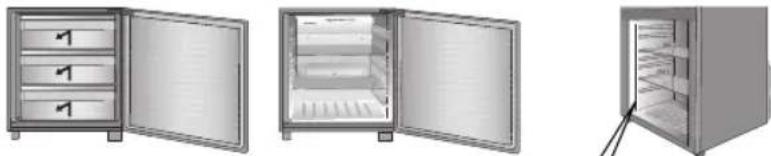
If the freezer drawer is removed, do not store food in front of this line..

Care and Cleaning instructions
natural_image
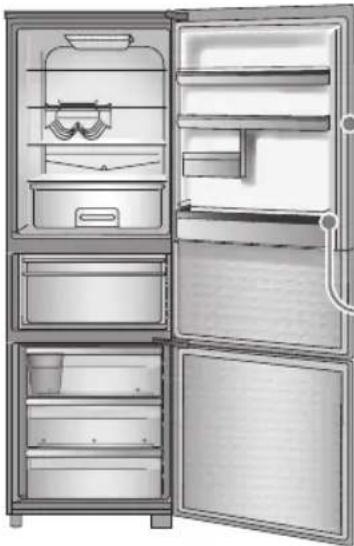
Illustration of an open refrigerator with doors, shelves, and a door handle (no text or symbols)Daily cleaning
Wipe regularly with a dry cloth.
Places to pay particular attention to:
Door opening seal
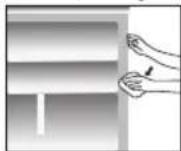
If the seal gets dirty and damaged, cold air is more likely to leak.
Bottle shelf
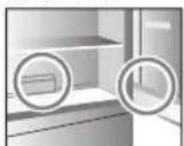
Wipe away any dirt and liquid before it builds up.
Each year, unplug your refrigerator, remove the shelves and give them a thorough clean.
Parts you can wash with water
Refrigerator
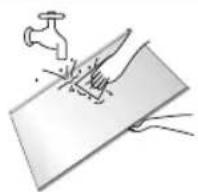
- Glass shelves
- Door shelves
- Bottle shelf
- Sealed drawer
- Egg tray
- Refrigerator drawer
• Pin
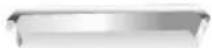
Note: Do not use abrasive cleaners such as Bicarbonate of Soda, as they can damage the plastic.
Fruit and vegetables / chill compartment
- Vegetable drawer
- Fruit drawer
- Humidity plate
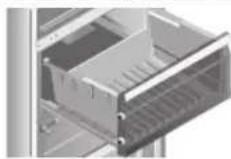
Freezer
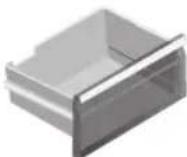
Freezer drawers
- Icebox
- Ice tray
- Ice tray cover
Cleaning the display and control panel
The refrigerator's display and control panel is made of delicate materials. To protect its surfaces, do not clean it with solvent-based chemicals. Simply wipe it with a dry or slightly damp cloth.
Cleaning the outside of the refrigerator
Use a warm, damp, soft cloth to clean the outside of your refrigerator. For more stubborn marks, use a mild kitchen detergent and wipe away with a soft damp cloth. Remove any remaining surface water with a dry cloth.
Notes for cleaning
When cleaning inside or outside your refrigerator, do not use:
- alkaline detergents - they can crack plastic parts.
- grinding dust, soap powder, oil-based cleaners, hot water, brushes, acids, benzenes, solvents or alcohol-based solutions - all can damage the refrigerator's surfaces and plastic parts.
Make sure you wipe off any stains from edible oils, which can also damage plastic parts.
Maintenance check
• Is the power cord damaged?
- Does the plug get hot?
- Is the plug firmly in the mains socket?
If the power cord or LED lamp are damaged, please consult authorized service centre. DO NOT attempt to replace these items yourself.
Extended disuse
If you're not going to use the refrigerator for a long time, unplug it and clean the plug as described above. Then leave the doors open for 2-3 days. This lets the interior dry out properly, and prevents odour and the build up of mould.
Do not switch the refrigerator on and off repeatedly. It will last longer if you leave it switched on during normal use.
Before moving or transporting your refrigerator
① Remove all items.
② Unplug it.
③ Raise the adjustable leg.
④ Pull, or 'walk' the refrigerator towards you.
⑤ Drain the water from the evaporation pan, at the lower back of the refrigerator:
- Put a container underneath the drain cock, and slowly loosen it.
- Pierce the film on the outlet with a screwdriver or similar. Then drain the water. (The next time you do this, simply loosen the drain cock.)
- After draining, make sure you tighten the drain cock to prevent future water leaks.
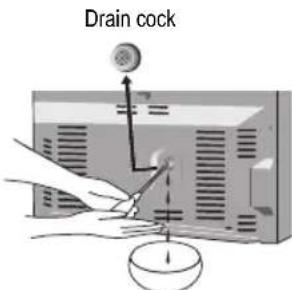
(Lower back of the refrigerator)
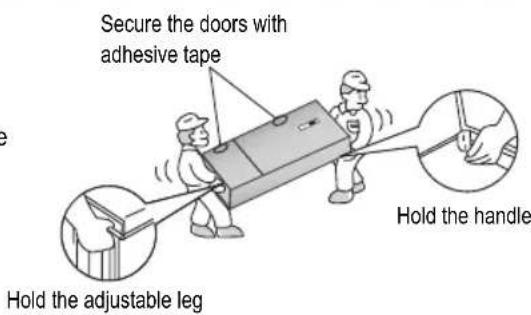
Moving and transporting your refrigerator
At least two people are needed to carry the refrigerator safely.
① Tighten the adjustable legs.
② Hold the adjustable legs at one end, and the handle at the other, as shown.
Note: Do not carry the refrigerator by holding its doors. Always transport the refrigerator in its normal upright position.
If - after you've checked our Frequently Asked Questions section - your refrigerator isn't working properly, unplug it and please consult authorized service centre.
| The refrigerator ‘rumbles’ after the compressor stops.You hear a sound after you open or close the door.After you open the door, you hear what sounds like air or water flowing.You hear a ‘click’ each time the refrigerator starts working.There's a continuous buzzing sound. | This is normal, and is often caused by refrigerant flowing back to the compressor.This is normal, and is due to the difference in air pressure between the inside and outside of the refrigerator.This is caused by refrigerant flowing through the internal pipework.This sound is from the three-way valve and is quite normal.In Hygiene Active mode, you'll hear this when the deodorising fan is working. It's normal. |
| The compressor is quite loud. | In Super Freeze mode, the compressor runs at a higher speed and will be more noticeable.The compressor also runs faster if there is a lot of food in your refrigerator, or if the room temperature is quite high. In these cases, it's normal for the compressor to be louder. |
| The refrigerator is making unusual noises. | Check that it is on a solid, flat and level surface.Make sure the back of the refrigerator isn't too close to the wall.Check and make sure there's nothing vibrating on top of the refrigerator.It's normal to hear some noises when the refrigerator starts or stops operation. |
| The compressor seems to run for a long time. | Check the refrigerator's display and control panel. It may be in Super Freeze Mode.When you first plug it in, the compressor will run for longer than normal to adjust to your chosen temperature settings.The compressor will run for longer in higher room temperatures.Is the door frequently opened and closed?Check that the door is tightly closed and not obstructed by items inside the refrigerator.If you put in a lot of food to chill or freeze at the same time, the compressor will need to run for longer. |
| The refrigerator doesn't seem to be chilling or freezing at all. | Make sure the power supply is plugged in, switched on and working.Make sure the voltage settings are correct - 220V-240V. |
| My food isn't as chilled as I'd like. | Check the temperature settings - they may be too high.Make sure the refrigerator isn't in direct sunlight or near other appliances that give off heat.Putting hot food in the refrigerator will temporarily affect the temperature.You may have too much food in the refrigerator.Is the door opened and closed too frequently?Make sure items in the refrigerator don't obstruct the door seal and that it closes properly. |
| The refrigerator compartment isn't cold enough. | Make sure the refrigerator isn't in Holiday Mode.In colder weather, or when the room temperature is lower, the refrigerator temperature might not seem as different as you'd expect. |
| Moisture is building up on the exterior, or on the refrigerator compartment walls. | This can happen when the room humidity rises, and is normal.Wipe off with a dry cloth. |
Moisture is building up in the vegetable drawer.
The refrigerator surface feels hot to the touch.
How much electricity will my refrigerator use?
Some food in the refrigerator compartment is being frozen.
The refrigerator shows a different temperature to the one set.
It's difficult to open the freezer door sometimes.
The LED lamp doesn't seem to be working.

- To keep your vegetables fresh for longer, the refrigerator keeps a high level of humidity.
- You can wipe moisture off when it builds up in the bottom of the vegetable drawer.

- Your refrigerator has a radiating pipe, which stops condensation building up.

- The specified power consumption is an average measured over 24hrs, based on the following settings:
- room temperature 25°C
- refrigerator compartment 5°C temperature
- fruit and vegetables compartment 1°C
- freezer compartment -18°C
- the door not being opened or closed.
- If the room temperature is higher, or there's too much food in the refrigerator, or when the door is opened and closed frequently, it's normal for the appliance to use more electricity than specified.

- Check the temperature setting for this compartment - it could be too low.
- Keep food away from the back wall of the compartment - this is the coldest area.

- Check that it's not in Super Freeze mode.
- If you've put warm food in the refrigerator, it will temporarily raise the internal temperature while it cools down.

- The differences in air pressure inside and outside the freezer compartment can make it hard to open the door - especially if you've just opened and closed it. After a few minutes it should be easier to open.

- Check the refrigerator isn't in Holiday mode.
- Is the refrigerator switched on?

Inhaltsverzeichnis
natural_image
Illustration of an open refrigerator with shelves and a hand holding the door (no text or symbols visible)natural_image
Interior view of a refrigerator with open door and shelves, showing internal compartments and arrows indicating direction (no text or symbols)natural_image
Simple 3D diagram of a rectangular cabinet with two curved arrows indicating rotation or movement (no text or symbols)Abbildung 2

natural_image
Exterior view of a modern stainless steel refrigerator with control panel (no visible text or symbols)Kühlraumfach
natural_image
Black-and-white photo of a breakfast platter with layered cake, glasses, and various food items including eggs, tomatoes, and snacks (no visible text or symbols)natural_image
Black-and-white photo of raw fish and a glass bowl containing food (no visible text or symbols)natural_image
Pure electrical circuit lines without any symbolsnatural_image
Illustration of hands holding a device with a magnified view of internal components (no text or symbols)natural_image
Diagram of a computer drawer with an arrow indicating direction (no text or symbols present)natural_image
Close-up of a hand pressing down on a mechanical component with an arrow indicating direction (no text or symbols visible)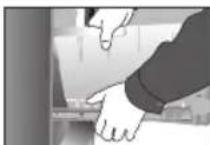
natural_image
Illustration of an open refrigerator with doors, shelves, and a door handle (no text or symbols visible)Tägliches Reinigen
natural_image
Interior view of a refrigerator with open door and shelves (no text or symbols visible)natural_image
Interior view of a refrigerator showing open doors and internal compartments (no text or labels visible)natural_image
Diagram of a gray rectangular container with two curved arrows indicating rotation or movement (no text or symbols)Afbeelding 2

natural_image
Exterior view of a modern stainless steel refrigerator with control panel (no visible text or symbols)Koelkastvak
Fridge
7c

Fridge

natural_image
Black-and-white photo of a breakfast and snack display with a cake, bread, fruit, and various items (no visible text or symbols)natural_image
Black-and-white photo of raw fish and meat on a surface, with a glass bowl of food in the background (no visible text or symbols)De compressor stopt.
natural_image
Illustration of an open refrigerator with doors, shelves, and a door handle (no text or symbols visible)natural_image
Illustration of an open refrigerator with shelves and doors (no text or symbols)natural_image
Interior view of a refrigerator showing doors, shelves, and storage compartments (no text or labels visible)natural_image
Simple 3D diagram of a rectangular box with two curved arrows indicating rotation or movement (no text or symbols)Figure 2

natural_image
Exterior view of a modern stainless steel refrigerator with control panel (no visible text or symbols)natural_image
Black-and-white photo of a breakfast platter with layered dessert, fruit toppings, and a glass of juice (no visible text or symbols)natural_image
Black-and-white photo of raw fish and meat on a surface, with a glass of sauce in the background (no visible text or symbols)natural_image
Illustration of an open refrigerator with doors, shelves, and a shower unit (no text or symbols)Nettoyage quotidien
natural_image
Illustration of an open refrigerator with shelves and a hand holding the door (no text or symbols)natural_image
Interior view of a refrigerator with open door and side shelves (no text or symbols visible)natural_image
Simple diagram of a cabinet with two curved arrows indicating rotation or movement (no text or symbols)Figura 2

natural_image
Exterior view of a modern stainless steel refrigerator with control panel (no visible text or symbols)Scomparto frigorifero
natural_image
Black-and-white photo of a breakfast platter with toppings including a cake, glasses, and egg sculptures (no visible text or symbols)natural_image
Black-and-white photo of a fish fillet with visible marbled texture and a glass of dipping sauce (no text or symbols)flowchart
graph LR
    A["Fridge Set"] --> B["Fridge"]
    B --> C["Fridge Set"]
    C --> D["-> 3c → 2c → 1c ← 5c ← 6c ← 7c ←"]
natural_image
Illustration of three open refrigerator units with drawers, showing exterior and interior views (no text or symbols)natural_image
Illustration of an open refrigerator with doors, shelves, and a door (no text or symbols visible)Pulizia quotidiana
natural_image
Illustration of an open refrigerator with shelves and doors (no text or symbols)natural_image
Interior view of a refrigerator with open door and shelves, showing internal compartments and directional arrows (no text or symbols)natural_image
Simple 3D diagram of a rectangular box with two side legs and curved arrows indicating rotation or movement (no text or symbols)Figura 2

natural_image
Exterior view of a modern stainless steel refrigerator with control panel (no visible text or symbols)natural_image
Black-and-white photo of a breakfast and snack display with a cake, glasses, eggs, and various food items (no visible text or symbols)natural_image
Black-and-white photo of a fish resting on a plate with a glass of dipping sauce in the background (no visible text or symbols)natural_image
Illustration of an open refrigerator with doors, shelves, and a door handle (no text or symbols visible)Limpieza diaria
natural_image
Illustration of a hand interacting with a computer monitor displaying a screen and a circular pointer (no text or symbols)natural_image
Illustration of a refrigerator with open door and shelves, no text or symbols presentInnan du avyttrar din gamla apparat
natural_image
Interior view of a refrigerator showing open doors and internal compartments (no text or labels visible)Ställe med klämrisk

natural_image
Diagram of a cabinet with two curved arrows indicating rotation or movement (no text or symbols)Bild 2

Översikt över delar
natural_image
Exterior view of a modern stainless steel refrigerator with control panel (no visible text or symbols)Kylskåpsfack
Fridge


Fridge

natural_image
Black-and-white photo of a breakfast platter with cake, glasses, and various food items including fruits, vegetables, and bread (no visible text or labels)natural_image
Black-and-white photo of a fish fillet with a glass bowl and food items in the background (no visible text or symbols)natural_image
Illustration of an open refrigerator with doors, shelves, and a door handle (no text or symbols)Daglig rengöring
Torka delarna med en torr trasa.
natural_image
Illustration of a hand using a dial to interact with a monitor (no text or symbols visible)natural_image
Illustration of an open refrigerator with shelves and a hand holding the door (no text or symbols)Før du deponerer det gamle apparatet ditt
natural_image
Interior view of a refrigerator with doors open and shelves, showing internal compartments and ventilation ducts (no text or symbols)Potensielt klemmepunkt

Ikke berør veggene inni fryseren eller produkter som ligger i fryseren med våte hender. Det kan føre til forfrysning.

natural_image
Simple 3D diagram of a rectangular box with two curved arrows indicating rotation or movement (no text or symbols)Figur 2

natural_image
Exterior view of a modern stainless steel refrigerator with control panel (no visible text or symbols)Kjøleskapsrom
Fridge
7c

Fridge

natural_image
Black-and-white photo of a breakfast platter with a cake, glasses, and various food items including eggs, bread, and meat (no visible text or labels)Kokt mat, drikke, egg, kaker, meieriprodukt
natural_image
Black-and-white photo of a fish and seafood with a glass of dipping sauce (no visible text or symbols)natural_image
Illustration of an open refrigerator with shelves, doors, and a bag (no text or symbols)Daglig rengjøring
natural_image
Illustration of an open refrigerator with shelves and doors, showing internal compartments (no text or symbols)natural_image
Interior view of a refrigerator showing the door, shelves, and top panel (no text or symbols visible)natural_image
Simple 3D diagram of a rectangular box with two curved arrows indicating rotation or movement (no text or symbols)Figur 2

natural_image
Front view of a stainless steel refrigerator with control panel and side door (no visible text or symbols)Kølerum
natural_image
Black-and-white photo of a breakfast and dinner scene with a cake, glasses, and various food items including eggs, nuts, and fish (no visible text or symbols)natural_image
Black-and-white photo of raw fish and a glass bowl with food items (no visible text or symbols)natural_image
Illustration of an open refrigerator with doors, shelves, and a door (no text or symbols visible)Daglig rengøring
natural_image
Illustration of an open refrigerator with shelves and doors (no text or symbols)natural_image
Diagram of a rectangular container with side legs and side feet, showing rotational arrows indicating movement (no text or symbols)Rysunek nr 2

natural_image
Exterior view of a modern stainless steel refrigerator with control panel (no visible text or symbols)Komora lodówki
natural_image
Black-and-white photo of a breakfast and snack tray with a cake, glasses, fruit, and various food items (no visible text or symbols)natural_image
Black-and-white photo of a fish head with visible scales and a glass of food in the background (no text or symbols)natural_image
Illustration of a double refrigerator with open doors and internal compartments (no text or symbols)natural_image
Illustration of an open refrigerator with shelves and a hand placing one item (no text or symbols visible)natural_image
Interior view of a refrigerator with visible door, shelves, and ventilation slots (no text or symbols)natural_image
Diagram of a refrigerator with two curved arrows indicating rotation or movement (no text or symbols)Obrázek 2

natural_image
Front view of a stainless steel refrigerator with control panel and side door (no visible text or symbols)Prostor chladničky
Fridge
7c

Fridge


natural_image
Black-and-white photo of a breakfast platter with a cake, glasses, and various food items including eggs, bread, and snacks (no visible text or symbols)natural_image
Black-and-white photo of raw fish and a glass bowl (no visible text or symbols)flowchart
graph LR
    A["Fridge Set"] --> B["Fridge"]
    B --> C["Fridge Set"]
    C --> D["4c → 3c → 2c → 1c"]
    C --> E["5c ← 6c ← 7c ←"]
natural_image
Illustration of an open refrigerator with doors, shelves, and a bag (no text or symbols visible)Denní čištění
natural_image
Illustration of a hand using a tool to press or interact with a monitor, no text or symbols visiblePursuant to the directive 2004/108/EC, article 9(2)
Panasonic Testing Centre
Panasonic Marketing Europe GmbH
Winsbergring 15, 22525 Hamburg, FR, Germany
©Panasonic Corporation 2009
Printed in China
AK-KW7960
- Panasonic®
- Operating Instructions
- Refrigerator-Freezer
- ENGLISH 2-15 DEUTSCH 16-29 NEDERLANDS 30-43
- FRANÇAIS 44-57 ITALIANO 58-71 ESPAÑOL 72-85
- Caring for the environment
- Disposing of the packaging
- Disposing of Waste Electrical and Electronic Equipment (private households)
- For business users in the European Union
- Disposing of appliances in countries outside the European Union
- Before disposing of your old appliance
- Safety instructions
- WARNING
- Indicates risk of serious injury
- Safety instructions (continued)
- CAUTION
- Indicates risk of injury or damage to property.
- Unpacking your appliance
- Choosing the right location
- Ventilation
- Temperature
- Level
- Refrigerator door
- Cleaning
- Plugging in
- Room temperature
- Display and control panel
- Setting up
- Switching the appliance on
- Selecting the temperature
- Setting the main refrigerator temperature
- To change the temperature:
- Setting the vegetable compartment temperature
- Setting the freezer temperature
- Setting the right temperature
- Features and functions
- Inverter Level Indicator
- Super Freeze
- Holiday
- Energy Saving
- Features and functions (continued)
- Making ice cubes
- Automatic defrosting
- Removing and attaching shelves
- Fruit and vegetables drawer
- Humidity control plate
- Removing and attaching shelves (continued)
- Freezer
- Care and Cleaning instructions
- Daily cleaning
- Parts you can wash with water
- Cleaning the display and control panel
- Cleaning the outside of the refrigerator
- Notes for cleaning
- Maintenance check
- Extended disuse
- Before moving or transporting your refrigerator
- Moving and transporting your refrigerator
- Inhaltsverzeichnis
- Tägliches Reinigen
- Nettoyage quotidien
- Pulizia quotidiana
- Limpieza diaria
- Innan du avyttrar din gamla apparat
- Översikt över delar
- Daglig rengöring
- Før du deponerer det gamle apparatet ditt
- Daglig rengjøring
- Daglig rengøring
- Denní čištění
Brand : PANASONIC
Model : NRB30FG1
Category : Refrigerator