 ManualGo.com
FWB05CAFN6V3 - Air Conditioning DAIKIN - Free user manual and instructions
Find the device manual for free FWB05CAFN6V3 DAIKIN in PDF.



| Feature | Details |
|---|---|
| Device type | Air conditioner |
| Cooling capacity | 5 kW |
| Refrigerant type | R-32 |
| Energy class | A++ |
| Noise level (indoor) | 35 dB(A) |
| Noise level (outdoor) | 50 dB(A) |
| Dimensions (indoor unit) | 800 x 290 x 215 mm |
| Dimensions (outdoor unit) | 800 x 600 x 300 mm |
| Weight (indoor unit) | 10 kg |
| Weight (outdoor unit) | 35 kg |
| Additional features | Dehumidification mode, remote control, programming |
| Maintenance | Clean filters every 3 months, annual check by a professional |
| Warranty | 2 years |
| Safety standards | Compliant with CE standards |
Frequently Asked Questions - FWB05CAFN6V3 DAIKIN
Download the instructions for your Air Conditioning in PDF format for free! Find your manual FWB05CAFN6V3 - DAIKIN and take your electronic device back in hand. On this page are published all the documents necessary for the use of your device. FWB05CAFN6V3 by DAIKIN.
USER MANUAL FWB05CAFN6V3 DAIKIN
Daikin Europe N.V. FWB04CAT*6V3***, FWB05CAT*6V3***, FWB06CAT*6V3***, FWB08CAT*6V3***, FWB10CAT*6V3***, FWB11CAT*6V3***, FWB15CAT*6V3***, FWB17CAT*6V3***, FWB04CAF*6V3***, FWB05CAF*6V3***, FWB06CAF*6V3***, FWB08CAF*6V3***, FWB10CAF*6V3***, FWB11CAF*6V3***, FWB15CAF*6V3***, FWB17CAF*6V3***, FWB04CAG*6V3***, FWB05CAG*6V3***, FWB06CAG*6V3***, FWB08CAG*6V3***, FWB10CAG*6V3***, FWB11CAG*6V3***, FWB15CAG*6V3***, FWB17CAG*6V3***,
- = 0, 1, 2, ..., 9, A, B, ..., Z ENIEC63000, RoHS
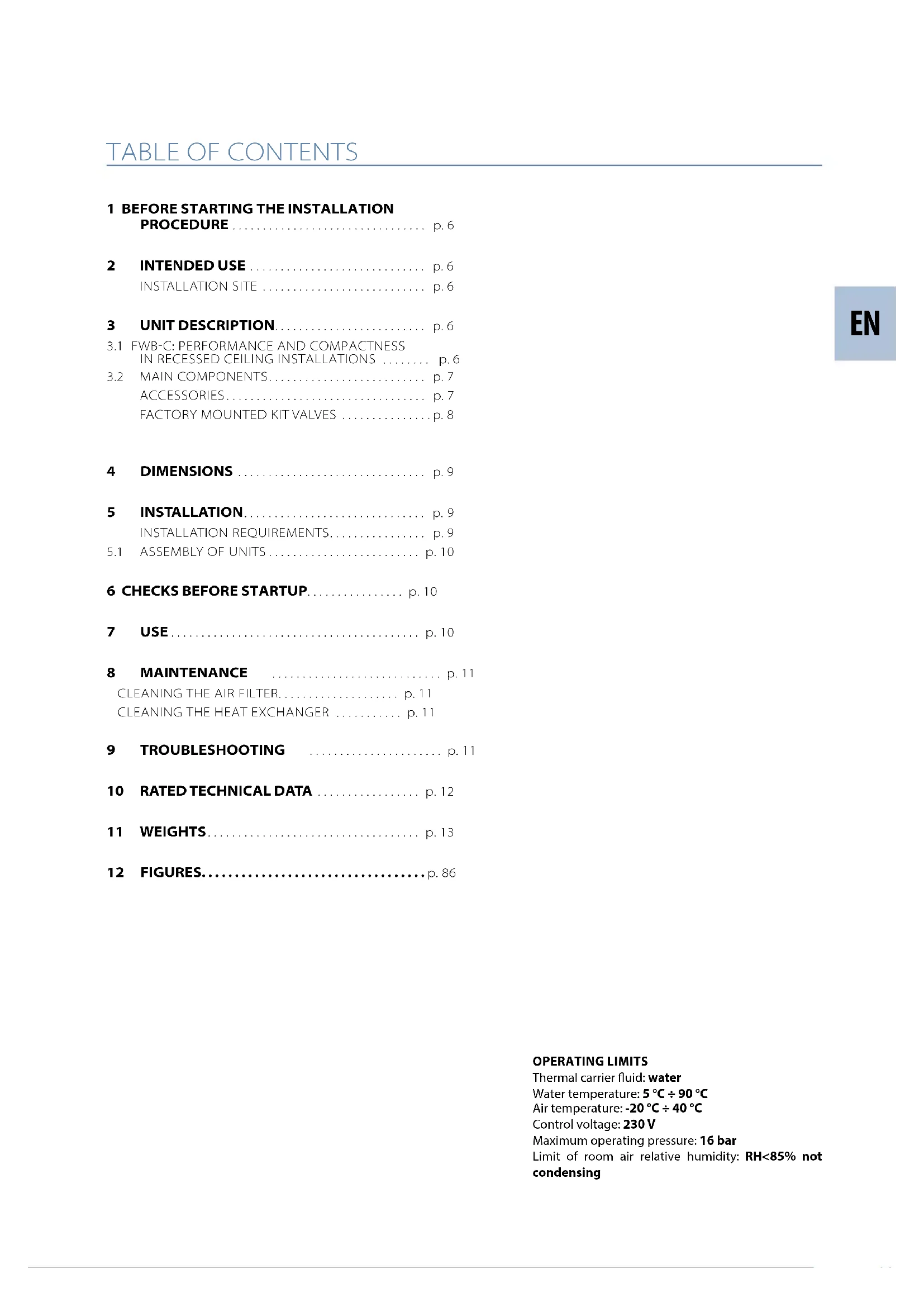
Restriction of Certain Hazardous Substances in electrical and electronic equipment Zandvoordestraat 300, B-8400 Oostende, Belgium Hiromitsu Iwasaki Director Ostend, 3rd of January 2022OPERATING LIMITS Thermal carrier uid: water Water temperature: 5 °C ÷ 90 °C Air temperature: -20 °C ÷ 40 °C Control voltage: 230 V Maximum operating pressure: 16 bar Limit of room air relative humidity: RH<85% not condensing
Carefully read this manual. Installation and maintenance should be carried out by technical personnel qualied for this type of machine, in compliance with current safety regulations. When receiving the unit please check its state verifying if any damage occurred during the transport. For installation and use of accessories, please refer to the relative technical sheets. Identify the model of the FWB-C fan coil following the indica- tions on the packing container. SAFETY SYMBOLS Carefully read this manual. Warning Use personal protective equipment USE SUITABLE PPE (GLOVES FOR REFRIGERANT, PROTEC- TIVE GOGGLES)
WARNING: Electrical and electronic products may not be
mixed with unsorted household waste. Do NOT try to dis- mantle the system yourself: the dismantling of the system, treatment of the refrigerant, of oil and of other parts must be done by an authorized installer and must comply with appli- cable legislation. Units must be treated at a specialized treat- ment facility for reuse, recycling and recovery. By ensuring this product is disposed of correctly, you will help to prevent potential negative consequences for the environment and human health. For more information, contact your installer or local authority.
WARNING: the unit hasn't dangerous components ac-
cording to the classication of Regulation 1357/2014. 2 INTENDED USE Daikin will not accept any liability for damage or injury caused as a result of installation by non-qualied personnel; improper use or use in conditions not allowed by the manufacturer; failure to perform the maintenance prescribed in this manual; use of spare parts other than original factory parts. Equipment designed for ambient air conditioning and intended for use in civil comfort applications. INSTALLATION SITE When choosing an installation site, you should observe the fol- lowing rules: The air conditioning unit should not be placed immediately under a socket Do not install the unit in places where inammable gases or powders are present Do not expose the unit to sprays of water; do not install the unit in laundry room Install the fan coil on walls or ceilings able to withstand its weight. Keep a clear space all around the unit to assure the proper functioning and accessibility for maintenance Store the unit in its packing container until you are ready to install it to prevent dust from inltrating inside it. 3 UNIT DESCRIPTION FWB-C: PERFORMANCE AND COMPACTNESS IN RECESSED CEILING INSTALLATIONS The ducted unit FWB-C was designed for conditioning environ- ments where it is required the installation of units in medium head performance and reduced overall dimensions. The range covers an air ow rate from 300 to 1200 m³/h distrib- uted over 8 models. The heat exchanger allows the use of FWB-C in the most dierent conditions. The bearing structure in fact accommodates a heat exchanger of 3 or 4 rows to which it is possible to combine an additional heat exchanger of 1 or 2 rows for exceptional performance even at low temperature dierentials. Heat exchanger can be optimized for centralized applications such as district cooling. FWB-C was designed to ceiling horizon- tal installation. The main condensate drip tray is situated inside the structure of the unit and is at a positive pressure relative to the drain outlet to facilitate condensate drainage. A wide range of wall-mounted controllers is available, including microprocessor controllers with display. Electric heating elements complete with safety devices are avail- able to integrate the hydronic operation.UT66002764-07 7 MAIN COMPONENTS Structure Realized in galvanized steel sheet, thermally and acoustically insulated by self-extinguishing panels class 1. Height reduced to facilitate installation in a horizontal position, in false ceilings. The bearing structure contains the tank for collecting and dis- charging condensate. Heat exchanger High eciency standard with 3 rows, but also available with 4 rows upon request, heat exchangers are made of copper tube and alluminium ns secured to the tubes by mechanical expansion. It is tted with brass manifold and an air valve.The heat exchanger, usually with left hand water connections can be turned by 180°. Available upon request high eciency heat exchanger optimized for district cooling application. Fans Double suction centrifugal fans made with ABS or aluminium, with statically and dynamically balanced forward-curving blades, directly coupled to the electric motor. Electric motor Single-phase asynchronous multi-speed electric motor with per- manently connected capacitor and thermal protector, mounted on vibration-damping supports. Air lter Washable air lter, made of acrylic bre, ltration class G3, ap- plied on the air intake; may be pulled out from below. Air inlet Air intake from the front or bottom of the unit, according to sys- tem requirements. Installation example The bearing structure allows to combine a large range of acces- sories in suction and air delivery in order to obtain the optimized unit conguration. ACCESSORIES Electronic microprocessor control panels with display FWTOUCH User interface with display in Dibond matereal available in: FWTOUCHB-Black FWTOUCHW-White FWTOUCHG-Grey FWECSAP Circuit board for FWECS control FWECSAC User interface with display for FWECS controller FWEC1A FWEC1A Microprocessor control with display FWEC2A FWEC2A Microprocessor control with display FWEC3A FWEC3A Microprocessor control with display FWFCKA FWEC*A control spacer for wall mounting FWEC2T Electronic controller FWEC2T for 2 pipes system, FWEC4T for 4 pipes system FWEC4T FWHSKA Humidity sensor for FWEC2A/3A, FWECS FWTSKA Water sensor for FWEC1A/2A/3A and FWECS controllers Electromechanical control YFSTA6 Fan stop thermostat Power interface and regulating louver controllers EPIMSB6 Power interface for connecting in parallel up to 4 fun coil units to the one controller Electrical heating elements
Heating element with installation kit, relay box and safety devices Accessories PLT**N PLI**C Plenum can be installed either on the air intake or air delivery of the unit. PLT**C is insulated plenum PLT**N isn't insulated plenum CDRP1A Condensate drainage pump kit EDPD Auxiliary water drip tray Additional coil EAHD**A Additional heat exchanger Filter FG4T*AA Air filter G4 Valves 2-way valves, ON/OFF or MUDULATING actuator, 230 V or 24 V power supply, hydraulic kit, for additional heat exchanger 2-way valve, ON/OFF or MODULATING actuator, 230 V or 24 V power supply, hydraulic kit, for main heat exchanger 3-way valves, ON/OFF or MODULATING actuator, 230 V or 24 V power supply, hydraulic kit, for additional heat exchanger 3-way valves, ON/OFF or MODULATING actuator, 230 V or 24 V power supply, hydraulic kit, for main heat exchanger 2-way valves pressure independent, ON/OFF actuator, 230 V power supply, hydraulic kit, for main and additional heat exchangerFWBC
The kit valves are available in dierent congurations: • ON/OFF or MODULATING motor driven 2-way valve (table 1 page 89)• ON/OFF or MODULATING motor driven 3-way valve (table 2 page 89)• Pressure indipendent ON/OFF motor driven 2-way valve (refer to Pressure independent manual FC66006204)connected to the control panel for FWB-C fan coils, control the room temperature by stopping the water ow through the heat exchanger.The kit includes:• valve• electrothermal actuator• plumbing kits for installing the valve on the heat exchanger.For Kv and hydraulic characteristics of 2, 3 way valves refer to tables 3-4-5 page 90.For other information refer to specic technical manual.Factory mounted 2 way kit valve Factory mounted 3 way kit valve Factory mounted 3 way kit valve: 1) On mode ; 2) By-Pass mode INLET COIL INLET VALVE OUTLET COIL OUTLET VALVE INLET VALVE OUTLET VALVE 1 2UT66002764-07 9 4 DIMENSIONS At p. 86-87FWB-C dimensional data and position of plumbing connections are shown. 5 INSTALLATION
WARNING: unit installation and start-up must be entrusted
to competent personnel and performed in a workmanlike manner, in accordance with current regulations.
WARNING: Install the ducted unit, the line switch (IL) and/or
all remote controls in a position out of the reach of persons who are in the bathroom or in the shower. IMPORTANT: It is advisable to install any accessories on the standard unit prior to positioning the latter, making refer- ence to the technical sheets. The air intake and outlet have a rectangular cross-section, with pre-cut holes for fastening the available accessories upon request. The heat exchanger connections can be switched over to the op- posite side by carrying out the following steps (Heat exchanger changing water side connections- p. 88): Ū remove the upper closing panel. Ū remove the collecting condensate tray. Ū remove the heat exchanger module by taking out the fas- tening screws (2 per side). Ū turn the heat exchanger by 180° (on the vertical axis) and screw it back into the unit again. Ū reassemble the tray and the upper closing panel. INSTALLATION REQUIREMENTS Some rules to follow Ū Vent air from the exchanger while the pumps are o. For this purpose use the air vent valves situated next to the ex- changer connections. Ū All ducts, especially the outlet ducts, must be insulated with anti-condensation material. Ū An inspection panel must be provided in proximity to the unit to enable maintenance and cleaning operations. Ū The unit must be installed on the basis of design and techni- cal considerations, carrying out an aeraulic assessment and considering the BACK PRESSURE oered by the PIPING ap- plied to the outlet to avoid the problem of failure to change speed: this responsibility cannot fall on the product but on the installation; Ū Install the unit with the appropriate inspection hatches for routine and special maintenance of the fan coils: for me- chanical, electrical and hydraulic replacement; Ū Install the control panel on the wall; choose an accessible position from where functions may be easily set and which is suitable for taking temperature readings, where applicable. Avoid positions directly exposed to sunlight or direct cur- rents of hot or cold air and make sure there are no obstacles which may preclude a correct temperature reading.
In normal operation, particularly with the fan at minimum speed and ambient air with high relative humidity, conden- sation may form on the air outlet and on some external parts of the unit. To avoid such issues while always remaining within the oper
ating limits envisaged for the unit, it is necessary to limit the inlet temperature of the water inside the heat exchanger. In particular, the dierence between the air dew point (T
and the inlet water temperature (T
) must NOT exceed 14 °C, according to the following relationship: TW>TA,DP-14 °C Example: in the case of ambient air at 25 ° C with 75% rela- tive humidity, the dew point temperature is about 20 ° C and therefore the inlet temperature of the water in the battery must be greater then: Ū 20-14 = 6 °C in order to avoid condensation on a fancoil equipped with a valve. Ū 20-12 = 8 °C If the valve kit accessory can not be installed. Fan coil with valveAir temperature dry bulb (°C)21 23 25 27 29 31 33Relative humidity %40 5 5 5 5 5 5 550 5 5 5 5 5 6 860 5 5 5 5 7 9 1170 5 5 6 8 9 11 1380 5 6 8 10 12 14 1690 6 8 10 12 14 16 18Fan coil without valveAir temperature dry bulb (°C)21 23 25 27 29 31 33Relative humidity %40 6 6 6 6 6 6 650 6 6 6 6 6 8 1060 6 6 6 7 9 11 1370 6 6 8 10 11 13 1580 6 8 10 12 12 16 1890 8 10 12 14 14 18 20 In the event the indoor unit is stopped for a prolonged peri- od, with the fan stopped and circulation of cold water in the heat exchanger, condensation may also form on the unit’s exterior. In this case it is advisable to install the 3-way (or 2-way) valve accessory in order to stop the ow of water in the coil when the fan is stopped. During wintertime periods of shut down, drain water from the system, to prevent ice from forming. If anti-freeze solutions are used, check for their freezing point using the table below. % Glycol by weightFreezing temperature (°C)Capacity adjustmentPressure drop adjustment0 0 1,00 1,0010 -4 0,97 1,0520 -10 0,92 1,1030 -16 0,87 1,1540 -24 0,82 1,20 Electrical connections Make the electrical connections with the power supply discon- nected, in accordance with current safety regulations.FWBC
All the wiring must be done by qualied personnel. For each thermal ventilating unit provide a main circuit breaker (IL), with opening contacts separated by at least 3 mm and an adequate protection fuse (F). Electrical intakes are shown on the rating labels on the units. During installation, strictly abide by the indications on the wir- ing diagram for the unit-control panel combination. Electrical wirings:
- Base Electrical Connenctions: pag. 91;
- FWECSAP on board + ON/OFF VALV: pag. 93;
- FWECSAP on board + ON/OFF VALV + Supplementary Heat- ing Element (EH): pag. 96;
- FWECSAP on board + MOD. VALV: pag. 99;
- FWECSAP on board + MOD. VALV + Supplementary Heating Element (EH): pag. 102;
- FWECSAP remote + ON/OFF VALV: pag. 105;
- FWECSAP remote + ON/OFF VALV + Supplementary Heat- ing Element (EH): pag. 108;
- FWECSAP remote + MOD. VALV: pag. 111;
- FWECSAP remote + MOD. VALV + Supplementary Heating Element (EH): pag. 114;
- FWEC1A + Supplementary Heating Element (EH): pag. 120;
- FWEC2A + Supplementary Heating Element (EH): pag. 126;
- FWEC3A + Supplementary Heating Element (EH): pag. 132;
- FWEC4T: pag. 138; NOTE: The electric wires (power and control circuits) must be pulled in through the gland on the side of the electric box where the plumbing connections are located and then con- nected to the terminals.
WARNING: COMMON motor wire = WHITE, wrong connec-
Mounting the unit Insert the vibration dampers provided in the 4 slots indicated for ceiling installation Fasten the base unit to the ceiling or wall using the 4 slots provided. It is recommended to use 8MA threaded bars plus screw an- chors of adequate capacity to bear the weight of the unit, and to prepare the positioning of the unit using 3 8MA bolts (2 in the lower part, 1 in the upper part as shown in gure p.89) and two washers for each bar. Before tightening the lock nut, adjust the main nut so as to assure that the unit is properly inclined so as to facilitate condensate drainage (gure p.89). To obtain the proper inclination, tilt the unit so that the intake side is slightly lower (approximately 10 mm) than the outlet side. Make the plumbing connections to the heat exchanger and, where the cooling function is to be used, to the condensate drainage outlet. Use one of the two tray drain outlets, which can be seen on the outside of the unit side panels To connect the unit to the drainage line, use a exible rub- ber hose and secure it to the pre-selected drain pipe (ø 3/8'') using a metal clamp (use the drain outlet situated on the plumbing connection side).
6 CHECKS BEFORE STARTUP
Check that the unit is installed in such a way as to guarantee the required inclination. Check that the drainage outlet is not clogged (by masonry debris etc.). Check the tightness of the plumbing connections. Make sure the electric wires are tightly connected (carry out this check with the power supply OFF). Make sure that air has been eliminated from the heat ex- changer. Power the fan coil and check its performance 7 USE To use the fan coil refer to the instructions on the control panel available as accessory.
WARNING: For safety reason, do not introduce your ngers
or other pointed objects in the air outlet grilles.
DANGER: The unit may be used by children of at least 8
years of age and by persons with reduced physical, sen- sory, or mental capabilities, or who lack experience or the necessary knowledge, provided that they are supervised or after they have received instructions relating to the safe use of the unit and understand the inherent dangers. Children must not play with the unit. Cleaning and maintenance to be carried out by the user must not be performed by unsu- pervised children.UT66002764-07 11 8 MAINTENANCE For safety reasons, before carrying out any maintenance or cleaning jobs, turn o the unit by moving the fan speed se- lector to “O” and putting o the main switch (0 position). DANGER! Due caution must be taken while carrying out maintenance: some metal parts may cause injuries; wear protective gloves. The maintenance requirements of FWB-C ducted units are lim- ited to periodic cleaning of the air lter and heat exchanger and checks on the eciency of condensate drainage. Maintenance may be performed only by specialised personnel. Whenever starting up the unit after it has not been used for a long time, check that there is no air in the heat exchanger. The motor requires no maintenance since it has self-lubricating bearings.
CLEANING THE AIR FILTER
Disconnect the unit from the power supply by setting the main switch on 0 (OFF). To clean the air lter proceed as follows:
1. Access the unit via the inspection panel and take out the air
lter as shown in gure (p.141).
2. If the lter is on the inside of the intake grille, remove the
latter and then proceed to carry out the steps described below.
3. Clean the lter with warm water or, in the event of dry dust
build-up, using compressed air.
4. Allow the lter to dry and then t it back in place.
Air lter dimensions, see gure: p.88.
CLEANING THE HEAT EXCHANGER
It It is advisable to check the condition of the exchanger before the start of every summer season to make sure that the ns are not obstructed by dirt. To access the heat exchanger, remove the outlet panel (whether of the type with collars or a rectangular ange) and the drip tray. On reaching the exchanger, clean it with compressed air or low-pressure steam taking care not to damage the ns. Before the start of every summer season, check the eciency of condensate drainage. Adequate periodic maintenance will ensure save both ener- gy and cost savings. 9 TROUBLESHOOTING If the unit is not working properly, before calling a service engi- neer carry out the checks indicated in the table below. If the problem cannot be solved, contact your dealer or the near- est service centre. PROBLEM CAUSE SOLUTIONThe unit fails to workNo power supply Restore the power supplyThe automatic safety cutout has tripped Call a service centre for assistanceThe on/off switch is on Start the unit by moving the switch to ONThe unit provides insufficient cooling or heatingThe air filter is dirty or clogged Clean the air filterAn obstacle is obstructing the air intake or outlet Remove the obstacleAir is trapped inside the heat exchanger Call the installer for assistanceThere are open windows and/or doors Close windows and/or doorsThe minimum speed has been selected Select medium or maximum speedThe unit “leaks” water The unit has not been installed with the correct inclination Call the installer for assistance The drainage outlet is clogged Call the installer for assistanceFWB-C
Available static pressure (E) Pa
Water pressure drop (2)(E) kPa
Water pressure drop (3)(E) kPa
Standard coil - number of rows
Inlet + radiated sound power level (4)(E) dB(A)
Available static pressure (E) Pa
Water pressure drop (2)(E) kPa
Water pressure drop (3)(E) kPa
Standard coil - number of rows
Inlet + radiated sound power level (4)(E) dB(A)
Water content - standard coil dm³ 2,50 3,30 2,50 3,30 Power supply cable type N07V-K N07V-K N07V-K N07V-K Cross-section area of power cables (5) mm² 1,50 1,50 1,50 1,50 Safety fuse F A 2 2 2 2 Fuses type gG gG gG gG (1) Water temperature 7°C / 12°C, air temperature dry bulb 27°C, wet bulb 19°C (47% relative humidity) according to EN1397:2021 (2) Water temperature 7°C / 12°C, air temperature dry bulb 27°C, wet bulb 19°C (47% relative humidity) (3) Water temperature 45°C / 40°C, air temperature 20°C(4) Sound power measured according to standards ISO 3741 and ISO 3742 (5) The shown section is to be considered as the minimum recommended section. The cables must be chosen in compliance with CEI - UNEL 35024/1. standard. (E) EUROVENT certified dataPower supply 230-1-50 (V-ph-Hz)UT66002764-07 13 » 4 pipes FWB-C
Available static pressure (E) Pa
Water pressure drop (2)(E) kPa
Water pressure drop (3)(E) kPa
Additional coil - number of rows
Inlet + radiated sound power level (4)(E) dB(A)
Available static pressure (E) Pa
Water pressure drop (2)(E) kPa
Water pressure drop (3)(E) kPa
Additional coil - number of rows
Inlet + radiated sound power level (4)(E) dB(A)
Water content - additional coil dm³ 0,97 0,97 0,97 0,97 Power supply cable type N07V-K N07V-K N07V-K N07V-K Cross-section area of power cables (5) mm² 1,50 1,50 1,50 1,50 Safety fuse F A 2 2 2 2 Fuses type gG gG gG gG (1) Water temperature 7°C / 12°C, air temperature dry bulb 27°C, wet bulb 19°C (47% relative humidity) according to EN1397:2021 (2) Water temperature 7°C / 12°C, air temperature dry bulb 27°C, wet bulb 19°C (47% relative humidity) (3) Water temperature 65°C / 55°C, air temperature 20°C(4) Sound power measured according to standards ISO 3741 and ISO 3742 (5) The shown section is to be considered as the minimum recommended section. The cables must be chosen in compliance with CEI - UNEL 35024/1. standard. (E) EUROVENT certified dataPower supply 230-1-50 (V-ph-Hz) 11 WEIGHTS FWB-C
- FWECSAP on board + ON/OFF VALV: pag. 93;
- FWECSAP on board + ON/OFF VALV + Supplementary Heat- ing Element (EH): pag. 96;
- FWECSAP on board + MOD. VALV: pag. 99;
- FWECSAP on board + MOD. VALV + Supplementary Heating Element (EH): pag. 102;
- FWECSAP remote + ON/OFF VALV: pag. 105;
- FWECSAP remote + ON/OFF VALV + Supplementary Heat- ing Element (EH): pag. 108;
- FWECSAP remote + MOD. VALV: pag. 111;
- FWECSAP remote + MOD. VALV + Supplementary Heating Element (EH): pag. 114;
- FWEC1A + Supplementary Heating Element (EH): pag. 120;
- FWEC2A + Supplementary Heating Element (EH): pag. 126;
- FWEC3A + Supplementary Heating Element (EH): pag. 132;
- FWECSAP on board + ON/OFF VALV: pag. 93;
- FWECSAP on board + ON/OFF VALV + Supplementary Heating Element (EH): pag. 96;
- FWECSAP on board + MOD. VALV: pag. 99;
- FWECSAP on board + MOD. VALV + Supplementary Heating Element (EH): pag. 102;
- FWECSAP remote + ON/OFF VALV: pag. 105;
- FWECSAP remote + ON/OFF VALV + Supplementary Heat- ing Element (EH): pag. 108;
- FWECSAP remote + MOD. VALV: pag. 111;
- FWECSAP remote + MOD. VALV + Supplementary Heating Element (EH): pag. 114;
- FWEC1A + Supplementary Heating Element (EH): pag. 120;
- FWEC2A + Supplementary Heating Element (EH): pag. 126;
- FWEC3A + Supplementary Heating Element (EH): pag. 132;
- FWECSAP on board + ON/OFF VALV + Supplementary Heating Element (EH): Abb. 96;
- FWECSAP on board + MOD. VALV: Abb. 99;
- FWECSAP on board + MOD. VALV + Supplementary Heating Ele- ment (EH): Abb. 102;
24,4 25,4 33,0 36,0 45,0 45,0 51,0 51,0 4 Rohre
- FWECSAP on board + ON/OFF VALV: pag. 93;
- FWECSAP on board + ON/OFF VALV + Supplementary Heat- ing Element (EH): pag. 96;
- FWECSAP on board + MOD. VALV: pag. 99;
- FWECSAP on board + MOD. VALV + Supplementary Heating Element (EH): pag. 102;
- FWECSAP remote + ON/OFF VALV: pag. 105;
- FWECSAP remote + ON/OFF VALV + Supplementary Heat- ing Element (EH): pag. 108;
- FWECSAP remote + MOD. VALV: pag. 111;
- FWECSAP remote + MOD. VALV + Supplementary Heating Element (EH): pag. 114;
- FWEC1A + Supplementary Heating Element (EH): pag. 120;
- FWEC2A + Supplementary Heating Element (EH): pag. 126;
- FWEC3A + Supplementary Heating Element (EH): pag. 132;
- FWECSAP on board + ON/OFF VALV + Supplementary Heat- ing Element (EH): str. 96;
- FWECSAP on board + MOD. VALV: str. 99;
- FWECSAP on board + MOD. VALV + Supplementary Heating Element (EH): str. 102;
- FWECSAP remote + ON/OFF VALV: str. 105;
- FWECSAP remote + ON/OFF VALV + Supplementary Heat- ing Element (EH): str. 108;
- FWECSAP on board + ON/OFF VALV: pag. 93;
- FWECSAP on board + ON/OFF VALV + Supplementary Heat- ing Element (EH): pag. 96;
- FWECSAP on board + MOD. VALV: pag. 99;
- FWECSAP on board + MOD. VALV + Supplementary Heating Element (EH): pag. 102;
- FWECSAP remote + ON/OFF VALV: pag. 105;
- FWECSAP remote + ON/OFF VALV + Supplementary Heat- ing Element (EH): pag. 108;
- FWECSAP remote + MOD. VALV: pag. 111;
- FWECSAP remote + MOD. VALV + Supplementary Heating Element (EH): pag. 114;
- FWEC1A + Supplementary Heating Element (EH): pag. 120;
- FWEC2A + Supplementary Heating Element (EH): pag. 126;
- FWEC3A + Supplementary Heating Element (EH): pag. 132;
- FWECSAP on board + ON/OFF VALV: pag. 93;
- FWECSAP on board + ON/OFF VALV + Supplementary Heat- ing Element (EH): pag. 96;
- FWECSAP on board + MOD. VALV: pag. 99;
- FWECSAP on board + MOD. VALV + Supplementary Heating Element (EH): pag. 102;
- FWECSAP remote + ON/OFF VALV: pag. 105;
- FWECSAP remote + ON/OFF VALV + Supplementary Heat- ing Element (EH): pag. 108;
- FWECSAP remote + MOD. VALV: pag. 111;
- FWECSAP remote + MOD. VALV + Supplementary Heating Element (EH): pag. 114;
- FWEC1A + Supplementary Heating Element (EH): pag. 120;
- FWEC2A + Supplementary Heating Element (EH): pag. 126;
- FWEC3A + Supplementary Heating Element (EH): pag. 132;
FWEC2A, FWEC3A, FWECS
- FWECSAP on board + ON/OFF VALV: pag. 93;
- FWECSAP on board + ON/OFF VALV + Supplementary Heating Element (EH): pag. 96;
- FWECSAP on board + MOD. VALV: pag. 99;
- FWECSAP on board + MOD. VALV + Supplementary Heating Element (EH): pag. 102;
- FWECSAP remote + ON/OFF VALV: pag. 105;
- FWECSAP remote + ON/OFF VALV + Supplementary Heat- ing Element (EH): pag. 108;
- FWECSAP remote + MOD. VALV: pag. 111;
- FWECSAP remote + MOD. VALV + Supplementary Heating Element (EH): pag. 114;
- FWEC1A + Supplementary Heating Element (EH): pag. 120;
- FWEC2A + Supplementary Heating Element (EH): pag. 126;
- FWEC3A + Supplementary Heating Element (EH): pag. 132;
Tab.3 Hydraulic characteristics Valve Part Number DN DN (mm) Max working pressure PN (Bar) Kvs Kvs_bypass ΔPs maximum static differential pressure at the ends of the valve against which the valve can open [bar] 213112 1/2"M 15 16 1,7 - 2,5 213134 3/4"M 20 16 2,8 - 1,5 413112(*) 1/2"M 15 16 1,7 1,2 2 413134(*) 3/4"M 20 16 2,5 1,6 1 NOTE (*): 3 way 4 ports valves are the standard ones, NC, used only in mixing mode
» 2 AND 3 WAY KIT VALVE PRESSURE DROPS
Tab.4 DP in+out 2 pipes (kPa) FCU Models Sizes Nominal Water Flow [l/h] *(1) 3 way valve kit 2 pipes in open position 3 way valve kit 2 pipes in by-pass mode lockshield in open position *(3) 2 way valve kit 2 pipes in open position FWB-C
1448 57,3 101,2 16,8 28,1 618 55,6 67,0 39,0 5,1 *(1) In Eurovent conditions: COOLING: Tw 7/12°C, Tair 27/19°C (47%); HEATING: Tw 45/40°C, Tair 20°C. *(2) In Eurovent conditions: COOLING: Tw 7/12°C, Tair 27/19°C (47%); HEATING: Tw 65/55°C, Tair 20°C. *(3) 3 way valve kits includ 2 lockshields.UT66002764-07 91 » Base electrical connection for FWB-C 04 Electrical wirings legend: Make the electrical connections with the power supply discon- nected, in accordance with current safety regulations. Check that the mains electricity supply is compatible with the volta- ge shown on the unit rating plate. Traced connection are on responsability of the installer.
- IL: Circuit breaker (not supplied)
- F: Fusible 2A (not supplied)
- C: Pre-wired to motor condenser
- VC: ON/OFF valve cold water/hot (2-pipes system) ON/OFF valve cold water (4-pipes system)
- VH: ON/OFF valve hot water (4-pipes system) BN: Brown = valves power supply phase BU: Blu = valves power supply neutral
- SAI: Pre-installed indoor air temperature probe
- SAE: Remote air temperature probe
- SW: Water temperature probe
- SWH: Water temperature probe for additional hot coil (4-pipes system). Available in option only with SW.
- SUI: Pre-installed relative humidity indoor probe
- SUE: Remote relative humidity probe
- SC: Relay box RE: Heating element TSA: Thermostat TSM: Thermalfuse K: Thermostat consent relay K1: Thermalfuse consent relay Specic for schemes with FWECSAP control T1: Transformer 230Vac/24Vac (not supplied)
- VC 0-10: modulating valve cold water/hot (2-pipes system) Modulating valve cold water (4-pipes system)
- VH 0-10: Modulating valve hot water (4-pipes system) RD: Red = +24Vac valves power supply BK: Black = 0V valves power supply /GND control signal GY: Grey = control signal 0-10 Vdc valves WARNING: With FWECSA and FWEC controls is possible to manage until 4 speeds. It's mandatory to use O1 input for FWEC and V1 input for FWECSA. Wire the 4 speeds cables in ascending order (min to max speed) from input 1 to 4. Every selected speed cable which isn't shown in wiring diagrams for the selected unit isn't "Eurovent certied".FWB-C
» Base Electrical connection for FWB-C 15-17 UT66002006 » Base electrical connection for FWB-C 05-11 UT66002005UT66002764-07 93 » Electrical connection FWB-C 04 +FWECSAP on board+VALVON/OFF UT66003020FWB-C
» Electrical connection FWB-C 05-11+FWECSAP on board+ VALVON/OFF UT66003022UT66002764-07 95 UT66003024 » Electrical connection FWB-C 15-17 + FWECSAP on board + VALVON/OFFFWB-C
» Electrical connection FWB-C 04 + FWECSAP on board + VALVON/OFF + EH060V3A UT66003021UT66002764-07 97 » Electrical connection FWB-C 05-11+ FWECSAP on board + VALVON/OFF + EH100V36A UT66003023FWB-C
UT66003025 » Electrical connection FWB-C 15-17+ FWECSAP on board + VALVON/OFF
+ EH200V36AUT66002764-07 99
» Electrical connection FWB-C 04 + FWECSAP on board + MOD VALV UT66003026FWB-C
» Electrical connection FWB-C 05-11+ FWECSAP on board + MOD VALV UT66003028UT66002764-07 101 » Electrical connection FWB-C 15-17+ FWECSAP on board + MOD VALV UT66003030FWB-C
» Electrical connection FWB-C 04 CA + FWECSAP on board + MOD
UT66003027UT66002764-07 103 » Electrical connection FWB-C 05-11 CA + FWECSAP on board + MOD
UT66003031 » Electrical connection FWB-C 15-17 CA + FWECSAP on board + MOD
VALV+EH200V36AUT66002764-07 105
» Electrical connection FWB-C 04 CA + FWECSAP remote + ON/OFF VALV UT66003032FWB-C
» Electrical connection FWB-C 04 + FWEC1A+EH060V3A UT66002798UT66002764-07 121 » Electrical connection FWB-C 05-11 + FWEC1A+ EH100V36A UT66002799FWB-C