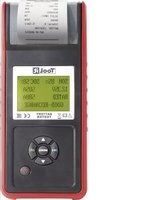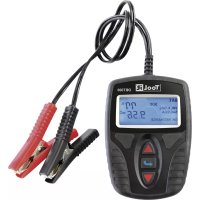
DBT 300 - Measuring equipment Toolit - Free user manual and instructions
Find the device manual for free DBT 300 Toolit in PDF.


| Brand | Toolit |
| Model | DBT 300 |
| Product type | Battery tester and charging system analyzer |
| Nominal voltage | 12 V (12 V and START/STOP batteries) |
| Compatible battery types | SLI, AGM, GEL, AGMF, START/STOP (SSA, SSEFB) |
| Capacity standards | CCA, BCI, CA, MCA, DIN, IEC, EN, SAE, GB |
| Measuring range | Up to 1200 CCA (SAE) |
| Display | LCD screen |
| Power supply | Via the tested battery |
| Main functions | Battery test, cranking test, alternator test, ripple measurement |
| Protection | Fuse against polarity reversal |
| Warranty | 2 years (parts and labor) |
| Maintenance | Clean terminals with a wire brush |
| Safety | Wear safety goggles, avoid flames and sparks |
| Compliance | European directives, EAC marking |
| Recycling | Selective collection (WEEE), do not dispose of with household waste |
| Included accessories | Positive (red) and negative (black) clamps |
Frequently Asked Questions - DBT 300 Toolit
User questions about DBT 300 Toolit
0 question about this device. Answer the ones you know or ask your own.
Ask a new question about this device
Download the instructions for your Measuring equipment in PDF format for free! Find your manual DBT 300 - Toolit and take your electronic device back in hand. On this page are published all the documents necessary for the use of your device. DBT 300 by Toolit.
USER MANUAL DBT 300 Toolit
This manual includes guidelines on the operation of your device and the precautions to follow for your own safety.
Ensure it is read carefully before first use and keep it handy for future reference.

Risk of explosion and fire!
A battery being charged can emit explosive gas.
The battery tester should only be connected to batteries with a rated output voltage of 12V .
CAUTION: Reverse polarity will cause the fuse to blow and could cause permanent damage. Damage due to reverse polarity is not covered by our warranty.
CAUTION: If the car's battery is disconnected, some management systems may be disabled.
Consult your vehicle manual for more information on installation.
Do not use the battery tester if the cord or terminals are damaged.
Do not use the battery tester if it has received a severe shock or has been damaged in any way.
Do not disassemble the device. Incorrect reassembly may result in a risk of electric shock or fire.

Acid projection hazard!
- Wear appropriate safety glasses and clothing.
- If your eyes or skin come into contact with battery acid, rinse the affected part of the body with plenty of water and seek immediate medical assistance.
- Avoid flames and sparks. Do not smoke.
- Protect the electrical contacts of the battery against short-circuiting.
The device complies with European Directive.
The certificate of compliance is available on our website.




EAC conformity mark (Eurasian Economic Commission)
This product should be disposed of at an appropriate recycling facility. Do not dispose of in domestic waste.
Product whose manufacturer is involved in the packaging's recycling process by contributing to a global system of sorting, collecting and recycling of households' packaging waste.
Recyclable product that falls within waste sorting recommendations
CONNECTING THE BATTERY TESTER
1- Make sure that the area is well ventilated before performing a test.
2- Tester for 12 V batteries (and START & STOP 12 V batteries) and test of the charging system.
3- Before performing a test on the battery, make sure that the ignition and the consumers are switched off. Close all doors and the boot.
4- Make sure that the battery connections are clean. If necessary, clean them with a wire brush.
The presence of oxydation between the tester terminals and the battery connectors or between the connectors of the battery and the terminals decreases the tester efficiency.
5- Connect the negative (black) terminal to the negative terminal of the battery. Connect the positive terminal (red) to the terminal positive of the battery.
BATTERY VOLTAGE
- Once the tester is connected, the display shows the battery voltage. Press and select «BAT» to start the battery test. Confirm by pressing
- Select the battery type (Liquid / AGMS / GEL / AGMF) using the arrows . If it is a «START/STOP» Battery, select between «SSA» or «SSEFB» (SS means start & stop). Press to validate and access the other criteria.
- Choose the standard written on the battery and validate (possible standards: CCA, BCI, CA, MCA, DIN, IEC, EN, SAE, GB)
- Enter the starting current, indicated on the battery, using the arrows (ex : 830SAE) then validate.
The test starts. If the tester displays BAT, & XX.XX V, charge the battery and test it again. If the display remains the same, replace the battery.
If the tester displays «BAT. CHARGED» (Is the tested battery charged?), press and select, «YES» or «NO».
Battery test result
| Result Analysis | |
| OK The battery is operational. | |
| OK RECHARGE Battery in good condition but low state of charge. | |
| RECHARGE RETEST Charge the battery and perform the test again. | |
| BAD | The battery is nearing the end of its life. Replacement required. OR a problem at the cell level is observed (short circuit....). Replace the battery. |
| ERROR CHARGE | Battery exceeds 1200 CCA (SAE) or clamps are not properly connected. If neither of the two causes listed above is involved, fully recharge the battery and test again. If the display remains the same, replace the battery. |
- In each case, to display the battery health status (SOH) and charge status (SOC), press to scroll through the results.
- Press return to the home screen.
TEST OF THE ALTERNATOR CHARGING SYSTEM
- In the main menu, press «CRANKING» to start the system test.
- Turn off all vehicle consumers (lights, air conditioning, radio, etc.).
- Press J. The screen shows Start the engine.
| Examples Screen display Analysis | |
| Voltage lower than 9.6 Volt LO | |
| Voltage above 9.6 Volt OK The starting voltage is normal. | |
| No waving ---- | |
| "The starting voltage is not detected. Check the connec-tions, cables and alternator.Repeat the test." |
- If the starting voltage is normal, press to continue the test. The display shows ALT. & XX.XX V>
-
Run the engine between 1200 and 1500 rpm.
-
One of the 3 results is displayed:
Result of the start voltage test
| Examples Results displayed Analysis | ||
| High starting voltage when the test is performed with the engine at idle | HI (= High) | Check that the connections are good. If every-thing is properly connected, replace the alterna-tor. |
| Normal starting voltage when the test is performed with the engine at idle | OK | No problem detected. Normal operation of the alternator. |
| Low starting voltage when the test is performed with the engine at idle | LO (= LOW) | The alternator does not provide enough power to the battery. Check the alternator belts, and make sure the alternator is running when the engine is running. If the belts slip or are broken, replace them and re-test. Check the connection between the alternator and the battery. If the connection is bad, clean or replace the cable and re-test. If the alternator belts and connection are in good condition, replace the alternator. |
- Result of the load system test with consumables running
- Turn on the heater to maximum (heat), headlights and taillights. Do not switch on cyclic loads such as air conditioning or windshield wipers.
| Examples Results displayed Analysis | ||
| High starting voltage whenthe test is performed with the consumers running | HI (= High) | "The output voltage of the alternator is abnormally high. Check that there are no connection problems. If not, replace the alternator." |
| "Normal starting voltage when the test is performed with the consumers running" | OK | No problem detected. Normal operation of the alternator. |
| "Low starting voltage when the test is performed with the consumers running" | LO (= LOW) | The alternator does not provide enough current for charging the electrical system and the battery. Check the alternator belts, and make sure the alternator is running when the engine is running. If the timing belts slip or are broken, replace the timing belts and re-test. Check the connection between the alternator and the battery. If the connection is bad, clean or replace the cable and re-test. If the belts and connection are in good condition, replace the alternator. |
- Press to display the ripple intensity of the charging circuit. The display shows RIPPLE & XX.XX V
| Results found Screen display | Analysis | |
| Normal wave intensity OK | The diodes work well in the alternator/starter | |
| High wave intensity HI | "One or more diodes do not do not work or are damaged. Make sure that the alternator support is properly positioned and that the belts are working properly. If so, replace the alternator." |
DISPLAY SCREEN CASE
| Examples Analysis | |
| The display shows HI The battery voltage is too high for the tester. | The battery voltage is too low for the tester. Recharge the battery and repeat the test. |
| The display shows Lo | |
| The screen is blank | The battery voltage is too low for the tester. Recharge the battery and repeat the test. If the display remains the same, replace the battery. |
| The display flashes or displays RIPPLE | The voltage is not stable. Charge the battery, then retest it. If the display remains the same, replace the battery. |
WARRANTY
The warranty covers faulty workmanship for 2 years from the date of purchase (parts and labour).
The warranty does not cover:
- Transit damage.
- Normal wear of parts (eg.: cables, clamps, etc.).
- Damages due to misuse (power supply error, dropping of equipment, disassembling).
- Environment related failures (pollution, rust, dust).
In case of failure, return the unit to your distributor together with:
- The proof of purchase (receipt etc ...)
- A description of the fault reported
SICHERHEITSHINWEISE

CUSTODIA DELLO SCHERMO