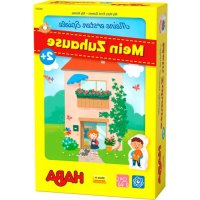
Mein Zuhause - Board game HABA - Free user manual and instructions
Find the device manual for free Mein Zuhause HABA in PDF.

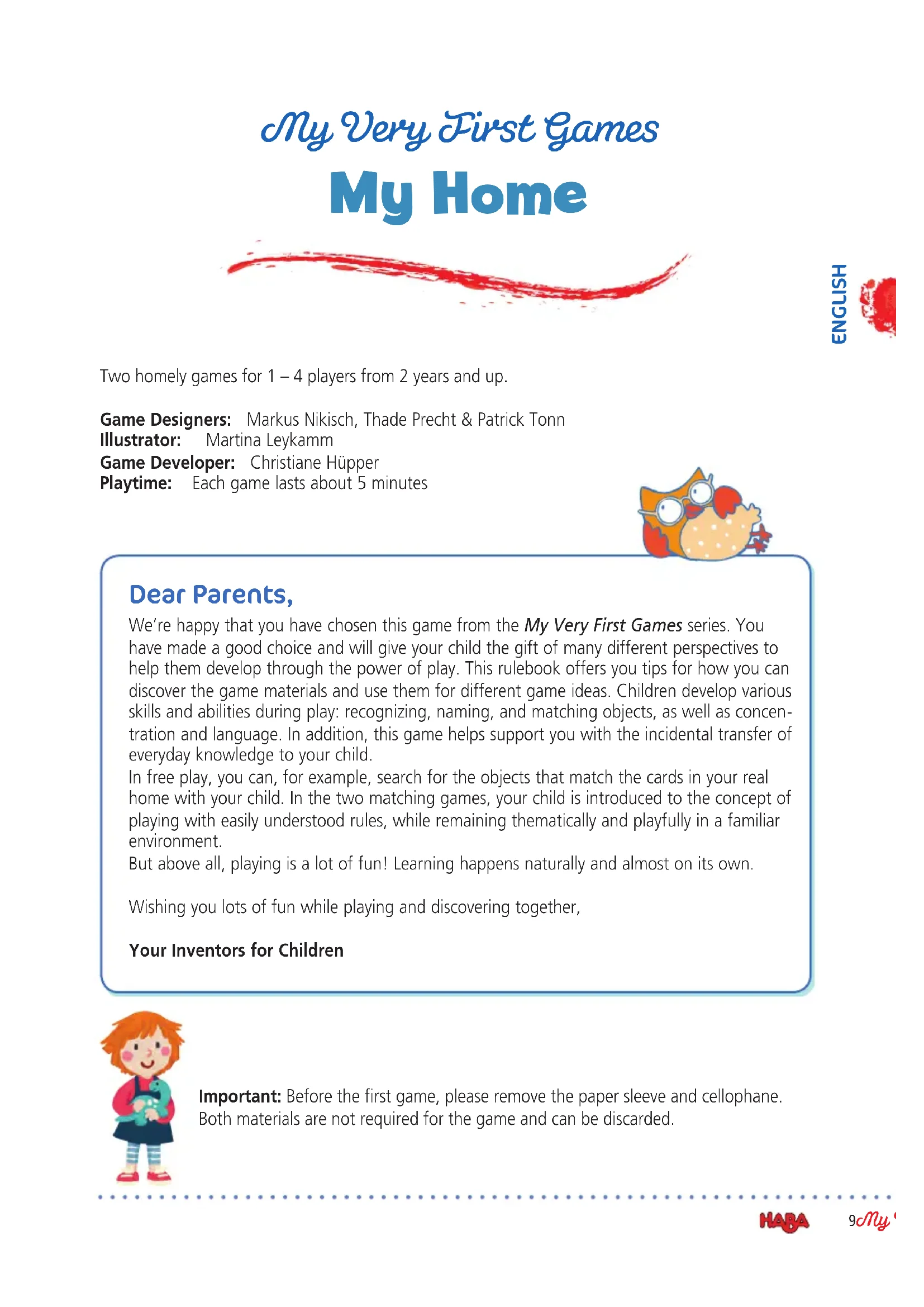


| Product type | Board game |
| Brand | HABA |
| Model | Mein Zuhause |
| Recommended age | From 2 years |
| Number of players | 1 to 4 players |
| Game duration | About 5 minutes |
| Materials | Cardboard, plastic |
| Box contents | 2 double-sided game boards, 1 figure, 32 object cards, 8 category cards, 1 rulebook |
| Box dimensions | Approximately 22 x 22 x 5 cm |
| Weight | Approximately 400 g |
| Languages of the instructions | French, German, English, Spanish, Italian, Dutch |
| Game type | Sorting and observation game |
| Care and cleaning | Wipe with a dry cloth; do not immerse in water |
| Safety | Contains small parts. Not suitable for children under 2 years (choking hazard) |
| Spare parts and repairability | Spare parts available at www.haba.fr |
Frequently Asked Questions - Mein Zuhause HABA
User questions about Mein Zuhause HABA
0 question about this device. Answer the ones you know or ask your own.
Ask a new question about this device
Download the instructions for your Board game in PDF format for free! Find your manual Mein Zuhause - HABA and take your electronic device back in hand. On this page are published all the documents necessary for the use of your device. Mein Zuhause by HABA.
USER MANUAL Mein Zuhause HABA
Two homely games for 1-4 players from 2 years and up.
Game Designers: Markus Nikisch, Thade Precht & Patrick Tonn
Illustrator: Martina Leykamm
Game Developer: Christiane Hupper
Playtime: Each game lasts about 5 minutes

Dear Parents,
We're happy that you have chosen this game from the My Very First Games series. You have made a good choice and will give your child the gift of many different perspectives to help them develop through the power of play. This rulebook offers you tips for how you can discover the game materials and use them for different game ideas. Children develop various skills and abilities during play: recognizing, naming, and matching objects, as well as concentration and language. In addition, this game helps support you with the incidental transfer of everyday knowledge to your child.
In free play, you can, for example, search for the objects that match the cards in your real home with your child. In the two matching games, your child is introduced to the concept of playing with easily understood rules, while remaining thematically and playfully in a familiar environment.
But above all, playing is a lot of fun! Learning happens naturally and almost on its own.
Wishing you lots of fun while playing and discovering together,
Your Inventors for Children
Important: Before the first game, please remove the paper sleeve and cellophane.
Both materials are not required for the game and can be discarded.
Game Components
2 game boards (printed on both sides): room/house, 1 play figure (printed on both sides), 32 object cards, 8 category cards (=4 pairs: small/big; light/heavy; indoors/outdoors; day/night), 1 rulebook


HSIN3
Discover Free Play and Notice Details:
I Your child will engage with the game's components during free play. Play along! Before the first game, explore the illustrations on the game boards, the different object cards, and the various categories together.
The game components are designed to encourage conversations with children about their surroundings, their everyday life, and the events of the day. This is why the components are an excellent starting point for a beginning conversation with your child.
It is important that you give your child time to answer and that you pick up on your child's statements as often as possible during the conversation. Ask lots of questions that cannot be answered with yes or no (e.g.: "Have a look around, what can you see in your bedroom?" or "What do you like to play with the most?"). Talk about topics that are on your child's mind at the moment, particular things that happened that day, or newly acquired skills. Ideally, there will be an object in the game that currently plays a particularly important role for your child. But of course, the selected objects only cover a small part of what your child knows, so use them as cues (e.g. the teddy bear for stuffed animals in general).
And finally: don't expect too much - your child still has a limited vocabulary and putting memories in an easy to understand order is much harder than you might think. This makes regular conversations all the more worthwhile, as they allow you to accelerate and experience your child's development in these exciting areas.
The two games are ideally suited to an adult guiding play and engagement with the game. The games can be played by more than one child at a time. See which form is most suitable for your child/children at the moment and guide them accordingly
Game 1: Hey, Let's Clean Up!
A first matching game that asks "What belongs where?"
The house in the game has 4 rooms: kitchen, living room, children's bedroom, and bathroom. The children are tasked to match the objects to the individual rooms they might belong in.
Before Starting
Place the two game boards side by side, with the inside of the house facing up, to create a connected house. Select 16 objects cards (objects and categories) and place them face-up below the game boards in the grid shown. Stack the remaining cards next to the game boards. Have the play figure ready.

Now Let's Get Started
Grandma and grandpa are about to come to visit. But the house is a mess and some things are even out on the lawn! Let's quickly tidy up and put the objects back in their correct rooms
Ask your child: Which room do you want to tidy up first? What is the room called?
Help if your child does not know what the room is called (yet).
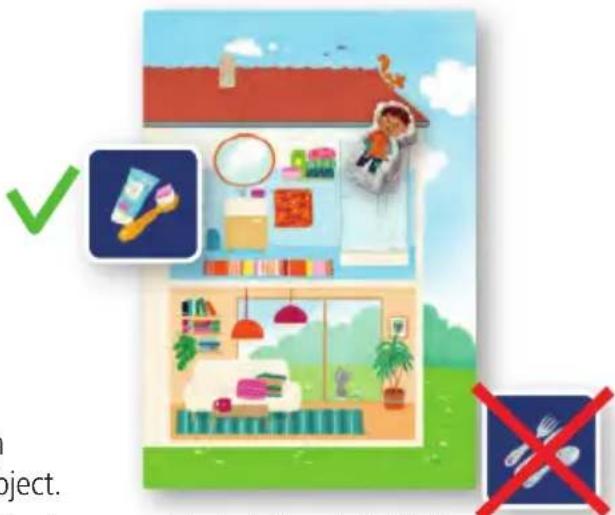
Guide your child: Place the figure in the room you want to tidy.
Then ask your child: Which object belongs in this room?
Now your child thinks about which object belongs in the room that the figure is standing in
Matching object:
If your child finds a matching object, they take the card, name the object, and place the card into the room with the figure in it.
- No matching object:
If your child can't find a matching object for this room, they take a card and place it in the yard (outside the house as shown).
Then have your child place the figure in another room where there is no object and search for a matching object.
If the 4 rooms each have 1 object, the figure goes to the face-up objects laid out. Refill the gaps created this round with object cards from the face-down pile. The next clean-up begins ...
End of the Game
When your child has tidied up 4 sets of objects 3 times, the game ends. If your child wants to keep playing, you can of course continue for a few rounds.

Encourage your child to talk about each object and what they see in the room picked. Think together about what the child knows from home or daycare. Maybe you are currently in the room shown. Remember that it will be difficult for your child to choose or talk about a "right" object at first. If they choose an object that you do not think is right, be lenient. There is no right or wrong in this game. The aim is to encourage your child to speak. Talk to them and then ask why they chose the object or why they like it.
... with More Than One Child Playing:
If more than one child is playing, have them take turns. If a child has matched an object to a room, they take this card and place it face-down in front of them. Then the next child takes their turn. Refill the gap in the object card grid to a total of 16 objects. The next child gets the figure, places it in a room and searches for a matching object. Keep taking turns until each child has tidied up 4 objects.
Tipp:
The game becomes a little easier if you only play with one part of the house or if you have exactly 4 objects ready in each round that match the 4 rooms.
You can also make the game a little more difficult if you ask the children to match 2 or even more objects to the rooms each turn.
Game 2: Big or Small, Heavy or Light?

Before Starting
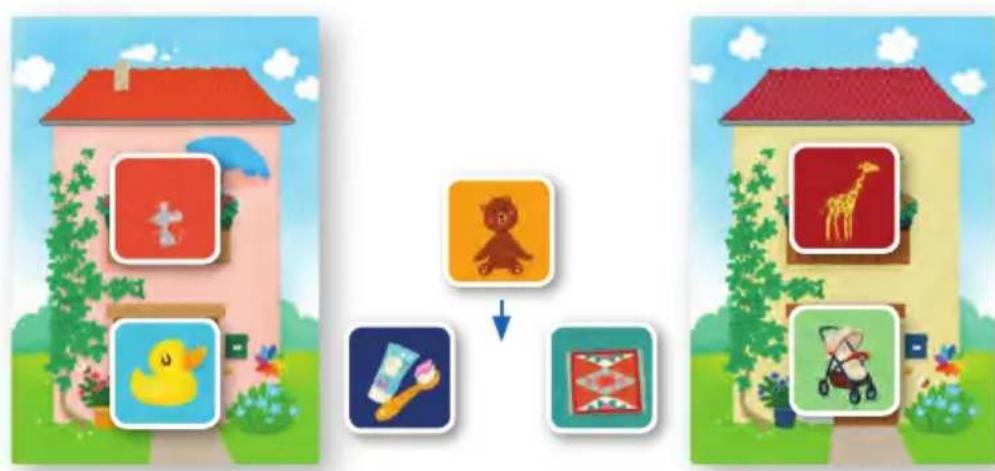
Place the two game boards side by side a little way apart with the outer walls facing up. From the category cards (light blue backs), select 1 pair of opposites you want to play with, e.g. mouse/giraffe for small/big. Place one card on the balcony of one house and the other card on the balcony of the other house.
Select 16 objects from the object cards and place them face-up below the game boards in a grid. Stack the remaining cards next to the game boards. Have the play figure ready. The remaining category cards are not needed for this game and can be returned to the box.

ENNNN

Now Let's Get Started
The child takes the figure and places it below the house for the category they now want to find a matching object. In this case the house with the mouse.
Point to the category card and ask your child something like:
Which object is as "small" as a "mouse"?
Each turn, name the category with the picture and its meaning so that your child can make the connection to the category. Help if your child can't decide or has questions about the objects. If your child finds a suitable object, encourage them to take the card
Then ask your child: What is the object called?
Help if your child can't (yet) name the object and ask them to place the card on the front door of the corresponding house.
If they can't find an object for this category, the child places an object in the yard between the houses.
Then place the figure below the other house and ask your child to find an object for this category with guiding questions.

End of the Game
When your child has matched 3 pairs, the game ends. If your child wants to keep playing, you can of course continue for a few rounds.

... with More Than One Child Playing:
If more than one child is playing, it is the next child's turn after a pair has been matched. Refill the object grid below the game boards to 16 object cards. The next child selects an object and classifies it accordingly.
The game ends when each child has matched 3 pairs of objects.
Game Variations: "Small Versus Big"
The basic rules of the game apply, but with the following changes:
The game is now to sort the objects between the two category cards, e.g. between small and big. Example: The toothbrush belongs to the category small and the rug to the category big. Does the teddy bear fit in between? And where does the book belong?
Your child will especially benefit if you create an evening ritual to go through your child's day with similar questions with the help of the game's components. This allows your child to classify the objects as substitutes for events of the day between morning (sun) and night (moon). This encourages your child to speak and strengthens their memory and their ability to perceive their own feelings.


Mes premiers jours
Dear Children and Parents,
At www.haba.de/Ersatzteile it's easy to ask whether a missing part of a toy or game can still be delivered.
Chers infants, chers parents,


- Dear Parents,
- Game Components
- HSIN3
- Discover Free Play and Notice Details:
- Game 1: Hey, Let's Clean Up!
- Before Starting
- Now Let's Get Started
- Matching object:
- - No matching object:
- End of the Game
- ... with More Than One Child Playing:
- Tipp:
- Game 2: Big or Small, Heavy or Light?
- Point to the category card and ask your child something like:
- Then ask your child: What is the object called?
- Game Variations: "Small Versus Big"
- Mes premiers jours
- Dear Children and Parents,
- Chers infants, chers parents,
Brand : HABA
Model : Mein Zuhause
Category : Board game