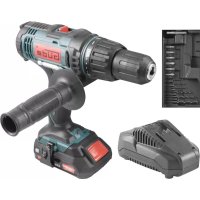
BSB 20201 24K - Screwdriver Güde - Free user manual and instructions
Find the device manual for free BSB 20201 24K Güde in PDF.

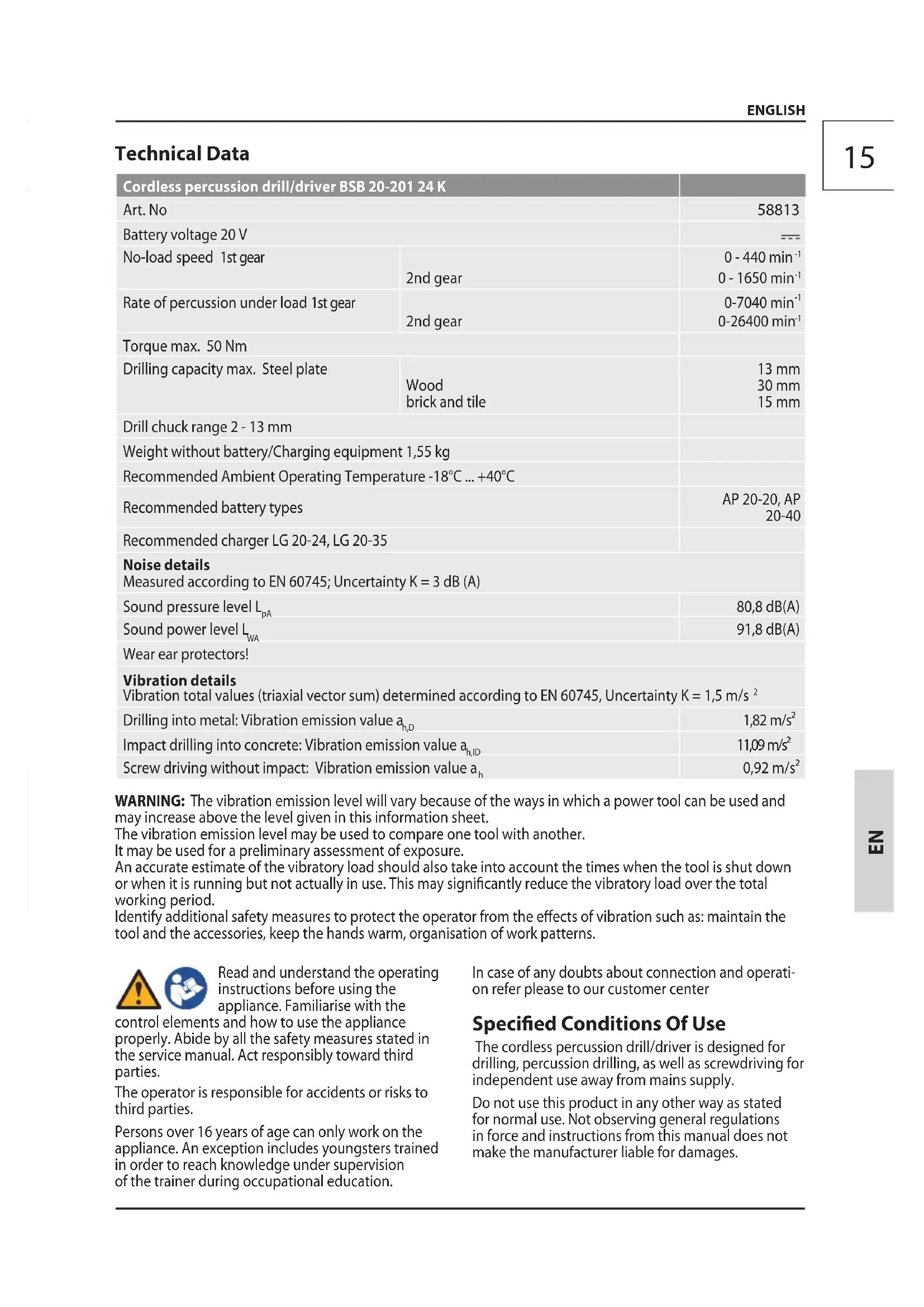


| Brand | Güde |
| Model | BSB 20201 24K |
| Product type | Cordless hammer drill/driver |
| Battery voltage | 20 V DC |
| No-load speed (1st gear) | 0 - 440 rpm |
| No-load speed (2nd gear) | 0 - 1650 rpm |
| Maximum torque | 50 Nm |
| Max. drilling diameter (steel) | 13 mm |
| Max. drilling diameter (wood) | 30 mm |
| Max. drilling diameter (brick/sandstone) | 15 mm |
| Chuck clamping range | 2 - 13 mm |
| Weight (without battery) | 1.55 kg |
| Operating temperature | -18 °C to +40 °C |
| Compatible batteries | AP 20-20, AP 20-40 |
| Compatible chargers | LG 20-24, LG 20-35 |
| Sound pressure level (LpA) | 80.8 dB(A) |
| Sound power level (LWA) | 91.8 dB(A) |
| Vibration (metal drilling) | 1.82 m/s² |
| Vibration (hammer drilling concrete) | 11.09 m/s² |
| Vibration (screwdriving) | 0.92 m/s² |
| Number of speeds | 2 |
| Power supply | 20 V Li-ion battery (not included) |
| Main functions | Drilling, hammer drilling, screwdriving |
| Maintenance and cleaning | Clean with a damp cloth; do not use solvents; keep ventilation slots clean |
| Safety | Wear safety glasses, ear protection; remove battery before any adjustment; follow safety instructions |
| Spare parts and repairability | List of spare parts available at www.guede.com; repairs by qualified personnel |
| General information | Intended use: cordless drilling, hammer drilling and screwdriving; protection class III |
Frequently Asked Questions - BSB 20201 24K Güde
User questions about BSB 20201 24K Güde
0 question about this device. Answer the ones you know or ask your own.
Ask a new question about this device
Download the instructions for your Screwdriver in PDF format for free! Find your manual BSB 20201 24K - Güde and take your electronic device back in hand. On this page are published all the documents necessary for the use of your device. BSB 20201 24K by Güde.
USER MANUAL BSB 20201 24K Güde
Translation of the original instructions Cordless percussion drill/driver
ENGLISH Please read the instructions carefully before starting the machine.
Never use the gear switch whilst the machine is operating. Only use the switch when the machine is at a standstill.
| Cordless percussion drill/driver BSB 20-201 24 K | ||
| Art. No | 58813 | |
| Battery voltage 20 V | --- | |
| No-load speed 1st gear | 2nd gear | 0 - 440 min-10 - 1650 min-1 |
| Rate of percussion under load 1st gear | 2nd gear | 0-7040 min-10 - 26400 min-1 |
| Torque max. 50 Nm | ||
| Drilling capacity max. Steel plate | Woodbrick and tile | 13 mm30 mm15 mm |
| Drill chuck range 2 - 13 mm | ||
| Weight without battery/Charging equipment 1,55 kg | ||
| Recommended Ambient Operating Temperature -18°C ... +40°C | ||
| Recommended battery types | AP 20-20, AP20-40 | |
| Recommended charger LG 20-24, LG 20-35 | ||
| Noise detailsMeasured according to EN 60745; Uncertainty K = 3 dB (A) | ||
| Sound pressure level \( {\mathrm{L}}_{\mathrm{{pA}}} \) | 80,8 dB(A) | |
| Sound power level \( {\mathrm{L}}_{\mathrm{{WA}}} \) | 91,8 dB(A) | |
| Wear ear protectors! | ||
| Vibration detailsVibration total values (triaxial vector sum) determined according to EN 60745, Uncertainty K = 1,5 m/s2 | ||
| Drilling into metal: Vibration emission value \( {\mathrm{a}}_{\mathrm{h},\mathrm{D}} \) | 1,82 m/s2 | |
| Impact drilling into concrete: Vibration emission value \( {\mathrm{a}}_{\mathrm{h},\mathrm{{ID}}} \) | 11,09 m/s2 | |
| Screw driving without impact: Vibration emission value \( {\mathrm{a}}_{\mathrm{h}} \) | 0,92 m/s2 | |
WARNING: The vibration emission level will vary because of the ways in which a power tool can be used and may increase above the level given in this information sheet.
The vibration emission level may be used to compare one tool with another.
It may be used for a preliminary assessment of exposure.
An accurate estimate of the vibratory load should also take into account the times when the tool is shut down or when it is running but not actually in use. This may significantly reduce the vibratory load over the total working period.
Identify additional safety measures to protect the operator from the effects of vibration such as: maintain the tool and the accessories, keep the hands warm, organisation of work patterns.


Read and understand the operating instructions before using the appliance. Familiarise with the
control elements and how to use the appliance properly. Abide by all the safety measures stated in the service manual. Act responsibly toward third parties.
The operator is responsible for accidents or risks to third parties.
Persons over 16 years of age can only work on the appliance. An exception includes youngsters trained in order to reach knowledge under supervision of the trainer during occupational education.
In case of any doubts about connection and operation refer please to our customer center
Specified Conditions Of Use
The cordless percussion drill/driver is designed for drilling, percussion drilling, as well as screwdriving for independent use away from mains supply.
Do not use this product in any other way as stated for normal use. Not observing general regulations in force and instructions from this manual does not make the manufacturer liable for damages.
Emergency procedure
Conduct a first-aid procedure adequate to the injury and summon qualified medical attendance as quickly as possible. Protect the injured person from further harm and calm them down. If you seek help, state the following pieces of information: 1. Accident site, 2. Accident type, 3. Number of injured persons, 4. Injury type(s)
Symbols

WARNING / Caution!

Read the operating instructions to reduce the risk of injury.

Wear eye protective goggles! Wear ear protectors!

Take the replaceable battery from the appliance before any extension, cleaning and servicing works.

Class III tool.

CE marking
Any damaged or disposed electric or electronic devices must be delivered to appropriate collection centres.

Volts

No-load speed

Direct Current
Battery

Protect the battery against heat and fire.

Protect the battery against water and moisture.

Protect the battery against temperatures above 40ircC .
Li-Ion
Do not throw the batteries in household waste.

Deliver the batteries to a collection centre of old batteries where they will be recycled in an environmentally friendly way.
WARNING Read all safety warnings and all
instructions. Failure to follow the warnings and instructions may result in electric shock, fire and/or serious injury.
Save all warnings and instructions for future reference.
Screwdriver safety warnings
Hold power tool by insulated gripping surfaces, when performing an operation where the fastener may contact hidden wiring. Fasteners contacting a "live" wire may make exposed metal parts of the power tool "live" and could give the operator an electric shock.
Drill safety warnings
Wear ear protectors when impact drilling. Exposure to noise can cause hearing loss.
Use auxiliary handle(s), if supplied with the tool. Loss of control can cause personal injury.
Hold power tool by insulated gripping surfaces, when performing an operation where the cutting accessory may contact hidden wiring. Cutting accessory contacting a "live" wire may make exposed metal parts of the power tool "live" and could give the operator an electric shock.
Additional Safety and Working Instructions
Use protective equipment. Always wear safety glasses when working with the machine. The use of protective clothing is recommended, such as dust mask, protective gloves, sturdy non-slip footwear and ear defenders.
The dust produced when using this tool may be harmful to health. Do not inhale the dust. Use a dust absorption system and wear a suitable dust protection mask. Remove deposited dust thoroughly, e.g. with a vacuum cleaner.
Do not machine any materials that present a danger to health (e.g. asbestos).
When working in walls ceiling, or floor, take care to avoid electric cables and gas or waterpipes.
Clamp your workpiece with a clamping device.
Unclamped workpieces can cause severe injury and damage.
Please turn the device immediately off when the tool used gets blocked! Do not turn the device on again when the tool is still blocked. This could cause bounce back with a high reaction moment. Determine and remove the cause of the blocking of the tool used while respecting the safety instructions.
The possible causes may be:
- it is tilted in the workpiece to be machined
- it has pierced through the material to be machined
- the power tool is overloaded
Do not reach into the machine while it is running. Chips and splinters must not be removed while the machine is running.
WARNING! Danger of burns
The insertion tool may become hot during use.
- when changing tools
- when setting the device down
The appliance must not be used if damaged or safety equipment is defective. Replace any worn-out and damaged parts.
Do not use the device near flammable liquids or gases. Risk of fire and explosion in case of short circuit.
Do not let any metal parts reach the airing slots - danger of short circuit!
Electronics
In case of overload, the rotational speed is being reduced until machine stops. Please note that the machine will automatically accelerate back to its original operating speed if the load is removed from it.
Battery

Risk of fire! Risk of explosion!
Never use damaged, defective or deformed accumulators. Never open or damage the accumulator or let it fall on the ground.
Never charge the battery in an environment with acids and easily flammable materials.
Protect the battery against heat and fire. Battery to be used at the ambient temperatures between 10ircC and +40ircC only.
Never put the battery on heaters and do not expose it to strong sunlight for a long time. After being subject to heavy load, let the battery cool down first.
Short circuit - do not bridge the accumulator contacts with metal parts.
The accumulator must be packaged (plastic bag, box) or accumulator contacts must be sealed up for accumulator disposal, transport or storage.
The Gude charger to be used only to charge the battery. There can be malfunction or fire if different chargers are used.
Vapours may leak out in case of unauthorised use or when using a damaged accumulator. Bring fresh air and seek medical advice if experiencing difficulties. Vapours may irritate the respiratory system.
Work instructions
Accumulators are supplied partially charged and must therefore be fully charged before being used for the first time.
- Charge the accumulator when the appliance is running slowly or stops.
- A li-ion battery may be charged at any time without any shortening of its life. Charging process interruption will not damage the accumulator.
- A li-ion battery is protected by the Electronic Cell Protection against deep discharge.
- A significantly shorter operating time of a charged battery means the battery life is over and the battery must be replaced.
Dispose of the batteries in an environmentally friendly manner.
Li-ion batteries are subject to the special disposal obligation. Have any defective batteries disposed of by a specialised shop. The battery must be taken out before the appliance is scrapped. Damaged batteries may harm the environment and your health if toxic vapours or liquids leak out of such batteries. Therefore, never send a defective battery by post, etc. Please contact your local recycling centre.
Dispose of the batteries when discharged. We recommend applying an adhesive tape on the poles to protect them against short circuit. Never open the battery.
Maintenance
Take the replaceable battery from the appliance before any extension, cleaning and servicing works.
Repairs and works specified in these Instructions may only be performed by qualified authorised staff.
Use only original accessories and original spare parts.
Keep the device, in particular the air vents, clean at all times. Never spray water on the device body!
Do not clean the plastics with solvents, flammable or toxic fluids. For cleaning, use a damp cloth only.
Only a regularly maintained and treated appliance can serve as a satisfactory aid. Insufficient maintenance and care can lead to unforeseen accidents and injuries.
If necessary, a list of spare parts can be found at www.guide.com.
\section*{Caracteristiques Techniques}
Translation of the EC-Declaration of Conformity
We, hereby declare the conception and construction of the below mentioned appliances correspond - at the type of construction being launched - to appropriate basic safety and hygienic requirements of EC Directives. In case of any change to the appliance not discussed with us the Declaration expires.
Annex IV Notified Body Name: No: Adress:
Type Ex.Cert.-No.:
- Specified Conditions Of Use
- Emergency procedure
- Symbols
- Battery
- WARNING Read all safety warnings and all
- Screwdriver safety warnings
- Drill safety warnings
- Additional Safety and Working Instructions
- Electronics
- Risk of fire! Risk of explosion!
- Work instructions
- Dispose of the batteries in an environmentally friendly manner.
- Maintenance
- Translation of the EC-Declaration of Conformity
Brand : Güde
Model : BSB 20201 24K
Category : Screwdriver