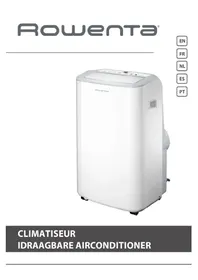
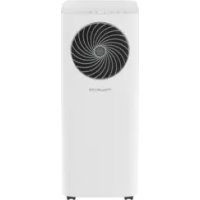
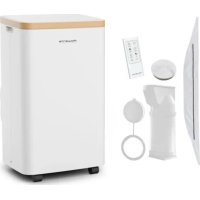
USER MANUAL RWAC1900C ROWENTA
PLEASE READ THE FOLLOWING INSTRUCTIONS CAREFULLY BEFORE USING THE APPLIANCE AND KEEP FOR FUTURE REFERENCE.
- This appliance is intended for domestic household use only and should not be used for any other purpose or in any other application, such as for non-domestic use or in a commercial environment.
- This appliance can be used by children aged from 8 years and above and persons with reduced physical, sensory or mental capabilities or lack of experience and knowledge if they have been given supervision or instruction concerning use of the appliance in a safe way and understand the hazards involved. Children shall not play with the appliance. Cleaning and user maintenance shall not be made by children without supervision.
- If the supply cord is damaged, it must be replaced by the manufacturer, its service agent or similarly qualified persons in order to avoid a hazard.
- For the details concerning the method of cleaning, please see section "Cleaning and Maintenance" on pages 13&14.
- The battery must be removed from the appliance before it is scrapped.
- The battery is to be disposed of safely.
- Batteries are to be inserted with the correct polarity.
- Exhausted batteries are to be removed from the product.
- Attention should be drawn to the environmental aspects of battery disposal. Don't throw used batteries in dustbin. Please contact your retailer in order to protect the environment.
-
The batteries (batteries installed) shall not be exposed to excessive heat such as sunshine, fire or the like.
-
This product contains non-fluorinated greenhouse gas (hermetically sealed) which is dangerous for the environment and contributes to global warming if released to the atmosphere.
-
Refrigerant type: R290 Global warming potential (GWP): 3
-
Refrigerant leakage contributes to climate change. Refrigerant with lower global warming potential (GWP) would contribute less to global warming than a refrigerant with higher GWP, if leaked to the atmosphere.
-
This product contains a refrigerant fluid with a GWP equal to 3. This means that if 1kg of this refrigerant fluid would be leaked to the atmosphere, the impact on global warming would be 3 times higher than 1kg of CO_2 , over a period of 100 years. Never try to interfere with the refrigerant circuit yourself or disassemble the product yourself and always ask a professional.
-
For disposal of the appliance: To prevent possible harm to the environment or human health from uncontrolled waste disposal, recycle the appliance responsibly to promote the sustainable reuse of material resources, the refrigerants and the flammable insulation blowing gases. The disposal should only be done through public collection points; contact the waste treatment center nearest your home for more details on the correct procedures for disposal.
-
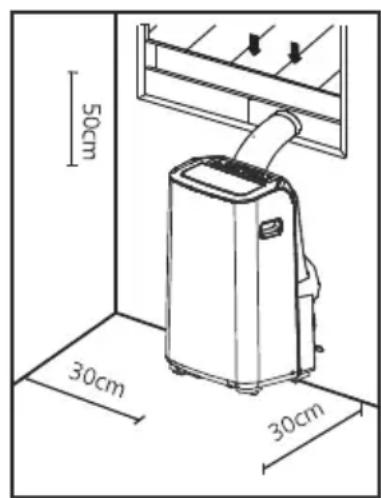
For installation, servicing: The appliance should be placed on a horizontal floor and keep the ventilation freely.
Don't try to replace or repair any components by yourself, ask the service agency for help if necessary.
- For handling: Always handle the appliance to avoid any damage.
IMPORTANT SAFETY INSTRUCTIONS
Battery handling and usage Remote control batteries (included):
- The batteries should only be replaced by adults. Do not allow children to use the remote control unless the battery cover is attached.
- Replace the battery only with the same type. The batteries used in the remote control are two AAA 1.5V batteries which are accessible and can be replaced.
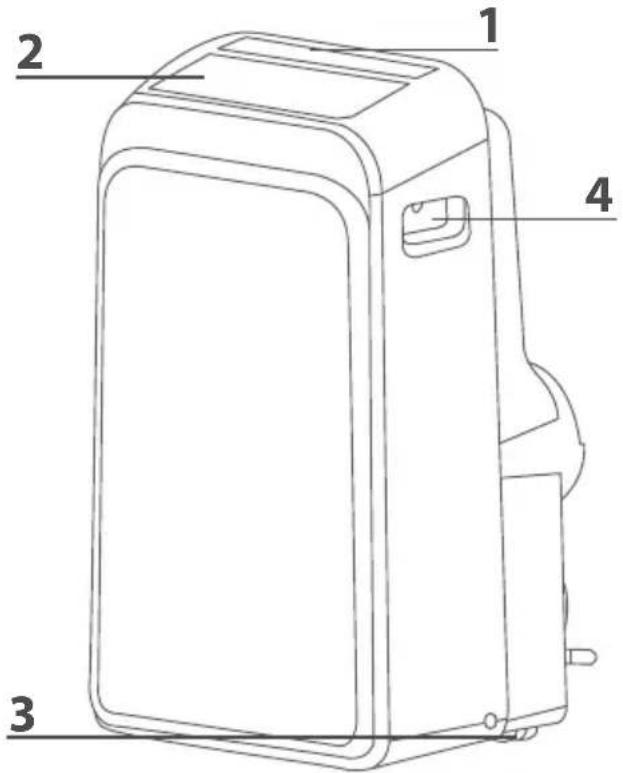
- Control panel
- Louver
- Caster
- Carrying handle (on both sides)
- Upper air inlet grille
- Air outlet grille
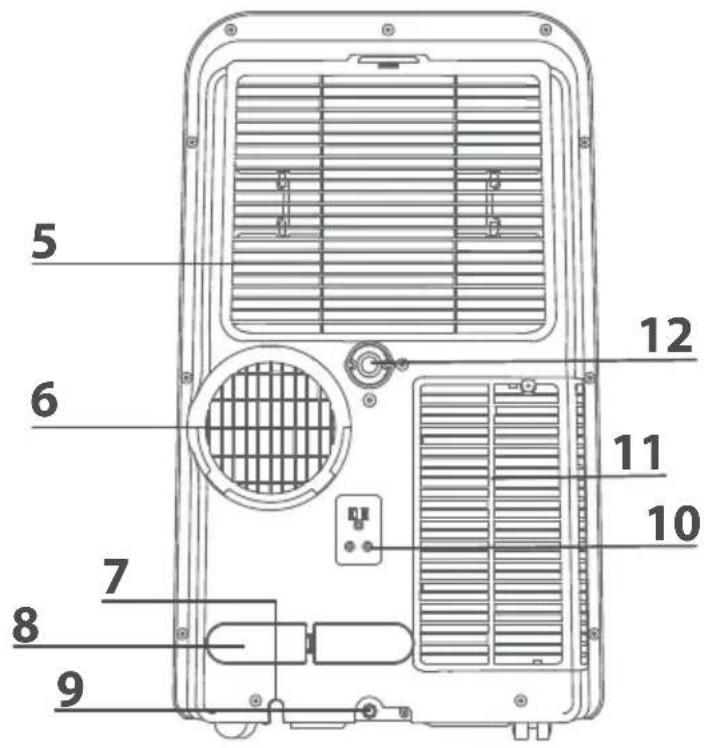
- Power cord outlet
- Power cord wraps
- Bottom drainage point
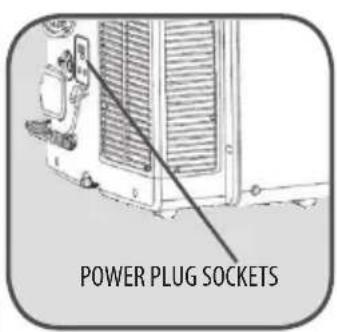
- Power plug sockets (use only when storing the appliance)
- Lower air inlet grille
- Upper drainage point
NOTE: Items with * are optional. Slight variations in design may occur.

Unit Adaptor

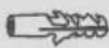
*Screw and anchor (only for wall installation)


*Security Bracket and Screw

*Window Slider Adaptor
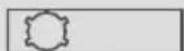
*Window Slider A

Drain Hose
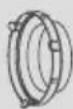
*Wall Exhaust Adaptor A (only for wall installation)

Wall Exhaust Adaptor B(with cap) (only for wall installation)
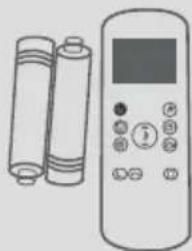
Remote Control and Battery

Power Cord Buckle
*Foam Seal A (Adhesive)
*Foam Seal B (Adhesive)

*Foam Seal C (Non-adhesive)
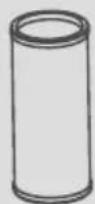
Exhaust Hose

*Bolt


Swing

Setting timer Setting mode

Setting fan speed

Sleep mode ON/OFF

+/- Adjusting temperature or time
Indicator lights:

ON
Timer on

OFF
Timer off

Cooling mode

Dehumidification mode

AUTO

Fan mode

Temperature in Celsius

Temperature in Fahrenheit

High fan speed

Medium fan speed

Small fan speed

Sleep mode

Power ON
REMOTE CONTROL
The functions work the same as the control panel of the appliance.

Adjusting temperature

Setting timer ON

Setting timer OFF

Setting mode

Power ON Setting fan speed

Swing

Sleep mode

Shortcut

Swinging display blacklight on/off
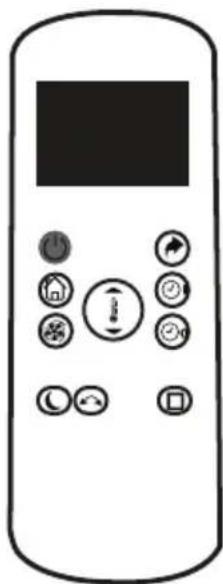
Battery installation: Remove the cover on the back of the remote control and insert two batteries with "+" and "-" marks correctly aligned.
Caution: Remove the batteries if the remote control is not in use for long periods of time.
INSTALLATION
This appliance is a portable air conditioner, which can be moved from room to room.
INSTALLATION
Windows Installation Kit
Note: The window kit is only designed to be installed with sliding windows.
The window kit is not designed or to be used with casement style windows.
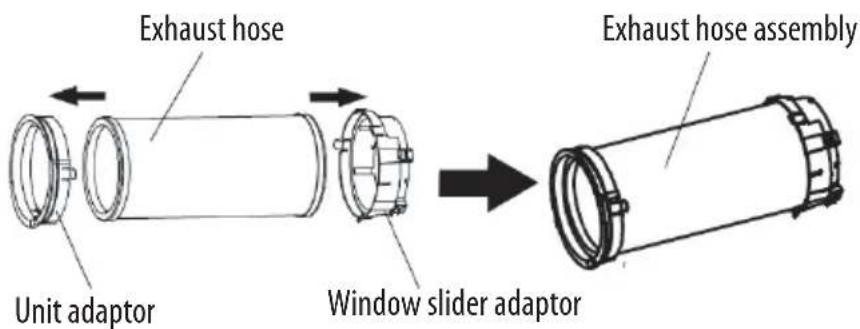
- Install the unit adaptor and window slider adaptor on both sides of the exhaust hose.
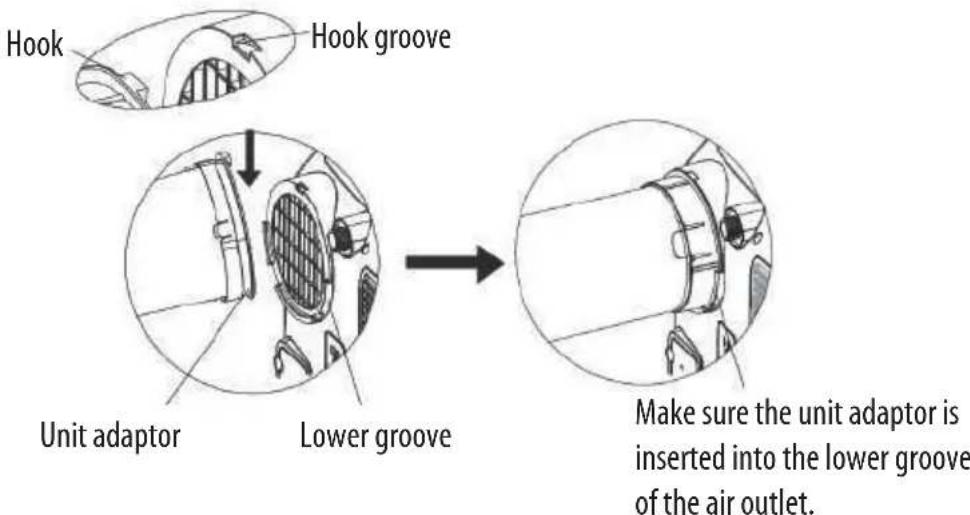
- Connect the exhaust hose assembly to the back of the appliance. Slide in the hose until it is locked in place.
- Adjust the window sliders as per width or height of your window and insert the supplied bolt to fix at the desired position. There is a hole where the exhaust hose will be inserted. Make sure this hole is not blocked.
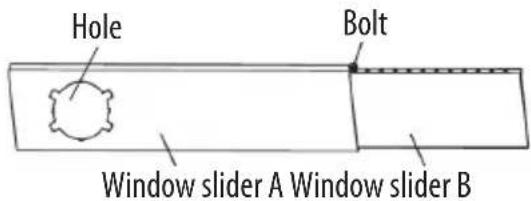
- Cut the foam seals A and B to the proper lengths and attach them to the window frame.
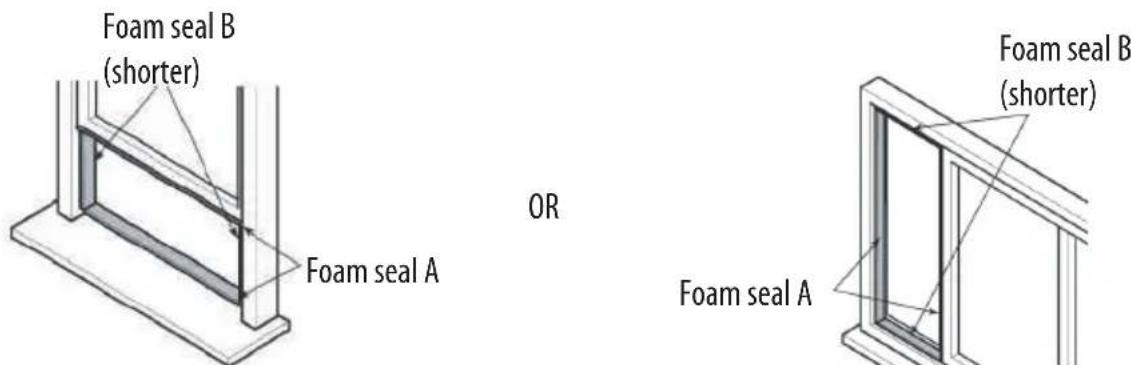
- Connect the window slider assembly to the window.
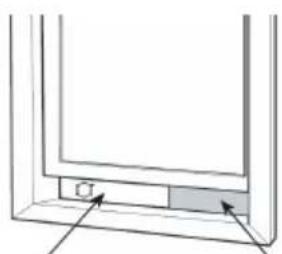
OR
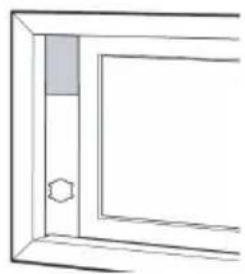
Window slider A Window slider B
- Cut the non-adhesive foam seal C to match the width (or height) of the window. Insert the seal between the glass and the window frame to prevent air and insects from getting into the room.
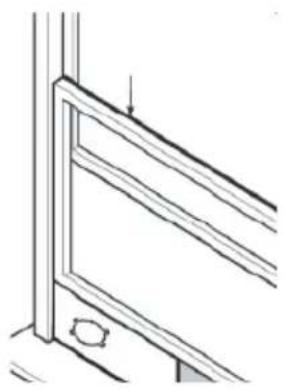
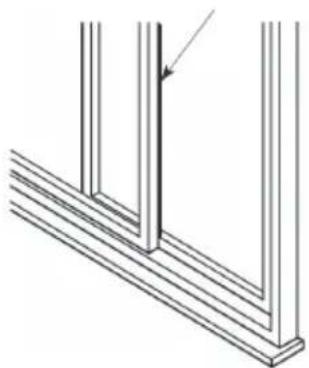
OR
- If desired, install the security bracket with 2 screws supplied.
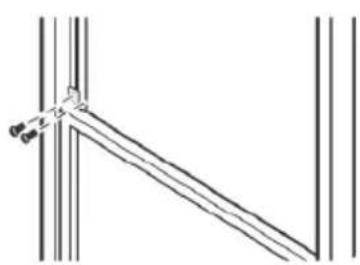
OR
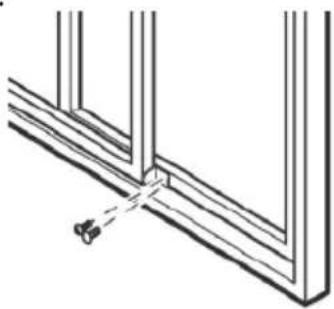
- Insert the window slider adaptor into the hole of the window slider.
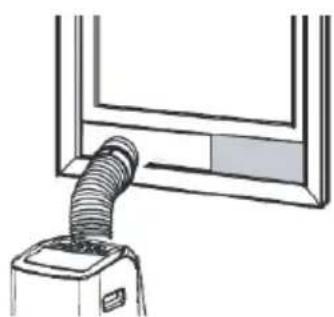
OR
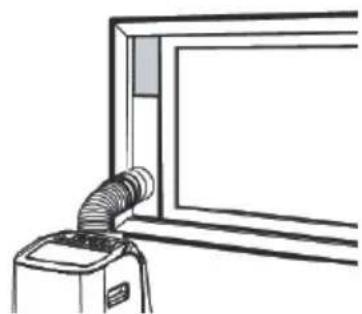
Wall Installation Kit
- Install the unit adaptor and wall exhaust adaptor A on both sides of the exhaust hose.
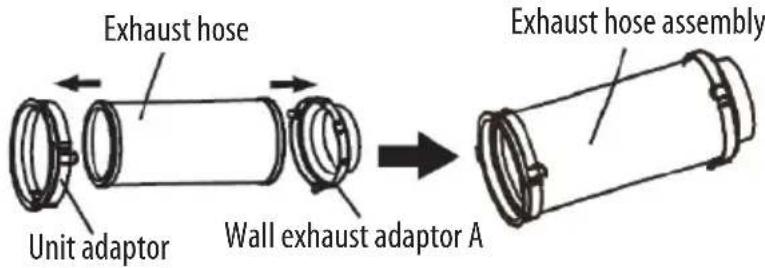
- Connect the exhaust hose assembly to the back of the appliance.
- Cut a 125mm hole into the wall for the wall exhaust adaptor B.
- Secure the wall exhaust adaptor B to the wall using the supplied anchors and screws.
- Connect the exhaust hose assembly to the wall exhaust adaptor B.
Expansion anchor position
Wall exhaust adaptor B Adaptor cap
NOTE: Cover the hole in the wall using the adaptor cap when not in use.
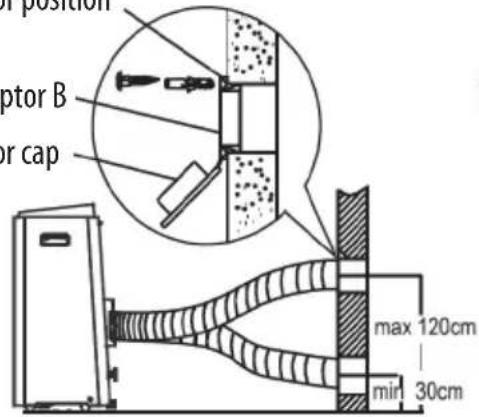
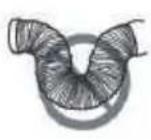
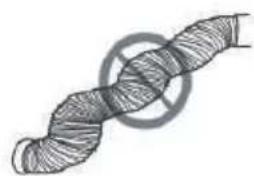
NOTE: Do not bend the exhaust hose.
Plug the appliance into the mains socket. A buzzer will beep and all indicator lights will illuminate briefly.
Turning ON/OFF
Press to switch on the appliance. Press again to switch off the appliance.
Mode selection
Repeatedly press to select the desired working mode: automatic, cooling, heating, dehumidification or fan. The indicator of your selected mode will illuminate.
When the fan ( ) and dehumid iation ( modes are selected, the display will show the ambient room temperature.


Setting the temperature
Repeatedly press + / - on the control panel or / on the remote to set the temperature. The display will show the temperature you set in auto (auto), and cooling (cool) modes.
Adjustable temperature range:
30^ (86^) max.
17^ (62^) min.
The temperature can be displayed in degrees Fahrenheit or degrees Celsius. To change the display from one to the other, press and hold + and - on the control panel at the same time for about 3 seconds.
Repeatedly press to select the fan speed.
The speed indicator light will illuminate to indicate which speed setting is in use.
If the appliance is in auto (auto) and dehumidification ( modes, you can not select the fan speed.


Setting the timer
You can set the timer for both delay start and delay stop.
Programming the timer for ON - when the appliance is OFF.
Press on the control panel or on the remote control. The timer on indicator light will illumantine on the control panel.
Repeatedly press or hold down + / - on the control panel or on the remote control to change the time in half an hour increments up to 10 hours, and then in 1 hour increments up to 24 hours.
The set time will be confirmed after about 5 seconds and then the delay start timer will start.
When the set time has been reached, the appliance will turn on automatically.

On the control panel On the remote control
Programming the timer for OFF - when the appliance is operating.
Press on the control panel or on the remote control. The timer off indicator light will illuminate on the control panel.
Repeatedly press or hold down + / - on the control panel or on the remote control to change the time in half an hour increments up to 10 hours, and then in 1 hour increments up to 24 hours.
The set time will be confirmed after about 5 seconds and then the delay stop timer will start.
When the set time has been reached, the appliance will turn off automatically.
On the control panel On the remote control
To cancel the timer setting
Press or hold down + / - on the control panel or on the remote control until either remote display or the display of the control panel shows "0.0".
Sleep operation
The sleep function adjusts the set temperature of the appliance to the thermal needs of the body falling asleep.
Press to operate the sleep mode. The sleep indicator light will illuminate.
The set temperature will increase (cooling) or decrease (heating) 1^ / 2^ after about 30 minutes. The temperature will then increase or decrease by another 1^ / 2^ after an additional 30 minutes. This new temperature will be maintained for about 7 hours before it returns to the originally selected temperature.
NOTE: This function is unavailable in fan and dehumidification modes.
To cancel the function, press . The sleep indicator light will go out.
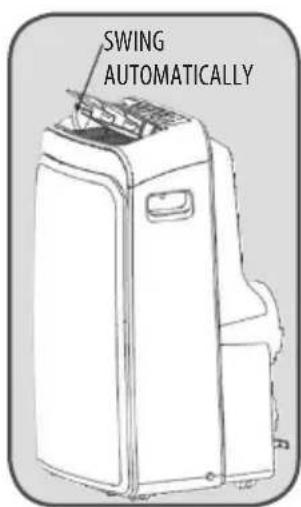
Swing opeartion
When you turn on the appliance, the louver will swing and stop at a certain angle.
You can press to let the Louver swing automatically.
Press again when you want the louver stop at a desired angle.
Switching display backlight ON/OFF (remote control only)
If you prefer to switch the display backlight off, press
Press again the backlight will switch on.
Reset (remote control only)
Once the pinhold button is pressed, all settings will be cancelled and the remote control will return to default settings.
DRAINAGE
When the internal water tank is full the display will show "P1".
To empty the water tank do the following:
- Switch off the appliance and remove the plug from the mains socket.
- Place a water tray (not supplied) on the floor underneath the bottom drainage point.
- Remove the drain cap and rubber plug from the drain and let the water run out.
-
Replace the rubber plug and drain cap, plug the appliance into the mains socket, and switch the appliance on.
-
"P1" will disappear on the display.
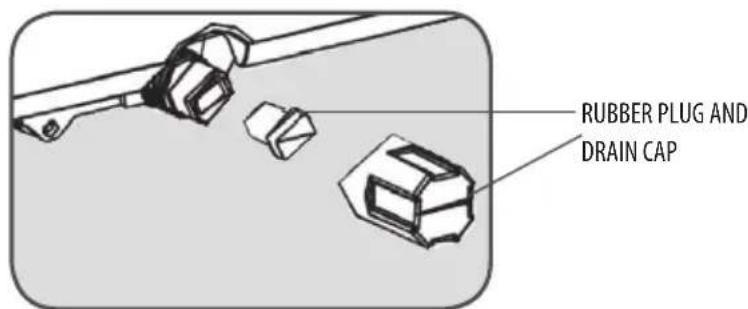
If you wish to operate the appliance with no need to empty the water tank, please:
- Remove the drain cap and rubber plug and retain for future use.
- Connect one end of the drain tube supplied to the bottom drainage point and locate the other end into a drain.
Continuous drainage
When you need operating this appliance in high humidity, during the dehumidification or cooling mode, connect the drain tube to this appliance.
- Remove the drain cap from the upper drainage point.
- Connect one end of the drain tube onto the drainage point and extend with extra water tube (not supplied) if needed.
- Place the other end of the drain tube in a normal drain. Make sure that the tube is free from twists and bends.
NOTE: The drain must be at or below the outlet level.
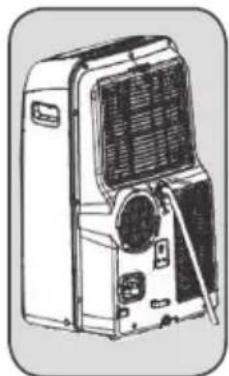
CLEANING AND MAINTENANCE
Switch off and unplug the appliance from the mains socket before cleaning. To maximise the efficiency of the appliance clean it regularly.
Cleaning the housing
Clean the housing with a slight damp cloth. Never use chemical or abrasive cleaning agents.
Cleaning the filters
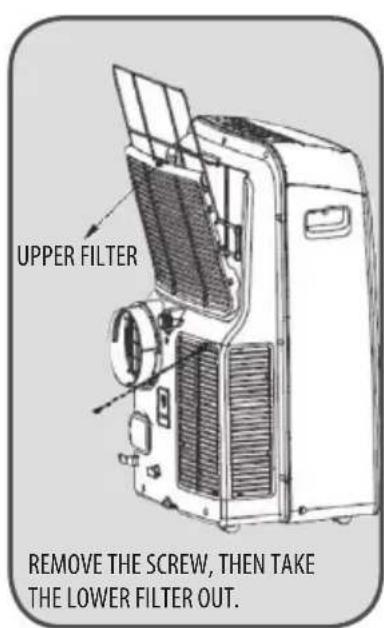
- The air conditioner is equipped with two filter to remove dust particles: A filter in the upper air inlet.
A filter in the lower air inlet.
- Remove the upper grille and then take out the upper filter which is behind the grille.
- Loosen a screw on the lower grille and then remove the lower filter.
- The filter should be cleaned regularly. Use a vacuum cleaner or tap the filter lightly to remove loose dust and dirt from the filter and then rinse thoroughly under running water. Dry thoroughly before replacing.
NOTE: Never use the air conditioner without the filter. Storage
- Drain all water in the appliance before completely operating the appliance on fan mode for a few hours, to thoroughly dry the inside of the appliance.
Clean the filter.
- Wrap the power cord and then insert the power plug into the power plug sockets at the rear of the appliance.
- Remove the batteries from the remote control.
- Place the appliance in a dry place.
The battery is to be disposed of safely.
Different types of batteries or new and used batteries are not to be mixed.
Batteries of the same or equivalent type as recommended are to be used.
Batteries are to be inserted with the correct polarity.
Exhausted batteries are to be removed from the product.
Attention should be drawn to the environmental aspects of battery disposal.
Don't throw used batteries in dustbin. Please contact your retailer in order to protect the environment.
The batteries (batteries installed) shall not be exposed to excessive heat such as sunshine, fire or the like.
TROUBLESHOOTING
Never try to repair or dismantle the air conditioner yourself.
| Problem Possible | Cause Possible Solution | |
| The air conditioner does not function. | No power supply. | Connect to a functioning outlet and switch on. |
| “P1” is shown on the display. | Empty the internal water tank. |
| The room temperature is lower than the selected temperature. | Change temperature selection. |
| The air conditioner seems to have little cooling effect. | In direct sunlight. | Close curtains. |
| Windows or doors open, many people or a heat source in the room. | Close doors and windows, remove the heat sources, and place an extra air conditioner. |
| Dirty filters. | Clean the filters. |
| Air inlet or air outlet blocked. | Remove the blockage. |
| The room temperature is lower than the selected temperature. | Change temperature selection. |
| The air conditioner is noisy. | The appliance stands uneven. | Place the appliance on an even, solid surface (less vibrations). |
| The remote control does not function. | Distance too great. | Make sure the remote control is correctly aimed at the control panel. |
| The remote control signal is not detected by the control panel. |
| The batteries are drained. | Replace the batteries. |
Error codes
| Display | Cause | Solution |
| E1 | The room temperature sensor has failed. | Unplug the appliance and plug it back in. If error repeats, call for service. |
| E2 | The evaporator temperature sensor has failed. |
| E3 | The condenser temperature sensor has failed. |
| E4 | The display panel communication has failed. |
TECHNICAL DATA
| Product fiche |
| Trade mark | ROWENTA |
| model | RWAC1900C |
| Energy efficiency class | A |
| Description | Symbol | Value | Unit |
| Rated capacity for cooling | Prated for cooling | 2.7 | KW |
| Rated power input for cooling | PEER | 0.97 | KW |
| Rated Energy efficiency ratio | EERd | 2.8 | - |
| Power consumption in thermostat-off mode | PTO | - | W |
| Power consumption in standby mode | PSB | 0.46 | W |
| Electricity consumption of single duct appliances | QSD | 1.0 | kWh/h |
| Energy consumption 1.0 kWh per 60 minutes, based on standard test results. Actual energy consumption will depend on how the appliance is used and where it is located. |
| Sound power level | LWA | 62 | dB(A) |
| Global warming potential | GWP | 3 | kgCO2eq. |
| Refrigerant leakage contributes to climate change. Refrigerant with lower global warming potential (GWP) would contribute less to global warming than a refrigerant with higher GWP, if leaked to the atmosphere. This appliance contains a refrigerant fluid with a GWP equal to 3. This means that if 1 kg of this refrigerant fluid would be leaked to the atmosphere, the impact on global warming would be 3 times higher than 1 kg of CO2, over a period of 100 years. Never try to interfere with the refrigerant circuit yourself or disassemble the product yourself and always ask a professional. (Refrigerant: R290) |
| Contact detail for obtaining more information | Establishments Darcy & fils © 129 Avenue Gallieni, 93140 Bondy, France Website: www.darty.com |
Fuse
Type: 4T, Voltage: 250V, Current:3.15A
Type: 334, Voltage: 250V, Current:3.15A
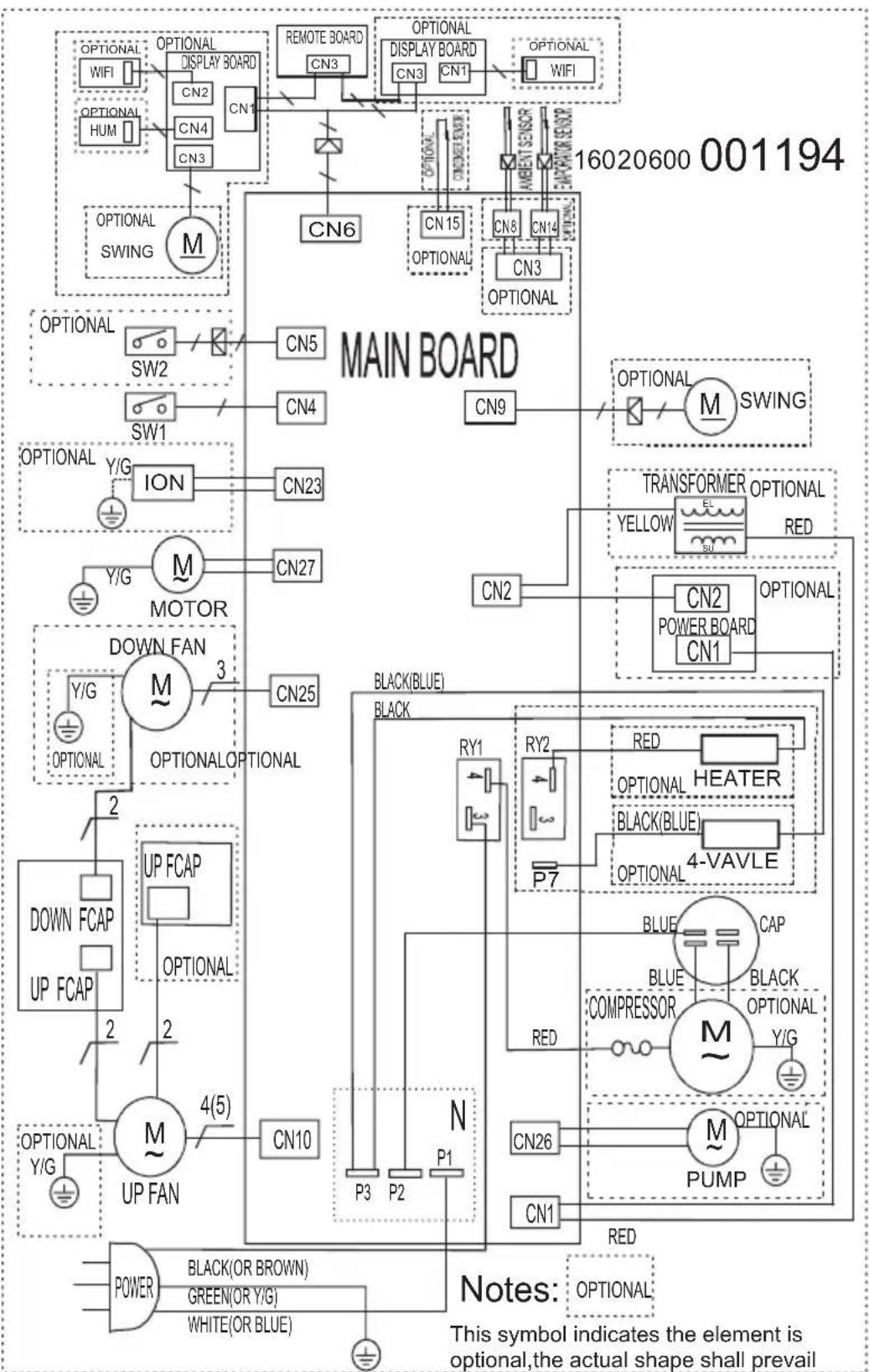
Circuit Diagram
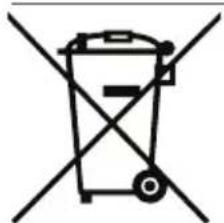
DISPOSAL
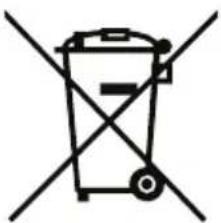
As a responsible retailer we care about the environment.
As such we urge you to follow the correct disposal procedure for the appliance, packaging materials and if applicable, batteries.
This will help conserve natural resources and ensure that it is recycled in a manner that protects health and the environment.
You must dispose of this appliance and its packaging according to local laws and regulations.
Because this appliance contains electronic components and may contain batteries, the appliance and its accessories must be disposed of separately from household waste when the appliance reaches its end of life.
Contact your local authority to learn about disposal and recycling.
The appliance and if applicable, batteries should be taken to your local collection point for recycling. Some collection points accept appliance free of charge.
We apologise for any inconvenience caused by minor inconsistencies in these instructions, which may occur as a result of product improvement and development.
Type:334, Tension: 250V, Courant: 3,15A
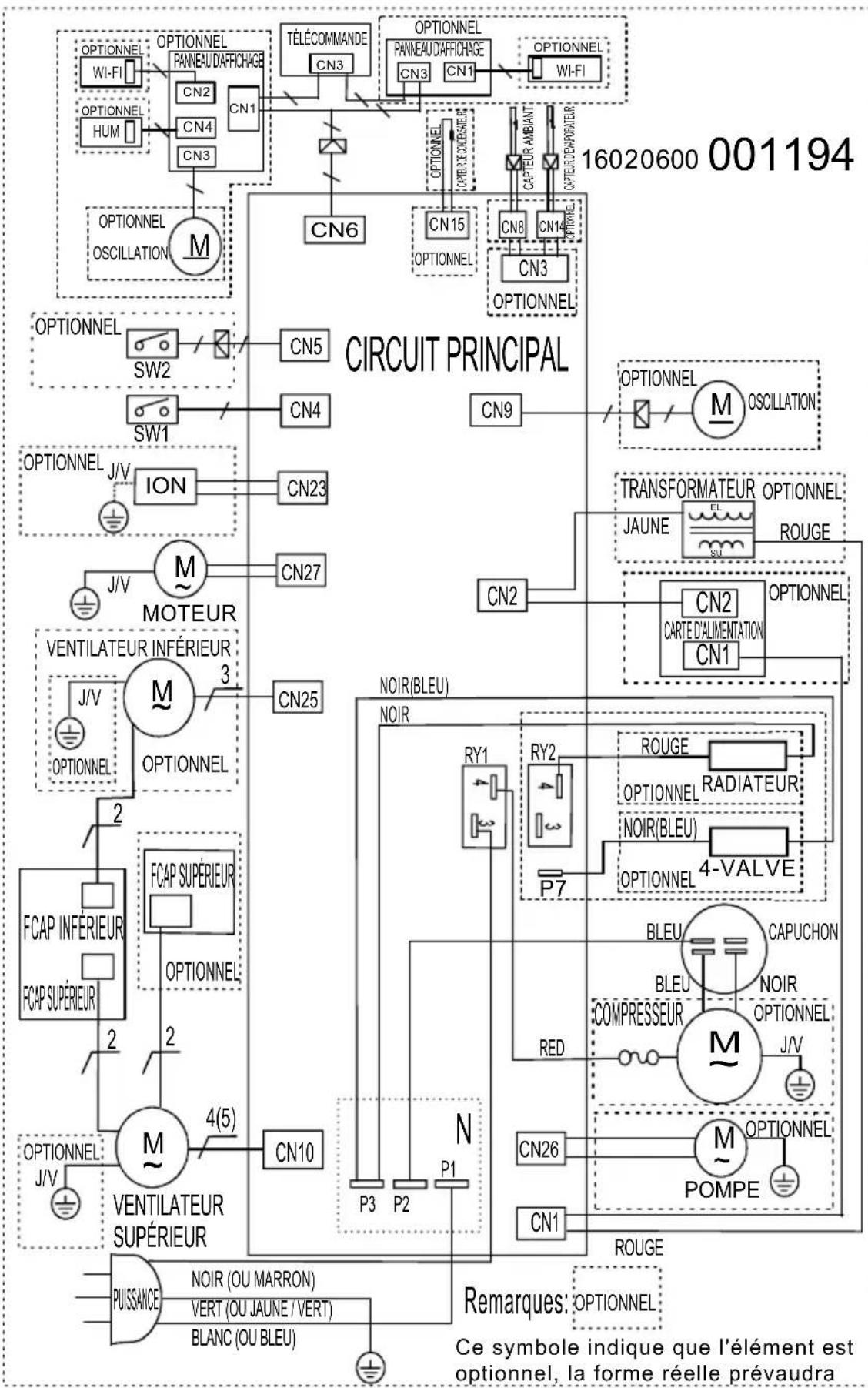
Scheme de Câblage
MISE AU REBUT
Hotline Darty France
Read the instructions.
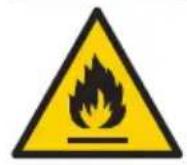
Warning: Risk of fire/Flammable materials!

Operator's manual; operating instructions

Service indicator; read technical manual
WARNING
Do not use means to accelerate the defrosting process or to clean, other than those recommended by the manufacturer. The appliance shall be stored in a room without continuously operating ignition sources (for example: open flames, an operating gas appliance or an operating electric heater. Do not pierce or burn. Be aware that refrigerants may not contain an odour. Appliance shall be installed, operated and stored in a room with a floor area larger than 10m^2 .
Installation (Space)
!that the installation of pipe-work shall be kept to a minimum;
-! that pipe-work shall be protected from physical damage and shall not be installed in an unventilated space;
that compliance with national gas regulations shall be observed;
-!that mechanical connections shall be accessible for maintenance purposes;
Maximum refrigerant charge amount (M):0.2kg
! Disposetof refrigerant based on local regulations,properly processed;
■!Minimum for area of the room: 10m 2
-!Keep ventilation openings clear of obstruction;
An unventilated area where the appliance using flammable refrigerants is installed shall be so constructed that should any refrigerant leak, it will not stagnate so as to create a fire or explosion hazard. This shall include:
!! the appliance shall be stored in a well-ventilated area where the room size corresponds to the room area as specified for operation;
!!the appliance shall be stored in a room without continuously operating open flames (for example an operating gas appliance) and ignition sources (for example an operating electric heater).
!! The appliance shall be stored so as to prevent mechanical damage from occurring.
- Any person who is involved with working on or breaking into a refrigerant circuit should hold a current valid certificate from an industry-accredited assessment authority, which authorises their competence to handle refrigerants safely in accordance with an industry recognised assessment specification.
Servicing shall only be performed as recommended by the equipment manufacturer. Maintenance and repair requiring the assistance of other skilled personnel shall be carried out under the supervision of the person competent in the use of flammable refrigerants.
Checks to the area
Prior to beginning work on systems containing flammable refrigerants, safety checks are necessary to ensure that the risk of ignition is minimised. For repair to the refrigerating system, the following precautions shall be complied with prior to conducting work on the system.
Work procedure
Work shall be undertaken under a controlled procedure so as to minimise the risk of a flammable gas or vapour being present while the work is being performed.
General work area
All maintenance staff and others working in the local area shall be instructed on the nature of work being carried out. Work in confined spaces shall be avoided. The area around the workspace shall be sectioned off. Ensure that the conditions within the area have been made safe by control of flammable material.
Checking for presence of refrigerant
The area shall be checked with an appropriate refrigerant detector prior to and during work, to ensure the technician is aware of potentially flammable atmospheres. Ensure that the leak detection equipment being used is suitable for use with flammable refrigerants, i.e. non-sparking, adequately sealed or intrinsically safe.
Presence of fire extinguisher
If any hot work is to be conducted on the refrigeration equipment or any associated parts, appropriate fire extinguishing equipment shall be available to hand. Have a dry powder or CO_2 fire extinguisher adjacent to the charging area.
No ignition sources
No person carrying out work in relation to a refrigeration system which involves exposing any pipe work that contains or has contained flammable refrigerant shall use any sources of ignition in such a manner that it may lead to the risk of fire or explosion.
All possible ignition sources, including cigarette smoking, should be kept sufficiently far away from the site of installation,
repairing, removing and disposal, during which flammable refrigerant can possibly be released to the surrounding space. Prior to work taking place, the area around the equipment is to be surveyed to make sure that there are no flammable hazards or ignition risks. "No Smoking" signs shall be displayed.
Ventilated area
Ensure that the area is in the open or that it is adequately ventilated before breaking into the system or conducting any hot work. A degree of ventilation shall continue during the period that the work is carried out. The ventilation should safely disperse any released refrigerant and preferably expel it externally into the atmosphere.
Checks to the refrigeration equipment
Where electrical components are being changed, they shall be fit for the purpose and to the correct specification. At all times the manufacturer's maintenance and service guidelines shall be followed. If in doubt consult the manufacturer's technical department
for assistance.
The following checks shall be applied to installations using flammable refrigerants:
the charge size is in accordance with the room size within which the refrigerant containing parts are installed;
the ventilation machinery and outlets are operating adequately and are not obstructed;
- if an indirect refrigerating circuit is being used, the secondary circuit shall be checked for the presence of refrigerant;
- marking to the equipment continues to be visible and legible. Markings and signs that are illegible shall be corrected;
- refrigeration pipe or components are installed in a position where they are unlikely to be exposed to any substance which may corrode refrigerant containing components, unless the components are constructed of materials which are inherently resistant to being corroded or are suitably protected against being so corroded.
Checks to electrical devices
Repair and maintenance to electrical components shall include initial safety checks and component inspection procedures. If a fault exists that could compromise safety, then no electrical supply shall be connected to the circuit until it is satisfactorily dealt with. If the fault cannot be corrected immediately but it is necessary to continue operation, an adequate temporary solution shall be used. This shall be reported to the owner of the equipment so all parties are advised.
Initial safety checks shall include:
- that capacitors are discharged: this shall be done in a safe manner to avoid possibility of sparking;
- that no live electrical components and wiring are exposed while charging, recovering or purging the system;
that there is continuity of earth bonding.
Repairs to sealed components
During repairs to sealed components, all electrical supplies shall be disconnected from the equipment being worked upon prior to any removal of sealed covers, etc. If it is absolutely necessary to have an electrical supply to equipment during servicing, then a permanently operating form of leak detection shall be located at the most critical point to warn of a potentially hazardous situation.
Particular attention shall be paid to the following to ensure that by working on electrical components, the casing is not altered in such a way that the level of protection is affected. This shall include damage to cables, excessive number of connections, terminals not made to original specification, damage to seals, incorrect fitting of glands, etc.
Ensure that apparatus is mounted securely.
Ensure that seals or sealing materials have not degraded such that they no longer serve the purpose of preventing the ingress of flammable atmospheres. Replacement parts shall be in accordance with the manufacturer's specifications.
NOTE The use of silicon sealant may inhibit the effectiveness of some types of leak detection equipment. Intrinsically safe components do not have to be isolated prior to working on them.
Repair to intrinsically safe components
Do not apply any permanent inductive or capacitance loads to the circuit without ensuring that this will not exceed the permissible voltage and current permitted for the equipment in use.
Intrinsically safe components are the only types that can be worked on while live in the presence of a flammable atmosphere. The test apparatus shall be at the correct rating.
Replace components only with parts specified by the manufacturer. Other parts may result in the ignition of refrigerant in the
atmosphere from a leak.
Cabling
Check that cabling will not be subject to wear, corrosion, excessive pressure, vibration, sharp edges or any other adverse environmental effects. The check shall also take into account the effects of ageing or continual vibration from sources such as compressors or fans.
Detection of flammable refrigerants
Under no circumstances shall potential sources of ignition be used in the searching for or detection of refrigerant leaks. A halide torch (or any other detector using a naked flame) shall not be used.
Leak detection methods
The following leak detection methods are deemed acceptable for systems containing flammable refrigerants.
Electronic leak detectors shall be used to detect flammable refrigerants, but the sensitivity may not be adequate, or may need recalibration. (Detection equipment shall be calibrated in a refrigerant-free area.) Ensure that the detector is not a potential source of ignition and is suitable for the refrigerant used. Leak detection equipment shall be set at a percentage of the lower flammability limit (LFL) of the refrigerant and shall be calibrated to the refrigerant employed and the appropriate percentage of gas (25% maximum) is confirmed.
Leak detection fluids are suitable for use with most refrigerants but the use of detergents containing chlorine shall be avoided as the chlorine may react with the refrigerant and corrode the copper pipe-work.
If a leak is suspected, all naked flames shall be removed/extinguished.
If a leakage of refrigerant is found which requires brazing, all of the refrigerant shall be recovered from the system, or isolated (by means of shut off valves) in a part of the system remote from the leak. Oxygen free nitrogen (OFN) shall then be purged through the system both before and during the brazing process.
Removal and evacuation
When breaking into the refrigerant circuit to make repairs - or for any other purpose - conventional procedures shall be used. However, it is important that best practice is followed since flammability is a consideration. The following procedure shall be adhered to:
remove refrigerant;
purge the circuit with inert gas;
evacuate
purge again with inert gas;
open the circuit by cutting or brazing.
The refrigerant charge shall be recovered into the correct recovery cylinders. The system shall be "flushed" with octafluoronaphthalene (OFN) to render the unit safe. This process may need to be repeated several times. Compressed air or oxygen shall not be used for this task.
Flushing shall be achieved by breaking the vacuum in the system with OFN and continuing to fill until the working pressure is achieved, then venting to atmosphere, and finally pulling down to a vacuum. This process shall be repeated until no refrigerant is within the system. When the final OFN charge is used, the system shall be vented down to atmospheric pressure to enable work to take place. This operation is absolutely vital if brazing operations on the pipe-work are to take place.
Ensure that the outlet for the vacuum pump is not close to any ignition sources and there is ventilation available.
Charging procedures
In addition to conventional charging procedures, the following requirements shall be followed.
- Ensure that contamination of different refrigerants does not occur when using charging equipment. Hoses or lines shall be as short as possible to minimise the amount of refrigerant contained in them.
Cylinders shall be kept upright.
- Ensure that the refrigeration system is earthed prior to charging the system with refrigerant.
- Label the system when charging is complete (if not already).
Extreme care shall be taken not to overfill the refrigeration system.
Prior to recharging the system, it shall be pressure tested with OFN. The system shall be leak tested on completion of charging but prior to commissioning. A follow up leak test shall be carried out prior to leaving the site.
Decommissioning
Before carrying out this procedure, it is essential that the technician is completely familiar with the equipment and all its detail. It is recommended good practice that all refrigerants are recovered safely. Prior to the task being carried out, an oil and refrigerant sample shall be taken in case analysis is required prior to re-use of reclaimed refrigerant. It is essential that electrical power is available before the task is commenced.
a) Become familiar with the equipment and its operation.
b) Isolate system electrically.
c) Before attempting the procedure ensure that:
mechanical handling equipment is available, if required, for handling refrigerant cylinders;
- all personal protective equipment is available and being used correctly;
the recovery process is supervised at all times by a competent person;
- recovery equipment and cylinders conform to the appropriate standards.
d) Pump down refrigerant system, if possible.
e) If a vacuum is not possible, make a manifold so that refrigerant can be removed from various parts of the system.
f) Make sure that cylinder is situated on the scales before recovery takes place.
g) Start the recovery machine and operate in accordance with manufacturer's instructions.
h) Do not overfill cylinders. (No more than 80% volume liquid charge).
i) Do not exceed the maximum working pressure of the cylinder, even temporarily.
j) When the cylinders have been filled correctly and the process completed, make sure that the cylinders and the equipment are removed from site promptly and all isolation valves on the equipment are closed off.
k) Recovered refrigerant shall not be charged into another refrigeration system unless it has been cleaned and checked.
Labelling
Equipment shall be labelled stating that it has been de-commissioned and emptied of refrigerant. The label shall be dated and signed. Ensure that there are labels on the equipment stating the equipment contains flammable refrigerant.
Recovery
When removing refrigerant from a system, either for servicing or decommissioning, it is recommended good practice that all refrigerants are removed safely.
the correct number of cylinders for holding the total system charge are available. All cylinders to be used are designated for the recovered refrigerant and labelled for that refrigerant (i.e. special cylinders for the recovery of refrigerant). Cylinders shall be complete with pressure relief valve and associated shut-off valves in good working order. Empty recovery cylinders are evacuated and, if possible, cooled before recovery occurs.
The recovery equipment shall be in good working order with a set of instructions concerning the equipment that is at hand and shall be suitable for the recovery of flammable refrigerants. In addition, a set of calibrated weighing scales shall be available and in good working order. Hoses shall be complete with leak-free disconnect couplings and in good condition. Before using the recovery machine, check that it is in satisfactory working order, has been properly maintained and that any associated electrical components are sealed to prevent ignition in the event of a refrigerant release. Consult manufacturer if in doubt.
The recovered refrigerant shall be returned to the refrigerant supplier in the correct recovery cylinder, and the relevant Waste Transfer Note arranged. Do not mix refrigerants in recovery units and especially not in cylinders.
If compressors or compressor oils are to be removed, ensure that they have been evacuated to an acceptable level to make certain that flammable refrigerant does not remain within the lubricant. The evacuation process shall be carried out prior to returning the compressor to the suppliers. Only electric heating to the compressor body shall be employed to accelerate this process. When oil is drained from a system, it shall be carried out safely.
Symboles
Brand - Marque/Merk/Marca: Rowenta
Model number - Référence commerciale: RWAC1900C
/Modelnummer /Numero de modelos /
Numero do modelos :
We declare that the above product has been evaluated and deemed to comply with the requirements of the listed European Directives and standards: