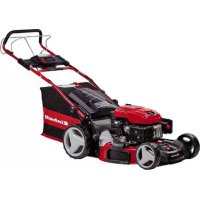
GEPM 48 SHW E Li - Electric mower EINHELL - Free user manual and instructions
Find the device manual for free GEPM 48 SHW E Li EINHELL in PDF.



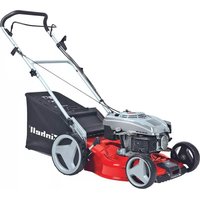
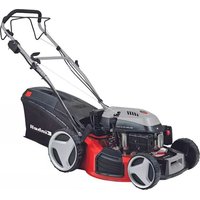
| Product type | Gasoline-powered lawn mower (petrol) with electric start and lithium battery |
| Brand | Einhell |
| Model | GEPM 48 SHW E Li |
| Cutting width | 480 mm |
| Cutting height | 25-70 mm (central adjustment) |
| Engine type | Four-stroke engine, 1 cylinder, 139 cm³ |
| Power consumption | 1.8 kW |
| Working speed | 2850 ± 100 rpm |
| Fuel | Unleaded petrol |
| Fuel tank capacity | Approx. 1.2 L |
| Engine oil | Approx. 0.5 L, grade 10W30 |
| Spark plug | F6RTC (gap 0.7 ± 0.1 mm) |
| Weight | 41.3 kg |
| Guaranteed sound power level | 96 dB(A) |
| Start power supply | 18V lithium battery (Power-X-Change) + reversible starter |
| Cutting modes | Bagging (grass collection bag), mulching, side discharge, front discharge |
| Grass collection bag capacity | Fill level indicator |
| Drive | Wheel drive (coupling lever) |
| Safety | Engine brake (stop lever), blade protection, engine stop in seconds |
| Maintenance and cleaning | Vertical cleaning with scraper, automatic water cleaning (hose connection), oil change, air filter, spark plug |
| Wear parts | Blade, V-belt, spark plug, air filter, battery |
| Warranty | 24 months (conditions according to manual) |
Frequently Asked Questions - GEPM 48 SHW E Li EINHELL
Caution: Only adjust when the engine is off.
User questions about GEPM 48 SHW E Li EINHELL
0 question about this device. Answer the ones you know or ask your own.
Ask a new question about this device
Download the instructions for your Electric mower in PDF format for free! Find your manual GEPM 48 SHW E Li - EINHELL and take your electronic device back in hand. On this page are published all the documents necessary for the use of your device. GEPM 48 SHW E Li by EINHELL.
USER MANUAL GEPM 48 SHW E Li EINHELL
GB Original operating instructions Petrol Lawn Mower
- Safety regulations
- Layout and items supplied
- Proper use
- Technical data
- Before starting the equipment
- Operation
- Cleaning, maintenance, storage, transport and ordering of spare parts
- Disposal and recycling
- Troubleshooting guide
- Charger indicator
GB
Danger!
When using the equipment, a few safety precautions must be observed to avoid injuries and damage. Please read the complete operating instructions and safety regulations with due care. Keep this manual in a safe place, so that the information is available at all times. If you give the equipment to any other person, hand over these operating instructions and safety regulations as well. We cannot accept any liability for damage or accidents which arise due to a failure to follow these instructions and the safety instructions.
1. Safety regulations
The corresponding safety information can be found in the enclosed booklet.
Danger!
Read all safety regulations and instructions. Any errors made in following the safety regulations and instructions may result in an electric shock, fire and/or serious injury.
Keep all safety regulations and instructions in a safe place for future use.
Explanation of the warning signs on the equipment (see Fig. 18)
1) Read the operating instructions.
2) Take care of the danger from catapulted parts. Keep a safe distance.
3) Danger! Sharp blades - Switch off the engine and pull the spark plug boot before doing any maintenance, repair, cleaning or adjustment work.
4) Fill with oil and fuel before starting the mower.
5) Caution: Wear ear protection and safety goggles.
6) Guaranteed sound power level.
7) Caution! Hot parts. Keep your distance.
8) Fill in fuel only when the engine is switched off.
9) Risk of cut injuries. Caution: rotating cutters.
10) Starting procedure
11) Engine start/stop lever (I=Engine on; 0=Engine off)
12) Drive lever (clutch lever)
13) Empty the tank before you move the mower into cleaning position.
14) Do not expose the device to rain.
2. Layout and items supplied
2.1 Layout (Fig. 1-17)
1a. Engine start/stop lever (engine brake)
1b. Drive lever (clutch lever)
2. Fuel pump (primer)
3a. Push bar, bottom
3b. Push bar, top
3c. Hole for cord bracket
3d. Cord bracket
4a. Catch bag
4b. Mulching adapter
4c. Level indicator
4d. Side ejector fl ap
4e. Side ejector adapter
5a. Ejector fl ap
5b. V-belt cover
6. Tank fller cap
7. Oil filler screw
8. Cutting height adjustment
9. Starter cable
10.Start button
10a. Cable clip (2x)
10b. Cable clip (1x)
11. Charger
12a. Screw (2x)
12b. Washer, large (2x)
12c. Star nut (2x)
13. Spark plug wrench
13a.Screw (2x)
13b. Washer, small (2x)
13c. Nut (2x)
14. Cleaning scraper
15. Power-X combi-panel
16. Safety plug
17. Battery pack
18. Pushlock button
19. Hose connection
2.2 Items supplied
Please check that the article is complete as specified in the scope of delivery. If parts are missing, please contact our service center or the sales outlet where you made your purchase at the latest within 5 working days after purchasing the product and upon presentation of a valid bill of purchase. Also, refer to the warranty table in the service information at the end of the operating instructions.
- Open the packaging and take out the equipment with care.
- Remove the packaging material and any packaging and/or transportation braces (if available).
GB
Check to see if all items are supplied.
- Inspect the equipment and accessories for transport damage.
If possible, please keep the packaging until the end of the guarantee period.
Danger!
The equipment and packaging material are not toys. Do not let children play with plastic bags, foils or small parts. There is a danger of swallowing or suffocating!
Petrol lawn mower
- Mulching adapter
Catch bag
Side ejector adapter
- Cleaning scraper
Cable clip (3x)
Star nut (2x)
Screw (2x)
- Washer, large (2x)
Spark plug wrench
Push bar, bottom
Push bar, top
Screw (2x)
- Washer, small (2x)
- Nut (2x)
Power-X combi-panel
Safety plug
Battery pack
- Charger
Petrol service manual
Original operating instructions
Safety information
3. Proper use
The equipment may only be used for the tasks it is designed to handle. Any other use is deemed to be a case of misuse. The user/operator and not the manufacturer will be liable for any damage or injuries of any kind caused as a result of this.
The petrol lawn mower is intended for private use i.e. for use in home and gardening environments.
Private use of the lawn mower refers an annual operating time generally not exceeding that of 50 hours, during which time the machine is primarily used to maintain small-scale, residential lawns and home/hobby gardens. Public facilities, sporting halls, and agricultural/forestry applications are excluded.
Please note that our equipment has not been designed for use in commercial, trade or industrial applications. Our warranty will be voided if the equipment is used in commercial, trade or industrial businesses or for equivalent purposes.
The operating instructions as supplied by the manufacturer must be kept and referred to in order to ensure that the lawn mower is properly used and maintained. The instructions contain valuable information on operating, maintenance and servicing conditions.
Warning! Due to the high risk of bodily injury to the user, the petrol lawn mower must not be used to carry out the following work: Trim bushes, hedges or shrubs, to cut scaling vegetation, planted roofs, or balcony-grown grass, to clean (suck up) dirt and debris off walkways, or to chop up tree or hedge clippings. Moreover, the lawn mower may not be used as a power cultivator to level out high areas such as molehills.
For safety reasons, the lawn mower may not be used as a drive unit for other work tools or toolkits of any kind.
4. Technical data
GE-PM 48 S HW-E Li
Engine type ....... One-cylinder four-stroke engine,
Power input: 1.8 kw
Working speed n_0 ..2850 ± 100 min
Fuel: . Petrol
Tank capacity: approx. 1,2 I
Engine oil: approx. 0.5 l / 10W30
Spark plug: F6RTC
Electrode gap (spark plug): 0.7 ± 0,1 mm
Cutting height adjustment: ... Central, (25-70 mm)
Cutting width: 480 mm
Weight: 41,3kg
Danger!
Sound and vibration
L_PA sound pressure level 81.2 dB(A)
Engine type .......One-cylinder four-stroke engine, 173 cc
Power input: 2.8 kw
Working speed n_0 .. 2850 ± 100 min
Fuel: . Petrol
Tank capacity: approx. 1.6 l
Engine oil: approx. 0.6 l / 10W30
Spark plug: F7RTC
Electrode gap (spark plug): 0.7 ± 0,1 mm
Cutting height adjustment: ... Central, (25-70 mm)
Cutting width: 530 mm
Weight: 44,1kg
Danger!
Sound and vibration
L_pA sound pressure level 83.8 dB(A)
K_eq uncertainty 3 dB
Lsound power level 96.5 dB(A)
K_w uncertainty 1.93 dB
Guaranteed sound power level 98 dB(A)
Vibration emission value a_b = 7.12 m/s^2
K uncertainty = 1.5m / s^2
Wear ear-muff s.
The impact of noise can cause damage to hearing.
Long work periods should be avoided due to the development of high noise and vibration levels.
Keep the noise emissions and vibrations to a minimum.
Only use appliances which are in perfect working order.
Service and clean the appliance regularly.
Adapt your working style to suit the appliance.
Do not overload the appliance.
- Have the appliance serviced whenever necessary.
- Switch the appliance off when it is not in use.
Caution!
Residual risks
Even if you use this electric power tool in accordance with instructions, certain residual risks cannot be rules out. The following hazards may arise in connection with the equipment's construction and layout:
- Damage to hearing if no suitable ear protection is used.
- Health damage caused by hand-arm vibrations if the equipment is used over a prolonged period or is not properly guided and maintained.
5. Before starting the equipment
5.1 Assembling the components
Some parts of the equipment come disassembled. For quick and easy assembly, read and follow the instructions below.
Note! You will need the following additional tools (not supplied) for assembly, and also for maintenance work:
One flat oil drip tray (for changing the oil)
One 1 liter measuring jug (oil/petrol resistant)
One petrol can
One funnel (suitable for the tank's petrol filler neck)
Household wipes (to wipe up oil/petrol residue; dispose of these at a filling station)
One petrol suction pump (plastic, available from DIY stores)
One oil can with hand pump (available from DIY stores)
Engine oil
Assembly
- Fit the push bar (Item 3) as shown in Fig. 3a-3b. For fastening choose one of the holes (Fig. 3a/Item A) to suit the required height of the handle.
Important! The identical height must be set on both sides. - Fit the Power-X combi-panel (Item 15) with the supplied screws as shown in Fig. (3c and 3d).
- Insert the grip of the starter cable (Item 9) into the hook provided for that purpose as shown in Fig.1.
- Fasten the actuator cables to the push bar with the supplied cable clips (Items 10a and 10b) as shown in Fig. 3e.
- Lift the ejector flap (Item 5a) with one hand
GB
and hook in the grass bag (Item 4a) as shown in Fig. 4a.
5.2 Adjusting the cutting height
Warning! Adjust the cutting height only when the engine has been switched off.
The cutting height is centrally adjusted with the cutting height adjustor lever (Fig. 7/Item 8). Different cutting heights can be selected.
- Actuate the adjustor lever and pull it to the required position. Let the lever click into position.
Fit the battery pack (Item 17) and safety plug (Item 16) as shown in Fig. 3f.
5.3 Charging the Li battery pack (Fig. 3f-16) Important!
The charger is allowed to be used only for the lithium-ion batteries of the Power-X-Change series!
Power-X-Change
18 V, 1.5 Ah, 5 lithium-ion cells
18 V, 2.0 Ah, 5 lithium-ion cells
18 V, 3.0 Ah, 10 lithium-ion cells
18 V, 4.0 Ah, 10 lithium-ion cells
18 V, 5.2 Ah, 10 lithium-ion cells
The battery is protected from exhaustive discharge. An integrated protective circuit automatically switches off the equipment when the battery is fl at.
Warning! Do not actuate the On/Off switch any more if the protective circuit has tripped. This may damage the battery.
- Remove the battery pack from the handle, pressing the pushlock button (18) downwards to do so.
- Check that your mains voltage is the same as that marked on the rating plate of the battery charger. Insert the power plug of the charger (11) into the socket outlet. The green LED will then begin to flash.
- Push the battery pack onto the battery charger.
In section 10 (Charger indicator) you will find a table with an explanation of the LED indicator on the charger.
If the battery pack fails to charge, check for the following:
- voltage at the power socket
whether there is good contact at the charging contacts of the charging unit
If the battery pack still fails to charge, send
the charger and charging adapter
and the battery pack
to our customer service center.
To ensure that the Li battery pack provides long service you should take care to recharge it promptly. You must recharge the battery pack when you notice that the performance of the equipment drops.
Battery capacity indicator (Fig. 3f)
Press the switch for the battery capacity indicator (Fig. 3f/Item A). The battery capacity indicator
(Fig. 3f/Item B) shows the charge status of the battery using 3 LEDs.
All 3 LEDs are lit:
The battery is fully charged.
2 or 1 LED(s) are lit:
The battery has an adequate remaining charge.
1 LED fl ashes:
The battery is empty, recharge the battery.
All LEDs fl ash:
The battery pack has undergone exhaustive discharge and is defective. Do not use or charge a defective battery pack.
6. Operation
Note!
The engine comes without oil and petrol. Therefore, be sure to add oil and petrol before starting the engine.
- Check the oil level (see 7.2.1).
- Use a funnel and measuring jug to fill the tank with petrol. Make sure that the petrol is clean.
Warning: Never use more than one safety petrol can. Do not smoke when refueling. Switch off the engine before refueling and allow the engine to cool down for a few minutes.
GB
- Ensure that the ignition cable is connected to the spark plug.
Carrying out a safety test on the engine start/stop lever
The lawn mower comes equipped with an engine start/stop lever (Fig. 5a/Item 1a) in order to prevent it from starting up unintentionally and to ensure that the engine and blade stop quickly in case of danger. The lever must be actuated (Fig. 5b) before the lawn mower is started. When the engine start/stop lever is released, it must return to its initial position (Fig. 5a).
Before you start mowing, you should run through this process several times in order to ensure that the lever and actuator cables are working properly.
Repeat the test several times after the engine has started up. When the engine starts/stop lever is released, the engine must stop within a few seconds. If not, contact Customer Service.
Danger: The blade begins to rotate as soon as the engine is started.
6.1 Starting the engine
6.1.1 Starting up with the electric starter
-
Ensure that the ignition cable is connected to the spark plug. Make sure that the safety plug (Fig. 3f/Item 16) is fitted in the Power-X combi-panel.
-
Press the fuel pump (primer) (Fig. 6/Item 2) three times. You can skip this point if the engine has already warmed up.
- Stand behind the lawn mower. Actuate the engine start/stop lever (Fig. 5b) with one hand. The other hand is on the Start button (Fig. 1/Item 10).
- Start the engine by pressing the Start button. Release the Start button immediately once the engine has started. Pressing the Start button again while the engine is running will damage the starting system. Important! In cold weather, it may be necessary to repeat the starting process several times.
6.1.2 Starting up with the reversing starter
- Ensure that the ignition cable is connected to the spark plug.
-
Press the fuel pump (primer) (Fig. 6/Item 2) three times. You can skip this point if the engine has already warmed up.
-
Stand behind the lawn mower. Actuate the engine start/stop lever (Fig. 5b) with one hand. The other hand must be on the starter handle.
- Start the engine using the reversing starter (Fig. 1/Item 9). To do this pull out the handle approx. 10 - 15cm until you feel a resistance and then start the engine with a sharp tug. If the engine does not start, tug the handle again.
Note! Never allow the actuator cable to snap back.
Note! In cold weather, it may be necessary to repeat the starting process several times.
Drive unit
Drive lever/clutch lever (Fig. 5a/Item 1b): If you press this (Fig. 5c) the clutch for the drive will be closed and the lawnmower will start to move with the engine running. Release the drive lever in good time to stop the moving lawnmower. Practice starting and stopping before you use the mower for the first time until you are familiar with controlling the mower.
6.2 Tips on mowing properly
Danger!
Never open the chute fl ap when the grass bag has been detached (to be emptied) and the engine is still running. The rotating blade can cause serious injuries!
Always carefully fasten the chute fl ap and debris bag. Switch off the engine before you remove them.
Whenever you need to perform any kind of adjustment, maintenance or repair work, switch off the engine and wait until the blade no longer rotates. Pull off the spark plug connector.
Mowing
The engine is confi gured for an optimal grass cutting speed, for ejecting grass into the debris bag, and for many years of use.
Only use a sharp blade that is in good condition. This will prevent the grass blades from fraying and the lawn from turning yellow.
Try to mow in straight lines for a nice, clean look. The swaths should overlap each other by a few centimeters in order to avoid stripes.
GB
Keep the underside of the mower housing clean and remove grass build-up. Deposits not only make it more difficult to start the mower; they decrease the quality of the cut and make it harder for the equipment to bag the grass.
Always mow along inclines (not up and down). You can prevent the lawn mower from slipping down by holding a position at an angle upwards. Select the cutting height according to the length of the grass. If necessary, mow a number of times so that you never cut more than 4cm of grass in one go.
Switch off the engine before doing any checks on the blade. Keep in mind that the blade continues to rotate for a few seconds after the engine has been switched off. Never attempt to manually stop the blade. Regularly check to see if the blade is securely attached, is in good condition and is sharp. If the contrary is the case, sharpen the blade or replace it. In the event that the blade strikes an object, immediately switch off the lawn mower and wait for the blade to come to a complete stop. Then inspect the condition of the blade and the blade mount. Replace any parts that are damaged.
Mulching (Fig. 4b)
In mulching mode the cuttings are shredded in the enclosed mower housing and then spread back onto the lawn. It is not necessary to gather and dispose of the grass.
Mulching is only possible if the lawn is relatively short..
To use the mulching function, disconnect the debris bag, slide the mulching adaptor into the ejector opening (Item 4b) and close the ejector opening.
Side ejector (Fig. 4b/4c)
You must fit the mulching adapter (Item 4b) in order to use the side ejector. Hook in the side ejector adapter (Fig. 4c/Item 4e) as shown in Fig. 4c.
Rear ejector (Fig. 4d)
To use the rear ejector function you must open the ejector flap (Fig. 4d/Item 5a) slightly. Lock it in place with the locking lever (Fig. 4d/Item A). Swing up the locking lever and insert its foot into the recess provided (Fig. 4d/Item B). The mulching adapter (Item 4b) is not allowed to be fitted when the rear ejector is used.
6.3 Switching off the engine
All you have to do to switch off the engine is release the engine start/stop lever (Fig. 5a/ Item 1a). Pull off the spark plug connector from the spark plug in order to prevent the engine from starting. Before you start the engine again, check the cable of the engine brake. Check that the actuator cable is correctly fitted. If the switch-off cable is kinked or damaged, it must be replaced.
6.4 Emptying the debris bag
When the debris bag is full, the air throughput will be low and the level indicator (4c) will be up close against the debris bag (Fig. 15). Empty the debris bag and clear out the ejector chute. Danger! Before taking off the debris bag, switch off the engine and wait until the blade has come to a stop.
To take off the grass basket, use one hand to lift up the chute fl ap and the other to grab onto the basket carry-handle. Remove the basket (Fig. 4a). For safety reasons, the chute fl ap automatically falls down after removing the grass basket and closes off the rear chute opening. If any grass remains in the opening, it will be easier to restart the engine if you pull the mower back approximately 1m
Do not use your hands or feet to remove clippings in or on the mower housing, but instead use suitable tools such as a brush or a hand broom.
In order to ensure that the majority of grass clippings are picked up, the inside of both the grass bag and especially the air grill must be cleaned after each use.
Reattach the grass bag only when the engine is switched off and the blade is stopped.
Using one hand, lift up the chute flap, while grabbing onto the basket handle with the other. Hang in the basket from the top.
GB
7. Cleaning, maintenance, storage, transport and ordering of spare parts
Danger!
Never work on or touch any current-conducting parts of the ignition system while the engine is running. Pull the spark plug boot from the spark boot before doing any maintenance or assembly work. Never carry out any work on the equipment while the engine is running. Work that is not described in these operating instructions, should only be carried out by authorized workshops.
7.1.1 Cleaning in the vertical cleaning position
The lawn mower should be cleaned thoroughly every time after it has been used. This applies in particular to its underside and the blade mount. Note: Before tilting the lawn mower into the vertical cleaning position, use a petrol extraction pump to drain all the fuel out of the fuel tank. Do not tilt the lawn mower by more than 90 degrees.
Vertical cleaning position (Fig. 13a/13b)
Important! Before moving the mower into the vertical cleaning position, switch off the engine and pull out the spark plug connector. Caution! Place the mower only on a firm, level surface.
- Open the star nuts (Item 12c).
- Press the lower push bar apart and swing it open (Fig.13a).
- Move the mower into the vertical cleaning position (Fig.13b).
- Clean the bottom side of the mower with the cleaning scraper (Fig.2/Item 14).
Warning!
Sharp blades! Wear gloves during the cleaning work.
It is easiest to remove dirt and grass immediately after mowing. Dried grass remnants and dirt may impair the mowing operation. Check if the grass ejector chute is free of grass remnants and remove any if necessary. Never clean the mower using a high-pressure cleaner. The engine must remain dry. Do not use aggressive cleaning agents such as cold cleaners or petroleum ether.
Warning!
- Leave the mower in the vertical cleaning position only for as long as necessary because
in this position there is a considerable risk of injury.
- Never leave the mower unsupervised.
- Keep children away.
7.1.2 Automatic cleaning of the mowing deck by means of the hos connection (Fig. 17/ Item 19)
The mowing deck is fitted with a hose connection (Item 19) (suitable for conventional garden hose couplings). The lawn mower should be cleaned thoroughly every time after it has been used.
Warning!
Switch off the engine before you do any work on the mower. Risk of injury from rotating blades. Keep the ejector fl ap (Item 5a) closed when you carry out the cleaning. Risk of injury from catapulted parts.
- Place the mower on a fi rm, level surface. The mower must stand on 4 wheels as in mowing mode. Take off the catch basket (ltem 4a) and make sure that the mulching adapter (ltem 4b) has been removed.
- Connect the water hose to the hose connection (19).
- Turn on the tap. Water will flow into the inside of the mowing deck.
- Start the engine. See section 6.1.
- Automatic cleaning will begin. The rotating blades will cast the water against the mowing deck and therefore clean it from the inside. A cleaning period of 1-2 minutes is enough when carried out regularly.
To remove dried grass residues we recommend carrying out several cleaning cycles. Wait a few minutes between the cleaning cycles so that the dried grass can soak and soften up.
Important!
Never clean the mower using a high-pressure cleaner. The engine must remain dry. Do not use aggressive cleaning agents such as cold cleaners or petroleum ether.
7.2 Maintenance
Please refer to the supplied petrol service manual for information on the maintenance intervals.
Note: Disposethe soiled maintenance material and operating materials at the appropriate collection point.
GB
7.2.1 Petrol engine
Note! Never run the engine with no or too little oil.
This can cause serious damage to the engine.
Checking the oil level
Place the lawn mower so that it stands level. Un-screw the oil dipstick (Fig. 9a/Item 7a) by turning it counter-clockwise and wipe the dipstick. Re-insert the dipstick into the filler opening as far as it will go but do not screw it in. Pull out the dipstick, hold it horizontally and read off the oil level. The oil level must be between the two marks min. and max. on the oil dipstick (Fig. 9b).
Changing the oil
The engine oil is best changed when the engine has been switched off but is still warm.
- Make sure that the debris bag has been removed.
- Empty the petrol tank with a petrol suction pump and run the engine until the remaining fuel is fully consumed.
- Place an oil drip tray alongside the mower.
- Open the oil filler plug (Item 7) and tilt the mo- wer 90^ sideways.
- The hot oil will flow through the open oil filler opening into the oil drip tray.
- After the old oil has drained out, set the mower upright again.
- Fill in engine oil up to the top mark on the oil dip stick.
- Important! Do not screw in the oil dipstick to check the oil level - only insert it as far as the thread.
- Dispose of the used oil in accordance with applicable regulations.
7.2.2 Blades
For safety reasons, have all blade sharpening, balancing and mounting work carried out by an authorized service center. To achieve optimal results, we recommend having the blades checked once a year.
Changing the blades (Fig. 8/pos. A)
When changing the cutting unit, be sure to use only genuine replacement parts. The identificaitc mark on the blade must correspond with the number specifi ed in the spare parts list.
Never install a blade from a different manufacturer.
Damaged blades
If, in spite of all caution, the blade comes into contact with an obstacle, switch off the engine imme
diately and pull off the spark plug connector. Tilt the lawn mower to the rear and check the blade for damage. Damaged or bent blades must be replaced. Never straighten a bent blade. Never work with bent or heavily worn blades as this will result in vibrations, causing further damage to the mower.
Warning! Risk of injury when working with a damaged blade.
7.2.3 Axles and wheel hubs
Grease should be applied to the axles and wheel hubs once per season.
To do so, remove the wheel caps with a screwdriver and loosen the fastening screws on the wheels.
7.2.4 Care and adjustment of the actuator cables
Oil the actuator cables at regular intervals and check that they move easily.
7.2.5 Maintenance of the air fi Iter (Fig. 10a/10b)
Soiled air fi liters reduce the engine output by supplying too little air to the carburetor. If the air contains a lot of dust, the air fi liter must be checked more frequently.
Never clean the air filter with petrol or inflammable solvents. Clean the air fiiter only with compressed air or by tapping it.
7.2.6 Maintenance of the spark plug
Clean the spark plug with a copper wire brush.
- Pull off the spark plug connector (Fig. 11/Item A).
- Remove the spark plug using a spark plug wrench.
- Assemble in reverse order.
7.2.7 Inspecting the V-belt
To inspect the V-belt you must remove the V-belt cover (Fig. 12/Item 5b).
7.2.8 Repairs
After carrying out any repair or maintenance work, ensure that all safety parts are installed and in perfect condition.
Keep potentially hazardous parts out of reach of other persons and children.
Note! In accordance with the German Product Liability Act, we are not liable for any damages if they result from improper repairs to the product or if parts are replaced by items other than genuine parts or parts approved by us. Furthermore, we
GB
are not liable for any damages if they result from improper repairs to the product. Arrange for your customer service or an authorized workshop to do the work. The same applies to accessory parts.
7.2.9 Operating times
Please observe the regulations concerning lawn mower operating times, which may differ from town to town.
7.3 Preparing the mower for long-term storage
Warning! Do not empty the petrol tank in enclosed areas, near fire or when smoking. Petrol fumes can cause explosions and fire.
- Drain the petrol tank using a petrol extraction pump.
- Start the engine and run it until the tank and fuel line are completely empty and the engine stalls.
- Change the oil after each season.
- Remove the spark plug. Use an oil-can to fi ll the cylinder with approx. 20ml of oil. Slowly pull back the starter handle, which will bathe the cylinder wall with oil. Screw the spark plug back in.
- Clean the cooling fins of the cylinder and the housing.
- Be sure to clean the entire equipment to protect the paint.
- Store the equipment in a well-ventilated place.
7.4 Preparing the mower for transport
Warning! Do not empty the petrol tank in enclosed areas, near fire or when smoking. Petrol fumes can cause explosions and fire.
- Drain the petrol tank using a petrol extraction pump.
- Always let the engine run until it has used up the remainder of petrol in the tank.
- Empty the engine oil from the warm engine.
- Remove the spark plug connector from the spark plug.
- Clean the cooling fins of the cylinder and the housing.
- Unhook the starter cable from the hook (Fig. 3b). Slacken the connection shown in Fig. 3a on the left and right of the push bar and swing
down the push bar (Fig. 14). Make sure that the actuator cables do not get kinked when the bar is pulled up.
- Wedge a few layers of corrugated cardboard between the upper and lower push bars and the engine in order to prevent any chafing.
- Secure the load sufficiently so that it cannot slip and cause damage or injuries during transportation.
7.5 Consumables, wear materials and spare parts
Spare parts, consumables and wear materials such as engine oil, V-belts, spark plugs, air filter inserts, petrol filters, batteries and blades are not covered by the warranty.
7.6 Ordering replacement parts:
Please quote the following data when ordering replacement parts:
Type of machine
Article number of the machine
Identification number of the machine
- Replacement part number of the part required
For our latest prices and information please go to www.isc-gmbh.info
8. Disposal and recycling
The equipment is supplied in packaging to prevent it from being damaged in transit. The raw materials in this packaging can be reused or recycled. The equipment and its accessories are made of various types of material, such as metal and plastic. Never place defective equipment in your household refuse. The equipment should be taken to a suitable collection center for proper disposal. If you do not know the whereabouts of such a collection point, you should ask in your local council offices.
GB
9. Troubleshooting guide
Warning: Switch off the engine and pull out the spark plug boot before making any checks or adjustments.
Warning: If, after making an adjustment or repair to the engine, you let it run for a few minutes, remember that the exhaust and other parts will get hot. Do not touch these parts as they may burn you.
| Fault Possible cause Remedy | ||
| The equipment does not operate smoothly and vibrationally | - Bolts loose - Blade attachment is loose - Blade imbalanced | - Check bolts - Check blade attachment - Replace blade |
| The engine does not start | - Engine start/stop lever is not pressed - Throttle lever in wrong position (if provided) - Spark plug defective - Fuel tank empty - Fuel pump (primer) not actuated (if provided) | - Press the engine start/stop lever - Check setting (if provided) - Replace spark plug - Top up fuel - Actuate the fuel pump (primer) (if provided) |
| Engine does not run smoothly | - Air filiter dirty - Spark plug dirty | - Clean the air filiter - Clean the spark plug |
| Lawn turns yellow, uneven cut | - Blade is not sharp - Cutting height too small - Engine speed too low | - Sharpen blade - Adjust to the proper height - Set the throttle lever to max. (if provided) |
| Grass chute is not clean | - Engine speed too low - Cutting height too small - Blade is worn - Grass bag is clogged | - Set the throttle lever to max. - Set properly - Replace the blade - Empty the grass bag |
| Starter does not turn | - Battery empty - Battery not connected - Safety plug not fi tted | - Charge battery - Connect battery - Fit safety plug |
The reprinting or reproduction by any other means, in whole or in part, of documentation and papers accompanying products is permitted only with the express consent of the iSC GmbH.
Subject to technical changes
10. Charger indicator
| Indicator status Explanations and actions | |
| Green is flashing | Ready for useThe charger is connected to the mains and is ready for use; there is no battery pack in the charger |
| Red in on Charging | The charger is charging the battery pack. |
| Green is on The battery is charged and ready for use.(Charging time for 1.5 Ah battery: approx. 2 hours)(Charging time for 2.0 Ah battery: approx. 2½ hours)(Charging time for 3.0 Ah battery: approx. 4 hours)(Charging time for 4.0 Ah battery: approx. 5 hours)(Charging time for 5.2 Ah battery: approx. 6½ hours)Action:Take the battery pack out of the charger. Disconnect the charger from the mains supply. | |
| Red is fl ashing Fault | Charging is no longer possible. The battery pack or charger is defective.Action:Never charge a defective battery pack.Take the battery pack out of the charger. |
| Red and green are fl ashing alternately | Temperature faultThe battery pack is too hot (e.g. due to direct sunshine) or too cold (below 0°C).Action:Remove the battery pack and keep it at room temperature (approx. 20°C) for one day.Should this fault still occur afterwards, the battery has undergone ex-haustive discharge and must never be charged or used again. Take the battery pack out of the charger. |
- For our latest prices and information please go to www.isc-gmbh.info
GB

For EU countries only
Never place any electric power tools in your household refuse.
To comply with European Directive 2012/19/EC concerning old electric and electronic equipment and its implementation in national laws, old electric power tools have to be separated from other waste and disposed of in an environment-friendly fashion, e.g. by taking to a recycling depot.
Recycling alternative to the return request:
As an alternative to returning the equipment to the manufacturer, the owner of the electrical equipment must make sure that the equipment is properly disposed of if he no longer wants to keep the equipment. The old equipment can be returned to a suitable collection point that will dispose of the equipment in accordance with the national recycling and waste disposal regulations. This does not apply to any accessories or aids without electrical components supplied with the old equipment.
The reprinting or reproduction by any other means, in whole or in part, of documentation and papers accompanying products is permitted only with the express consent of the iSC GmbH.
Subject to technical changes
GB
Service information
We have competent service partners in all countries named on the guarantee certificate whose contact details can also be found on the guarantee certificate. These partners will help you with all service requests such as repairs, spare and wearing part orders or the purchase of consumables.
Please note that the following parts of this product are subject to normal or natural wear and that the following parts are therefore also required for use as consumables.
| Category Example | |
| Wear parts* | Air filter, Bowden cables, grass basket, tires, drive clutch, Battery |
| Consumables* Blades | |
| Missing parts |
- Not necessarily included in the scope of delivery!
In the effect of defects or faults, please register the problem on the internet at www.isc-gmbh.info. Please ensure that you provide a precise description of the problem and answer the following questions in all cases:
- Did the equipment work at all or was it defective from the beginning?
Did you notice anything (symptom or defect) prior to the failure? - What malfunction does the equipment have in your opinion (main symptom)? Describe this malfunction.
GB
Warranty certificate
Dear Customer,
All of our products undergo strict quality checks to ensure that they reach you in perfect condition. In the unlikely event that your device develops a fault, please contact our service department at the address shown on this guarantee card. You can also contact us by telephone using the service number shown. Please note the following terms under which guarantee claims can be made:
- These guarantee terms apply to consumers only, i.e. natural persons intending to use this product neither for their commercial activities nor for any other self-employed activities. These warranty terms regulate additional warranty services, which the manufacturer mentioned below promises to buyers of its new products in addition to their statutory rights of guarantee. Your statutory guarantee claims are not affected by this guarantee. Our guarantee is free of charge to you.
- The warranty services cover only defects due to material or manufacturing faults on a product which you have bought from the manufacturer mentioned below and are limited to either the rectification of said defects on the product or the replacement of the product, whichever we prefer. Please note that our devices are not designed for use in commercial, trade or professional applications. A guarantee contract will not be created if the device has been used by commercial, trade or industrial business or has been exposed to similar stresses during the guarantee period.
-
The following are not covered by our guarantee:
-
Damage to the device caused by a failure to follow the assembly instructions or due to incorrect installation, a failure to follow the operating instructions (for example connecting it to an incorrect mains voltage or current type) or a failure to follow the maintenance and safety instructions or by exposing the device to abnormal environmental conditions or by lack of care and maintenance.
- Damage to the device caused by abuse or incorrect use (for example overloading the device or the use or unapproved tools or accessories), ingress of foreign bodies into the device (such as sand, stones or dust, transport damage), the use of force or damage caused by external forces (for example by dropping it).
-
Damage to the device or parts of the device caused by normal or natural wear or tear or by normal use of the device.
-
The guarantee is valid for a period of 24 months starting from the purchase date of the device. Guarantee claims should be submitted before the end of the guarantee period within two weeks of the defect being noticed. No guarantee claims will be accepted after the end of the guarantee period. The original guarantee period remains applicable to the device even if repairs are carried out or parts are replaced. In such cases, the work performed or parts fitted will not result in an extension of the guarantee period, and no new guarantee will become active for the work performed or parts fitted. This also applies if an on-site service is used.
-
To make a claim under the guarantee, please register the defective device at: www.isc-gmbh.info. Please keep your bill of purchase or other proof of purchase for the new device. Devices that are returned without proof of purchase or without a rating plate shall not be covered by the guarantee, because appropriate identification will not be possible. If the defect is covered by our guarantee, then the item in question will either be repaired immediately and returned to you or we will send you a new replacement.
Of course, we are also happy offer a chargeable repair service for any defects which are not covered by the scope of this guarantee or for units which are no longer covered. To take advantage of this service, please send the device to our service address.
Also refer to the restrictions of this warranty concerning wear parts, consumables and missing parts as set out in the service information in these operating instructions.
F
Sommaire
Chere cliente, cher client,
Svingningsemissionstal ah = 7,12 m/s²
Usikkerhed K = 1,5m / s^2
Brug horevaern.
CMOHHTPOBaTb akHymyIaTOp (no3.17) n 6e3oNaChHyIO wTeNceBHyIO BnIKy (no3.16), KaK nokaHaHO Ha pnc.3f.
5.2 PerynpoBb BbICToBcpe3a
PpeynpeHdHne! PeryInpoBHy BbICotbI cpe3a pa3pewaetc npOn3BODHTb ToIbHO npN BbIKIOUeHHOM DBrHateNe.
PerynipOBKa BbICOt bcpes3a OcyueCTBJIeTcR CEHTpaIN3OBAHHo pIn NmOoun pbHara perynipOBKn BbICOt bcpes3a (pnc.7,po3.8).MoJHo hactponb pa3Hy0 Bblcoty cpe3a.
HaKMMte Ha pbyar perynipOBKn BbICOTb cpe3a n nepeBedeTe ero B HyyHoe noLoKeHHe. Pbyar doJIneH 3aΦHKcnpoBaTbca.
5.3 3apnHa 6noHa IInTheBbix aHHymyIHTopoB (pnc. 3f / 16)
BHHMaHHe!
3apnHoe yctpoCTBO MOxHO NcNoIb3ObaTb TIObKO dIa 3apdN IITNI-OOHbIX aKHyMnyTopoB cepHn Power-X-Change!
Power-X-Change
18B,1,5A4,5NHTH-NHOHHbIX3JIeMeHTOB
18B,2,OA4,5NHTH-NHOHHbIX 3JIeMeHToB
18B.3.0A.Y.10JITNU-HOHbIX3JIeMeHToB
18B,4.0A.Y,10JNTN-HOHbIX3JIeMeHToB
18B,5,2Aq,10NITIN-HOHHBIXJEMEHTOB
AkhymyIaTOp 3aunuHcN OT rny60KoR opa3raJa. BcTpoEHnOe yCTPOJcTBo 3auNTbI OTHIOUaET yCTPOJcTBo ABtOMaTHueckn npn pa3raJe aHHyMlyrTopa.
IpeynpeKdHne! He BkIOuayTe 60JIbe
RUS
peekuataeBkUeyHo-BbIKUoyHo,ecnnpaobtalo 3aunTHoe yctpoCTBO.30 MoHET npBeCTN K NOBpeJdeHIO aKHyMylTota.
- N3BJIeHnTe aKHyMnyTOpHbI 6NoH n3 pyKoTn, pN 3Tom HaHmMaTe fHKcHpyUOyU KlaBnUy (18).
- Y6eHNTecb TOM, YTO yka3aHHoe Ha HnprMeHHo TaBnHKe 3HaueHHe HAnpJxHeHH CTeN COOTBeTCTByET NMeIOUeMYC 3HaueHHo HAnpJxHeHH CTeN BCTabIe WtEKe3apAHorO yCTpoiCTBa (11) BHTeNCeBHyIO po3EtHy. 3JeHbI CBETOINOD HAHTET MfRaTb.
- Bctabte aKhymyIaTOpB 3apAHOe yCTpoCTBO.
Bpa3dene 10(«HnndkaTOpbI 3apAnHoro yctpoCTBa) npBeHeHa Ta6InuCa C yHa3aHneM 3NaueHn CBeTOINOHOH INDnKaun Ha 3apAHOM yCTpoCTbe.
Ecnn AHHyMylTOpHbI 6IOK He 3apJHaeTcA, HEOxOIMO nPoBepntb CLeJeUoee:
HaJIyHe HaIpyKeHnCeTHB WTeNceHbHOI pO3ETke;
HaJIINHHeIIOTHORO CoEINHEnHa KOHTaKTax 3apdHOrO yCTpoiCTBa.
Ecnn ankymyntopn6k0BCEe He 3apKaetcnpoc6baOTnpaBtB
3apAHOe yCTpoCtBOI 3apAHybI aadTep
n aKKMyIaTOpHbI 6IOK B Haw OTdeI OcbLyKbBaHna.
ДяТOrO,YTObI obecneuHt bIITeHbHbI cpoK clyKbI aKKyMnTOrpHoro naKetA obecneHbTe CBOEBPemEHNo 3apJky IINTeBFO BO aKKyMnTOrpHoro naKetA.3To HeOBxOJIMO OcyUcEeTBJIbTb Oco6eHb BTex cUYaJX, KORJa OTMeueaTc CHINKeHHe MOUHocIn yCTPOiCTBa.
HnHaun3apda aHHymyTopa (pnc.11)
HaHMMte Ha KONky INDINKaUN 3apJa aKHYMJIYTOPa (Pnc.11/ no3.A). INDINKaTOp 3apJa aKHYMJIYTopa (Pnc.11/ no3.B) nOKa3bAeT yPOBeHb 3apJa aKHYMJIYTopa npn NOMOu 3CBETNOIOOB.
ToprBce 3 CBeToAnoHa:
AkkymyIaTOp nIoHocTbIO 3apRKeH.
Topr2nH1CBetOndo
OctatoHbI 3aPd aKHyMylAToPA doCTaTOeH.
Muraet 1 cBeToaOa:
AHHyMnTOp pa3paJKeH, Heo6xOaIMo 3apAnTb ero.
MhraT BCE CBetOAnoDbI:
AkkymyIaTOp nIoHocTbIO pa3pRKeH IOBpeJxHe. 3aPpeSeHo npOdoJIKaTb IcNoIb3OBAHnE i3apJaKaTb HeNCnPpaBHyI aKKymyIaTOp!
6. 06paueHne c yctpoiCTBOM
Yka3aHne!
BnurateIb noctabnaTc6e3 3HcnpnyataaunHOHBIX MATEpnaIOB
TOMypeepBBOOMB3KcNpyatauHO 08aTeIbHo 3aIITb MaCNO H6eH3nH.
- PpOBePnTb yPoBeHb Macla (CM.7.2.1).
2.ПиЗАЛВИЕбБИИнAИСЮЛБУМТЕВОПОНNYИМЕРHYIO EMKOCb.Y6eДNTcB.CYTOбБИИNЯJBILETCЯHCTBIM.
PpeynpeKeHHeH: Bcerda nCnoIb3yIte ToIbKO 6e3oNaChyIO KaHnCTpy IaIe 6eH3nHa. He Kypnte npn 3anpaBke 6eH3nHa.Ipeed 3anpaBkoI 6eH3nHa OTKJIQUHTe DBIrAteIbN daTe DBrAteTIO OCTbITb HEcKOBKO MNHT.
3.Y6eHTeCb,TOI npoBOD 3aJnHaHnIPOKJIIOUeH K CBEYe 3aJINFaHnI.
IpoBepKa 6e3oNaChOCTn pbUra Tycha/ octaHOBKn DBrTaTeJIa
ДлпnpdynpeHdHnClyaHoro nycha ra3oHOHOcNJIKN, a taHKe IJb6bIcTporO octahOBa DBInrataJI N HOJa B CJyae onaCHOCTn Ra3oHOKOCNJIKA OCHaJIeHa pbUarom nycka/OctaHOBKn DBInrataJI (pnc.5a, no3.1a). Ha Hero Heo6xOdIMO HauKaTb (pnc.5b) nepeD nyCKOM Ra3oHOHOCNJIKN.Прг OTnyckAHn pbYuara Nycka/OctaHOBKn DBInrataJIH OH DOJIHeBepHyTBcBn B INCXODHoe pIoJOHeHne (pnc.5a).
Ipeed 3aynckom Dniratela Heo6xodmo BbINOHNHT bTOT npocecc HecKoJIbKO pa3, YTO6bl y6eINbC8B TOM, yTO pbUar n TpOcOBle TARH FyHKIOHNPuykOT HaJeKaUmm Opa3OM.
Nobtopnte 30T Tect eue pa3 npn 3anyuenHOM Dbratene. Nocne OTnyckanra pbyara nyca/ octahOBKn DBrrateldoJKeH OCTaHOBNTbC B TeeyHe HeCKoJIbKnx CeyHd. Ecln
RUS
3TOrO He npOn3oJTeT, o6paTnTeCb B OTeI 06cnyKuBaHn KJIneHTOB.
Onachoctb!Pn nyche Dniratela BpaaetcpekyuHn HK.
6.1IyckdbnraTeTna
6.1.1 Pny npn nmoos 3neKtpocTaprepa
- Y6eINTecb, YTO npoBOD 3aKnHraHnnaDIOHIOUOEN K CBEHe 3aHNrAHH. Y6eINTecb, YTO 6eONacHaa TtceNcJIbHa BnIka (pnc. 3f, no3. 16) BCTaBHeHa B yHInBepCaJIbHyIO naHeB Power-X.
- HAnMnte Ha 6eH3nHObBn Hacoc (Primer) (pnc.6, no3.2) 3 pa3a. Ecn n DnBaIraTeIb nporpeT, 3OT nyHKT MoHxO onyCTnTb.
- CToIe 3a raoHokocnKoHaHmTe pbHar nycka/ocTaHOBKn DBrarTeJIra (pnc.5b) OJHo pyKo. Dpyryu pyky depHnTe Ha KhoNKe nycka (pnc.1, no3.10).
- 3aynctte Dbratelnytem HaKaTn HONKn NcKa.NocIe 3aynca Dbratelna HeMeJeHNO OTNcyTne KONKy NcKa. NOBTOHoe HkaTHe KHONK NcKa BO Bpemra p60bI Dbratela npBODNT K NOBpeKeHDoH NoCTeMbl NcKa.Yka3AnHe! PnnpoxlaHoi NorOde MoKet NOTpe6oBaTbcra NobTopntb npocecc NcKa HeChOJIbKO pa3.
6.1.2 Pyn npn nmoos peBepcnBHO cTapTepa
- Y6eHITecb, YTO npoBOD 3aKnIraHIN NOKJIIOHc K CBEYe 3aKnIRAHN.
- HAnMMte Ha 6eH3nHObbl Hacoc (Primer) (pnc.6, no3.2) 3 pa3a.Ecn dBnIgatelnb nporpeT, 3OT nyHKT MOXHO ONyCTNb.
- CToIe 3a rasoHokocnKoH. HAnMnte pbHar nycKa/OctaHOBn DBrIraTeJI (pnc.5b) OJHOI pyKoI. Dpyra pyKa DOJIKHHa HxOOnTbcrHa npyKoTke CTapTepa.
- 3anyctHTe DBHrataIb npn nOmoU npeBepcNBHO CTapTepa (pnc.1, no3.9). IaTTO BbITryb pyKoRTy npnmePHO Ha 10-15 cm (noKa He NohyCTByETc conpoTnBHe), 3aTeM CnIbHO DePHyTb OHmN pbIKOM. Ecln DBHrataIb He 3anyCTTcT, To HxHIO DePHyTb 3a pyKoRTy eue pa3.
YhaaHHe He OTnycKaTe TpocOByIO Tary 6paTHo C cnio.
Yka3aHHe!PnpnoxpaHNOIporoMe moKeT noTpe6oBaTbCnOBTopuTb npOeCC nycha HeckOJIbKO pa3.
PpBbDnKHeHn
IyckOBoB pbyar (pbHar cUeJIeHnA) (pnc.5a, no3.1b):
Pn npBBeHn B DeIcTBne 3TOr pbyara (pnc.5c) 3ambkaetc cseIJIeHHe nla npBbOa DBHXEHn, nra3OHOKoNkHaHnHaET DBHXEHn npn pa6oTaOeM DnIgATEJe.
CBoEBpeMeHHO OTNcyTHe NycBOB pbHar dIg octaHOBKn DBHXyuec Ra3OHOHcHKn.IpePe nepBoKoc6bOn NotpeHnpYTeCb B 3aNyCe H octaHOBKe, NOHa BHe OcBOHTcB C XoOobIMn KaueCTBaMn.
6.2 Yka3aHnno npabHbHn Koc6e
Onachoctb!
HnKOrda He OTHpbIbAaTe HpbluKy BbIbOpa npn OnopOnHeHHn PnCnOcOBeHHn DnA c6opa TpaBbI bce eue pa6oTaIOeM dBntrapeJe. Bpaauounca HOH MoKeT haHeCTN Bam TpaMbI.
Bcerda aKHypaTHO 3aKpenJIaTe KpbIshny BbIbPOca N TpaBOc6OpHbM MeWOK. PnC CHrTm NpeDbapHTeNbHO BbIKIOuHTb DBurateIb.
Ipeed hauaIom IIO6bIX pa60r No hactpoHne, Texo6cLyHHBAHnIO n peMOHTy BbIKIOHTe DBnIateJIb N DOHdNTecb NOHORO OCTaHOba HOHa. BbInbTe WTEKeP CBeu 3aHHraHnN 3 rHe3da.
Houen
BniratelpaacHTaHaCKOpocTbIpype3aHnTPaBbI N BbIbOcA TpaBbIBc6OpHbIMeWOKNHaDNTeBhlCpOK CnyKobI.
IcnoIb3OBAbT ToIbKO OCTpbIE, IcnpaBHbIe HOxN, TTO6bl CTe6bn TpaBbI He pAcTppeaHnCb, H ra3OH He NoKeIteJI.
YTo6bI Do6HtbcA kKhpaTHoI CTPNHH, Heo6xOJIMo BECTn Ra3OHOKOCNHy KaH MOHKO 60JIe IprMbIMn DOpOKKaAM. PnI 3OTM dopOKHBCerda DoJIKNbI NepeKpbIBaTbc4 Ha HECKOBHc CAHTmEtPOB, YTo6bI He OCTaBAJINCb nONOCbl.
Heo6xOdHMO COepeKbT B YNCTOTE HINHHIO CTOpOHy KOpNYCA KOCHNI N O63aTeBHO ydaIbT b OTIOHEHNr TpaBbl.OTIOHEHNr 3aTpYdHOT IPOeCC 3aNyCa, CnHKeAOT KaueCTBO Cpe3a N HApUwAOT BbIbPc TpaBbl.
RUS
Ha cKIOHax cIeMyET npOKlaBbA Tb CkauBaemyIO DOpOKNy NonepeK cKIOHa. CockaJIb3bIBaHINra3OHOKcNIKM OMOHO 136EJaTb, yCTAHOBIN ee NOJyTNOM BBepX. Bbl6epNTe BlicOTy cpe3a B 3abCNMOCTN OT PaKTNUeCCHOI dInHb TpaBnHO nOKpOBA. B IIOTHNO BlicOKO TpaBE HAcTPOte MaHCmAlNbHbYypOBeH b Cpe3a N KOCHTe MeDJIeHNHe. BblONHtne HeCKoJIbKO pioxoOBo, TAK YTO6bI CHIMAtb HE 60nee 4 cm TpaBnHO nOKpOBA 3a Odn pa3.
Ipepe IIO6bIMnpOBepkAMNHOKa BbIKIOUHTe DBIrataJIb.He 3a6yIbTe,HTO nocLe BbIKIOUChENH bINrAteJIb HOK npoOJIkaETBpaauTbcEue HeCKoJIbKOceHyd.HNKOrdaHe nbTaITcEc bOctAHOBNTb HOK.PeyIpyHO npOBepRJe,HTo6bl HOK 6bl HndJekaummOBpa3OM 3aKpEnJIeH, HaxODINCR HnCPaBHom COCTOHNu 6bl JxopoIo 3aTOUeH.Ecn 3To He TaK, 3aTOUHe Nn 3aMeHIne Ero. Ecn HaxODaunH B DnKHeHN HOH yDapReTcO KaKoi-Ni6o PpeDMET, OCTAHOBtEra3OHOKOCNIkyNdoXDNTECB NOHOn OCTAHOBIN HOKa.3aTEM npOBepBe cCtOTHne HOKa IN depKaTeJIH OHOc HcN HOK IOBpeJDeH,ero Heo6XDoHMo 3aMeHInb.
MylbHropobAHne (pnc. 4b)
Ipn MybHpOBaHHn Cpe3aHHa TpaBa
ImeJIbHaTeCn B 3aKpbTOM KOpNcE KocNIHN CHOba pacPpeJelAeTc Hra3oHe. Het
HeoXOIMOCTN B c6ope TpaBb N yTuIN3aUN.
MylbHpOBaHHe BO3MOKHO TOLbKO npn OTHOCHTeBHO KOPOTKOM Ra3OHe.
YTO6bI NCNOB3OBA Tb FHNKUH MUYBnUPOBAHN CHIMNTe C6OpHBMyMeWOK, BCTaBBTe BOTBepCTNE BB6Poca MylbnypuuJn aanTep (no3.4b) n 3aKpOte KpbIkuy Bb6Poca.
BoHOBOB BbIb6poc (pnc.4b-4c)
Tc06bI HcNOb3oBaTb 60KOB Bbl6poc,doJIKeH 6bITb CMOTnPOBAN MUYbHpyUoiu aAnTep (no3.4b). HabecBe T aAnTeP dIg 60KOBOro 6bIbPoCa (pnc.4c, no3.4e), KaK nokaHaHO Ha pncyHke 4c.
HHHm BbIbpc (pnc. 4d)
TObI BOCNoB3OBAtBCfYHKUeH HNKHeRo
BbIbPoCA, HeoBXoHMo pNIOKpBtKpBluKY
BbIbPoCA (pnc.4d, no3.5a). 3aΦnKcpyTe
ee c NOMoBbIO pbHara ΦHKCaTopa (pnc.
4d, no3.A). OTKnHbTe PbMAr ΦHKCaTopa nOMecTHe erO onopy BrpeHa3HaueHHoe
ДлгэТOrOуглбелене(pnc.4d,nos.B).ДлгИСПОЛБЗOBAHЯннКHERо Вьбрoca HeьзяуctанавиBaTbМУьчИPyUOuNi aanTeP(no3.4b).
6.3 OTHIOUeHHe DBnraTeJIa
TTO6bBbHIOUHTb DBHRateIb,OTNCTe bIur nycha/OctahOBn DBIRateJIa (pnc. 5a, no3.a).CHIMITE CBEUYOH HAKOHEHNK CO CBEUY 3AHHARHAIN, TTO6bI ppeoDBpaTHb NCK DBIRATEJI. Pepe NOBTOPBbIM NCHOM IPOBepbTe TPOCOBYIO TAY MOTOPHO TOPM OPOBepbTe, TTO6bI TPOCOBAI TRA 6bIHa npABINbHO CMOHTPOBaHa. HadlONMeHHbI NOBpeKeJDeHHbI TPOC BkIKIOUeHHeo6XOp 3AMEHITb.
6.4 OnopokHeHne TpaOBC6pHOro MeHa
Korda TpaOBC6pHbI MeoK HanoJIHe,
KoJIYeCTBO npOnyckaemoro Bo3duXa
ymHeBaTeCn, n Yka3aTeJb 3aNoJIHeHn
(4c) nIoTHo npIneRaET K MeuHy (pnc.15).
OnopokHnte MeoK n OChTte KaHaJI
BbIbPoCa.
Onachoctb!Ipeed Chrtnem c6pHoro MeuHa BbIKIOHTb DBrIaTeJIb N NOOxKaTaB octaHOBN peKyUero HnCTpyMeHTa.
Дя сггггсбогу мeшka odно руко npinnoHrtb KpbIshKByBbIbOpa, apyroу pyHoИЗВLEчьсбогиMeWOK3aPyKHyДЯ nepeHocn (pnc.4a). B coOTBETCTBnC npeDnHcAHmE NO TExNHKe 6e3oNaCHOCTN npri ChTn CsbogHO MeShka KpbIshKa BblbOca 3axlonbBaetcN 3aKpbIBaET 3aHHee OTBepCTne BblbOpa.EcIn npri ATOM B OTBepCTn 3aCtpeBAIoT OCTaTH TpaBbI, ToДЯ 06JIeTuHn NyCKa DBHrTaTeJy ueLcoObpa3No OTTHryTb Ra3OHOKOsHny pImePho Ha1M Ha3a.
OcTaTHN cpe3aHHoN TpaBbI B KOpnyce HocuHKn Hn paBOoYem INCTpyMeHTe CneDyET YdaJIaTb He pyKoN IIN HOrAMn, a NOxHOJaUIMn BCNOmORAteNbHbIMn CpeDCTBaMn, HApNpMep, UTeTKoN IIN BEHkOM.
HnB KOem Cnyae He yCTaHaBnBaTb npyroHOK.
NoBpeKdEHHbHe HOXH
EcIn, HecmOpra Ha BCE MepbI npedocToPOXHOCTH, HOx COnpIKoCHyJcR CnpnTCTBnEM, HEmeJeHNO BbIKIOUHTb DBratetJIb N ChrTb CBeuHOHaKoHeuHKn. HaIOHOHTb raoHOKOCNHy HA3aN I npOBepHTb HOK Ha NaHnne NOpeKeHN. IOpeKeHNbIe HIN NCKPnBLeHNbIe HOHN He No6bOxOIMO 3aMeHNTb.HNKOrda He BbInpaBnTe NCKPnBLeHNbI HoK. HNKOrda He pa6oTaIte C NCKPnBLeHNbIM NIM CNbHo N3HOWeHNbIM HOXOM, 3TO Bbl3bIbaeT BV6paunN MMOKeT npINBeCTN K DaJIbNeHIM NOpeKeHNJAM
RUS
KOCNIK.
IpeynpeKdHne!Pnpa6oTe c NOBpeKdHbIM HOXOM CyueCTByET ONaCHOCTb TpaBMnPOBaHn.
7.2.3 Konechbte OCH n CTynu
KoilechbIe OcH n CTynuCbI Heo6xOyIMCm3bIBaTb OINH pa3 B Ce3OH.ⅡIa 3TOrO CHMnTE KOJIaHn KOleC pNnOMOuOTBepTKn OTBnHTnte KpeJeXhBe BNHTbl KOLeC.
7.2.4 PerynipobKa n yxOd 3a TpocOBbIMN Taramn
PeyrnpHO cma3bIaBte TpOcOBIE TARn MacIOM nPiOBepeTNe IeKoCTb INX XOA.
7.2.5 TexHHueckoe 06cJyHbAHne BO3dyuHoro fHbtpa (pnc.10a/10b)
3aqrpaHHeBIO3dyuHbIe FnIbTpblCHNkaOT MOUHOCb DBHratae H3-3a yMeHbSeHHaNOdaHbO3dyxaB KAp6kpatOp.PnB BbICOKo KOHcHTpaun NblN B03dyxHEo6xOdmo 4aue npOBepaTb O3dyuHbIyFnbTp.
3aPpeHcOOnuHcTaB O3dyuHbIyFnbTp
6BeHNiHMn HnnpOuHMn pactBOPnTeJAMn.
1nCTnTB O3dyuHbIy FnIbTp TOIbHO CkAteBIM BO3dyXOM nIN PyTEM BblBaHHa.
7.2.6 Texnuechoe 06cnyHbAHne cBeu3aHrAHH
OuHCTHTe CBeUy 3aXnHaHnI uTeHoN H3 MeDHO npBOJOLOKN.
- BbHbTe CbeHNo HAKOHeHHK (pnc. 11, no3. A).
- CHINMITE CBEUY 3aHnraHnC NOMOIO CBeyHORO KIOUOa.
- C6opka ocyuaceTBJAreTcB ObpaTHoN nocJeDoBaTeJIbHOCTn.
CoxpaHaeTc npaBO Ha TEXHHueckHe N3MeHHeHn.
RUS
10. INHINHaTOPbI 3apArdHO yCTpoiCTBa
- He obraataIbHO BxOaT B o6bem NoCTaBKn!
Ipn O6hApuyHenHn DepeKToB Hn HncnPabHocTe Mbl Ipocm Bac 3aRbTb o TAKOM Cnyae B cETN INHTepHcHa caTe www.isc-gmbh.info. Obpatnte BnHMaHHe Ha ToHoe ONCaHHe HncPabHOCTn B IIO6om CNYae OTBeTbe Ha cnedyuune BONPOcbI:
- UcpoiCTBO yIke pa6oTaIO nIIN OHO 6bIIO HeNCnPpABHbIM C cAmO rHaJa?
Bam 6pocnIOcB yTo-1n60 B rIa3a nepeD BO3HKnHOBeHneM HeNCnpaBHOCTN (npu3HaK nepeD HncnpaBHOCTbO)?
KaHyIO HeCNpABHOCb HMeET ycTPOiCtBO, NO BaSeMy MHeHIO (OCHOBHO npn3HaK)? OnuHTe 3Tu HeCNpABHOCtB.
RUS
TapaHTnHoe CBnTeJIbCTBO
YbHaemnoknyntelbHua, YBaHaemnoknyntelb,
HnnpdykTb npoxoTt uatelhneu KOnhtpoJI kaueCTBa.EcIn 3To yctpoIcBO BCE He 6ydet
fynKmIOHPOBaT b6zypHe, Mbl npocim Bac opaHTbcB Hnaw cepBncbHn OTdJe no adepcy,
yka3aHHOMy B 3OTom rapaHTnHOM TaIOHe. Mbl TaKHe oxOTHo OTBeTM Ha Baun BonpOcBi nTelefoHy,
HomeR KOtporo npnbEeh HnKe. Pn npdeBraHnriHn rapaHTnHbIX Tpe6oBaHn deCTbyOT cIeDyoUne
ycNoBNa.
- HactoIuHne npaBnla rapaHTn DeiCtByOT NCHIOUHTeB OTOHOENN NOJb3ObaTeJe, T.e. fHnuecknx Iu, KOTOpBie He HamepeBaIOCTc HcNOJIb3OBAbT b HactoIuee N3dJIeN B pAmKx CBOe npocecMOHaBnOH INpyrO CamOToTERTbHO JDeTERTbHOCTn. HactoIue npaBnla rapaHTm peryIpyOT DONoJIbHTBHe yCIOBnA OKa3AHnRA rapaHTnHBx YCNYT, KOtOpBie HINKeYOMaHTbI npOn3BOIDNTeB o6ceNuBaET NOKyNaTEJAM CBOX HOBbY cTPOJCTB D BOLOHE N C YCOBnAR m rapaHTn B COOTBeTCTBN C 3aHOHOM. 3Tu rapaHTnHbE o63aTeNbCTBa He 3aParNABoT BaHn 3aKOHNbE rapaHTnHbIE tpe6OBaHH. HaanrpaHTnHbIE ycynI dIg Bac 6ecnIaTHbl.
- RapaHTHnHbE yCnyr paacnpocTpaHrOcTc TlBHO HA DeFeKTb HOBOrO yCTPOrCTBa HnKeynOMrHyTO rpoN3BOHTeJI, KOTOpoe Bbl pno6peJI, C83aHNbIe C HeOCTaKOM MATEpHaJIa NIN IpnON3BOdCTBeHHbIM 6pAKOM, IN ORpAHuYBaIOcTc NO HaMeWy BbOpy UcTaPHeMHm TaHXs DeFeKTOB uYcToPcTBa NII 3aMeHOH yCTPoJcTBa.YUHTte, YTO HauHI yCTpoiCTBa HE npDeHaaHaeHbI JN CNOJIb30BAHnB I PpOMbIJIeHHbIX cEJIAX, BpeMecLeHHOM IpnON3BOdCTBE H Na IpoQeCCHOHaJIbHOH OCHObE. NoTOMy rapaHTHnHbI dORoBOP CHTAeTcH NeDECTBtJIbHIM, eCNy UcToPcTBO NcNoJIb30BaIOCb B TeueHneRpaATnHOrO cPoKa H a KcyTApHB, PpOMbIJIeHHbIX npDePnPrTTHx NIN BpeMecLeHHOM IpnON3BOdCTBe, A tAOke NOBepraIOcb CONOTABMOH HarpyKe.
-
Haa rapaHTnHa pacnpocTpaHaeTc Ha:
-
NOBpeKdEHHy yCtpoHCTBa, Bo3NHkUHe B pe3yIbTaTe HecO6JIIODeHHy pyKOBODCTBa NO MOHTaKy IIN HeNpabInbHO MOHTaHa, HecO6JIIODeHHy pyKOBODCTBa NO kCNpyATAuHN (HapnIMep, pni NOKJIOUeHHN K CETN C HEnpaBnJIbHbIM HAprrKeHHem IIN POdom TOHa), HecO6JIIODeHHN Tpe6oBaHH N KAcateJIbHo TEXHueCKOrO 0cClyHnBaHH N Tpe6oBaHH TexHnK 6e3OnaCHocTn, Bo3DEiCTBn HA yCtpoHCTBO AHOAmalbHbIX YcNoBn OKpyKaIoUe Chedbl Nn HHeOCTaTOHOrO YXoDa nTexHnueChORO 0cbLyHnBAHH;
-
NOBpeKdHn yCtpoiCTBa, BO3HNkUne B pe3yIbTaTe HnpePaBnIbHO rNn HnHaJdEkaeero
ICNOIb3OBAHn (HanpIMep, nepepy3Ka YcTPOiCTBa IIN npimHeHHe He dOnyueHbIX K
HCIOJIb3OBAHn Hacadok INn npHaDJeXHoCTe), nonaDaHH B ycTPOiCTBO nocToPOHHx
PpeMeTob (HanpIMep, neceKa, kAMHeN INn bblN, nopeBxDeHH npn TpaHcNoptPiPoBe),
PnpimHeHn CInbl INn BheWHnx BO3deICTBn (HapIMep, nobpeKdHn npn paDEHH); -
NOBpeKdEHHy yCTpoCTBA HIN YACTeY cTPOCTBA, CB3aHbIe C H3HOCOM B C8R3N C 3KcJIpyatauNe, O6bHbIM HIN DpyrIM ECTeBHbIM H3HOCOM.
-
rapaHTnHbI cpoK coCTabJIeT 24 MeCA,OTcET HaunHaetcO dHr NOKyHN yCTPOIcTBA. rapaHTnHbI npaba Heo6xOIMO ppeJbAJIbTb DO nCTeUeHHa cpoKa rapaHTnB TceEHn DBYx HeJeIb NocE TOrO KaK 6yTe ObHApYHeHa HEnCpABHOCTb.3aJIbEHHa Ra paHTnHOE OcbLynHBaHne NocE nCTeEHn CpoKa rapaHTn He npHIMAcOTc. PeMOHT IIN 3aMeHa YcPoIcTBa HE BeET K npOJIeHHo RapaHTnHO rcoHa TaHKe PpOk03aHHa TaKoi YeClyrN oCTeHT HOBOrO rapaHTnHOrO cpoKA HycToE CTBO IIN BO3MOKH OyCTaHOBLeHHbI deTALn He HAuHaHaeTc3 aHOBO. 3TO ycNoBE DeIcTByET TaKHe PpO bpaueHH B MecTHbI cepBNCbI OTdI.
5.Длпрдьгеленя rapaHTHbIXТpe6OBAHn CO6uNTe O HeNcnpaBHOCTHa YcTpoCTBa Ha caTe www.isc-gmbh.info.ПиroTOBtE KBNTAHUIO O NOKynHe NIIpyrNe DOka3aTeJIbCTBa npHO6peTeHnA BamHoBOrO yCToPcIbTA. OKa3AnHe rapaHTHbIXYcIg rPIMeHITeJIbHO K YcTpoCTBaM, HApRaBHeHbIM Ha paccmOTpeHne 6e COOTBeCTByIOuXn DOka3aTeJIbCTB NII PhmEHHO TabInuHKn, INKIOUaTcER BnHy HeIOCTaTKa DAHHbIX DIA NDeHTNfHKaUN TAKNX YcTpoCTB.Ecln HauHa rapaHTHpaCpNaocptPaHreTcHn HeNcnpaBHOCTb YcTpoCTBa,Bbl HeMeJLeHNO NOLyHTe OTpeMOHTnPOBaHHOe NII HOBOe YcTpoCTBO.
Camo 6oob paayMeTcB, mbo MoHem TaHHe yctpaHnB pnp ONIATE 3aTpa HEnCpNaBHocTHyCTpoiCTBa, KOTOpBHe bXoBb T B oEBm rapaHTnHbX ycnyr nnn npn ncehen cpoKa rapaHTn. IJN 3TOR BoAM Heo6xOIMO BblcTaB yctpoHCTBO Ha aDpe NaeH cJyKb6 cepBnCA.
YTo hacaetc 6bIcTpo3HaunBaOxxC, paXoNDhIX DetaJIe N HeDocTaOxH KOMnoHETOB, Mbl o6paaaem BHnMaHHe Ha OpaHnueHn 3ToI rapaHTn COIaCHO HΦOpMauN O cepBnCHOM 06CnyKnBaHH NaO pkoBOdCTBaNo kCNyatauN.
SLO
Vsebina
4e. Pooapouoyea nAevupikns Eaywyns
5a. KaIuμa εEaywyn
5b. KaIuμa Tpanεoδn μavT
7.2.3 AEvoc Tpoovkai nImuves
Olaovc kai oai nmuves twv tpoxwva
lauivovtai eiaoppa maopa tnooiov.
Tto okoanto auto va aphiapeite ta taoia twv
tpoxw me eva kaotaaedi kai vaeiisweve TIC
Bideocotepeownc twv tpoxw.
7.2.4 NepinoiOn kaipuoian twv oxoiwv
Na laawveTe ouxva ta oxiovia kai va ta TNV eukivnoia touc.
GR
7.2.5 Epyaiec ouvtnpnnc tou piatpou tou aepa (Eik.10a/10b)
Evnpwon yia to epbic
GB explains the following conformity according to EU directives and norms for the following product
□90/396/EC_2009/142/EC
89/686/EC_96/58/EC
2011/65/EU
2006/42/EC
Annex IV
Notified Body:
Notified Body No.:
Prc:No
2000/14/EC_2005/88/EC
Annex V
Annex VI
Noise: measured L_PA = 93.4 dB (A); guaranteed L_WA = 96 dB (A)
P=1,8KW; L/0=48cm
Notified Body: TÜV SÜD Industrie Service GmbH, Westendstrasse 199
80686 München, Deutschland, Notifi ed Body (0036)
2012/46/EU
Emission No.: e1197/68SA2012/46091104 (II)
Standard references: EN 55014-1; EN 55014-2;
EN 60335-1: EN 60335-2-29: EN 62233; EN 61000-3-2: EN 61000-3-3;
EN ISO 14982; EN ISO 5395-1; EN ISO 5395-2; EN 62321
Subject to change without notice
Archive-File/Record: NAPR015988
Documents registrar: Markus Jehl
Wiesenweg 22, D-94405 Landau/Isar
GB explains the following conformity according to EU directives and norms for the following product
□90/396/EC_2009/142/EC
89/686/EC_96/58/EC
2011/65/EU
2006/42/EC
Annex IV
Notified Body:
Notified Body No.: Don: No.
2000/14/EC_2005/88/EC
Annex V
X Annex VI
Noise: measured L_WA = 83.8 dB (A); guaranteed L_WA = 98 dB (A)
P = 2.8 KW; L/0 = 53 cm
Notified Body: TUV SUD Industrie Service GmbH, Westendstrasse 199
80686 München, Deutschland, Notifi ed Body (0036)
2012/46/EU
Emission No.: e1197/68SA2012/46152902 (II)
Standard references: EN 55014-1; EN 55014-2;
EN 60335-1: EN 60335-2-29: EN 62233; EN 61000-3-2: EN 61000-3-3;
EN ISO 14982; EN ISO 5395-1; EN ISO 5395-2; EN 62321
Subject to change without notice
Archive-File/Record: NAPR015987
Documents registrar: Markus Johl
Wiesenweg 22, D-94405 Landau/Isar


EH 10/2017 (01)
- GB
- Danger!
- Safety regulations
- Explanation of the warning signs on the equipment (see Fig. 18)
- Layout and items supplied
- Layout (Fig. 1-17)
- Items supplied
- Proper use
- Technical data
- GE-PM 48 S HW-E Li
- Sound and vibration
- Wear ear-muff s.
- Keep the noise emissions and vibrations to a minimum.
- Caution!
- Residual risks
- Before starting the equipment
- Assembling the components
- Assembly
- Adjusting the cutting height
- Warning! Adjust the cutting height only when the engine has been switched off.
- Charging the Li battery pack (Fig. 3f-16) Important!
- Power-X-Change
- Battery capacity indicator (Fig. 3f)
- All 3 LEDs are lit:
- or 1 LED(s) are lit:
- LED fl ashes:
- All LEDs fl ash:
- Operation
- Note!
- Carrying out a safety test on the engine start/stop lever
- Starting the engine
- Starting up with the electric starter
- Starting up with the reversing starter
- Drive unit
- Tips on mowing properly
- Mowing
- Mulching (Fig. 4b)
- Side ejector (Fig. 4b/4c)
- Rear ejector (Fig. 4d)
- Switching off the engine
- Emptying the debris bag
- Cleaning, maintenance, storage, transport and ordering of spare parts
- Cleaning in the vertical cleaning position
- Vertical cleaning position (Fig. 13a/13b)
- Warning!
- Automatic cleaning of the mowing deck by means of the hos connection (Fig. 17/ Item 19)
- Important!
- Maintenance
- Please refer to the supplied petrol service manual for information on the maintenance intervals.
- Petrol engine
- Checking the oil level
- Changing the oil
- Blades
- Changing the blades (Fig. 8/pos. A)
- Damaged blades
- Axles and wheel hubs
- Care and adjustment of the actuator cables
- Maintenance of the air fi Iter (Fig. 10a/10b)
- Maintenance of the spark plug
- Inspecting the V-belt
- Repairs
- Operating times
- Preparing the mower for long-term storage
- Preparing the mower for transport
- Consumables, wear materials and spare parts
- Ordering replacement parts:
- Disposal and recycling
- Troubleshooting guide
- Charger indicator
- Service information
- Warranty certificate
- Dear Customer,
- F
- Sommaire
- Brug horevaern.
- PerynpoBb BbICToBcpe3a
- PpeynpeHdHne! PeryInpoBHy BbICotbI cpe3a pa3pewaetc npOn3BODHTb ToIbHO npN BbIKIOUeHHOM DBrHateNe.
- 3apnHa 6noHa IInTheBbix aHHymyIHTopoB (pnc. 3f / 16)
- RUS
- HnHaun3apda aHHymyTopa (pnc.11)
- ToprBce 3 CBeToAnoHa:
- Topr2nH1CBetOndo
- Muraet 1 cBeToaOa:
- MhraT BCE CBetOAnoDbI:
- 06paueHne c yctpoiCTBOM
- Yka3aHne!
- BnurateIb noctabnaTc6e3 3HcnpnyataaunHOHBIX MATEpnaIOB
- TOMypeepBBOOMB3KcNpyatauHO 08aTeIbHo 3aIITb MaCNO H6eH3nH.
- IpoBepKa 6e3oNaChOCTn pbUra Tycha/ octaHOBKn DBrTaTeJIa
- 6.1IyckdbnraTeTna
- Pny npn nmoos 3neKtpocTaprepa
- Pyn npn nmoos peBepcnBHO cTapTepa
- PpBbDnKHeHn
- Yka3aHnno npabHbHn Koc6e
- Onachoctb!
- Houen
- MylbHropobAHne (pnc. 4b)
- BoHOBOB BbIb6poc (pnc.4b-4c)
- HHHm BbIbpc (pnc. 4d)
- OTHIOUeHHe DBnraTeJIa
- NoBpeKdEHHbHe HOXH
- Konechbte OCH n CTynu
- PerynipobKa n yxOd 3a TpocOBbIMN Taramn
- TexHHueckoe 06cJyHbAHne BO3dyuHoro fHbtpa (pnc.10a/10b)
- Texnuechoe 06cnyHbAHne cBeu3aHrAHH
- INHINHaTOPbI 3apArdHO yCTpoiCTBa
- TapaHTnHoe CBnTeJIbCTBO
- SLO
- Vsebina
- AEvoc Tpoovkai nImuves
- NepinoiOn kaipuoian twv oxoiwv
- GR
- Epyaiec ouvtnpnnc tou piatpou tou aepa (Eik.10a/10b)
- Evnpwon yia to epbic
Brand : EINHELL
Model : GEPM 48 SHW E Li
Category : Electric mower