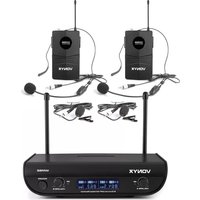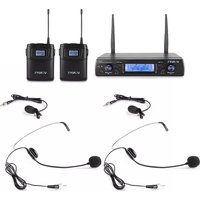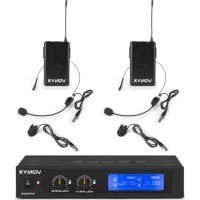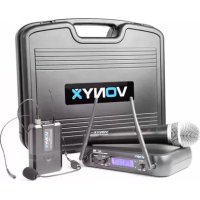
WM73C - Microphone Vonyx - Free user manual and instructions
Find the device manual for free WM73C Vonyx in PDF.



| Feature | Details |
|---|---|
| Microphone type | Wireless microphone |
| Operating frequency | UHF (Ultra High Frequency) |
| Frequency response | 50 Hz - 18 kHz |
| Directionality | Cardioid |
| Range | Up to 100 meters in open field |
| Power supply | Rechargeable battery |
| Battery life | About 6 hours |
| Connectivity | XLR and 6.35 mm jack output |
| Recommended use | Concerts, conferences, presentations |
| Maintenance | Regularly clean the microphone, check connections |
| Safety | Avoid humid environments, do not expose to extreme temperatures |
| General information | Ideal for professional and amateur users |
Frequently Asked Questions - WM73C Vonyx
User questions about WM73C Vonyx
0 question about this device. Answer the ones you know or ask your own.
Ask a new question about this device
Download the instructions for your Microphone in PDF format for free! Find your manual WM73C - Vonyx and take your electronic device back in hand. On this page are published all the documents necessary for the use of your device. WM73C by Vonyx.
USER MANUAL WM73C Vonyx
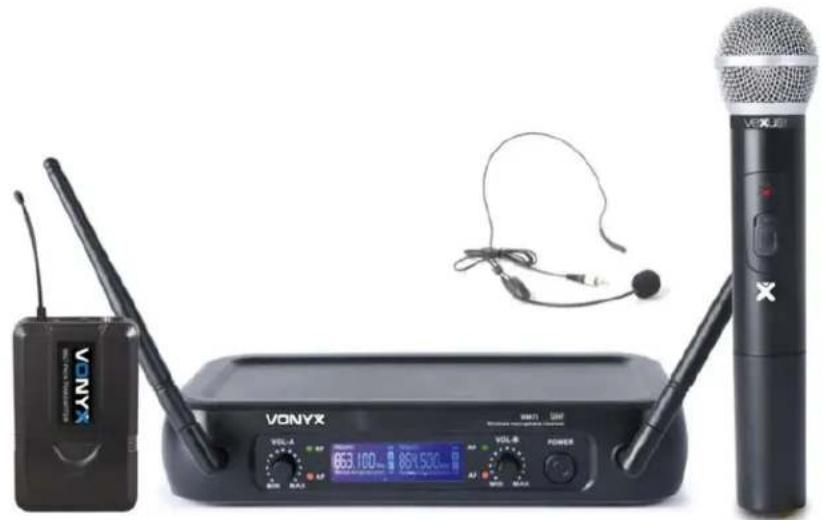
WM73C Mic. UHF 2ch Combi with display WM73 Mic. UHF 2ch Handheld with display WM73H Mic. UHF 2ch Headset with display
Ref. nr.: 179.203 / 179.206 / 179.209
INSTRUCTION MANUAL
GEBRUKSAANWIJZING
GEBRAUCHSANLEITUNG
MANUAL DE INSTRUCCIONES
NOTICE D'UTILISATION
V1.1
ENGLISH
Thanks for purchasing this Vonyx wireless microphone, please read this instruction carefully so that can understand how to operate the product of style you bought correctly. Please store this instruction in a safe place after reading as a reference in the future. This series of professional wireless microphone system used a super steady PLL-synthesized control technique and match with the high efficient, low consumption discharging technique.
Warning:
- Always read the manual before using the product.
- Keep the manual so every new user can read it before using the product.
Always keep the packaging. When a malfunction occurs, please send it in the original packaging. - Only for indoor use. Do not use in moistures places.
- Don't expose to direct sunlight or heat sources. Don't block ventilation openings.
- Don't let small objects or fluids enter the housing. Don't put candles on it. This may cause malfunction.
- Clean this unit with a dry cloth. Don't use cleaning fluids or solvent.
- Unit contains no serviceable parts. Only the replacement parts named in this manual can be changed by the user or servicing personnel.
- Never open the unit, service may only be done by qualified personnel.
- Never remove or place the mains plug in a socket with wet hands.
- Disconnect the unit from mains power before servicing.
- Condensation water can form while reusing, please let the unit reach the environmental temperature before using it.
- Keep out of children's reach.
- When the unit is damaged in a way that internal parts are visible. NEVER connect the unit to a mains socket and NEVER switch the unit on. In this case, contact your supplier.
- When a lightning storm occurs, always disconnect this unit from the mains socket. Do the same when the unit won't or hasn't be used for a long period of time.
Using this unit might cause disturbance in insufficiently shielded equipment. This disturbance might cause damage or accidents. Please check if there is any sensitive equipment in close proximity of the unit before installing it.

Electric products must not be put into household waste. Please bring them to a recycling centre. Ask your local authorities or your dealer about the way to proceed. The specifications are typical. The actual values can slightly change from one unit to the other. Specifications can be changed without prior notice.
Do not attempt to make any repairs yourself. This would invalid your warranty. Do not make any changes to the unit. This would also invalid your warranty. The warranty is not applicable in case of accidents or damages caused by inappropriate use or disrespect of the warnings contained in this manual. Vonyx cannot be held responsible for personal injuries caused by a disrespect of the safety recommendations and warnings. This is also applicable to all damages in whatever form.

This product is for license free use in all EU member states.
FRONT- AND BACKSIDE
179.203 WM73C UHF 2ch Combi with display
179.206 WM73 UHF 2ch Handheld microphones with display
179.209 WM73H UHF 2ch Headset with display
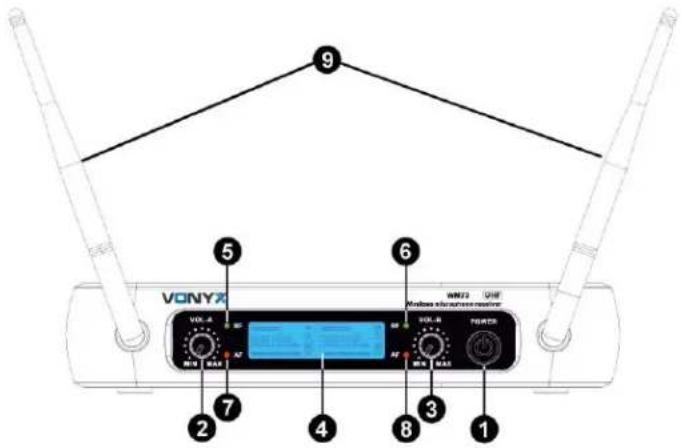
- Power switch to switch ON/OFF the system
- Volume channel A
- Volume channel B
- LCD Display
- "RF" signal indicator channel A: Indicate when receive RF signal from transmitter.
- "RF" signal indicator channel B: Indicate when receive RF signal from transmitter.
- "AF" audio level indicator channel A: Indicate the wireless system audio signal level.
- "AF" audio level indicator channel B: Indicate the wireless system audio signal level.
- Antenna.
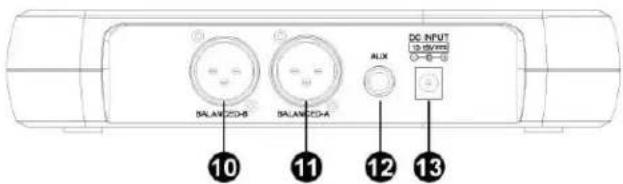
- XLR- connector balanced channel A
- XLR- connector balanced channel B
- Aux 1/4" Jack connector
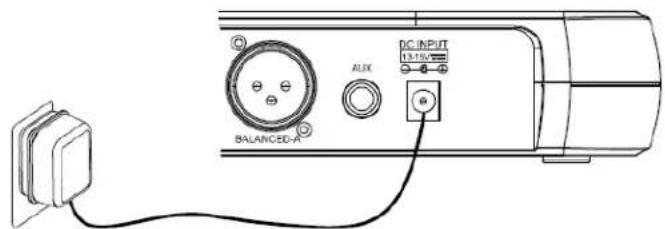
- Power inlet, 13-15Vdc
HANDHELD TRANSMITTER
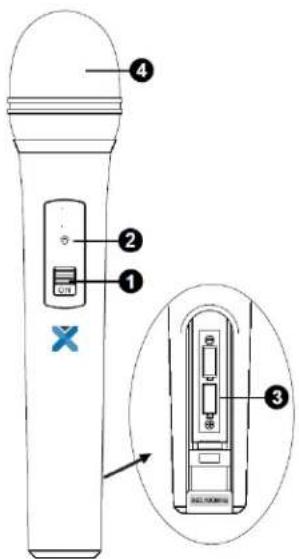
- Power ON/OFF Switch.
- Low battery indicator: Red light glows when the power is low and change the battery.
- Battery Cover: Open it to install the battery. remove batteries in case of long time no use (prevent leakage).
- Grille: Protects the cartridge and help reducing the breath sounds and wind noise.
BODYPACK TRANSMITTER (OPTIONAL)
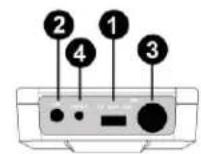
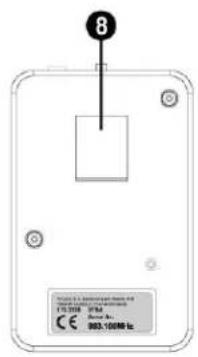
- Power ON/OFF and Audio mute switch.
- Antenna
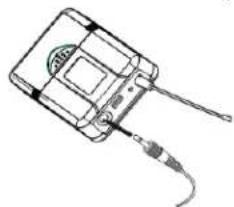
- Microphone input Jack: it is suitable for lavalier tie-clip or headset system.
- Low battery indicator (Red light glows when the power is low and change the battery)
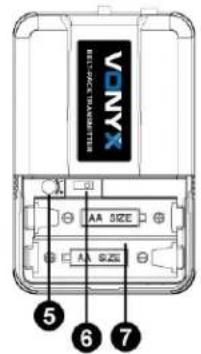
- Gain Adjusting Volume: Adjust the transmitter audio input gain.
- State Setting Switch: Set the using state of lavalier tie-clip or headset system.
- Battery Cover: Open it to install the battery. Remove batteries in case of long time no use (prevent leakage).
- Belt Clip
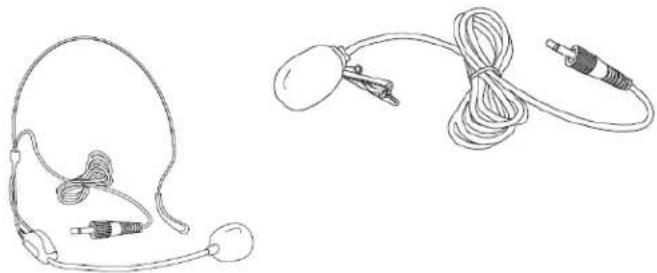
LAVALIER TIE-CLIP MICROPHONE
Connect the connector of supplied lavalier microphone to the connecting jack of transmitter (Shown as below). Set the transmitter work state in wireless lavalier system (6).
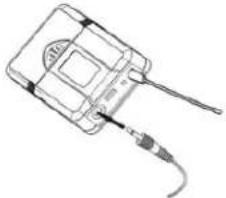
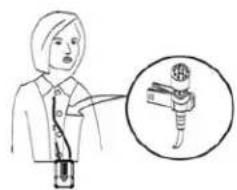
HEADSET MICROPHONE
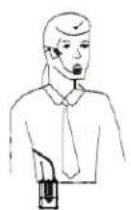
Connect the connector of supplied headset microphone to the connecting jack of transmitter (Shown as below). Set the transmitter work state in wireless headset system (6).
SYSTEM CONNECTIONS
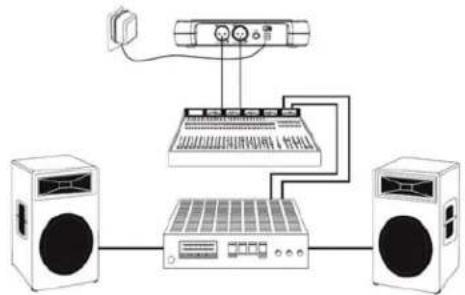
- Receiver power connection: Connect the AC adapter into the DC power connector on the back of the receiver. Plug the AC adapter into a AC230V 50Hz outlet.
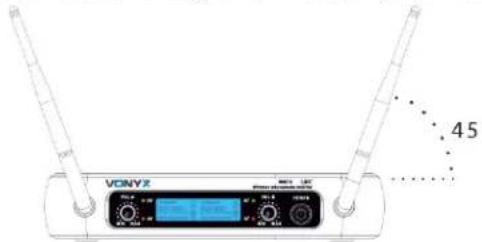
- Antenna: Keep the position of antenna at a 45^ angle from vertical. Shown as below.
- Audio connection: Connect the audio cable from the audio output on the receiver to the input on your amplifier equipment.
OPERATION
Turn off the system first, turn down the receivers volume to the minimum and then turn on the receiver, CPU initializes, the LCD screen begins to display and the system reverts to the last shutdown's state!
Tune to the desired frequency of the receiver and observe the RF- and AF signal level. If the signal level is displayed it means the receiver has interference from other signals or noise. The system has a mute circuit to avoid interference noise. If interfere with each other occurs it is recommended to use other frequencies. If the system is turned on look at the transmitter and receiver's frequency.
Then the receiver display shows RF signal level value, the antenna status will display antenna A or B. Adjust the volume to the desired level.
Volume adjustment
Adjust the receiver's volume to the 12 o'clock position, then adjust the volume of the amplifier or mixer to a desired level. If the receiver volume has been adjusted too loud the amplifier will produce a saturated distortion which will blow the amplifier or/and the loudspeaker(s)!
Best acoustics:
- You should always see the receiver antenna from your transmitter location.
- The distance between transmitter and receiver should be as short as possible.
- If the receiver has two antennas, they should be adjusted 45^ with a vertical line.
- Keep the antennas away from metal surfaces and shelter.
- Let the antennas not contact or cross each other.
- Before using the system during the presence of public do a test to find out where the "dead spots" are. Avoid these spots when operational
TROUBLESHOOTING
| PROBLEM INDICATOR SOLUTION | ||
| No sound Red transmitter indicator is not flash Slide transmitter POWER ON/OFF | ||
| switch to ON position. Make sure battery is inserted properly, observing battery (+/-). If battery is inserted properly, replace with fresh battery. | ||
| No sound | Red transmitter indicator is flash. | Slide transmitter MUTE/ON switch to ON position. |
| No sound Red receiver indicator POWER light off. Make sure AC adapter is securely plugged into electrical outlet and into DC input connector. Make sure AC electrical outlet works and supplies proper voltage. | ||
| No sound Receiver signal indicators | A/B lights glowing. | Turn up receiver volume control. Confirm that the output connections from the receiver to the external equipment are secure. |
| No sound Receiver signal indicators | A/B lights off. Transmitter and receiver POWER light glowing. | Confirm transmitters and receivers frequencies match. Move transmitter closer to receiver. |
| Sound level differs from level of a cabled instrument. | Receiver signal indicators A/B lights glowing. | Adjust transmitter gain level to compessary. Adjust receiver volume as necessary. |
| Distortion level increases gradually | Receiver signal indicators A/B lights and transmitter LOW BATTERY light glowing | Replace transmitter battery |
| Bursts of noise or other audible radio signals present. | Signal indicators A/B/ lights on. Identify potential sources of interferences (other RF-sources) and turn off, remove or use a wireless system operating on a different frequency. | |
| Momentary loss of sound as transmitter is moved around performing area. | Receiver signal indicator A/B lights of when sound is lost | Reposition receiver and perform walk-through test again. If audio dropouts persist, mark "dead" spots and avoid them during performance. |
TECHNICAL SPECIFICATION
| WM73C WM73 WM73H | |||
| Ref.nr: | 179.203 | 179.206 | 179.209 |
| Frequency range | 863-865Mhz | 863-865Mhz | 863-865Mhz |
| Frequency response | 50Hz-18kHz | 50Hz-18kHz | 50Hz-18Khz |
| Signal/Noise ratio | >85dB | >85dB > 85dB | |
| Class | 1 | 1 | 1 |
| Rated voltage | AC220~240V 50Hz | AC220~240V 50Hz | AC220~240V 50Hz |
| Adapter | 13-15V DC / 500mA | 13-15V DC / 300mA | 13-15V DC / 300mA |
| Dimensions per unit | 210 x 145 x 42 mm | 210 x 145 x 42 mm | 210 x 145 x 42 mm |
| Bodypack STB4 | Handheld STM4 | |
| Ref.nr: | 179.203B | 179.206H |
| Frequency range 863 | 865Mhz 863 | 865Mhz |
| Battery | 2x 1.5V AA Battery | 2x 1.5V AA Battery |
| RF output | >10dBm | >10dBm |
| Class | 1 | 1 |
| Dimensions per unit | 100 x 65 x 30 mm | 238 x 50 x 50 mm |
The specifications are typical. The actual values can slightly change from one unit to the other. Specifications can be changed without prior notice.
Class I product for use in Frequency band 863-865MHz.
NEDERLANDS
Declaration of Conformity
Supplier
Details:
TRONIOS
BV
WM73H micro UHF 2ch Headset with display
Trade
Name:
VONYX
Regulatory Requirement:
EN 60065:2002+A1:2006+A11:2008
EN 50371: 2002
EN 301489-1 :2008-04
EN 301489-9 :2007-11
EN 300422-1 :2008-03
EN 300422-2 :2008-03
EN 301357-1 :2008-01
EN 301357-2 :2008-01
The product conforms to the essential requirements stated in Directives 2006/95 and 2004/108/EC and other relevant provisions of the R&TTE Directive (1999/5/EC).
Almelo,
01-07-2015
Name
: B. Kosters
Controller regulations
Signature
Specifications and design are subject to change without prior notice..
www.tronios.com
Copyright © 2015 by TRONIOS the Netherlands