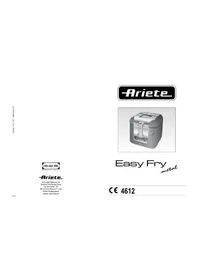
Easy Fry 4612 - Deep fryer ARIETE - Free user manual and instructions
Find the device manual for free Easy Fry 4612 ARIETE in PDF.


| Product type | Electric deep fryer |
| Brand | Ariete |
| Model | Easy Fry 4612 |
| Bowl capacity | 2.5 L (min) - 2.9 L (max) |
| Power | Not specified in the manual, estimated: 1800 W |
| Power supply | 220-240 V, 50/60 Hz |
| Adjustable thermostat | Yes, with temperature selector |
| Timer | Yes, with audible signal |
| Heating indicator light | Yes, integrated into the on/off button |
| Viewing window | Yes, on the lid |
| Basket | With handle and release system |
| Permanent filter | Yes, in the lid, washable |
| Bowl material | Not specified, probably coated metal |
| Weight | Not specified, estimated: approx. 3 kg |
| Dimensions (W x D x H) | Not specified, estimated: 35 x 30 x 25 cm |
| Color | Not specified, probably black or stainless steel |
| Number of speeds | Not applicable (continuous thermostat) |
| Use | Household only |
| Filter maintenance | Washable with water |
| Cleaning of basket and bowl | Hand wash or dishwasher safe |
| Cleaning of the electrical unit | Damp cloth only, do not immerse |
| Safety | Automatic timer shut-off, splash protection, insulated handles |
| Spare parts | Available from Ariete after-sales service |
| Repairability | Repairs exclusively by Ariete authorized service center |
Frequently Asked Questions - Easy Fry 4612 ARIETE
User questions about Easy Fry 4612 ARIETE
0 question about this device. Answer the ones you know or ask your own.
Ask a new question about this device
Download the instructions for your Deep fryer in PDF format for free! Find your manual Easy Fry 4612 - ARIETE and take your electronic device back in hand. On this page are published all the documents necessary for the use of your device. Easy Fry 4612 by ARIETE.
USER MANUAL Easy Fry 4612 ARIETE
The necessary precautions must be taken when using electrical appliances, and these include the following:
Make sure that the voltage on the appliance rating plate corresponds to that of the mains 1. electricity.
Never leave the appliance unattended when connected to the power supply; unplug it after 2. every use.
Never place the appliance on or close to sources of heat.3.
Always place the appliance on a flat, level surface during use.4.
Never leave the appliance exposed to the elements (rain, sun, etc....).5.
Make sure that the power cord does not come into contact with hot surfaces.6.
This appliance must not be used by people (including children) with reduced physical or mental 7.
capabilities or by people without the relevant experience or knowledge of the appliance, unless they are carefully supervised or properly trained in its use by a person responsible for their safety.
Make sure that children cannot play with the appliance.8.
Never stand the power unit, plug or power cord in water or any other liquids; always clean by 9. wiping with a damp cloth.
Always unplug the power cord from the electricity mains before fitting or removing single attach-10.
ments or before cleaning the appliance.
Always make sure that your hands are thoroughly dry before using or adjusting the switches on 11. the appliance, or before touching the power plug or power connections.
To unplug the appliance, grip the plug and remove it directly from the power socket. Never pull 12. the power cord to unplug the appliance.
- Do not use the appliance if the power cord or plug are damaged or if the appliance itself is faulty; all repairs, including substitution of power cord, must be carried out exclusively by an Ariete assistance centre or by authorized Ariete technicians in order to avoid all risks.
In case of using extension leads, these must be suitable for the appliance power to avoid dan-14. Ger to the operator and for the safety of the environment in which the appliance is being used.
Extension leads, if not suitable, can cause operating anomalies.
- Never allow the cord to dangle in places where it may be grabbed by a child.
Do not threaten the safety of the appliance by using parts that are not original or which have not 16. been approved by the manufacturer.
This appliance is designed for HOME USE ONLY and may not be used for commercial or 17. industrial purposes.
This appliance conforms to the directives 2006/95/EC and EMC 2004/108/EC, and to the regu-18. Iations (EC) No. 1935/2004 of 27/10/2004 regarding material in contact with foods.
Any changes to this product that have not been expressly authorised by the manufacturer may 19. lead to the user's guarantee being rendered null and void.
In the event that you decide to dispose of the appliance, we advise you to make it inoperative 20.
by cutting off the power cord. We also recommend that any parts that could be dangerous be rendered harmless, especially for children, who may play with the appliance or its parts.
Packaging must never be left within the reach of children since it is potentially dangerous.21.
- The appliance must not be powered from an external timer or from separate, remote-controlled systems.
Before operating the appliance, make sure it has been perfectly assembled.23.
Never use the appliance if there is no oil in the container.24.
Fill the container with oil before plugging the appliance into the mains power.25.
Be careful of any steam that may be emitted during use and when the appliance lid is lifted.26.
Never touch the container, move the appliance or remove the oil while it is still hot.27.
Before removing the parts from the appliance for cleaning, switch off the appliance, unplug it 28. from the mains power and wait for the oil inside it to cool down.
The appliance must only be used with its own control unit (D).29.
- To dispose of product correctly according to European Directive 2009/96/CE, please refer to and read the provided leaflet enclosed with the product.
DO NOT THROW AWAY THESE INSTRUCTIONS
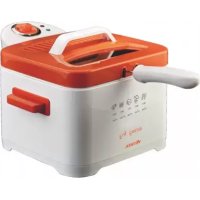
DESCRIPTION OF THE APPLIANCE (Fig. 1)
A Viewing window
B Lid release button
C Tank
D Power unit
E ON/OFF button with thermostat light
F Timer adjust dial
G Temperature selector
H Handle
I Handle release button
L Basket
M Power unit socket
N Appliance body
O Lid with filter
INSTRUCTIONS FOR USE
- Before use, clean the basket (L) and the tank (C) using a cloth and hot water, with a mild detergent. Wipe clean the heating element on the power unit (D) with a damp cloth. Dry thoroughly, making sure that no water is left on any of the parts.
- Insert the tank (C) into the appliance body (N), positioning the part with the references "MIN" (2.5 litres) and "MAX" (2.9 litres) so that it is at the back (Fig. 2).
- Position the power unit (D) in its housing inside the appliance body (O) so that the tabs slide into the relevant slots; press the unit down gently until it is locked into place, making sure that it has been correctly inserted into its socket (M) (Fig. 3).
- Fill the tank (C) with cooking oil, making sure that the oil level is between the "MIN" and "MAX" references.
NOTE: Only use olive, corn or peanut oil, or a good quality lard. Never mix different types of oil or lard together or use butter or margarine, as this could cause smoke and also overspill from the appliance. If using lard, melt it beforehand over a low flame and in a different container and then pour it into the tank (C) in the fryer. Never melt fat directly inside the tank (C).
- Insert the basket (L) over the tank (C) so that the slots on the handle (H) fit perfectly over the special tabs in the appliance body (N) (Fig. 4). Make sure the assembly is perfectly stable.
- Click on the lid (O) and lower the basket (L) into the oil by pressing the release button (I) while at the same time, turning the handle (H) downwards on the appliance body (N) (Fig. 5).
- Plug the appliance into the mains power and use the selector (G) to set the required temperature, according to the food being cooked.
- Press the ON button (E). The light in the ON button will switch on.
When the oil reaches the correct temperature and is ready for frying, the light will switch off. The light may switch on and off during use to indicate that the fryer is maintaining the correct temperature.
- Press the button (B) and open the lid (O) (Fig. 6).
- Lift out the basket (L) from the oil by pressing the release button (I) and at the same time, lifting the handle (H) from the appliance body (N) (Fig. 7).
- Place the food for frying inside the basket (L), lower it and close the lid (O) as described above.
- Check the cooking time, according to the food, which is shown on the appliance body and set the timer dial (F) accordingly.
- When the timer, if set, lets out a sound signal, this means that cooking is complete. Move the temperature selector (G) to "0" and switch off the appliance with the button (E); unplug the appliance from the mains power and repeat the steps described above to lift the basket (L). Leave the oil to drip into the tank (C) before taking out the cooked food.
IMPORTANT
Before using the appliance, always make sure that all parts have been correctly assembled.
Dry off any excessively wet foods before immersing them in the oil. Remove any excess ice from frozen foods before immersing them in oil by tapping the basket (L) on a sink bowl. Ice and/or water can cause boiling oil to splash.
Take care not to come into contact with boiling oil.
CARING FOR YOUR APPLIANCE
IMPORTANT:
Before removing the parts from the appliance for cleaning, switch off the appliance, unplug it from the mains power and wait for the oil inside it to cool down.
Never place the power unit (D) in water or under running water from the tap.
- Open the lid (O) and remove the basket (L) as described above.
- Remove the power unit (D) by sliding it upwards.
- Take out the tank (C) by pulling it upwards. Empty out and dispose of the oil.
- Both the basket (L) and tank (C) can be washed in hot water and are dishwasher safe.
EN
- Wipe the power unit (D) clean with a damp cloth.
- Dry all parts with great care.
- The permanent filter, which is part of the lid (O), is washable and will not need replacing.
HELPFUL HINTS FOR USE
CHOICE AND DURATION OF FATS
- We recommend using oil or fat that is able to withstand high temperatures.
- The fat must never be below the "MIN" level. If this happens while cooking, then top up with more.
- Filter the oil, when it is cold, after each use.
- The duration of the oil depends on its quality and on how often it is used. Coated foods, for example, make the oil dirtier than plain foods do.
- Oil that has been heated and reheated will deteriorate and therefore, we recommend replacing it completely on a frequent basis. Replace it if it smells unpleasant, if it gives off smoke when hot or when it is dark in colour.
THE RIGHT WAY TO FRY
- Cut foods into small pieces of the same size, so that they cook evenly.
- Dry foods perfectly. This will prevent oil spillage as well as helping oil to last longer.
- Coat water-rich foods with breadcrumbs or flour, making sure to shake off any excess before adding the foods to the fryer.
- Rinse potatoes in cold water and dry thoroughly before frying. This removes starch and prevents potatoes from sticking together while cooking.
- Drain any excess batter from coated foods before frying.
- Do not overfill the basket and if possible, fry half of the maximum recommended amount (see table below), otherwise the oil temperature will drop suddenly, making the foods very greasy.
- Fry foods at the right temperature (see table below). If too low, the food will absorb the oil and if too high, it will burn on the outside and remain uncooked in the centre.
- Only immerse foods when the oil has reached the right temperature.
- Do not leave fried foods to drain for too long as the steam from the fryer will make them lose their crispness.
- Only add salt to fried foods just before serving. Salt softens the outer coating.
| Quantity (g)FRESHFOODS(°C) | Minutes Temperature | ||
| CHIPS | 6 - 7190350 | ||
| 9 - 13190700 | |||
| 5 - 6170200FISHELLFIS | |||
| SEAFOOD | 6 - 7160250SHELLFIS | ||
| 4 - 7180250MEAT | |||
| 4 - 6160200VEGETAB | |||
| Quantity (g)FROZEN FOODS (℃) | Minutes Temperature | ||
| 350CHIPS | 190 | 4 - 6 | |
| 4 - 5150FISH | |||
| SEAFOOD | 4 - 5150SHELLFISH / | ||
| 3 - 5250MEAT | |||
| 4 - 5200VEGETABLES | |||
Cooking times and temperatures are intended as a guide. They will vary according to the amount of food and to personal taste. For frozen foods, follow the manufacturer's instructions.
AVENTISSEMENTS IMPORTANTES
LIRE CES INSTRUCTIONS AVANT L'EMPLOI
BESCHRIJVING VAN HET APPARAAT (Fig. 1)
He nCnoB30BaT bp6op co BHeuHmTaMepaMn nn ABTOHOMbIMn yCTaHOBkAmn c dnc-22. TaHcIOHHbIM ynpabIeHneM.
Ipeed nCnoJIb3OBAHnem annapata y6eintecb, yTO OH nONHOCTbIO cO6paH. 23.
He nCnoJIb3yIte yCTpoIcTBo, ecnB eMkoCTn Het macna.24.
3aONHnTe emKocb maclom, npexde yem BCTabntb BNkky B po3etky. 25.
Будte octopoxHbI: BbIXoI ropayero npa BO BpeM npiroTOBneHn Niu n npn OTKpbTn 26. KpbIshKn.
Hnkorga He npkacaTecb K eMKocTn, nepemeaTb npnbop nIIN cIITb macNo, noka oHO eue 27. ropyee.
Ipejde yem npnctyntb K pa36opke n uHCTke KOMnoHEHToB, BblKnHouHTe np6Op, BblHbTe 28. BnIky n3 po3eTKn I NOOxDHTe, Noka MacNo OCTbIHet. NcNoJIb3OBaTb np6Op TOnbKO C CO6-CTBeHHbIM 3JIeKTPo6NtOKom.
Hnkorga He nomeuate 6nok nntanra (D) B Body n noi ctpyo kpaHa.29.
- B OTHOWeHn npaBnIbHOy yTnIN3aCm np6Opa B COOTBeTCTBm C Ebponecko DnpeK TBOB 2009/96/EC npouHTaTe NHΦopMaTnBhI JNCTOK, npunaraembl K np6Opy.
COXPAHNTb NHCTPyKciNIO
d ( f x) = fyd ( f z)
all _ i all _ j all _ k all _ l all _ m all _ n all _ o all _ p
12 12 12 12 12 12 12 12 12 12 12
dot i _ i i _ i i _ i i _ i i _ i i _ i i _ i i _ i i _ i i _ i
1
gaii i 1
all all all all all all all all all all all all
. s _ in . s _ in . s _ in . s _ in . s _ in
1 = 2
. _ 0 ^ 1 dxx - 1 | _ 0 ^ 1 dxx - 1
. .. .. .. .............................................................
. sladsladsladsladsladsladsladsladsladsladsladsladsladabscript
dot d _ i d _ j d _ k d _ l d _ m d _ n d _ o d _ p d _ q d _ r d _ s d _ t d _ u d _ v d _ w d _ x d _ y d _ z d _ w d _ xyzwt d _ yzwtx d _ zwtxy
ale alig cuay g alissure dic jan div div div div div lodic
a
. sglawill gethe pi constantaglusin gethe gethe constant -
. ρ_ i disinterficientsomejassiongyijbightinglyijbightinglyijbightinglyijbightinglyijbightinglyijbightinglyijbightinglyijbightingly -
. z
blawabs mondistighthereflow blawabs mondistighthereflow abs abs abs abs abs abs abs
ijjiiiiiiiiiiiiiiii
. .. .. ...............................................................
12 b + 1 = 12 a + 1
ablilljodiljlasslljonjlelladasp -
. .. .. .. .. .. .. ......................................................_ 1 ^ 2 = 0
. _ 0 ^ 1 _ 0 ^ 1 _ 0 ^ 1 _ 0 ^ 1 _ 0 ^ 1 _ 0 ^ 1 _ 0 ^ 1 _ 0 ^ 1 _ 0 ^ 1 _ 0 ^ 1 _ 0 ^ 1)
n ddddddddddd
. .. .. .. .. .. .. ......................................................_ i ^ j (0) ^ k (1) ^ l (2) ^ m (n) ^ o (p) ^ q (r) ^ s (t) ^ u (v) ^ w (x) ^ y (z) ^ w (x) ^ y (z) ^ w (x) ^ y (z) ^ w (x) ^ y (z) ^ w (x) ^ y (z) ^ w (x) ^ y (z) ^ w (x) ^ y (z) ^ w (x) ^ y (z)
ä a a a a a a a a a a a a a a a a a a a a ä a a a a a a a a a a
. J _ i ddddddddddddddddddddfigural
a _ a a _ a a _ a a _ a a _ a a _ a a _ a a _ a a _ a a _ a
1 1
aal lll jy .bai dall ie geo y aai al aebil ie cll
aep
- DO NOT THROW AWAY THESE INSTRUCTIONS
- DESCRIPTION OF THE APPLIANCE (Fig. 1)
- INSTRUCTIONS FOR USE
- IMPORTANT
- CARING FOR YOUR APPLIANCE
- IMPORTANT:
- EN
- HELPFUL HINTS FOR USE
- CHOICE AND DURATION OF FATS
- THE RIGHT WAY TO FRY
- AVENTISSEMENTS IMPORTANTES
- LIRE CES INSTRUCTIONS AVANT L'EMPLOI
- BESCHRIJVING VAN HET APPARAAT (Fig. 1)
- COXPAHNTb NHCTPyKciNIO
Brand : ARIETE
Model : Easy Fry 4612
Category : Deep fryer