
DHL555BSD - Range hood BOSCH - Free user manual and instructions
Find the device manual for free DHL555BSD BOSCH in PDF.
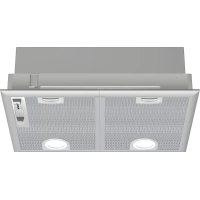



| Brand | Bosch |
| Model | DHL555BSD |
| Category | Extractor hood |
| Installation type | Built-in |
| Extraction mode | Evacuation or recirculation |
| Lighting | Halogen bulbs |
| Grease filter | Washable metal filter |
| Material | Stainless steel |
| Electrical supply | 220-240 V, 50 Hz |
| Control type | Not specified (probably buttons or sliders) |
| Number of speeds | Not specified |
| Noise level | Not specified |
| Width | Not specified (estimate 55-90 cm depending on model) |
| Weight | Not specified |
| Filter maintenance | Clean at least every 2 months |
| Surface cleaning | Stainless steel: in the direction of the metal, without aggressive cleaner |
| Bulb replacement | Use halogen bulbs of the same type and power |
| Safety | Protection against re-aspiration of combustion gases |
| Minimum height above cooking surface | Not specified (follow the instructions of the cooking appliance) |
| Minimum width of the hood | Must be equivalent to that of the cooking surface |
Frequently Asked Questions - DHL555BSD BOSCH
User questions about DHL555BSD BOSCH
0 question about this device. Answer the ones you know or ask your own.
Ask a new question about this device
Download the instructions for your Range hood in PDF format for free! Find your manual DHL555BSD - BOSCH and take your electronic device back in hand. On this page are published all the documents necessary for the use of your device. DHL555BSD by BOSCH.
USER MANUAL DHL555BSD BOSCH
Important safety information
Important safety information
Read these instructions carefully. Only then will you be able to operate your appliance safely and correctly. Retain the instruction manual and installation instructions for future use or for subsequent owners.
The appliance can only be used safely if it is correctly installed according to the safety instructions. The installer is responsible for ensuring that the appliance works perfectly at its installation location.
The width of the extractor hood must correspond at least with the width of the hob.
For the installation, observe the currently valid building regulations and the regulations of the local electricity and gas suppliers.
When conveying the exhaust air, official and legal regulations (e.g. state building regulations) must be followed.
This appliance is intended for domestic use and the household environment only. The appliance is not intended for use outside. Do not leave the appliance unattended during operation. The manufacturer is not liable for damage which is caused by improper use or incorrect operation.
This appliance is intended for use up to a maximum height of 2000 metres above sea level.
This appliance may be used by children over the age of 8 years old and by persons with reduced physical, sensory or mental capabilities or by persons with a lack of experience or knowledge if they are supervised or are instructed by a person responsible for their safety how to use the appliance safely and have understood the associated hazards.
Children must not play with, on, or around the appliance. Children must not clean the appliance or carry out general maintenance unless they are at least 15 years old and are being supervised.
Keep children below the age of 8 years old at a safe distance from the appliance and power cable.
Check the appliance for damage after unpacking it. Do not connect the appliance if it has been damaged in transport.
This appliance is not intended for operation with an external clock timer or a remote control.
Danger of suffocation!
Packaging material is dangerous to children. Never allow children to play with packaging material.
Risk of death!
- Risk of poisoning from flue gases that are drawn back in. The exhaust air must not be conveyed into a functioning smoke or exhaust gas flue or into a shaft which is used to ventilate installation rooms that contain heating appliances. If the exhaust air is to be conveyed into a non-functioning smoke or exhaust gas flue, you must obtain the consent of the heating engineer responsible.
- Risk of poisoning from flue gases that are drawn back in.
Always ensure adequate fresh air in the room if the appliance is being operated in exhaust air mode at the same time as room air-dependent heat-producing appliance is being operated.
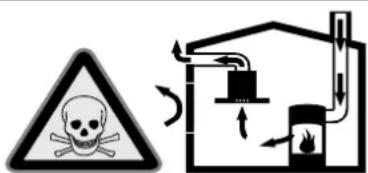
Room air-dependent heat-producing appliances (e.g. gas, oil, wood or coal-operated heaters, continuous flow heaters or water heaters) obtain combustion air from the room in which they are installed and discharge the exhaust gases into the open air through an exhaust gas system (e.g. a chimney).
In combination with an activated vapour extractor hood, room air is extracted from the kitchen and neighbouring rooms - a partial vacuum is produced if not enough fresh air is supplied. Toxic gases from the chimney or the extraction shaft are sucked back into the living space.
- Adequate incoming air must therefore always be ensured.
An incoming/exhaust air wall box alone will not ensure compliance with the limit.
Safe operation is possible only when the partial vacuum in the place where the heat-producing appliance is installed does not exceed 4 Pa (0.04 mbar). This can be achieved when the air needed for combustion is able to enter through openings that cannot be sealed, for example in doors, windows, incoming/ exhaust air wall boxes or by other technical means.
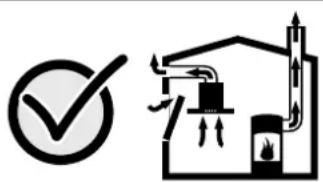
In any case, consult your responsible Master Chimney Sweep. He is able to assess the house's entire ventilation setup and will suggest the suitable ventilation measures to you.
Unrestricted operation is possible if the vapour extractor hood is operated exclusively in the circulating-air mode.
- Risk of poisoning from flue gases that are drawn back in. If installing a ventilation system in a room with a heat-producing appliance connected to a chimney/flue, the electricity supply to the hood must be equipped with a suitable safety switch.
Risk of fire!
- Grease deposits in the grease filter may catch fire.
Clean the grease filter at least every 2 months.
Never operate the appliance without the grease filter.
Grease deposits in the grease filter may catch fire. Never work with naked flames close to the appliance (e.g. flambéing). Do not install the appliance near a heat-producing appliance for solid fuel (e.g. wood or coal) unless a closed, non-removable cover is available. There must be no flying sparks. - Grease deposits in the grease filter may catch fire. The specified safety distances must be observed in order to prevent an accumulation of heat. Observe the specifications for your cooking appliance. If gas and electric hobs are operated
together, the largest specified distance applies.
Only one side of the appliance may be installed directly next to a high-sided unit or a wall. The distance between the appliance and wall or high-sided unit must be at least 50 mm.
- Hot oil and fat can ignite very quickly. Never leave hot fat or oil unattended. Never use water to put out burning oil or fat. Switch off the hotplate. Extinguish flames carefully using a lid, fire blanket or something similar.
- When gas burners are in operation without any cookware placed on them, they can build up a lot of heat. A ventilation appliance installed above the cooker may become damaged or catch fire. Only operate the gas burners with cookware on them.
- Operating several gas burners at the same time gives rise to a great deal of heat. A ventilation appliance installed above the cooker may become damaged or catch fire. Never operate two gas burners simultaneously on the highest flame for longer than 15 minutes. One large burner of more than 5 kW (wok) is equivalent to the power of two gas burners.
Risk of burns!
The accessible parts become very hot when in operation. Never touch hot parts. Keep children at a safe distance.
Risk of injury!
- Components inside the appliance may have sharp edges. Wear protective gloves. The appliance may fall down if it has not been properly fastened in place. All fastening components must be fixed firmly and securely.
- The appliance is heavy. To move the appliance, 2 people are required. Use only suitable tools and equipment.
- Items placed on the appliance may fall down. Do not place any objects on the appliance.
Risk of electric shock!
A defective appliance may cause electric shock. Never switch on a defective appliance. Unplug the appliance from the mains or switch off the circuit breaker in the fuse box. Contact the after-sales service. Incorrect repairs are dangerous. Repairs may only be carried out and damaged power cables replaced by one of our trained
after-sales technicians. If the appliance is defective, unplug the appliance from the mains or switch off the circuit breaker in the fuse box. Contact the after-sales service.
- Do not use any high-pressure cleaners or steam cleaners, which can result in an electric shock.
- Components inside the appliance may have sharp edges. These may damage the connecting cable. Do not kink or pinch the connecting cable during installation.
- When changing the bulbs, the bulb socket contacts are live. Before changing the bulb, unplug the appliance from the mains or switch off the circuit breaker in the fuse box.
- It must always be possible to disconnect the appliance from the power supply. The appliance must only be connected to a protective contact socket that has been correctly installed. If the plug can no longer be reached after installation, an energy-isolating device in the phases must be provided in the permanent electrical installation in accordance with the installation regulations. The permanent electrical installation must only be wired by a professional electrician. We recommend installing a residual-current circuit breaker (RCCB) in the appliance's power supply circuit.
Replacing bulbs
These instructions apply to several appliance variants. It is possible that individual features are described which do not apply to your appliance.
Risk of burns!
Bulbs become very hot when switched on. There is still a risk of burning for some time after they have been switched off. Allow the bulbs to cool down before replacing them.
Risk of electric shock!
When changing the bulbs, the bulb socket contacts are live. Before changing the bulb, unplug the appliance from the mains or switch off the circuit breaker in the fuse box.
Replacing the halogen bulbs
Important! Only use bulbs of the same type and wattage.
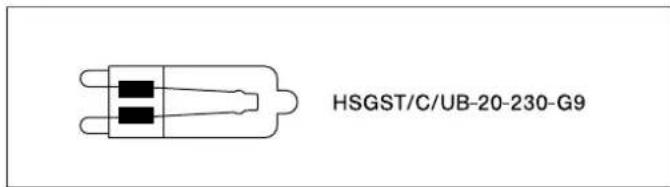
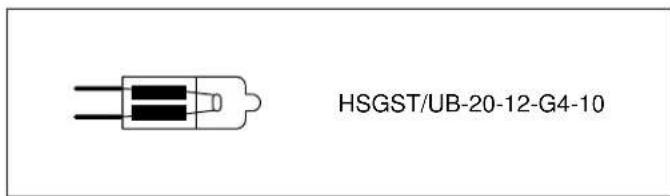
Note: When inserting halogen bulbs, do not touch the glass bulb. Use a clean cloth to insert the halogen bulbs.
- Carefully remove the bulb ring using a suitable tool.
- Remove the bulb and replace it with a bulb of the same type.
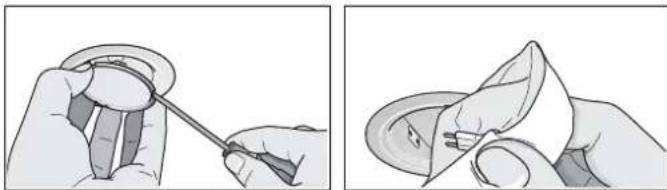
- Fit the bulb cover.
- Plug in the mains plug and switch the fuse back on.
Replacing filament bulbs
Important! Only use bulbs of the same type and wattage.
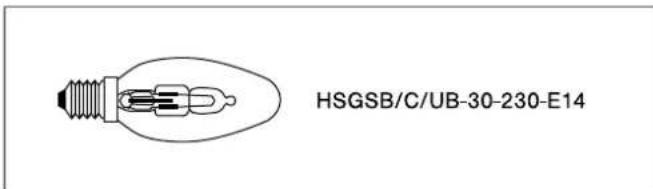
- Lift the bulb cover slightly and move it towards the outside of the appliance.
- Unscrew the bulb and replace it with a bulb of the same type.
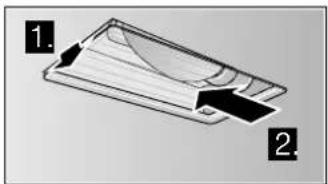
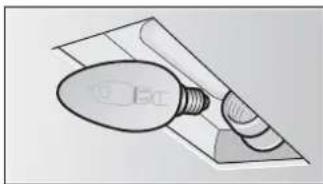
- Fit the bulb cover.
- Plug in the mains plug and switch the fuse back on.
Causes of damage
Caution!
Risk of damage due to corrosion. Always switch on the appliance while cooking to avoid condensation. Condensate can produce corrosion damage.
Always replace faulty bulbs to prevent the remaining bulbs from overloading.
Risk of damage due to ingress of humidity into the electronic circuitry. Never clean operator controls with a wet cloth.
Surface damage due to incorrect cleaning. Clean stainless steel surfaces in the direction of the grain only. Do not use any stainless steel cleaners for operator controls.
Surface damage due to strong or abrasive cleaning agents. Never use strong and abrasive cleaning agents.
Risk of damage from returning condensate. Install the exhaust duct in such a way that it falls away from the appliance slightly (1° slope).
Danger of burns!
The accessible parts become very hot during operation. Never touch the hot parts. Keep children at a distance.
Danger of personal injury!
Danger of burns!
Danger of burns!
Danger of burns!
Unpack and inspect the appliance. Do not connect the appliance if it has been damaged during transport.
Unpack and inspect the appliance. Do not connect the appliance if it has been damaged during transport.
This appliance is not intended for use by persons (including children) with reduced physical, sensory or mental capabilities, or lack of experience and knowledge, unless they have been given supervision or instruction concerning use of the appliance by a person responsible for their safety.
Danger of suffocation!
The packaging material represents a danger for children. Never allow children to play with the packaging material.
Exhaust gases that have been drawn back into the room can cause poisoning. It is forbidden to connect the extractor to a chimney or duct that is used for ventilation of rooms with appliances that use open flames. When connecting the extractor to a chimney that is not in use, it is necessary to obtain permission from the authorities responsible for its operation and maintenance. Exhaust gases drawn back in can cause poisoning. Always ensure sufficient air supply.
- Appliances with open flames that draw air from the room (for example, gas, liquid fuel, wood or coal heaters, instantaneous water heaters, boilers) obtain combustion air from the room where they are installed, and exhaust gases are discharged through the extraction system (for example, an exhaust pipe) from the room to the outside.
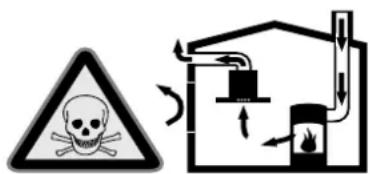
During operation of the extractor, air is removed from the kitchen and adjacent rooms, and due to insufficient air supply, a pressure drop occurs. Harmful gases from the exhaust pipe or exhaust box are drawn back into the living spaces.
Therefore, always ensure sufficient air supply. The wall box of the supply/exhaust air system alone does not guarantee compliance with the limit value.
For safe operation, the pressure in the room where the appliance with an open flame is installed must not exceed 4 Pa (0.04 mbar). This can be achieved if the required air can flow through non-closable openings, for example, in doors, windows, with the help of a wall box of the supply/exhaust air system or other technical measures.
In any situation, consult a competent person responsible for the operation and cleaning of pipes, who can assess the ventilation system of the entire house and propose a solution for taking appropriate measures.
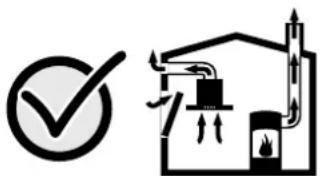
If the extractor operates exclusively in recirculation mode, operation is possible without restrictions.
Exhaust gases drawn back in can cause poisoning. When installing a ventilation system with an open flame source connected to the extractor, a suitable safety switch must be provided for the extractor supply.
Danger of fire!
Grease deposits in the grease filter can catch fire.
Clean the grease filter at least every 2 months.
Never use the appliance without the grease filter. - Grease deposits in the grease filter can catch fire. Never work with an open flame near the appliance (for example, flambéing). The appliance can be installed near a solid fuel combustion source (for example, wood or coal), provided a non-flammable protective screen is installed.
Protective screen. It can be a spark-proof partition.
- The filter can ignite if the device is used improperly. To avoid fire, keep the specified safe distance. Follow the instructions given for your device. When operating a gas and electric hob simultaneously, keep the largest specified distance. The device may only be installed on one side directly next to a cabinet column or wall. The distance from the wall or cabinet column must be at least 50 mm. Hot oil or fat ignites easily. Do not leave hot oil or fat unattended. Never extinguish fire with water. Turn off the appliance. You can carefully smother the fire with a lid, a fire blanket, or damp cloths. A gas burner left on without cookware produces a lot of heat. A ventilation unit installed above it can be damaged or catch fire. Turn on the gas burner only when cookware is placed on it. When operating several gas burners simultaneously, a lot of heat is produced. A ventilation unit installed above can be damaged or catch fire. Two gas burners must not operate simultaneously with a high flame for more than 15 minutes. The power of one burner (more than 5 kW) corresponds to the power of two gas burners.
Danger of fire!
During operation, exposed parts of the device become very hot. Do not touch hot parts. Keep children away.
Danger of injury!
- Some parts inside the device have sharp edges. Use protective gloves. If the device is not properly secured, it can fall. All fastening elements must be securely installed. The device is heavy. Moving it requires two people. Use
only suitable auxiliary means. Objects placed on the device can fall. Do not place objects on the device.
Danger of electric shock!
A faulty appliance can be dangerous and cause electric shock. Never switch on a faulty appliance. Unplug the power cord from the socket or switch off the circuit breakers in the fuse box. Contact a service technician. Unqualified repairs can make the appliance a source of danger. All repair work and replacement of wires and pipes must be carried out only by service technicians who have received special training. If the appliance is faulty, unplug the power cord from the socket or switch off the circuit breakers in the fuse box. Contact a service technician. Penetrating moisture can lead to electric shock. Do not use high-pressure cleaners or steam cleaners. Some parts inside the appliance have sharp edges, which can damage the connecting cable. Make sure that the connecting cable is not pinched or bent. When replacing lamps, note that the contacts in the socket are live. Before changing lamps, unplug the power cord from the socket or switch off the circuit breakers in the fuse box. Ensure that the appliance can be disconnected from the power supply at any time. The appliance may only be connected to the mains via a properly installed socket with an earthing contact. If, after installation of the appliance, the plug is no longer accessible, a suitable disconnecting device must be provided in the fixed electrical installation according to installation regulations. Installation of the fixed electrical installation may only be carried out by a qualified electrician. We recommend installing a residual current device (RCD) in the power supply circuit of the appliance.
Replacing lamps
This instruction manual is valid for several appliance variants. Therefore, it is possible that some equipment features described in the manual are not present in your appliance.
Danger of burns!
During operation, lamps become very hot. There is a risk of burns for some time after switching off. Before replacing lamps, let them cool down.
Danger of electric shock!
When replacing lamps, note that the contacts in the socket are live. Before changing lamps, unplug the power cord from the socket or switch off the circuit breakers in the fuse box.
Replacing halogen lamps
Important! Use only lamps of the same type and power.
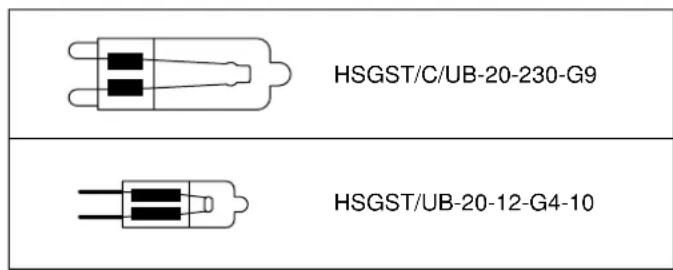
Note: When installing halogen lamps, it is forbidden to touch the glass bulbs. Use a clean cloth to install halogen lamps.
- Carefully remove the lamp cover with a suitable tool. 2. Remove the lamp and replace it with a lamp of the same type.
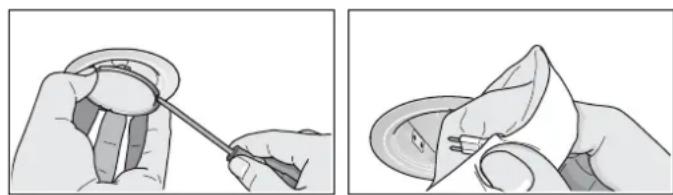
3. Install the halogen lamp. 4. Plug the plug into the socket or switch the circuit breakers back on.
Replacing the filter
Important! Use only lamps of the same type and power.
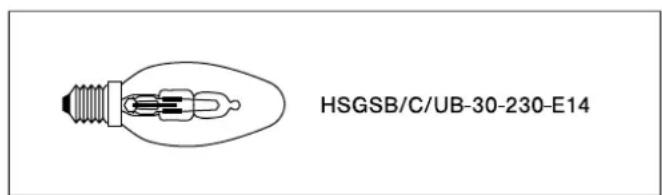
1. Slightly press the halogen lamp and turn it towards the outside of the appliance. 2. Remove the lamp and replace it with a lamp of the same type.
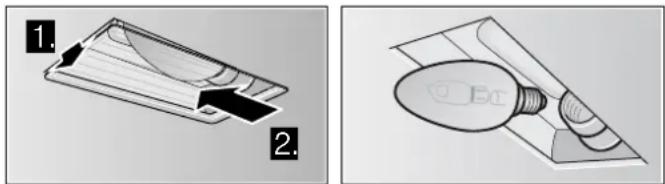
3. Install the lamp shade. 4. Insert the plug into the socket and switch on the fuse again.
Risk of injury
Warning!
Danger of damage due to corrosion. To avoid the formation of condensate, always switch on the appliance when preparing food. Condensate water can cause damage due to corrosion.
To prevent overloading of the lamp socket, defective lamps must be replaced immediately.
Danger of electric shock due to moisture penetration. Never touch the control elements with wet hands.
Surface damage due to incorrect cleaning. Clean stainless steel surfaces only in the direction of polishing. Do not use abrasive cleaners for control elements.
Surface damage due to the use of aggressive or abrasive cleaning agents. Do not use aggressive or abrasive cleaning agents.
Danger of damage due to condensate return. Install the air outlet duct slightly below the appliance (slope 1°).
- IMPORTANT SAFETY INFORMATION
- DANGER OF SUFFOCATION
- RISK OF DEATH
- RISK OF FIRE
- CLEAN THE GREASE FILTER AT LEAST EVERY 2 MONTHS
- RISK OF BURNS
- RISK OF INJURY
- RISK OF ELECTRIC SHOCK
- REPLACING BULBS
- REPLACING THE HALOGEN BULBS
- REPLACING FILAMENT BULBS
- CAUSES OF DAMAGE
- CAUTION
- DANGER OF BURNS
- DANGER OF PERSONAL INJURY
- EXHAUST GASES THAT HAVE BEEN DRAWN BACK INTO THE ROOM CAN CAUSE POISONING. IT IS FORBIDDEN TO CONNECT THE EXTRACTOR TO A CHIMNEY OR DUCT THAT IS USED FOR VENTILATION OF ROOMS WITH APPLIANCES THAT USE OPEN FLAMES. WHEN CONNECTING THE EXTRACTOR TO A CHIMNEY THAT IS NOT IN USE, IT IS NECESSARY TO OBTAIN PERMISSION FROM THE AUTHORITIES RESPONSIBLE FOR ITS OPERATION AND MAINTENANCE. EXHAUST GASES DRAWN BACK IN CAN CAUSE POISONING. ALWAYS ENSURE SUFFICIENT AIR SUPPLY
- GREASE DEPOSITS IN THE GREASE FILTER CAN CATCH FIRE
- NEVER USE THE APPLIANCE WITHOUT THE GREASE FILTER. - GREASE DEPOSITS IN THE GREASE FILTER CAN CATCH FIRE. NEVER WORK WITH AN OPEN FLAME NEAR THE APPLIANCE (FOR EXAMPLE, FLAMBÉING). THE APPLIANCE CAN BE INSTALLED NEAR A SOLID FUEL COMBUSTION SOURCE (FOR EXAMPLE, WOOD OR COAL), PROVIDED A NON-FLAMMABLE PROTECTIVE SCREEN IS INSTALLED
- DANGER OF FIRE
- DANGER OF INJURY
- DANGER OF ELECTRIC SHOCK
- REPLACING LAMPS
- REPLACING HALOGEN LAMPS
- REPLACING THE FILTER
- WARNING
Brand : BOSCH
Model : DHL555BSD
Category : Range hood