FBK 4 B2 - Saw FLORABEST - Free user manual and instructions
Find the device manual for free FBK 4 B2 FLORABEST in PDF.



| Product type | 4-in-1 petrol multi-tool (chainsaw, hedge trimmer, grass trimmer) |
| Brand | Florabest |
| Model | FBK 4 B2 |
| Engine | 2-stroke, air-cooled, 42.7 cm³, 1.35 kW max |
| Fuel | Petrol/oil mixture (40:1), 1.2 L tank |
| Engine unit weight | Approx. 5.6 kg (empty tank) |
| Cutting length (chainsaw) | 260 mm (Oregon type 100 bar) |
| Cutting length (hedge trimmer) | 425 mm |
| Cutting diameter (3-tooth blade) | 255 mm |
| Cutting diameter (line spool) | 430 mm |
| Max cutting speed (chainsaw) | 20 m/s (chain) |
| Saw chain | Oregon 91PO40X |
| Chain lubrication | Automatic, oil tank (140 ml), biodegradable oil recommended |
| Guaranteed sound power level | 114 dB(A) |
| Vibration front handle (chainsaw) | 3.855 m/s² (uncertainty K=1.5 m/s²) |
| Vibration rear handle (chainsaw) | 7.590 m/s² (uncertainty K=1.5 m/s²) |
| Main functions | Chainsaw (pruner), hedge trimmer, grass trimmer (3-tooth blade/line spool), pole |
| Recommended maintenance | Clean after each use, chain lubrication, sharpening, check air filter and spark plug every 25h |
| Safety | Safety lock, protective cover, chain brake, carrying harness |
| Spare parts | Available via Kompernass after-sales service |
| Warranty | 3 years (from date of purchase) |
Frequently Asked Questions - FBK 4 B2 FLORABEST
User questions about FBK 4 B2 FLORABEST
0 question about this device. Answer the ones you know or ask your own.
Ask a new question about this device
Download the instructions for your Saw in PDF format for free! Find your manual FBK 4 B2 - FLORABEST and take your electronic device back in hand. On this page are published all the documents necessary for the use of your device. FBK 4 B2 by FLORABEST.
USER MANUAL FBK 4 B2 FLORABEST
Translation of the original instructions
Read carefully before using machine!
NL BE
BENZINE-COMBI-APPARAAT 4-IN-1
Before reading, unfold both pages containing illustrations and familiarise yourself with all functions of the device.
FR BE
KOMPERNASS HANDELS GMBH
BURGSTRASSE 21
DE-44867 BOCHUM
DEUTSCHLAND
www.kompernass.com
Package contents. 21
Technical data 21
Explanation of the symbols used 22
Safety instructions. 24
Operational safety instructions for hedge trimmers 24
Supplementary safety instructions for hedge trimmers. 25
Operational safety instructions for pole pruners 25
Precautions against kickback. 26
Operational safety instructions for strimmers. 26
Operational safety instructions for cutting blades 27
Safety devices/equipment 27
Before use 28
Attaching the round handle. 28
Assembling the quick release mechanism 28
Fixing/attaching the carrying harness. 28
Assembling the hedge trimmer 28
Removing the hedge trimmer. 28
Swivelling the hedge trimmer. 28
Mounting the saw chain and blade 28
Removing the saw chain 28
Tightening and checking the saw chain 29
Lubricating the chain 29
Sharpening the saw chain. 29
Attaching the extension attachment. 29
Fitting/removing the protective guard 29
Installing/replacing the cutting blade 29
Installing/replacing the strimmer 30
Putting on the carrying harness 30
Setting the cutting height 30
Fuel and oil 30
Use 30
Starting when the engine is cold 30
Starting when the engine is hot 30
Working with the hedge trimmer 31
Cutting techniques 31
Working with the pole pruner. 31
Sawing techniques 31
Working safely 32
Transport
Cleaning 32
Maintenance 32
Storage and transportation 33
Troubleshooting. 34
Engine unit. 34
Polepruner 34
Hedge trimmer. 34
Maintenance intervals 34
Polepruner 34
Hedge trimmer. 34
Ordering spare parts 34
Disposal 35
Kompernass Handels GmbH warranty. 35
Service 36
Importer.
Translation of the original Conformity Declaration 36
4-IN-1 PETROL MULTI-TOOL FBK 4 B2
Introduction
Congratulations on the purchase of your new appliance. You have chosen a high-quality product. The operating instructions are a part of this product. They contain important information about safety, usage and disposal.
Before using the product, please familiarise yourself with all operating and safety instructions. Use the product only as described and for the range of applications specified. Please also pass these operating instructions on to any future owner.
Intended use
Long-handled hedge trimmer
This appliance is intended for the cutting and trimming of hedges, bushes and flowering shrubs in the home environment. This is a hand-held appliance with an integrated engine unit with linear reciprocating cutting blades.
WARNING!
Hedge trimmers are not suitable for use by children.
Pole pruner
This appliance is intended for trimming branches in trees.
3-section cutting blade/strimmer
Use with the 3-section cutting blade: for cutting high grass, undergrowth and light scrub.
Use with strimmer: for cutting grass and small weeds.
Extension attachment
CAUTION!
Do not use the extension attachment/boon in combination with the 3-section cutting blade/strimmer attachment!
Any other use that is not expressly permitted in these operating instructions may damage the appliance and represents a serious risk for the user.
Please make sure that you pay attention to the restrictions in the safety instructions. Comply with all national regulations which may restrict the use of the machine. Any other uses of or modification to the appliance is deemed to be improper and carries the risk of serious personal injury. Not intended for commercial use.
PROHIBITED APPLICATIONS!
Due to the physical risk posed to the user, the appliance may not be used to perform the following activities: cleaning footpaths and as a shredder for shredding tree and hedge sections. Furthermore, the appliance may not be used to level ground elevations such as molehills. For safety reasons, the appliance may not be used as a drive unit for any other devices. The user, not the manufacturer, is liable for any resulting damage or injuries of any kind.
Features
Engine unit FBK 4 B2-1
Safety lock-out
On/Off switch
3 Carrying lug
4 x mounting bolts (with snap ring, washer and nut)
5 Round handle
Rubber ring
5b Pin
Barrier bar
7 Screw grip
8 Boom
Throttle control
10 Spark plug connector
10 Choke lever
12 Starter pull cord
13 Fuel tank
Filler cap
15 Fuel pump (primer)
16 Air filter housing cover
Hedge trimmer attachment FBK 4 B2-3
17 Handle
18 Lock/release
Gear housing
20 Cutter bar
21 Base plate (hedge trimmer)
2 Control lever
Front boom (hedge trimmer)
Locking pin
25 Drive shaft
Pole pruner attachment FBK 4 B2-4
26 Front boom (pole pruner)
Safety ring
2 Oil filler cap
29 Oil tank
30 Blade
Saw chain
Bench grinder support
33 Stop
Locking pin
Drive shaft
36 Nut
Thread
Sprocket cover
Blade guide
40 Blade hole
Guide rail
Oil dispenser
43 Chain sprocket
Oil adjusting screw
45 Chain tensioner pin
46 Chain tensioner screw
Strimmer/cutting blade attachment FBK 4 B2-2
2x bolts (with snap ring, washer and nut)
48 Blade guard
49 3-section cutting blade
50 Strimmer with cutting filament
Front boom (strimmer/3-section cutting blade)
7 Lockingpin
Drive shaft
Extension attachment
Boom
Screwgrip
Locking pin
Drive shaft
Accessories
Carrying strap
Protective cover for blade
Chain guard
Organic chain oil
6 Oil/petrol mixing canister
Safety goggles
64 Hex key M4
6 Hex key M5
66 Open-ended spanner SW 8/10
Spark plug wrench/flat-blade screwdriver
Toolbag
9 Nut M10 x 1.0 (left-hand thread)
70 Pressure plate cover
Pressureplate
7 Driveplate
Cutting filament
Package contents
1 engine unit
1 hedge trimmer attachment FBK 4 B2-3 (hereinafter hedge trimmer)
1 pole pruner attachment FBK 4 B2-4 (hereinafter pole pruner)
1 strimmer/cutting blade attachment FBK 4 B2-2
1 extension attachment
1 handle with barrier bar
1 strimmer with cutting filament
1 cutting filament (filament : 2.4 mm/filament length: 6m
1 3-section cutting blade
1 Carrying harness
1 chain guard
1 blade guard
1 oil/petrol mixing canister
1 100 ml organic chain oil
1 tool bag
1 M4 hex key
1 M5 hex key
1 spark plug wrench/flat-blade screwdriver
1 SW 8/10 open-ended spanner
1 pair of safety goggles
1 operating instructions
Technical data
Engine unit: FBK 4 B2-1
Engine type: 2-stroke engine, air-cooled, chrome cylinder
Engine output (max.): 1.35 kW/1.85 hp
Cylinder capacity: 42.7 cm³
Engine idle speed: 3000 min (rpm)
Max. engine speed
with 3-section cutting blade: 9200 min ^1 (rpm)
with strimmer: 8700 min -1 (rpm)
with chainsaw: 9200 min (rpm)
with hedge trimmer: 9200 min -1 (rpm)
Max. cutting speed
with 3-section cutting blade: 6900min^1 (rpm)m
with strimmer: 6525 min -1 (rpm)
with chainsaw: 20 m/s
with hedge trimmer: 1550 min (rpm)
Ignition: electronic
Drive: centrifugal clutch
Weight:
(empty tank): approx. 5.6kg
Fuel tank capacity: 1200 cm
Spark plug: CDK L8RTC
Fuel consumption at
max. engine performance: 0.6kg / h
Specific
fuel consumption
at max. engine performance: 446 g/kWh
Hedge trimmer: FBK 4 B2-3
Cut length: 425 mm
Tooth spacing: 20 mm
Weight
(ready for use): approx. 2.24 kg
Pole pruner attachment: FBK 4 B2-4
Weight (ready for use): approx. 1.6 kg
Oil tank, recommended fill level: 140~cm^3
Cut length: approx. 260 mm
Blade: Oregon type 100SDEA318
Saw chain: Oregon 91P040X
Strimmer/cutting blade
attachment: FBK 4 B2-2
Strimmer with cutting filament (IAN 282573):
Filament cutting circle 430 mm
Filament length: 6.0 m
Filament 2.4 mm
3-section cutting blade (IAN 282573):
Cutting blade cutting
diameter 255 mm
Noise and vibration information:
Noise measurement value determined in accordance with ISO 22868, EN 10517. The A-rated noise level of the power tool is typically as follows:
Hedge trimmer:
| Sound pressure level PA: | 98.79 | dB(A) |
| Uncertainty KWA: | 2.5 | |
| Sound power level WA: | 109.53 | dB(A) |
| Guaranteed sound power level WA: | 114 dB(A) | |
| Uncertainty KWA: | 2.5 | |
| Pole pruner: | ||
| Sound pressure level PA: | 97.06 | dB(A) |
| Uncertainty KWA: | 2.5 | |
| Sound power level: 110.87 dB(A) | ||
| Uncertainty KWA: | 2.5 | |
| 3-section cutting blade: | ||
| Sound pressure level PA: | 97.64 | dB(A) |
| Uncertainty KPA: | 2.5 | |
| Sound power level WA: | 111.27 | dB(A) |
| Uncertainty KWA: | 2.5 | |
| Strimmer: | ||
| Sound pressure level PA: | 99.08 | dB(A) |
| Uncertainty KPA: | 2.5 | |
| Sound power level WA: | 111.10 | dB(A) |
| Uncertainty KWA: | 2.5 |

ear protectors to prevent hearing damage!
Vibration values (vector total of three directions) determined in accordance with EN 11806-1, EN ISO 10517, EN ISO 11680-1:
Hedge trimmer:
| Vibration on the front handle: vibration emission value a h,0 = 4.182 m/s2 Uncertainty K = 1.5 m/ |
| Vibration on the rear handle: vibration emission value |
| aR,D=9.695 m/s2 |
| Uncertainty K = 1.5 m/ |
Pole pruner:
| Vibration on the front handle: vibration emission value qL,D=3.855 m/s2 Uncertainty K = 1.5 m/s2 |
| Vibration on the rear handle: vibration emission value ak,p=7.590 m/s2 Uncertainty K=1.5 m/s2 |
Strimmer:
| Vibration on the front handle: vibration emission value a,b,d=4.864 m/s2 Uncertainty K=1.5 m/s2 |
| Vibration on the rear handle: vibration emission value a h, d = 9.750 m/s2 Uncertainty K = 1.5 m/s2 |
3-section cutting blade:
| Vibration on the front handle: vibration emission value a,b,d=4.622 m/s2 Uncertainty K=1.5 m/s2 |
| Vibration on the rear handle: vibration emission value ak,D=7.708 m/s2 Uncertainty K=1.5 m/s2 |
NOTE
The vibration level specified in these instructions has been measured in accordance with the standardised measuring procedure specified in EN ISO 11806-1, EN ISO 10517, EN ISO 11680-1 and can be used to make equipment comparisons. The specified vibration emis-dB sion value can also be used to make an initial exposure estimate.
WARNING!
The vibration level varies in accordance with use and may be higher than the value specified in these instructions in some cases. There is a risk of underestimation of the vibration load if the appliance is used regularly in this manner. To estimate the vibration load during a specific working period accurately, periods during which the appliance is switched off (or running, but not being used) must also be taken into account. This can significantly reduce the vibration load over the total working period.
WARNING!
d You can reduce the vibration risk, for example, the risk of Raynaud's phenomenon, by taking regular breaks during which you rub your hands together.
Explanation of the symbols used
Warning! Read the operating instructions before use!

Wear protective gloves!

Wear safety shoes!

Wear ear protection!

Wear a hard hat!

Wear protective goggles!
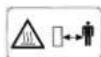
Important, hot parts. Keep a safe distance away!

- Switch on the appliance

- Fill fuel pump (primer)

- Pull the choke lever

- Pull the starter pull cord

Pull the choke lever
#
Press the fuel pump (primer) 6 ×

Mixing ratio: 40 parts petrol to 1 part oil

Petrol: RON 95/RON 98

2-stroke-motor oil: ISO-LEGD/JASO FD
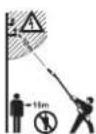
Risk of fatal electrical shock! Keep at least 10 m away from overhead power lines!

Attention! Falling objects.
Especially when cutting above head height.

Attention! Risk of injury due to running blades!

Keep a safe distance away!

General warning!

- Push the pin on the front boom into the groove on the engine unit boom as far as the stop.
- Once it is correctly inserted, the red line must match up with the one on the engine unit boom.
- If this is not possible, pull on the starter pull cord to adjust the shaft. ATTENTION! The On/Off switch must be set to "0".

Protect the appliance from rain and moisture!

Max. 9000 min ^-1 (rpm)

Attention! Left-hand thread.

Beware of flung objects!

Beware of kickback!

Caution! Risk of injury from rotating cutting blade! Keep hands and feet away!

Attention - petrol is highly flammable! Explosion hazard! Do not spill fuel!

Turn the appliance off and disconnect the spark plug before performing any maintenance work!

Attention! Risk of suffocation!

Caution! Poisonous CO vapours (carbon monoxide vapours)! Do not use the appliance in confined spaces!

Warning! Do not use circular saw blades for the cutting blade function.

Add a little grease after every 20 hours of operation (gear grease)

A distance of 1.5 metres must be maintained between the machine and third parties!

The cutting tool continues running after it is turned off (cutting blade/cutting filament)

Sound power level LWA data in dB.

Fire, naked flames and smoking are prohibited!

Safety instructions
IMPORTANT! READ CAREFULLY BEFORE USE! KEEP FOR YOUR RECORDS.
Operational safety instructions for hedge trimmers
NOTE
The hedge trimmer is supplied completely assembled.
- Instructions and pictorial representations regarding the settings and use of the hedge trimmer and/or its controls, maintenance, lubrication by the user can be found in these instructions and on the fold-out page.
Notes on the working position (see fold-out page).
Notes on the operating controls (see fold-out page).
Notes on the safe handling of fuel (see section "Preparation", point f).
Notes on the recommended replacement or repair of parts or the Customer Service and specification of spare parts to be used, inasmuch as these affect the health and safety of the user, can be found in these instructions.
The explanation of all graphical symbols, information, features and technical data as well as the procedure in the event of accidents and faults can be found in these instructions.
- Blocking tool: Remove any blockages from the cutter board.
WARNING!
Children may never use the hedge trimmer.
Stay alert, watch what you are doing and use common sense when operating the appliance. Do not use the appliance while you are ill, tired or under the influence of drugs, alcohol or medication. A moment of inattention while operating the appliance may result in serious personal injury.
Avoid improper use. Use the machine only as described under "Intended use".

Familiarise yourself with the operating instructions before you operate the appliance. b)
Preparation
a) THE HEDGE TRIMMER CAN CAUSE SERIOUS INJURIES! Read the instructions on correct handling, preparation, maintenance, starting and stopping the hedge trimmer very carefully. Familiarise yourself with all manual controls and the proper use of the hedge trimmer.
b) Children may never use the hedge trimmer.
c) Beware of overhead power lines.
d) Do not use the hedge trimmer while anyone, especially children, is in the vicinity.
e) Wear appropriate clothing! Do not wear loose clothing or jewellery which could get caught in moving parts. We recommend wearing heavy-duty gloves, non-slip footwear and goggles.
f) Handle fuel carefully. It is highly flammable and the vapours are explosive. The following points should be followed:
-Use only specially-designed containers.
- Never open the tank filler cap or top up the petrol tank while the motor is running or hot. Allow the motor and the exhaust components to cool down before refuelling.
-Do not smoke.
-Refuel outside only.
- Never store the hedge trimmer or the fuel tank in a room where there is an open flame, for example in a hot water boiler.
If the petrol has overflowed, do not attempt to start the engine. Remove the machine from the fuel-contaminated area before restarting.
Always replace the filler cap after refuelling and close it securely.
-If the tank is empty, this should be done in the open.
g) If the cutting unit comes in contact with a foreign object or if the operating noise increases or the hedge trimmer starts to vibrate abnormally, stop the engine and allow the hedge trimmer to come to a standstill. Pull the spark plug connector off the spark plug and take the following action:
-check for damage;
- check for loose parts and secure all the loose parts;
- replace damaged parts with equivalent parts or have them repaired.

Wear ear protection!

Wear protective goggles!
Familiarise yourself with the operation of the hedge trimmer so that you know how to stop immediately in an emergency.
Operation
a) The engine is to be immobilised before:
cleaning or removal of a blockage;
-inspection, maintenance or work on the hedge trimmer;
-setting the working position of the cutting unit;
if the hedge trimmer is to be left unattended.
b) Always make sure that the hedge trimmer is in the proper working position before the engine is started.
c) During operation of the hedge trimmer, always ensure that you have firm footing, especially when using a ladder.
d) Do not use the hedge trimmer if it has a defective or badly worn cutting unit.
e) To minimise the risk of fire, ensure that the engine and the silencer are free of residues, leaves or leaked lubricant.
f) Ensure that all supplied handles and safety guards are mounted when operating the hedge trimmer. Never attempt to operate an incompletely assembled hedge trimmer or a hedge trimmer with non-approved modifications.
g) Always use both hands if the hedge trimmer is equipped with two handles.
h) Always familiarise yourself with your environment and be aware of potential dangers that you may not be able to hear because of the noise of the hedge trimmer.
Maintenance and storage
a) If the hedge trimmer is shut down for maintenance, inspection or storage switch off the engine, pull the spark plug connector off the spark plug and ensure that all rotating parts have come to a standstill. Allow the machine to cool down before carrying out an inspection, settings, etc.
b) Store the hedge trimmer where the petrol vapours cannot come into contact with flames or sparks. Always allow the hedge trimmer to cool down before storage.
c) When transporting or storing the hedge trimmer, cover the cutting unit with the protective cover for the cutting unit.
Supplementary safety instructions for hedge trimmers
Environmental safety
Only operate the hedge trimmer in daylight or good artificial light.
While trimming, ensure that you do not come into contact with objects such as fence wire or plant supports. They could cause damage to the cutter bar. Inspect the hedge to be cut carefully and remove any wires or other foreign bodies.
■ Be aware of your environment and all possible hazards that you may be unable to hear while cutting the hedge.

DANGER!
In the event of imminent danger or an emergency, switch off the engine immediately.
Electrical safety
Hold the power tool only by the insulated grips as the cutting blades could come into contact with hidden power lines. Contact between the blades and a live wire may make exposed metal parts of the power tool live and could give the operator an electric shock.
Personal safety
During operation, no other person or animal may be within a radius of 15 metres. The operator is responsible for third parties within the working area.
During operation, ensure that you have proper footing and balance at all times, especially when used on steps or ladders.
Never touch the cutter bo0 of the hedge trimmer.
- Keep your hands away from the cutting blades. Do not attempt to clear clippings or hold onto the material to be cut while the blades are still in motion. Remove any jammed clippings only when the appliance has been switched off. A moment of inattention while operating the hedge trimmer may result in serious personal injury.
Wait until the tool has come to a standstill before putting it down.
Use and handling

CAUTION!
Between tasks or after completion of a task, do not set the cutter bar down on its tip as this could cause damage to the cutter bar
Before use, always check that the blades, the blade screws and other parts of the cutting tool are not worn or damaged. Never work with a damaged or heavily worn blade.
After making settings to the working angle, check whether both setting levers are clicked firmly into place. If one of the setting levers remains open, the second could be unintentionally be released by a branch and the cutter bar 20 could swing down.
Never use the hedge trimmer with defective or missing safety devices.
Never grasp the hedge trimmer by the safety guards.
- Carry the hedge trimmer by the front handle when switched off, with the cutter bar facing away from your body. When transporting or storing the trimmer, always put on the protective cover. Careful handling of the appliance reduces the likelihood of accidental contact with the moving blades.
Store the hedge trimmer in a dry, high or closed space out of the reach of children.
Do not attempt to repair the equipment unless you have received the necessary training.
For safety's sake, change worn or damaged parts.
DANGER!
In the event of imminent danger or an emergency, switch off the engine immediately.
Operational safety instructions for pole pruners
CAUTION! RISK OF INJURY!
To prevent injuries, never touch the appliance above the safety ring while it is running!
Preparation
Always wear a hard hat, ear protection and safety gloves. Also wear safety goggles to prevent splashes of oil or sawdust from getting into your eyes. Wear a dust mask to protect yourself from dust.
Wear sturdy, non-slip boots.
Do not use the appliance in the rain.
Before use, check the appliance's safety condition, especially the blade and the saw chain.
Do not use the appliance near power lines. Maintain a minimum distance of 10 m to above-ground power lines.
Electrical safety
Do not use the appliance in a potentially explosive environment containing flammable liquids, gases or dusts. The sparks generated by the machine could ignite the vapours or gases.
Appliances with defective switches must be repaired immediately to avoid damage or injuries.
Personal safety
Never use the appliance while standing on a ladder.
Do not lean too far forward while using the appliance. Ensure you are standing firmly and keep your balance at all times. Use the supplied carrying harness to spread the weight evenly on the body.
To avoid injuries due to falling branches, do not stand under the branches that you want to cut off. Be aware of branches that may spring back and cause injuries. Work at an angle of approximately 60^ .
■ Be aware that an appliance kickback can occur.
Keep an eye not only on the branches being cut, but also on falling material, to avoid tripping.
Cover the guide rail and the chain with the cover during transport and storage.
Avoid unintentional starting of the appliance.
Store the appliance outside the reach of children. Only those who are fully acquainted with the operating instructions and the appliance itself may operate the appliance.
Use and handling
Never start the appliance before the blade, saw chain and sprocket covers have been fitted correctly.
Do not cut any wood that is lying on the ground and do not attempt to saw roots that are protruding from the soil. Avoid immersing the saw chain in the soil at all costs, as this could blunt the saw chain.
If the appliance accidentally comes into contact with a solid object, turn off the engine immediately and inspect the appliance for damage.
After 30 minutes of work, take a break of at least one hour.
If the pole pruner is shut down for maintenance, inspection or storage, switch off the engine, pull the spark plug connector off the spark plug and ensure that all rotating parts have come to a standstill. Allow the machine to cool down before carrying out an inspection, settings, etc.
Service the appliance carefully. Check for misalignment or binding of moving parts, breakage of parts and any other damage that may impair the tool's operation. If damaged, have the power tool repaired before use. Many accidents are caused by poorly-maintained tools.
- Keep cutting tools sharp and clean. Properly maintained cutting tools with sharp cutting edges are less likely to bind and are easier to control.
Have the appliance checked by qualified specialists. Use only the replacement parts recommended by the manufacturer.
Precautions against kickback
CAUTION KICKBACK!
Be aware of the danger of kickback when working with the appliance. There is a risk of personal injury. You can avoid kickbacks by being careful and using the correct sawing technique.
■ Contact with the tip of the rail may in some cases lead to an unexpected rearwards reaction resulting in the guide rail flying upwards towards the operator (see fig. A).
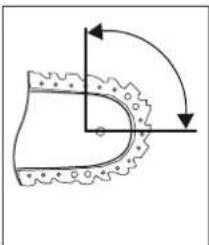
Fig. A
■ Kickbacks can occur if the tip of the guide rail touches an object or if the wood bends and the saw chain gets caught in the cut (see fig. B).
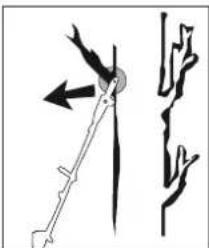
Fig.B
If the saw chain jams in the upper edge of the guide rail, the rail can kick back violently towards the operator.
Any such reaction can lead to you losing control over the saw and possibly injuring yourself. Do not rely solely on the chainsaw's built-in safety devices. As the user of a chainsaw, you can take a number of measures to avoid accidents and injury. A kickback is caused by incorrect use or misuse. It can be avoided by taking proper precautions, as described below:
Hold the saw firmly with both hands, with your thumb and fingers around the handles of the chainsaw. Position your body and arms so you can withstand kickback forces. If suitable measures are taken, the operator can control the recoil forces. Never let go of the chainsaw.
Avoid any abnormal posture and do not saw over shoulder height This will prevent inadvertent contact with the tip of the rail and allows a better control of the chainsaw in unexpected situations.
Always use the replacement rails and saw chains specified by the manufacturer. Incorrect replacement rails and saw chains can lead to a tearing of the saw chain and/or kickback.
Follow the manufacturer's instructions for sharpening and maintenance of the saw chain. Setting the depth limiter too low can increase the risk of kickback.
Do not saw with the tip of the blade. This can lead to a kickback.
Ensure that there aren't any objects on the ground that you can trip over.
Operational safety instructions for strimmers
Preparation
Wear close-fitting clothes that offer good protection, such as long trousers, sturdy work shoes, heavy-duty protective gloves, a hard hat, a protective mask for your face or safety goggles to protect your eyes and good ear plugs or some other hearing protection against noise.
Always use the enclosed shoulder strap.
Always ensure that the handles are dry and clean and that no petrol mixture is present.
Before working, check the area for objects such as pieces of metal, bottles, stones, etc, that could get thrown up and cause injuries to the user.
Before starting the engine, make sure that the strimmer is not in contact with any obstacles.
Do not use the appliance until you have familiarised yourself with its use.
Electrical safety
Never use the appliance near highly flammable liquids or gases, either in closed rooms or in the open. This may result in explosions and/or fire.
Do not work with a damaged or incomplete appliance or an appliance that has been modified without the consent of the manufacturer. Never use the unit with defective protective equipment. Do not use the appliance if it has a defective on/off switch. If the appliance has been dropped, check for significant damage or defects.
Personal safety
This appliance may only be operated, adjusted and maintained by appropriately trained individuals and adults.
If you are not familiar with the appliance, practice handling the appliance while the engine is off.
Do not touch the exhaust.
Do not operate the appliance under the influence of alcohol or drugs.
Always hold the appliance with both hands. Your thumbs and fingers should encircle the handles.
■Work posture: Do not operate the appliance in an uncomfortable position, when you are unbalanced, with arms fully stretched or with only one hand.
Always ensure that you have a solid and firm stance.
Do not use the appliance if bystanders or animals are in the direct vicinity. Maintain a minimum distance of 15 metres between the operator and other people or animals when trimming. Maintain a minimum distance of 30 metres between the operator and other people or animals when mowing down to the ground.
When mowing on a slope, always stand at a lower level than the cutting tool. Never cut or trim on an icy, slippery hill or slope.
Any modifications to the product may risk personal safety and void the manufacturer's warranty.
Children should be supervised to ensure that they do not play with the appliance.
Do not use the appliance if it is damaged or if there are visible defects.
Use and handling
Use the appliance only for its intended purpose: cutting grass, mowing, pruning branches, cutting and trimming hedges and bushes.
■ Do not use the appliance for extended periods; take regular breaks.
Ensure that screws and connecting elements are firmly tightened. Never operate the appliance if it is not correctly adjusted, incomplete or if it is not properly assembled.
- Open the fuel tank slowly in order to allow any pressure which may have built up in the tank to dissipate. To prevent the risk of fire, move at least 3 metres away from the refuelling area before starting the appliance.
Guide the strimmer to the desired height. Avoid contact with small objects (e.g. stones) when using the strimmer.
Always hold the strimmer on the ground when the appliance is in operation.
Do not use the appliance unless the appropriate protective guard has been installed and is in good condition.
Do not use any other cutting tools. For your safety, only use the accessories and additional devices that are indicated in the operating instructions. The use of parts other than those recommended in the operating instructions, or other accessories, can put you at risk of injury.
Always trim and cut using the high speed range. Do not let the engine run at a low speed when starting to mow or trim.
When starting and operating the appliance, ensure that it does not come into contact with the ground, stones, wire or other foreign material. Switch off the appliance before you put it down.
Switch off the appliance before you put it away.
Always turn the engine off before working on the cutting tool.
Operational safety instructions for cutting blades
Preparation
The cutting blade flings objects and soil with great force. These can blind or cause other injuries. Wear eye, face and leg protection. Always remove objects from the work area before using the cutting blade.
The cutting blade continues running after the throttle lever has been released. A running-down cutting blade can inflict cuts to yourself or other people standing nearby. Turn the engine off and make sure that the cutting blade has come to a complete stop before performing any work on the cutting blade.
Personal safety
The appliance can blind and cause injuries to bystanders. Maintain a minimum distance of 15 metres in all directions between the appliance and other people or animals.
Use and handling
Do not use the appliance if any of the cutting blade accessories have not been properly installed.
The cutting blade can kick back from objects with force. This can cause injuries to your arms and legs. If the appliance comes into contact with a foreign body, immediately shut down the engine and wait until the cutting blade has come to a complete stop. Check the cutting blade for damage. Always replace the cutting blade if it is bent or cracked.
Safety devices/equipment
The relevant plastic protective guard for the cutting blade or filament operation must be installed when working with the appliance in order to prevent objects from being flung away.
WARNING!
Never mow/trim while other individuals, especially children or animals, are in the vicinity.
Maintain a safety distance of 15m Turn off the appliance immediately if this distance is not maintained.
CAUTION! RISK OF POISONING!
Exhaust gases, fuels and lubricants are toxic. Exhaust gases must never be inhaled.
WARNING!
Petrol is highly flammable. Store petrol only in the containers provided.
Refuel only outdoors and do not smoke.
The filler cap must not be opened and refuelling must not take place while the engine is running or when the appliance is hot.
Do not attempt to start the engine if the petrol has overflowed. Instead, remove the appliance from the area polluted by petrol. Do not attempt to restart the appliance until the petrol fumes have dissipated.
For safety reasons, the petrol tank and filler cap must be replaced if they are damaged.
Limit the noise generation and vibrations to a minimum!
Only use appliances that are in good condition.
Maintain and clean the appliance on a regular basis.
Adapt your working method to the appliance.
Do not force the power tool.
Have the appliance inspected if necessary.
Switch the appliance off when not in use.
Wear protective gloves.
Before use
CAUTION!
Always wear non-slip footwear and appropriate safety clothing such as protective gloves, a hard hat, a protective mask and safety goggles as well as hearing protection.
Check the area in which the appliance is to be used and remove any objects that may be caught and slung away.
Before use and after dropping or other impacts, always visually inspect the appliance to check whether the cutting tool, mounting bolts and the entire cutting unit are damaged. Worn or damaged cutting tools and mounting bolts must be replaced.
Always carry out a visual inspection before use to check whether the cutting tools are worn or damaged. To prevent imbalance, worn or damaged cutting tools and mounting bolts should be replaced only as complete sets.
Attaching the round handle
Start by fitting the rubber ring on the boom
Attach the barrier bar onto the rubber ring from below, as shown in the diagram.
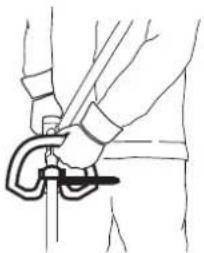
The pin of the barrier bar must be pushed into one of the two holes on the boom to lock into place.
Push the round handle onto the rubber ring provided on the boom.
Insert the 4 mounting bolts from above through the round handle and fix them onto the barrier bar with the 4 nuts.
Tighten the screws
Assembling the quick release mechanism
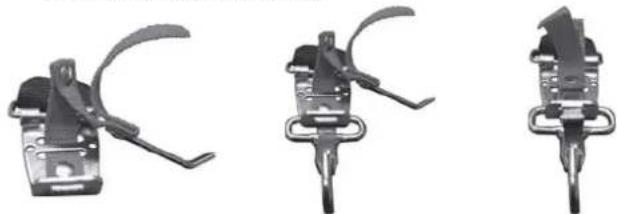
Hook in the carabiner and secure it with the red strap on the quick release mechanism (see figures). Pull on the red strap if you have to put down the appliance quickly.
Fixing/attaching the carrying harness
Hook the carrying harness into the carrying lug
Adjust the length of the carrying harness to your size so that the carrying lug is at hip height when the strap is hooked in place.
Assembling the hedge trimmer
Start by undoing the screw grip 7 on the boom 8 of the engine unit.
Push the pin on the front boom of the hedge trimmer into the groove on the engine unit boom as far as the stop. Once it is correctly inserted, the red line must match up with the one on the engine unit boom.
Tighten the screw grip
NOTE
Assembly of the pole pruner/strimmer/3-section cutting blade/extension attachment is carried out in the same order.
Removing the hedge trimmer
Undo the screw grip 7 and pull the front boom 23 of the hedge trimmer out of the engine unit boom 8.
NOTE
- Removal of the pole pruner/strimmer/3-section cutting blade/extension attachment is carried out in the same order.
Swivelling the hedge trimmer
Release the lock/release18
Press the control lever and swivel the hedge trimmer into the desired position.
Allow the control lever to click into the recess in the base plate (hedge trimmer) 21.
Mounting the saw chain and blade
WARNING!
Wear protective gloves! There is a danger of injury from the sharp cutting teeth!
NOTE
Pay close attention to the running direction of the saw chain on the blade and at the base plate (hedge trimmer).
Depending on wear, the blad can be turned.
Undo the nut35 using the open-ended spanner 65.
Remove the sprocket cover.
Lay the saw chain3 over the blade 3 starting at the tip.
Now fit the blade and saw chain
Lay the guide rail over the blade guide while inserting the chain tensioner pin in the blade hole At the same time, lay the saw chain over the chain sprocket
Now you can tighten the saw chain (see section "Tightening and checking the saw chain").
Replace the sprocket cover38 and tighten the nut 69ently.
Removing the saw chain
You may have to loosen the saw chain 31 to remove the blade 30 and the saw chain 31 (see section "Tightening and checking the saw chain"). Follow these instructions in reverse order.
Tightening and checking the saw chain
WARNING!
Wear protective gloves! There is a danger of injury from the sharp cutting teeth!
Turn the chain-tensioner screw in a clockwise direction using the flat-blade screwdriver to increase the tension.
The saw chain must lie against the underside of the blade. Check whether the saw chain can be drawn over the blade by hand.
NOTE
A new saw chain 31 stretches and must be tightened more frequently.
Lubricating the chain
Remove the oil filler cap26
Fill the oil tank with approx. 100 ml of organic chain oil
The chain lubrication can be increased or decreased using the oil adjusting screw.
Press and then turn the oil adjusting screw clockwise to decrease the chain lubrication.
Press and then turn the oil adjusting screw anticlockwise to increase the chain lubrication.
WARNING!
- Never work without lubricating the chain first! If the saw chain runs dry, the cutting equipment may become irreparably damaged within a short time. Always check chain lubrication and oil level in the tank before starting work.
NOTE
- Use only saw chain oil. Preferably biodegradable. Do not use waste oil, motor oil, etc.
- While working, check whether the chain lubrication is working correctly.
Sharpening the saw chain
NOTE
A bench grinder can be attached to the bench grinder support for a secure grip during grinding.
- You will find detailed information on sharpening in a sharpening set, e.g. from Oregon.
- Alternatively, you can use an electrical saw chain sharpening device and follow the manufacturer's instructions.
If you have any doubts about carrying out the work, the saw chain should be replaced.
Attaching the extension attachment
CAUTION!
Do not use the extension attachment/boon in combination with the 3-section cutting blade/strimmer attachment!
NOTE
Use the extension attachment/boon for working at greater heights.
Fit the extension attachment/boom between the engine unit and the hedge trimmer/pole pruner. The assembly is carried out in the same manner as for the attachments described previously.
Fitting/removing the protective guard
WARNING!
When working with the 3-section cutting blade, the blade guard must be fitted. The blade guard positioned under the metal panel of the boom. The blade guard now attached to the front boom with the 2 screws to do this, use the supplied hex key
Cutting equipment
3-section cutting blade blade guard
48
Strimmer 50
Blade guard cutting filament protective guard
WARNING!
- Do not use any other cutting equipment apart from that which is supplied with the product. The use of any other cutting equipment or protective equipment is deemed to be improper and carries a significant risk of accidents.
Installing/replacing the cutting blade
Fit/remove the 3-section cutting blade as shown in figures 1a-1f.
Find the hole in the drive plate, align it with the opposite hole and block it with the supplied hex key.
Place the 3-section cutting blade on the drive plate (see fig. 1b). The inscription must be visible from above when holding the tool in the working position (see fold-out page). Both sides of the 3-section cutting blade can be used.
Fit the pressure plate over the thread over the splined shaft (see fig. 1c).
Fit the pressure plate cove70 (see fig. 1d).
Tighten the nu with the spark plug spanner anticlockwise ACH-TUNG! Left-hand thread! (see fig. 1f).
The 3-section cutting blade is fitted with a plastic cover on delivery. This must be removed before use and refitted during periods when not in use.
The plastic cover can now be removed.
CAUTION! SHARP EDGES, WEAR PROTECTIVE GLOVES
Fit the cutting filament protective guard on the protective guard 48
The cutting filament protective guard must be fitted when working with the cutting filament. The cutting filament protective guard (pre-fitted on delivery) is fitted as shown in figure 2a.
Ensure that the cutting filament protective guard is correctly clicked into place. There is a blade on the inside of the cutting filament protective guard. This is covered with a safety cover (see fig. 2a.).
Remove the safety cove before starting work and replace it after finishing work.
CAUTION! SHARP EDGES, WEAR PROTECTIVE GLOVES
To remove the cutting filament protective guard from the protective guard make a tool, such as a screwdriver, to carefully remove the three mounting pins.
ATTENTION! RISK OF INJURY!
Installing/replacing the strimmer
Install/replace the strimmer as displayed in figure 2c.
Find the hole in the drive plat, align it with the opposite hole and block it with the supplied hex key.
Screw the strimmer onto the thread in an anticlockwise direction.
ATTENTION! Left-hand thread!
Putting on the carrying harness
NOTE
The following adjustments can be made to make sure that you can work without becoming fatigued. The settings may vary depending on your body size.
Before starting work, adjust the carrying harness to suit your body size.
Balance the appliance with the fitted cutting tool so that the cutting tool swings just over the ground without the need to move the appliance with your hands.
1.) Put on the carrying harness and close the clasps so that they click into place (see fig. 3a).
2.] As shown in figure 3b, pull on the bell to position the carrying harness centrally on your body and adjust the upper body size.
3.) To tighten the two shoulder straps, pull on the two shoulder straps as shown in figure 3c.
4.) To ensure to the correct position of the appliance on the carrying harness, pull the belt as shown in figure 3d.
5.) Hook in the carabiner (see figs. 3e-3g) and secure it with the red strap on the quick release mechanism.
6.) Now take the appliance and hang it so that the carrying lug clicks into the carabiner E, as shown in figure 3h. The carrying lug can also be moved by loosening the screw G and sliding it to achieve the optimum orientation of the appliance.
Setting the cutting height
Put on the carrying harness and hook in the appliance (see section "Putting on the carrying harness").
Use the various belt straps on the carrying harness to adjust the optimum working and cutting position (see section "Putting on the carrying harness").
Perform a few circular movements without starting the engine in order to find the ideal shoulder strap length (see fig. 6a).
The carrying harness is equipped with a quick release mechanism. Pull on the red strap you have to release the appliance quickly (see fig. 3i).
CAUTION
Always use the carrying harness when working with the device. Put on the carrying harness as soon as you have started the engine and it is ticking over. Turn off the engine before removing the carrying harness.
Fuel and oil
Only use a mixture of unleaded petrol (at least RON 95) and special 2-stroke engine oil (JASO FD/ISO-LEGD). Mix the fuel mixture in accordance with the fuel mix table.
Add the respective correct amounts of unleaded petrol and 2-stroke oil to the supplied oil/petrol mixing canister (see "Fuel mix table"). Then shake the canister well.
Fuel mix table
Mixing process: 40 parts petrol to 1 part oil
Petrol 2-stroke oil
0.5 litres 12.5 ml
Use
CAUTION!
Please pay attention to the statutory provisions in the relevant noise protection regulations.
Before starting the appliance, always check that:
The fuel system is not leaking.
The protective equipment and cutting equipment is complete and in perfect working order.
All screw connections are firmly tightened.
All moving parts can move smoothly and freely.
Starting when the engine is cold
CAUTIONI
Never allow the starter pull cord to whip back. This could cause damage.
1.) Fill the fuel tank (see also the section "Fuel and oil").
2.) Push the fuel pump (primer) 15 6 times.
3.) Switch the On/Off switch to "I".
4.) Pull the choke lever into the position | n|
5.) Hold the appliance firmly and pull out the starter pull cord to the point of first resistance. Now pull hard on the starter pull cord. The appliance starts.
6.) If the engine does not start, repeat step 5.
7.) As soon as the engine is running, press first the safety lock-out 1 and then the throttle 9 to activate the automatic choke.
If the engine does not start after several attempts, read the "Troubleshooting guide" section.
CAUTION!
Always pull the starter pull cord 12 straight out. Hold the handle of the starter pull cord 12 firmly when the starter pull cord 12 retracts. Do not allow the starter pull cord 12 whip back.
NOTE
At very high ambient temperatures, it is possible that even a cold engine has to be started without using the choke!
Starting when the engine is hot
(The appliance has been turned off for less than 15-20 minutes)
1.) Switch the On/Off switch to "I".
2.) The choke lever does not need to be pulled out to start a warm motor.
3.) Hold the appliance firmly and pull out the starter pull cord to the point of first resistance. Now pull hard on the starter pull cord. The appliance should start after 1-2 pulls. If the appliance still hasn't started after 6 pulls, repeat steps 1-7 under "Starting when the engine is cold".
Turning the engine off
Emergency stop sequence
If the appliance needs to be stopped immediately, turn the On/Off switch 2 to "0".
Normal sequence
Release the throttle levels and wait until the engine has slowed down to its idling speed. Then move the On/Off switch 2 to "0".
CAUTION!
The 3-section cutting blade must be stationary when the engine is idling. If the 3-section cutting blade is turning, adjust the carburettor!
Working procedures
Before using the appliance, practice all working techniques (see figs. 6a-6c) with the engine stopped.
Extending the cutting filament
To extend the cutting filament, run the engine at full speed and tap the strimmer on the floor. The filament extends automatically. The knife on the cutting filament protective guard cuts the thread to the permissible length (see fig. 6d).
CAUTION!
Grass/weed residues can get caught under the protective guard
Remove the remains using a scraper or similar item when the engine is switched off.
Various cutting methods
Trimming/mowing (3-section cutting blade or strimmer)
Swing the appliance in a scything motion (see fig. 6a).
Hold the cutting tool parallel to the ground and set the desired cutting height.
Low trimming (with strimmer)
Hold the appliance with a slight incline to the ground (see fig. 6b). Always cut away from your body. Never pull the appliance towards you.
Short mowing (with strimmer)
Short mowing removes all the vegetation right down to the ground. Angle the stimmer 30^ to the right. Set the handle to the desired position (see fig. 6c).
Cutting against trees/fences/foundations (with strimmer)
NOTE
The filament will wear or fray quickly if it comes into contact with trees, rocks, walls or foundations. The filament will break off if it strikes fence mesh.
CAUTION!
Do not use the appliance to remove any objects from footpaths, etc. The appliance is powerful and can fling small stones or other objects 15 metres or more and may cause injuries or damage to cars, houses and windows.

Wear protective goggles!
Seizing
Immediately turn off the engine if the cutting tool becomes blocked.
Remove all grass and scrub from the appliance before restarting the appliance.
Prevent kickback
When working with the 3-section cutting blade there is a risk of kickback if the blade strikes against solid obstacles (tree trunks, branches, tree stumps, rocks or similar). This will result in the cutting tool being catapulted back against the direction of rotation. This can lead to the loss of control of the appliance. Do not use the cutting blade near fences, metal posts, boundary stones or foundations. To cut low-density shrubs, position the appliance as shown in fig. 6e to avoid kickbacks.
Working with the hedge trimmer
Cutting techniques
The double-sided cutter bar allows cutting in both directions or by using swinging movements from one side to the other.
For a vertical cut, move the hedge trimmer evenly forwards or up and down in an arc.
For a horizontal cut, move the hedge trimmer in a scything motion along the edge of the hedge so that cut branches fall to the ground.
See fold-out page (figure A).
NOTE
Remove thicker branches with a branch cutter.
Working with the pole pruner
Sawing techniques
WARNING!
Always pay attention to the falling clippings.
Be aware of the danger of branches swinging back.
NOTE
Place the stop on the branch. This will help you work more safely and quietly.
Now you can begin sawing.
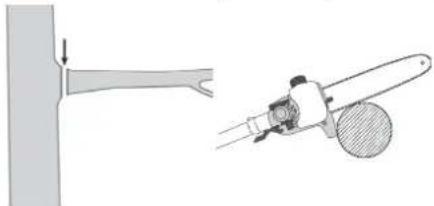
Sawing off small branches
Saw small branches (0 - 8cm) from the top down (see figure).
Sawing off larger branches
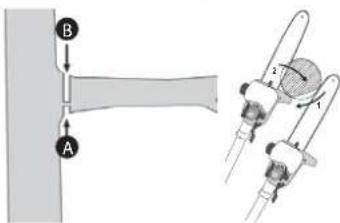
When sawing larger branches (8-25 cm), first make a relief cut (see figure). A relief cut also prevents peeling of the bark on the main trunk.
Saw from the top to the bottom A.
Saw in sections
Trim long or thick branches before you make the final cut (see figure).
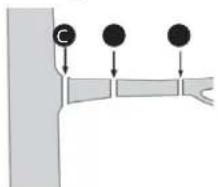
Working safely
- Keep the appliance, the cutting mechanism and the chain guar 60 in good condition to prevent injury.
If the appliance has been dropped, check for significant damage or defects.
Observe the specified working angle max. 60^ ± 10^ to ensure safe working (see figure).
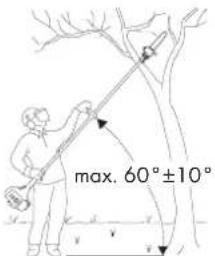
- Do not use the appliance while standing on a ladder or with unsteady footing.
Do not be tempted into making a poorly considered cut. You could endanger yourself and others.
Children should be supervised to ensure that they do not play with the appliance. - Change your working position regularly. Using the appliance for a long time can lead to vibration-related circulation disorders of the hands. You can extend the usage duration by using appropriate gloves or by taking regular breaks. Note that any personal predisposition to poor blood circulation, low external temperatures or large gripping forces can reduce the usage period.
Transport
Use the protective case 59/60 for transporting the appliance.
To prevent injuries, ensure that the appliance cannot switch on during transport (see figure).
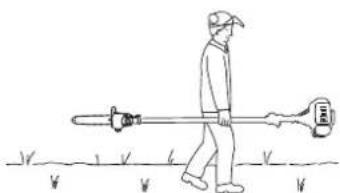
Cleaning
Cleaning the engine unit
NOTE
Clean the appliance thoroughly after every use.
Always switch off the appliance before cleaning and then disconnect the spark plug connector 10.
Clean the appliance regularly with a damp cloth and a mild detergent. Make sure that no water can penetrate into the interior of the appliance.
Cleaning the pole pruner
The pole pruner must be cleaned of sawdust at regular intervals.
Remove the sprocket cover.
Remove the saw chain from the blade and clean the guide rail.
Keep the saw chain sharp and check the tension; check the oil level and the oil supply.
Cleaning the hedge trimmer
Check the hedge trimmer for loose screws on the cutter bar and tighten these if necessary.
Remove stuck cuttings.
Maintain the cutter bar20 using an oil spray or an oil can.
Cleaning the strimmer/cutting blade attachment
Remove stuck cuttings.
Keep the 3-section cutting blade sharp to facilitate your work.
Maintenance
Replacing the strimmer/cutting filament
1.) The strimmer must be removed as described in the section "Installing/ replacing the strimmer". Press the marking (see fig. 5a) and remove the cover (see fig. 5b).
2.) Remove the spool bobbin from the strimmer housing (see fig. 5c).
3.) Remove any remaining cutting filament.
4.) Double the new cutting filament and hook the loop that you have made into the recess on the spool bobbin (see fig. 5d).
5.) Wind the filament tightly in an anticlockwise direction. The spool bobbin separates the two halves of the cutting filament (see fig. 5d).
6.) Now take the cover in your hand and place the spool bobbin in it. Make sure that the filament holder of the spool bobbin lines up with the filament guide on the cover.
7. Now release the cutting filament from the spool bobbin and guide it through the metal eyes in the cover.
8.) Put the two halves of the housing back together so that they click into place.
9.] Cut any excess filament back to about 13cm . This reduces the load on the engine when starting and warming up.
10.] Refit the strimmer (see section "Installing/replacing the strimmer").
Air filter maintenance
Contaminated air filters reduce the engine performance due to low air supply to the carburettor.
Regular inspection is essential. The air filter must be inspected after every 25 hours of operation and cleaned if necessary.
The air filter must be checked more frequently if the air is dusty.
1.) Remove the cover of the air filter housing.
2. Remove the air filter
3.) Clean the air filter by tapping or blowing it out (with compressed air).
4.) Assembly is done in the reverse order.

CAUTION!
Never clean the air filter with petrol or flammable solvents.
Spark plug maintenance
1.) Pull off the spark plug connector.
2.) Remove the spark plug using the enclosed spark plug spanne
3.) Assembly is done in the reverse order.
Electrode gap = 0.6mm (distance between the electrodes between which the ignition spark is generated). Check the spark plug for contamination after the first 10 hours of operation and clean it with a copper wire brush if required.
Afterwards, service the spark plug after every 50 hours of operation.
Grinding the protective guard blade
The blade (see fig. 2a) can become blunt over time. If you find this to be the case, undo the 2 screws that hold the blade onto the cutting filament protective guard. Clamp the blade in a vice. Grind the blade with a sharpening stone and make sure you maintain the angle of the cutting edge.
Adjusting the carburettor
Remove the cover of the air filter housing16.
Adjusting the throttle cable
If the appliance no longer reaches maximum speed after a while and all other causes as described in the "Troubleshooting" section have been ruled out, this may mean that the throttle cable needs to be adjusted. To adjust the throttle cable, screw in the screw or the adjusting screw as well as the lock nut correctly (see Fig. 4).
Lubricating the gears
Add liquid gear grease after every 20 hours of operation (approx. 10g ) to lubricate the angle gear.
To do this, undo the screw (see fold-out page) to press the gear grease into the gear housing.
After filling the gearbox, close the lubrication hole with the screwD.
Storage and transportation
Store the appliance in a safe location.
Store the appliance and accessories in a safe location which is protected against naked flames and sources of heat/sparks, such as gas-powered water heaters, dryers, oil stoves or mobile heaters, etc.
Ensure that the protective guard 43, the strimmer 50 and the engine are free of cutting residue when storing.
The plastic cover for the 3-section cutting blade must be refitted for transport and storage.
Always turn the appliance off before performing any maintenance work and remove the spark plug connector 10
Storing the appliance
The appliance must be prepared for storage if it is to be stored for longer than 30 days. Otherwise the residual fuel in the carburettor will evaporate and leave a gooey sediment. This may make starting the appliance more difficult and result in expensive repair work.
- Remove the filler cap to relieve any pressure in the fuel tank Carefully empty the fuel tank 13
2.) To remove all fuel from the carburettor, start the engine and leave it to run until it stops.
3.) Allow the engine to cool for about 10 minutes.
4.) Remove the spark plug (see section "Spark plug maintenance").
5.) Add 1 teaspoon of 2-stroke oil to the combustion chamber. Pull the starter pull cord 12 several times to wet all mechanical parts with oil. Replace the spark plug.
NOTE
Store the appliance in a dry place and away from possible ignition sources.
Start-up after storage
1.) Remove the spark plug (see section "Spark plug maintenance").
2.) Pull the starter pull cord quickly in order to remove any excess oil from the combustion chamber.
3.) Clean the spark plug and observe the correct electrode gap on the spark plug.
4.) Fill the fuel tank. See the section "Fuel and oil".
Transport
If you are planning to transport the appliance, empty the fuel tank as explained in the section "Storage".
Troubleshooting
Engine unit
| Problem Possible | cause Troubleshooting | |
| The engine does not start. | Incorrect start-up process. For | low the instructions regarding starting. |
| The engine starts but does not run at full power. | Incorrect adjustment of the choke lever ①. | Set the choke lever ① to ①. |
| Contaminated air filter. Clean | air filter. | |
| The engine does not run smoothly. | Incorrect spark plug gap. Clean | clean the spark plug and adjust the spark plug gap or replace the spark plug. |
| Soot deposits or wetness on the spark plug. | Incorrect carburettor adjustment. | Clean spark plug or replace it with a new spark plug. |
Pole pruner
| Problem Possible | Cause Troubleshooting | |
| Motor is running,saw chain 31 does not move. | Hedge trimmer attachment or pole pruner attachment is not connected properly to the engine unit. | Check assembly. |
| No progress. | Saw chain 31/over-heating or is sagging. | Top up the oil or reg-rind, replace or tighten the saw chain 31 |
Hedge trimmer
| Problem Possible | Cause Troubleshooting | |
| Motor is running, blades do not move. | Hedge trimmer attachment or pole pruner attachment is not connected properly to the engine unit. | Check assembly. |
Maintenance intervals
Polepruner
The figures given here are based on normal operating conditions. In the event of more difficult conditions, such as strong dust generation and longer daily operating hours, the given intervals are to be reduced correspondingly.
| Appli- ance part | Action Before | starting work | Weekly | n the event of faults | In the event of dam- age | As re- quired |
| Lubricat- ing the chain | Check | X | ||||
| Check saw chain 31 | and pay attention to the sharp- ness | X | ||||
| Check chain tension | X | |||||
| sharpen X | ||||||
| Check guide rail 41 | (wear, damage) | X | ||||
| clean and turn | X | X | ||||
| deburr X | ||||||
| replace | X | X | ||||
| Check sprocket | X | |||||
| replace | X |
Hedge trimmer
The figures given here are based on normal operating conditions. In the event of more difficult conditions, such as strong dust generation and longer daily operating hours, the given intervals are to be reduced correspondingly.
| Appliance part | Action | Before starting work | After completion of work | As required |
| Cutting blade | Visual inspection | X | ||
| Cleaning | X | X |
Ordering spare parts
Ordering spare parts
The following information should be provided when ordering spare parts:
Type of appliance
Item number of the appliance
Device ID number
Current prices and information are available at
www.kompernass.com
NOTE
Replacement parts which are not listed (e.g. strimmer, cutting filament) can be ordered via our service hotline.
Disposal

The packaging is made from environmentally friendly materials and can be disposed of at your local recycling plant. The appliance and its accessories are made from various materials, such as metal and plastic.
Your local community or municipal authorities can provide information on how to dispose of the appliance.
Environmental protection
Carefully empty the petrol and oil tank and dispose of your appliance at a recycling plant. The plastic and metal parts used can be separated and recycled.
Dispose of waste oil and petrol at a waste collection centre and do not dump these into the sewerage or drainage system.
Dispose of contaminated maintenance material and working materials at a collection point provided for this purpose.
This appliance has a 3-year warranty valid from the date of purchase. If this product has any faults, you, the buyer, have certain statutory rights. Your statutory rights are not restricted in any way by the warranty described below.
Warranty conditions
The validity period of the warranty starts from the date of purchase. Please keep your original receipt in a safe place. This document will be required as proof of purchase.
If any material or production fault occurs within three years of the date of purchase of the product, we will either repair or replace the product for you at our discretion. This warranty service is dependent on you presenting the defective appliance and the proof of purchase (receipt) and a short written description of the fault and its time of occurrence.
If the defect is covered by the warranty, your product will either be repaired or replaced by us. The repair or replacement of a product does not signify the beginning of a new warranty period.
Warranty period and statutory claims for defects
The warranty period is not prolonged by repairs effected under the warranty. This also applies to replaced and repaired components. Any damage and defects present at the time of purchase must be reported immediately after unpacking. Repairs carried out after expiry of the warranty period shall be subject to a fee.
Scope of the warranty
This appliance has been manufactured in accordance with strict quality guidelines and inspected meticulously prior to delivery.
The warranty covers material faults or production faults. The warranty does not extend to product parts subject to normal wear and tear or fragile parts such as switches, batteries, baking moulds or parts made of glass.
The warranty does not apply if the product has been damaged, improperly used or improperly maintained. The directions in the operating instructions for the product regarding proper use of the product are to be strictly followed. Uses and actions that are discouraged in the operating instructions or which are warned against must be avoided.
This product is intended solely for private use and not for commercial purposes. The warranty shall be deemed void in cases of misuse or improper handling, use of force and modifications/repairs which have not been carried out by one of our authorised Service centres.
Warranty claim procedure
To ensure quick processing of your case, please observe the following instructions:
Please have the till receipt and the item number (e.g. IAN 12345) available as proof of purchase.
You will find the item number on the type plate, an engraving on the front page of the instructions (bottom left), or as a sticker on the rear or bottom of the appliance.
If functional or other defects occur, please contact the service depart- ment listed either by telephone or by e-mail.
You can return a defective product to us free of charge to the service address that will be provided to you. Ensure that you enclose the proof of purchase (till receipt) and information about what the defect is and when it occurred.

You can download these instructions along with many other manuals, product videos and software on www.lidl-service.com.
Service
WARNING!
Have your appliance repaired by qualified specialists only. Always use genuine spare parts. This will ensure that the safety of the appliance is maintained.
GB Service Great Britain
Please note that the following address is not the service address. Please use the service address provided in the operating instructions.
KOMPERNASS HANDELS GMBH
BURGSTRASSE 21
DE-44867 BOCHUM
GERMANY
www.kompernass.com
Translation of the original Conformity Declaration
We, KOMPERNASS HANDELS GMBH, document officer: Mr. Semi Uguzlu, BURGSTR. 21, DE-44867 BOCHUM, GERMANY, hereby declare that this appliance complies with the following standards, normative documents and EC directives:
Machinery directive (2006/42/EC)
Outdoor directive
(2005/88/EC)
(2000/14/EC)
Emissions directive (2012/46/EU)
Applied harmonised standards:
EN ISO 11806-1:2011
EN ISO 10517:2009+A1
EN ISO 11680-1:2011
Type/appliance designation:
4-in-1 Petrol Multi-Tool FBK 4 B2
Year of manufacture: 01 - 2017
Serial number: IAN 282573
Bochum, 06/01/2017
CE
Semi Uguzlu
- Quality Manager
We reserve the right to technical changes in the context of further product development.
Table des matieres
Introduction 38
Chere cliente, cher client
KOMPERNASS HANDELS GMBH
BURGSTRASSE 21
DE-44867 BOCHUM
ALLEMAGNE
www.kompernass.com
Directive relative aux machines (2006/42/CE)
- Responsible qualite -
BENZINE-COMBI-APPARAAT 4-IN-1 FBK 4 B2
Inleiding
Zaagketting: Oregon 91P040X
Draadspoel/
mes-hulpstuk: FBK 4 B2-2
KOMPERNASS HANDELS GMBH
BURGSTRASSE 21
DE-44867 BOCHUM
DUITSLAND
www.kompernass.com
Benzine-combi-apparaat 4-in-1 FBK 4 B2
Pozor! Padajici predmely.
Obzvlaste pri rezani nad hlavou.

Pozor! Nebezpeci zraneni beziciimi nozi.

Dodržovat odstup!

Obecná ystrahal

POZOR! OSTRE HRANY, NOSIT OCHRANNÉ RUKAVICE
Namontovat ochranny kryt frezaci strunna ochranny kryt 48
Pri praci s rezac strunou se navic musi namontovat ochranny kryt rezac struny G. Montaz ochranneho krytu rezac struny G (ktery je z tovamy jiz predmontovan) se provadi tak, jak je znazorneno na obr. 2a.
Dbeje na to, aby ochranny kryt rezac strun spravne zaklap. Na vnilfni strane ochranneho krytu rezac struny se nachazi nuA Tento je zakryt pojistikou (viz obr. 2a).
Prid zaćatem prace pojistć odstrante a po przyci ji opět pripevněte.

POZOR! OSTRE HRANY, NOSIT OCHRANNÉ RUKAVICE
K demontázi ochranného krytu rezacı strunc z ochranného krytu si k opatrnému povoleni tri upevnovacich koliku vezmete na pomoc napr. szroubovák. POZORI NEBEZPECI ZRANENI!
Mohlo by to ohrozit Vás iostatni.
Deti musi byt pod dohledem, a to pro jistotu, aby si s pristrojem nehraly.
Mente pravidelné svou pracovni polohu. Delsi pouzivani pristroje muze vest k porucham prokrveni rukou zpusobenym vibracemi. Dobu pouzi-vani vsak muzete prodlouzit vhdnymi rukavicemi nebo pravidelnimi prestavkami. Upozornujeme, ze obsn diispozice k spatneu prokrveni, nizke venkovni teploty nebo velk sily vynakladane na udrzeni pristroje pri praci mohou dobu pouzivani snizit.
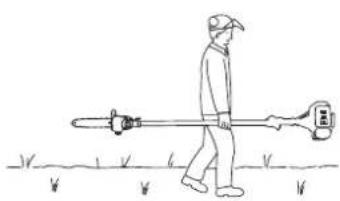
Preprava
Pri preprave pouziveje ochranna pouzdr 60
Dbeje na to, abyste pristoj pri prenaseni nezapnuli, predejdete tak zraneni (viz obrazek).
Cisteni
KOMPERNASS HANDELS GMBH
BURGSTRASSE 21
DE-44867 BOCHUM
NEMECKO
www.kompernass.com
KOMPERNASS HANDELS GMBH
BURGSTRASSE 21
DE-44867 BOCHUM
ALEMANIA
www.kompernass.com
KOMPERNASS HANDELS GMBH
BURGSTRASSE 21
DE-44867 BOCHUM
ALEMANHA
www.kompernass.com
KOMPERNASS HANDELS GMBH
BURGSTRASSE 21
DE-44867BOCHUM
GERMANY
www.kompernass.com