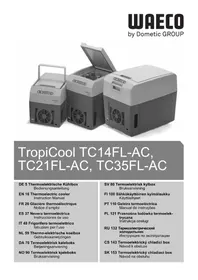
TropiCool TC35 - Fridge WAECO - Free user manual and instructions
Find the device manual for free TropiCool TC35 WAECO in PDF.


| Product type | Mobile thermoelectric cooler |
| Brand | Waeco (WAECO) |
| Model | TropiCool TC35 |
| Energy efficiency class | A++ |
| Gross capacity | 35 liters |
| Net capacity | 33 liters |
| Weight | 10 kg |
| Power supply | 12/24 V DC or 220-240 V~ AC |
| Power consumption | 46 W (12 V), 50 W (24 V), 64 W (230 V); approx. 77 kWh/year |
| Temperature range (cooling) | Down to approx. 1 °C inside (max 30 °C below ambient temperature) |
| Temperature range (heating) | Up to approx. 65 °C inside |
| Climate class | T (ambient temperature: +16 °C to +43 °C) |
| Cooling system | Peltier (wear-free) with fan dissipation |
| Main functions | Cooling, heating, ECO mode, automatic priority switching, temperature memory |
| Display | LED indicators: blue for cooling, red for heating; 7-level temperature indicator |
| Maintenance and cleaning | Clean with a damp cloth; do not immerse; do not use abrasive products |
| Safety | Unplug before cleaning; do not use if damaged; use a residual current device on boats |
| Spare parts and repairability | Repairs reserved for authorized service; power cable fuse (5 A) replaceable |
| Delivery contents | Cooler, 230 V mains cable, 12/24 V cable, user manual |
| Noise | 41 dB(A) |
| Certifications | CE, TÜV GS |
Frequently Asked Questions - TropiCool TC35 WAECO
User questions about TropiCool TC35 WAECO
0 question about this device. Answer the ones you know or ask your own.
Ask a new question about this device
Download the instructions for your Fridge in PDF format for free! Find your manual TropiCool TC35 - WAECO and take your electronic device back in hand. On this page are published all the documents necessary for the use of your device. TropiCool TC35 by WAECO.
USER MANUAL TropiCool TC35 WAECO
TropiCool TC14FL-AC, TC21FL-AC, TC35FL-AC
Please read this operating manual carefully before starting the device. Keep it in a safe place for future reference. If the device is passed on to another person, this operating manual must be handed over to the user along with it.
The manufacturer cannot be held liable for damage resulting from improper usage or incorrect operation.
List of contents
1 Explanation of symbols 16
2 Safety notes 17
3 Scope of delivery 19
4 Use as intended 19
5 Technical description 20
6 Operation 20
7 Cleaning and servicing. 23
8 Disposal 23
9 Troubleshooting 24
10 Technical data 25
1 Explanation of symbols

DANGER!
Safety instruction: Failure to observe this instruction will cause fatal or serious injury.

WARNING!
Safety instruction: Failure to observe this instruction can cause fatal or serious injury.

CAUTION!
Safety instruction: Failure to observe this instruction can lead to injury.

NOTICE!
Failure to observe this instruction can cause material damage and impair the function of the product.

NOTE
Supplementary information for operating the product.
Action: This symbol indicates that action is required on your part. The required action is described step-by-step.
This symbol describes the result of an action.
2 Safety notes
2.1 General safety

fig. 1 5, page 3: This refers to an element in an illustration. In this case, item 5 in figure 1 on page 3.
DANGER!
- On boats: If the appliance is powered by the mains, ensure that the power supply has a residual current circuit breaker.

WARNING!
- Do not operate the device if it is visibly damaged.
- This device may only be repaired by qualified personnel. Improper repairs can lead to considerable hazards.
- Persons (including children) whose physical, sensory or mental capacities or whose lack of experience or knowledge prevent them from using this product safely should not operate it without the supervision or instruction of a responsible person.
- Electrical devices are not toys. Always keep and use the device out of the reach of children.
Children must be supervised to ensure that they do not play with the device. -
If this device's power cable is damaged, it must be replaced by the manufacturer, customer service or a similarly qualified person in order to prevent safety hazards.
-
Do not store any explosive substances such as spray cans with propellants in the device.

CAUTION!
-
Disconnect the device from the mains
-
before each cleaning and maintenance
-
after every use
-
Food may only be stored in its original packaging or in suitable containers.

NOTICE!
- Only connect the device as follows:
- With the DC cable to a DC plug socket in the vehicle (e. g. cigarette lighter)
- Or with the 230 V connection cable to the 230 V AC mains supply
- Check that the voltage specification on the type plate corresponds to that of the energy supply.
- The cooling device is not suitable for transporting caustic materials or materials containing solvents.
- Never pull the plug out of the socket by the cable.
- If the cooler is connected to the DC socket: Disconnect the cooler and other power consuming devices from the battery before connecting the quick charging device.
- If the cooler is connected to the DC socket: Disconnect the cooler or switch it off when you turn off the engine. Otherwise, you may discharge the battery.
2.2 Operating the device safely

DANGER!
- Do not touch exposed cables with your bare hands. This especially applies when operating the device with an AC mains power supply.

CAUTION!
- Before starting the device, ensure that the power supply line and the plug are dry.

NOTICE!
- Do not use electrical devices inside the cooler unless they are recommended by the manufacturer for the purpose.
- Do not place the device near naked flames or other heat sources (heaters, direct sunlight, gas ovens etc.).
- Danger of overheating!
Ensure at all times that there is sufficient ventilation so that the heat that arises during operation does not build up. Make sure that the device is sufficiently far away from walls and other objects so that the air can circulate.
- Ensure that the ventilation openings are not covered.
- Do not fill the inner container with ice or fluid.
- Never immerse the device in water.
- Protect the device and the cable against heat and moisture.
3 Scope of delivery
Refrigerator
- Connection cable for 220-240 V~
- Connection cable for 12/24 V=
- Instruction manual
Check before starting up the device that all parts are available belonging to the scope of delivery.
4 Use as intended
The refrigerator can be used to cool and keep foodstuffs warm. The device can be also used for camping purposes.
If you want to cool medicine, check please if the cooling capacity of the device corresponds to the requirements of the respective pharmaceuticals.
All materials processed in the refrigerator are safe for foodstuffs.
5 Technical description
The cooling box is suitable for mobile use. It can cool goods up to max. 30°C under ambient temperature (thermostatic switch-off with approx. +1°C ) or keep them cool or warm them up to max. 65°C or keep them warm.
If the device has reached the set temperature range, then it will automatically switch over to the energy save mode. In this mode only the energy is consumed which is required to reach the temperature inside the box.
The cooling is a wear-free thermo-electric cooler with heat removal through a ventilator.
The cooling box is equipped with an automatic priority circuit. Thus it is ensured that with simultaneous connection to the alternating current circuit and to a 12/24-V-battery, the alternating current circuit will be used.
6 Operation

NOTE
Before you put the new refrigerator into operation, you should clean it inside and outside with a damp cloth for hygienic reasons (see also chapter "Cleaning and servicing" on page 23).
6.1 Tips to save energy

NOTE
A ventilator in the interior space of the cooling box provides for the circulation of the cold air within the box. Thus a better cooling capacity will be achieved. In order that the cold air cannot reach the outside when opening the cooling box, this is equipped with a switch which turns off the ventilator as soon as the lid is opened.
- Choose a well ventilated installation location which is protected against direct sunlight.
- If you want to set an increased energy efficiency and a limited cooling capacity for the cooler unit, use the cooler's ECO mode.
- Allow warm food to cool down first before placing it in the device to keep cool.
- Do not open the cooling device more often than necessary.
- Do not leave the cooler unit open for longer than necessary.
6.2 TC35FL-AC: Opening the cooler
The TC35FL-AC cooler must be unlocked for opening (fig. 4, page 3).
6.3 Switch on the cooling box

NOTICE!
Take care that there are only objects or goods in the cooling box which may be cooled or heated to the selected temperature.
Place the cooling box on a stable base.

NOTE
The plug is safe against wrong polarity: You can plug it only in one direction into the (fig. 3, page 3) socket.
Connect the cooling box
- with the connecting cable contained in the scope of delivery to a 220-240 V socket or...
- with the supplied connecting cable to the 12/24 V socket in the vehicle (fig. 3, page 3).
Press the button "ON/OFF" at the control panel (fig. 2 A, page 3) to switch on the cooling box.
✓The cooling box starts to cool or heat the interior space.
Operating display Operating mode
red (fig. 2 B, page 3)
heating
blue (fig. 2 C, page 3) cooling
6.4 Switch over between cooling and heating
If you want to switch over between cooling and heating, press the button "HOT/COLD" (fig. 2 D, page 3).

NOTE
The control unit of the cooling box has a memory function. It memorises the selected temperature range for each mode (cooling and heating). Thus the temperature range which is previously selected in the mode is set again with each switching on or switching over.
The red or blue operating display lights up and the device starts to cool/heat.
When you want to finish the cooling or heating process, press the button "ON/OFF" (fig. 2 A, page 3).
When you stop using the cooler, disconnect it from the mains.
6.5 Select temperature
The status display of the temperature (fig. 2 F, page 3) indicates the selected temperature range. With an increasing number of illuminating LEDs, the intensity of the temperature range also increases.

NOTE
The following temperature indications are subject to tolerances and are dependent on the measuring position.
Interior space-temperature at approx. 25°C ambient temperature:
| Status display Temperature range | |
| Cooling | seven illuminating LEDs approx 1 °C in the interior space |
| an illuminating LED approx 16 °C in the interior space (ECO mode) | |
| Heating | seven illuminating LEDs approx 65 °C in the interior space |
| an illuminating LED approx 50 °C in the interior space |
If you want to select the temperature to cool/heat, press the button "Temp" (fig. 2 F, page 3), until the requested temperature range is reached.
6.6 Connect to the cigarette lighter

NOTE
When you connect the cooling box to the cigarette lighter of your vehicle (fig. 3, page 3), observe that you have to turn on the ignition, if necessary, so that the device is supplied with current.
6.7 Removing the lid
You can remove the lid of the cooler (fig. 5, page 4):
Open the lid until it is at a ca. 30° angle to the cooler.
Pull the lid forwards and lift it off diagonally.
7 Cleaning and servicing

WARNING!
Always disconnect the device from the mains before you clean and service it.

NOTICE! Risk of damage
- Never clean the cooler under running water or in dish water.
- Do not use abrasive cleaning agents or hard objects during cleaning as these can damage the cooler.
Occasionally clean the device interior and exterior with a damp cloth.
Make sure that the air inlet and outlet vents on the device are free of any dust and dirt, so that heat can be released and the device is not damaged.
8 Disposal
Place the packaging material in the appropriate recycling waste bins wherever possible.
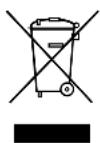
If you wish to finally dispose of the product, ask your local recycling centre or specialist dealer for details about how to do this in accordance with the applicable disposal regulations.
9 Troubleshooting
Fault Possible cause Suggestion
Your box does not function and the fan impeller which is visible from outside does not rotate.
The cigarette lighter in your vehicle does not conduct any voltage.
In the most vehicles, the ignition switch must be switched on, so that the cigarette lighter has voltage.
The ignition is switched on and the box does not work. Disconnect the plug immediately from the socket and execute the following checks.
The socket of the cigarette lighter is dirty. This results in a poor electrical contact.
Clean the socket of the cigarette lighter with a non-metallic brush and a solvent, so that the middle contact pin is clean. If your cooling box plug becomes very warm in the cigarette lighter box, either the socket must be cleaned or the plug is possibly not correctly assembled.
The fuse of the connecting cable is burnt through.
Replace the fuse of the connecting cable (5 A).
The vehicle fuse is burnt through.
Replace the vehicle fuse of the cigarette lighter (usually 15 A). (Observe the operating instructions in your motorcar for this).
Your box does not cool satisfactorily and the fan impeller at the outside does not rotate.
The ventilator motor is defective.
The repair can be executed only by an authorized customer service.
Your box does not cool satisfactorily and the fan impeller at the outside does not rotate.
The ventilator motor for the inner ventilator is defective.
The repair can be executed only by an authorized customer service.
The thermo-electric element is defective.
The integrated power unit is defective.
The repair can be executed only by an authorized customer service.
10 Technical data
| TC14FL-AC TC21FL-AC TC35FL-L-AC | |||
| Input voltage: | 12/24 V----/220-240 V~ | ||
| Power input: | 46 W (12 V----) 50 W (24 V----) 64 W (230 V~) | ||
| 8.5 W (AC, ECO mode) | 8.8 W (AC, ECO mode) | ||
| Temperature range: | Cooling: up to approx. 1 °C interior space-temperature (up to 30 °C under ambient temperature) Heating: up to approx. 65 °C interior space-temperature | ||
| Category: 10 (other compartment) | 10 (other compartment) | 10 (other compartment) | |
| Energy efficiency class: A++ A++ A++ | |||
| Energy consumption: 74 kWh/annum 77 kWh/annum 77 kWh/annum | |||
| Gross capacity: 14 | 21 | 35 I | |||
| Usable capacity: | 14 | 20 | 33 I | ||
| Climate class: | T | T | T |
| Ambient temperature: | +16 °C- +43 °C | +16 °C- +43 °C | +16 °C- +43 °C |
| Noise emission: | 41 dB(A) | 41 dB(A) | 41 dB(A) |
| Weight: | 5,5 kg | 7 kg | 10 kg |
| Inspection/Certificate: | CE e 4 TÜV GS Sichwer | CE e 4 TÜV GS Sichwer | CE e 4 TÜV GS Sichwer |
5 Description technique
Rd (fig. 2 B, side 3)
Opvarmning
Blà (fig. 2 C, side 3)
Afkøling
6.1 Tips for energisparing

MERK
Rd (fig. 2 B, side 3)
Varme
Blå (fig. 2 C, side 3) Kjøle
Bce MaTePnaJIbI, INcNoJIb3YeMbIe B XOJIOuINbHnKe, He Bbl3bIBaHT ONaCeHn IJr npOdyKTOB nITaHnJ.
5 Texnueckoe Onncahne
XoIIOHbHK NOxOHT Ira MObHOrO nCNoB3OBaHn. OH MoKeToxJaXdaTb npOyKtbl Do Tempepatpyb MaKc. 30 ° C HnKe TeMnepatpyb OkpykaHoue cpebl (TePMocTaTnueckoe OTKnUoyHe ne npn OK. +1 ° C ) n
NODepKINBaTb INX B OXnJaXeHHOM COCTOHN INI IN NOOrpeBaTb INX DO TEM- nepaTpybIMakc. 65°C IN NOdepKINBaTb B pa3OrpeTom COCTOHN.
Ecn np6op DoCTnHacTpoEHHO Dnana30Ha Tempeatyp, To OH aBtomaTneckn nepeKIOUaETcB peXm 3HeproScbepeXeHna. B 3Tom peXime noTpe6IeTcToIbKO 3HeprN, Tpe6yemaJn PoIDepXaHn TempepaTypbl BHyTpN XoNoDnBnka.
OxnaKeHne oBecnueNBaeTcR HeN3HaUNBaEMbIMN 3JeMeHTamN PJIbTbe, a OTBOI TeIIa oBecneuNBaeTcR BeHTNIJrTOpOM.
XoIOnIbHnK OChaSeH aBtOMaTnueckO npOpnteTHo CXemoi. OHa oBeCneuBaet, yTo - npi OndHOBpeMeHHOM npICoEdnHeHN K cTeN nepeMeHHoro Toka n 6aTaapee 12/24B - nCnoIb3yeTcra cTe b nepemeHHoro Toka.
6 YnpaBJIeHne

YKA3AHNE
Ipeed BBODOM HOBOrO XoJIoNJIbHnKa B pa6Ory ero, B rInrHeHuecknx ZeIax, CneIyEt npTepeTb cHApxN I N3HyTpN BJaXHOITpIKNoI (cM. TaKKe «UncTkA n yXoD» Ha cTp. 140).
6.1 CoBeTbI no 3Heproc6epeKeHnIO

YKA3AHNE
BeHTnIaTOp BHyTpN XoIoAnIbHnKa obecneuINBaET cnpKyIaIHO XoIoOnHOrO Bo3dyxa, 6laoradapr Yemy DoCTnraeTcR LyUshaer XoIo-ONpOn3BOdntelbHocTb. IJra TOrO, UTO6bl XoIoOnHbB O3dux npi OTkpBITnXoIoAnIbHnKa He BbIXoIIn Hapxuy, XoIoAnIbHnK OChaueH BbIKIOuataTeJeM, KOTOpBI BbIKIOUaet BeHTnIaTOp pni OTkpBITn KpbIshKn.
- BbIbpaIte XopoIo npOBeTpNaemoe, 3aunueHHoe OT COJIHeHbIX lyueMecTo npImMeHnIa.
- Ecni Bbi XOTIte OTpeRyIInpOBAbT NOBbiUeHHyIO 3HeproaΦΦeKTHBHOCTb IN ORpaHnueHHyIO XOLODOpPON3BOIDTeJIbHOCTb XOLODINbHnka, TO BOCNoJb3yItecB peXIMOM pa60tBI XOLODINbHnka ECO.
- Дайта сенихам oxладиься, пекдем подерхиBaTb INB XOLOДHOM COCTОгнIN B XOLOДИльнIKE.
He OTKpbBaIte XoJOnnJIbHnK YaIe, Yem 3TO DeIcTBnTeJIbHO Heo6xOIMO.
He octabnayTe XOJIOJIbHNIK OTKpbITbIM DOJIbIe, Yem 3TO DeiCTBNTeJIbHO Heo6XoIIMO.
6.2 TC35FL-AC:OTKpbITne xoJIoNJIbHnKa
XoIOnIbHnK TC35FL-AC npn OTKpbTmN DoJxKeH 6bITb pa36IoKnpoBaH (pnc. 4, ctp. 3).
6.3 BkIIOUeHne XOIoJNbHnka

BHUMAHNE!
CneIte 3a TeM, YTO6bIB XOJIOINbHnKe HaxoININcB TOJIbKO npEIMeTbI INPOyKTbI, KOTOpbIE pa3peWaeTcR OXJaKdaTb IIN pa3OrpeBaTb Do BbIbpaHHoTempePaTypbI.
YcTaHOBInTe XoIOnIbHnK Ha npOHyIO onOpy.

YKA3AHNE
UTekep nMeet 3aunTy OT nepenolIOcOBKn. Bbl MoKeTe BCTaBnTbe ro TOnbKO B ODNOM HAnpaBHeHn B rHe3do (pnc. 3, cTp. 3).
ПрсоeINHHTe XOJOnIbHNK
- BXOДЯПИМВ OБьEM NOCTaBKN COeINHHTeMbIIM Ka6eJIeM K pO3eTke cETn NepemeHHoro Toka 220-240 B, nII ...
- BXOДЯИМВ OБьEM NOCTaBKN COeДиHHTeJIbHbIM Ka6eJIeM K pO3eTKe 12/24 Bв abTomo6nne (pnc. 3, cTp. 3).
Дя Вкюецьхолдьнka нажмte кону «ON/OFF» ha naheyn ynpablenen (pnc. 2 A,стp. 3).
XoIOniNbHnK NaHnHaET OxJaDaTb IIn HarpeBaTb BHyTpHee npocTpaHCTBO.
Cervená (obr. B, strane 3)
Ohrievanie
Modra (obr. 2 C, strane 3)
Chladenie
Dometic Australia Pty. Ltd.
1 John Duncan Court
Varsity Lakes QLD 4227
+61755076000
+61755076001
Mail: sales@dometic-waeco.com.au
AUSTRIA
Dometic Austria GmbH
The Gateway 25 Canton Road,
Tsim Sha Tsui·Kowloon
Hong Kong
+852 24611386
+852 24665553
Mail: info@dometic-waeco.com.hk
ITALY
Domatic Italy S.r.l.
Via Virgilio, 3
I-47100 Forl
+390543754901
+390543756631
Mail: info@dometic.it
NORWAY
Dometic Norway AS
Skolmar 24
N-3232 Sandefjord
+4733428450
+4733428459
Mail: firmapost@waeco.no
POLAND
Domatic Poland Sp. z o.o.
UI. Puławska 435A
02-801 Warszawa
Poland
+48224143200
+48224143201
Mail: info@dometic.pl
RUSSIA
Dometic RUS LLC
Komsomolskaya square 6-1
107140 Moscow
Russia
+74957807939
+74959165653
Mail: info@dometic.ru
SLOVAKIA
Domatic Slovakia s.r.o.
Tehelná 8
SK-98601 Filakovo
+421 47 4319 107
+421474319166
Mail: info@dometic.sk
SPAIN
Dometic Spain S.L.
Avda. Sierra del Guadarrama, 16
E-28691 Villanueva de la Canada
Madrid
+34902111042
+34900100245
Mail: info@dometic.es
SWEDEN
Dometic Scandinavia AB
Gustaf Melins gata 7
Domatic Switzerland AG
Riedackerstrasse 7a
CH-8153 Rümlang (Zürich)
+41448187171
+41448187191
Mail: info@dometic-waeco.ch
TAIWAN
WAECO Impex Ltd.
Taipei Office
2 FL-3 · No. 56 Tunhua South Rd, Sec 2
Taipei 106, Taiwan
+886227014090
+886227060119
Mail: marketing@dometic-waeco.com.tw
UNITED KINGDOM
Domatic UK Ltd.
Dometic House The Brewery
Blandford St. Mary
DorsetDT119LS
+448446260133
+448446260143
Mail: sales@dometic.co.uk
UNITED ARAB STATES
Domatic Middle East FZCO
P.O.Box 17860
S-D 6, Jebel Ali Freezone
Dubai, United Arab Emirates
+97148833858
+97148833868
Mail: info@dometic.ae
UNITED STATES OF AMERICA
Dometic Marine Division
2000 N. Andrews Ave. Extension
Pompano Beach, FL 33069 USA
+19549732477
+19549794414
Mail: marinesales@dometicusa.com
- TropiCool TC14FL-AC, TC21FL-AC, TC35FL-AC
- List of contents
- Explanation of symbols
- DANGER!
- WARNING!
- CAUTION!
- NOTICE!
- NOTE
- Safety notes
- General safety
- Operating the device safely
- Scope of delivery
- Use as intended
- Technical description
- Operation
- Tips to save energy
- TC35FL-AC: Opening the cooler
- Switch on the cooling box
- Operating display Operating mode
- Switch over between cooling and heating
- Select temperature
- Connect to the cigarette lighter
- Removing the lid
- Cleaning and servicing
- NOTICE! Risk of damage
- Disposal
- Troubleshooting
- Fault Possible cause Suggestion
- Technical data
- Description technique
- Tips for energisparing
- MERK
- Texnueckoe Onncahne
- YnpaBJIeHne
- YKA3AHNE
- CoBeTbI no 3Heproc6epeKeHnIO
- TC35FL-AC:OTKpbITne xoJIoNJIbHnKa
- BkIIOUeHne XOIoJNbHnka
- BHUMAHNE!
- Dometic Australia Pty. Ltd.
- AUSTRIA
- Dometic Austria GmbH
- ITALY
- Domatic Italy S.r.l.
- NORWAY
- Dometic Norway AS
- POLAND
- Domatic Poland Sp. z o.o.
- RUSSIA
- Dometic RUS LLC
- SLOVAKIA
- Domatic Slovakia s.r.o.
- SPAIN
- Dometic Spain S.L.
- SWEDEN
- Dometic Scandinavia AB
- Domatic Switzerland AG
- TAIWAN
- WAECO Impex Ltd.
- UNITED KINGDOM
- Domatic UK Ltd.
- UNITED ARAB STATES
- Domatic Middle East FZCO
- UNITED STATES OF AMERICA
- Dometic Marine Division
Brand : WAECO
Model : TropiCool TC35
Category : Fridge