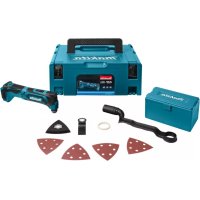
TM30DZJX4 - Multifunction tool MAKITA - Free user manual and instructions
Find the device manual for free TM30DZJX4 MAKITA in PDF.


| Product Type | Cordless Multi-Tool |
| Brand | Makita |
| Model | TM30DZJX4 (TM30D) |
| Rated Voltage | 10.8 V - 12 V max DC |
| Oscillations per Minute | 6,000 - 20,000 min⁻¹ |
| Oscillation Angle | 1.6° left/right (3.2° total) |
| Overall Length | 277 mm - 296 mm |
| Net Weight | 1.1 - 1.3 kg |
| Compatible Batteries | BL1016, BL1021B, BL1041B (Lithium-ion) |
| Compatible Chargers | DC10SA, DC10SB, DC10WC, DC10WD, DC18RE |
| Intended Uses | Sawing, cutting (wood, plastic, non-ferrous metals), dry sanding, scraping, fixing |
| Sound Pressure Level (sanding) | 78 dB(A) (K=3 dB(A)) |
| Sound Pressure Level (plunge cutting) | 85 dB(A) (K=3 dB(A)) |
| Sound Power Level (plunge cutting) | 93 dB(A) (K=3 dB(A)) |
| Vibration (sanding) | ≤2.5 m/s² (K=1.5 m/s²) |
| Vibration (plunge cutting) | 10.5 m/s² (K=1.5 m/s²) |
| Vibration (segmental cutting) | 5.5 m/s² (K=1.5 m/s²) |
| Vibration (scraping) | 9.0 m/s² (K=1.5 m/s²) |
| Orbital Stroke Rate Adjustment | 5 positions (1 to 5) |
| Front Lamp | Built-in, lights with switch |
| Battery Protection System | Protection against overload, high temperature and deep discharge |
| Included Accessories | Hex wrench, sanding pad (depending on version) |
| Safety Standards | EN62841-2-4, EN62841-1 |
Frequently Asked Questions - TM30DZJX4 MAKITA
User questions about TM30DZJX4 MAKITA
0 question about this device. Answer the ones you know or ask your own.
Ask a new question about this device
Download the instructions for your Multifunction tool in PDF format for free! Find your manual TM30DZJX4 - MAKITA and take your electronic device back in hand. On this page are published all the documents necessary for the use of your device. TM30DZJX4 by MAKITA.
USER MANUAL TM30DZJX4 MAKITA
- Due to our continuing program of research and development, the specifications herein are subject to change without notice.
- Specifications may differ from country to country.
The weight may differ depending on the attachment(s), including the battery cartridge. The lightest and heaviest combinations, according to EPTA-Procedure 01/2014, are shown in the table.
Applicable battery cartridge and charger
| Battery cartridge BL1016 / BL1021B / BL1041B | |
| Charger DC10SA / DC10SB / DC10WC / DC10WD / DC18RE |
Some of the battery cartridges and chargers listed above may not be available depending on your region of residence.
WARNING: Only use the battery cartridges and chargers listed above. Use of any other battery cartridges and chargers may cause injury and/or fire.
Intended use
The tool is intended for sawing and cutting wood, plastic, gypsum, non-ferrous metals, and fastening elements (e.g. nails and staples). It is also intended for working soft wall tiles, as well as dry sanding and scraping of small surfaces. It is especially for working close to edge and flush cutting.
Noise
The typical A-weighted noise level determined according to EN62841-2-4:
Work mode: Sanding
Sound pressure level (L_pA):78 dB (A)
Uncertainty (K): 3 dB (A)
The noise level under working may exceed 80 dB (A).
The typical A-weighted noise level determined according to EN62841-1:
Work mode: Cutting with plunge cut saw blade
The typical A-weighted noise level determined according to EN62841-1:
Work mode: Cutting with segmental saw blade
Sound pressure level (L_pA):84 dB(A)
Sound power level (L_WA):92dB(A)
Uncertainty (K) : 3 dB(A)
The typical A-weighted noise level determined according to EN62841-1:
Work mode: Scraping
Sound pressure level (L_pA):84 dB(A)
Sound power level (L_WA):92 dB (A)
Uncertainty (K) : 3 dB(A)
NOTE: The declared noise emission value(s) has been measured in accordance with a standard test method and may be used for comparing one tool with another.
NOTE: The declared noise emission value(s) may also be used in a preliminary assessment of exposure.
WARNING: Wear ear protection.
WARNING: The noise emission during actual use of the power tool can differ from the declared value(s) depending on the ways in which the tool is used especially what kind of workpiece is processed.
WARNING: Be sure to identify safety measures to protect the operator that are based on an estimation of exposure in the actual conditions of use (taking account of all parts of the operating cycle such as the times when the tool is switched off and when it is running idle in addition to the trigger time).
Vibration
The vibration total value (tri-axial vector sum) determined according to EN62841-2-4:
Work mode: Sanding
Vibration emission (a_h):2.5m / s^2 or less
Uncertainty (K): 1.5m / s^2
The vibration total value (tri-axial vector sum) determined according to EN62841-1:
Work mode: Cutting with plunge cut saw blade
Vibration emission (a_h):10.5m / s^2
Uncertainty (K): 1.5m / s^2
The vibration total value (tri-axial vector sum) determined according to EN62841-1:
Work mode: Cutting with segmental saw blade
Vibration emission (a_h):5.5m / s^2
Uncertainty (K): 1.5m / s^2
The vibration total value (tri-axial vector sum) determined according to EN62841-1:
Work mode: Scraping
Vibration emission (a_h):9.0m / s^2
Uncertainty (K): 1.5m / s^2
NOTE: The declared vibration total value(s) has been measured in accordance with a standard test method and may be used for comparing one tool with another.
NOTE: The declared vibration total value(s) may also be used in a preliminary assessment of exposure.
WARNING: The vibration emission during actual use of the power tool can differ from the declared value(s) depending on the ways in which the tool is used especially what kind of workpiece is processed.
WARNING: Be sure to identify safety measures to protect the operator that are based on an estimation of exposure in the actual conditions of use (taking account of all parts of the operating cycle such as the times when the tool is switched off and when it is running idle in addition to the trigger time).
Declarations of Conformity
For European countries only
The Declarations of conformity are included in Annex A to this instruction manual.
SAFETYWARNINGS
General power tool safety warnings
WARNING Read all safety warnings, instructions, illustrations and specifications provided with this power tool. Failure to follow all instructions listed below may result in electric shock, fire and/or serious injury.
Save all warnings and instructions for future reference.
The term "power tool" in the warnings refers to your mains-operated (corded) power tool or battery-operated (cordless) power tool.
Cordless multi tool safety warnings
-
This power tool is intended to function for sawing, cutting, scraping and sanding. Read all safety warnings, instructions, illustrations and specifications provided with this power tool. Failure to follow all instructions listed below may result in electric shock, fire and/or serious injury.
-
Hold power tool by insulated gripping surfaces, when performing an operation where the cutting accessory may contact hidden wiring. Cutting accessory contacting a "live" wire may make exposed metal parts of the power tool "live" and could give the operator an electric shock.
- Use clamps or another practical way to secure and support the workpiece to a stable platform. Holding the work by hand or against your body leaves it unstable and may lead to loss of control.
- Always use safety glasses or goggles. Ordinary eye or sun glasses are NOT safety glasses.
- Hold the tool firmly.
- Make sure the application tool is not contacting the workpiece before the switch is turned on.
- Keep hands away from moving parts.
- Do not leave the tool running. Operate the tool only when hand-held.
- Always switch off and wait for the blade to come to a complete stop before removing the blade from the workpiece.
- Do not touch the application tool or the workpiece immediately after operation; they may be extremely hot and could burn your skin.
- Do not operate the tool at no-load unnecessarily.
- Always use the correct dust mask/respirator for the material and application you are working with.
- Some material contains chemicals which may be toxic. Take caution to prevent dust inhalation and skin contact. Follow material supplier safety data.
- This tool has not been waterproofed, so do not use water on the workpiece surface.
- Ventilate your work area adequately when you perform sanding operations.
- Use of this tool to sand some products, paints and wood could expose user to dust containing hazardous substances. Use appropriate respiratory protection.
- Be sure that there are no cracks or breakage on the pad before use. Cracks or breakage may cause a personal injury.
- Do not use accessories which are not specifically designed and recommended by the tool manufacturer. Just because the accessory can be attached to your power tool, it does not assure safe operation.
-
Wear personal protective equipment. Depending on application, use face shield, safety goggles or safety glasses. As appropriate, wear hearing protectors, gloves and workshop apron capable of stopping small abrasive or workpiece fragments. The eye protection must be capable of stopping flying debris generated by various operations. The dust mask or respirator must be capable of filtrating particles generated by your operation. Prolonged exposure to high intensity noise may cause hearing loss.
-
Keep bystanders a safe distance away from work area. Anyone entering the work area must wear personal protective equipment. Fragments of workpiece or of a broken accessory may fly away and cause injury beyond immediate area of operation.
- Never lay the power tool down until the accessory has come to a complete stop. The spinning accessory may grab the surface and pull the power tool out of your control.
- Do not run the power tool while carrying it at your side. Accidental contact with the accessory could snag your clothing, pulling the accessory into your body.
- Do not operate the power tool near flammable materials. Sparks could ignite these materials.
- Do not use accessories that require liquid coolants. Using water or other liquid coolants may result in electrocution or shock.
- Always be sure that the tool is switched off and unplugged or that the battery cartridge is removed before carrying out any work on the tool.
- Always be sure you have a firm footing. Be sure no one is below when using the tool in high locations.
- Before operation, make sure that there is no buried object such as electric pipe, water pipe or gas pipe in the workpiece. Otherwise, it may cause an electric shock, electrical leakage or gas leak.
SAVE THESE INSTRUCTIONS.
WARNING: DO NOT let comfort or familiarity with product (gained from repeated use) replace strict adherence to safety rules for the subject product. MISUSE or failure to follow the safety rules stated in this instruction manual may cause serious personal injury.
Important safety instructions for battery cartridge
- Before using battery cartridge, read all instructions and cautionary markings on (1) battery charger, (2) battery, and (3) product using battery.
- Do not disassemble or tamper with the battery cartridge. It may result in a fire, excessive heat, or explosion.
- If operating time has become excessively shorter, stop operating immediately. It may result in a risk of overheating, possible burns and even an explosion.
- If electrolyte gets into your eyes, rinse them out with clear water and seek medical attention right away. It may result in loss of your eyesight.
- Do not short the battery cartridge:
(1) Do not touch the terminals with any conductive material.
(2) Avoid storing battery cartridge in a container with other metal objects such as nails, coins, etc.
(3) Do not expose battery cartridge to water or rain.
A battery short can cause a large current flow, overheating, possible burns and even a breakdown.
- Do not store and use the tool and battery cartridge in locations where the temperature may reach or exceed 50^ (122^) .
- Do not incinerate the battery cartridge even if it is severely damaged or is completely worn out. The battery cartridge can explode in a fire.
- Do not nail, cut, crush, throw, drop the battery cartridge, or hit against a hard object to the battery cartridge. Such conduct may result in a fire, excessive heat, or explosion.
- Do not use a damaged battery.
- The contained lithium-ion batteries are subject to the Dangerous Goods Legislation requirements. For commercial transports e.g. by third parties, forwarding agents, special requirement on packaging and labeling must be observed. For preparation of the item being shipped, consulting an expert for hazardous material is required. Please also observe possibly more detailed national regulations. Tape or mask off open contacts and pack up the battery in such a manner that it cannot move around in the packaging.
- When disposing the battery cartridge, remove it from the tool and dispose of it in a safe place. Follow your local regulations relating to disposal of battery.
- Use the batteries only with the products specified by Makita. Installing the batteries to non-compliant products may result in a fire, excessive heat, explosion, or leak of electrolyte.
- If the tool is not used for a long period of time, the battery must be removed from the tool.
- During and after use, the battery cartridge may take on heat which can cause burns or low temperature burns. Pay attention to the handling of hot battery cartridges.
- Do not touch the terminal of the tool immediately after use as it may get hot enough to cause burns.
- Do not allow chips, dust, or soil stuck into the terminals, holes, and grooves of the battery cartridge. It may cause heating, catching fire, burst and malfunction of the tool or battery cartridge, resulting in burns or personal injury.
- Unless the tool supports the use near high-voltage electrical power lines, do not use the battery cartridge near high-voltage electrical power lines. It may result in a malfunction or breakdown of the tool or battery cartridge.
- Keep the battery away from children.
SAVE THESE INSTRUCTIONS.
CAUTION: Only use genuine Makita batteries. Use of non-genuine Makita batteries, or batteries that have been altered, may result in the battery bursting causing fires, personal injury and damage. It will also void the Makita warranty for the Makita tool and charger.
Tips for maintaining maximum battery life
- Charge the battery cartridge before completely discharged. Always stop tool operation and charge the battery cartridge when you notice less tool power.
- Never recharge a fully charged battery cartridge. Overcharging shortens the battery service life.
- Charge the battery cartridge with room temperature at 10^ - 40^ (50°F - 104°F). Let a hot battery cartridge cool down before charging it.
- When not using the battery cartridge, remove it from the tool or the charger.
FUNCTIONAL DESCRIPTION
CAUTION: Always be sure that the tool is switched off and the battery cartridge is removed before adjusting or checking function on the tool.
Installing or removing battery cartridge
CAUTION: Always switch off the tool before installing or removing of the battery cartridge.
CAUTION: Hold the tool and the battery cartridge firmly when installing or removing battery cartridge. Failure to hold the tool and the battery cartridge firmly may cause them to slip off your hands and result in damage to the tool and battery cartridge and a personal injury.
▶ Fig.1: 1. Red indicator 2. Button 3. Battery cartridge
To remove the battery cartridge, slide it from the tool while sliding the button on the front of the cartridge.
To install the battery cartridge, align the tongue on the battery cartridge with the groove in the housing and slip it into place. Insert it all the way until it locks in place with a little click. If you can see the red indicator as shown in the figure, it is not locked completely.
CAUTION: Always install the battery cartridge fully until the red indicator cannot be seen. If not, it may accidentally fall out of the tool, causing injury to you or someone around you.
CAUTION: Do not install the battery cartridge forcibly. If the cartridge does not slide in easily, it is not being inserted correctly.
Battery protection system
The tool is equipped with a battery protection system.
This system automatically cuts off power to the motor to extend battery life.
The tool will automatically stop during operation if the tool and/or battery are placed under one of the following conditions:
Overloaded:
The tool is operated in a manner that causes it to draw an abnormally high current.
In this situation, turn the tool off and stop the application that caused the tool to become overloaded. Then turn the tool on to restart.
If the tool does not start, the battery is overheated. In this situation, let the battery cool before turning the tool on again.
Low battery voltage:
The remaining battery capacity is too low and the tool will not operate. If you turn the tool on, the motor runs again but stops soon. In this situation, remove and recharge the battery.
Indicating the remaining battery capacity
Only for battery cartridges with the indicator
Fig.2: 1. Indicator lamps 2. Check button
Press the check button on the battery cartridge to indicate the remaining battery capacity. The indicator lamps light up for a few seconds.
| Indicator lamps Remaining | capacity | |
| Lighted Off | □ | |
| 75% to 100% | ||
| 50% to 75% | ||
| 25% to 50% | ||
| 0% to 25% | ||
NOTE: Depending on the conditions of use and the ambient temperature, the indication may differ slightly from the actual capacity.
Switch action
CAUTION: Before installing the battery cartridge into the tool, always check to see that the tool is switched off.
Fig.3: 1. Slide switch
To start the tool, slide the slide switch toward the "I (ON)" position.
To stop the tool, slide the slide switch toward the "O (OFF)" position.
Adjusting the orbital stroke rate
Fig.4: 1. Dial
The orbital stroke rate is adjustable. To change the orbital stroke rate, turn the dial between 1 and 5. The higher the number is, the higher the orbital stroke rate is. Preset the dial to the number suitable for your workpiece.
NOTE: The dial cannot be turned directly from 1 to 5 or from 5 to 1. Forcing the dial may damage the tool. When changing the dial direction, always turn the dial moving it through each intermediate number.
Lighting up the front lamp
CAUTION: Do not look in the light or see the source of light directly.
Fig.5: 1. Front lamp
Slide the slide switch toward the "I (ON)" position to light up the front lamp. The lamp keeps on lighting while the switch is the "I (ON)" position.
The light automatically goes out after pressing the rear of the slide switch, and then sliding the slide switch toward the "O (OFF)" position.
Overload protection
When the tool is overloaded and temperature of the tool or the battery cartridge reaches a certain level, the front lamp blinks and the tool automatically stops. Remove a cause of overload, and cool down the tool and the battery cartridge to restart.
ASSEMBLY
CAUTION: Always be sure that the tool is switched off and the battery cartridge is removed before carrying out any work on the tool.
Installing or removing application tool
Optional accessory
WARNING: Do not install application tool upside down. Installing application tool upside down may damage the tool and cause serious personal injury.
NOTE: Install application tool in the correct direction according to your work. Application tool can be installed at an angle of every 30 degree.
To Install an application tool (optional accessory), put the application tool on the tool flange so that the protrusions of the tool flange fit in the holes in the application tool. Then secure the application tool by tightening the bolt firmly with the hex wrench.
Fig.6: 1. Protrusions of the tool flange 2. Holes in the application tool 3. Application tool installation bolt
Fig.7: 1. Application tool installation bolt 2. Hex wrench 3. Tighten
To remove the application tool, loosen and remove the application tool installation bolt using a hex wrench and then take off the application tool.
When using the tool as a sander, set a sanding paper on the sanding pad (hook and loop fitting).
Make sure that their shape and dust extraction holes match each other when setting.
Fig.8: 1. Sanding pad 2. Tighten 3. Sanding paper
To remove the sanding paper, raise its end and peel it off.
When using application tools with a different type of installation section, use a correct adapter (optional accessory).
Fig.9: 1. Application tool installation bolt 2. Holes in the application tool 3. Adapter (required for some application tools) 4. Protrusions of the tool flange
Hex wrench storage
Fig.10: 1. Hex wrench
When not in use, store the hex wrench as shown in the figure to keep it from being lost.
OPERATION
WARNING: Before starting the tool and during operation, keep your hand and face away from the application tool.
CAUTION: Do not apply excessive load to the tool which may cause a motor lock and stop the tool.
CAUTION: Do not operate the tool with pressing the battery cartridge against the tool.
Cutting, sawing and scraping
CAUTION: Do not move on the tool forcibly in the direction (eg. towards either side) of tool application with no cutting edge. It may damage the tool.
Fig.11
Put the application tool on the workpiece.
And then move the tool forward so that the application tool movement does not slow down.
NOTE: Forcing or excessive pressure on the tool may reduce efficiency.
NOTE: Before cutting operation, it is recommended to preset the orbital stroke rate 3 - 5.
Sanding
CAUTION: Do not reuse a sanding paper used for sanding metal to sand wood.
CAUTION: Do not use a worn sanding paper or sanding paper without grit.
Apply a sanding paper on the workpiece.
Fig.12
NOTE: Using a test material sample to try is recommendable to determine a correct orbital stroke rate suitable for your work.
NOTE: Use a sanding paper with the same grit until sanding the whole workpiece is completed. Replacing a sanding paper with different grit sanding paper may not get a fine finish.
Dust extraction attachment
Optional accessory
CAUTION: Do not use the dust extraction attachment when sanding metal. Sucking spark and hot particle results in smoking and ignition.
▶ Fig.13: 1. Joint 2. Nozzle band 3. Dust nozzle 4. Dust attachment 5. Spacer 6. Felt ring (ø 47 mm) 7. Pad (with STARLOCK marking) 8. Application tool installation bolt 9. Felt ring (ø 37 mm) 10. Pad (with OIS marking)
- Install joint, dust nozzle and dust attachment.
- Install the nozzle band on the tool so that its protrusions fit in the holes in the tool to secure it.
- Put the felt ring and the sanding pad on the dust attachment and then secure them with the application tool installation bolt.
To perform cleaner operation, connect a vacuum cleaner to the tool. Connect a hose of vacuum cleaner to the dust extraction attachment (optional accessory).
Fig.14
MAINTENANCE
CAUTION: Always be sure that the tool is switched off and the battery cartridge is removed before attempting to perform inspection or maintenance.
NOTICE: Never use gasoline, benzine, thinner, alcohol or the like. Discoloration, deformation or cracks may result.
To maintain product SAFETY and RELIABILITY, repairs, any other maintenance or adjustment should be performed by Makita Authorized or Factory Service Centers, always using Makita replacement parts.
OPTIONAL ACCESSORIES
CAUTION: These accessories or attachments are recommended for use with your Makita tool specified in this manual. The use of any other accessories or attachments might present a risk of injury to persons. Only use accessory or attachment for its stated purpose.
If you need any assistance for more details regarding these accessories, ask your local Makita Service Center.
Segment saw blade
Round saw blade
- Plunge cut saw blade
- Scaper (rigid)
- Scaper (flexible)
- Serrated seg blade
General joint cutter
- HM remover
HMseg saw blade
- HM sanding plate
Diamond seg sawblade
- Sanding pad
- Adapter
- Abrasive paper delta (red / white / black)
- Fleece delta (medium / coarse / without grit)
Polishing felt delta
- Hex wrench
- Dust extraction attachment
- Makita genuine battery and charger
NOTE: Some items in the list may be included in the tool package as standard accessories. They may differ from country to country.
SPECIFICATIONS
ACCESSIONS EN OPTION
VEILIGHEIDSWAARSCHUWINGEN
OPTIONELE ACCESSOIRES
Cortar, serrary raspar
EkToum n oynonc (a): 9,0 m/s2
Aβεβαiδητα(K):1,5m/s²
IAPATHPHSH: H T 山 山 ( ) O uvoAikwv kpaadaouwv exei eptnpo ioupwva me nTv pTOTUIN eOdo dokiunc kai mTopei va xpnoiotoineY iia T ouykpiog evoc pyaaleiou e KATIO aAALO.
NAPATHPHSH: H T () ouvoikwv kpaadaaowv mTopei va xnpoiotointhetai kai otnv TpoKaTapKTIKn axioloyon Tns ekthetaons.
A NPOEIAOIOIH: H EKTOPTN Kpdaaumw KA t n XpnoTou nAekptiKoEpyaleiou e Tpaayatikec ouvthkeC mTopei va diaapeei an to T dnawevn tiun(εs) EKTOPTNc avaloya e Tou c poutouc xpoanC tou epyaieou, iiaitepa to EIOcTou Teuaxiou epyaoiaC Tous UTOKEITAI ETESEpyaia.
A PPOEI OIOIH: Povtiote va labetae ta katalnnla metpa npoataiac tou xepiotn baoei evoc utoloyioou tsE kEoons oT pyayatikcs ouvntkec xpns (aauabovtac utoyn oaes Tc ouviotwoecs tou kuklou aeitoupyiac otwoc touxpoiou cTO TO Epyaleio eivai EKTOS AEIToupyiac kai otav piokei aepav n aeitoupyia nepav tou xpvou Evpyooinos).
Δηλωση Συμύρφωσης
Móvo yia xwpe ts Eupwnns
O1Anwoseic∑muoppwonπeipaaβavovtai oTo
Papaptnma A oTo napov eYxεipidio odnyiwv.
ПОНТОИЗEGI
AΣΦΑΛΕΙΑΣ
Evikc pOeioToIOeI aOaaleiayia to nEKTpiko epyaeeio
A PPOEIOOIH H aIaBaoTe oIe Tc TPOEI- 0010nOeI c aopaaieac, ONYIEc, EIKOVoypaqnoei KAI TPOBIAYPApeC Tou TApexovta Ie auto To nKTPiKO epyaleio. H m npon oawv twv oyviw vou avayapovtai KatWTepw mTOpE i va kataanEi e nAE KTOPTANJia, TUPKayia n/Kai Obaapo Tpaumatioo.
UαTe oεc TIG POeioToin-σεi KAI TIG OByie G YIA μελoVTIKn TApapouπn.
Ttpoeiooiaei, o opoc «nEeKtpiO epyaleio» avapeetai oe nEeKTPIO epyaleio Tou TpOPOTeiTai aTo Tnv Kupia TApoxn NkEeTKPIOU emuatc (Me nEeKPTIko Kaawio) n OE nEeKTPIO epyaleio Tou TpOPOTeiTai aTo MTTaia (xwpiNkEeKTPIO kaawio).
PpOeIodOnoiNoEiC yia TnV aOoFαAεiα yia To φopntó TnλUεpyaεio
- Auto To nEeKTPIO EpyAeio TPOOPIETAI YIA TPOIOVA, KOITN, EUGIO KAI LEIAVON. AiaBaoTE OAEs TIC TPOEIOTOINOEi C OAPAAIEAC, OENYIEs, ANEIKOVIOEIG KAI TPOIDAYPAPECS TOU OUVOeUouv TO TAPOV NEkTPIO EpyAeio. H mTnpon oAWv Tuv ONDyW vou aVpaovTai KATWTepw MTOpei va KATAANGEI OE nEeKPTOINJIA, TUPKAYIA n/Kai OOBAPO TPAUATIOUo.
- Na Kpatate To nAektpiko Epyaaleio aTIO TIG Movwvec ETiawveic laBnC OTAV EKTEaleite Epyaiec kata TIC OTIOe ts EApntma KOTNCS MTOpei va ePthetae OE TTAPH Nkpumueva KaWdelta. ZE TEPiTTwoN Etapnc Tou EApntmuatoc KOtnc MNE Aektpofo KoAWIO, MTOpei Ta EKTE-0eva METAIAKA EApntmuata Tou nAektpkoU Epyaaleiou VA KAATAOuv TAIBI nAektpofopa KAI VA TPOKAeouv NAEKTPoITAnxiia OTo Xeipiotn.
- Na xpnoiouieite oiykntpec n kantoio aallo Tpaktiko meo yia va aopaizete kai va otnpi zete to teuxo epyaioac oe ia otaepn nataopua.Av kpatate to teuxio epyaioac oe to xepi oac n tivawto owma oc,theta iai aotae c kai mtopei va xaote tov eaeyxo.
- Na xpoioiopoieite navtoe yuaia a ophialeiac n pooatauteikα paiwv. Ta ouvnioeva yuaia kai ta yuaia naiou DEN aTROeauv yuaia aphialeiac.
- KpatnoTe To epyaIeio oTaOepa.
- Na βεβαινεοτε ΜTο εργαλείο εφαμουγής δεν ακουμπάει TTo τεμαχίο εργασίας πΠν ενεργοτοίεITE TOnδιακόπηλειουργίας.
- Mny nnoia zete Ta xepia oac oe Kivoumu eva epn.
-
Mny apnvte To epyaleio oE aeitoupyia.To epyaleio npetnei va piokeTai oE aeitoupyia mvo otav to kpatate.
-
NaVToE va oBnVete To epyaAeio kai va TepiueveTe va Otaatnoei va KiveiTai EvTeAωs n AmaTpiiv Tn ByaCte aTO TEmuXIO epyaOiac.
- Mny ayyicTe To epyaIio eapuoyns to Teiaoxe pyaoiaag aeoos mTa Tn aeitoupyia Tou epyaIiou. MTopei va evai Eaipetikk epka kai va npokanthei eykauma oTo depma ca.
- Mn θέτετο εργαλείο σε λειπουργία χωρίς φόpto, αν auto δεν εἶναι παραιπὸ.
- Na xpoioiopoieite navtoe npoomega kata tnc okovn n avantveuotnpa trou eivai katal- Anloc yia to uiko kai tnv epapoyn oac.
- Mepiku uiku Tepiexovxmu kou tpoei va eivai tokia. Ipooexete wote va aiopeuyete nV EIOTvon oKovnc kai tnv eTnqn me to δepua.Akoautheta ta δeOeva aosfaaleiac uikou Toun npexovta anto tv pountheutn.
- To εργαλείο αὐτό δέν εἰναι αἰδίβροχο, γι' αὐτό μη χρησιμοποίειν ερό στην επιφάνεια του τεμαχίου εργασίας.
- Na aepizete to xwpo epyaoiaac tnapkwc otav ektealeite epyaiec laivanc.
- H xphon Tou epyaaleiou autou yia tn leiavon oipouevwv poiovtwv,baowkai uawv mtopeiv aekoei To xpnoTn oe kovn Tou nepiexe tIKivuvec ouiec. Na xphoioptoiite katalnnan avattveutik npootaia.
- Piv aTo Tn xpOn, va eaiwveote otI dev utapxouv pwyeç n oTaaiura tO n baoon. O pwyueç n ta oTaaiura μTopei va Tpokaé- couv oBapo TpoosNIKO TpaUaTIaO.
- Mn xpoiooioe iEapntnata Tou dev exouv oxediostei EIDiKa yia to epyaaleio kai Tou dev ouviotwtai EIDiKa aTTOV KAATAKEuaOTn Tou epyaieou. H xpon evoc EApntmuoC atla kai mvo ETEiD huvatai va PpOAPmuTei oTo nAekptiko epyaleio,Dev diaqpaalizI Tnv aopaaH aeitoupyia Tou.
-
Na φopáte atoúkó εgπλισο πpooταiac. Avaloya με tnv εφapuoyn, va xŋoɪμoTIOEITE πpooTlIDA ppoTαiac, ppoTeutiká yuaλia-tpoωπiδεç n yuaia aσφαλεiac. ōtav aataeitai, va φopáte ppoTateutiká akɔng, yavTiKa TODIa OUVεpyeiou IKAVa V TAPéXouv TPOOtaia aTO ta EKTIVAOOμeva MIPaOμata Tou λεiavTKOU μεou n Tou TEpaXiou Epyaioac. Ta TPOOATEUTIKA μatiw TTpeTIeI va εivai IKAVa σATAHNOUVTUXOV EKTIVAOSOμeva θpaʊμata Tou δημIoPyouVTai KATA nTv EKTLEON δiaΦρωv EpyaioW. H μaoka OKovnc n naVATVEOTIKN OUKeUN TTpeTIe Iva εivai IKavec va φItpapouv Ta σωμatIDIA Tou δημIoPyouVTai KATA nTv EKTLEON TWv EpyaioW oac. H TapatetauEvn EKθeON ΕθOpuBo uynλnc EvTaon C TTopei va Tpokaloei aTiwλeia akɔng.
20.ΦovTiOe wote oI TapeupIOKóEvOI va Bpi- OKOvTA OE aOpaAaN aTIOaON aTIO TN θEoN Epyaioac. OTIOIOBnTOTE EIOEpyeTAl OTO Xwpo Epyaioac nPeTEIva oopa EsoTIAOo aToMIkns PPOoTACiAc. Opaouata Tou TEuaXiou Epyaioac n Evoc EApntmuoTou Exei UTOTe Ipaun OTOpei va EKTIVaxBoUV KA VA PPokaEaouv Tpaumaio pEpaivTwopiwv Tou aEoou Xwpu EKTLEeON epyaioW. -
Mny aqnvete To nAekptiko epyaaleio kAtw, Tpiv Otaupatnoe i npwg n Tepiotpown Tou EapntnatoC. To TepiotpeoEvO EAptnua mTopei va Eumlambdaeoi Tnv ETIAPVAEpyaiac KAI VA TpaBnEi TO nAekptko epyaaleio EKTOS Aevxou.
- Mn ΕεσεTE TO ΜλΕΚΤΡΙΚΟ εργαλείο ΕλειΟύργia, KATA Tn ΜεταφρόA Tou OTO ΛΑΙ Ας. Tuxia Επαφή με To Εξάρτημα θα μΠούσεν Φ προκαλε-σει Tnv εμπλοκή Tou OTO pουχισό και επαφή με To σωμα σας.
- Mn xeiipieoTe TO nAekptiko epyaaleio kovTa oE uAekta uAikc. OITIVthpeC mTPOe i va TpokaAeouv avapAeGn autwTwuAikwv.
- Mn xnpoiopoioite Egaptna Tou aattouv Uypa uukia.H xpon vepou n aaawu ypuov uukikwv mtope va kataanxi o e naektpoianxi a nook.
- Na 4povtiEe TavTg TnV aTVEpyoioi non kai aTOnuovdeon Tou epyaieou kai Tnv apaipeon Tng Kaetac mTatapiw TPiv aTOn Tnv EKTEeon OTIOAOBHTOTE epyaiaocTo epyaieio.
- Na βεβαινωνεότε πάντοε ὄτι έτέκεσε ος έθερα. Oταν χρησιμιοποίει το εργαλείοσε σεύηλες τοῦθεοίες, να βεβαινωνεότε ὄτι δεν βρίσκεται κανένας αἰτό κατω.
- Piv Tn aeitoupyia, Bbaiwtheta otivapxie katoio amuevo avtikeiEvo oTWC nKtpikoc oWanvac, OwAnvacc vepou nOwAnvaccpiou oTo Teuxo epyaosic. dApopetikac, Tpoe va poknEi nKtpoTAnxi, Nktpikn diappon n diappon aepiou.
KaTaNVToTOHETNON,vaBepaiWtheOToOxnaTou KAI OI ONC EAYWNGKoVNC TaipiaZouv MTeaTuOc.
Eik.8: 1. Baoon eiaavocg 2. 3. Fuaioxapto
Tia va aqapéoet To yuaoxapTo, oNKwote To akpo Tou Kai aqapéoTe To.
Otav xnpoiotnoieE pyaleia epapoyns E diaopoPETIKo TUTo TmuatoC ykataaotaC, npoiotoine Owto Pooapoyea (TpoaipeTKo aSeouap).
Eik.9: 1. Mntoulovi totoehtnong εpyaeeiou εapapoyns 2. Otec sto εpyaeeio εapapoyng 3. Ppooapoyea (attaiteiayia epiKa εpyaeeia εapapoyng) 4. Ppoexocstn φλavzεpyaeeiou
Eik.10: 1. EaywviKo kAeI
OTAV dev xpoaiouioiteTo eaywviokkoi, aiooKeuote to otiwac ateikoviietai, ia va mnu to xaete.
AEITOYPTIA
Eik.13: 1. Evwog 2. Zwn akpouoiou
3.Akpoopuio 0Kovns 4.Ipooapntma 0Kovns 5.ATtoatnc 6. 0aktuio 0oxas (47mm)7.Baon ( ) STARLOCK
8. Mtnoulovi Ttooetnang epyaaiou
εφαρογης 9. Δakτuλioς τοχας (0 37 mm)
10. Baoη (με ενδειξη OIS)
- TOnoTheTnEv Evwn,To aKpOpuio Kovnc kai To TPOaPTnua OKovns.
- TOnoTheTne TcWvN akpoouoiu OTo EpyaAio WATE oI PPOEoxEc va TaipiaQov OTc OTc OTo EpyaAio, yia va to aopaiOeT.
- TOnoTeTnate To dakTuAio Tooxas Kai Tn Baon eivanoc OTo TPOOaPTnua OKovns KAI tA aopaiote Ta Te To Pmoulovi TOnoTeTnnc EpyaEiou EapuoynC.
Tia va ekteleoeTe kaapotepec epyaiecs, ouvdeote nE- ktpiKn okoUTa oTo epyaleio. uvdote tov eukamTTo 0wlnva Tns nEektpiKnc okoUTACe To pOoaptnua Eaywyng oKovns (TPOaipetiko EApntma).
Eik.14
SYNTHPH∑H
A INPOOXH: Npiv Tnv EKTaleon Epyaovv EITIe- wponc n ouvtnpnoc, naVTote va 8ebaWveote oTn ouakeun aTVEpyoTOINkE KAI n Kaetata mTatapiwexi apaipethetai.
EIAONOIHs: Mv xpnoiouoieTne TepeVziv, Tepaikocaihepa, diautko, akoan n Taipouoe ouic. Mtopei va poknthei aoXpuaioos, npapopawon npwysc.
Tia Tn diatnpnon Tng A2AFAEIAZ kai AIOIISTIAZ tou TpoiovtoC,OI ETIOKeuec KAI OTIOIAbHNTote aALN epyaia ouvtnponnc npuOmuong TpETTEVA EKTEAOvTuAtIO EGOIOBtneva n EpyoTaiaKa Kevtpa EGUITNPETNOs TnS Makita, xpoiouTOIWvTac TAVOTe AVAAAKTIA TNG Makita.
ΠPOAIPETIKA ΕΑPTHMATA
A NPOEXH: Auta ta agptnata n npoaptnata ouviotwta iia xpno n e to epyaieio Makita Tnou Tneipypaaptnke otic oyniec autc. H xpno ontooiovonntote aawv egapntnatwv n npoapntnatwv mTopei va Tpokaaei kivduvo TpaumaTIOOUe atOa. Na xpnoiopoitoeite ta egapntnata n Tpoapntnata mOvo ia tnv xpno nou pooepizovtaI.
Eav xpeiaeote OTIOaIbHTOTE Bontheia yia TEPIOOTepc TAnpoopopiec oE oxenmuata, aTtovTheiTOToTIKOaC Kevtpo Eutnpetnns Makita.



- Applicable battery cartridge and charger
- Intended use
- Noise
- Vibration
- Declarations of Conformity
- For European countries only
- SAFETYWARNINGS
- General power tool safety warnings
- Save all warnings and instructions for future reference.
- Cordless multi tool safety warnings
- SAVE THESE INSTRUCTIONS.
- Important safety instructions for battery cartridge
- Tips for maintaining maximum battery life
- FUNCTIONAL DESCRIPTION
- Installing or removing battery cartridge
- Battery protection system
- Overloaded:
- Low battery voltage:
- Indicating the remaining battery capacity
- Only for battery cartridges with the indicator
- Switch action
- CAUTION: Before installing the battery cartridge into the tool, always check to see that the tool is switched off.
- Adjusting the orbital stroke rate
- Fig.4: 1. Dial
- Lighting up the front lamp
- Fig.5: 1. Front lamp
- Overload protection
- ASSEMBLY
- Installing or removing application tool
- Optional accessory
- Hex wrench storage
- Fig.10: 1. Hex wrench
- OPERATION
- Cutting, sawing and scraping
- Fig.11
- Sanding
- Dust extraction attachment
- MAINTENANCE
- OPTIONAL ACCESSORIES
- SPECIFICATIONS
- ACCESSIONS EN OPTION
- VEILIGHEIDSWAARSCHUWINGEN
- OPTIONELE ACCESSOIRES
- Cortar, serrary raspar
- Δηλωση Συμύρφωσης
- ПОНТОИЗEGI
- AΣΦΑΛΕΙΑΣ
- Evikc pOeioToIOeI aOaaleiayia to nEKTpiko epyaeeio
- UαTe oεc TIG POeioToin-σεi KAI TIG OByie G YIA μελoVTIKn TApapouπn.
- PpOeIodOnoiNoEiC yia TnV aOoFαAεiα yia To φopntó TnλUεpyaεio
- AEITOYPTIA
- SYNTHPH∑H
- ΠPOAIPETIKA ΕΑPTHMATA
Brand : MAKITA
Model : TM30DZJX4
Category : Multifunction tool