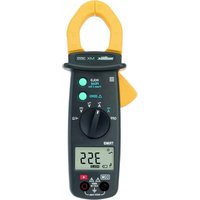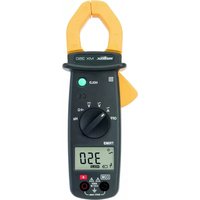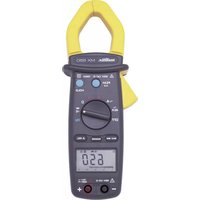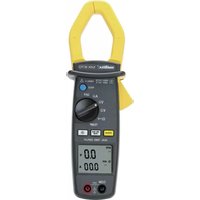
MX 24 - Multimeter METRIX - Free user manual and instructions
Find the device manual for free MX 24 METRIX in PDF.



Frequently Asked Questions - MX 24 METRIX
User questions about MX 24 METRIX
0 question about this device. Answer the ones you know or ask your own.
Ask a new question about this device
Download the instructions for your Multimeter in PDF format for free! Find your manual MX 24 - METRIX and take your electronic device back in hand. On this page are published all the documents necessary for the use of your device. MX 24 by METRIX.
USER MANUAL MX 24 METRIX
User's manual page 14 Chapter
| 1 | Input terminal (positions from 12 to 20) | 12 | AC voltage measurement, ranges 5 VAC to 600 VAC (low impedance) |
| 2 | Multimeter reference input | 13 | AC+DC voltage measurement, ranges 5 VAC+DC to 750 VAC+DC |
| 3 | Input terminal, ranges 50 mAADC and 50 mAAC+DC | 14 | DC voltage measurement, ranges 5 VDC to 1000 VDC |
| 4 | Input terminal, ranges 10 ADC and 10 AAC+DC | 15 | Voltage measurement, ranges 500 mV DC to 500 mVAC+DC |
| 5 | Range change: RANGE | 16 | Frequency measurement |
| 6 | Secondary functions: AC+DC | 17 | Continuity test |
| 7 | Surveillance measurement | 18 | Resistance measurement |
| 8 | Display hold | 19 | Capacitance measurement |
| 9 | Backlighting | 20 | Diode test |
| 10 | Automatic storage | 21 | Current measurement, ranges 50 mA DC and 50 mAAC+DC |
| 11 | Power off | 22 | Current measurement, ranges 10 ADC and 10 AAC+DC |
5.2.1. Tensions continues
| Position du commutateur | Gammes Precision Impédance | d'entrée | Protection (*) | Résolution | |
| ADPDC | 500 mVDC | 0,3 %L + 2 UR | 10 MΩ | ± RM600 V 0.1 mVDC | |
| VDC | 5 VDC | 11 MΩ | ± 1100 VPEAK | 1 mVDC | |
| 50 VDC | 10 MΩ | 10 mVDC | |||
| 500 VDC | 100 mVDC | ||||
| 1000 VDC | 1 VDC | ||||
50 ADC/50mV,±0.5% HA0512
300 ADC/30mV,±0,5%
HA0300
Divers
Etui de transport
AE0190
USER'S MANUAL CONTENTS
1. GENERAL INSTRUCTIONS 15
1.1. Precautions and safety measures 15
1.1.1.Preliminary 15
1.1.2.During use 15
1.1.3. Symbols 16
1.1.4. Instructions 16
1.2. Protection devices 16
1.3. Safety devices.. 17
1.4.Warranty 17
1.5. Maintenance and metrological verification 17
1.6.Unpacking-Repackaging 17
2.DESCRIPTION 18
2.1. Selector switch 18
2.2.Keypad 18
2.3. Display 18
2.4. Power supply 18
2.5. Input terminals 18
3. GETTING STARTED 19
3.1. Connecting the test leads 19
3.2. Switching on the instrument 19
3.3. Switching off the instrument 19
3.4.Special configuration 19
3.5. Multimeter maintenance 19
3.5.1.Fuse self-test 19
3.5.2. Battery self-test 20
3.5.3. Replacing the battery or fuses 20
3.5.4.Cleaning 20
3.5.5.Storage 20
4. FUNCTIONAL DESCRIPTION 21
4.1.RANGE/AC+DCkey 21
4.1.1.ADPDC/ADPAC+DC Position 21
4.1.2. 50 mADC / 50 mAAC+DC Position.. 21
4.1.3. 10 ADC / 10 AAC+DC Position 22
4.2. MIN/MAX key 22
4.3.MEM/AUTO MEM key 22
4.4. key 22
5. TECHNICAL SPECIFICATIONS 23
5.1. General 23
5.2. Characteristics 23
5.2.1. DC voltages 23
5.2.2. AC voltages (AC and AC+DC) 23
5.2.3.DC current 24
5.2.4. AC currents (AC+DC) 24
5.2.5. Resistance / Continuity test 24
5.2.6.Capacitance 25
5.2.7. Diode threshold voltage measurement 25
5.2.8. Frequencies 25
5.2.9. Safety 25
5.2.10. General information 26
5.2.11.Environment 26
5.2.12. EMC 26
5.3. Accessories 27
5.3.1. Supplied with the multimeter 27
5.3.2. Optional 27
1. GENERAL INSTRUCTIONS
You have just acquired a portable digital multimeter and we thank you for your confidence.
This instrument complies with the specification of IEC 61010-1 + A1 + A2, 1995, concerning safety requirements for electronic measuring apparatus. To get the best service from this instrument, read carefully this user's manual and respect the detailed safety precautions.
The contents of this manual must not be reproduced in any form whatsoever without our consent.
1.1. Precautions and safety measures
1.1.1. Preliminary
- This device can be used for measurements on category III installations, for voltages never exceeding 600 V (AC or DC) relative to the earth.
- Definition of overvoltage categories (cf. publication IEC 664-1):
CATI : The circuits of CAT I are protected by measures limiting transient overvoltages to appropriate low level.
Example: protected electronic circuits
CAT II: The circuits of CAT II are power supply circuits of appliances or portable equipment with transient overvoltages of an average level.
Example: appliances and portable equipment
CAT III: The circuits of CAT III are power supply circuits of power equipment with important transient overvoltages.
Example: fixed installation or industrial equipment
CAT IV : The circuits of CAT IV may comprise very important transient overvoltages.
Example: primary supply level
-
When using this multimeter, the user must observe all normal safety rules concerning:
-
protection against the dangers of electric current.
-
protection of the multimeter against misuse.
-
For your own safety, only use the measuring probes which have been delivered with the instrument : they conform to the IEC 61010-1 + A1 + A2, 1995 safety standard. Before use, check that they are in good working condition.
1.1.2. During use
-
Test equipment risk assessment : Users of this equipment and or their employers are reminded that Health and Safety Legislation require them to carry out a valid risk assessment of all electrical work so as to identify potential sources of electrical danger and risk of electrical injury such as from inadvertent short circuits. Where the assessment show that the risk is significant then the use of fused test leads constructed in accordance with the HSE guidance note GS38 "Electrical Test Equipment for use by Electricians" should be used.
-
Never exceed the protection limit values indicated in the specifications for each type of measurement.
- When the multimeter is linked to measurement circuits, do not touch unused terminals.
- When the scale of the value to be measured is unknown, check that the scale initially set on the multimeter is the highest possible or, wherever possible, choose the autoranging mode.
- Before changing functions, disconnect the test leads from the circuit under test.
- In TV repair work, or when carrying out measurements on power switching circuits, remember that high amplitude voltage pulses at the test points can damage the multimeter. Use of a TV filter will attenuate any such pulses.
- Never perform resistance or continuity measurements on live circuits.
1.1.3. Symbols
Symbols used in this manual and on the instrument :

CAUTION : Refer to the instruction manual.
Incorrect use may result in damage to the device or its components.

DANGER: High voltage, risk of electric shock.

Earth
1.1.4. Instructions
- Before opening the instrument, always disconnect from all sources of electric current and make sure not to be loaded with static electricity, which may destroy internal components.
- Fuses must be replaced with fuses of the same rating and type.
- Any adjustment, maintenance or repair work carried out on the multimeter while it is live should be carried out only by appropriately qualified personnel, after having taken into account the instructions in this present manual.
A "qualified person" is one who is familiar with the installation, construction and operation of the equipment and the hazards involved. He is trained and authorized to energize, de-energize circuits and equipment in accordance with established practices.
- When the instrument is open, remember that some internal capacitors can retain a dangerous potential even after the instrument is powered down.
- If any faults or abnormalities are observed, take the instrument out of service and ensure that it cannot be used until it has been checked out.
- It is recommended to remove the battery from the instrument if not used.
1.2. Protection devices
This instrument is fitted with various protection devices :
-
Varistor protection for limiting transients of over 1100 V at the VΩ terminal, particularly 6 kV pulse streams as defined in French standard IEEE 587.
-
A PTC (positive temperature coefficient) resistor protects against permanent overvoltages of up to 600 V during resistance, capacitance, continuity and diode test measurements. This protection is reset automatically after overload.
- Two HBC fuses provide protection up to 600 V during measurements of intensity type.
* An IP protection rating of 50.
1.3. Safety devices
- The battery unit cannot be accessed without first disconnecting the measuring leads.
- When measuring voltages above 24 V, the sign blinks on the display.
- When measuring voltages above 10 A, the sign blinks on the display and an intermittent audible signal warns the user.
- If the maximum range is repeatedly exceeded, an intermittent audible signal warns the user in VLOW Z, VAC+DC, VDC, ADPDC, ADPAC+DC, 50 mAADC, 50 mAAC+DC, 10 ADC, 10 AAC+DC functions.
1.4. Warranty
This equipment is warranted against any defects of manufacture or materials according to the general conditions of sale.
During the warranty period (3 years), defective parts will be replaced, the manufacturer reserving the right to repair or replace the product. In the event of the equipment being returned to the distributor or to a local agency, carriage to the centre shall be payable by the customer. The warranty does not cover the following :
- Repairs necessitated by misuse of the equipment or use in association with incompatible equipment.
- Modification of the equipment or any related software without the explicit authorization of the manufacturer.
- Repairs necessitated by attempts to repair or maintain the product made by a person not approved by the manufacturer.
- Adaptation to a specific application not provided for in the specifications of the equipment or the user manual.
- Damage after a drop, a shock or flooding.
1.5. Maintenance and metrological verification
Return your instrument to your distributor for any work to be done within or outside the guarantee.
1.6. Unpacking - Repackaging
This equipment has been fully checked out mechanically and electrically before shipping. All precautions have been taken to ensure that the instrument arrives at its destination undamaged. However, it is advisable to carry out a rapid check for damage sustained in shipping. If there is any evidence of damage, make this known immediately to the shipper.
Should you need to return the multimeter, preferably use the original packaging and indicate the reasons as clearly as possible on an accompanying note.
Our products are patented in FRANCE and internationally and the logotypes are registered. We reserve the right to modify specifications and prices as required by technological improvements.
2. DESCRIPTION
This compact multimeter is a self-contained with an appropriate mechanical construction, enables hand-held version, with a protective elastomer case. This casing is sealed. It is designed for a high degree of user safety, maximum protection and unrivalled performance.
2.1. Selector switch
This multimeter is a standalone, hand-held professional measuring instrument, capable of measuring the following quantities (accessed by the twelve-position rotary selector switch):
-
AC voltages with AC (or RMS) capacitive coupling (Input impedance : 500 kΩ)
-
AC voltages with AC+DC (or TRMS) direct coupling
- DC voltages
- DC / AC+DC voltages, range 500 mV
- AC currents with AC+DC (or TRMS) direct coupling
- DC currents
* resistance values
* continuity (with beeper) - capacitance
^ 念 diode threshold voltage
*frequencies
2.2. Keypad
A four-key keypad lets you :
- select the autoranging mode (RANGE / AC+DC key)
*store a value (MEM key) - activate the MIN-MAX-AVG detection mode (MIN/MAX key)
- select a function derived from the main function, or switch on the multimeter again after it has been shut down automatically (RANGE / AC+DC key)
* activate back lighting of the display unit ( key)
2.3. Display
This multimeter display provides :
- perform 5 000-count measurements (50 000-count Hz-measurement),
- function indicator (V, A, AC+DC, F, Hz, ●, Ω, AUTO, MEM, MIN, MAX, AVG) and multiplicator (n, μ, m, k, M),
- battery discharged indicator BAT : approximately 12 hours of operation,
* clearly legible figures (11 mm high), - an analogue readout of the parameter being measured through a 34-segment bargraph.
Display back light when required in poor lighting conditions. automatic switch-off.
2.4. Power supply
This multimeter is powered by a standard 9 V battery (6LF22) which provides approximately 500 hours of operation (on function Vdc).
2.5. Input terminals
Measurements are performed using two measuring leads supplied with the instrument connected to input terminals 1, 2, 3 and 4, as indicated in section 3.1.
3. GETTING STARTED
3.1. Connecting the test leads
Connect the black lead to the COM socket (for all measurements). Depending on the position of the selector switch, connect the red lead as follows:
| Rotary selector switch position | Input terminal |
| VLOW Z, VAC+DC, VDC, ADPDC (ADPAC+DC), FREQ, ΦΩ, , ′ ″ | V Ω ′ ″ |
| 50 mADC (50 mAAC+DC) 50 mA | |
| 10 ADC (10 AAC+DC) 10 A |
3.2. Switching on the instrument
The selector switch is on the OFF position.
Turn the selector switch to the required function.
All segments of the display come on for a few seconds. The instrument is then ready for measurements.
3.3. Switching off the instrument
The instrument can be switched off manually by returning the selector switch to the OFF position, or automatically after approximately half an hour if no key is pressed or the switch is not operated.

Note For user safety, automatic shutdown is also disabled when a measured magnitude (voltage/current) present at the input exceeds dangerous level indicator displayed).
3.4. Special configuration
To adapt the configuration of the instrument to the measurement environment, the user can choose 50Hz or 60Hz rejection :
Switch on with the rotary switch while holding down the MEM key. The selection is reversed from the last configuration, is displayed for two seconds and remains backed up in non-volatile memory.
3.5. Multimeter maintenance
3.5.1. Fuse self-test
This check can be carried out with the multimeter in use without opening up the casing.
-
0.63 A fuse (F1): set the rotary switch to the position and short-circuit the 50mA and VΩ sockets. The display should read approx. 0.001 V. If the digital display indicates an overflow « .OL », The fuse is blown.
-
10 A fuse (F2): set the rotary switch to the position and short-circuit the COM and VΩ sockets. The display should read approx. 0.001 V. If the digital display indicates an overflow « .OL », The fuse is blown.
3.5.2. Battery self-test
When the BAT indication appears on the display, the instrument still has approximately 12 hours of operation, but specifications can no longer be guaranteed.
Replace the battery.
3.5.3. Replacing the battery or fuses

Caution! Disconnect test leads from any circuit under test, turn the meter off and remove test leads from the input terminals.
Use the following procedure:
1 - Disconnect test leads from any inputs terminals
2 - Using a appropriate tool, make slide the case bottom of the instrument
3 - Replace the battery or fuse (respect the value and the type).
4 - Replace the immovable part.
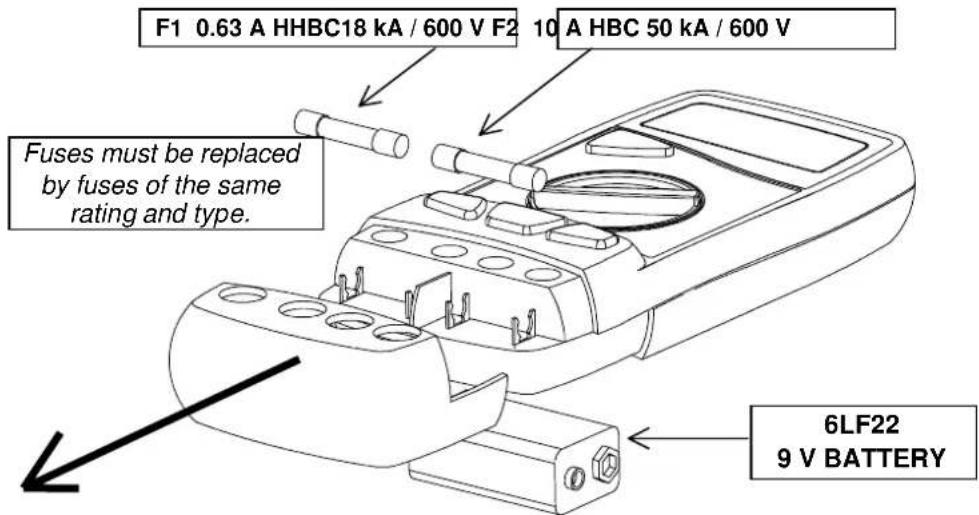

Fitting the fuses :
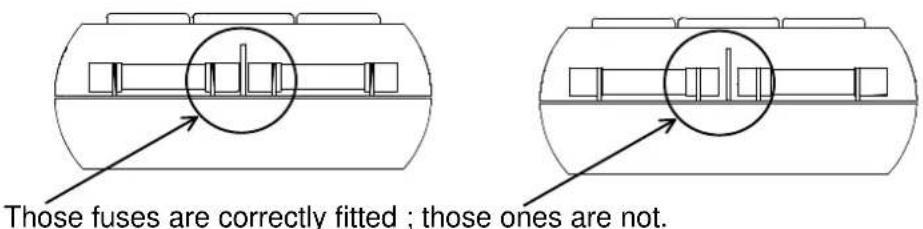
3.5.4. Cleaning
Clean the instrument using a damp cloth and soap. Never use abrasive or solvents.
3.5.5. Storage
To guarantee the measurement accuracy, after a long period storage in extreme environment conditions, wait enough time for the instrument to acclimatise to the working environment conditions (see environment specifications).
4. FUNCTIONAL DESCRIPTION
4.1. RANGE / AC+DC key
The RANGE key is operative in following positions of the selector switch :
VLOWZ,VAC+DC,VDC,Ω
This key makes it possible :
- In AUTO (Autoraging) mode to switch to MANUAL mode (short press).
- In MANUAL mode, to select the next range (short press) or return to AUTO mode (long press), the AUTO sign appears on the display.
This can be used to switch on the multimeter again after an automatic shutdown. It can also be used to access secondary functions associated with the selector switch positions : mode AC+DC.
The flowcharts below define these various functions.
4.1.1. ADPDC / ADPAC+DC Position
This function is adapted for accessories with mV output.
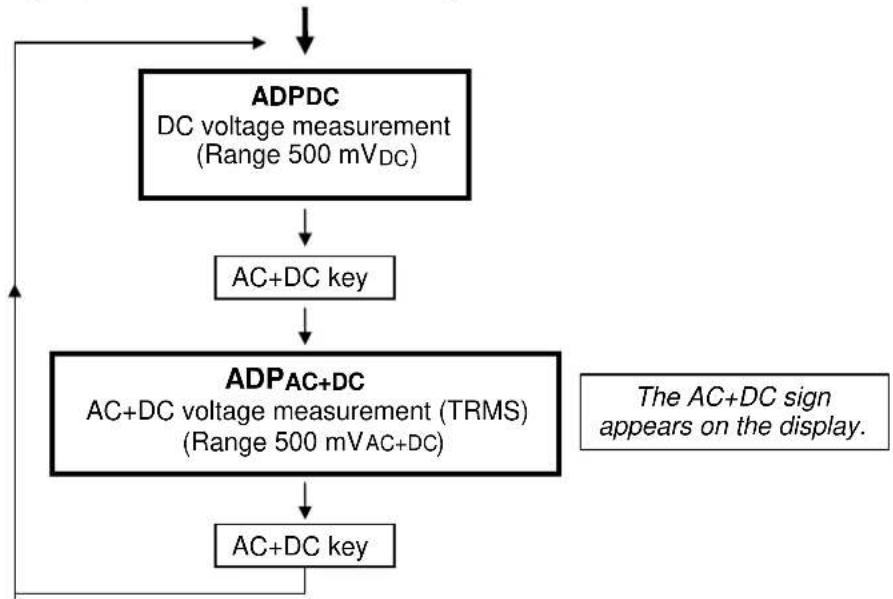
4.1.2. 50 mAc / 50 mAAC+DC Position
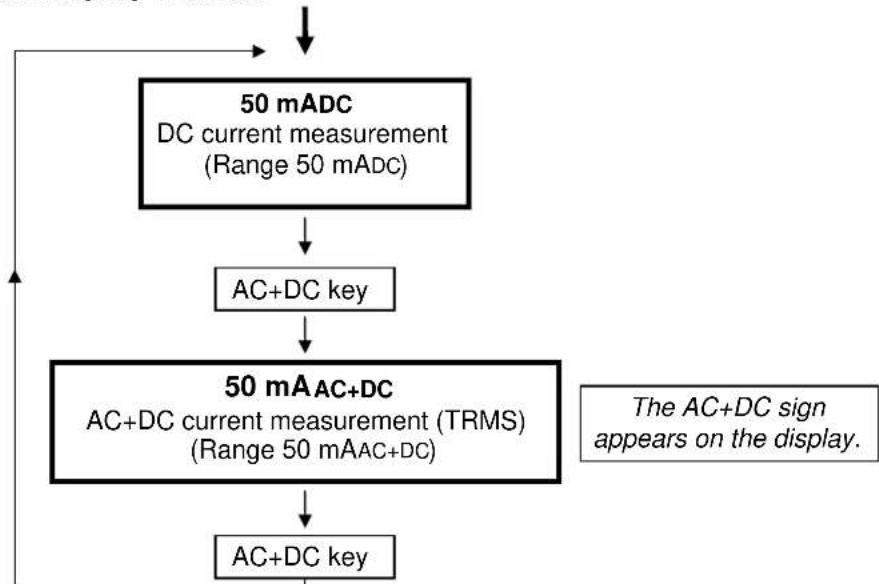
4.1.3. 10 AC/10 AAC+DC Position
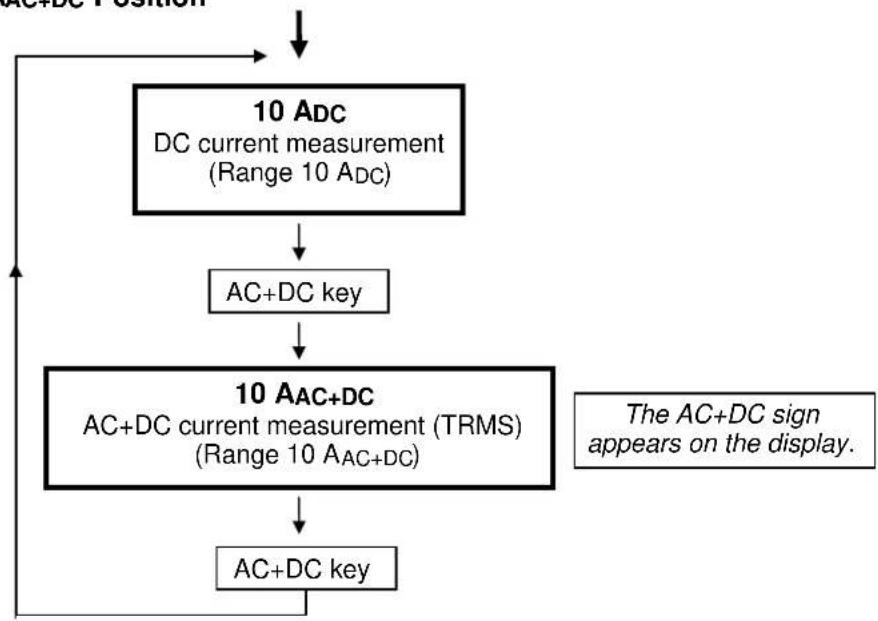
4.2. MIN/MAX key
If you press this key (long press), you access the surveillance mode (or coming out), in which minimum (MIN), maximum (MAX) and sliding average (AVG) values of the current measurement are stored (capture time ≤ 500 ms). The signs MIN MAX AVG appear on the display.
You can look up each of these values by repeatedly pressing the same key (short press). The symbols MIN, MAX or AVG flicker with the selected value.
The three MIN, MAX, AVG values are stored in memory and can be read after quitting the surveillance mode.
When you access the surveillance mode again, all previous values stored are cleared. This key also desactivates the auto power-off, if it is pressed when switching on (P_OFF) .
4.3. MEM / AUTO MEM key
Short press (MEM) :Fixes the display on the current value. A second short press returns the multimeter to normal mode. The MEM sign appears on the display. The MEM mode is available on all measurement.
Long press (AUTO MEM) : Accesses or quits the "autostore" mode. The MEM sign blinking on the display. Affected ranges : VLOW Z, VAC+DC, VDC, ADPDC, ADPAC+DC
Autostore
Set the probes on the point to be measured. An audio signal indicates whether the measurement is stable. When you remove the probes, a second audible signal indicates that this stable value displayed has been stored.

The bargraph remains active during the "autostore" and display MEM mode.
Pressing this key when switching on the instrument enables the selection of a rejection of 50 or 60Hz . The selection is reversed from the last configuration. It is displayed for 2 secs. and remains backed up in non-volatile memory.
4.4.

key
Activates/desactivates back lighting of the display unit. It automatically goes off after 30 seconds.
5. TECHNICAL SPECIFICATIONS
5.1. General
Only the values assigned tolerances or given limits are guaranteed values. Values without tolerances are given for information only, without guarantee (standard NFC 42670). The measurement errors must be considered in an environment of reference temperature (refer to § 5.2.11).

It is essential that all measuring instruments are regularly calibrated.
5.2. Characteristics
Accuracy is ± [% reading (R) + number of digits (D)].
{Accuracy:"n % R + n D" means "n % of the reading ^+ n digits"}
5.2.1. DC voltages
| Selector switch position | Ranges | Accuracy | Input impedance | Protection (*) | Resolution |
| ADPDC | 500 mVDC | 0,3%R + 2 D | 10 MΩ | ± R680 V | 0.1 mVDC |
| VDC | 5 VDC | 11 MΩ | ± 1100 VPEAK | 1 mVDC | |
| 50 VDC | 10 MΩ | 10 mVDC | |||
| 500 VDC | 100 mVDC | ||||
| 1000 VDC | 1 VDC |
() Acceptance permanent max. voltage
Number of points : 5 000
Range selection : automatic or manual for the 5 V, 50 V,
500 V, 1000 V ranges
Common mode rejection (500 mV range): at 50 and 60Hz better than 120 dB
Serial mode rejection : at 50 and 60 Hz, better than 60 dB
Intermittent signal sounds and « OL » on the display in case of range overpassing.
5.2.2. AC voltages (AC and AC + DC
| Selector switch position | Ranges Accuracy 40 Hz to 1 kHz | Input impedance | Protection (*) | Resolution | |
| VLOW Z | 5 VAC | 1 %R + 2 D | 500 kΩ ±60 | 0 V RMS | 1 mVAC |
| 50 VAC | 10 mVAC | ||||
| 500 VAC | 100 mVAC | ||||
| 600 VAC | 1 VAC | ||||
| ADPAC+DC | 500 mVAC+DC | 1.5 %R + 3 D | 10 MΩ // 100 pF | ±600 VRMS | 0.1 mVAC+DC |
| VAC+DC | 5 VAC+DC | 1.5 %R + 2 D | 11 MΩ // 100 pF | ±1100 VPEAK | 1 mVAC+DC |
| 50 VAC+DC | 10 MΩ // 100 pF | 10 mVAC+DC | |||
| 500 VAC+DC | 100 mVAC+DC | ||||
| 750 VAC+DC | 1 VAC+DC | ||||
() Acceptance permanent max. voltage
Specifications applicable from 5% to 100% of the range for a sinusoidal signal in band 40Hz to 1kHz .
Number of points : 5 000
Range selection : automatic or manual for the 5 V, 50 V,
500 V, 600 or 750 V ranges
Common mode rejection : at 50 and 60 Hz, better than 60 dB
Additional error according to crest factor : 1 % for a crest factor of 1.5 to 2
4% for a crest factor of 2 to 3
Intermittent signal sounds and « OL » on the display in case of range overpassing.
5.2.3. DC current
| Selector switch position | Ranges Accuracy Max voltage drop | Protection Fuses (*) | Resolution | |||
| 50 mADC | 50 mADC | 0.3 %R + 2 D < 600 mV 600 V | RMS | F1 + F2 10 μA DC | ||
| 10 ADC (**) | 10 ADC | 1 %R + 5 D < 700 mV 600 V | RMS | F2 10 mA DC | ||
() Refer to fuse specifications section 3.5.3.
( ) Over 7: the measurement must not exceed 1 minute.
Number of points : 5 000
OL on the display (range 50 mADC only) and intermittent signal sounds in case of range overpassing.
5.2.4. AC currents (AC+DC)
| Selector switch position | Ranges Ac | curacy 40 Hz to 1 kHz | Max voltage drop | Protection | Fuses (*) | Resolution |
| 50 mAAC+DC | 50 mAAC+DC | 1.5 %R + 2 D < | 600 mV | 600 V RMS | F1 + F2 | 10 μAAC+DC |
| 10 AAC+DC (**) | 10 AAC+DC | 2.5 %R + 5 D < | 700 mV | 600 V RMS | F2 10 | mA AC+DC |
() Refer to fuse specifications section 3.5.3.
( ) Over 7: the measurement must not exceed 1 minute.
Specifications applicable from 5% to 100% of the range for a sinusoidal signal in band 40 Hz to 1 kHz.
Number of points : 5000
Additional error according to crest factor : 1 % for a crest factor of 1.5 to 2
4% for a crest factor of 2 to 3
O L on the display (range 50 mAAC + DC only) and intermittent signal sounds in case of range overpassing.
5.2.5. Resistance / Continuity test
| Selector switch position | Ranges | Accuracy | Measurement current | Protection (*) | Resolution |
| Ω | 500 Ω | 0.3 %R + 3 D | 1 mA | 600 VRMS | 0.1 Ω |
| 500 Ω | 0.3 %R + 3 D | 1 mA | 0.1 Ω | ||
| 5 kΩ | 100 μA | 1 Ω | |||
| 50 kΩ | 10 μA | 10 Ω | |||
| 500 kΩ | 1 μA | 100 Ω | |||
| 5 MΩ | 0.5 %R + 3 D | 100 nA | 1 kΩ | ||
| 50 MΩ | 1 %R + 5 D | 10 nA | 10 kΩ |
() Overload protection can be reset automatically.
Number of points : 5000
Range selection: automatic or manual (fixed in continuity mode)
Maximum open circuit voltage : 4 V
Detection threshold in continuity mode : 10 Ω to 20 Ω
Response time in continuity mode : < 1 ms
For measurements in 5M and 50M ranges, the use of shielded connection is highly recommended.
5.2.6. Capacitance

Note Discharge all capacitors before taking measurements.
| Selector switch position | Ranges | Accuracy Meas | urement current | Max measurement time | Protection (*) | Resolution |
| + | 50 nF 100 nA < 1 s 10 μA < 1 s 100 μA < 1 s 1 nF %R + 2 D 100 mA | pF | RMS | 10 nF | ||
| 500 nF 1 | pF | |||||
| 5 μF 10 | ||||||
| 50 μF 1 | μA < 1 s | 600 V | ||||
| 500 μF | 1 mA | < 2 s 100 nF | ||||
| 5000 μF | 1 mA | ≈ 3 s/mF | 1 μF | |||
| 50 mF 1 | ≈ 3 s/mF | 10 μF |
() Overload protection can be reset automatically.
To reduce the influence of the ambient electromagnetic fields on the measurement, it is recommended to use shielded cables for measurements in 50~ F range.
Number of points : 5000
Range selection : automatic or manual
Maximum open circuit voltage : 4 V
5.2.7. Diode threshold voltage measurement
Measurable voltages : 0 to 1.999 V
Measurement current : 1 mA ± 20 %
Resolution : 1 mV
Protection: 600 VRMS, can be reset automatically
5.2.8. Frequencies
| Selector switch position | Ranges | Accuracy | Input impedance | Protection | Resolution |
| FREQ | 0.62 to 5 Hz | 03 %R + 1 D | 10 MΩ | 600 VRMS | 0.0001 Hz |
| 5 to 50 Hz | 0.001 Hz | ||||
| 50 to 500 Hz 0. | 0.01 Hz | ||||
| 500 to 5 kHz | 0.1 Hz | ||||
| 5 to 50 kHz | 1 Hz | ||||
| 50 to 500 kHz | 0.05 %R + 1 D | 10 Hz |
Number of points : 50 000
Range selection : automatic
Sensitivity :
| Frequency band | Sinus | Square |
| 10 Hz to 100 kHz | 100 mVeff. | 200 mVpp |
| 100 kHz to 500 kHz | 1 Veff. | 1 Vpp |
5.2.9. Safety
IEC 61010-1 + A1 + A2, 1995
Insulation : class 2
Pollution degree : 2
Indoor use, altitude < 2000m
Installation category of input : CAT III, 600 V max. to earth
5.2.10. General information
Mechanical
Dimensions: 170 × 80 × 35 ~mm
Weight (inc. battery) : 285 g
Casing and circuit : self-extinguishing materials
Packaging
Dimensions: 230 × 155 × 65 ~mm
Weight : 385 g
Power supply
Power requirements : single 9 V alkaline battery (6LF22)
Low battery indication : BAT is displayed when the battery
Battery life : 500 hours approx. in V
voltage drops below operating voltage DC mode
Display
Liquid crystal display comprising :
- a 50 000-count display + sign (digits 11 mm high)
- a 34-bar analogue bargraph display
- appropriate units for each type of measurement
- triggered mode indicators (storage, ranging, ...)
battery discharged indicator
Measurement rate
Digital display : 2 measurements/s
Bargraph : 20 measurements/s
5.2.11.Environment
Reference temperature: 23^ ± 5^
Limit range of operation: -5^ to 45^
Rated range of use :
Storage temperature range :
Temperature coefficient :
additional error in
- frequency sensitivity :
Relative humidity :
-10°C to 55°C
-20°C to 70°C
max. 0.1 × (accuracy) / K
50 D from -5^ to 0^
max. 0.3 × (sensitivity) / K
0 to 80% from 0 to 35^
(70% max. for 5/50 MΩ)
0 to 70% from 35^ to 50^
IP50
Water-tightness :
Max. influence in electro-magnetic fields at
3 V/m acc. to EN 61000-4-3, 1995:
± 150 D in 10 A AC+DC range
± 50 D in mA AC+DC range
± 3% in all other ranges
5.2.12.EMC
This apparatus was designed in accordance with the EMC standards in force and its compatibility has been tested accordance with the following standards :

- Emission EN 50081-1, 1992
- Immunity EN 50082-1, 1997
The product conforms to the prescriptions of the European directive low voltage directive 73/23/EEC and the EMC directive 89/336/EEC, amended by 93/68/EEC.
5.3. Accessories
5.3.1. Supplied with the multimeter
One set of test leads with safety probes AG1063
One 6LF22 9 V battery AL0042
One user's manual 906129548
Protective elastomer case AE0237
5.3.2. Optional
Probes
EHT 3 kVAC/DC
EHT 30kV_DC
HT0203
HT0212
Type K thermocouple, 1mV / ^ general purpose and surface type, -25^ to +350^ HK0210N
Optical tachometer, 100 rpm to 60 000 rpm HA1237
Current clamps
Range 200 AAC, 1 AAC/1 mVAC, max cable 20 mm, connection : sockets AM0014N
Range 200 AAC, 1 AAC/10 mVAC, max cable 20 mm, connection : sockets AM0016N
Range 600 ADC, 600 AAC, max cable 30 mm, connection : sockets AM0600N
Range 1000 ADC, 600 AAC, max cable 43mm connection: sockets AM1000N
Shunts
30 ADC / 300 mV, ± 0.5% HA0170
50 ADC / 50 mV, ± 0.5% HA0512
300 ADC/30mV, ± 0.5% HA0300
Miscellaneous
Carrying case AE0190
5V,50V,500V,600o750V
(70% mass per 5/50 MΩ)
da 0 a 70 % tra 35^ C e 50^ C
IP50
Ermeticità :
5V,50V,500V,600o750V
max. 0.1 × (precision) / K
50D de -5°C a 0°C
max 0.3 x (sensibilitad) / K