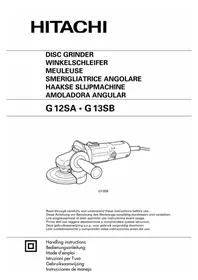
G 12SA - Angle Grinder HITACHI - Free user manual and instructions
Find the device manual for free G 12SA HITACHI in PDF.



| Product type | Angle grinder |
| Brand | Hitachi |
| Model | G 12SA |
| Rated power | 750 W |
| No-load speed | 10,000 rpm |
| Wheel diameter | 115 mm or 125 mm |
| Wheel bore | 22 mm |
| Peripheral speed | 4,800 m/min |
| Weight (without accessories) | 2.0 kg |
| Supply voltage | 110-240 V depending on region |
| Accessories included | Grinding wheel, wrench, side handle |
| Main applications | Grinding, weld grinding, steel, bronze, aluminum, resins, slates, bricks, marble |
| Safety device | Adjustable protective guard, shaft lock, on/off switch |
| Maintenance | Check carbon brushes, mounting screws, clean regularly |
| Spare parts | Carbon brushes, grinding wheels, nuts, wheel cover |
| Noise level | 84 dB(A) |
| Vibration | < 2.5 m/s² |
Frequently Asked Questions - G 12SA HITACHI
User questions about G 12SA HITACHI
0 question about this device. Answer the ones you know or ask your own.
Ask a new question about this device
Download the instructions for your Angle Grinder in PDF format for free! Find your manual G 12SA - HITACHI and take your electronic device back in hand. On this page are published all the documents necessary for the use of your device. G 12SA by HITACHI.
USER MANUAL G 12SA HITACHI
Parts are subject to possible modification without notice due to improvements. The drawing and the list are parts structural drawing and parts list of model G12SA. For model G13SB refer to the drawing and the list.
| Item No. | Part Name |
| 1A Tapping Screw D5×30 | |
| 2 Gear Cover | |
| 3A Seal Lock U-Nut M8 | |
| 4 Pinion | |
| 5 Seal Ring (A) | |
| 6 Ball Bearing (629DDMC3EAV2S) | |
| 7 Rubber Ring | |
| 8 Felt | |
| 9A Spring | |
| 10 Inner Cover | |
| 11 Lock Plate | |
| 12 Armature | |
| 13A Fan Guide | |
| 15 Side Handle | |
| 17 Gear | |
| 18 Seal Lock Screw (W/Sp. Washer) M4×10 | |
| 19 Bearing Cover (B) | |
| 20A Ball Bearing (6201DDUCMAV2S) | |
| 21 Feather Key 3×3×8 | |
| 22 Spindle (A) | |
| 23 Felt Packing D18 | |
| 24 Seal Packing | |
| 25 Packing Gland | |
| 26 Seal Lock Screw (W/Sp. Washer) M5×16 | |
| 27 Machine Screw M50×20 | |
| 28 Spring Washer M5 | |
| 30 Wheel Guard (A) Ass'y | |
| 31 Wheel Washer | |
| 32 D. C. Wheels 115MM A36Q | |
| 33A Wheel Nut | |
| 34 Gear Ass'y | |
| 35 Spring | |
| 36 Slide Bar | |
| 37 Brush Terminal | |
| 38 Flat Hd. Screw M4×10 | |
| 39 Slide knob (C) | |
| 40 Name Plate | |
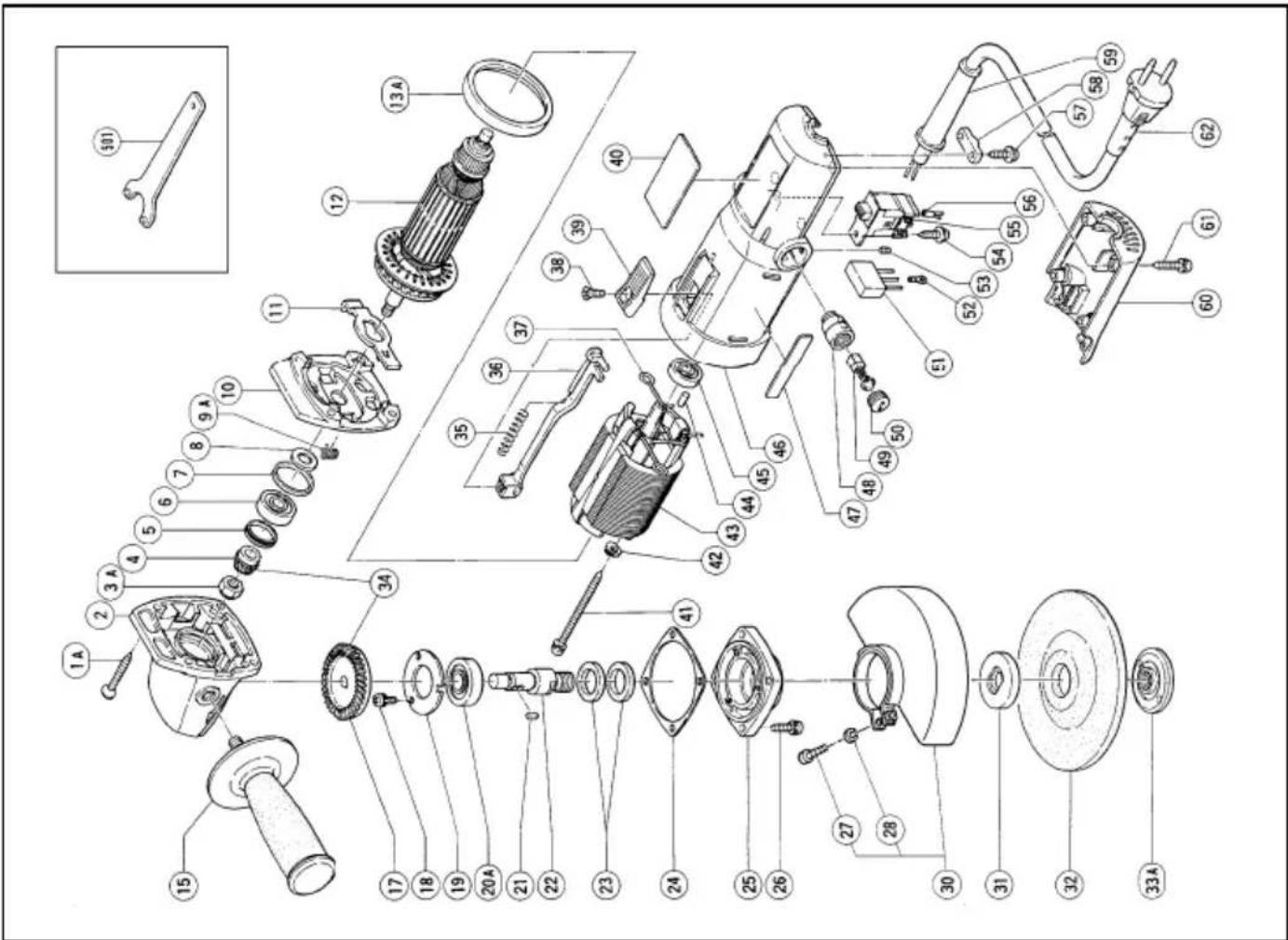
G12SA The exploded assembly drawing should be used only for autorized service center.
1
3
2
| English Deutsch Français | |||
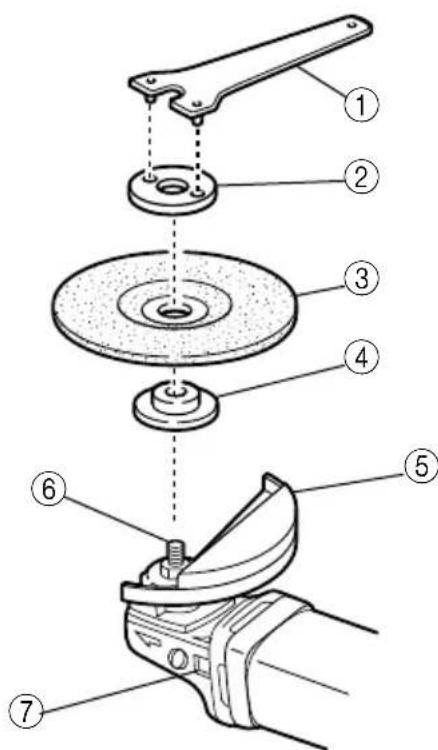
| ① | Wrench | Schlüssel | Clef |
| ② | Wheel nut | Mutter für die Schleilfscheibe | Ecrou de la meule |
| ③ | Depressed center wheel | Schleifscheibe | Meule |
| ④ | Wheel washer | Unterlegscheibe | Rondelle de la meule |
| ⑤ | Wheel guard | Schutzhaube | Couvre-meule |
| ⑥ | Spindle | Spindel | Arbre |
| ⑦ | Lock palte | Sperrplatte | Plaque de blocage |
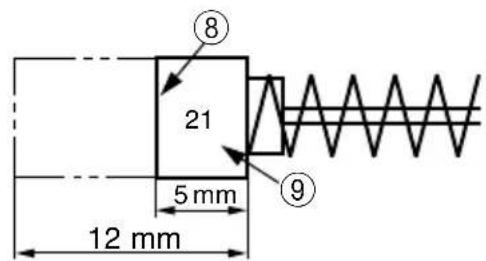
| ⑧ | Wear limit | Verschleißgrenze | Limite d'usure |
| ⑨ | No. of carbon brush | Nr. der Kohlenbüürste | No. balai en carbone |
WARNING! When using electric tools, basic safety precautions should always be followed to reduce the risk of fire, electric shock and personal injury, including the following.
Read all these instructions before operating this product and save these instructions.
For safe operations:
- Keep work area clean. Cluttered areas and benches invite injuries.
- Consider work area environment. Do not expose power tools to rain. Do not use power tools in damp or wet locations. Keep work area well lit. Do not use power tools where there is risk to cause fire or explosion.
- Guard against electric shock. Avoid body contact with earthed or grounded surfaces. (e.g. pipes, radiators, ranges, refrigerators).
- Keep children away. Do not let visitors touch the tool or extension cord. All visitors should be kept away from work area.
- Store idle tools. When not in use, tools should be stored in a dry, high or locked up place, out of reach of children.
- Do not force the tool. It will do the job better and safer at the rate for which it was intended.
- Use the right tool. Do not force small tools or attachments to do the job of a heavy duty tool. Do not use tools for purposes not intended; for example, do not use circular saw to cut tree limbs or logs.
- Dress properly. Do not wear loose clothing or jewellery, they can be caught in moving parts. Rubber gloves and non-skid footwear are recommended when working outdoors. Wear protecting hair covering to contain long hair.
- Use eye protection. Also use face or dust mask if the cutting operation is dusty.
- Connect dust extraction equipment. If devices are provided for the connection of dust extraction and collection facilities ensure these are connected and properly used.
- Do not abuse the cord. Never carry the tool by the cord or yank it to disconnect it from the receptacle. Keep the cord away from heat, oil and sharp edges.
- Secure work. Use clamps or a vise to hold the work. It is safer than using your hand and it frees both hands to operate tool.
- Do not overreach. Keep proper footing and balance at all times.
- Maintain tools with care. Keep cutting tools sharp and clean for better and safer performance. Follow instructions for lubrication and changing accessories. Inspect tool cords periodically and if damaged, have it repaired by authorized service center. Inspect extension cords periodically and replace, if damaged. Keep handles dry, clean, and free from oil and grease.
-
Disconnect tools. When not in use, before servicing, and when changing accessories such as blades, bits and cutters.
-
Remove adjusting keys and wrenches. Form the habit of checking to see that keys and adjusting wrenches are removed from the tool before turning it on.
- Avoid unintentional starting. Do not carry a plugged-in tool with a finger on the switch. Ensure switch is off when plugging in.
- Use outdoor extension leads. When tool is used outdoors, use only extension cords intended for outdoor use.
- Stay alert. Watch what you are doing. Use common sense. Do not operate tool when you are tired.
- Check damaged parts. Before further use of the tool, a guard or other part that is damaged should be carefully checked to determine that it will operate properly and perform its intended function. Check for alignment of moving parts, free running of moving parts, breakage of parts, mounting and any other conditions that may affect its operation. A guard or other part that is damaged should be properly repaired or replaced by an authorized service center unless otherwise indicated in this handling instructions. Have defective switches replaced by an authorized service center. Do not use the tool if the switch does not turn it on and off.
- Warning
The use of any accessory or attachment, other than those recommended in this handling instructions, may present a risk of personal injury.
- Have your tool repaired by a qualified person. This electric tool is in accordance with the relevant safety requirements. Repairs should only be carried out by qualified persons using original spare parts. Otherwise this may result in considerable danger to the user.
PRECAUTIONS ON USING DISC GRINDER
- Never operate these power tools without Wheel Guards.
- Use only depressed center wheel with a "Safe Speed" of at least as high as the "No-Load RPM" indicated on the power tool nameplate.
- Always hold the disc grinder firmly with both hands by the body and the side handle when using.
SPECIFICATIONS
| Model | G12SA G13SB | ||
| Voltage (by areas)* | (110V, 115V, 120V, 127V, 220V, 230V, 240V) ∇ | ||
| Power input* | 750W* | ||
| No-load speed | 10000/min | ||
| Wheel | outer dia × hole dia | 115 × 22 mm | 125 × 22 mm |
| peripheral speed | 4800 m/min | ||
| Weight (only main body) | 2.0 kg | ||
*Be sure to check the nameplate on product as it is subject to change by areas.
STANDARD ACCESSORIES
(1)Depressed Center Wheel 1
(2) Wrench 1
(3) Side Handle 1
Standard accessories are subject to change without notice.
OPTIONAL ACCESSORY
○Handle Joint
To be used when you attach the side handle to the right side of the tool.
Optional accessory is subject to change without notice.
APPLICATIONS
Removal of casting fin and finishing of various types of steel, bronze and aluminum materials and castings.
Grinding of welded sections or sections cut by means of a cutting torch.
Grinding of synthetic resins, slate, brick, marble, etc.
PRIOR TO OPERATION
1. Power source
Ensure that the power source to be utilized conforms to the power requirements specified on the product nameplate.
2. Power switch
Ensure that the power switch is in the OFF position. If the plug is connected to a receptacle while the power switch is in the ON position, the power tool will start operating immediately, which could cause a serious accident.
3. Extension cord
When the work area is removed from the power source, use an extension cord of sufficient thickness and rated capacity. The extension cord should be kept as short as practicable.
4. Fitting and adjusting the wheel guard
The wheel guard is a protective device to prevent injury should the depressed center wheel shatter during operation. Ensure that the guard is properly fitted and fastened before commencing grinding operation. By slightly loosening the setting screw, the wheel guard can be turned and set at any desired angle for maximum operational effective
ness. Ensure that the setting screw is thoroughly tightened after adjusting the wheel guard.
-
Ensure that the depressed center wheel to be utilized is the correct type and free of cracks or surface defects. Also ensure that the depressed center wheel is properly mounted and the wheel nut is securely tightened. Refer to the section on "Depressed Center Wheel Assembly".
-
Always hold the body handle and side handle of the power tool firmly. Otherwise the counterforce produced may result in inaccurate and even dangerous operation.
7. Conducting a trial run
Before commencing grinding operation, the machine should be given a trial run in a safe area to ensure that it is properly assembled and that the depressed center wheel is free from obvious defects.
Recommended trial run durations are as follows: After replacing grinding wheel
3 minutes or more Prior to starting routine work 1 minute or more
8. Confirm the lock plate
Confirm that the lock plate is disengaged by pushing the lock plate two or three times before switching the power tool on. (See Fig. 2)
9. Fixing the side handle
Screw the side handle into the gear cover.
PRACTICAL GRINDER APPLICATION
1. Pressure
To prolong the life of the machine and ensure a first class finish, it is important that the machine should not be overloaded by applying too much pressure. In most applications, the weight of the machine alone is sufficient for effective grinding. Too much pressure will result in reduced rotational speed, inferior surface finish, and overloading which could reduce the life of the machine.
2. Grinding angle
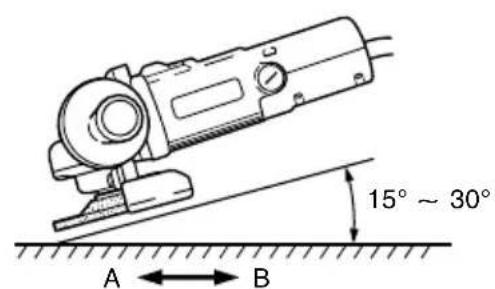
Do not apply the entire surface of the depressed center wheel to the material to be ground. As shown in Fig. 1, the machine should be held at an angle of 15irc 30irc so that the external edge of the depressed center wheel contacts the material at an optimum angle.
- To prevent a new depressed center wheel from digging into the workpiece, initial grinding should
be performed by drawing the grinder across the workpiece toward the operator (Fig. 1 direction B). Once the leading edge of the depressed center wheel is properly abraded, grinding may be conducted in either direction.
- Precautions immediately after finishing operation After switching off the machine, do not put it down until the depressed center wheel has come to a complete stop. Apart from avoiding serious accidents, this precaution will reduce the amount of dust and swarf sucked into the machine.
CAUTION
When the machine is not in use, the power source should be disconnected.
DEPRESSED CENTER WHEEL ASSEMBLY
1. Assembling (Fig. 2)
(1) Turn the machine upsidedown so that the spindle is facing upward.
(2) Align the oval-shaped indentation of the wheel washer with the notched part of the spindle, then attach them.
(3) Fit the protuberance of the depressed center wheel onto the wheel washer.
(4) Screw the wheel nut onto the spindle.
(5) While pushing the lock plate with one hand, lock the spindle by turning the grinding wheel slowly with the other hand.
Tighten the wheel nut by using the supplied wrench as shown in Fig. 2.
2. Disassembly
Follow the above procedures in reverse.
MAINTENANCE AND INSPECTION
1. Inspecting the depressed center wheel
Ensure that the depressed center wheel is free of cracks and surface defects.
2. Inspecting the mounting screws:
Regularly inspect all mounting screws and ensure that they are properly tightened. Should any of the screws be loose, retighten them immediately. Failure to do so could result in serious hazard.
3. Inspecting the carbon brushes (Fig. 3)
The motor employs carbon brushes which are consumable parts. Since an excessively worn carbon brush can result in motor trouble, replace the carbon brush with a new one having the same carbon brush No. shown in the figure when it becomes worn to or near the "wear limit". In addition, always keep carbon brushes clean and ensure that they slide freely within the brush holders.
4. Replacing a carbon brush:
Disassemble the brush cap with a minus-head screwdriver. The carbon brush can then be easily removed.
5. Maintenance of the motor
The motor unit winding is the very "heart" of the power tool.
Exercise due care to ensure the winding does not become damaged and/or wet with oil or water.
NOTE
Due to HITACHI's continuing program of research and development, the specifications herein are subject to change without prior notice.
IMPORTANT
Correct connection of the plug
The wires of the main lead are coloured in accordance with the following code:
Blue: - Neutral
Brown: -Live
As the colours of the wires in the main lead of this tool may not correspond with the coloured markings identifying the terminals in your plug proceed as follows: The wire coloured blue must be connected to the terminal marked with the letter N or coloured black. The wire coloured brown must be connected to the terminal marked with the letter L or coloured red.
Neither core must be connected to the earth terminal.
NOTE
This requirement is provided according to BRITISH STANDARD 2769:1984.
Therefore, the letter code and colour code may not be applicable to other markets except The United Kingdom.
Information concerning airborne noise and vibration
The measured values were determined according to EN50144.
The typical A-weighted sound pressure level: 84 dB (A).
Wear ear protection.
The typical weighted root mean square acceleration value does not exceed 2.5m / s2
ACCESSIONS EN OPTION
Joint de poignée
- PRECAUTIONS ON USING DISC GRINDER
- STANDARD ACCESSORIES
- OPTIONAL ACCESSORY
- APPLICATIONS
- PRIOR TO OPERATION
- Power source
- Power switch
- Extension cord
- Fitting and adjusting the wheel guard
- Conducting a trial run
- Confirm the lock plate
- Fixing the side handle
- PRACTICAL GRINDER APPLICATION
- Pressure
- Grinding angle
- CAUTION
- DEPRESSED CENTER WHEEL ASSEMBLY
- Assembling (Fig. 2)
- Disassembly
- MAINTENANCE AND INSPECTION
- Inspecting the depressed center wheel
- Inspecting the mounting screws:
- Inspecting the carbon brushes (Fig. 3)
- Replacing a carbon brush:
- Maintenance of the motor
- NOTE
- IMPORTANT
- Information concerning airborne noise and vibration
- ACCESSIONS EN OPTION
Brand : HITACHI
Model : G 12SA
Category : Angle Grinder