EasyManual
DS18DJL(WC) - Drill HITACHI - Free user manual and instructions
Find the device manual for free DS18DJL(WC) HITACHI in PDF.



Frequently Asked Questions - DS18DJL(WC) HITACHI
User questions about DS18DJL(WC) HITACHI
0 question about this device. Answer the ones you know or ask your own.
Ask a new question about this device
Download the instructions for your Drill in PDF format for free! Find your manual DS18DJL(WC) - HITACHI and take your electronic device back in hand. On this page are published all the documents necessary for the use of your device. DS18DJL(WC) by HITACHI.
USER MANUAL DS18DJL(WC) HITACHI
Read all safety warnings and all instructions.
Failure to follow the warnings and instructions may result in electric shock, fire and/or serious injury.
Save all warnings and instructions for future reference.
The term "power tool" in the warnings refers to your mains-operated (corded) power tool or battery-operated (cordless) power tool.
1) Work area safety
a) Keep work area clean and well lit.
Cluttered or dark areas invite accidents.
b) Do not operate power tools in explosive atmospheres, such as in the presence of flammable liquids, gases or dust.
Power tools create sparks which may ignite the dust or fumes.
c) Keep children and bystanders away while operating a power tool.
Distractions can cause you to lose control.
2) Electrical safety
a) Power tool plugs must match the outlet.
Never modify the plug in any way.
Do not use any adapter plugs with earthed (grounded) power tools.
Unmodified plugs and matching outlets will reduce risk of electric shock.
b) Avoid body contact with earthed or grounded surfaces, such as pipes, radiators, ranges and refrigerators.
There is an increased risk of electric shock if your body is earthed or grounded.
c) Do not expose power tools to rain or wet conditions.
Water entering a power tool will increase the risk of electric shock.
d) Do not abuse the cord. Never use the cord for carrying, pulling or unplugging the power tool. Keep cord away from heat, oil, sharp edges or moving parts.
Damaged or entangled cords increase the risk of electric shock.
e) When operating a power tool outdoors, use an extension cord suitable for outdoor use.
Use of a cord suitable for outdoor use reduces the risk of electric shock.
f) If operating a power tool in a damp location is unavoidable, use a residual current device (RCD) protected supply.
Use of an RCD reduces the risk of electric shock.
3) Personal safety
a) Stay alert, watch what you are doing and use common sense when operating a power tool. Do not use a power tool while you are tired or under the influence of drugs, alcohol or medication.
A moment of inattention while operating power tools may result in serious personal injury.
b) Use personal protective equipment. Always wear eye protection.
Protective equipment such as dust mask, nonskid safety shoes, hard hat, or hearing protection used for appropriate conditions will reduce personal injuries.
c) Prevent unintentional starting. Ensure the switch is in the off-position before connecting to power source and/or battery pack, picking up or carrying the tool.
Carrying power tools with your finger on the switch or energising power tools that have the switch on invites accidents.
d) Remove any adjusting key or wrench before turning the power tool on.
A wrench or a key left attached to a rotating part of the power tool may result in personal injury.
e) Do not overreach. Keep proper footing and balance at all times.
This enables better control of the power tool in unexpected situations.
f) Dress properly. Do not wear loose clothing or jewellery. Keep your hair, clothing and gloves away from moving parts.
Loose clothes, jewellery or long hair can be caught in moving parts.
g) If devices are provided for the connection of dust extraction and collection facilities, ensure these are connected and properly used.
Use of dust collection can reduce dust related hazards.
4) Power tool use and care
a) Do not force the power tool. Use the correct power tool for your application.
The correct power tool will do the job better and safer at the rate for which it was designed.
b) Do not use the power tool if the switch does not turn it on and off.
Any power tool that cannot be controlled with the switch is dangerous and must be repaired.
c) Disconnect the plug from the power source and/or the battery pack from the power tool before making any adjustments, changing accessories, or storing power tools.
Such preventive safety measures reduce the risk of starting the power tool accidentally.
d) Store idle power tools out of the reach of children and do not allow persons unfamiliar with the power tool or these instructions to operate the power tool.
Power tools are dangerous in the hands of untrained users.
e) Maintain power tools. Check for misalignment or binding of moving parts, breakage of parts and any other condition that may affect the power tools operation.
If damaged, have the power tool repaired before use.
Many accidents are caused by poorly maintained power tools.
f) Keep cutting tools sharp and clean.
Properly maintained cutting tools with sharp cutting edges are less likely to bind and are easier to control.
g) Use the power tool, accessories and tool bits etc. in accordance with these instructions, taking into account the working conditions and the work to be performed.
Use of the power tool for operations different from those intended could result in a hazardous situation.
5) Battery tool use and care
a) Recharge only with the charger specified by the manufacturer.
A charger that is suitable for one type of battery pack may create a risk of fire when used with another battery pack.
b) Use power tools only with specifically designated battery packs.
Use of any other battery packs may create a risk of injury and fire.
c) When battery pack is not in use, keep it away from other metal objects like paper clips, coins, keys, nails, screws, or other small metal objects that can make a connection from one terminal to another.
Shorting the battery terminals together may cause burns or a fire.
d) Under abusive conditions, liquid may be ejected from the battery; avoid contact. If contact accidentally occurs, flush with water. If liquid contacts eyes, additionally seek medical help. Liquid ejected from the battery may cause irritation or burns.
6) Service
a) Have your power tool serviced by a qualified repair person using only identical replacement parts.
This will ensure that the safety of the power tool is maintained.
PRECAUTION
Keep children and infirm persons away.
When not in use, tools should be stored out of reach of children and infirm persons.
- Use auxiliary handle(s), if supplied with the tool.
Loss of control can cause personal injury. - Hold power tool by insulated gripping surfaces, when performing an operation where the cutting accessory or fastener may contact hidden wiring.
Cutting accessory or fasteners contacting a "live" wire may make exposed metal parts of the power tool "live" and could give the operator an electric shock. - Always charge the battery at a temperature of 0 - 40^ . A temperature of less than 0^ will result in over charging which is dangerous. The battery cannot be charged at a temperature higher than 40^ .
The most suitable temperature for charging is that of 20 - 25^ - When one charging is completed, leave the charger for about 15 minutes before the next charging of battery.
Do not charge more than two batteries consecutively. - Do not allow foreign matter to enter the hole for connecting the rechargeable battery.
- Never disassemble the rechargeable battery and charger.
-
Never short-circuit the rechargeable battery. Short-circuiting the battery will cause a great electric current and overheat. It results in burn or damage to the battery.
-
Do not dispose of the battery in fire. If the battery is burnt, it may expl
- Bring the battery to the shop from which it was purchased as soon as the post-charging battery life becomes too short for practical use. Do not dispose of the exhausted battery.
- Using an exhausted battery will damage the charger.
- Do not insert object into the air ventilation slots of the charger.
Inserting metal objects or inflammables into the charger air ventilation slots will result in electrical shock hazard or damaged charger.
- When mounting a bit into the keyless chuck, tighten the sleeve adequately. If the sleeve is not tight, the bit may slip or fall out, causing injury.
- This product contains a strong permanent magnet in the motor.
Observe the following precautions regarding adhering of chips to the tool and the effect of the permanent magnet on electronic devices.
CAUTION
Do not place the tool on a workbench or work area where metal chips are present.
The chips may adhere to the tool, resulting in injury or malfunction.
If chips have adhered to the tool, do not touch it. Remove the chips with a brush.
Failure to do so may result in injury.
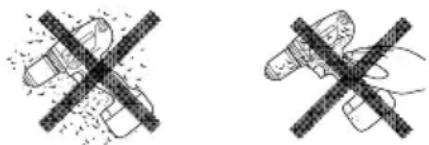
If you use a pacemaker or other electronic medical device, do not operate or approach the tool.
Operation of the electronic device may be affected.
Do not use the tool in the vicinity of precision devices such as cell phones, magnetic cards or electronic memory media.
Doing so may lead to misoperation, malfunction or loss of data.
CAUTION ON LITHIUM-ION BATTERY
To extend the lifetime, the lithium-ion battery equips with the protection function to stop the output.
In the cases of 1 to 3 described below, when using this product, even if you are pulling the switch, the motor may stop. This is not the trouble but the result of protection function.
- When the battery power remaining runs out, the motor stops.
In such a case, charge it up immediately. - If the tool is overloaded, the motor may stop. In this case, release the switch of tool and eliminate causes of overloading. After that, you can use it again.
- If the battery is overheated under overload work, the battery power may stop. In this case, stop using the battery and let the battery cool. After that, you can use it again.
Furthermore, please heed the following warning and caution.
WARNING
In order to prevent any battery leakage, heat generation, smoke emission, explosion and ignition beforehand, please be sure to heed the following precautions.
- Make sure that swarf and dust do not collect on the battery.
During work make sure that swarf and dust do not fall on the battery.
Make sure that any swarf and dust falling on the power tool during work do not collect on the battery. - Do not store an unused battery in a location exposed to swarf and dust.
Before storing a battery, remove any swarf and dust that may adhere to it and do not store it together with metal parts (screws, nails, etc.). - Do not pierce battery with a sharp object such as a nail, strike with a hammer, step on, throw or subject the battery to severe physical shock.
- Do not use an apparently damaged or deformed battery.
- Do not use the battery in reverse polarity.
- Do not connect directly to an electrical outlets or car cigarette lighter sockets.
- Do not use the battery for a purpose other than those specified.
- If the battery charging fails to complete even when a specified recharging time has elapsed, immediately stop further recharging.
-
Do not put or subject the battery to high temperatures or high pressure such as into a microwave oven, dryer, or high pressure container.
-
Keep away from fire immediately when leakage or foul odor are detected.
- Do not use in a location where strong static electricity generates.
- If there is battery leakage, foul odor, heat generated, discolored or deformed, or in any way appears abnormal during use, recharging or storage, immediately remove it from the equipment or battery charger, and stop use.
CAUTION
- If liquid leaking from the battery gets into your eyes, do not rub your eyes and wash them well with fresh clean water such as tap water and contact a doctor immediately. If left untreated, the liquid may cause eye-problems.
- If liquid leaks onto your skin or clothes, wash well with clean water such as tap water immediately. There is a possibility that this can cause skin irritation.
- If you find rust, foul odor, overheating, discolor, deformation, and/or other irregularities when using the battery for the first time, do not use and return it to your supplier or vendor.
WARNING
If a conductive foreign matter enters in the terminal of lithium ion battery, the battery may be shorted, causing fire. When storing the lithium ion battery, obey surely the rules of following contents.
Do not place conductive debris, nail and wires such as iron wire and copper wire in the storage case.
To prevent shorting from occurring, load the battery in the tool or insert securely the battery cover for storing until the ventilator is not seen. (Fig. 1)
SPECIFICATIONS
POWER TOOL
| Model DS14DJL DS18DJL | ||||||
| No-load speed (Low / High) 0 - 450 / 0 - 1250 min-1 | ||||||
| Capacity | Drilling | Wood (Thickness 18 mm) | 30 mm 38 mm | |||
| Metal (Thickness 1.6 mm) | Steel: 13 mm, Aluminum: 13 mm | |||||
| Driving | Machine screw | 6 mm | ||||
| Wood screw | 6.0 mm (diameter) × 75 mm (length) (Requires a pilot hole) (Requires a pilot hole) | 6.8 mm (diameter) × 50 mm (length) (Requires a pilot hole) | ||||
| Rechargeable battery | BSL1415: Li-ion BSL1425: Li-ion BSL1815: 14.4 V (1.5 Ah 4 cells) 14.4 V (2.5 Ah 4 cells) 18 | Li-ion BSL1825: Li-ion V (1.5 Ah 5 cells) 18 V | (2.5 Ah 5 cells) | |||
| Weight* 1.6 kg 1.7 kg | ||||||
- Weight: According to EPTA-Procedure 01/2003
CHARGER
| Model | UC18YKSL | UC18YFSL |
| Charging voltage | 14.4 V – 18 V | |
| Weight | 0.35 kg | 0.5 kg |
STANDARD ACCESSORIES
OPTIONAL ACCESSORIES (sold separately)
| DS14DJL (2LEGK) DS18DJL (2LEGK) | ①Plus driver bit (No. 2)...................................... 1 |
| ② Charger (UC18YKSL)...................................... 1 | |
| ③Battery (BSL1415 or BSL1815)...................................... 2 | |
| ④Plastic case...................................... 1 | |
| ⑤Battery cover...................................... 1 | |
| DS14DJL (2LFGK) (2LFRK) DS18DJL (2LFGK) (2LFRK) | ①Plus driver bit (No. 2)...................................... 1 |
| ② Charger (UC18YKSL or UC18YFSL)...................................... 1 | |
| ③Battery (BSL1425 or BSL1825)...................................... 2 | |
| ④Plastic case...................................... 1 | |
| ⑤Battery cover...................................... 1 | |
| ⑥Cordless torchlight (UB18DAL)...................................... 1 | |
| DS18DJL (NNK) | ①Plus driver bit (No. 2)...................................... 1 |
| ②Plastic case...................................... 1 | |
| Wituout chager, battery, torchlight and battery cover. | |
| DS14DJL (NN) DS18DJL (NN) | ①Plus driver bit (No. 2)...................................... 1 |
| Wituout chager, battery, plastic case, torchlight and battery cover. |
Standard accessories are subject to change without notice.
Battery BSL1415,BSL1425 BSL1815,BSL1825
Hook (with screw)
Optional accessories are subject to change without notice.
APPLICATIONS
- Driving and removing of machine screws, wood screws, tapping screws, etc.
Drilling of various metals
Drilling of various woods
BATTERY REMOVAL/INSTALLATION
1. Battery removal
Hold the handle tightly and push the battery latch (2 pcs.) to remove the battery (See Figs. 1 and 2).
CAUTION
Never short-circuit the battery.
2. Battery installation
Insert the battery while observing its polarities (See Fig. 2).
CHARGING
Before using the power tool, charge the battery as follows.
- Connect the charger's power cord to the receptacle. When connecting the plug of the charger to a receptacle, the pilot lamp will blink in red (At 1-second intervals).
- Insert the battery into the charger.
Firmly insert the battery into the charger as shown in Fig. 3.
3. Charging
When inserting a battery in the charger, charging will commence and the pilot lamp will light up continuously in red.
When the battery becomes fully recharged, the pilot lamp will blink in red. (At 1-second intervals) (See Table 1)
(1) Pilot lamp indication
The indications of the pilot lamp will be as shown in Table 1, according to the condition of the charger or the rechargeable battery.
Table 1
| Indications of the pilot lamp | ||||
| Pilot lamp(red) | Before charging | Blinks | Lights for 0.5 seconds. Does not light for 0.5 seconds. (off for 0.5 seconds) | |
| While charging | Lights | Lights continuously | ||
| Charging complete | Blinks | Lights for 0.5 seconds. Does not light for 0.5 seconds. (off for 0.5 seconds) | ||
| Overheat standby | Blinks | Lights for 1 second. Does not light for 0.5 seconds. (off for 0.5 seconds) | Battery overheated. Unable to charge. (Charging will commence when battery cools) | |
| Charging impossible | Flickers | Lights for 0.1 seconds. Does not light for 0.1 seconds. (off for 0.1 seconds) | Malfunction in the battery or the charger | |
(2) Regarding the temperatures of the rechargeable battery
The temperatures for rechargeable batteries are as shown in Table 2, and batteries that have become hot should be cooled for a while before being recharged.
Table 2 Recharging ranges of batteries
| Rechargeable batteries | Temperatures at which the battery can be recharged |
| BSL1425, BSL1415 | 0°C – 50°C |
| BSL1825, BSL1815 |
(3) Regarding recharging time
Depending on the combination of the charger and batteries, the charging time will become as shown in Table 3.
Table 3 Charging time (At 20^ C )
| Charger Battery | UC18YKSL UC | 18YFSL |
| BSL1415, BSL1815 | Approx. Approx. 40 min. 22 min. | |
| BSL1425, BSL1825 | Approx. Approx. 75 min. 35 min. | |
NOTE
The recharging time may vary according to the ambient temperature and power source voltage.
-
Disconnect the charger's power cord from the receptacle.
-
Hold the charger firmly and pull out the battery NOTE
Be sure to pull out the battery from the charger after use, and then keep it.
Regarding electric discharge in case of new batteries, etc.
As the internal chemical substance of new batteries and batteries that have not been used for an extended period is not activated, the electric discharge might be low when using them the first and second time. This is a temporary phenomenon, and normal time required for recharging will be restored by recharging the batteries 2-3 times.
How to make the batteries perform longer
(1) Recharge the batteries before they become completely exhausted.
When you feel that the power of the tool becomes weaker, stop using the tool and recharge its battery. If you continue to use the tool and exhaust the electric current, the battery may be damaged and its life will become shorter.
(2) Avoid recharging at high temperatures.
A rechargeable battery will be hot immediately after use. If such a battery is recharged immediately after use, its internal chemical substance will deteriorate, and the battery life will be shortened. Leave the battery and recharge it after it has cooled for a while.
CAUTION
If the battery is charged while it is heated because it has been left for a long time in a location subject to direct sunlight or because the battery has just been used, the pilot lamp of the charger lights for 1 second, does not light for 0.5 seconds (off for 0.5 seconds). In such a case, first let the battery cool, then start charging.
- When the pilot lamp flickers (at 0.2-second intervals), check for and take out any foreign objects in the charger's battery connector. If there are no foreign objects, it is probable that the battery or charger is malfunctioning. Take it to your authorized Service Center.
Since the built-in micro computer takes about 3 seconds to confirm that the battery being charged with UC18YKSL/UC18YFSL is taken out, wait for a minimum of 3 seconds before reinserting it to continue charging. If the battery is reinserted within 3 seconds, the battery may not be properly charged.
PRIOR TO OPERATION
Setting up and checking the work environment
Check if the work environment is suitable by following the precautions.
HOW TO USE
1. Confirm the clutch dial position (See Fig. 4)
The tightening torque of this unit can be adjusted according to the clutch dial position, at which the clutch dial is set.
(1) When using this unit as a screwdriver, line up the one of the numbers "1, 3, 5 ... 22" on the clutch dial, or the dots, with the triangle mark on the outer body.
(2) When using this unit as a drill, align the clutch dial drill mark "W" with the triangle mark on the outer body.
CAUTION
The clutch dial cannot be set between the numerals "1, 3, 5 ... 22" or the dots.
Do not use with the clutch dial numeral between "22" and the line at the middle of the drill mark. Doing so may cause damage. (See Fig. 5)
2. Tightening torque adjustment
(1) Tightening torque
Tightening torque should correspond in its intensity to the screw diameter. When too strong torque is used, the screw head may be broken or be injured. Be sure to adjust the clutch dial position according to the screw diameter.
(2) Tightening torque indication
The tightening torque differs depending on the type of screw and the material being tightened.
The unit indicates the tightening torque with the numbers "1, 3, 5 ... 22" on the clutch dial, and the dots. The tightening torque at position "1" is the weakest and the torque is strongest at the highest number. (See Fig. 4)
(3) Adjusting the tightening torque
Rotate the clutch dial and line up the numbers "1, 3, 5, ... 22" on the clutch dial, or the dots, with the triangle mark on the outer body. Adjust the clutch dial in the weak or the strong torque direction according to the torque you need.
CAUTION
The motor rotation may be locked to cease while the unit is used as drill. While operating the driver drill, take care not to lock the motor.
Too long hammering may cause the screw broken due to excessive tightening.
3. Change rotation speed
Operate the shift knob to change the rotational speed. Move the shift knob in the direction of the arrow (see Figs. 6 and 7).
When the shift knob is set to "LOW", the drill rotates at a low speed. When set to "HIGH", the drill rotates at a high speed.
CAUTION
- When changing the rotational speed with the shift knob, confirm that the switch is off.
Changing the speed while the motor is rotating will damage the gears.
When setting the shift knob to "HIGH" (high speed) and the position of the clutch dial is "17" or "22", it may happen that the clutch is not engaged and that the motor is locked. In such a case, please set the shift knob to "LOW" (low speed).
If the motor is locked, immediately turn the power off. If the motor is locked for a while, the motor or battery may be burnt.
Be sure to turn the shift knob.
4. The scope and suggestions for uses
The usable scope for various types of work based on the mechanical structure of this unit is shown in Table 4.
Table 4
| Work Clutch dial | Position Suggestion | ||
| Drilling Steel | Wood | purpose | |
| Use for drilling | |||
| Aluminum | |||
| Driving | Machine screw | 1 - 22 Use the bit or socket matching the screw diameter. | |
| Wood screw | 1 - | Use after drilling a pilot hole. | |
5. How to select tightening torque and rotational speed
Table 5
| Use | Clutch dial Position | Rotating speed selection (Position of the shift knob) | ||
| LOW (Low speed) HIGH | (High speed) | |||
| Driving | Machine screw 1 | 22 | For 6 mm or smaller diameter screws. | For 6 mm or smaller diameter screws. |
| Wood screw 1 - | For 6.8 mm or smaller nominal diameter screws. (DS18DJL) | For 4.8 mm or smaller nominal diameter screws. (DS18DJL) | ||
| For 6 mm or smaller nominal diameter screws. (DS14DJL) | For 3.8 mm or smaller nominal diameters screws. (DS14DJL) | |||
| Drilling | Wood | For 38 mm or smaller diameters. (DS18DJL) | For 24 mm or smaller diameters. (DS18DJL) | |
| For 30 mm or smaller diameters. (DS14DJL) | For 12 mm or smaller diameters. (DS14DJL) | |||
| Metal | For drilling with a metal working drill bit. | |||
CAUTION
The selection examples shown in Table 5 should be considered as general standard. As different types of tightening screws and different materials to be tightened are used in actual works proper adjustments are naturally necessary.
- When using the driver drill with a machine screw at HIGH (high speed), a screw may damage or a bit may loose due to the tightening torque is too strong. Use the driver drill at LOW (low speed) when using a machine screw.
NOTE
The use of the battery in a cold condition (below 0 degree Centigrade) can sometimes result in the weakened tightening torque and reduced amount of work. This, however, is a temporary phenomenon, and returns to normal when the battery warms up.
6. Using the light
Pull the trigger switch to light up the light. The light keeps on lighting while the trigger switch is being pulled. The light goes out after releasing the trigger switch. (Fig. 8)
(The light automatically goes out 10 seconds after releasing the trigger switch.)
CAUTION
Do not expose directly your eye to the light by looking into the light.
If your eye is continuously exposed to the light, your eye will be hurt.
7. Mounting and dismounting of the bit
(1) Mounting the bit
Loosen the sleeve by turning it toward the left (in the counterclockwise direction as viewed from the front) to open the clip on the keyless chuck. After inserting a driver bit, etc., into the keyless drill chuck, and tighten the sleeve by turning it toward the right (in the clockwise direction as viewed from the front). (See Fig. 9)
If the sleeve becomes loose during operation, tighten it further.
The tightening force becomes stronger when the sleeve is tightened additionally.
(2) Dismounting the bit
Loosen the sleeve by turning it toward the left (in the counterclockwise direction as viewed from the front), and then take out the bit etc. (See Fig. 9)
NOTE
If the sleeve is tightened in a state where the clip of the keyless chuck is opened to a maximum limit, a click noise may occur. This is the noise that occurs when the loosening of the keyless chuck is prevented and is not a malfunction.
CAUTION
When it is no longer possible to loosen the sleeve, use a vise or similar instrument to secure the bit. Set the clutch mode between 1 and 11 and then turn the sleeve to the loose side (left side) while operating the clutch. It should be easy now to loosen the sleeve.
8. Automatic spindle-lock mechanism
This unit has automatic spindle-lock mechanism for quick bit changes.
9. Confirm that the battery is mounted correctly
10. Check the rotational direction
The bit rotates clockwise (viewed from the rear side) by pushing the R-side of the selector button.
The L-side of the selector button is pushed to turn the bit counterclockwise. (See Fig. 10) (The (L) and (R) marks are provided on the body.)
11. Using the hook (Sold separately)
The hook is used to hang up the power tool to your waist belt while working.
CAUTION
- When using the hook, hang up the power tool firmly not to drop accidentally.
If the power tool is dropped, it may lead to an accident. - When carrying the power tool with hooked to your waist belt, do not fit any bit to the tip of power tool. If the sharp bit such as drill is fitted to the power tool when carrying it with hooked to your waist belt, you will be injured.
Install securely the hook. Unless the hook is securely installed, it may cause an injury while using.
(1) Placing the hook and tightening the screws. Install securely the hook in the groove of power tool and tighten the screws to fix the hook firmly. (Fig. 11)
(2) Removing the hook. Remove the screws fixing the hook with Phillips screw driver. (Fig. 12)
12. Switch operation
- When the trigger switch is depressed, the tool rotates.
- When the trigger is released, the tool stops.
The rotational speed of the drill can be controlled by varying the amount that the trigger switch is pulled. Speed is low when the trigger switch is pulled slightly and increases as the trigger switch is pulled more.
NOTE
A buzzing noise is produced when the motor is about to rotate; This is only a noise, not a machine failure.
MAINTENANCE AND INSPECTION
1. Inspecting the tool
Since use of a dull tool will degrade efficiency and cause possible motor malfunction, sharpen or replace the tool as soon as abrasion is noted.
2. Inspecting the mounting screws
Regularly inspect all mounting screws and ensure that they are properly tightened. Should any of the screws be loose, retighten them immediately. Failure to do so could result in serious hazard.
3. Maintenance of the motor
The motor unit winding is the very "heart" of the power tool.
Exercise due care to ensure the winding does not become damaged and/or wet with oil or water.
4. Cleaning on the outside
When the driver drill is stained, wipe with a soft dry cloth or a cloth moistened with soapy water. Do not use chloric solvents, gasoline or paint thinner, for they melt plastics.
5. Storage
Store the driver drill in a place in which the temperature is less than 40^ and out of reach of children.
NOTE
Make sure that the battery is fully charged when stored for a long period (3 months or more). The battery with smaller capacity may not be able to be charged when used, if stored for a long period.
NOTE
Storing lithium-ion batteries
Make sure the lithium-ion batteries have been fully charged before storing them.
Prolonged storage of batteries with a low charge may result in performance deterioration, significantly reducing battery usage time or rendering the batteries incapable of holding a charge.
However, significantly reduced battery usage time may be recovered by repeatedly charging and using the batteries two to five times.
If the battery usage time is extremely short despite repeated charging and use, consider the batteries dead and purchase new batteries.
6. Service parts list
CAUTION
Repair, modification and inspection of Hitachi Power Tools must be carried out by a Hitachi Authorized Service Center.
This Parts List will be helpful if presented with the tool to the Hitachi Authorized Service Center when requesting repair or other maintenance.
In the operation and maintenance of power tools, the safety regulations and standards prescribed in each country must be observed.
MODIFICATIONS
Hitachi Power Tools are constantly being improved and modified to incorporate the latest technological advancements.
Accordingly, some parts may be changed without prior notice.
Important notice on the batteries for the Hitachi cordless power tools
Please always use one of our designated genuine batteries. We cannot guarantee the safety and performance of our cordless power tool when used with batteries other than these designated by us, or when the battery is disassembled and modified (such as disassembly and replacement of cells or other internal parts).
GUARANTEE
We guarantee Hitachi Power Tools in accordance with statutory/country specific regulation. This guarantee does not cover defects or damage due to misuse, abuse, or normal wear and tear. In case of complaint, please send the Power Tool, undismantled, with the GUARANTEE CERTIFICATE found at the end of this Handling instruction, to a Hitachi Authorized Service Center.
NOTE
Due to HITACHI's continuing program of research and development, the specifications herein are subject to change without prior notice.
Information concerning airborne noise and vibration
The measured values were determined according to EN60745 and declared in accordance with ISO 4871.
Measured A-weighted sound power level: 97 dB (A)
Measured A-weighted sound pressure level: 86 dB (A)
Uncertainty KpA: 3 dB (A).
Wear hearing protection.
Vibration total values (triax vector sum) determined according to EN60745.
Drilling:
Vibration emission value _h,D = 4.5m / s^2 Uncertainty K = 1.5m / s^2
The declared vibration total value has been measured in accordance with a standard test method and may be used for comparing one tool with another.
It may also be used in a preliminary assessment of exposure.
WARNING
The vibration emission during actual use of the power tool can differ from the declared total value depending on the ways in which the tool is used.
- Identify safety measures to protect the operator that are based on an estimation of exposure in the actual conditions of use (taking account of all parts of the operating cycle such as the times when the tool is switched off and when it is running idle in addition to the trigger time).
VEILIGHEIDSWAARSCHUWINGEN VOOR SNOERLOZE BOOR-SCHROEFMACHINE
Siemensring 34, 47877 willich, Germany
Tel: +49 2154 49930
Fax: +49 2154 499350
URL: http://www.hitachi-powertools.de
Hitachi Power Tools Netherlands B.V.
Brabanthaven 11, 3433 PJ Nieuwegein, The Netherlands
Tel: +31 30 6084040
Fax: +31 30 6067266
URL: http://www.hitachi-powertools.nl
Hitachi Power Tools (U. K.) Ltd.
Precedent Drive, Rooksley, Milton Keynes, MK 13, 8PJ, United Kingdom
Tel: +44 1908 660663
Fax: +44 1908 606642
URL: http://www.hitachi-powertools.co.uk
Hitachi Power Tools France S. A. S.
Prac de I 'Eglantier 22, rue des Crerisiers Lisses-C. E. 1541,
91015 EVRY CEDEX, France
Tel: +33 169474949
Fax: +33 1 60861416
URL: http://www.hitachi-powertools.fr
Hitachi Power Tools Belgium N.V. / S.A.
Koningin Astridlaan 51, 1780 Wemmel, Belgium
Tel: +32 2 460 1720
Fax: +32 2 460 2542
URL http://www.hitachi-powertools.be
Hitachi Fercad Power Tools Italia S.p.A
Via Retrone 49, 36077, Altavilla Vicentina (VI), Italy
Tel: +39 0444 548111
Fax: +39 0444 548110
URL: http://www.hitachi-powertools.it
Hitachi Power Tools Iberica, S.A.
Puigbarral, 26-28 Pol. Ind. Can Petit 08227 TERRSSA (Barcelona) Spain
Tel: +34 93 735 6722
Fax: +34 93 735 7442
URL: http://www.hitachi-powertools.es