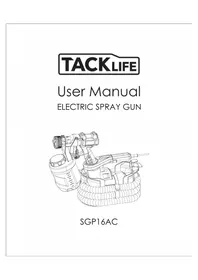
SGP16AC - Paint spray Tacklife - Free user manual and instructions
Find the device manual for free SGP16AC Tacklife in PDF.



| Product Type | Electric Spray Gun |
| Brand | Tacklife |
| Model | SGP16AC |
| Power Supply | 220-240 V ~ 50 Hz |
| Rated Power | 800 W |
| Tank Capacity | 1200 ml |
| Included Nozzle Sizes | Φ1.0 mm, Φ2.0 mm, Φ2.5 mm |
| Maximum Viscosity | 110 DIN-s (flow time ≤ 110 seconds) |
| Air Hose Length | 1.8 m |
| Max Flow Rate | 1100 ml/min |
| Spray Patterns | Horizontal flat jet, vertical flat jet, circular jet |
| Settings | Adjustment of flow rate and spray width |
| Air Filter | Washable and reusable |
| Double Insulation | Yes (no ground wire required) |
| Maintenance | Disassembly and cleaning of parts after each use; washable air filter |
| Approximate Weight | 2.5 kg |
| Dimensions (L × W × H) | 30 × 20 × 25 cm |
| Available Spare Parts | Nozzles, seals, spray tip, check valve, air hose |
| Repairability | Repairs by authorized center; do not open the motor unit |
| Intended Use | Domestic use for water-based or oil-based paints and varnishes (excluding textured paint) |
Frequently Asked Questions - SGP16AC Tacklife
User questions about SGP16AC Tacklife
0 question about this device. Answer the ones you know or ask your own.
Ask a new question about this device
Download the instructions for your Paint spray in PDF format for free! Find your manual SGP16AC - Tacklife and take your electronic device back in hand. On this page are published all the documents necessary for the use of your device. SGP16AC by Tacklife.
USER MANUAL SGP16AC Tacklife
It is important for you to read and understand this manual. The information it contains relates to protecting YOUR SAFETY and PREVENTING PROBLEMS. The symbols below are used to help you recognize this information.

Danger!:
Indicates an imminently hazardous situation which, if not avoided, will result in death or serious injury.

Warning!
Indicates a potentially hazardous situation which, if not avoided, could result in death or serious injury.

Caution!
Indicates a potentially hazardous situationwhich, if not avoided, may result in minor or moderate injury.
Notice!
Used without the safety alert symbol indicates apotentially hazardous situation which, if not avoided, may result in property damage.

The following are explanations of important safetyhazard pictorial in this manual.

Read and understand the instruction manual.
IMPORTANT SAFETY INSTRUCTIONS
Fire hazard.
Explosion hazard.
Respiratory hazard.
Electric shock hazard

SAVE THESE INSTRUCTIONS:
To reduce the risks of fire or explosion, electrical shock and the injury to persons, read and understand all instructions included in this manual.
Be familiar with the controls and the proper usage of the equipment.
This product is intended for household use only.

Warning!
Fire or explosion hazard. Solvent and spray materialfumes can explode or ignite. Severe injury or property damage can occur.
To avoid these risks, take the following preventions:
-
Exhaust and fresh air introduction must be provided to keep the air within the spray area free from accumulation of flammable vapors.
-
Avoid all ignition sources such as static electricitysparks, open flames, pilot lights, hot objects, littobacco products, and sparks from connecting and disconnecing power cords or working light switches.
- Fire extinguisher equipment shall be present andworking.
- Keep area clean and free of paint or solvent containers, rags, and other flammable materials.
Follow the material and solvent manufacturer's safetyprecautions and warnings. - Do not spray flammable or combustible materials near an open flame or sources of ignition such as littobacco products, motors, and electrical equipment.
Know the contents of the spray materials and their cleaning solvents. Read all Material Safety DataSheets (MSDS) and container labels provided with the spray materials and solvents. Follow the spray materialand solvent manufacturer's safety instructions.
- Do not use materials with a flashpoint higher than 60^ ( 140^ ). Flashpoint is the temperature that a fluid can produce enough vapors to ignite (see coatingsupplies).

Warning!
Explosion hazard due to incompatible materials. Severe injury or property damage can occur.
To avoid these risks, take the following preventions:
Do not use bleach.

- Do not use halogenated hydrocarbon solvents such as methylene and 1,1,1 - trichloroethane. They are not compatible with aluminum and may cause an explosion. If you are unsure of a material's compatibility with aluminum, contact your coating supplier.

Warning!
Spraymaterials, solvents, and other materials can be harmful if inhaled or come in contact with thebody. Vapors can cause severe nausea, fainting,or poisoning
To avoid these risks, take the following preventions:

Use a respirator or mask if vapors can be inhaled. Read all instructions supplied with the mask to be sure it will provide the necessary protection.
Wear protective eyewear.
Wear protective clothing as required by coatingmanufacturer.

Warning!
Electric shock hazard. May cause severe injury.
To avoid these risks, take the following preventions
- Keep electrical cord plug and sprayer trigger free from spray material and other liquids. Never hold cord atplug connections to support cord. Failure to observ may result in an electrical shock.
- Never immerse electrical parts in water or any other liquid. Wipe the exterior of the sprayer with a dampcloth for cleaning. Always make sure the sprayer is un-plugged before taking it apart for cleaning.
Do not expose unit to rain or wet conditions. - Do not abuse the cord. Never use the cord to carry the unit or pull the plug from an outlet. Keep cord awayfrom heat, oil, sharp edges or moving parts. Replacedamaged cords immediately.
GENERAL SAFETY WARNINGS

Warning!
General. To Reduce the risk of severe injury or property damage.
To avoid these risks, take the following preventions:
Do not aim the gun at, or spray any person, including self, or animal.
Do not spray outdoors on windy days
Wear protective clothing to keep spray material offskin and hair.
Hose may become hot and cause skin burn.
Follow all appropriate local, state, and national codesgoverning ventilation, fire prevention, and operation.
Always use appropriate gloves, eye protection and a respirator or mask when spraying, thinning, mixing, pouring, or cleaning.
- Do not operate or spray near children. Keep childrenaway from equipment at all times. Keep sprayer out ofthe reach of children.
- Do not overreach or stand on an unstable support. Keep effective footing and balance at all times.
Stay alert and watch what you are doing.
Do not operate the unit when fatigued or under the influence of drugs or alcohol.

- Read all instructions and safety precautions forequipment and spray material before operating anyequipment.
Hearing protection is recommended for extended use.
ELECTRICAL SAFETY
This tool is double insulated; therefore no earthwire is required. Always check that the powersupply corresponds to the voltage on the ratingplate.
- If the supply cord is damaged, it must be replaced by the manufacturer or an authorized Service Centre in order to avoid a hazard.
- When using the tool outdoors, only use extensioncables intended for outdoor use. A suitable ratedextension cable of up to 30m can be used without loss of power.
- Electric safety can be further improved by using a highsensitivity.3-bladegrounding plug and a 3-slot receptacle that will accept theplug on the product. Make sure your extension cord is in goodcondition. When using an extension cord, be sure to use oneheavy enough to carry the current your product will draw. Anundersized cord will cause a drop in line voltage resulting inloss of power and overheating. If an extension cord is to beused outdoors, it must be marked with the suffix W-A after thecord type designation. For example, a designation of SJTW-Awould indicate that the cord would be appropriate for outdooruse. For proper size cords see chart.
Guide for extension cord usage:
| Type of cable | Up to | 5 metres | from 5 to 10 metres | |
| Parallel | 2x 1,0 | mm2 | 2x 1,5 mm2 |

Warning!
Some spray materials contain chemicals known to the State of California to cause cancer, birth defects or other reproductive harm. To reduce your exposure wearappropriate safety equipment such as face masks, gloves, and other appropriate protective equipment. Please review and follow the safety precautions on the paint container.
FEATURES (Fig. A, Fig. A1, Fig. A2)
- Sprayer
- Power unit
- Smart nozzle selector
- Tip collar
- Air cap
- Nozzle (Φ1.0mm/Φ2.0mm/Φ2.5mm)
- Y-type seal ring
- Spray width lever
- Spray tip
- Spray unit housing
- Spraygun handle
- Quick refill lid
- Sealing linear
- O-ring
- Pickup tube
- Check valve assembly
16.1 Check valve sleeve 1
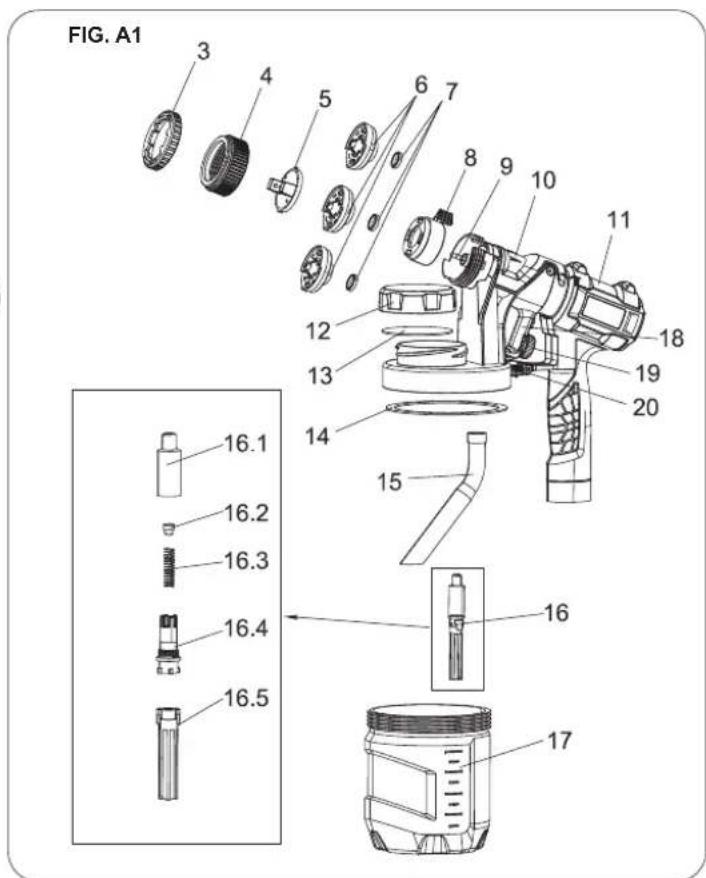
16.2 Check valve
16.3 Spring
16.4 Check valve sleeve 2
16.5 Valve extension
17. Canister
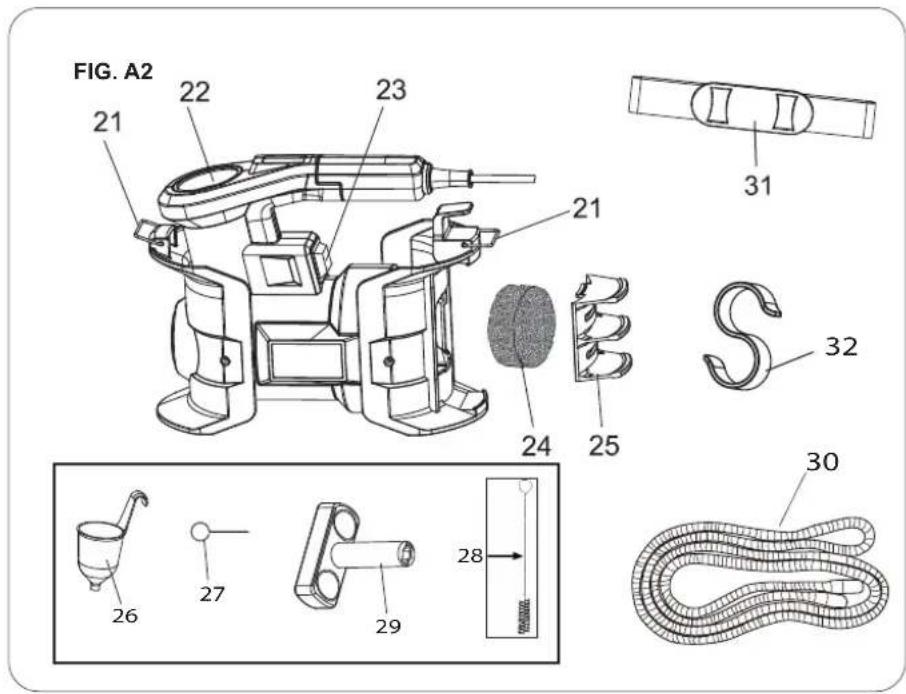
EXTENSION CORD
- Trigger
- Flow control knob
- Quick release lock
- Shoulder strap hook
- Sprayer dock
- On / Off switch
- Filter
- Filter cover
- Viscosity cup
- Cleaning needle
- Cleaning brush
- Spray tip key
- Air hose
- Shoulder straps
- Hose clip
SET - UP

Warning!
Be sure to use appropriate protective gear and unplug unit.

Warning!
Make sure area is well ventilated and free off lammable vapors.
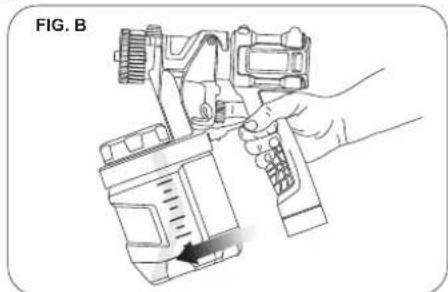
Aligning the pickup tube (Fig. B)
The pickup tube(#15)needs to be aligned in the direction toward the front of the canister (Fig. B). This will ensure you spray as much material as possible before you need to refill.
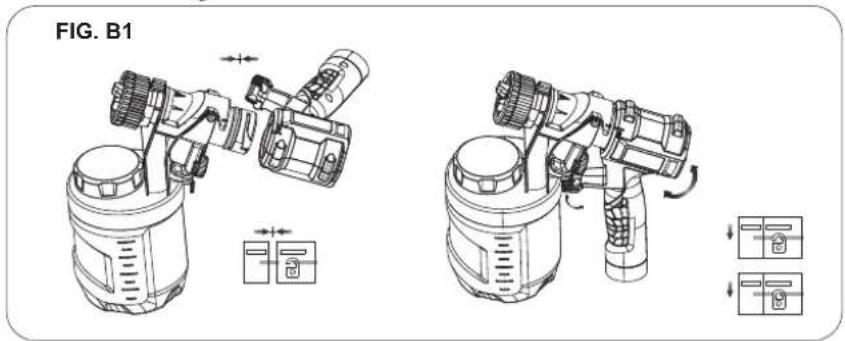
Attaching spray unit to spray gun handle (Fig. B1)
Align the marking line on the spray unit with the icon of unlock, then rotate the spray gun handle clockwise until stop. Rotate the quick release lock (#20) and snap onto the hook on the edge of canister lid.
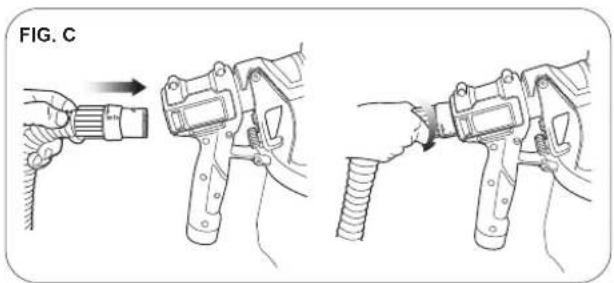
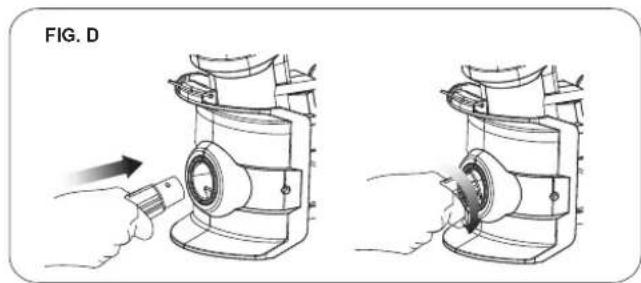
Attaching the air hose (Fig.C, Fig. D)
Insert one end of the air hose into the hose connector of the back of the prayer. A slight twisting action when inserting thehose will help insure a snug fit.(Fig. C) Insert the other end of the air hose into the hose connector of the front of the power unit. A slight twisting action when inserting thehose will help insure a snug fit. (Fig. D)
Liquid material preparation (Fig. E and E1)
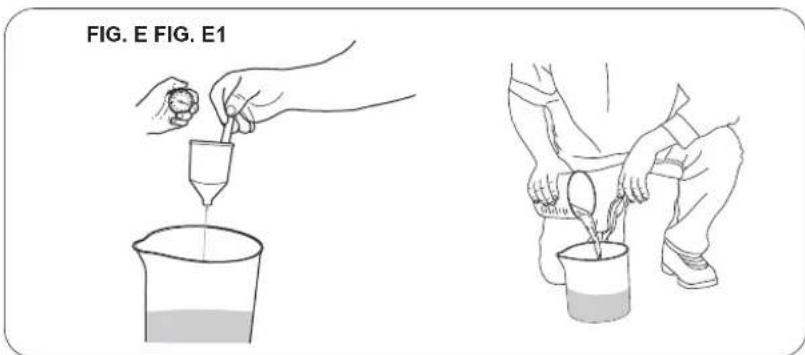
Tip: Make sure the type of material you use can be cleaned with either mineral spirits or paint thinner (for oil-based paints) or a warm water and soap solution (for watersoluble paints like latex). Use drop cloths during pouring, mixing, and viscosity testing of materials to be sprayed to protect your floors and anything else in the spraying area that you wish to remain untouched. The liquid being sprayed may need to be thinned (diluted) before starting. When thinning, use the proper liquid thinner recommended on the container by the material manufacturer.
Warning!
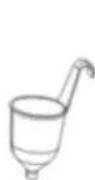
Do not use materials with a flashpoint higher than 60^ (140°F). A viscosity test cup is provided to determine the "runout time" of the material being used.
Before measuring for the proper viscosity, stir thematerial thoroughly.
Dip the viscosity cup into the material being sprayed and fill the cup completely.
- With the cup held over the material container, measure the amount of time it takes for the streamof material flowing out to "break" or stop being aconstant stream out of the bottom of the cup (100 seconds or less) (Fig. E). This is the "runout time". Refer to the thinning table for information on the thinning required for different materials.
If material needs thinning, add the appropriate liquid, thinning material recommended by the manufacturer(Fig. E1).
It is possible to spray latex paint with this unit, however, the required thinning may exceed material manufacturer's recommendation. Thin latex paint so that it runs through viscosity cup within 10 seconds. The operator should consider the type of application and final location of the project when spraying a material that requires more than 110 secondsto run through the viscosity cup.
OPERATION
| THINNING TABLE | |
| SPRAY MATERIAL | RUNOUT TIME |
| Clear and semi-transparent stains and sealers Oil based primers, varnishes and polyurethane | No thinning required (Less than110 seconds runout) |
| Solid color water basedstains | May require thinning(More |
| Water based or latexpaints | than110 seconds runout) |
| Note: Not recommended for textured paint | |
PREPARATION TIPS
Always stir and strain the material thoroughly before use
- With any spraying job you should always ensure that you have properly prepared the surface to get the best finish. That is, all surfaces are free from dust, dirt, rust and grease. Lightly pressure wash decks or exterior surfaces and ensure that they are dry before spraying.
- Even though HVLP sprayers have very little overspray, it is recommended that you mask all edges and other areas and use drop cloths to protect your floors and anything else in the spraying area that you wish to remain untouched.
Skin that forms on the top of paint can clog thesprayer. Remove skin before mixing. Strain with
- afunnel with a filter attached or through hosiery remove any impurities that could clog system. Before starting have gloves, paper towels, rags etc. available for unexpected spills.
FILLING THE CANISTER (FIG. F)
- Check to make sure that the canister is completely screwed onto the sprayer.
Unscrew the quick refill lid (#17).
Stand the sprayer firmly on an smooth and horizontal surface
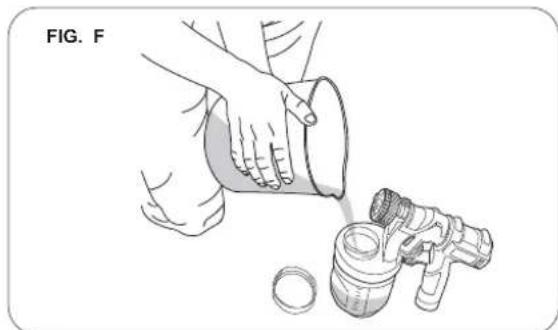
Pour the properly thinned and strained material to besprayed into the canister (Fig. F).
Clean any residual liquid from the threads or sides ofthe canister and sprayer.
Starting the threads evenly, screw the lid completely onto the top fill canister. Check the lid to make sure it is threaded on squarely and completely before picking up the sprayer.
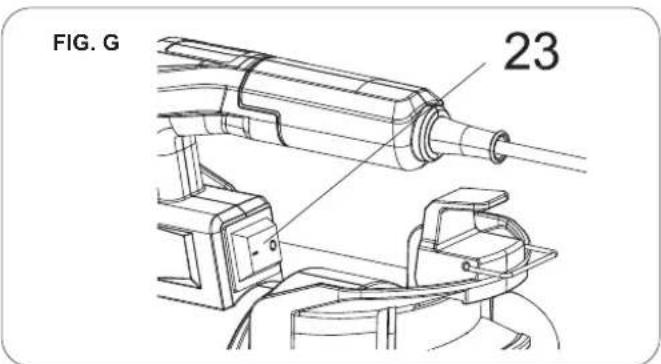
ON/OFF SWITCH (Fig. G)
The on/off switch is located on the top of the power unit. Press the switch button to turn on or turn off the power unit.
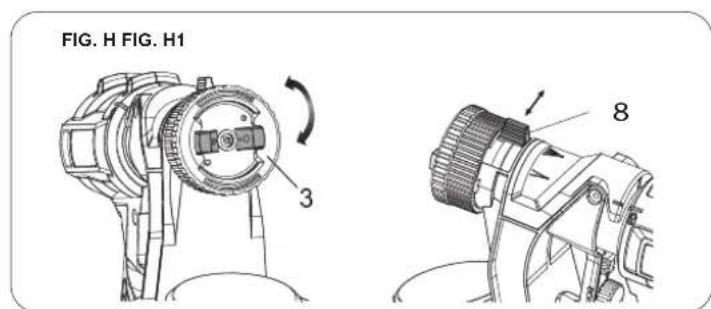
SMART SELECT NOZZLE SELECTION (Fig. H, Fig. H1)
There are three spray patterns to choose from:
- Vertical Flat Jet
- Horizontal Flat Jet
- Circular Jet
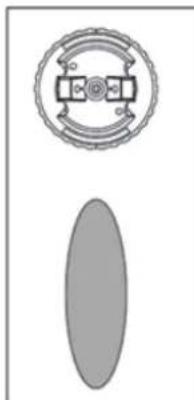
To select Vertical Flat Jet, turn the air cap (#5) to horizontal direction by turning the smart nozzle selector (#3) clockwise until stop.
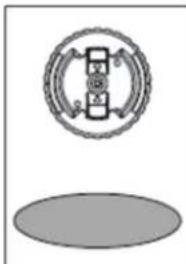
To select Circular Jet, turn the Spray Width Lever (#8) to the
of Minimum.Note: Spray nozzle can only be assembled in onedirection that the notch of the nozzle(#6) must align with the skirt on spray unit housing(#10). Refer toFig. T1 for properassembly

Warning!
Risk of injury. Never point the sprayer at anypart of the body. Never pull the trigger while adjusting the spray setting.
ADJUSTING WIDTH OF SPRAY PATTERN (Fig.H1)
By turning the Spray Width Lever (#8) between the Minimum marking and Maximum marking, the width of the spray patterns can be adjusted accordingly.
FIG. H
| Application | Spray Width Lever #8 | Air Cap #3 S | Spray Jet Pattern |
| Initial coatings, corners, edges, and hard to reach locations | Small circular jet | ||
| Small-medium size surface | Vertical narrow jet for horizontal coating direction Horizontal narrow jet | ||
| for horizontal coating direction Horizontal narrow jet for vertical coating direction | |||
| Vertical wide jet for horizontal coating direction | |||
| Large size surface top coating | Horizontal wide jet for vertical coating direction |
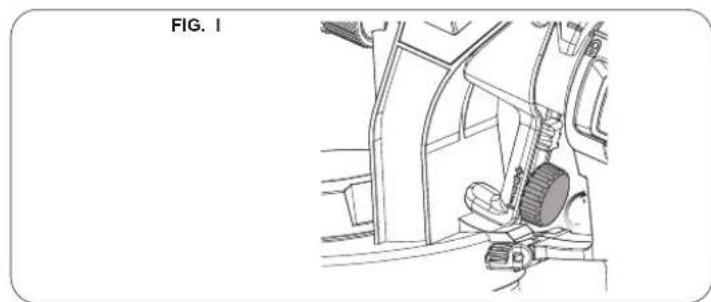
FLOW CONTROL KNOB (Fig. 1)
The flow control knob(#19) regulates the amount of liquid that can be sprayed. Turning the flow knob clockwise increases the flow of liquid. Turning the knob counter anti-clock wise decreases the flow of liquid.
Tip: Always test the spray pattern on scrap cardboard or similar material first. Begin with flow control knob onthe highest flow setting. If less flow is desired, dial the flow control knob anti-clockwise to decrease the flow of liquid. Heavier, thicker materials should besprayed with the flow control knob on high flow setting. Thinner materials should be sprayed with the flow control knob on low flow setting
DEVELOPING THE PROPER SPRAYING TECHNIQUE
- Practice spraying on a piece of scrap material such as cardboard to test your spray pattern and become familiar with the flow control feature of the sprayer.
Ensure surface to be sprayed is free of dust, dirt, and grease. - Ensure spray area is clean and free of dust that could be blown onto newly sprayed surfaces.
Cover any areas not intended to be sprayed.
Always spray from a minimum of 50mm to amaximum of 300mm (Fig. J).
A commonly used method for spraying a largesurface is the "crisscross" pattern. This is done by spraying in horizontal strips and then crossing over these strips with vertical strips.(Fig. L)
To get an even spray distribution, always keep your arm at the same distance (Fig. J) from the surface you are spraying and avoid moving your wrist (Fig. K). - Maintain smooth and consistent speed which will help avoid inconsistencies. Begin spraying after the pass has begun and release trigger before stopping the pass.
- Avoid spraying too heavily in any one area. Severallighter coats are better than one heavy coat which can lead to running and dripping. Remember that the flow control knob regulates the amount of liquid that can be sprayed. Turning the flow knob clockwise increases the flow of liquid. Turning the knob counterclockwise decreases the flow of liquid. If runs or drips do occur, have a dry paint brush on handto smooth them out.
- Turn the power unit off and place the sprayer in the built-in dock of the power unit when not spraying for any length of time.
CLEANING

Warning!
Be sure to use appropriate protective gear.
- Do not use materials with a flashpoint higher than 60^ (140°F). Flashpoint is the temperature that a fluid can produce enough vapors to ignite (see coatingsupplier).
Make sure clean up area is well ventilated and free of flammable vapors.
Always spray outdoors when spraying cleaningsolution through sprayer.
Do not submerge power unit. - Use drop cloths during pouring, mixing, and viscosity testing of materials to be sprayed
- to protect yourfloors and anything else in the spraying area that you wish to remain untouched.
To begin cleaning:
Turn the power unit off, unplug the cord and disconnect air hose from sprayer. - Unscrew the canister from the sprayer and pour any remaining liquid back into the original container(Fig. M).
- Pour a small amount of the appropriate cleaningsolution into the canister (Fig. N).
- Warm soapy water for water based materials
- Manufacturers recommended cleaning solution for oilbased materials
Screw on the canister back to the sprayer securely and vigorouslyshake the sprayer.
Unscrew the canister and properly dispose of cleaning solution. - Refill the canister with a small amount of new cleaningsolution (Fig. M). Screw onthe canister back the sprayer.
Reattach the air hose to the sprayer, plug in the cord and turn on the power unit.
Spray the cleaning solution through the sprayer ontoscap material for 2 to 3 seconds (Fig. O).
Turn the power unit off, unplug the cord and disconnectair hose from sprayer.
Unscrew the canister from the sprayer. - Remove the o-ring(#14), pickup tube(#15), check valve (#16), and quick refill lid(#12) from the sprayer. Clean the parts with the cleaning brush in the appropriate cleaning solution (Fig. P).
Note: When removing the check valve, twist the check valve clockwise and then pull it out.(Fig P1)
- Unscrew the tip collar (#4) and remove all the partsof the spra(#3,#4,#5,#6,#7.#8) from the sprayer.Remove the spray tip(#9) from the sprayer (Fig.Q1). Clean all parts with the cleaning brushin the appropriate cleaning solution (Fig. Q, Fig.Q1). Be sureto clean around check valve with brush (Fig. Qinsert).
- If using water based material, clean the sprayer by running water through pickup tube inlet as shown in Fig.R. If using oil based materials, clean pickuptube inlet with the appropriate cleaning solution. Repeat until sprayer is completely clean.
Dry all parts thoroughly.
Properly dispose of cleaning solution. - Place a drop of household oil into the inside of the sprayer from the hole for assembling the spray tip(Fig. S).
Reassemble sprayer (Fig. T).
Note: Spray nozzle can only be assembled in one direction that the notch of the nozzle(#6) must align with the skirt on spray unit housing(#10). Refer toFig. T1 for properassembly
Note: The spray tip must be assembled in the sprayer with the bumps on the spray tipin vertical direction
Note: Assemble the pickup tube(#15) and check valve (#16) by firmly pushing them onto the inlet on the sprayer.
Wrap the air hose around the power unit and put all accessories back into place
MAINTENANCE
Use only mild soap and damp cloth to clean the powerunit. Never let any liquid get inside the power unit; neverimmerse any part of the power unit into a liquid.

Important!
To assure product SAFETY and RELIABILITY, repairs, maintenance and adjustment (other than those listed in this manual) should be performed by authorized service centers or other qualified service personnel, always using identical replacement parts. The power unit contains washable/reusable filters (#24). Check the filter before Check the filter
before and after each use. If dirty, wash with warm water and allow to air dry before installing or replace if necessary. (Fig. U)
To check the filter, - remove the filter cover (#25) by squeezing the top and bottom sides of the filter cover (#25) and pulling the coveroff the powerit.
PROTECTING THE ENVIRONMENT

Important!
Never operate the power unit without the filter in place. Debris could be sucked in and interfere with the function of the power unit.
STORAGE
Make sure unit is clean and dry before storing. Store unitindoors in a dry location. To prevent damage, wrap theelectrical cord so that
ACCESSIONS
it is not crimped during storage.Recommended accessories for use with your product areavailable from your local dealer or authorized service center.

Warning!
The use of any accessory not recommended for use with this product could be hazardous. Separate collection. This product must not be disposed of with normal household waste. Should you find one day that your product needs replacement, or if it is of no further use to you, do not dispose of it with household waste. Make this product available for separate collection. Separate collection of used products and packaging allows materials to be recycled and used again. Re-use of recycled materials helps prevent environmental pollution and reduces the demand for raw materials. Local regulations may provide for separate collection of electrical products from the household, at municipal waste sites or by the retailer when you purchase a new product.
TROUBLESHOOTING
| TROUBLE! MATERIAL RUNS OR DRIPS. | |
| WHAT'S WRONG? WHAT TO DO... | |
| Spraying too much materiai | Reduce paint flow by turning material adjustment knob. |
| Spraying too slowly. | Increase speed of application. |
| Spraying too close. | Increase distance from surface. |
| Viscosity too thin. | Check dilution recommendation. |
| TROUBLE! MATERIAL DRIPS FROM NOZZLE | |
| WHAT'S WRONG? | WHAT TO DO... |
| Nozzle loose | Screw nozzle tight |
| Nozzle breaks | Change |
| Y-type seal ring of nozzle breaks | Change |
| Material accumulated /clog inside nozzle | Clean |
| TROUBLE! TOO MUCH OVER SPRAY. | |
| WHAT'S WRONG? | WHAT TO DO... |
| Sprayer too far from surface. | Reduce distance to surface. |
| Too much material being sprayed. | Reduce paint flow by turning flow control knob |
| TROUBLE! LITTLE OR NO MATERIAL BEING RELEASED. | |
| WHAT'S WRONG? | WHAT TO DO... |
| Spray nozzle/tip clogged. | Clean nozzles. |
| Y-type seal ring of nozzle missing | Add seal ring to nozzle and assemble in place |
| Pickup tube loose or clogged. | Check tube. |
| Canister loose | Screw canister tightly in place |
| Quick refill lid loose | Screw quick refill lid tight in place |
| Air hose split or disconnected | Check air hose |
| Flow control knob setting too low. | Increase flow control setting |
| Air inlet blocked | Clean or change air filter |
| Material too thick. | Thin material per manufacturer recommendation |
| TROUBLE! MATERIAL BEING SPRAYED IS SPLATTERING | |
| WHAT'S WRONG? | WHAT TO DO... |
| Viscosity of material is too high. | Thin material per manufacturer recommendation. |
| TROUBLE! ATOMIZATION IS TOO COARSE | |
| WHAT'S WRONG? | WHAT TO DO... |
| Viscosity of material too high. | Thin material per manufacturer recommendation. |
| Flow control knob setting too high | Decrease flow control setting |
| Material accumulated /clog inside nozzle | Clean |
| Air inlet blocked | Clean or change air filter |
| Canister loose | Screw canister tightly in place |
| Quick refill lid loose | Screw quick refill lid tight in place |
| TROUBLE! SPRAYER PULSATES. | |
| WHAT'S WRONG? | WHAT TO DO... |
| Air filter clogged | Clean or change air filter |
| Material in canister almost empty. | Refill canister. |
| Canister loose | Screw canister tightly in place |
| Quick refill lid loose | Screw quick refill lid tight in place |
| TROUBLE! SPRAY MATERIAL DOES NOT COVER PROPERLY | |
| WHAT'S WRONG? | WHAT TO DO... |
| Flow control knob setting too low. | Increase flow control setting |
| Clearance to target area too large | Reduce spray distance |
| Too few spray paths sprayed over target area | Apply more spray paths sprayed over target area |
| Viscosity of material too high. | Thin material per manufacturer recommendation. |
Technische Daten
FLOW CONTROL KNOB (Abb. I)
CONSERVEZ CES INSTRUCTIONS:
Aligning the pickup tube (Fig. B)
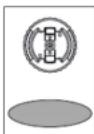
To select Vertical Flat Jet, turn the air cap (#5) to horizontal direction by turning the smart nozzle selector (#3) clockwise until stop.
To select Horizontal Flat Jet, turn the air cap (#5) to vertical direction by turning the smart nozzle selector (#3) anti-clockwise, until stop.
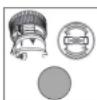
To select Circular Jet, turn the Spray Width Lever (#8) to the icon of Minimum.
Note: Spray nozzle can only be assembled in onedirection that the notch of the nozzle(#6) must align with the skirt on spray unit housing(#10). Refer to Fig. T1 for properassembly
IAdvertencia:
Risk of injury. Never point the sprayer at anypart of the body. Never pull the trigger while adjusting thespray setting.
ADJUSTINGWIDTHOFSPRAY PATTERN(Fig.H1)
By turning the Spray Width Lever (#8) between the Minimum marking and Maximum marking, the width of the spray patterns can be adjusted accordingly.
FIG. H
| Application | Spray Width Lever #8 | Air Cap #3 S | Spray Jet Pattern |
| Initial coatings, corners, edges, and hard to reach locations | Small circular jet | ||
| Vertical narrow jet for horizontal coating directionHorizontal narrow jet for vertical coating direction | |||
| Jarma ancha vertical para Recubrimiento horizontal direccion | |||
| Talla grande Superficie superior revestimiento | Jet horizontal de ancho Para recubrimiento vertical direccion |
MANDO DE CONTROL DE FLUJO(Fig.1)
Wear protective eyewear.
Wear protective clothing as required by coatingmanufacturer.

Avertimento!
ADD: No.31, Qing Linxi Road, Longgang District,
Shenzhen, Guangdong, China 518172
Made in China