BKH 90 GL - Basket BERBEL - Free user manual and instructions
Find the device manual for free BKH 90 GL BERBEL in PDF.

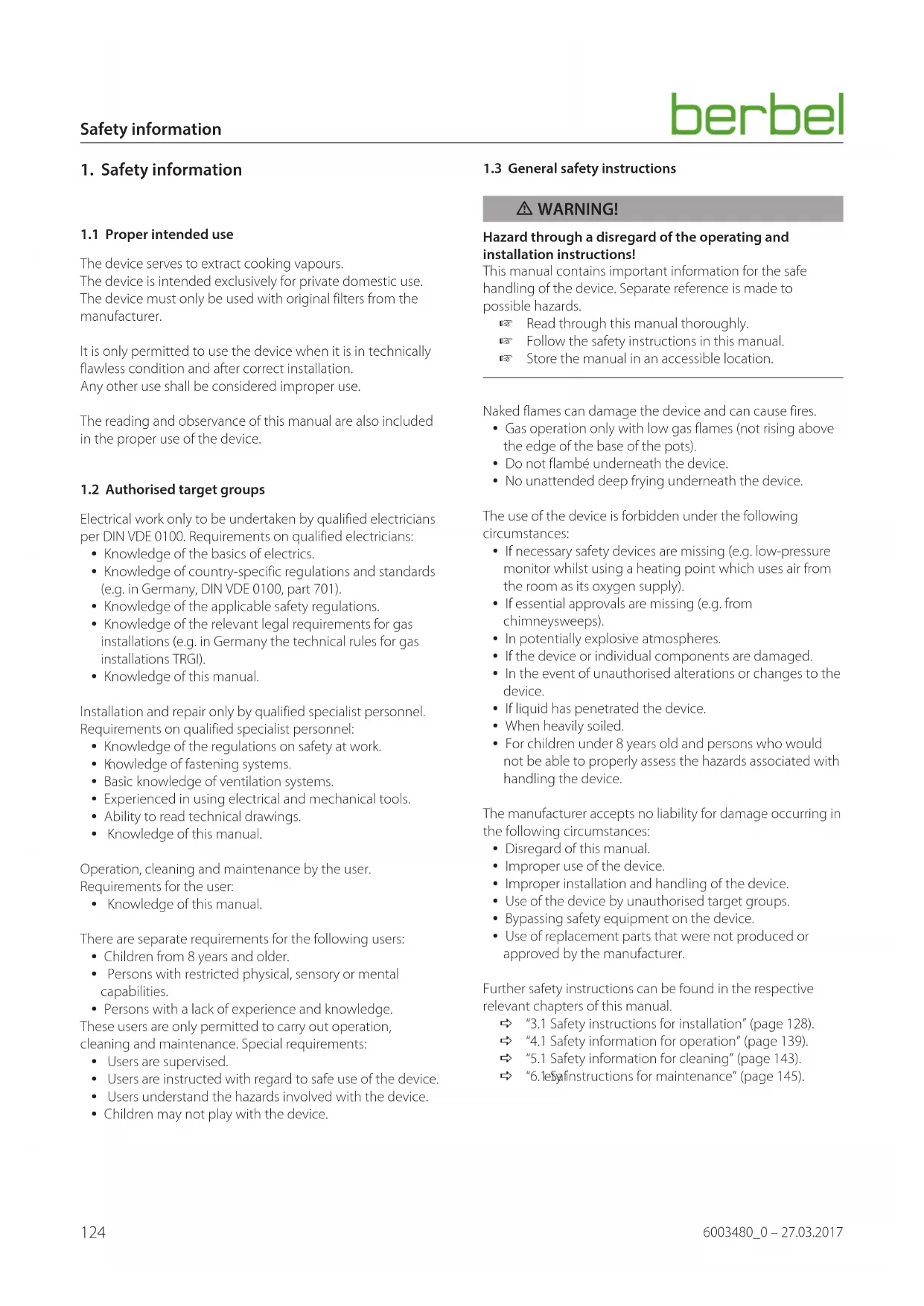


| Product type | Inclined cooker hood |
| Brand and model | BERBEL BKH 90 GL |
| Dimensions (W x D x H) | 898 x 440 x 995-1375 mm (depending on mode) |
| Net weight | 35 kg |
| Power supply | 230 V ~ 50 Hz |
| Rated power | 187 W |
| Annual energy consumption | 37.1 kWh (extraction mode) |
| Operating modes | Air recirculation, air extraction, hybrid |
| Separation technology | Centrifugal force + Back-Flow |
| Power levels | 4 (1, 2, 3, Max) |
| Max air flow (extraction) | 420 m³/h |
| Max air flow (recirculation) | 350 m³/h |
| Max noise level (extraction) | 64 dB(A) |
| Max noise level (recirculation) | 67 dB(A) |
| Cooktop lighting | LED 14.2 W, 520 lx, adjustable temperature 2700-6500 K |
| Effect lighting | LED 2.6 W, 264 lm |
| Filters | Removable Capillar Trap, recirculation or hybrid filter |
| Filter saturation indicator | Yes (flashes every 350 h) |
| Timer off function | Yes (10 minutes) |
| Switching function extraction/recirculation | Yes (in hybrid mode) |
| Energy class | A |
| Manufacturer contact | +49 (0) 5971/80 80 9-0 |
Frequently Asked Questions - BKH 90 GL BERBEL
User questions about BKH 90 GL BERBEL
0 question about this device. Answer the ones you know or ask your own.
Ask a new question about this device
Download the instructions for your Basket in PDF format for free! Find your manual BKH 90 GL - BERBEL and take your electronic device back in hand. On this page are published all the documents necessary for the use of your device. BKH 90 GL by BERBEL.
USER MANUAL BKH 90 GL BERBEL
DE Kopffreihaube
FR Hotte aspirante inclinee
IT Cappa a parete (headfree)
NL Hoofdvrije afzuigkap
EN Headroom hood
Glassline 2
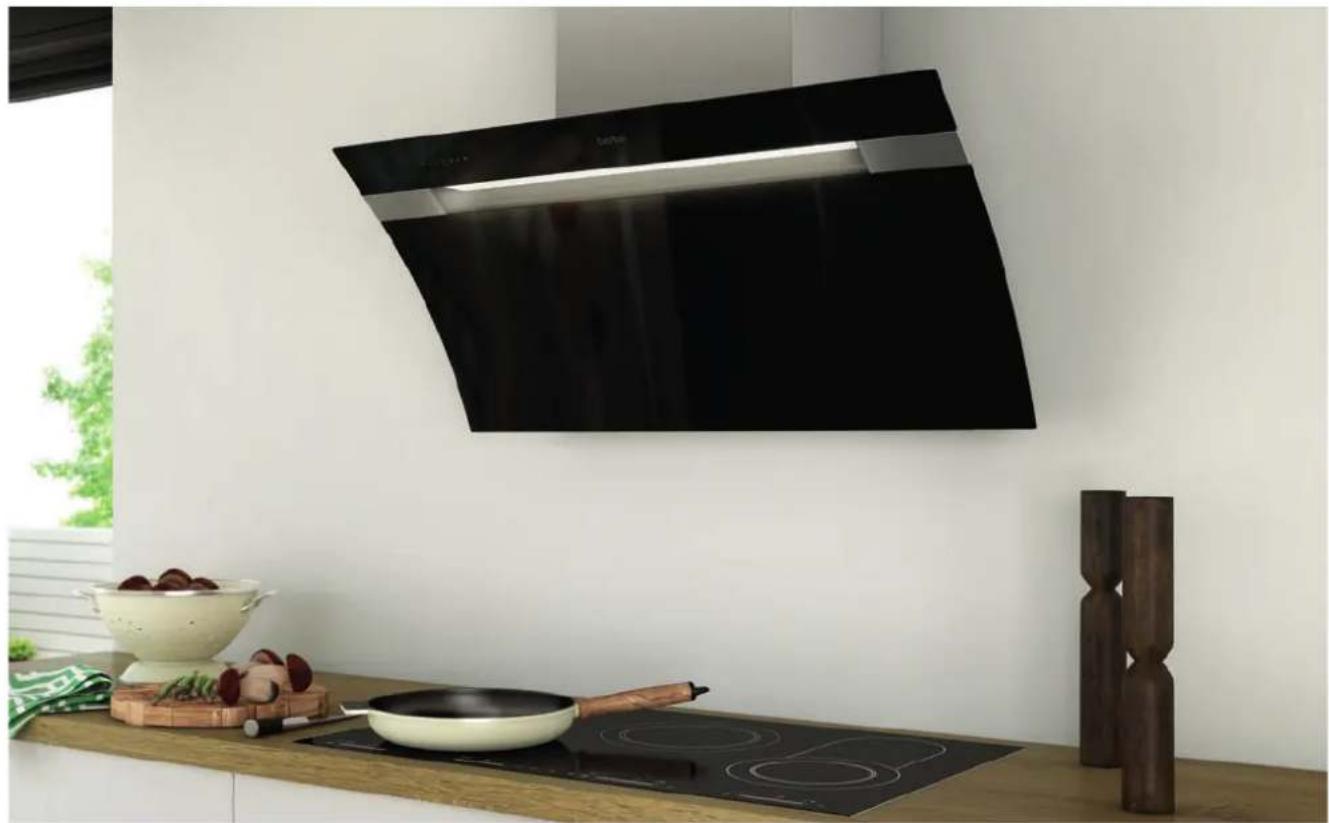
DE Gebrauchs- und Montageanleitung für die Modelle
FR Manuel d'utilisation et de montage des modèles
IT Istruzioni d'uso e di montaggio per i modelli
NL Gebruiks- en montagehandleiding voor de modellen
EN Operating and installation instructions for the models
BKH 90 GL-2
BKH 110 GL-2
- De zekering is geactiveerd of is defect.
Operating and installation instructions for:
Headroom hood BKH 90 GL-2
Headroom hood BKH 110 GL-2
Descriptions are identical for all models.
Differences are noted separately.
Illustrations show:
Headroom hood BKH 90 GL-2
- Original instructions.
Part of the product.
Copyright protected. - Duplications, re-printing and distribution only with permission.
- Subject to alteration.
Safety information
DANGER!
Notes with the word DANGER warn of a hazardous situation that results in serious injuries or death.
WARNING!
Notes with the word WARNING warn of a hazardous situation that could result in serious injuries or death.
CAUTION!
Notes with the word CAUTION warn of a situation that could result in minor injuries.
ATTENTION!
Notes with the word ATTENTION warn of a situation that could result in damage to property or to the environment.
Symbol clarification - text
Handling requirement
Listing
Reference to another point in this document
Reference to other documents that should be observed
Symbol clarification - illustrations
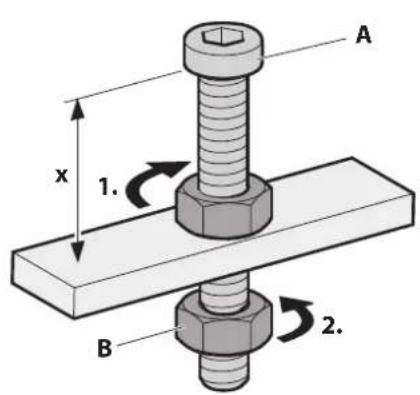
Highlighting of the parts involved in the action with shading
- Handling steps with numbering
A Part designations with upper case characters
x Dimensions with lower case characters or units in mm
Movement and direction arrows
Table of contents
1. Safety information 124
1.1 Proper intended use 124
1.2 Authorised target groups. 124
1.3 General safety instructions 124
2. Product information 125
2.1 Functional principle 125
2.2 Operating modes. 125
2.2.1 Recirculated air mode 125
2.2.2 Extracted air mode 125
2.2.3 Hybrid mode.. 125
2.3 Product overview. 126
2.4 Scope of delivery 127
2.5 Technical data 127
3. Installation 128
3.1 Safety instructions for installation. 128
3.2 Requirements for the installation location 128
3.3 Requirements for individual operating modes. 129
3.3.1 Requirements for recirculated air mode 129
3.3.2 Requirements for extracted air mode. 129
3.3.3 Requirements for hybrid mode.. 129
3.4 Requirements for the exhaust air ducting (only for extracted air mode or hybrid mode) 129
3.5 Installation procedure 130
3.5.1 Preparation for installation 130
3.5.2 Unpack the device 130
3.5.3 Remove the lower section and Capillar Trap 131
3.5.4 Hang the device in place. 132
3.5.5 Connect accessories 134
3.5.6 Install filter (with recirculating and hybrid operation) 135
3.5.7 Connect exhaust air ducting (with exhausted air and hybrid mode) 136
3.5.8 Establish electrical power supply 136
3.5.9 Mount the chimney 137
3.5.10 Insert the Capillar Trap and lower section... 138
3.5.11 Check and carry out commissioning 138
4. Operation 139
4.1 Safety information for operation 139
4.2 Control panel 139
4.3 Normal operation. 140
4.3.1 Run-on function 141
4.3.2 Hob lighting 141
4.3.3 Extraction mode / recirculated air mode changeover 141
4.3.4 Check filter filling indicator 142
4.4 Configuration 142
5. Cleaning 143
5.1 Safety information for cleaning 143
5.2 Cleaning procedures. 143
6. Maintenance 145
6.1 Safety instructions for maintenance 145
6.2 Maintenance. 145
6.2.1 Changing the lamps 145
6.2.2 Replacing filter filling (with recirculating and hybrid mode). 145
8.1 Disposefofpackaging 149
8.2 Disposetof the device 149
9. Annex. 150
9.1 Product data sheet 150
9.2 Accessories. 151
9.3 Contact 151
1. Safety information
1.1 Proper intended use
The device serves to extract cooking vapours.
The device is intended exclusively for private domestic use.
The device must only be used with original filters from the manufacturer.
It is only permitted to use the device when it is in technically flawless condition and after correct installation. Any other use shall be considered improper use.
The reading and observance of this manual are also included in the proper use of the device.
1.2 Authorised target groups
Electrical work only to be undertaken by qualified electricians per DIN VDE 0100. Requirements on qualified electricians:
- Knowledge of the basics of electrics.
- Knowledge of country-specific regulations and standards (e.g. in Germany, DIN VDE 0100, part 701).
- Knowledge of the applicable safety regulations.
- Knowledge of the relevant legal requirements for gas installations (e.g. in Germany the technical rules for gas installations TRGI).
- Knowledge of this manual.
Installation and repair only by qualified specialist personnel. Requirements on qualified specialist personnel:
- Knowledge of the regulations on safety at work.
- Knowledge of fastening systems.
- Basic knowledge of ventilation systems.
- Experienced in using electrical and mechanical tools.
- Ability to read technical drawings.
- Knowledge of this manual.
Operation, cleaning and maintenance by the user. Requirements for the user:
- Knowledge of this manual.
There are separate requirements for the following users:
Children from 8 years and older.
- Persons with restricted physical, sensory or mental capabilities.
- Persons with a lack of experience and knowledge.
These users are only permitted to carry out operation, cleaning and maintenance. Special requirements:
- Users are supervised.
- Users are instructed with regard to safe use of the device.
- Users understand the hazards involved with the device.
Children may not play with the device.
1.3 General safety instructions
WARNING!
Hazard through a disregard of the operating and installation instructions!
This manual contains important information for the safe handling of the device. Separate reference is made to possible hazards.
Read through this manual thoroughly.
Follow the safety instructions in this manual.
Store the manual in an accessible location.
Naked flames can damage the device and can cause fires.
Gas operation only with low gas flames (not rising above the edge of the base of the pots).
- Do not flambe underneath the device.
- No unattended deep frying underneath the device.
The use of the device is forbidden under the following circumstances:
- If necessary safety devices are missing (e.g. low-pressure monitor whilst using a heating point which uses air from the room as its oxygen supply).
If essential approvals are missing (e.g. from chimneysweeps). - In potentially explosive atmospheres.
- If the device or individual components are damaged.
- In the event of unauthorised alterations or changes to the device.
If liquid has penetrated the device. - When heavily soiled.
- For children under 8 years old and persons who would not be able to properly assess the hazards associated with handling the device.
The manufacturer accepts no liability for damage occurring in the following circumstances:
- Disregard of this manual.
- Improper use of the device.
- Improper installation and handling of the device.
- Use of the device by unauthorised target groups.
- Bypassing safety equipment on the device.
- Use of replacement parts that were not produced or approved by the manufacturer.
Further safety instructions can be found in the respective relevant chapters of this manual.
3.1 Safety instructions for installation" (page 128).
4.1 Safety information for operation" (page 139).
"5.1 Safety information for cleaning" (page 143).
"6.15a:instructions for maintenance" (page 145).
2. Product information
2.1 Functional principle
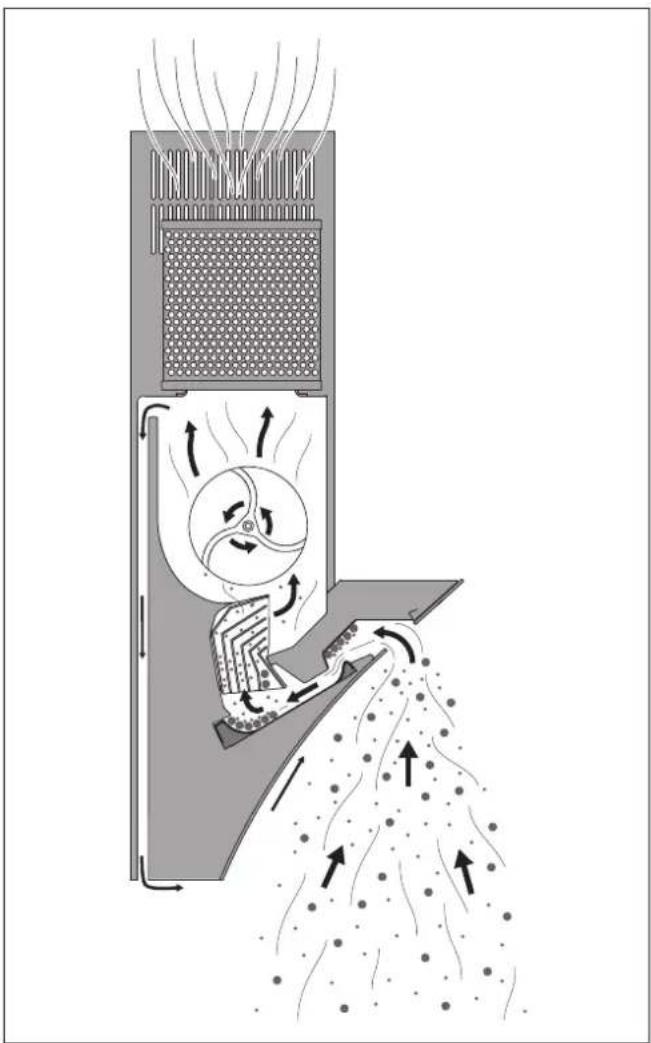
Centrifugal force
- Cooking vapours are drawn through a gap and into the hood where they are accelerated and routed through bends.
- The resultant centrifugal force ejects particles of dirt (e.g. particles or grease and oil) out of the air.
- The dirt particles are separated out and collected on the upper and lower section as well as a catchment screen ("Capillar Trap").
Back-flow technology
- Condensate or droplet formation on the decorative panel (e.g. if steam touches the cold surface) is prevented by a vent installed from the bottom to the top.
- Part of the vented air quantity is fed to the back of the extractor hood, blown over the glass front and directed into the suction gap.
2.2 Operating modes
The device is suitable for the following operating modes:
- Recirculated air mode
- Extracted air mode
- Hybrid mode
2.2.1 Recirculated air mode
The filter filling in the recirculated air filter neutralises any smelly odours present. The odour-free, cleaned room air is fed back into the room. The humidity in the room can be reduced with the fresh air feed.
In recirculated air mode, it is necessary to use the run-on function so that the device can remove the remaining odours. Using the run-on function increases the life of the filter filling. The filter filling must be replaced at regular intervals.
2.2.2 Extracted air mode
The cleaned room air can be routed to the outside via the building structure (e.g. ducting, chimney).
With extracted air mode an adequate fresh air supply is required. The device can only extract the amount of air to the outside that is present in the room or which is drawn into the room.
2.2.3 Hybrid mode
In hybrid mode, it is possible to select flexibly between recirculated air mode and extracted air mode.
In extracted air mode, the cleaned room air is routed to the outside through the wall box which opens automatically. Extracted air mode is recommended in summer or with particularly intensive frying.
In recirculated air mode the wall box remains closed. The filter filling in the hybrid filter neutralises any smelly odours present. The odour-free, cleaned room air is fed back into the room.
The recirculated air mode is recommended in winter if no warm room air is to be surrendered to the outside.
2.3 Product overview
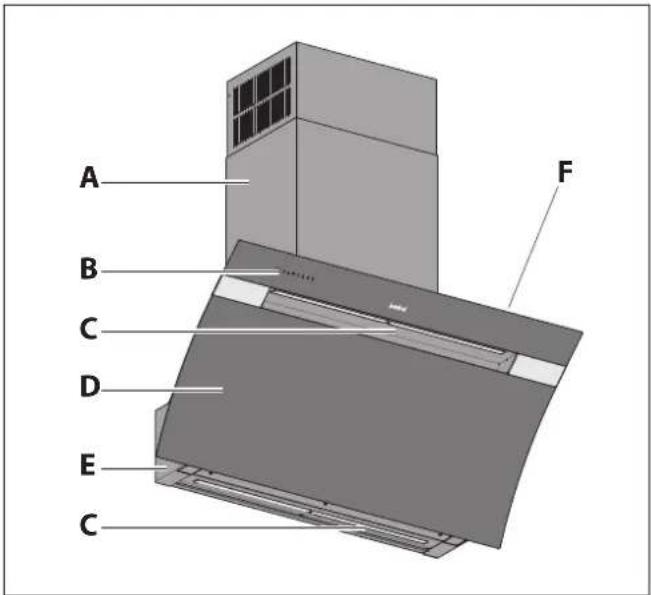
A Chimney
B Control panel
4.2 Control panel (page 139).
C Hob lighting
D Front panel made of glass
E Hood body
F Effect lighting - on the rear of the hood body
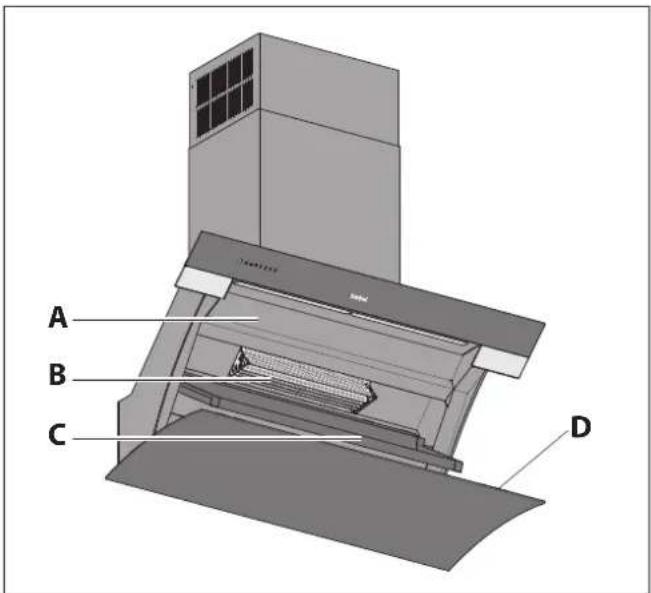
A Upper section
B Capillar Trap (removable)
C Lower section (removable)
D Type plate - on the inside of the front panel
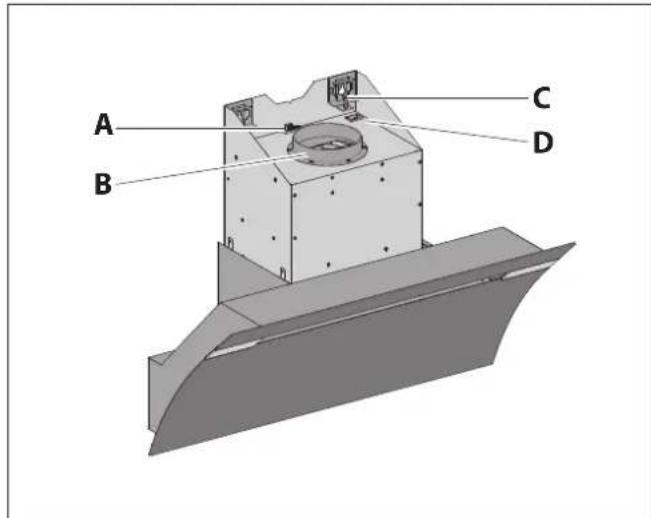
A Connection terminals for wall box, window contact switch (multifunction contact) and bus connection
B Fan outlet with guide for filter or exhaust air ducting
C Adjusting screws for alignment
D Socket for the mains cable
2.4 Scope of delivery
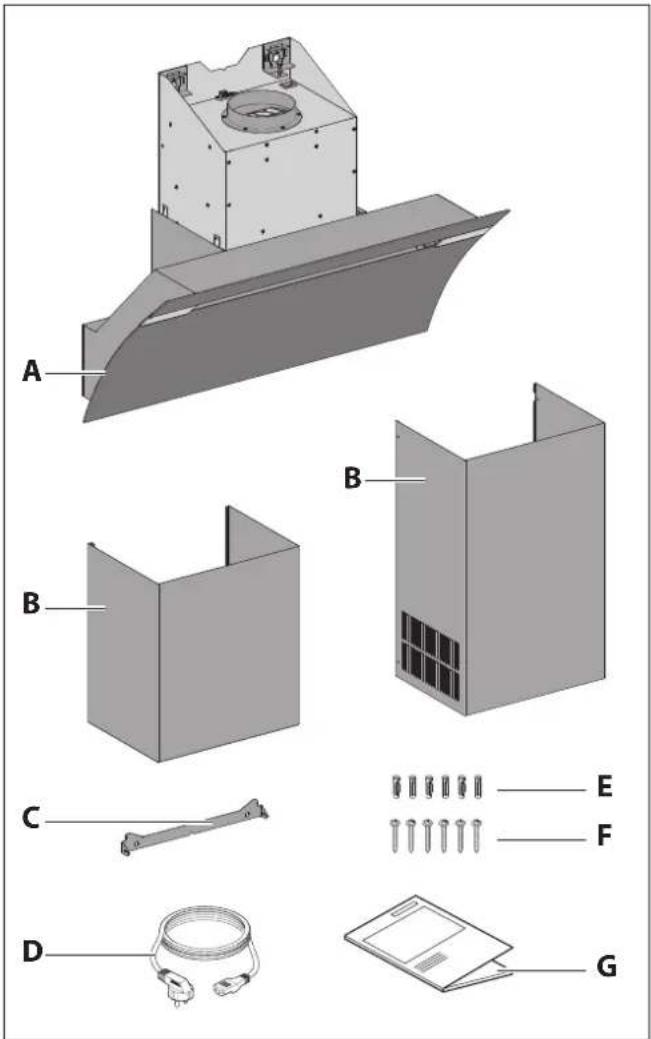
A Hood body with front panel
B Chimney (two-part, can be pulled apart)
C. Chimney fastening
D. Mains cable with plug and cold device plug
E 6 nylon wall plugs 8mm
F 6 Torx screws TX30 with integrated washers
G Operating and installation instructions
The fastening materials are only suitable for solid walls.
Further accessories may be required depending on the operating mode.
9.2 Accessories" (page 151).
2.5 Technical data
| BKH 90 GL-2 | BKH 110 GL-2 | |
| Connection voltage 230 V / 50 Hz | 230 V / 50 Hz | |
| Total power 187 W 193 W | ||
| Fan power consumption 170 W | 170 W | |
| Lighting - hob lighting | LED 14.2 W, 520 lx | LED 19.5 W, 630 lx |
| Colour temperature hob lighting, setting | 2700 - 6500 K | 2700 - 6500 K |
| Lighting - effect lighting | LED 2.6 W, 264 lm | LED 2.6 W, 264 lm |
| Width | 898 mm | 1098 mm |
| Depth | 440 mm | 440 mm |
| Height in recirculated air mode with recirculated air filter BUF 150 + | 995 - 1375 mm | 995 - 1375 mm |
| Height in recirculated air mode with recirculated air filter permalyt | 1025 - 1375 mm | 1025 - 1375 mm |
| Height in extracted air mode | 995 - 1235 mm | 995 - 1235 mm |
| Height in hybrid mode | 1070 - 1375 mm | 1070 - 1375 mm |
| Net weight | 35 kg | 41 kg |
Information about energy consumption can be found in the product fiche.
9.1 Product data sheet" (page 150).
Information on the model (e.g. serial number, year of construction) is quoted on the front panel.
2.3 Product overview" (page 126).
3. Installation
3.1 Safety instructions for installation
WARNING!
Hazard through disregard of the installation instructions!
This chapter contains important information for the safe installation of the device.
Read through this chapter carefully before installing the device.
Follow the safety instructions.
Carry out the installation as described.
- Installation only by qualified specialist personnel. "1.2 Authorised target groups" (page 124).
-
Electrical work only to be undertaken by qualified electricians. "1.2 Authorised target groups" (page 124).
-
Installation requires two persons.
- When working at heights, ensure good stable footing (e.g. stable stepladder).
- The hob and other parts that can be touched must be allowed to cool prior to installation.
- Store the film or other parts of the packaging in a location which is inaccessible to children.
- The device must be in an undamaged and fault-free condition prior to installation.
- Cables must not be kinked, crushed or damaged.
- Never open the fan housing.
- The power supply voltage must match the voltage information quoted on the ratings plate.
2.5 Technical data" (page 127).
- Ensure that the power supply is stable and remains so prior to the installation.
Connect the power supply only when instructed to do so in the installation instructions.
3.2 Requirements for the installation location
WARNING!
Risk of death due to improper installation!
Disregard of the ambient conditions can lead to hazardous situations, e.g. in the handling of electrical power or gas.
Make sure that the requirements for the installation location are complied with.
- Do not install in potentially explosive atmospheres.
- Whilst using a heating point which uses air from the room as its oxygen supply (e.g. fireplace):
- A safety device is absolutely essential.
- The safety device (e.g. under-pressure monitor P4, tested per DIN 18841:2005-12 TÜV and per DVGWVP121) must prevent gases being drawing into the room.
-
An approval for commissioning (e.g. from a chimneysweep) must be available.
-
Installation is only permitted on structural building elements capable of bearing the load (solid structure).
- If it is necessary to break through the wall: A wall break-through influences the structural integrity of the building. This work must only be carried out by a specialist.
- If installed above fireplaces that use solid fuels (e.g. coal stove):
The fireplace must have a sealed cover which cannot be removed. Otherwise there is a fire risk due to flying sparks. Applicable legal and country-specific regulations must be observed.
- The air flowing out must be able to dissipate unimpeded. Do not impede the air flow, e.g. through the installation of objects on or above the device.
- Make sure that the building electrical supply is properly earthed.
- The power supply voltage present must match the voltage information quoted on the ratings plate.
- There must be an electrical power outlet in the vicinity of the hood installation.
- The mains plug must be accessible after the installation of the hood. Alternatively, all-pole isolating device (with a contact gap of at least 3mm ) must be provided.
Country-specific, legal provisions must be observed.
3.3 Requirements for individual operating modes
Further accessories may be required depending on the operating mode.
9.2 Accessories" (page 151).
3.3.1 Requirements for recirculated air mode
- Recirculated air filter at the fan outlet.
Cross-section of the ventilation slot in the superstructure larger than 300~cm^2 - Filter filling freely accessible for changing.
3.3.2 Requirements for extracted air mode
- Exhaust air ducting at the fan outlet.
"3.4 Requirements for the exhaust air ducting (only for extracted air mode or hybrid mode)" (page 129). - Diameter of the exhaust air ducting at least 150mm (corresponds to a surface area of approx. 177~cm^2
- Adequate fresh air supply is assured through the installation of the necessary accessories.
Window contact switch.
- Wall box.
3.3.3 Requirements for hybrid mode
- Hybrid filter at the fan outlet.
- Connection of the exhaust air ducting to the hybrid filter. "3.4 Requirements for the exhaust air ducting (only for extracted air mode or hybrid mode)" (page 129).
Cross-section of the ventilation slot in the superstructure larger than 300cm^2 - Diameter of the exhaust air ducting at least 150mm (corresponds to a surface area of approx. 177~cm^2
- Filter filling freely accessible for changing.
- Adequate fresh air supply is assured through the installation of the necessary accessories.
Window contact switch.
- Wall box BMK-F 150.
3.4 Requirements for the exhaust air ducting (only for extracted air mode or hybrid mode)
WARNING!
Fire hazard and asphyxiation hazard due to improper installation!
When using the exhaust air ducting with other devices or when connecting an active exhaust air channel (e.g. chimney), gases or smoke can be drawn into the room.
Make sure that the requirements for the exhaust air ducting are complied with.
The exhaust air ducting is used exclusively by this device.
- The exhaust air ducting is made of non-combustible material in accordance with DIN 4102 class 1.
- When using a chimney as the exhaust air duct;
The chimney must not be used by other devices.
- The extracted air must be introduced into the chimney using a 90^ bend pointing upwards.
- Approval by a master chimney sweep.
- When routing the exhaust air ducting through the roof or the outside wall:
The cross-section must not be smaller than that of the fan outlet.
- Installation of condensed water collector in the exhaust air ducting in order to prevent water damage inside the device. The condensed water collector must be adequately dimensioned.
The cross-section, length, type and course of the exhaust pipe affect the extraction efficiency. Changing the direction of the air too severely leads to a loss of performance and to noise.
To optimise the device performance:
- Keep the exhaust air ducting as short as possible and route it directly to the outside.
- The stipulated cross-section of the exhaust air ducting is complied with.
"3.3 Requirements for individual operating modes" (page 129).
- Exclusive use of ducts and bends with smooth inner surfaces.
In order to avoid turbulence or backpressure in the transported air - do not use:
- Spiral hoses.
- Flexible tubes.
- Flat deflection pieces.
- Sharp-edged exhaust air channels.
The exhaust air ducting must be in place before installing the device.
3.5 Installation procedure
Short overview:
- Preparation for installation
- Unpack the device
- Remove the lower section and Capillar Trap
- Hang the device in place
- Connect accessories
- Install filter (with recirculating and hybrid operation)
- Connect exhaust air ducting (with exhausted air and hybrid mode)
- Establish electrical power supply
- Mount the chimney
- Insert the Capillar Trap and lower section
- Check and carry out commissioning
3.5.1 Preparation for installation
Familiarise yourself with the installation situation and the associated documents.
Device and instructions.
- Accessories.
- Installation location.
- Intended operating mode.
Assemble the tools and materials required:
Stable stepladder
- Folding rule or measuring tape
Pencil
Spirit level
- Slotted screwdriver SL 2.5 x 0.4
- Torx screwdriver TX30
- 08mm masonry bit
- Hammer drill
- 10 mm spanner
- Protective material (e.g. thick cardboard) for the hob and the worktops
Keep the installation area free of objects that could be in the way or that could be damaged.
Make sure that the hob and other parts that could be touched have cooled down.
Protect the hob and other surfaces in the installation area (e.g. with thick cardboard).
Ensure that the power supply is switched off and remains so. Connect the power supply only when instructed to do so in the installation instructions.
If accessories (e.g. wall box, window contact switch) are required for the installation:
Observe the instructions for the accessories.
Ensure that the accessories are correctly installed and ready for connection.
Ensure that the connection cables from accessories are correctly routed and accessible.
3.5.2 Unpack the device
ATTENTION!
Hazard of glass breaking or other damage due to incorrect handling!
The device and its surfaces can be damaged when being unpacked or transported.
Do not cut into the protective cardboard packaging.
Keep objects that could scratch the device far away from it (e.g. tools, belt buckles).
Unpack the device and all accompanying parts carefully.
Place the device on its back on a firm, clean and protective surface (e.g. thick cardboard).
Check the device and its constituent parts for damage.
Check the delivery is complete.
2.4 Scope of delivery" (page 127).
If parts are missing or damaged:
Please consult your dealer or customer services.
Remove the packaging material.
8.1 Disposef of packaging" (page 149).
3.5.3 Remove the lower section and Capillar Trap
ATTENTION!
Danger of property damage through falling parts! When moving the device, the front panel may open and parts lying inside could fall out.
Remove the parts lying inside before installation.
Rotational dampers ensure that the front panel opens smoothly.
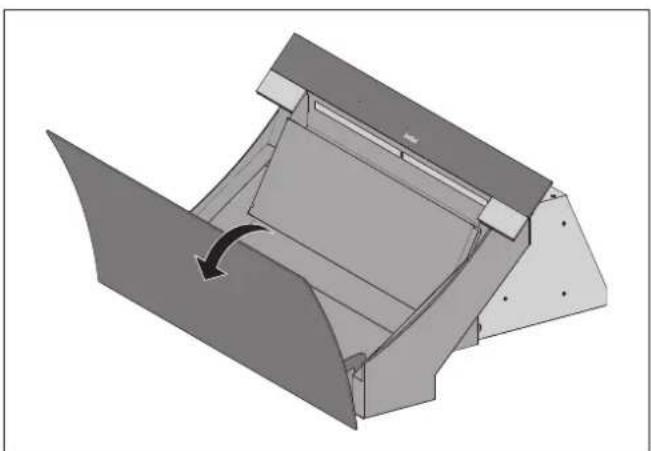
Open the front panel.
The lower section is secured in the top end position and can only be removed after folding down.
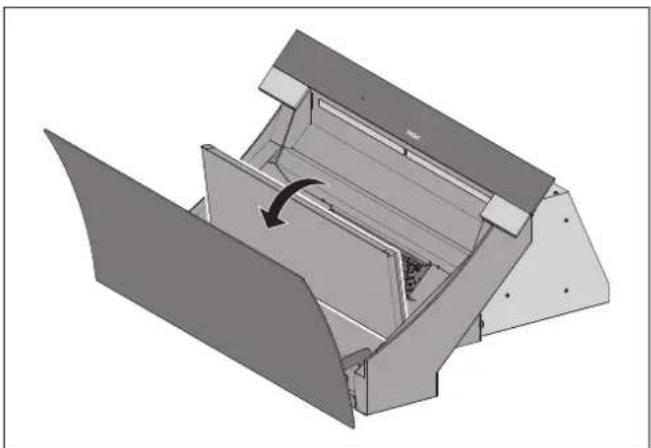
Fold the lower section down.
Pull the lower section out forwards.
The Capillar Trap is inserted and is held in the device through a side lock.
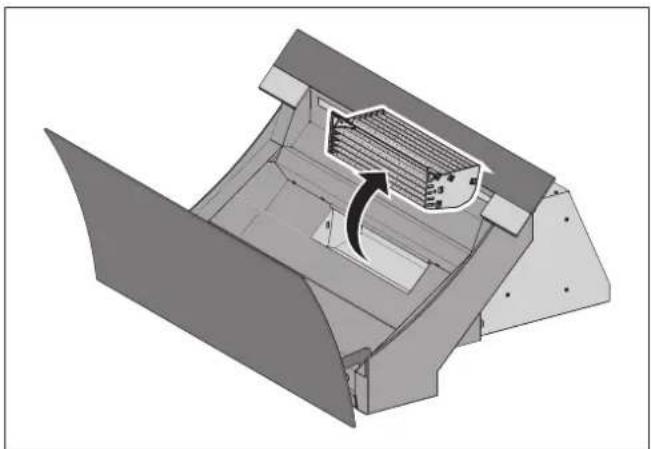
Grasp the Capillar Trap on its sides with both hands.
Pull the Capillar Trap out in a bow movement.
3.5.4 Hang the device in place
The device is designed to be hung on walls. The chimney can be adapted to the ceiling height by pulling it out.
When mounting on a solid wall:
Make sure that the wall has sufficient load bearing capacity.
Use the fastening materials provided.
With different installation situations:
Enquire about alternative fastening systems (e.g. consult with your architect).
Only use fastening hardware suitable for the type of wall.
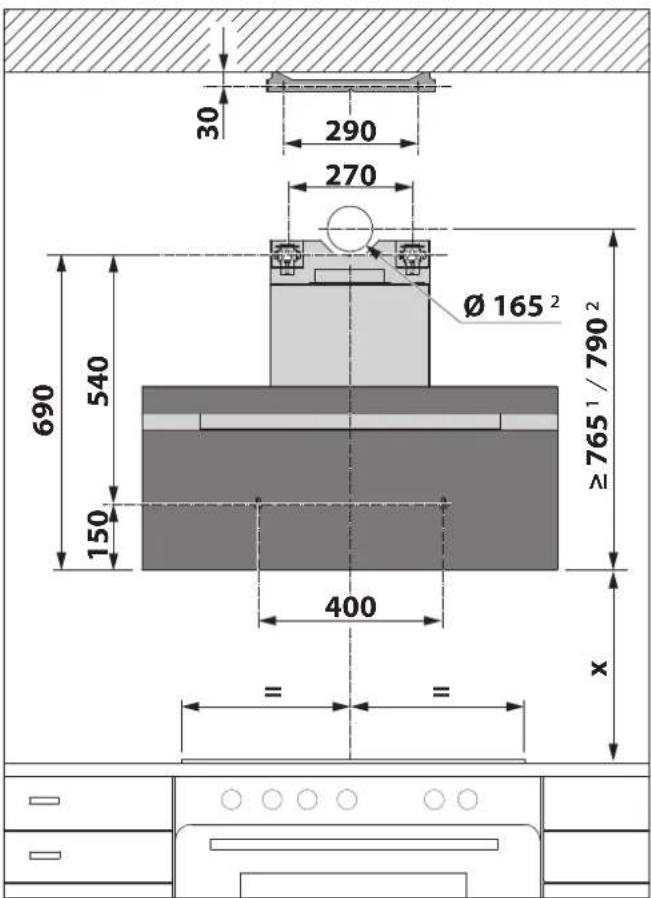
1 for extracted air mode with exhaust air duct to the rear.
2 for hybrid mode with exhaust air duct to the rear.
Safety distance (x):
- Recommendation 500~mm
With gas hobs, at least 650mm
Determine the hanging position.
Ensure that the chimney mount is correctly positioned:
- The chimney cannot be mounted if it falls below the required measurement (30 mm).
- Any irregularities (e.g. in the ceiling) can be compensated with slotted holes.
Make sure that the safety distance is complied with.
WARNING
Risk of death due to explosions or electric shock!
Drilling through gas, water or electrical lines can lead to hazardous situations.
Ensure that there are no lines in the wall at the fastening points.
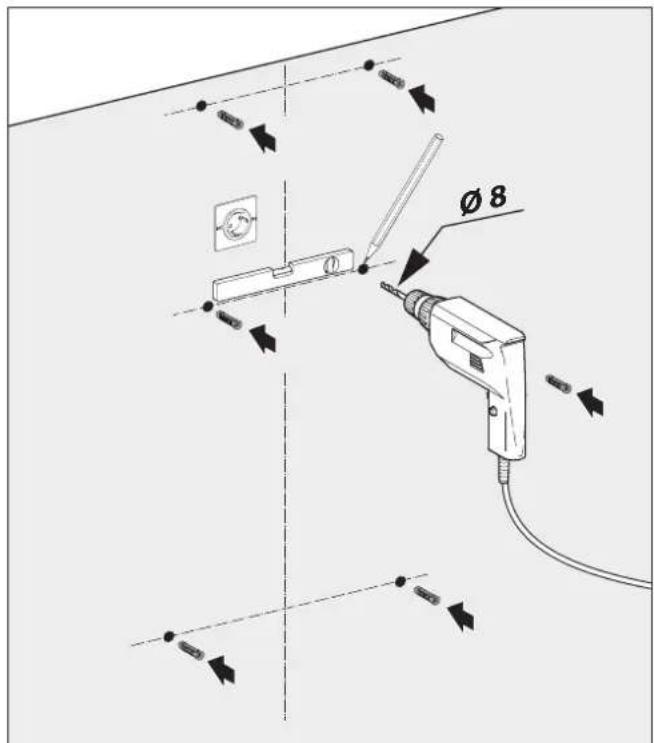
Determine the locations of the fastening points and mark them.
Drill the holes in the wall.
Insert the wall plugs into the holes.
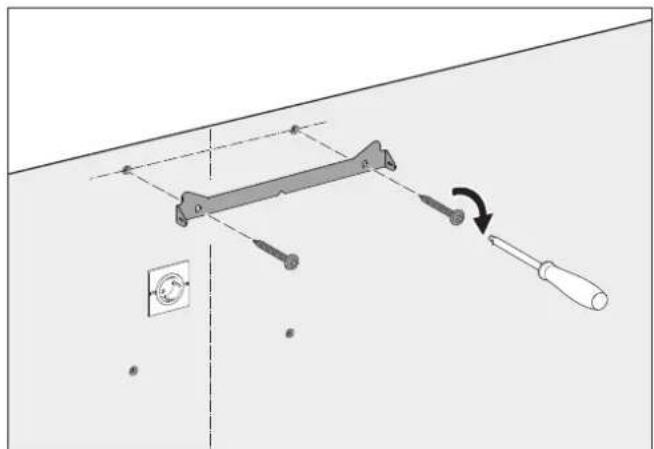
Screw the chimney fastening bracket on.
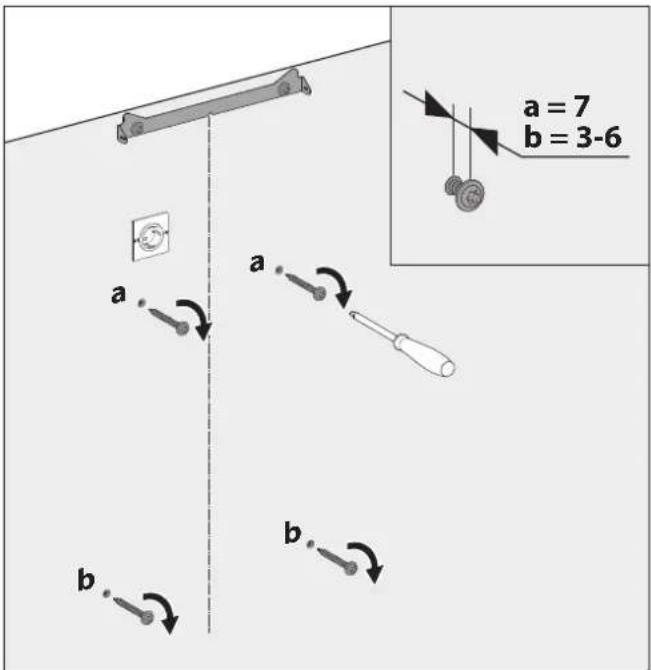
The top fastening screws should only be tightened once the device has been aligned.
The lower fastening screws prevent the device pulling away from the wall and are no longer accessible after the device is hung in place.
Tighten the mounting screws appropriately.
WARNING!
Danger of injuries through improper handling!
Hanging the device requires a great deal of physical exertion due to its size and weight. If the device falls down, serious injuries are possible.
Two persons are required to hang the device.
Ensure stable footing when hanging the device.
Ensure that no other people are in the working area.
ATTENTION!
Danger of property damage through improper handling!
Hanging the device requires a great deal of physical exertion due to its size and weight. If the device falls, the device, kitchen furnishings and other objects could be damaged.
Cover the cooled hob.
Keep the installation area clear.
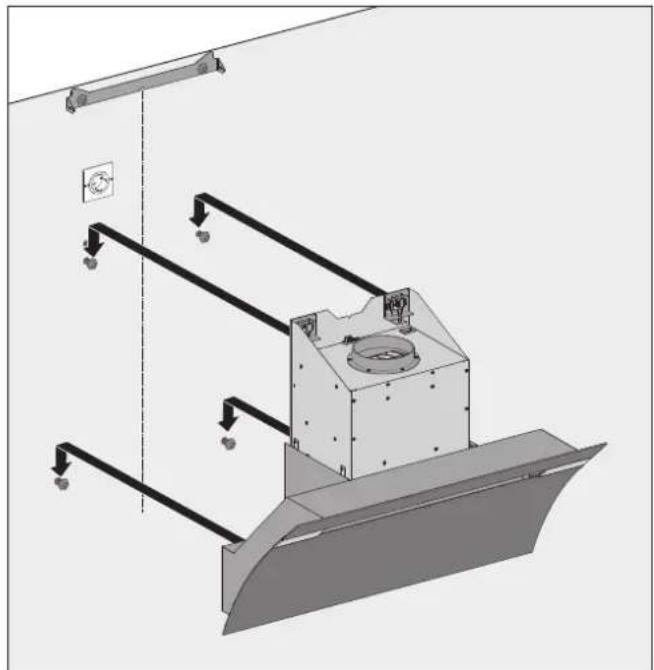
Hang the device on the mounting points.
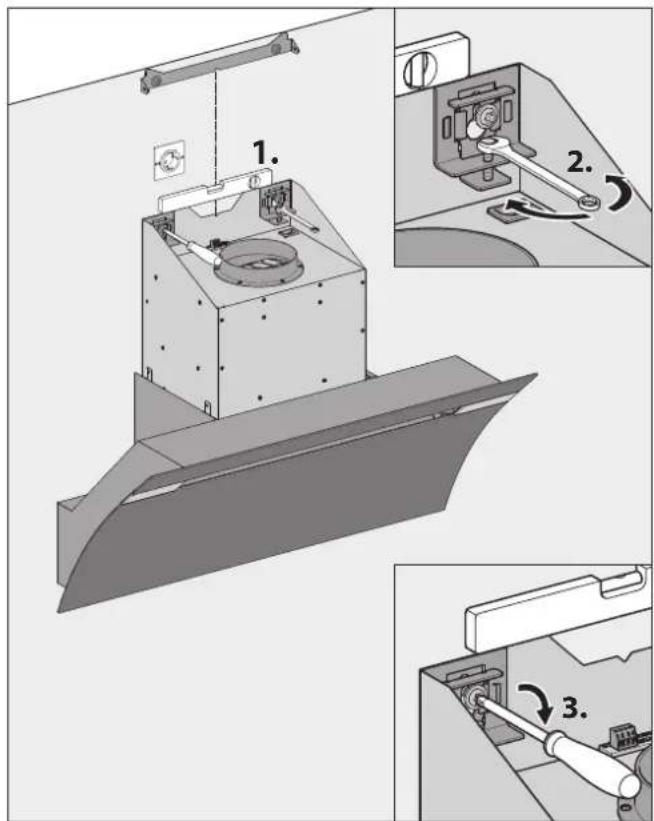
Check the horizontal alignment of the device.
Align the device with the adjusting screws.
Tighten the mounting screws.
3.5.5 Connect accessories
Depending on the installation situation, accessories may be connected to the hood:
- Wall box
Window contact switch
Under-pressure monitor
Observe the instructions for the accessories.
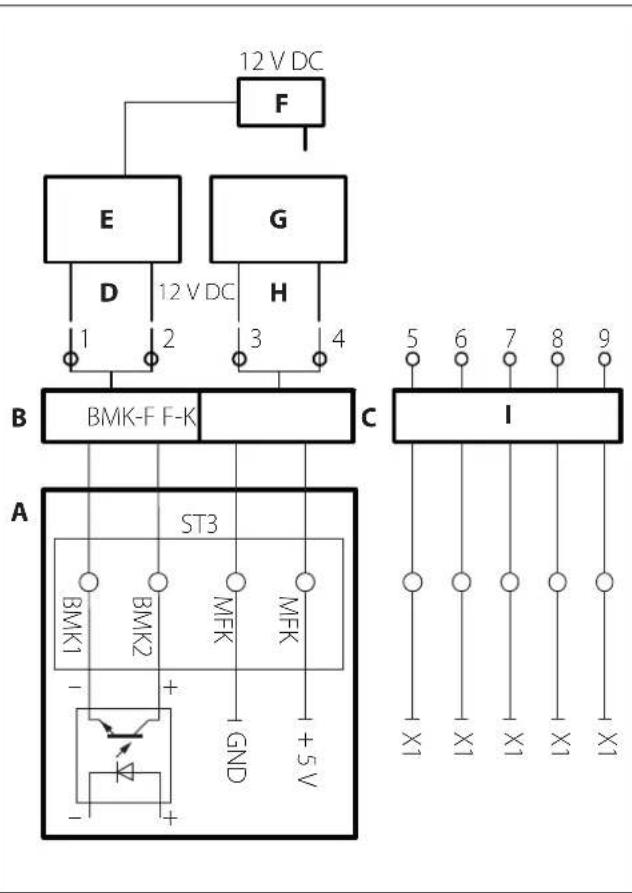
A Control box
- BMK1: Wall sleeve contact, optocoupler collector, max. 12 mA/12 V DC, safe galvanic separated
- BMK2: Wall sleeve contact, optocoupler emitter, max. 12 mA/12 V DC, safe galvanic separated
B Terminal "BMK-F" for the wall box connection
C Terminal "F-K" (multifunction contact) for the window contact switch or under-pressure monitor connection
D Control line from the wall box
E Wall box
F Wall box power unit
G Window contact switch
H Control line from the window contact switch
Bus connection
Connection is implemented via cable terminals on a detachable connector on the fan housing.
ATTENTION!
Risk of damage through incorrect connection!
A mix-up of the control wires can result in damage to the electronics.
When connecting the control line ensure correct polarity: Core 1 on terminal 1, core 2 on terminal 2.
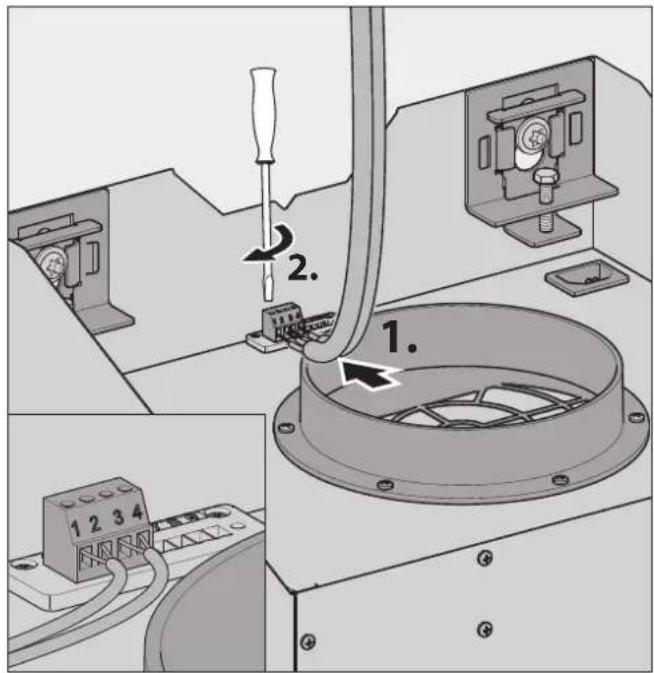
Wall box
Connect the wall box as follows:
Core 1 on terminal 1
Core 2 on terminal 2
- The wall box is closed when the control contacts are open.
- The wall box is open when the control contacts are closed.
Window contact switch
Connect the window contact switch as follows:
Blue/white core to terminal 3
- Brown/green core to terminal 4
- The hood's fan is only operational when the window is open.
Under-pressure monitor
- The hood's fan is only operational when no critical under-pressure is determined in the room.
3.5.6 Install filter (with recirculating and hybrid operation)
There is a pipe connection (0 150 mm) on the fan housing as an installation aid for the installation of the filter.
The filter is placed correctly when the bottom edge of the filter is parallel to the top edge of the fan's housing and the gap is approximately 5mm wide.
CAUTION!
Danger of injuries due to sharp edges!
The side panels of the fan box have edges that can cause cutting injuries to the hands, e.g. with rough handling of the filter attachment.
Carefully fit the filter from above.
Avoid contact with the side panels.
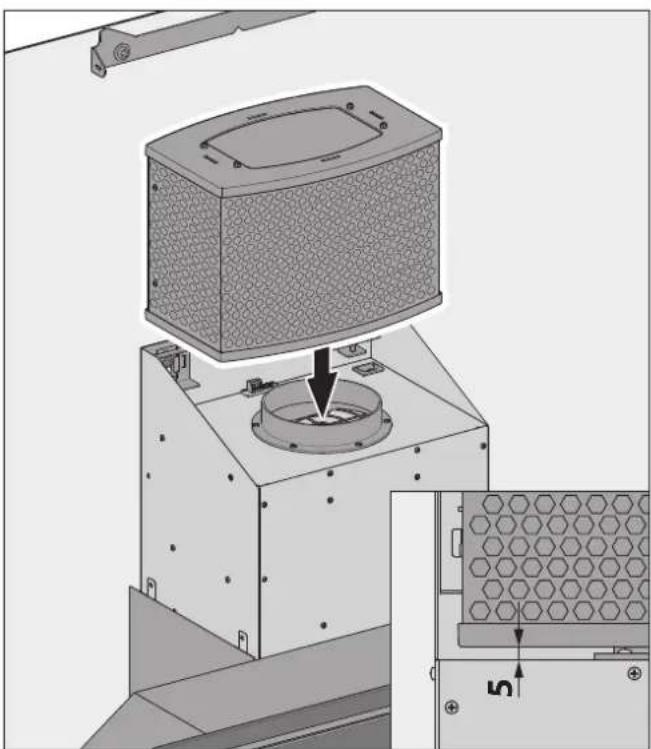
Recirculated air mode
Place the recirculated air filter onto the guide on the fan housing from above.
Ensure that the recirculated air filter is correctly installed.
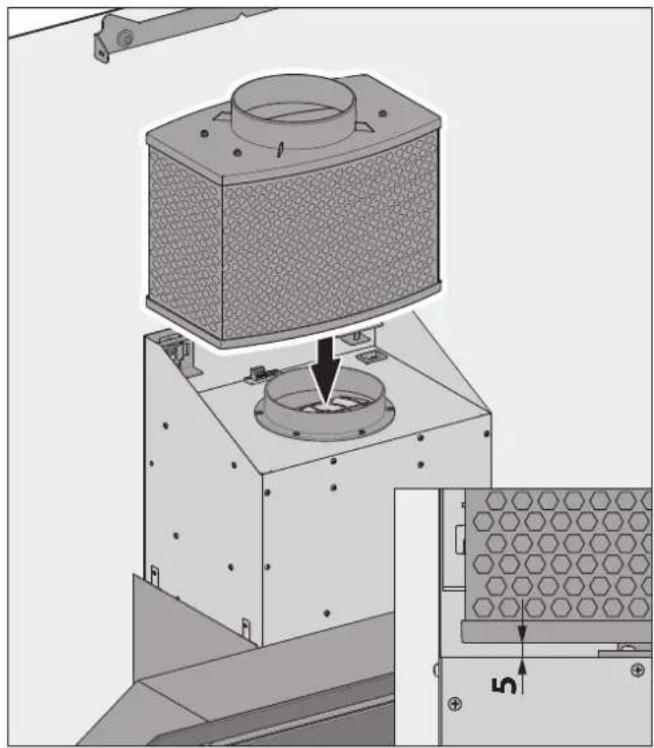
Hybrid mode - exhaust air upwards
Place the hybrid filter onto the guide on the fan housing from above.
Ensure that the hybrid filter is correctly installed.
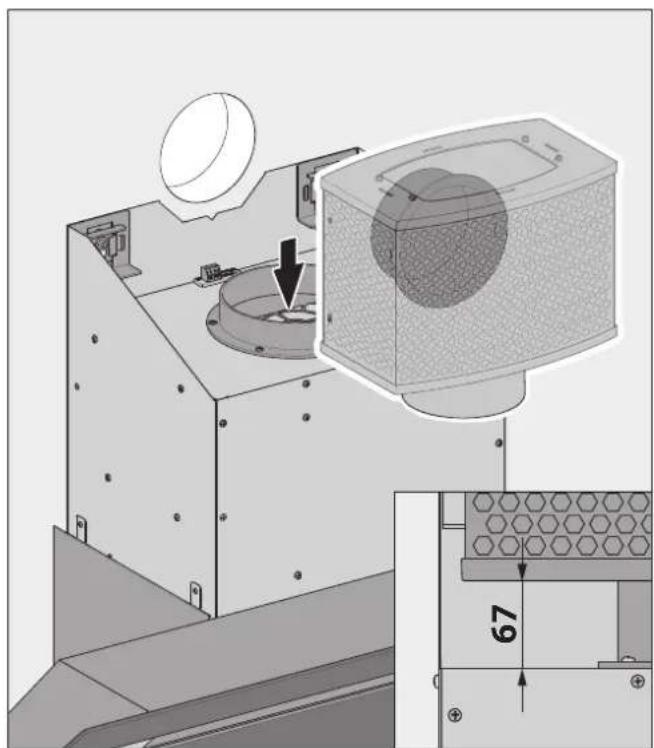
Hybrid mode-exhaust air to the rear
Place the hybrid filter onto the guide on the fan housing from above.
Ensure that the hybrid filter is correctly installed.
3.5.7 Connect exhaust air ducting (with exhausted air and hybrid mode)
Extracted air mode
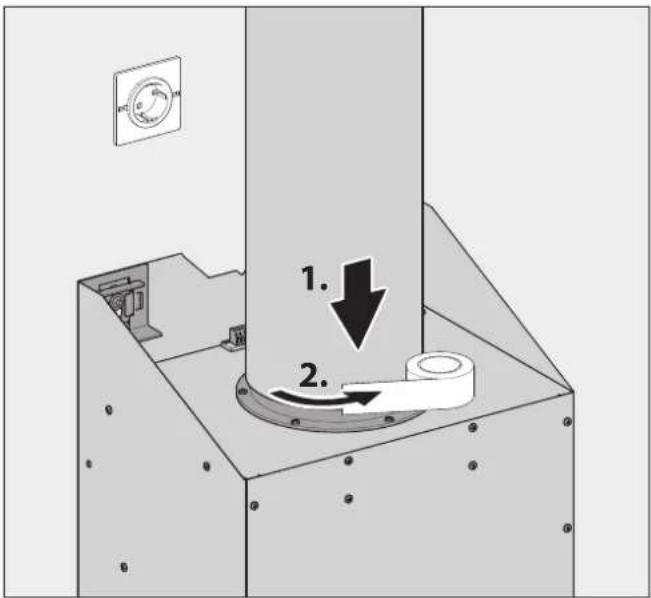
Fit the exhaust air ducting onto the guide on the fan housing from above.
Seal the transition between the exhaust air ducting and the guide with the help of sealing tape (accessory).
Ensure that the exhaust air duct is correctly fitted.
Hybrid mode
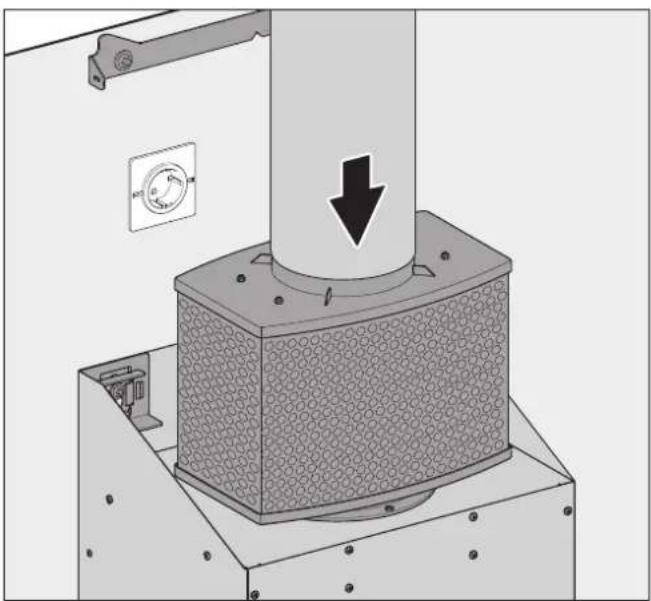
Fit the exhaust air ducting onto the collar of the hybrid filter from above.
Ensure that the exhaust air duct is correctly fitted.
3.5.8 Establish electrical power supply
Observe the voltage specifications on the rating plate.
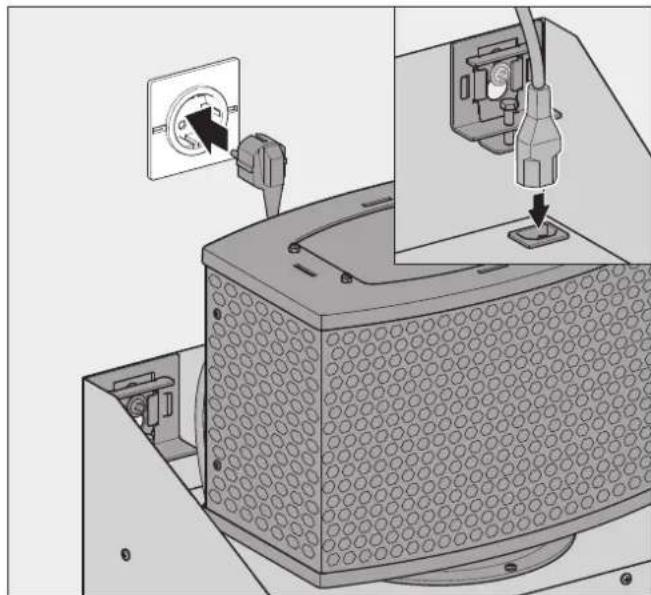
Plug the cold device plug into the socket on the fan housing.
Plug the mains plug into the socket.
Route the cable such that it is not kinked, crushed or damaged and so that it will not get in the way when replacing the filter filling.
Make sure that the device can be disconnected on all poles from the electricity supply after installation.
The device is ready for operation.
3.5.9 Mount the chimney
The chimney comprises two chimney ducts that slide inside one another. There are two ventilation slots inside the inner chimney duct.
ATTENTION!
Danger of damage due to improper handling!
The body of the hood and the chimney could be damaged by movements during the installation.
Keep a distance between the chimney and the body of the hood.
Keep objects that could scratch the device far away from it (e.g. tools, belt buckles).
The chimney ducts are aligned with one another depending on the operating mode.
Recirculating mode and hybrid mode
The ventilation slots are located at the top and are not covered.
Extracted air mode
The inner chimney duct can be drawn out and re-inserted upside-down in order to cover the ventilation slots.
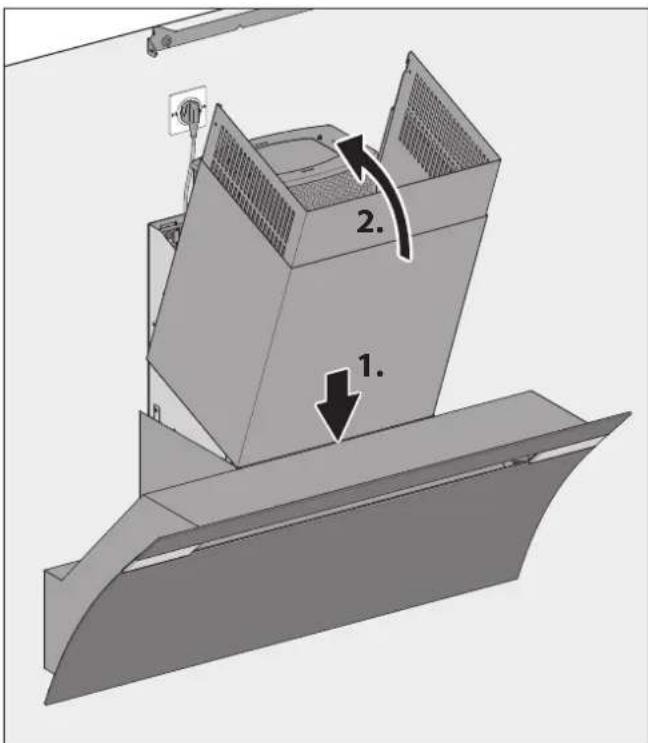
Lift the chimney up with two persons.
Place the lower edge of the chimney into the groove of the device.
Pivot the chimney flush against the wall.
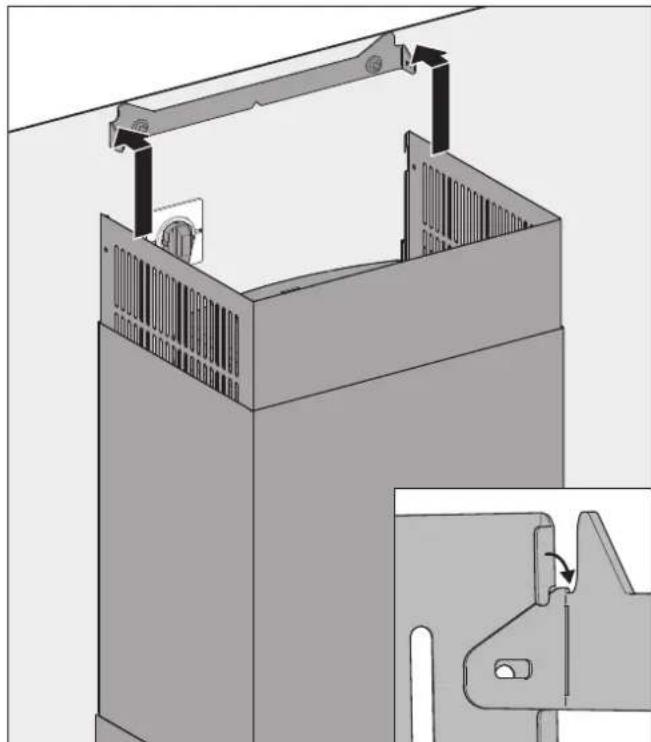
Pull the inner chimney duct upwards.
Hang the inner chimney duct up on the chimney mount.
3.5.10 Insert the Capillar Trap and lower section
After the installation, the parts lying inside should be re-fitted.
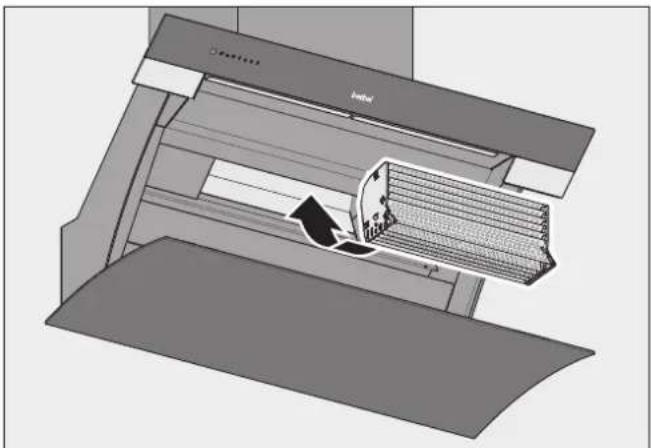
Insert the Capillar Trap into the mounting slot in a bow movement with both hands.
Push the Capillar Trap upwards until it latches into place.
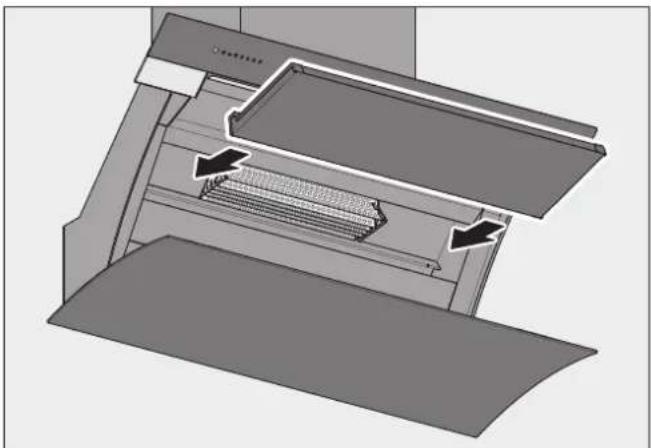
Insert the lower section horizontally into the device until it reaches the rear stop.
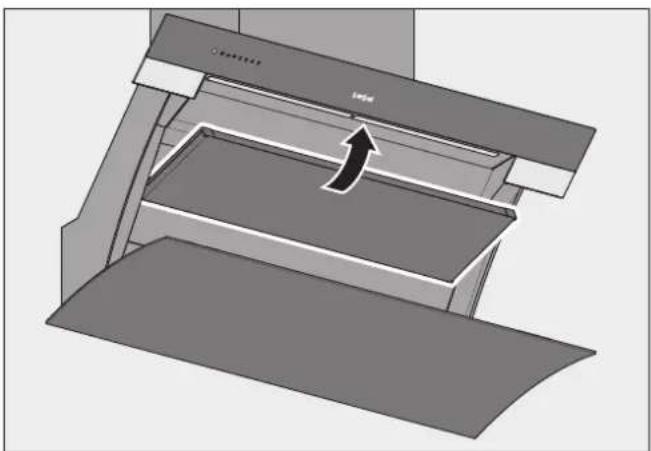
Pivot the lower section upwards until both magnetic fasteners can be heard to click into place.
Check that the lower section is inserted correctly and is held by the retaining magnets.
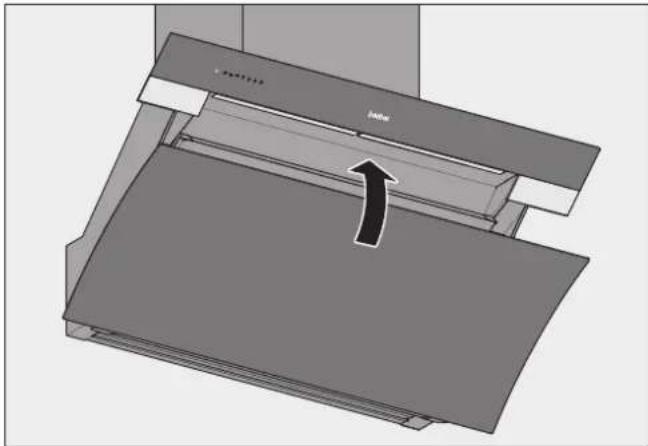
Close the front panel.
3.5.11 Check and carry out commissioning
ATTENTION!
Risk of disruptions due to moisture in the device!
If the device is moved from a cold environment into a hot one, condensation may form inside.
Wait about 2-3 hours before bringing the device into service.
Check that the mains plug is freely accessible or that an all-pole isolating device (min. 3 mm contact gap) is present.
Check that the mains cable and the electrical connection cable are not kinked, crushed or damaged.
Ensure that air outlets are not closed or covered.
With recirculated air devices: Make sure that the ventilation slots are clear.
Check the correct functioning of the device.
- Operation" (page 139).
4. Operation
4.1 Safety information for operation
WARNING!
Hazard through a disregard of the operating instructions!
This chapter contains important information for the safe operation of the device.
Read through this chapter carefully before operating the device.
Follow the safety instructions.
Operation only by authorised users.
"1.2 Authorised target groups" (page 124).
- No operation permitted by children under 8 years old and persons who would not be able to properly assess the hazards associated with handling the device.
- Do not use during a fire or when there is an imminent danger of fire (e.g. a smell of gas).
Gas operation only with low gas flames (not rising above the edge of the base of the pots). Naked flames can damage the device and can cause fires.
- Do not flâbé underneath the device. Fire hazard.
- No unattended deep frying underneath the device.
- When in use, the hob and other parts that could be touched can become very hot. There is a risk of burning.
- Grease residues should be removed. Grease residues pose a fire hazard.
No moisture in the device.
- Avoid dripping or splashing water.
- Containers with liquids (e.g. vases, bottles) must not be placed on the device.
- Do not impede the air flow.
- Do not impede the air channel on the underside of the device.
- Use only when the Capillar Trap is fitted and with the lower section closed.
- In recirculated air mode: Do not cover the air outlets (e.g. glasses/plates on or in front of the ventilation slots). Out-flowing air must be able to escape through the ventilation slots without impediment. Otherwise backpressure may form. If the cooking vapours are no longer able to escape there is a danger of fire.
- With exhausted air or hybrid operation: Adequate fresh air supply must be assured.
Measures to ensure a sufficient supply of fresh air:
Open the windows.
Open the doors.
Ensure that the window contact switch and the wall box are installed and ready for operation.
With heating points which use air from the room as their oxygen supply (e.g. fireplace):
Make sure that the mandated safety devices are functioning correctly.
4.2 Control panel
The device is controlled via the control panel.
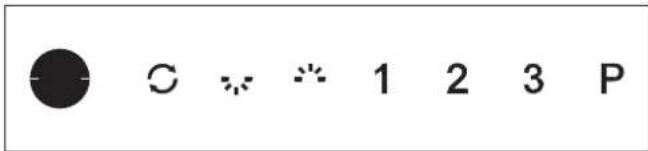
The position of the control panel can be seen in the trough of the ON/OFF button at any time. The remaining touch fields illuminate if the device is switched on.
After switching on the mains power supply the device needs a few seconds in order to adapt itself to the environmental conditions. During this time, it cannot be operated.
Touching a touch field executes the corresponding function:
- Touch field illuminates dimly = Function not active
- Touch field illuminates brightly = Function active
| Touch field | Function |
| ● | ON/OFF, access configuration mode |
| ○ | Recirculated air mode, check filter filling indicator |
| ◇ | Hob lighting |
| ◇ | Effect lighting |
| 1 | Power level 1 |
| 2 | Power level 2 |
| 3 | Power level 3 |
| P | Power level POWER (max. 6 minutes) |
4.3 Normal operation
| Touch field | Function |
| The device is turned off. Touch the touch field 1x. The device switches on. The device is switched on. Touch the touch field 1x. The device switches off. If the run-on function is activated: The run-on time (10 minutes) starts automatically in the last selected power level. | |
| Touch field illuminates brightly: Recirculated air mode is switched on. Touch field flashes: The filter filling must be replaced. | |
| Touch field illuminates brightly: Hob lighting is switched on. | |
| Touch field illuminates brightly: Effect lighting is switched on. | |
| 1 | Touch field illuminates brightly: Power level 1 (lowest fan power) is active. |
| 2 | Touch field illuminates brightly: Power level 2 (medium fan power) is active. |
| 3 | Touch field illuminates brightly: Power level 3 (high fan power) is active. |
| P | Touch field illuminates brightly: Power level POWER (max. fan performance) is active for max. 6 minutes. Then the device switches to power level 3. |
To achieve an optimal efficiency in removing cooking fumes:
Turn the device on 1-2 minutes before you start cooking. This allows the flow of air to build up, and the fumes are removed at an early stage.
During the cooking process, switch to a power level that is appropriate for the intensity of the cooking vapours:
Power level 1 - lowest fan power
Power level 2 - medium fan power
Power level 3 - high fan power
If the intensity of the cooking vapours does not subside, switch to a higher power level.
Switch to the POWER setting if frying.
Turn on the run-on function when you have finished cooking.
4.3.1 Run-on function" (page 141).
Check the fresh air supply at regular intervals.
Use the device also to reduce other unpleasant smells. Such as from:
- Onions and garlic
- Oven, microwave and steamer
Fondue and raclette
WARNING
Fire hazard due to grease residue!
In operation grease residue, which is highly inflammable, collects in and on the device.
Clean the device properly.
"5. Cleaning" (page 143).
If a power stage is active, a gentle air flow is routed from the air channel on the underside of the device to the front air inlet. This air circulation is necessary. The air channel on the underside of the device must never be closed off.
The hob lighting is fitted with energy-saving LED lighting. The lighting can be used at any time and independently of the fan.
If you switch the machine on and hear an unusually loud fan noise:
Clean the device.
Observe the stipulations for cleaning.
"5. Cleaning" (page 143).
If you switch the machine on and notice a smell:
Change the filter filling.
Observe the stipulations for changing the filter filling.
"6.2.2 Replacing filter filling (with recirculating and hybrid mode)" (page 145).
After 6 hours without operation, the device (including lighting) automatically switches off.
4.3.1 Run-on function
The device comes with a run-on function. If this function is used, the device will work for a further ten minutes at the last chosen power level.
In recirculated air mode, it is necessary to use the run-on function so that the device can remove the remaining odours. Using the run-on function increases the life of the filter filling. The filter filling must be replaced at regular intervals.
The run-on function can be switched on manually or automatically. The automatic run-on function is activated in configuration mode.
4.4 Configuration" (page 142).
| Touch field | Function |
| ● | The device is switched on. |
| If the automatic run-on function is activated: Touch the touch field 1x. The device switches off. The run-on time starts automatically in the last selected power level. | |
| If the automatic run-on function is not activated: Touch the touch field 2x - within 2 seconds. The device switches off. The run-on time is started manually in the last selected power level. | |
| During the run-on time (10 minutes), the operating symbol for the selected power level will flash. |
4.3.2 Hob lighting
The hob lighting is fitted with energy-saving LED lighting. The lighting can be used at any time and independently of the fan.
The hob lighting is dimmable.
The colour temperature is set in configuration mode.
4.4 Configuration" (page 142).
| Touch field | Function |
| ... | Press the touch field 1x, in order to switch the hob lighting on or off. Hold touch field down to start the dimmer. After releasing the touch field, the hob lighting remains at the selected brightness. After switching off, the hob lighting starts with full brightness the next time it is switched on. |
4.3.3 Extraction mode / recirculated air mode changeover
If the device is configured for hybrid mode, it is possible to switch between extraction mode and recirculated air mode at any time after activating the changeover function.
The changeover function is activated in configuration mode.
4.4 Configuration" (page 142).
| Touch field | Function |
| ○ | If the changeover function is activated: Touch the touch field 1x. Touch field illuminates dimly: The device operates in exhausted air mode. The wall box is opened. The cleaned air is discharged outside. Touch field illuminates brightly: The device is operating in recirculated air mode. The wall box is closed. The cleaned air is discharged into the room. |
4.3.4 Check filter filling indicator
The device has a check indicator in order to remind the operator to change the filter filling. In recirculated air mode, the check indicator flashes every 350 hours of operation. The hours counter is started anew by switching off the check indicator.
The check indicator is switched off in configuration mode.
4.4 Configuration" (page 142).
| Touch field | Function |
| ○ | Touch field flashes: The filter filling must be replaced. ⇒ "6.2.2 Replacing filter filling (with recirculating and hybrid mode)" (page 145). |
4.4 Configuration
| Touch field | Function |
| The device is switched on, the power stages are not active. Touch the touch field 1x - for longer than 10 seconds. The power level touch field flashes 5x. The device switches to configuration mode. The configuration mode is turned on. To exit the configuration mode: Touch the touch field 1x. The settings are now saved. All operating symbols illuminate for 5 seconds. The device is in normal mode again. |
In the configuration mode, the following functions can be activated or deactivated by touching the corresponding touch fields.
| Touch field | Function |
| Touch the touch field 1x. The hob lighting switches on. Press the touch field again to start the colour cycle. After the touch field is released, the colour cycle stops and the selected colour temperature is saved. |
| Touch field | Function |
| 1 | Effect lighting. As delivered, the function is activated. Touch the touch field 1x. Touch field illuminates brightly, touch field for effect lighting illuminates dimly; Effect lighting is switched off. |
| 2 | Extraction mode / recirculated air mode changeover. As delivered, the function is turned off. Touch the touch field 1x. Touch field illuminates brightly, touch field for recirculated air mode illuminates dimly: The changeover function is activated. Touch the touch field 1x. Touch field illuminates dimly, touch field for recirculated air mode is off: The changeover function is deactivated. |
| 3 | Check filter filling indicator. The function is set such that touch field for recirculated air mode flashes every 350 operating hours. The filter filling has been changed: Touch the touch field 1x. Touch field illuminates brightly: The hour counter starts anew, the touch field for recirculated air mode is switched off. |
| P | Automatic run-on. As delivered, the function is turned off. Touch the touch field 1x. Touch field illuminates brightly: Automatic run-on is activated. |
5. Cleaning
5.1 Safety information for cleaning
WARNING!
Hazard through a disregard of the cleaning instructions!
This chapter contains important information for the safe cleaning of the device.
Read through this chapter carefully before cleaning the device.
Follow the safety instructions.
- Cleaning only by authorised users.
1.2 Authorised target groups (page 124). - No cleaning permitted by children under 8 years old and persons who would not be able to properly assess the hazards associated with handling the device.
After use, the hob and other parts that could be touched may still be hot. There is a risk of burning.
Grease residues should be removed. Grease residues pose a fire hazard.
The device should be cleaned regularly:
Control panel, surface, upper section and lower section each time after cooking.
- With daily use, the Capillar Trap after three weeks at the latest.
5.2 Cleaning procedures
The device draws in dirt particles (e.g. grease and oil particles) with the air from the room. The dirt particles are separated off and collected in the upper section, the lower section and in the Capillar Trap.
Before every cleaning:
Turn off the device.
Make sure that the hob and other parts that could be touched have cooled down.
ATTENTION!
Danger of damage through improper cleaning!
Sharp-edged objects, abrasive or unsuitable cleaning agents can damage the device.
The following cleaning agents are unsuitable and must not be used:
- Acetone
- Trichloroethylene
- Solutions on a cellulose basis (e.g. cellulose thinner)
Artificial resin thinner - Abrasive media
Polishes containing silicone
Polishes containing oil
Wax
Water vapour - On painted surfaces: Microfibre cloth
Keep objects that could scratch the device away from it (e.g. rings).
Use mild household cleaner (e.g. alkali-free, pH-neutral multipurpose cleaner).
Use a soft, damp cloth.
Clean without exercising excessive pressure.
The instructions and information on the cleaning agent should be observed.
Control panel
Clean the control panel with a lint-free, slightly damp cloth (e.g. a microfibre cloth).
Dry the control panel with a lint-free, soft cloth.
Surfaces
Clean the surfaces with a soft, damp cloth and a mild household cleaner.
Dry the surfaces with a soft cloth.
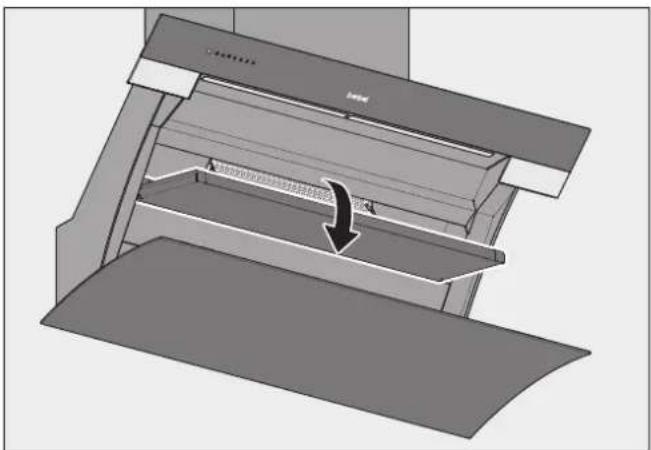
Upper and lower sections
Fold the lower section down.
Pull the lower section out forwards.
Clean the upper section with a soft, moist cloth.
Clean the lower section with a soft, moist cloth.
Dry the upper and lower sections with a soft cloth.
Re-attach the lower section.
3.5.10 Insert the Capillar Trap and lower section (page 138).
Capillar Trap
The Capillar Trap is inserted and is held in the device through a side lock.
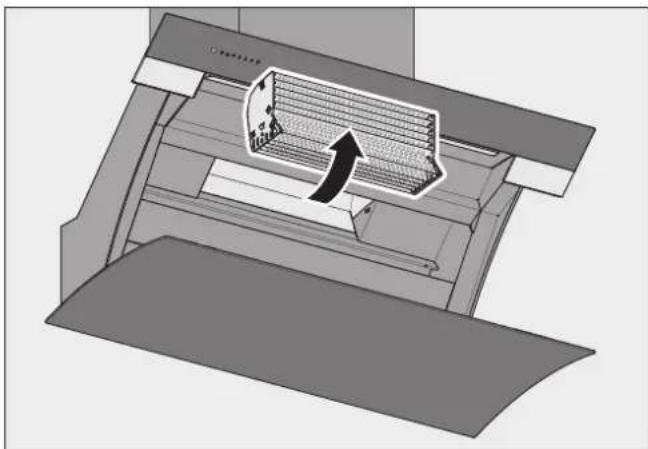
Grasp the Capillar Trap on its sides with both hands.
Pull the Capillar Trap out in a bow movement.
Clean the Capillar Trap e.g. in a dishwasher.
Clean the surfaces and edges on the recess for the Capillar Trap with a soft, moist cloth.
Make sure that the Capillar Trap is completely dry.
Re-attach the Capillar Trap.
"3.5.10 Insert the Capillar Trap and lower section" (page 138).
6. Maintenance
6.1 Safety instructions for maintenance
WARNING!
Hazard through a disregard of the maintenance instructions!
This chapter contains important information for the safe maintenance of the device.
Read through this chapter carefully before carrying out maintenance work on the device.
Follow the safety instructions.
Carry out the maintenance work as described.
- Repairs only by qualified specialist personnel. "1.2 Authorised target groups" (page 124).
-
Electrical work only to be undertaken by qualified electricians. "1.2 Authorised target groups" (page 124).
-
Maintenance only by authorised users. "1.2 Authorised target groups" (page 124).
- No maintenance work permitted by children under 8 years old and persons who would not be able to properly assess the hazards associated with handling the device.
- When working at heights, ensure good stable footing (e.g. stable stepladder).
The hob and other parts that can be touched must be cooled down. - Never open the fan housing.
6.2 Maintenance
6.2.1 Changing the lamps
The device is fitted with maintenance-free LED lighting. In the event of a fault:
Please consult your dealer or customer services.
6.2.2 Replacing filter filling (with recirculating and hybrid mode)
Odours are trapped in the filter filling in the recirculating air filter or hybrid filter. The odour-free, cleaned room air is fed back into the room.
Recirculating air filters and hybrid filters are maintenance-free for up to two years.
Then filter filling must be replaced at regular intervals.
Maintenance intervals
- Daily use: With odours in the exhaust air or after 12 months at the latest.
Occasional use: With odours in the exhaust air or after 24 months at the latest.
ATTENTION!
Danger of property damage through falling parts!
When working on the device, parts of the device or tools could fall and damage the kitchen equipment.
Protect the cooled hob and other surfaces in the cooking area (e.g. with thick cardboard).
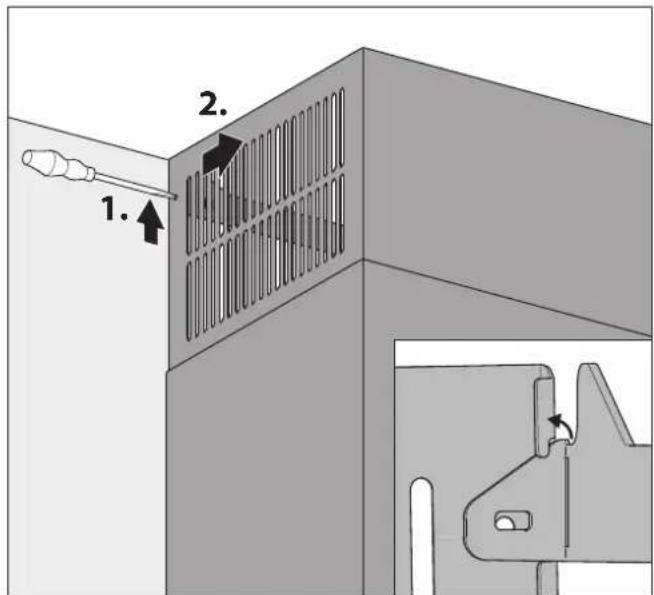
Loosen the inner chimney duct on both sides from the chimney mount.
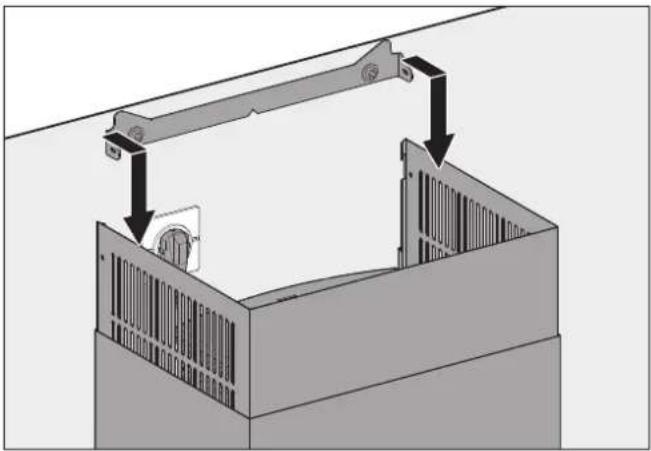
Slide the inner chimney duct downwards.
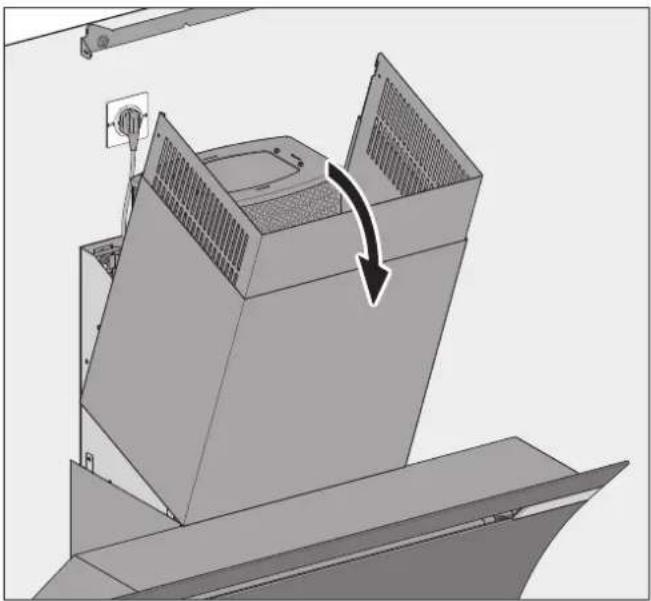
Lift the chimney away from the device.
Remove the recirculation air filters
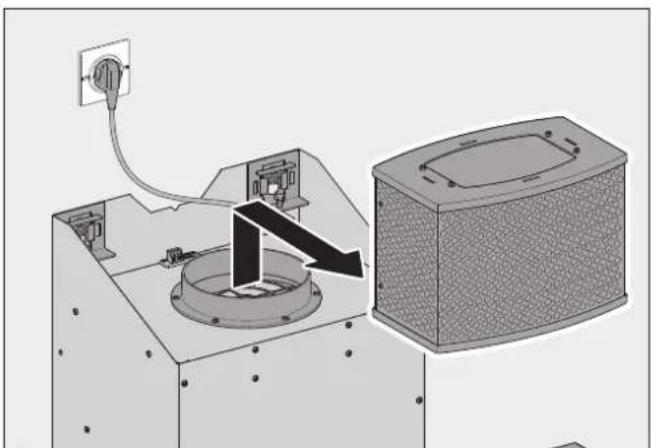
Lift the filter at least 30mm
Remove the filter to the front.
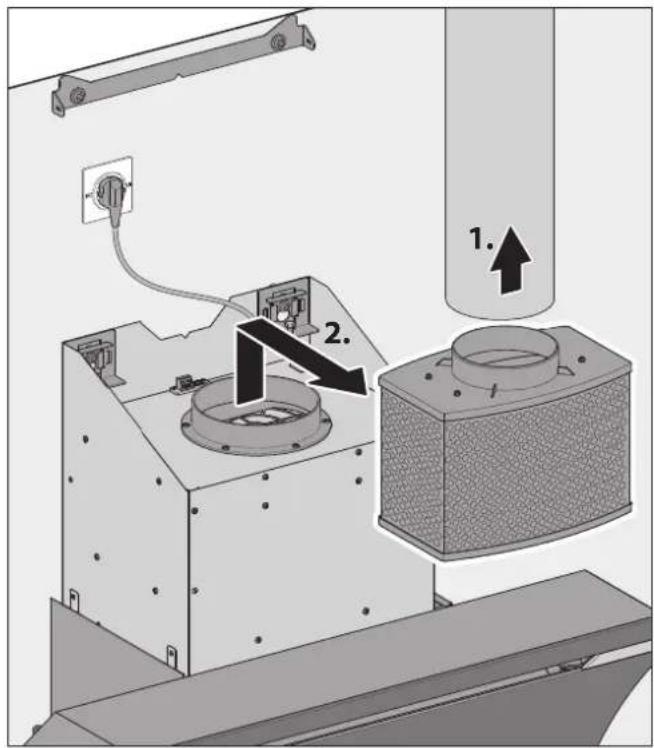
Removing the hybrid filter
Remove the exhaust pipe from the hybrid filter.
Lift the filter at least 30mm
Remove the filter to the front.
The replacement of the filter filling is carried out as described in the associated instructions.
Change the filter filling.
Clean the filter from the outside (e.g. through extraction with a vacuum cleaner).
Re-fit the filter.
"3.5.6 Install filter (with recirculating and hybrid operation") (page 135).
Mount the chimney.
3.5.9 Mount the chimney" (page 137).
Switch off the check indicator on the control panel.
4.4 Configuration" (page 142).
6.3 Fault rectification
Possible faults are described below: Description of the fault.
Possible cause.
Remedy.
Fan and lighting do not work.
No power supply.
Check that the mains cable is connected on both sides.
The breaker may have been tripped or is defective.
Check to see if the breaker has tripped.
If you use electric circuit breakers, turn the circuit breaker on again.
For other types of fuse, consult a qualified electrician.
The fan does not work.
The device is not switched on.
Check all power levels.
4.3 Normal operation (page 140).
- The device is connected to a window contact switch and the window is closed.
Open the window.
- The device is connected to an under-pressure monitor. The under-pressure monitor detects a critical under-pressure.
Open a window.
Wait until the air pressure returns to normal.
The lighting does not work.
The lamp has blown.
Please consult your dealer or customer services.
Smells occur during operation.
The filter filling is used up.
Change the filter filling.
"6.2.2 Replacing filter filling (with recirculating and hybrid mode)" (page 145).
Poor device performance.
The recirculated air filter is clogged.
Replace the filter filling of the recirculated air filter.
"6.2.2 Replacing filter filling (with recirculating and hybrid mode)" (page 145).
The hybrid filter is clogged.
Replace the filter filling of the hybrid filter.
"6.2.2 Replacing filter filling (with recirculating and hybrid mode)" (page 145).
The exhaust pipe was not properly connected or installed.
Please consult your dealer or customer services.
Control panel does not react after being touched several times.
The control panel is soiled.
Clean the control panel.
"5. Cleaning" (page 143).
- The device software requires a restart.
Briefly disconnect the mains power supply.
Moisture in the device.
-
Dripping or splashing water has penetrated the device.
-
Liquid (e.g. from vases, bottles on the device) has penetrated the device.
Immediately shut off the power supply, by removing the fuse.
Make sure that the power supply cannot be unintentionally reconnected. For example by tasking a person with ensuring that the fuse/breaker is not restored/switched on.
Ensure that no more liquid can penetrate the device.
Allow the device to dry.
Have the device checked and repaired by qualified, specialist personnel prior to using the device again.
If a fault persists:
Please consult your dealer or customer services.
7. Dismounting
WARNING!
Danger of injuries through improper handling!
Taking the device down requires a great deal of physical exertion due to its size and weight. If the device falls down, serious injuries are possible.
Two persons are required to take the device down.
Ensure stable footing when taking the device down.
Ensure that no other people are in the working area.
ATTENTION!
Danger of property damage through improper handling!
Taking the device down requires a great deal of physical exertion due to its size and weight. If the device falls, the device, kitchen furnishings and other objects could be damaged.
Cover the cooled hob.
Keep the installation area clear.
Disconnect all poles of the power supply for the device.
Pull out the mains plug.
Loosen the inner chimney duct from the chimney mount.
Lift the chimney away from the device.
If present:
Remove any accessory connection cables.
For exhausted air and hybrid operation:
Remove the exhaust air duct.
For recirculating air and hybrid operation:
Remove the filter.
Loosen the mounting screws by approx. one turn.
Lift the device with two persons.
Lift the device off, forwards.
Set the device down on a firm and protective surface.
8. Disposal
8.1 Dispose of packaging
ATTENTION!
Risk of environmental damage due to improper disposal of the packaging!
Do not put the packaging into the normal household waste.
Take the packaging for environmentally friendly and proper recycling.
The packaging provides protection from transport damage. Only the original packaging guarantees sufficient protection during transportation.
Store the packaging in a location which is inaccessible to children.
The packaging materials have been selected from an environmentally friendly perspective and are made from re-usable materials. The packaging materials can be returned to the raw materials cycle after use. This saves valuable raw materials.
- The outer packaging is made from cardboard.
- The filling material and the insets are made from cardboard or styrofoam.
- The protective film and bags are made from polythene (PE).
Dispose of the packaging in an environmentally friendly manner, separated by materials.

8.2 Dispose of the device
ATTENTION!
Risk of environmental damage due to improper disposal of the device!
The device is subject to the European Directive 2012/19/EU and should not be disposed of with household waste.
Do not put the device into the normal household waste at the end of its service life.
Enquire about the disposal options or environmentally friendly and proper recycling opportunities with your municipal or regional authorities.
Render the device unusable after dismounting it, e.g. by cutting the de-energised mains cable.
Dispose of the device in accordance with the legal provisions via a professional disposal centre or at your local disposal facility.

9. Annex
9.1 Product data sheet
In accordance with article 3 section 1 b point ii of the Regulation (EU) No.65/2014
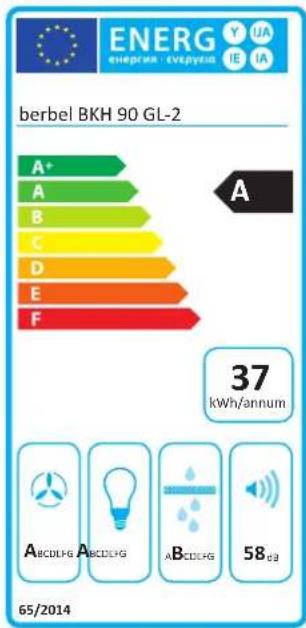
BKH 90 GL-2 BKH 110 GL-2
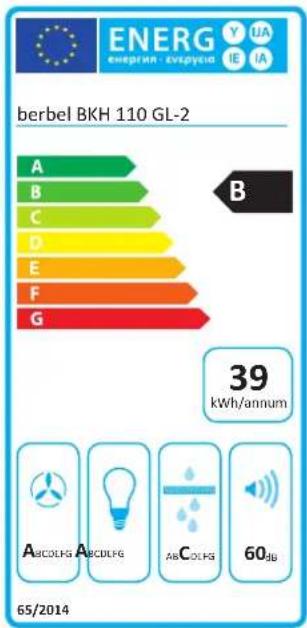
| BKH 90 GL-2 | BKH 110 GL-2 | |
| Annual energy consumption in kWh | 37.1 394 | |
| EEI Hood Class A B | ||
| FDE Hood 30.5 31.9 | ||
| FDE Hood Class A A | ||
| LE Hood 36.6 32.3 | ||
| LE Hood Class A A | ||
| GFE Hood 85.7 84.3 | ||
| GFE Hood Class B C | ||
| Flow rate in extracted air mode in m3/h | ||
| Stage min./max. | 250/340 | 260/390 |
| Stage Power/Intense | 420 | 480 |
| Flow rate in recirculated air mode in m3/h | ||
| Stage min./max. | 190/280 | 210/330 |
| Stage Power/Intense | 350 | 410 |
| Noise power level in extracted air mode in db(A) | ||
| Stage min./max. | 50/58 | 52/60 |
| Stage Power/Intense | 64 | 66 |
| Noise power level in recirculated air mode in db(A) | ||
| Stage min./max. | 54/62 | 54/64 |
| Stage Power/Intense | 67 | 69 |
| Power consumption stand-by in Watt (W) | 0.9 | 0.9 |
| Power consumption stand-off in Watt (W) | 0.5 | 0.5 |
9.2 Accessories
When using accessories, the associated documentation must be observed.
| Article no. | |
| Recirculated air filter permalyt® BUR 150 1005520 | |
| Recirculated air filter BUF 150 + 1003325 | |
| Hybrid filter BHF 150 + 1003607 | |
| Hybrid filter BHF 150 + h 1004895 | |
| Top-up pack berbel Pro Aktiv 150 1000875 | |
| Under-pressure monitor P4 6001728 | |
| Wall box BMK-F 150 1001330 | |
| Wall box BMK-Z 150 1001390 | |
| Radio window contact switch 1002916 | |
| Remote control BFB 6002409 | |
| Exhaust air set I round 150 | 1004729 |
| Exhaust air set II flat 150 | 1004730 |
| Exhaust air set III flat 150 double | 1004731 |
| Exhaust air set ECO I round 150 | 1004732 |
| Exhaust air set ECO II flat 150 | 1004733 |
| Exhaust air set ECO III flat 150 double | 1004734 |
9.3 Contact
If you have any questions or suggestions, please select from the following options:
Telephone: +49 (0) 5971/80 80 9-0 Mon to Thu 8:00 - 17:30 hrs and Fri 8:00 - 16:30 hrs
Fax: +49 (0) 5971/80 80 9-10
Internet: www.berbel.de
Email: info@berbel.de
Contact the manufacturer's customer support department
There are several ways for you to contact our customer service. Please select from the following options:
Telephone: +49 (0) 5971/80 80 9-660 Mon to Thu 8:00 - 17:30 hrs and Fri 8:00 - 16:30 hrs
Fax: +49 (0) 5971/80 80 9-10
Email: service@berbel.de