RD410 - Steam cleaner Soba - Free user manual and instructions
Find the device manual for free RD410 Soba in PDF.



Frequently Asked Questions - RD410 Soba
User questions about RD410 Soba
0 question about this device. Answer the ones you know or ask your own.
Ask a new question about this device
Download the instructions for your Steam cleaner in PDF format for free! Find your manual RD410 - Soba and take your electronic device back in hand. On this page are published all the documents necessary for the use of your device. RD410 by Soba.
USER MANUAL RD410 Soba
IMPORTANT SAFETY INSTRUCTIONS
When using your RD410, basic safety precautions should always be observed, including the following:
- Read all instructions before using your RD410.
- Use the system only for its intended use.
- To protect against a risk of electric shock, do not immerse any part of the system in water or other liquids.
- Never yank cord to disconnect from outlet; instead, grasp plug and pull to disconnect.
- Do not allow cord to touch hot surfaces. Let the system cool completely before putting away or opening water tank (removing the safety cap). Wrap cord loosely around system when storing.
- Always disconnect system from electrical outlet when filling with water or emptying and when not in use. Always turn the safety cap slowly when opening the water tank. This will allow any remaining steam to escape gradually.
- Do not operate the system with a damaged cord or plug, or if the appliance or any other part of the system has been dropped or damaged. To avoid the risk of electric shock, do not disassemble or attempt to repair the RD410. Return the system for examination and repair. Incorrect reassembly or repair can cause a risk of electrical shock or injury to persons when the RD410 is used.
- Close supervision is necessary for any appliance being used by or near children. Do not leave the system unattended while connected.
- Burns can occur from touching hot metal parts, hot water or steam. Use caution when draining unit after use as there may be hot water in the unit. Never direct steam at any person. The steam is very hot and can cause burns.
- Do not operate in the presence of explosive and/or flammable fumes.
- This appliance is intended only for household use. Follow all user instructions in this manual.
- Never use any chemicals or other substances than tap water in the machine. Use of chemicals may damage the machine. Use of chemicals will automatically void your warranty.
To reduce the risk of fire, electric shock, or injury:
- Do not leave the RD410 plugged in when unattended. Unplug the electrical cord when not in use and before servicing or refilling water tank.
- Do not allow to be used as a toy. Close attention is necessary when used by or near children, pets or plants.
- Use only as described in this manual. Use only manufacturer's recommended accessories.
- Do not pull cord, use cord as a handle, close a door on cord, or pull cord around sharp edges or corners. Keep cord away from heated surfaces.
- Do not use extension cords or outlets with inadequate current carrying capacity.
- Turn off all controls as applicable before unplugging from electrical outlet.
- Do not unplug by pulling on cord. To unplug, grasp the plug, not the cord.
- Do not handle plug or steam cleaner with wet hands or operate without shoes.
- Do not put any objects into openings. Do not use with any opening blocked.
- Store your appliance indoors in a cool, dry area.
- Keep your work area well lit.
- When in use, never turn the appliance over or on its side. Never direct steam towards people, animals or plants.
- Do not immerse the steam cleaner into water or other liquids. Always unplug the power cord from the electrical socket when filling the steam cleaner.
- Do NOT add cleaning solutions, scented perfumes, oils or any other chemicals to the water used in this appliance as this may damage the unit or make it unsafe for use. Use tap water or distilled/purified water if the tap water in your area is very hard.
SAVE THESE INSTRUCTIONS. FOR HOUSEHOLD USE ONLY.
ADDITIONAL IMPORTANT SAFEGUARDS
- To avoid circuit overload, do not operate another appliance on the same socket (circuit).
- If an extension cord is absolutely necessary, a 8 ampere cord should be used. Cords rated for less amperage may overheat. Care should be taken to arrange cord so that it cannot be pulled or tripped over.
- Do not leave unattended when the system is connected to a power supply/ electrical outlet.
WARNING: This appliance is equipped with a grounded-type 3-wire cord (3-prong plug). This plug will only fit into an electrical outlet made for a 3-prong plug. This is a safety feature. If the plug should fail to fit the outlet, contact an electrician to replace the outlet. Do not attempt to defeat the safety purpose of the grounding pin, part of the 3-prong plug.
CAUTION: Always drain condensed water from hose before use or if unit has been left idle for a period of time. To drain hose, direct nozzle into an appropriate container or sink and depress hand grip steam trigger. Once hose has been drained, normal use may be resumed. Never direct nozzle towards people, animals or plants.
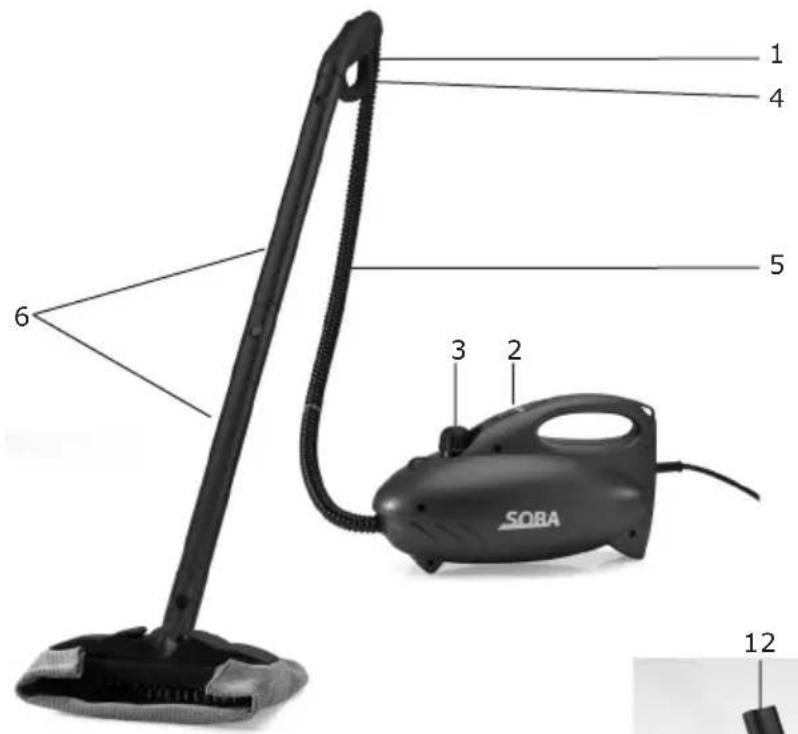
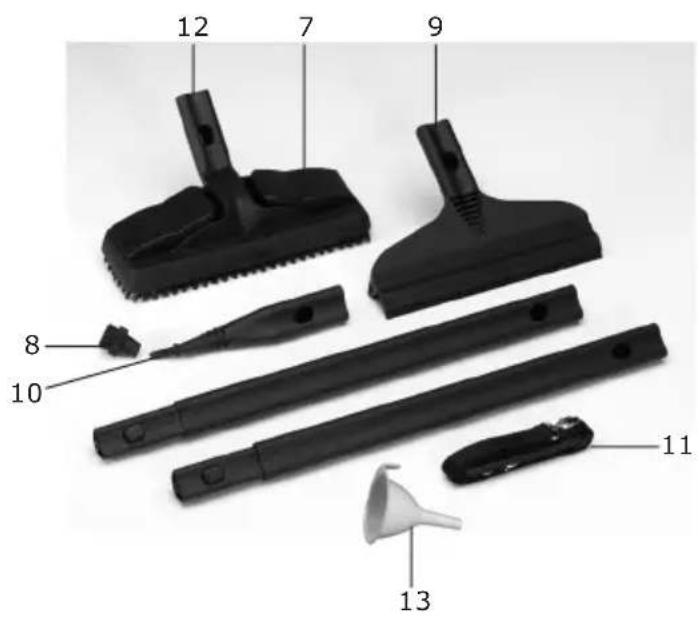
GETTING TO KNOW YOUR RD410
- Steam button
- Power "On" Light (Amber)
- Safety / Filler Cap
- Hand Grip
- Flexible Steam Hose
- Extension Tubes (2)
- Floor Brush
- Detail Brush
- Glass & Tile Squeegee
- Concentrator Nozzle
- Shoulder Strap
- Angle Adapter
- Filling Funnel
TECHNICAL SPECIFICATIONS
Voltage: 230V / 50Hz
Power: 1560 Watts
Water Capacity: 0.8 lt
Max. Steam Temperature: 120^
Steam Generator: Stainless Steel
FEATURES OF RD410
- No more detergents or chemicals. Just add water.
- Lightweight & Portable
- Stainless Steel Boiler: Non-corroding, 18/10 stainless steel boiler. Welded construction.
Heavy-duty crush-proofhose. - Versatile, quick-change accessories.
- Indoor and Outdoor Use: Bathrooms, kitchens, living areas, pet areas and appliances. Automotive, patio and windows.
OPERATING INSTRUCTIONS
Components
Power "On" Light (amber): This light will illuminate when the unit is plugged into the 230V wall outlet and will remain on until the unit is unplugged.
CAUTION: Read the instructions for "Filling the Water Tank" before opening the Safety Cap. Always depress hand grip steam trigger until all pressure/steam has been vented from boiler. Always unplug before filling.
IMPORTANT: Do NOT add cleaning solutions, scented perfumes, oils or any other chemicals to the water used in this appliance. Use tap water or distilled/purified water if the tap water in your area is very hard.
Filling Your RD410 with Water
- Before filling the RD410, make sure that the unit is NOT plugged in.
- Turn Safety/Filler Cap (3) counter clockwise until removed.
- Place Water Filling Funnel in tank and add 0.8 lt of water. Do not overfill. Replace Safety/Filler Cap by turning clockwise. Heating time is approximately 3-5 minutes with cold water. Filling boiler with hot water will shorten heat up time.
- Plug the unit into a standard 230 volt (3-prong) grounded wall receptacle. The power light will illuminate.
- Allow approximately 3-5 minutes for vapor to reach its working temperature and pressure.
- Connect desired attachments onto the Flexible Steam Hose.
- Upon initial use, some water will come out from the nozzle of the attachment. This is unheated water in the hose and is normal.
CAUTION: Allow unit to cool for 5 minutes before refilling. When refilling the machine while it is still hot, the first drops of water might bubble up. Use caution when opening the Safety/Filler Cap as cap may become hot during use and escaping steam can cause scalding.
IMPORTANT: When the RD410 has run out of water, steam output will cease.
CAUTION: Always drain condensate from hose before use or if unit has been left idle for a period of time. To drain hose, direct nozzle into an appropriate container or sink and depress hand grip steam trigger. Once hose has been drained, normal use may be resumed. Never direct nozzle towards people, animals or plants.
Refilling Your RD410 with Water
- Disconnect Electrical Power Cord from wall outlet.
- Depress and hold the hand grip steam trigger to ensure that any remaining pressure in the boiler has been released.
- Carefully loosen the safety/filler cap by turning counter clockwise. Any residual steam will be released below the safety/filler cap if the tank has not been completely vented. When the hissing stops and the last of the steam has been released, remove the filler cap.
CAUTION: Allow unit to cool down for 5 minutes. Escaping steam can cause scalding.
- Refill water tank with water using the filling funnel.
- Firmly screw the safety/filler cap back onto the unit by turning clockwise.
- Connect power cord to the wall outlet.
Using Your RD410 with Floor Brush
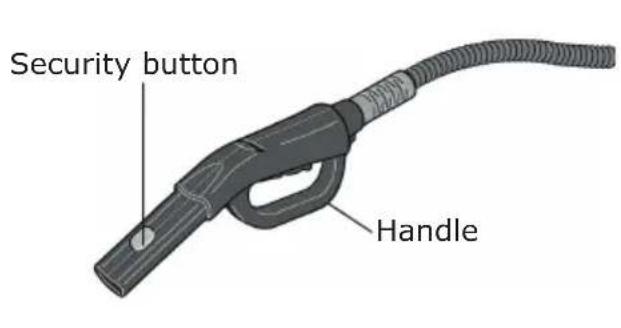
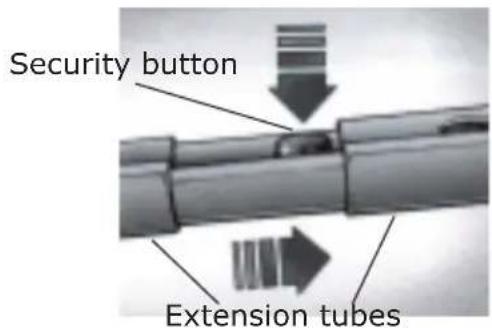
- Connect one of the extension tubes to the hand grip on the flexible steam hose. To attach the extension tubes one onto the other or onto the hand grip, press the locking button ensuring that it fits into the hole (see illustrations.) To disconnect, repeat the operation by pressing the locking button and pulling the two sections apart.
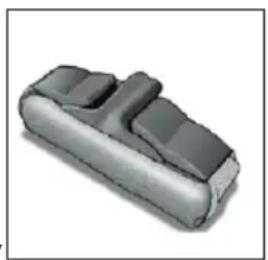
NOTE: Fit floor brush with the angle adapter on to the extension tube.
- If the angle adapter is not attached to the floor brush, hold the brush with its bristles up in your left hand. With the angle adapter pointing downward, insert it into the hole in the back of the brush, then turn the angle adapter 180^ .
- Insert the electrical power cord into the wall outlet. Heating time is approximately 3-5 minutes with cold water. Filling the steam generator with hot water will shorten heat up time.
Attaching a Towel to the Floor Brush
100% white terry cloth towel can be fitted on this brush so as to absorb the dirt and protect delicate surfaces. It can also be used on vertical washable surfaces following the same procedure as for the floor.
IMPORTANT: Please note that bristles may break through thin towels. If you don't have thick enough towels, please use 2 towels.
- Prepare white terry cloth towel (dimensions 34cm× 40cm ).
- Place the brush on the towel.
- Fold the towel.
- Fold the other side of the towel.
- Place the corner under the cloth holder.
- Place the towel around the brush, and repeat folding the towel. When folding the towel, leave some slack. Do not pull tightly around the brush.
ATTACHING THE ACCESSORIES TO THE FLEXIBLE STEAM HOSE
Dual Edge Glass & Tile Squeegee
This attachment is very useful for cleaning large windows, plastic material, ceramic, tiled or marble surfaces.
To use: Connect the tile squeezegee to the hand grip or use with extension tube for hard to reach surfaces.
Apply steam abundantly, rub with the soft spongy edge, then remove excess water and dirt with the glass wiping edge.
CAUTION: When cleaning windows, always avoid any sudden changes in temperature to prevent glass breakage or cracks.
Concentrator Nozzle
This attachment is very useful for cleaning surfaces that are difficult to reach. It is ideal for radiators, door and window jambs, shutters and sanitary fixtures. The concentrator nozzle will fit directly onto the handgrip or may be used with extension tubes.
Detail Brush
It is best for cleaning grout in-between the tiles, ceramic and marble.
To use: Push the detail brush on the end of the concentrator nozzle, which may be used directly on the hand grip or with extension tubes.
TIPS ON HOW TO USE YOUR SYSTEM
Water
- Use tap water for all your cleaning needs.
- However, if you live in an area with hard water, use demineralised/distilled water when steaming light colored fabrics to eliminate the possibility of hard water stains.
IMPORTANT: Do NOT add cleaning solutions, scented perfumes, oils or any other chemicals to the water used in this appliance. Use tap water or distilled/purified water if the tap water in your area is very hard.
Temperature
- The vapor temperature at the tip of the nozzles is between 105^ and 115^ .
- The temperature of the vapor falls to 38^ C at a distance of 25 ~cm from the nozzle.
WARNING: A towel wrapped around the brush can become hot enough to burn. Make sure that you let the towel cool off before touching it.
Using Towels
- For best results use 100% cotton white terry cloth towels.
- Use correct size (34 cm x 40 cm) of towel to allow you to wrap the towel around the brushes and clip it under the spring loaded cloth holder.
- The purpose of using a towel is to absorb moisture and dirt being removed. Always use dry towels. A wet towel will smear the dirt.
- Wash towels with strong detergent and bleach.
- Using scented fabric softener while washing the towels will cause the scent to be released into the air when using the towels with your steam system.
Efficient Work
- For vertical surfaces, wipe always from the top down, in this way the dirty water will not soil surfaces already cleaned.
- Avoid changing brushes back and forth while cleaning.
- Start with the smallest brush to clean tight spots and corners first.
- Wipe dirt as soon as possible, otherwise it will dry and re-adhere to the surface.
USAGE SUGGESTION FOR RD410
Wood, Vinyl and Marble Floors
Use the floor brush with a terry cloth attached. Move the brush across the floor as if you are mopping. When the towel is soiled, you can turn the towel over or replace it with a clean towel. If you are working on a very dirty area, you can move the brush over the area slowly, several times. If it is a wood floor, move fast to avoid heat or moisture buildup in the wood. By cleaning with the towel over the brush, you will not affect the shine on the floor.
To Strip Wax
Use floor brush for open areas; detail brush for corners or tight areas - no towel, slow strokes. Work a small area at a time - remove the emulsified wax from the floor. When all of the wax has been stripped, immediately clean the floor and brushes with water before residue has a chance to harden on them. Go back over the stripped area with the floor brush with a towel to remove any remaining residue before waxing.
To Clean Waxed Floors
Wrap clean towel around the floor brush, brush quickly. This will cause the dirt to be removed but not the wax.
Vinyl Floors
Do not allow heat to buildup in any kind of vinyl, since it can soften it enough to affect its texture. Work fast on vinyl.
Tile Floors
Use the detail attachment with the detail brush attached to an extension. Have the floor brush with cloth attached ready as well. Clean the grout between the tiles with the detail brush. Remove the detail brush and attach the floor brush, move the brush across the floor to clean the tile and remove excess moisture and residue. For areas of tile that are very dirty, remove the towel and agitate with the brush. Do not let the area dry before you wipe it up.
Spot Cleaning (Carpets)
Use the concentrator nozzle with or without the detail brush. Move slowly over the soiled area, allowing the steam to penetrate. Agitate with detail brush or clean towel. Dab the spot with the towel (do not rub). Repeat as necessary to remove stain. Vacuum only after the carpet has completely dried. Always test color fastness of carpet in an inconspicuous area before cleaning. If your RD410 fails to remove stubborn stains a commercially available carpet shampoo may be required.
Do NOT add cleaning solutions, scented perfumes, oils or any other chemicals to the water used in this appliance as this may damage the unit or make it unsafe for use.
Upholstery
Use the floor brush attached directly to the hand grip with a clean white terry cloth towel. Use fast, light strokes, avoid getting the fabric wet. Be patient with stubborn spots; work on a spot gently for no more than a minute at a time, then wait five minutes for the area to dry and repeat. Use circular movements or back-and-forth and side-to-side movements to get all sides of surface fibers. Finish with a brushing in one direction that will give the fabric a uniform appearance.
CAUTION: Always determine the color-fastness of any fabric - especially with reds or blues - by taking a clean, moist, warm towel and gently rubbing a small area as far down on the back or other out of the way place on the furniture as possible. If color comes off on the towel, you may need to have the piece dry cleaned.
Window, Glass Surfaces and Mirrors
Use the dual edge glass and tile squeezegee. Work with the vapor jet on using the top to bottom movements. Use the squeezegee with the vapor off to clear the water from the glass. To do this without leaving streaks, use lateral movements from the top to the bottom of the surface.
Fiberglass or Stainless Steel Surfaces
Use the floor brush or detail brush. Slowly move the brush over the surface to be cleaned. The vapor will emulsify the dirt and grease on the surface. Follow behind with a terry cloth towel over the brush to remove excess moisture and residue.
Tip: An old idea for polishing stainless steel is to wipe it down with seltzer soda water after it is cleaned.
Soap Scum
Soap scum dissolves almost immediately under a combination of heat and moisture. Rinse the surface with a small amount of water afterwards or go back over it once more with a clean terry cloth towel.
Note: Soap scum sometimes will develop a hard surface from waterborne minerals. If this is the case, use the floor brush with no towel first to break up this surface - or spray or wipe first with lemon, vinegar or seltzer soda water to soften the minerals. Moving too slowly can dry out the soap scum and cause it to granulate on the surface. The surface will have a gritty feel. If this happens, apply vapour to the surface with the open brush again and reclean.
Garden Furniture
Use any of the brushes depending on the surface area. Work quickly when cleaning resin outdoor furniture.
Blinds
Use the detail brush to clean blinds. Move the brush over the surface, allowing enough time for the vapor to penetrate. Work quickly on PVC blinds. Test for color fastness on fabric blinds before using.
Bathroom Areas
To clean the bathtub or shower area, use the detail brush for grout, shower door tracks, hard to get areas and heavily soiled areas. The dual edge window/tile squeezegee will be the most efficient way to clean the rest of the area. Allow plenty of time for the heat to penetrate the surface. This is especially helpful in the shower area if there is tile or grout. Removal of soap scum on tile, grout, and shower doors is also easier with the RD410.
To clean sanitary fixtures, use concentrator nozzle with or without detail brush. Use a terry cloth towel or paper towel to wipe up excess moisture and residue.
To clean the sink and faucets, use detail brush.
Exterior Areas
To clean inside your car, use the floor brush with a terry cloth towel attached to clean upholstery and interior areas just as in the home. You should not expose the bristles to leather - use only the brush with the terry cloth towel attached. For detailing the wheels, use the concentrator nozzle and the detail brush. Exterior windows are cleaned best by applying the vapor with the concentrator nozzle and following with a paper towel.
To clean bicycles, use the detail brush. To clean equipment, use the detail brush, depending on the surface area.
Artificial Plants
Use the concentrator nozzle without a brush attached to blow off the dust and dirt.
Clothing
A vapour cleaning system is excellent for removing wrinkles from fabrics. Simply "vaporize" the surface from a distance of 30 - 45cm . The dry vapor removes wrinkles without leaving the fabric wet like ordinary fabric steamers do.
Nicotine and Tar
Nicotine and tar dissolves at high temperatures and becomes a light yellow oil that has the consistency of sewing machine oil. When the nicotine/tar film is touched by a hot terry cloth towel clipped over the floor brush, it immediately dissolves and flows into the towel. You can remove it from flat surfaces as fast as you can move the brush over the surface.
Removing Wax, Tar, Etc.
Many stains are only stuck on the surface of materials and can be easily and quickly removed by "blowing" excess material away from the surface from the side. This is accomplished by using the concentrator nozzle. Hold the terry cloth towel to the side to catch the loose residue as it is blown by the nozzle.
Note: Always vacuum any loose residue off the surface before you apply vapor to it.
Hints: The RD410 has many uses that have not been mentioned. This was meant only to give you a general idea of what can be achieved with the unit. However, the ways in which to use the attachments and brushes are in most cases universal. It is most helpful to always have a terry cloth towel or paper towel ready to use for removal of moisture and residue. 100% white cotton towels work best. You can clean the brushes with your steam cleaner. To clean the floor brush, hold at one end and use the concentrator nozzle to simply blow off dirt into the garbage can. When cleaning the detail brush, use a pair of pliers to hold and blow dirt as above or place in the basket of your dishwasher.
Note: Wipe immediately before the cleaned area dries. When cleaning the oven, use the detail brush to clean around the elements and drip trays. Use the detail brush for cracks, crevices, and hard to reach areas.
Refrigerator
Use the concentrator nozzle to blow away dirt in the ice machine and on door seals. The vapor will not dry out or crack the seals as chemicals often do. Can openers and other kitchen equipment can be easily cleaned with the detail brush on the nozzle to get into all the nooks and crannies. Mold stains around door gaskets can be removed with the detail brush.
To clean microwaves or other small appliances use the detail brush for small areas. Note: When cleaning small electrical appliances always unplug them from outlet before cleaning.
To clean counter tops, use the floor brush with a terry cloth towel attached. For heavily soiled areas, use the brush without the terry cloth towel first in order to loosen the debris, then follow with a terry cloth towel attached to finish.
CARE & MAINTENANCE
If you consistently use demineralized or distilled water, cleaning the tank is unnecessary.
Rinsing out the steam cleaner:
Normally, a periodic rinse of your RD410 will free it from deposits. This is recommended every 10-15 tankfulls, to free up any scale deposits from the tank. Fill the boiler with water and shake the cleaner vigorously. Tilt the cleaner upside down to empty the boiler of water and any scale deposits.
Descaling your steam cleaner
If the tap water in you area contains a high level of calcium deposits and you have been using tap water to do your steam cleaning, you should descale your unit after 10-15 tankfulls.
- Unplug the steam cleaner from the power source before you descale the boiler.
- Fill the boiler with 1 part (150 ml) vinegar and 4 parts (600 ml) water and leave overnight or for a period of approximately 8 hours. Do not screw the safety/filler cap onto the steam cleaner while you are descending the boiler. Do not use the steam cleaner while descending solution is inside the boiler.
- After the period of soaking, turn the steam cleaner upside down to empty solution from the boiler. Due to the fact that a small amount of solution will be left in the boiler, it is necessary to rinse the boiler out with clean water 2 or 3 times. Your steam cleaner is now ready for use.
ATTACHING THE SHOULDER STRAP
Using the detachable shoulder strap allows for greater freedom of movement when both hands are needed for various cleaning tasks.
To attach the shoulder strap to the steam cleaner, simply snap the shoulder strap hooks onto the connecting rings on the unit body.
When using the RD410 with the shoulder strap, avoid rocking or tilting the unit excessively as this may cause water to enter the hose and be discharged along with the steam.
Puissance: 1560 Watts
CONDITIONS OF GUARANTEE
The guarantee is valid for 2 years from date of supply to the end user. In order to claim under the guarantee the faulty appliance must be taken to the official after-sales service agent together with proof of purchase (copy of the invoice or receipt). The guarantee covers the costs for work and material.
The guarantee shall be invalid or prematurely discontinued if damages are due to any of the following causes: utilisation of the appliance in the commercial sector, exterior influences, non-professional installation, non-observance of the instructions for use or operating instructions, force majeure, inappropriate use, intervention by non-authorised persons as well as normal wear and tear. Also excluded are damage due to dropping or falling, water or operating with incorrect electrical power.
CONDITIONS DE GARANTIE
Contact us for Customer Service addresses in other countries.
Information from SOBA International Trading AG.