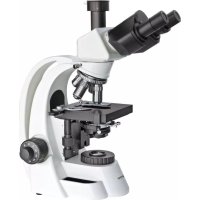
BIOSCIENCE 401000X - Microscope BRESSER - Free user manual and instructions
Find the device manual for free BIOSCIENCE 401000X BRESSER in PDF.



| Product Type | Biological Microscope |
| Brand | Bresser |
| Model | BIOSCIENCE 401000X |
| Category | Microscope |
| Total Magnification | 40x to 1000x (with 10x eyepieces and 4x, 10x, 40x, 100x oil objectives) |
| Eyepieces | 2 × WF 10x/20 mm, 20 mm field |
| Objectives | Achromatic: 4x (NA 0.1), 10x (NA 0.25), 40x (NA 0.65), 100x oil (NA 1.25) |
| Condenser | Abbe, NA 1.25, height and centering adjustable, with iris diaphragm |
| Stage | Orthogonal movements, longitudinal travel 50 mm, transverse travel 75 mm |
| Focus | Coarse and fine focus (minimum graduation 0.002 mm), with safety stop |
| Illumination | Halogen 12 V / 30 W, adjustable intensity, Köhler illumination |
| Power Supply | Mains, integrated transformer |
| Dimensions (approx.) | 30 × 25 × 45 cm (L×W×H) |
| Weight (approx.) | 5 kg |
| Maintenance and Cleaning | Optics: special cloth or soft cloth moistened with isopropanol. Painted parts: soft cloth, white spirit for grease stains. Do not use organic solvents on plastics. |
| Safety | Keep out of reach of children; children should only work under adult supervision. |
| Spare Parts and Repairability | Replacement halogen lamp (12 V, 20 W); bulb accessible through compartment under base. Objectives and eyepieces available separately. |
| Warranty | 2 years, extendable upon registration at www.bresser.de/warranty_terms |
Frequently Asked Questions - BIOSCIENCE 401000X BRESSER
User questions about BIOSCIENCE 401000X BRESSER
0 question about this device. Answer the ones you know or ask your own.
Ask a new question about this device
Download the instructions for your Microscope in PDF format for free! Find your manual BIOSCIENCE 401000X - BRESSER and take your electronic device back in hand. On this page are published all the documents necessary for the use of your device. BIOSCIENCE 401000X by BRESSER.
USER MANUAL BIOSCIENCE 401000X BRESSER
Do not dispose of electric equipment together with household waste material! In observance of European Directive 2002/96/EC on waste electrical and electronic equipment (WEEE) and its implementation in accordance with national law, electric equipment that have reached the end of its life must be collected separately and returned to an environmentally compatible recycling facility. Discharged batteries and damaged re-chargable batteries must be disposed of at special battery collection points. Information is available from your local disposal agent or local authority.

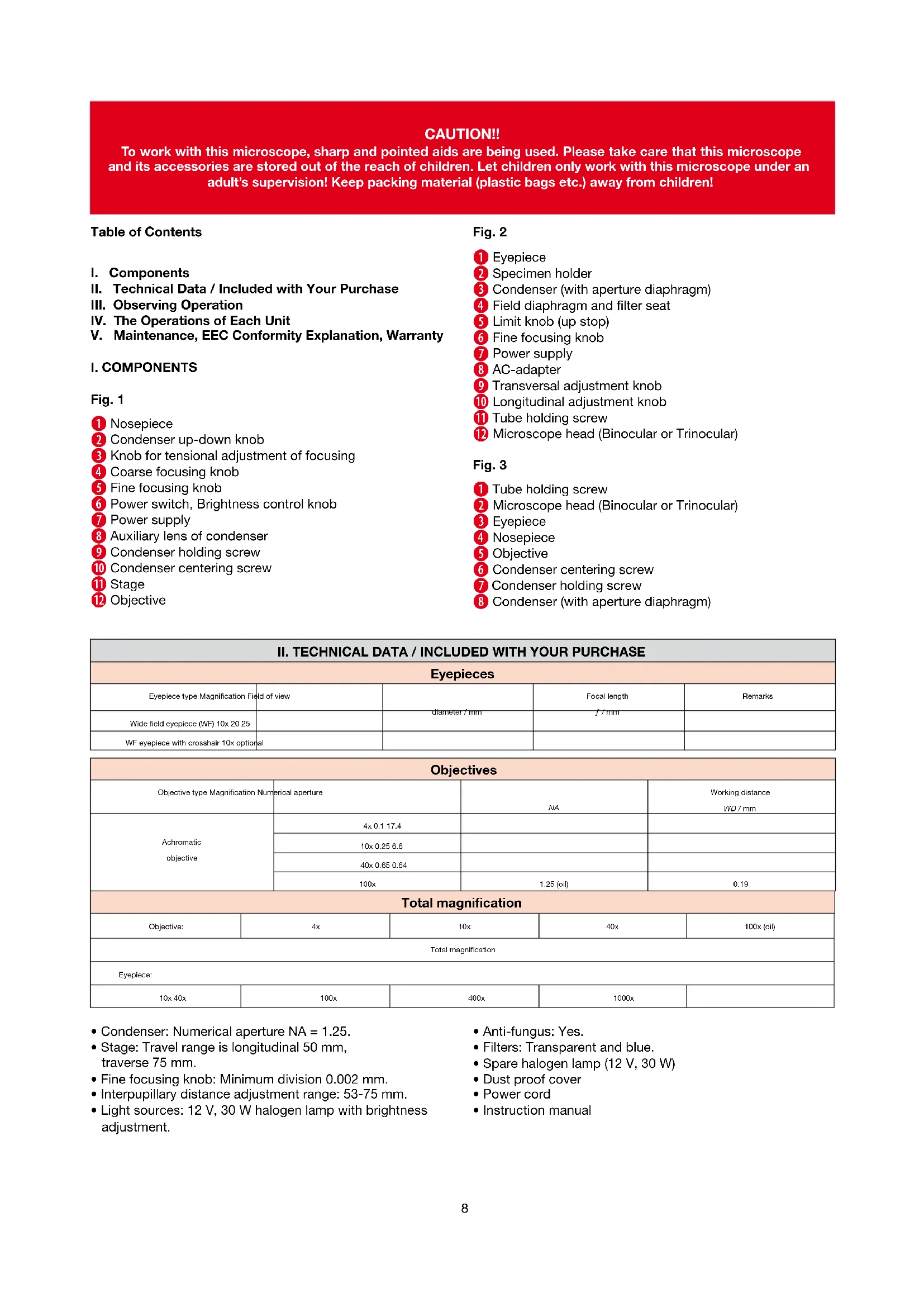
To work with this microscope, sharp and pointed aids are being used. Please take care that this microscope and its accessories are stored out of the reach of children. Let children only work with this microscope under an adult's supervision! Keep packing material (plastic bags etc.) away from children!
Table of Contents
I. Components
II. Technical Data / Included with Your Purchase
III. Observing Operation
IV. The Operations of Each Unit
V. Maintenance, EEC Conformity Explanation, Warranty
I. COMPONENTS
Fig. 1
1 Nosepiece
2 Condenser up-down knob
3 Knob for tensional adjustment of focusing
4 Coarse focusing knob
5 Fine focusing knob
6 Power switch, Brightness control knob
7 Power supply
8 Auxiliary lens of condenser
9 Condenser holding screw
10 Condenser centering screw
11 Stage
12 Objective
Fig. 2
Eyepiece
Specimen holder
3 Condenser (with aperture diaphragm)
4 Field diaphragm and filter seat
Limit knob (up stop)
6 Fine focusing knob
7 Power supply
8 AC-adapter
9 Transversal adjustment knob
10 Longitudinal adjustment knob
Tube holding screw
12 Microscope head (Binocular or Trinocular)
Fig. 3
1 Tube holding screw
2 Microscope head (Binocular or Trinocular)
Eyepiece
4 Nosepiece
Objective
6 Condenser centering screw
7 Condenser holding screw
8 Condenser (with aperture diaphragm)
| II. TECHNICAL DATA / INCLUDED WITH YOUR PURCHASE | ||||
| Eyepieces | ||||
| Eyepiece type Magnification Field of view | Focal length | Remarks | ||
| Wide field eyepiece (WF) 10x 20 25 | diameter / mm | / mm | ||
| WF eyepiece with crosshair 10x optional | ||||
| Objectives | |||
| Objective type Magnification Numerical aperture | NA | Working distanceWD / mm | |
| Achromaticobjective | 4x 0.1 17.4 | ||
| 10x 0.25 6.6 | |||
| 40x 0.65 0.64 | |||
| 100x | 1.25 (oil) | 0.19 | |
| Total magnification | ||||
| Objective: | 4x | 10x | 40x | 100x (oil) |
| Total magnification | ||||
| Eyepiece: | ||||
| 10x 40x | 100x | 400x | 1000x | |
- Condenser: Numerical aperture NA = 1.25.
- Stage: Travel range is longitudinal 50mm , traverse 75mm .
- Fine focusing knob: Minimum division 0.002mm .
-
Interpupillary distance adjustment range: 53-75 mm.
Light sources: 12 V, 30 W halogen lamp with brightness adjustment. -
Anti-fungus: Yes.
- Filters: Transparent and blue.
- Spare halogen lamp (12 V, 30 W)
- Dust proof cover
Power cord - Instruction manual
III. OBSERVING OPERATION
- Turn down the power switch in order to switch on the illumination. The power switch also works as a brightness control knob.
- By turning the nosepiece, set the 10x objective into the operation position. Then focus the specimen, which is on the stage.
- Adjust the interpupillary distance and the diopter (for binocular observation).
- Adjust the up & down position of the condenser, the light control and the aperture diaphragm in order to get a satisfying luminal effect. When you watch with the 4x or 10x objective, bring down the condenser to get symmetrical light. When you watch with the 4x objective, put the auxiliary lens of condenser in observation position.
- When you interchange objectives, turn the nosepiece and refocus slightly with the fine focusing knob. When you use the 100x objective, be sure to put a drop of immersion oil between the objective and the specimen as well as between the condenser and the slide.
IV. THE OPERATIONS OF EACH UNIT
1. Adjustment of interpupillary distance (Fig. 4)
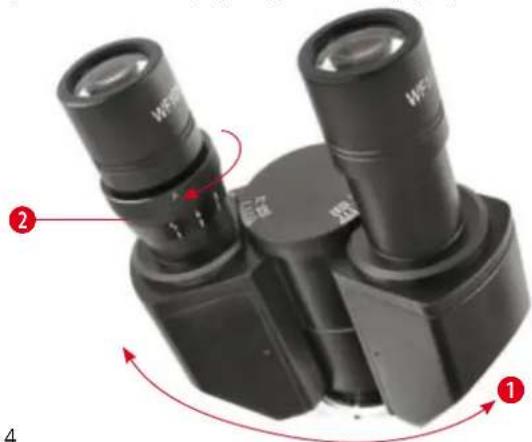
Fig. 4
Put the specimen on the stage and bring it into the exact focus. Adjust the interpupillary distance of the binocular viewing by "folding" the binocular tube (1) on the optical head, until the right and the left field of view can be composed to one.
2. Adjustment of diopter (Fig. 4)
Put the specimen on the stage. Turn the 40x objective to the working position. Firstly, observe at the right eyepiece with the right eye; adjust the coarse and fine focusing knob to image clearly. Secondly, observe at the left eyepiece with the left eye; adjust the diopter control (2) to image clearly.
3. Coarse/Fine focusing (Fig. 5)

Fig. 5
The instrument uses a coaxial coarse/fine focusing mechanism. The knob for tensional adjustment of focusing (4) is used for adjusting the tension of the coarse focusing knob (3) to prevent the stage from naturally sliding down. The limit knob (1) prevents accidental contact between specimen and objective. After locking the limit knob (by turning up and fastening) at a chosen height of the stage, you cannot focus the object closer to the objective using the coarse focusing knob. So, the object is protected against damage. (2) is the fine focusing knob.
4. Stage (Fig. 6)
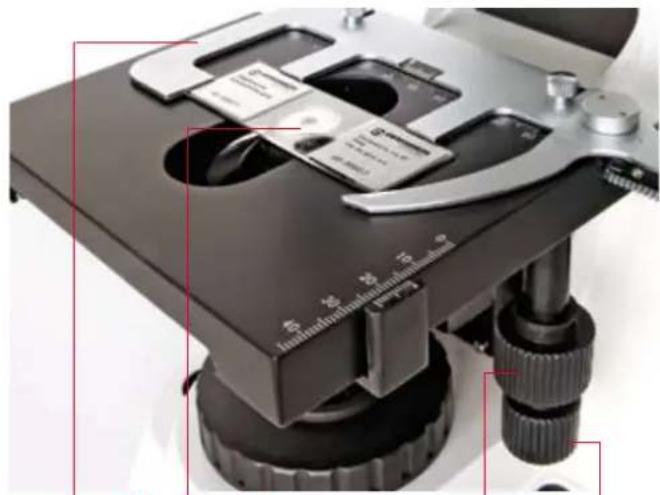


Fig. 6
The convenient specimen holder (1) on the stage is used for holding the slide glass (2). The longitudinal (lengthwise) adjustment knob (3) and the transversal (cross) adjustment knob (4) are coaxial. The stage moves expediently.
5. Adjustable Abbe condenser (Fig. 7)
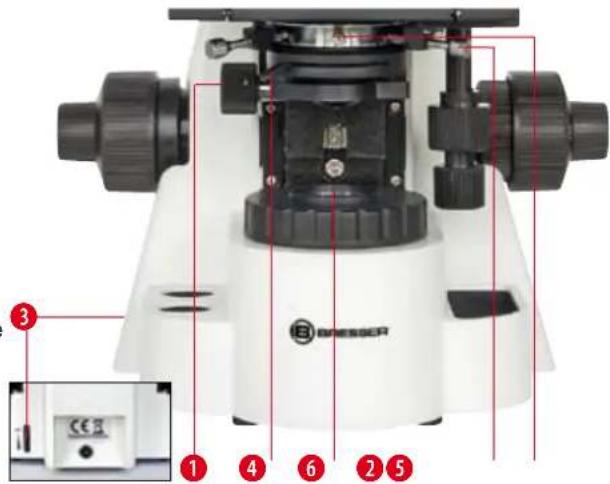
Fig. 7
The condenser is moved up or down via turning the up-down knob (1). For centering, the condenser centering screws (6) are used. The condenser can be taken down easily if one unscrews the condenser holding screw (2). The place for a filter plate is on the filter seat (5).
6. Power switch and adjustable brightness (Fig. 7)
Turn down the power switch (3). Adjust the light control (4) until the image can be observed comfortably. Note: Don't let the light control at the position of maximum brightness for a long time. That reduces the life-span of the lamp.
7. Kohler illumination (Fig. 7)
The Kohler illumination is the optimal microscopic illumination and therefore standard for scientific research and microphotography. One gets it using the fixed field diaphragm and the height- and center-adjustable Abbe condenser:
a) Using the condenser up-down knob (1), move the condenser (Fig. 3, No. 8) to the highest position, right under the stage.
b) Turn on the power switch (3) and focus the object.
c) Shut the field diaphragm (5) as close as possible. If the image of the field diaphragm lies out of the field of view, move it into the field using the condenser centering screws (6).
d) Using the condenser up-down knob (1), change the height of the condenser, until the image of the field diaphragm is clear.
e) Using the condenser centering screws (6), center the image of the field diaphragm in the field of view.
f) Open the field diaphragm so widely, that its edge has only just left the field of view and this field is complete illuminated. It may be, that you have to center the condenser a little bit again. Now, adjust the aperture diaphragm, which is described in the next paragraph.
8. Aperture diaphragm (Fig. 8)
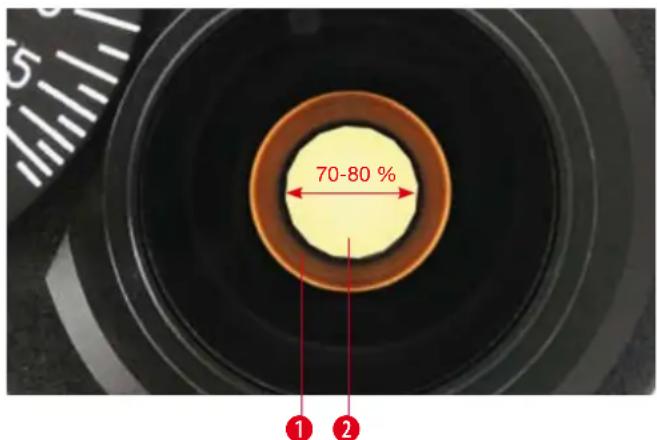
Fig. 8
The aperture diaphragm lever (Fig. 7, No. 4) can be turned in order to open or close the aperture diaphragm. Remove the eyepieces and watch through the eyepiece tube. For centering, the condenser centering screws (Fig. 7, No. 6) are used when the diaphragm image is eccentric with the objective pupil (1). Turn the aperture diaphragm lever for getting a good resolution and contrast perception. Usually, the diameter of the aperture diaphragm image (2), which has to be adjusted, is 70-80 percent of the objective pupil.
9. Exchange of the lamp (Fig. 9)
a) Switch off the power switch and pull out the plugs of the AC-adapter from mains socket and from mains in at the microscope (Fig. 2, No. 7).
b) Incline the microscope, loose the fixing screw (3) of the lamp door on the middle part of the bottom and open the lamp door; so, you remove the lamp baseboard (1) from the bottom.
c) Pull out the old lamp (4) from the lamp base (5). Be careful, as the lamp may be hot!
d) Insert the new lamp (4) into the lamp base (5). Notice the properly touching; take care not to touch the lamp with bare fingers. E. g., use the protective envelope of the lamp or a tissue, in order to grasp the bulb.
e) Reinstall the lamp door (1) with lamp base board (5) on the bottom with the screw (3).
f) After mounting the lamp well, plug in the power cord, turn on the power switch, turn the objective lens into the light path, adjust the condenser upwards and downwards, and make light enter the view field. If the light spot is offset from the center of view, loose the screw (2) slightly and move the lamp base (5). Move the lamp spot into the center, then tighten up the screw (2) immediately.
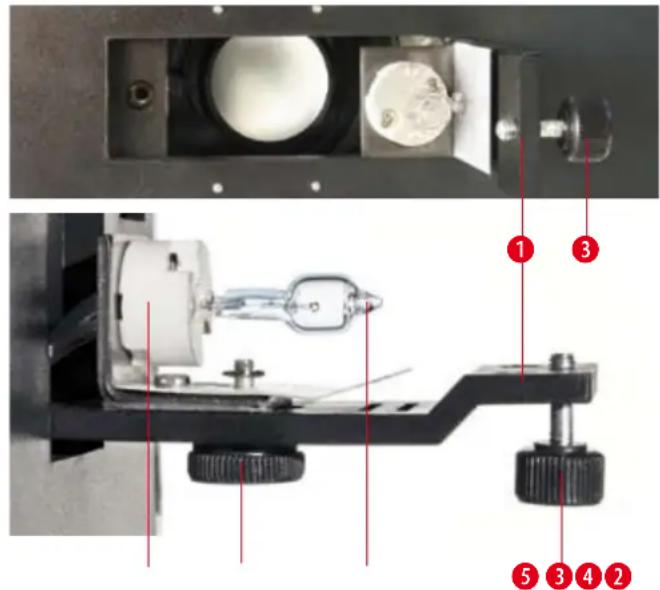
Fig. 9
V. MAINTENANCE
1. Sweep the lens
Sweep the lens by lens tissue or soft fabric immersed with a mixed liquid of alcohol/ether. Clean the 100x oil objective from oil whenever you finish operating.
2. Clean the painted parts
The dust on the painted parts can be removed by gauze. For the grease spots, the gauze immersed slightly with aviation gasoline is recommended. Do not use organic solvents such as alcohol, ether or other thinner etc. for cleaning the painted parts or plastic components.
3. Avoid disassembling the microscope
Because of being a precise instrument, do not disassemble the microscope casually. That may cause serious damage to its performance.
4. Being not used
Cover the microscope with the dust cover (made of polymethylmethacrylate or polyethylene) and place it there, where it is dry and mouldless. We suggest the storage of all objectives and eyepieces in a closed container with drying agent.
EEC CONFORMITY EXPLANATION
Bresser GmbH, resident in 46414 Rhede/Westf., Gutenbergstr. 2, Germany, explains the agreement with in the following specified EEC guidelines for this product:
EN 61326: 1997
EN 61000-3-2
Product description: Biological microscope
Rhede, July 20, 2007
Bresser GmbH
Helmut Ebbert
Managing director
Warranty & Service
The regular guarantee period is 2 years and begins on the day of purchase. To benefit from an extended voluntary guarantee period as stated on the gift box, registration on our website is required.
You can consult the full guarantee terms as well as information on extending the guarantee period and details of our services at www.bresser.de/warranty_terms.
Would you like detailed instructions for this product in a particular language? Then visit our website via the link below (QR code) for available versions.
Alternatively you can also send an email to manuals@bresser.de or leave a message on +49 (0) 28 72 - 80 74-220*. Please always state your name, precise address, a valid phone number and email address, as well as the article number and name.
*Number charged at local rates in Germany (the amount you will be charged per phone call will depend on the tariff of your phone provider); calls from abroad will involve higher costs.

Rhede, 20. July 2007
Bresser GmbH
Helmut Ebbert
Errors and technical changes reserved

- Table of Contents
- Components
- Fig. 1
- Fig. 2
- Fig. 3
- OBSERVING OPERATION
- THE OPERATIONS OF EACH UNIT
- Adjustment of interpupillary distance (Fig. 4)
- Adjustment of diopter (Fig. 4)
- Coarse/Fine focusing (Fig. 5)
- Stage (Fig. 6)
- Adjustable Abbe condenser (Fig. 7)
- Power switch and adjustable brightness (Fig. 7)
- Kohler illumination (Fig. 7)
- Aperture diaphragm (Fig. 8)
- Exchange of the lamp (Fig. 9)
- MAINTENANCE
- Sweep the lens
- Clean the painted parts
- Avoid disassembling the microscope
- Being not used
- EEC CONFORMITY EXPLANATION
- Warranty & Service
Brand : BRESSER
Model : BIOSCIENCE 401000X
Category : Microscope