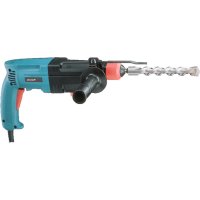
HR2413 - Drill MAKITA - Free user manual and instructions
Find the device manual for free HR2413 MAKITA in PDF.


| Brand | Makita |
| Model | HR2413 |
| Product type | Hammer drill (rotary hammer) |
| Drilling capacity (concrete) | 24 mm |
| Drilling capacity (wood) | 32 mm |
| Drilling capacity (steel) | 13 mm |
| No-load speed | 0 - 1050 rpm |
| Blow rate | 0 - 4900 blows/min |
| Overall length | 371 mm |
| Net weight | 2.3 kg |
| Power supply | Single-phase, mains voltage (230 V) |
| Tool holder | SDS+ |
| Main functions | Drilling without percussion, drilling with percussion, reversible rotation |
| Safety devices | Torque limiter, safety lock, double insulation |
| Auxiliary handle | Adjustable side handle |
| Sound level | Sound pressure 90 dB(A), sound power 101 dB(A) |
| Vibration | Weighted acceleration 8 m/s² |
| Maintenance | Cleaning with blow bulb, regular lubrication of drill bit shank |
| Included accessories | Side handle, depth rod, blow bulb, dust collector, flat wrench |
Frequently Asked Questions - HR2413 MAKITA
User questions about HR2413 MAKITA
0 question about this device. Answer the ones you know or ask your own.
Ask a new question about this device
Download the instructions for your Drill in PDF format for free! Find your manual HR2413 - MAKITA and take your electronic device back in hand. On this page are published all the documents necessary for the use of your device. HR2413 by MAKITA.
USER MANUAL HR2413 MAKITA
| Explanation of general view | ||
| 1 T i g h t e n | 9 Depth gauge | 17 Sleeve |
| 2 Loosen | 10 Switch trigger | 18 Ring |
| 3 Side grip | 11 Reversing switch lever | 19 Tighten |
| 4 Bit shank | 12 Action mode changing knob | 20 Loosen |
| 5 Bit grease | 13 Blow-out bulb | 21 Wrench |
| 6 B i t | 14 Dust cup | 22 Soft jaws |
| 7 Chuck cover | 15 Chuck adapter | 23 Screw |
| 8 Clamp screw | 16 Keyless drill chuck |
SPECIFICATIONS
Model HR2410/HR2410X HR2413
Capacities
Concrete 24 mm 24 mm
Wood 32 mm 32 mm
Steel 13 mm 13 mm
No load speed (^-1) 0-1,050 0-1,050
Blows per minute 0-4,900 0-4,900
Overall length 371 mm 371 mm
Net weight 2.4 kg 2.3 kg
- Due to our continuing program of research and development, the specifications herein are subject to change without notice.
Note: Specifications may differ from country to country.
Intended use
The tool is intended for hammer drilling and drilling in brick, concrete and stone. It is also suitable for drilling without impact in wood, metal, ceramic and plastic.
Power supply
The tool should be connected only to a power supply of the same voltage as indicated on the nameplate, and can only be operated on single-phase AC supply. They are double-insulated in accordance with European Standard and can, therefore, also be used from sockets without earth wire.
Safety hints
For your own safety, please refer to the enclosed safety instructions.
SPECIFIC SAFETY RULES
GEB007-2
DO NOT let comfort or familiarity with product (gained from repeated use) replace strict adherence to rotary hammer safety rules. If you use this tool unsafely or incorrectly, you can suffer serious personal injury.
- Wear ear protectors. Exposure to noise can cause hearing loss.
- Use auxiliary handles supplied with the tool. Loss of control can cause personal injury.
- Hold power tools by insulated gripping surfaces when performing an operation where the cutting tool may contact hidden wiring or its own cord. Contact with a "live" wire will make exposed metal parts of the tool "live" and shock the operator.
-
Wear a hard hat (safety helmet), safety glasses and/or face shield. Ordinary eye or sun glasses are NOT safety glasses. It is also highly recommended that you wear a dust mask and thickly padded gloves.
-
Be sure the bit is secured in place before operation.
- Under normal operation, the tool is designed to produce vibration. The screws can come loose easily, causing a breakdown or accident. Check tightness of screws carefully before operation.
- In cold weather or when the tool has not been used for a long time, let the tool warm up for a while by operating it under no load. This will loosen up the lubrication. Without proper warm-up, hammering operation is difficult.
- Always be sure you have a firm footing. Be sure no one is below when using the tool in high locations.
- Hold the tool firmly with both hands.
- Keep hands away from moving parts.
- Do not leave the tool running. Operate the tool only when hand-held.
- Do not point the tool at any one in the area when operating. The bit could fly out and injure someone seriously.
- Do not touch the bit or parts close to the bit immediately after operation; they may be extremely hot and could burn your skin.
- Some material contains chemicals which may be toxic. Take caution to prevent dust inhalation and skin contact. Follow material supplier safety data.
SAVE THESE INSTRUCTIONS.
WARNING:
MISUSE or failure to follow the safety rules stated in this instruction manual may cause serious personal injury.
OPERATING INSTRUCTIONS
Side grip (auxiliary handle) (Fig. 1)
The side grip swings around to either side, allowing easy handling of the tool in any position. Loosen the side grip by turning it counterclockwise, swing it to the desired position and then tighten it by turning clockwise.
Installing or removing drill bit
Important:
Always be sure that the tool is switched off and unplugged before installing or removing the bit.
Clean the bit shank and apply bit grease before installing the bit. (Fig. 2)
Insert the bit into the tool. Turn the bit and push it in until it engages. (Fig. 3)
If the bit cannot be pushed in, remove the bit. Pull the chuck cover down a couple of times. Then insert the bit again. Turn the bit and push it in until it engages. (Fig. 4) After installing, always make sure that the bit is securely held in place by trying to pull it out.
To remove the bit, pull the chuck cover down all the way and pull the bit out.
Depth gauge (Fig. 5)
The depth gauge is convenient for drilling holes of uniform depth. Insert the depth gauge into the hole in the grip base. Adjust the depth gauge to the desired depth and then tighten the clamp screw to secure the depth gauge.
NOTE:
The depth gauge cannot be used at the position where the depth gauge strikes against the gear housing.
Switch action (Fig. 6)
CAUTION:
Before plugging in the tool, always check to see that the switch trigger actuates properly and returns to the "OFF" position when released.
To start the tool, simply pull the trigger. Tool speed is increased by increasing pressure on the trigger. Release the trigger to stop.
Reversing switch action (Fig. 6)
For Model HR2410 and HR2410X
CAUTION:
- Always check the direction of rotation before operation.
- Use the reversing switch only after the tool comes to a complete stop. Changing the direction of rotation before the tool stops may damage the tool.
- Do not pull the switch trigger when the reversing switch lever is in the neutral position. If you pull the trigger forcibly, the switch may be damaged.
This tool has a reversing switch to change the direction of rotation. Move the lever to the position for clockwise rotation or the position for counterclockwise rotation.
Selecting action mode (Fig. 7)
This tool employs an action mode changing knob. Select one of the two modes suitable for your work needs by using this knob. For rotation only, turn the knob so that the arrow on the knob points toward the symbol on the tool body. For rotation with hammering, turn the knob so that the arrow on the knob points toward the symbol on the tool body.
CAUTION:
Always set the knob fully to your desired mode symbol. If you operate the tool with the knob positioned half-way between the mode symbols, the tool may be damaged.
Torque limiter
The torque limiter will actuate when a certain torque level is reached. The motor will disengage from the output shaft. When this happens, the bit will stop turning.
CAUTION:
- As soon as the torque limiter actuates, switch off the tool immediately. This will help prevent premature wear of the tool.
- Hole saws, core bits, diamond core bits, etc. cannot be used with this tool. They tend to pinch or catch easily in the hole. This will cause the torque limiter to actuate too frequently.
Hammer drilling operation
Position the bit at the desired location for the hole, then pull the trigger.
Do not force the tool. Light pressure gives best results. Keep the tool in position and prevent it from slipping away from the hole.
Do not apply more pressure when the hole becomes clogged with chips or particles. Instead, run the tool at an idle, then remove the bit partially from the hole. By repeating this several times, the hole will be cleaned out and normal drilling may be resumed.
CAUTION:
There is tremendous and sudden twisting force exerted on the tool/bit at the time of hole breakthrough, when the hole becomes clogged with chips and particles, or when striking reinforcing rods embedded in the concrete.
Always use the side grip (auxiliary handle) and firmly hold the tool by both side grip and switch handle during operations. Failure to do so may result in the loss of control of the tool and potentially severe injury.
Bit grease
Coat the bit shank head beforehand with a small amount of bit grease (about 0.5 - 1g ).
This chuck lubrication assures smooth action and longer service life.
Blow-out bulb (Fig. 8)
Use the blow-out bulb to clean out the hole.
Dust cup (Fig. 9)
Use the dust cup to prevent dust from falling over the tool and on yourself when performing overhead drilling operations. Attach the dust cup to the bit as shown in Fig. 9. The size of bits which the dust cup can be attached to is as follows.
| Bit diameter (mm) | |
| Dust cup 5 6 – 14.5 | |
| Dust cup 9 12 – 16 |
Drilling in wood or metal (Fig. 10 & 11)
Use the optional drill chuck assembly (standard equipment for Model HR2410X). When installing it, refer to "Installing or removing drill bit" described on the previous page.
Hold the ring and turn the sleeve counterclockwise to open the chuck jaws. Place the bit in the chuck as far as it will go. Hold the ring firmly and turn the sleeve clockwise to tighten the chuck.
To remove the bit, hold the ring and turn the sleeve counterclockwise. Set the action mode changing knob to "rotation only". You can drill up to 13mm diameter in metal and up to 32mm diameter in wood.
CAUTION:
- Never use "rotation with hammering" when the drill chuck assembly is installed on the tool. The drill chuck assembly may be damaged.
- Pressing excessively on the tool will not speed up the drilling. In fact, this excessive pressure will only serve to damage the tip of your bit, decrease the tool performance and shorten the service life of the tool.
- There is a tremendous twisting force exerted on the tool/bit at the time of hole breakthrough. Hold the tool firmly and exert care when the bit begins to break through the workpiece.
- A stuck bit can be removed simply by setting the reversing switch to reverse rotation in order to back out. However, the tool may back out abruptly if you do not hold it firmly.
- Always secure small workpieces in a vise or similar hold-down device.
For Model HR2410 only and HR2410X
Also, the drill chuck will come off when reversing the tool.
NOTE:
If you need to assemble the drill chuck and chuck adapter assembly, proceed as follows. Secure the drill chuck in a vise or similar securing devise. (Fig. 12)
Remove the screw from the chuck adapter assembly and screw the chuck adapter into the drill chuck. Use a wrench to tighten the chuck adapter securely, applying about 30 - 40N· m torque. (Note: you can obtain 30- 40N· m torque by applying pressure of 300 - 400N to the wrench while holding the portion 10~cm from the wrench head.)
Open the chuck jaws fully and insert the screw through the chuck opening. Tighten the screw counterclockwise with a screwdriver. (Fig. 13)
MAINTENANCE
CAUTION:
Always be sure that the tool is switched off and unplugged before carrying out any work on the tool.
To maintain product safety and reliability, repairs, maintenance or adjustment should be carried out by a Makita Authorized Service Center.
ACCESSIONS
CAUTION:
These accessories or attachments are recommended for use with your Makita tool specified in this manual. The use of any other accessories or attachments might present a risk of injury to persons. Only use accessory or attachment for its stated purpose.
If you need any assistance for more details regarding these accessories, ask your local Makita service center.
- Depth gauge
Side grip - Plastic carrying case
- Blow-out bulb
- SDS Plus tungsten-carbide tipped bit
- Drill chuck
- Chuck adapter
Dustcup
Keyless drill chuck - Chuck key
- Bit grease
- Dust extractor attachment
- Safety goggle
Descriptif
15 Borepatronadapter
16 Noglelosborepatron
17 Muffe
18 Ring
19 Løsne
20 Spaende
21 Skruenogle
22 Blode bakker
23 Skrue
SPECIFICATIONER
Model HR2410/HR2410X HR2413
Kapacitet
Beton 24 mm 24 mm
Trae 32 mm 32 mm
Stal 13 mm 13 mm
Omdrejninger (^-1) 0-1050 0-1050
Slagantal (min) 0-4900 0-4900
Backlagesomkoppling (Fig. 6)
EC-DECLARATION OF CONFORMITY
We declare under our sole responsibility that this product is in compliance with the following standards of standardized documents,
EN60745, EN55014, EN61000
in accordance with Council Directives, 89/336/EEC and 98/37/EC.
FRANÇAISE
DECLARATION DE CONFORMITE CE
Michigan Drive, Tongwell, Milton Keynes,
Bucks MK15 8JD, ENGLAND
Responsible manufacturer: Produtore responsable:
de accordo com as directivas 89/336/CEE e 98/37/CE do Conselho.
DANSK
EU-DEKLARATION OM KONFORMITET
Michigan Drive, Tongwell, Milton Keynes,
Bucks MK15 8JD, ENGLAND
For European countries only
Noise and Vibration
The typical A-weighted noise levels are
sound pressure level: 90 dB (A)
sound power level: 101 dB (A)
Uncertainty is 3 dB (A).
- Wear ear protection. -
The typical weighted root mean square acceleration value is 8m / s^2
These values have been obtained according to EN60745.
FRANÇAISE
aänenpainetaso: 90 dB (A)
aenthenotatoso:101dB(A)
Epavarmuus on 3 dB (A).