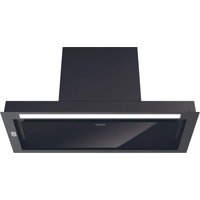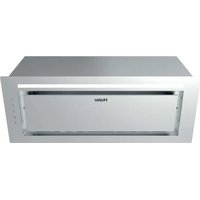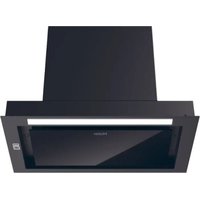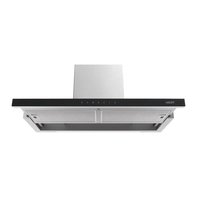
HCH6100ACS - Basket HAIER - Free user manual and instructions
Find the device manual for free HCH6100ACS HAIER in PDF.



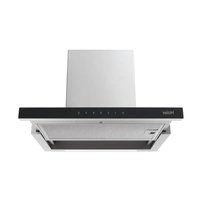
| Product Type | Wall-Mounted Range Hood |
| Brand | Haier |
| Model | HCH6100ACS |
| Width | 30 inches (76 cm) |
| Finish | Stainless Steel |
| Power Supply | 120 V, 60 Hz, 15 A |
| Control Type | Push Buttons |
| Fan Speeds | 3 speeds |
| Lighting | 2 halogen bulbs (included) |
| Venting Type | Ducted to outside or recirculation (optional charcoal filter) |
| Duct Diameter | 6 inches (15.2 cm) |
| Grease Filter | Metallic, dishwasher safe |
| Charcoal Filter | Optional, non-washable, lifetime 6 months |
| Minimum Installation Height | 24 inches (61 cm) for electric range, 27 inches (69 cm) for gas |
| Maximum Suggested Installation Height | 36 inches (91 cm) |
| Warranty | 1 year parts and labor (comprehensive) |
| Package Contents | Hood, duct cover, grease filter, mounting template, screws, wall anchors, power cord |
Frequently Asked Questions - HCH6100ACS HAIER
User questions about HCH6100ACS HAIER
0 question about this device. Answer the ones you know or ask your own.
Ask a new question about this device
Download the instructions for your Basket in PDF format for free! Find your manual HCH6100ACS - HAIER and take your electronic device back in hand. On this page are published all the documents necessary for the use of your device. HCH6100ACS by HAIER.
USER MANUAL HCH6100ACS HAIER
24", 30" and 36" Wall-Mount Range Hood
natural_image
3D rendering of a metallic industrial chimney or cover plate with mounting flanges (no text or symbols)TABLE OF CONTENTS
RANGE HOOD SAFETY INSTRUCTIONS....2
INSTALLATION REQUIREMENTS....5
Tools and Parts....5
Location Requirements 6
Electrical Requirements 7
INSTALLATION INSTRUCTIONS....7
Prepare Location 7
Install Range Hood....9
Connect Vent System 10
Make Electrical Connection .... 11
Complete Installation....11
RANGE HOOD USE....12
Range Hood Controls 12
RANGE HOOD USE....13
Cleaning 13
TROUBLESHOOTING....15
LIMITED WARRANTY 16
RECORD KEEPING
Thank you for purchasing this Haier product. This user manual will help you get the best performance from your new hood.
For future reference, record the model and serial number located inside of the hood, and the date of purchase.
Staple your proof of purchase to this manual to aid in obtaining warranty service if needed.
Model number
Serial number
Date of purchase
RANGE HOOD SAFETY INSTRUCTIONS
Your safety and the safety of others are very important.
We have provided many important safety messages in this manual and on your appliance. Always read and obey all safety messages.

text_image
Warning symbol with exclamation mark inside a triangle, commonly used to indicate caution or hazard.This is the safety alert symbol.
This symbol alerts you to potential hazards that can kill or hurt you and others. All safety messages will follow the safety alert symbol and either the word "DANGER," "WARNING" or "CAUTION."
These words mean:
! DANGER
An imminently hazardous situation. You could be killed or seriously injured if you don't immediately follow instructions.
WARNING
A potentially hazardous situation which, if not avoided, could result in death or serious bodily injury.
CAUTION
A potentially hazardous situation which, if not avoided, may result in moderate or minor injury.
All safety messages will tell you what the potential hazard is, tell you how to reduce the chance of injury, and tell you what can happen if the instructions are not followed.
IMPORTANT SAFETY INSTRUCTIONS
WARNING: To reduce the risk of fire, electrical shock, injury to persons, or damage when using the range hood, follow basic precautions, including the following:
- This appliance is intended for normal family household use only.
- Before servicing or cleaning the unit, switch power off at service panel and lock the service disconnecting means to prevent power from being switched on accidentally. When the service disconnecting means cannot be locked, securely fasten a prominent warning device, such as a tag, to the service panel.
- Installation work and electrical wiring must be done by qualified person(s) in accordance with all applicable codes and standards, including fire-rated construction.
-
Do not operate any fan with a damaged cord or plug. Discard fan or return to an authorized service facility for examination and/or repair.
-
Sufficient air is needed for proper combustion and exhausting of gases through the flue (chimney) of fuel burning equipment to prevent backdrafting. Follow the heating equipment manufacturer's guideline and safety standards such as those published by the National Fire Protection Association (NFPA), the American Society for Heating, Refrigeration and Air Conditioning Engineers (ASHRAE), and the local code authorities.
- When cutting or drilling into wall or ceiling; do not damage electrical wiring and other utilities.
- Ducted fans must always be vented outdoors.
- For general ventilating use only. Do not use to exhaust hazardous or explosive materials and vapors.
- To reduce risk of fire and to properly exhaust air, be sure to duct air outside - do not vent exhaust air into spaces within walls or ceilings, attics or into crawl spaces, or garages.
- To reduce the risk of fire, use only metal ductwork.
- To reduce the risk of fire or electrical shock, do not use this fan with any solid-state speed control device.
IMPORTANT SAFETY INSTRUCTIONS
To reduce the risk of a range top grease fire:
- Never leave surface units unattended at high settings. Boilovers cause smoking and greasy spillovers that may ignite. Heat oils slowly on low or medium settings.
- Always turn hood ON when cooking at high heat or when flambeing food (i.e. Crepes Suzette, Cherries Jubilee, Peppercorn Beef Flambé).
- Clean ventilating fans frequently. Grease should not be allowed to accumulate on fan or filter.
- Use proper pan size. Always use cookware appropriate for the size of the surface element.
To reduce the risk of injury to persons, in the event of a grease fire, observe the following:
- Never leave surface units unattended at high settings. Boilovers cause smoking and greasy spillovers that may ignite. Heat oils slowly on low or medium settings.
- Flaming grease outside of utensil can be extinguished with baking soda or, if available, a multipurpose dry chemical or foam type extinguisher.
- Never pick up a flaming pan. Smother or use dry chemical or foam type extinguishers.
- Wipe up spill over immediately.
- Do not allow aluminum foil, plastic, paper or cloth to come in contact with a hot surface.
- Do not allow pans to boil dry.
• Always have a working smoke detector near the kitchen.
Do Not Use Water on Grease Fires
- Smother fire or flame or use dry chemical or foam-type extinguisher.
Use Only Dry Pot Holders
- Moist or damp pot holders on hot surfaces may result in burns from steam. Do not let pot holder touch hot heating elements. Do not use a towel or other bulky cloth.
READ AND SAVE THESE INSTRUCTIONS
INSTALLATION REQUIREMENTS
TOOLS AND PARTS
Gather the required tools and parts before starting installation. Read and follow the instructions provided with any tools listed here.
Tools needed
- Level
- Drill with 1 14 , 1 / 8 , and 5 / 16 drill bits
- Pencil
• Wire stripper or utility knife - Tape measure or ruler
-
Pliers
-
Caulking gun and weatherproof caulking compound
- Vent clamps
• Jigsaw or keyhole saw - Flat-blade screwdriver
- Metal snips
• Phillips screwdriver
• Metric hex key set
For non-vented (recirculating) installations, you will also need:
- 6" (15.2 cm) dia. round metal vent duct - length required is determined by ceiling height.
Parts supplied
Remove parts from packages. Check that all parts are included.
• 120 V power cord with 3 prong plug
- Hood canopy assembly with blower, vent transition, light bulb and canopy glass already installed
- Metal grease filter
- Vent cover support bracket
- Mounting template
• 2-piece vent cover
- 4 - 4 x 8 screws
- 6 - 5 x 45 mm mounting screws
• 2 - 8 x 40 mm wall anchors
• 4 - 10 x 50 mm wall anchors
LOCATION REQUIREMENTS
IMPORTANT: Observe all governing codes and ordinances.
Have a qualified technician install the range hood. It is the installer's responsibility to comply with installation clearances specified on the model/serial rating plate. The model/serial rating plate is located behind the left filter on the rear wall of the vent hood.
Canopy hood location should be away from strong draft areas, such as windows, doors and strong heating vents.
Grounded electrical outlet is required. See "Electrical Requirements" section.
FOR MOBILE HOME INSTALLATIONS
The installation of this range hood must conform to the Manufactured Home Construction Safety Standards, Title 24 CFR, Part 328 (formerly the Federal Standard for Mobile Home Construction and Safety, Title 24, HUD, Part 280) or when such standard is not applicable, the standard for Manufactured Home Installation 1982 (Manufactured Home Sites, Communities and Setups) ANSI A225.1/NFPA 501A, or latest edition, or with local codes.
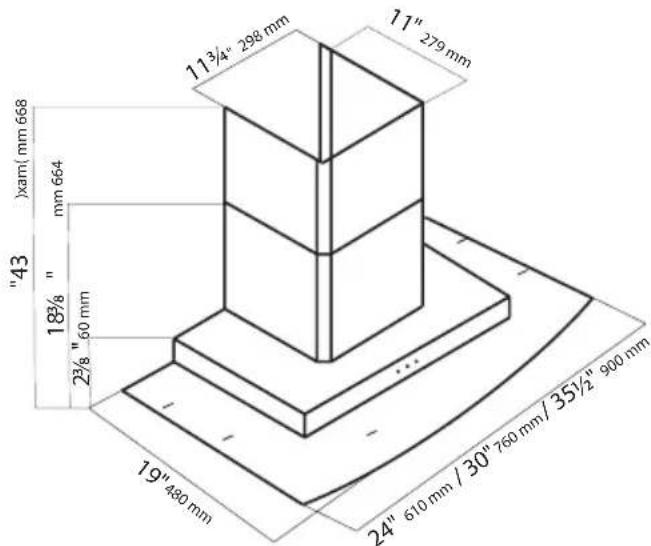
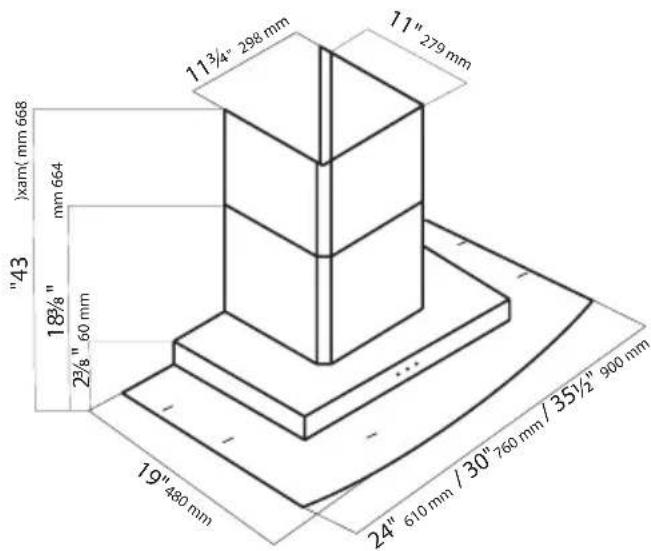
PRODUCT DIMENSIONS
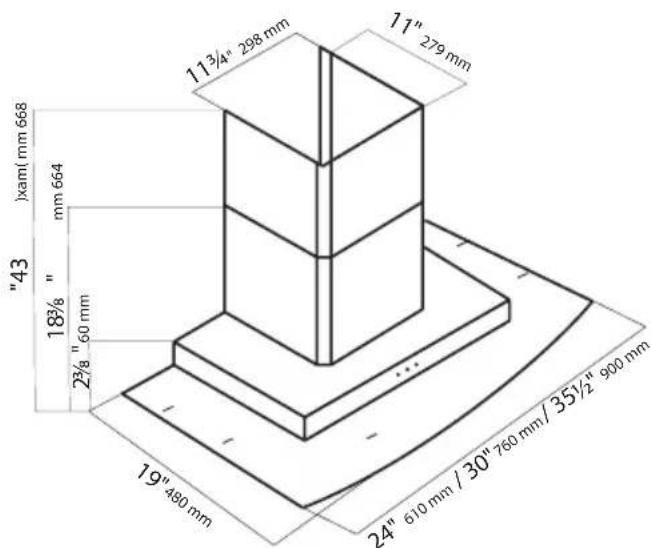
text_image
"43" 18¾" mm 664" 23¾" 60 mm" 19" 480 mm" 11¾" 298 mm" 11" 279 mm" 24" 610 mm / 30" 760 mm / 35½" 900 mm"ELECTRICAL REQUIREMENTS
Observe all governing codes and ordinances.
Ensure that the electrical installation is adequate and in conformance with National Electrical Code, ANSI/NFPA 70 (latest edition), or CSA Standards C22.1-94, Canadian Electrical Code, Part 1 and C22.2 No. 0-M91 (latest edition) and all local codes and ordinances.
If codes permit and a separate ground wire is used, it is recommended that a qualified electrician determine that the ground path is adequate.
A copy of the above code standards can be obtained from:
National Fire Protection Association
1 Batterymarch Park
Quincy, MA 02169-7471
CSA International
8501 East Pleasant Valley Road
Cleveland, OH 44131-5575
It is important to make sure you have the proper electrical connection.
RECOMMENDED GROUNDING METHOD
A 120 volt, 60 Hz, AC only, 15-amp fused, grounded electrical supply is required. Use an outlet that cannot be turned off by a switch. Do not use an extension cord.
NOTE: Before cleaning, or removing a light bulb, turn vent hood off, and then disconnect the vent hood from the electrical source. When you are finished, reconnect the vent hood to the electrical source.
INSTALLATION INSTRUCTIONS
PREPARE LOCATION
- It is recommended that the vent system be installed before hood is installed.
- Before making cutouts, make sure there is proper clearance within the ceiling or wall for exhaust vent.
-
Check your ceiling height and the hood height maximum before you select your hood.
-
Disconnect power.
-
Determine which venting method to use: roof, wall, or nonvented.
-
Select a flat surface for assembling the range hood. Place covering over that surface.
WARNING
Excessive Weight Hazard
Use two or more people to move and install range hood.
Failure to do so can result in back or other injury.
- Using 2 or more people, lift range hood onto covered surface.
MOUNT RANGE HOOD TO THE WALL
- Determine and mark the centerline on the wall where the canopy hood will be installed.
- Select a mounting height between a minimum of 24" (61.0 cm) for an electric cooking surface, a minimum of 27" (68.6 cm) for a gas cooking surface, and a suggested maximum of 36" (91.4 cm) above the range to the bottom of the hood. Mark a reference line on the wall.
- Place the vent hood on the wall, adjust to align and fasten with screws and screw anchors suited to the wall type (reinforced concrete, plasterboard etc.)
- Mark centers of the fastener locations through the template to the wall.
IMPORTANT: All screws must be installed into wood. If there is no wood to screw into, additional wall framing supports may be required.
Remove the template.
- Drill 316 " (4.8 mm) pilot holes at all locations where screws are being installed into wood.
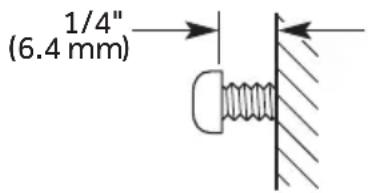
- Install the 2 - 5 x 45 mm mounting screws. Leave a 14 " (6.4 mm) gap between the wall and the back of the screw head to slide range hood into place.
text_image
1/4" (6.4 mm)VENT COVER BRACKET INSTALLATION
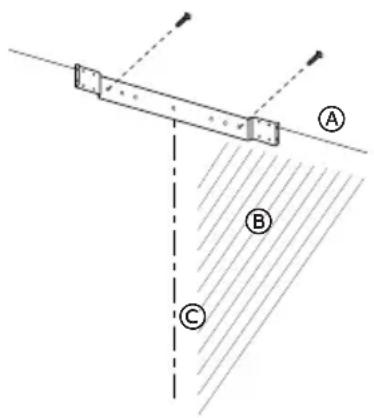
- Attach vent cover bracket to wall flush to the ceiling using 2 - 5 x 45 mm screws.
text_image
Diagram showing three labeled points (A, B, C) with directional arrows and a dashed vertical line, likely illustrating a physics or engineering concept.COMPLETE PREPARATION
-
Determine and make all necessary cuts in the wall for the vent system. Install the vent system before installing the hood. See "Venting Requirements" section.
-
Determine the required height for the home power supply cable and drill a 1¼" (3.2 cm) hole at this location.
-
Run the home power supply cable according to the National Electrical Code or CSA Standards and local codes and ordinances. There must be enough 12 " conduit and wires from the fused disconnect (or circuit breaker) box to make the connection in the hood's electrical terminal box.
NOTE: Do not reconnect power until installation is complete.
- Use caulk to seal all openings.
INSTALL RANGE HOOD
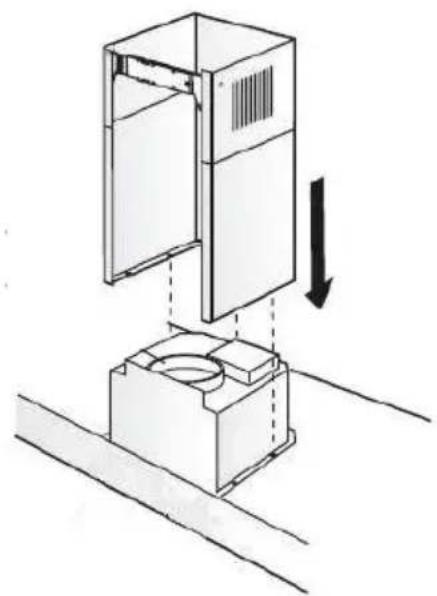
- Using 2 or more people, hang range hood on 2 mounting screws through the mounting slots on back of hood.
natural_image
Diagram of a mechanical device with a downward arrow indicating force or movement (no text or symbols present)-
Remove the grease filter. See "Range Hood Care" section.
-
Level the range hood and tighten upper mounting screws.
-
Install 2 - 5 x 45 mm lower mounting screws and tighten.
CONNECT VENT SYSTEM
For non-vented (recirculating) installation only:
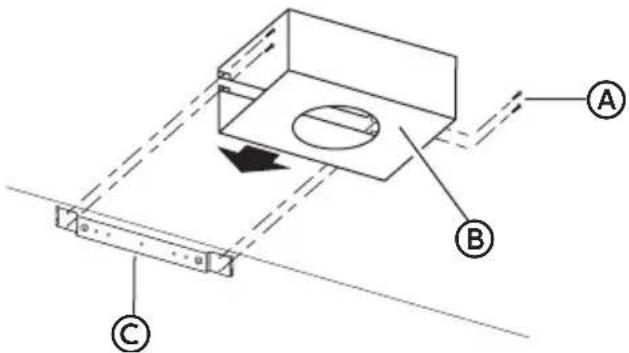
- Assemble the air deflector with the duct cover bracket with 4 - assembly screws provided with the Recirculation Kit.
text_image
Technical diagram showing a mechanical assembly with labeled components A, B, and C, including directional arrows and a circular feature.Ⓐ Assembly Screws
B Air Deflector
© Duct Cover Bracket
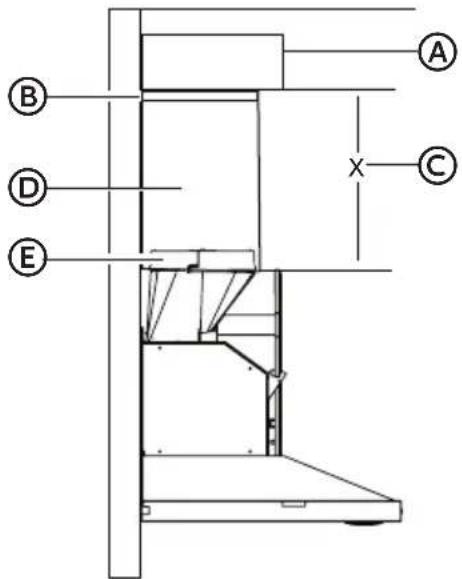
- Measure from the bottom of the air deflector to the bottom of the hood outlet.
text_image
A B D E X C(A) Air deflector
B Vent clamp
© X = length to cut vent duct
(D) Vent duct
E Exhaust outlet
- Cut the duct to the measured size (X).
-
Remove the air deflector.
-
Slide the duct onto the bottom of the air deflector.
- Place the assembled air deflector and duct over the exhaust outlet from the hood.
- Reassemble the air deflector to the duct cover bracket with 4 assembly screws.
- Seal connections with vent clamps.
MAKE ELECTRICAL CONNECTION
WARNING

Electrical Shock Hazard
Plug into a grounded 3 prong outlet.
Do not remove the ground prong from the power cord plug.
Do not use an adapter.
Do not use an extension cord.
Failure to do so can result in death, fire or electrical shock.
- Plug into a grounded 3-prong outlet.
COMPLETE INSTALLATION
- For non-vented (recirculating) installations only, install charcoal filters over metal grease filter. See the "Range Hood Care" section.
- Install metal filters. See the "Range Hood Care" section.
- Check the operation of the range hood blower and light. See the "Range Hood Use" section.
NOTE: To get the most efficient use from your new range hood, read the "Range Hood Use" section.
RANGE HOOD USE
The range hood is designed to remove smoke, cooking vapors and odors from the cooktop area. For best results, start the hood before cooking and allow it to operate 15 minutes after the cooking is complete to clear all smoke and odors from the kitchen.
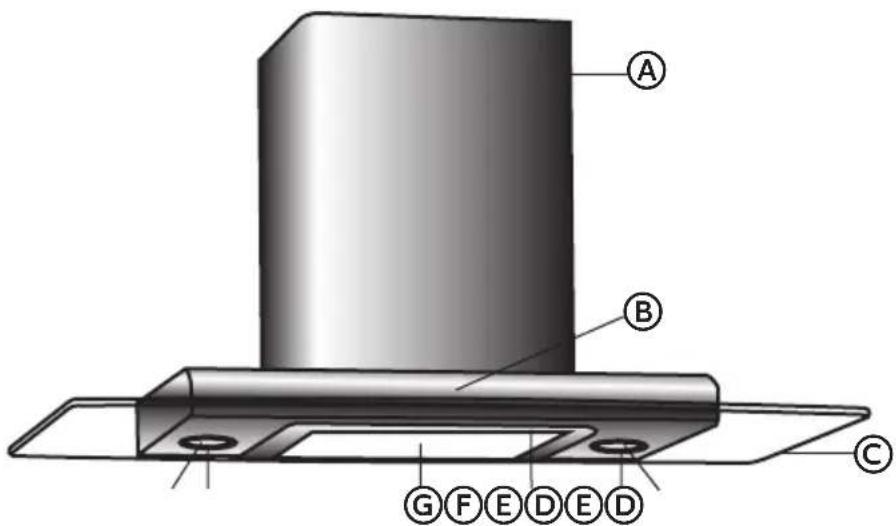
The hood controls are located on the front side of the canopy.
text_image
A B G F E D E D CⒶ Duct cover
B Control panel
© Glass canopy
D Lamp cover
E Halogen Bulb
F Grease filter release
© Grease filter
RANGE HOOD CONTROLS
text_image
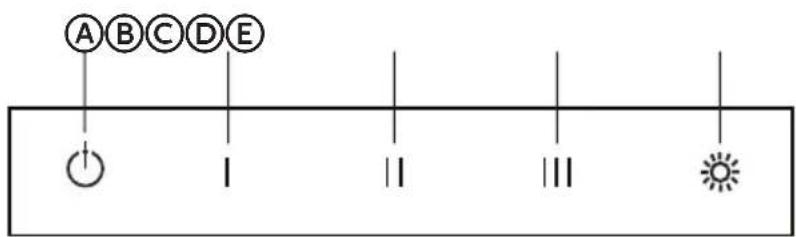
A B C D E I II III SⒶ Power/Off
⑧ Speed 1
© Speed 2
(D) Speed 3
E Light
OPERATING THE LIGHT
The light button controls both lights. Press once for On and again for Off.
The Blower Speed buttons turn the blower on and control the blower speed and sound level for quiet operation. The speed can be changed anytime during fan operation by pressing the desired Blower Speed button.
RANGE HOOD USE
CLEANING
IMPORTANT: Clean the hood and grease filters frequently according to the following instructions. Replace grease filters before operating hood.
EXTERIOR SURFACES:
To avoid damage to the exterior surface, do not use steel wool or soap-filled scouring pads.
Always wipe dry to avoid water marks.
Cleaning Method:
• Liquid detergent soap and water, or all-purpose cleanser
- Wipe with damp soft cloth or nonabrasive sponge, then rinse with clean water and wipe dry.
METAL GREASE FILTER
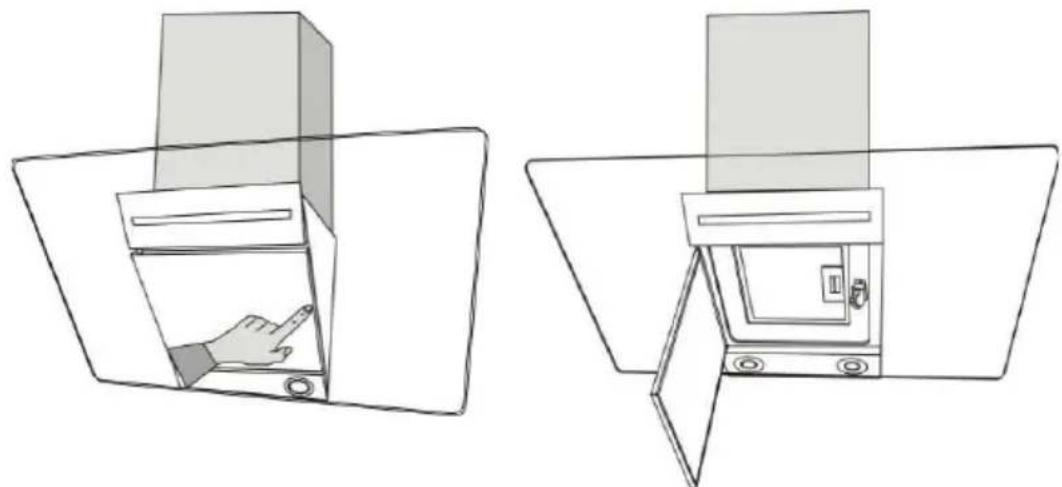
- Push up on the middle, right side of the decorative glass to open the door.
natural_image
Two technical line drawings showing a hand interacting with a device inside a cabinet (no text or symbols present)- Remove the metal filter.
- Wash metal filters as needed in dishwasher or hot detergent solution.
- Replace metal grease filters.
CHARCOAL FILTER
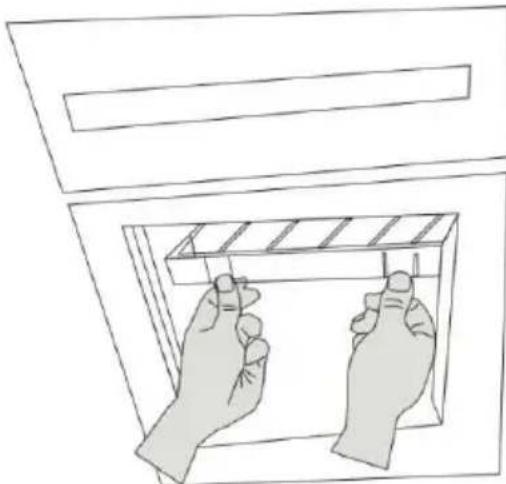
The charcoal filter is not washable. It should last up to 6 months with normal use.
To replace charcoal filter:
- Remove metal grease filter from range hood. See "Metal Grease Filter" in this section.
- Bend spring clips away from metal grease filter.
natural_image
Line drawing of two hands holding a grid-like object inside a rectangular frame (no text or symbols)- Place charcoal filter into top side of metal filter.
- Bend spring clips back into place to secure the charcoal filter to the metal filter.
- Replace metal grease filter. See "Metal Grease Filter" in this section.
REPLACING A LAMP
Turn off the range hood and allow the lamp to cool. To avoid damage or decreasing the life of the new bulb, do not touch bulb with bare fingers. Replace bulb using tissue or wearing cotton gloves to handle bulb.
If new lamps do not operate, make sure the lamps are inserted correctly before calling service.
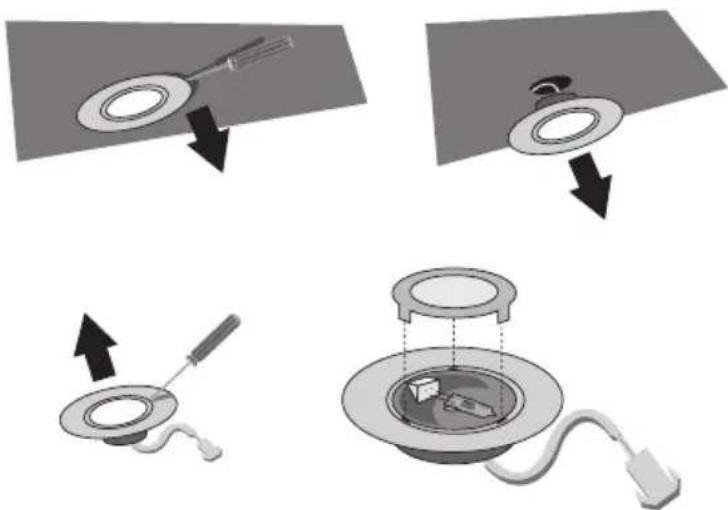
- Disconnect power.
- Use a flat-blade screwdriver to pry open the light cover.
- Avoiding contact with skin, replace the used bulb with a new halogen bulb of the same size, shape and wattage.
text_image
Diagram illustrating four steps of a lamp installation or cleaning procedure, showing how to switch from a flat panel to a closed lamp.- Replace the light shield and snap closed.
- Reconnect power.
TROUBLESHOOTING
First try the solutions suggested here to possibly avoid the cost of a service call.
| Problem Possible Reason Solution | ||
| Hood doesn’t work | Electric Supply Check that the | hood is plugged into a receptacle. |
| Check that the power is turned on. | ||
| Poor Airflow Aluminum | grease filters are clogged | Clean and dry the filters, and then reassemble. |
| Charcoal filters are clogged | Replace the charcoal filters. | |
| Motor running, but no airflow | Butterfly valve jammed Call | for service. |
| After running for a while, the motor stops. | The high temperature safety device is activated. | The kitchen is not sufficiently ventilated. |
| The hood is installed too close to the stove | The hood must be a minimum of 25 58 " (65 cm) above the stove. | |
| Strong cooking smell | Charcoal filters are not installed | In re-circulating mode, charcoal filters must be installed. |
| Oil dripping onto stove | Oil cup missing or not installed | Replace aluminum filter and replace oil cup. |
| Aluminum grease filter saturated | Wash the aluminum grease filters | |
| Whirring sound Fan blade problem Call for service | ||
FOR MORE HELP, VISIT HAIER.COM OR CALL THE CONSUMER HELP LINE AT 1-877-377-3639.
LIMITED WARRANTY
IN-HOME SERVICE
FULL ONE YEAR WARRANTY
For 12 months from the date of original retail purchase, Haier will repair or replace any part free of charge including labor that fails due to a defect in materials or workmanship.
Haier may replace or repair at their sole discretion any part, sub system including the entire product.
Product must be accessible, without encumbrance and installed properly to receive for warranty repair service.
LIMITED WARRANTY
NOTE: This warranty commences on the date the item was purchased, and the original purchase receipt must be presented to the authorized service representative before warranty repairs are rendered.
Exceptions: Commercial Use Warranty
90 days labor from date of original purchase 90 days parts from date of original purchase
No other warranty applies.
FOR WARRANTY SERVICE
All service must be performed by a Haier authorized service center. For the name and telephone number of the nearest authorized service center, please call 1-877-337-3639.
Before calling please have available the following information:
Model number and serial number of your appliance. The name and address of the dealer you purchased the unit from and the date of purchase.
A clear description of the problem.
A proof of purchase (sales receipt).
This warranty covers home appliance services within the contiguous United States and Canada and where available in Alaska, Hawaii and Puerto Rico.
What is not covered by this warranty:
Replacement or repair of household fuses, circuit breakers, wiring or plumbing.
A product whose original serial number has been removed or altered.
Any service charges not specifically identified as normal such as normal service area or hours.
Damage to clothing.
Damage incurred in shipping.
Damage caused by improper installation or maintenance.
Damage from misuse, abuse accident, fire, flood, or acts of nature.
Damage from service other than an authorized Haier dealer or service center.
Damage from incorrect electrical current, voltage or supply.
Damage resulting from any product modification, alteration or adjustment not authorized by Haier.
Adjustment of consumer operated controls as identified in the owner's manual.
Hoses, knobs, lint trays and all attachments, accessories and disposable parts.
Labor, service transportation, and shipping charges for the removal and replacement of defective parts beyond the initial 12-month period.
Damage from other than normal household use.
Any transportation and shipping charges.
THIS LIMITED WARRANTY IS GIVEN IN LIEU OF ALL OTHER WARRANTIES, EXPRESS ED OR IMPLIED, INCLUDING BUT NOT LIMITED TO, THE WARRANTIES OF MERCHANTABILITY AND FITNESS FOR A PARTICULAR PURPOSE
The remedy provided in this warranty is exclusive and is granted in lieu of all other remedies.
This warranty does not cover incidental or consequential damages, so the above limitations may not apply to you. Some states do not allow limitations on how long an implied warranty lasts, so the above limitations may not apply to you.
This warranty gives you specific legal rights, and you may have other rights, which vary from state to state.
Haier America
Wayne, NJ 07470
TABLE DES MATIÈRES
SÉCURITÉ DE LA HOTTE 18
EXIGENCES D'INSTALLATION....22
Outils et pièces 22
text_image
Warning sign with exclamation mark inside a triangle, commonly used to indicate caution or hazard.DIMENSIONS DU PRODUIT
text_image
"43" xam, mm 668 mm 664 18¾" 2¾" 60 mm 19" 480 mm 11³/⁴" 298 mm 11" 279 mm 24" 610 mm / 30" 760 mm / 35½" 900 mmNational Fire Protection Association
1 Batterymarch Park
Quincy, MA 02169-7471
CSA International
8501 East Pleasant Valley Road
Cleveland, OH 44131-5575
text_image
Diagram showing a beam with supports at points A and B, and a vertical dashed line labeled C, likely illustrating a physics or engineering concept.COMPLETE PREPARATION
natural_image
Diagram of a mechanical device with a downward arrow indicating motion or force, no text or symbols presenttext_image
Technical diagram showing a mechanical assembly with labeled components A, B, and C, including a directional arrow indicating motion.text_image
A B D E C Xtext_image
A B C G F E D E Dnatural_image
Two technical line drawings showing a hand interacting with an open door panel, no text or symbols present.natural_image
Illustration of two hands holding a grid-like object inside a rectangular frame (no text or symbols)REPLACEMENT D'UNE LAMPE
text_image
Diagram illustrating four steps of a device installation or cleaning process, showing tool, component, and final assembly.text_image
Warning symbol with exclamation mark inside a triangleDIMENSIONES DEL PRODUCTO
text_image
"43" 18¾" mm 664" 2¾" 60 mm 19" 480 mm 11¾" 298 mm 11" 279 mm 24" 610 mm / 30" 760 mm / 35½" 900 mmNational Fire Protection Association
1 Batterymarch Park
Quincy, MA 02169-7471
CSA International
8501 East Pleasant Valley Road
Cleveland, OH 44131-5575
text_image
Diagram showing a beam with supports at A and B, and a shaded region labeled C, likely illustrating a physics or engineering concept.natural_image
Diagram of a mechanical device with a downward arrow indicating motion or force, no text or symbols presenttext_image
Technical diagram showing a mechanical assembly with labeled components A, B, and C, including a directional arrow indicating motion.text_image
A B C G F E D E Dnatural_image
Two technical line drawings showing a hand interacting with an open door panel, one open and one closed (no text or symbols)natural_image
Line drawing of two hands holding a small abacus inside a larger frame (no text or symbols)text_image
Diagram illustrating four steps of a lamp installation or cleaning procedure, showing how to switch from a flat plate to a lamp cover.If you have a problem with this product, please contact the
"Haier Customer Satisfaction Center" at
1-877-337-3639.
DATED PROOF OF PURCHASE, MODEL #, AND SERIAL #
REQUIRED FOR WARRANTY SERVICE
IMPORTANT
HCH2100ACS, HCH3100ACS
HCH6100ACS
Issued: June 2015 Printed in China Part # 00XXXXXXXXXX