Life pro - Car seat KIDDY - Free user manual and instructions
Find the device manual for free Life pro KIDDY in PDF.



User questions about Life pro KIDDY
0 question about this device. Answer the ones you know or ask your own.
Ask a new question about this device
Download the instructions for your Car seat in PDF format for free! Find your manual Life pro - KIDDY and take your electronic device back in hand. On this page are published all the documents necessary for the use of your device. Life pro by KIDDY.
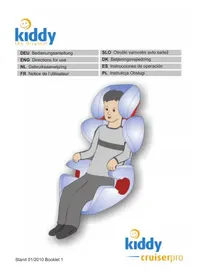
USER MANUAL Life pro KIDDY
ENG Directions for use
natural_image
Illustration of a baby car seat with accessories and a child inside (no text or symbols)Inhalt
natural_image
Diagram of a mechanical assembly with hands and a red circular indicator labeled 'b' (no text or symbols present)Abb. 2
natural_image
Illustration of a mechanical device with red directional arrows indicating movement or force (no text or symbols)Abb. 4
text_image
Diagram illustrating a medical procedure with labeled anatomical features and directional arrows indicating movement or force.Abb. 7
natural_image
Simple line drawing of a mechanical component inside a circular frame (no text or symbols)natural_image
Illustration of a person seated in a chair with a red circle highlighting the seat area (no text or symbols present)natural_image
Illustration of a car seat with a highlighted seat and attached gear (no text or symbols)Abb. 9
natural_image
Illustration of a person's seatbelt being lifted by hands (no text or symbols)Abb. 10
natural_image
Illustration of a baby in a baby car seat being assisted by an adult, with a red arrow indicating the baby's seatbelt (no text or symbols present)Abb.12
natural_image
Illustration of a child seated in a car seat using a seatbelt device (no text or symbols visible)Abb. 13
-
Introduction...... 3
-
Applicability.... 3
-
General safety instructions.... 4
-
Fitting into the vehicle.... 7
4.1 Choice of seat....7 4.2 Settings....7
4.2.1 Setting the back rest and the shoulder supports Shoulder supports.... 7
4.2.2 2 Setting the seat surface length....9 (thigh rest)
4.2.3 Setting the lying down position.... 10
- Securing the child in the back support fitting..... 10
5.1 Securing the child with safety belt device and vehicle's own 3-point belt.... 10
5.2 Securing the child with vehicle's own 3-point belt.... 12
- Care notes.... 13
6.1 Removing the cover.... 13
6.2 Replacing the cover.... 13
6.3 Cleaning the cover.... 14
6.4 Cleaning the plastic parts.... 14
-
Procedure after an accident.... 14
-
Guarantee.... 15
1. Introduction
We are pleased that you have opted for a child restraint system for the kiddy life pro.
The kiddy life pro is part our company's new pro line, which offers maximum safety to protect your growing child by means of a special energy-deriving material.
In order to secure your child completely in the kiddy life pro, this is fitted in the head and shoulder support area with the new material honeycomb. The impact of a side collision will be absorbed particularly well before it reaches the sensitive head and shoulder area of the child.
For complete protection of your child the kiddy life pro has to be used exactly as per these directions.
2. Applicability
The child seat kiddy life pro is suitable for weight categories I to III, which means for infants from the age of approx. 9 months to children of 12 years with a body weight between 9kg and 36kg or up to the weight size of 150 cm.
The kiddy life pro is checked and approved according to the standard ECE 44-03.
It received the design certification for the category "universal". This means that it may be used in all vehicle types on seats with 3-point vehicle belt in accordance with ECE 16 or comparable standards.
Follow the recommendations of the vehicle manual.
text_image
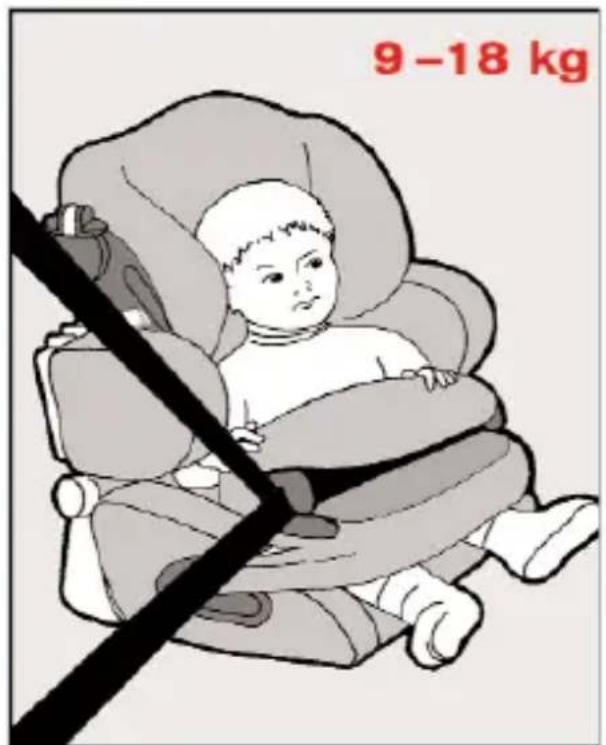
9-18 kgFig. A Fig. B
text_image
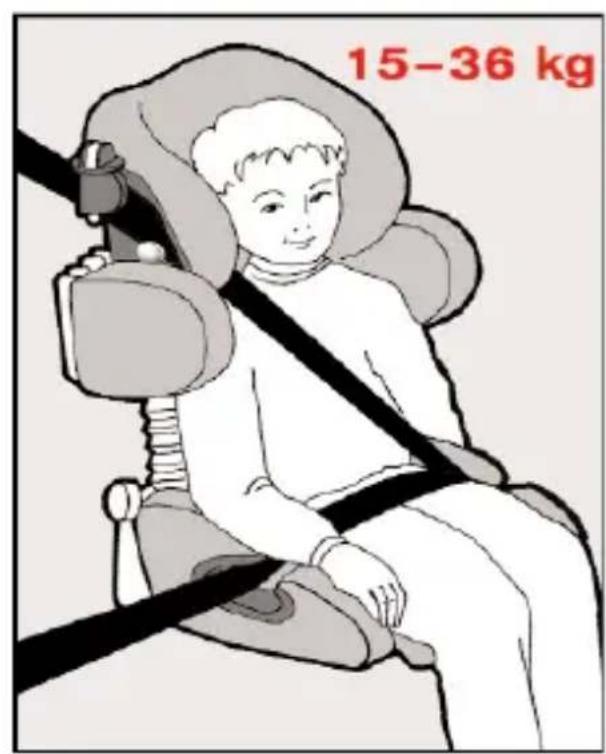
15-36 kgThe impact shield is provided for a body weight of 9 - 18 kg (approx. 9 months up to approx. 4 years). With the impact shield the permissible load limits (according to ECE-44-03) fall short by up to 80%.
For children with a body weight of approx. 9-13kg the seat cushion should also be used with the impact shield.
3. General safety instructions
Read the instruction manual carefully before fitting the child seat for the first time. Incorrect use can be life-threatening for your child. Always keep the directions for use in the pocket provided in the cover on the back rest. This way it is always at hand.
Many injuries are caused by carelessness and are easily avoidable.

The impact shield has to be used for children 9-18 kg (approx. 9 months to 4 years).

Only use the seat cushion with the impact shield and only for children with a body weight of 9-13 kg. Otherwise the seat position (protection) would be worsened in the event of an accident.

Never remove the seat extension. In the event of collision it offers effective protection against slipping through the lap belt or the impact shield.

Before every journey check whether the child restraint system is set optimally for the child's body size. Do not carry out any settings during the journey. Make sure that all parts are locked in place correctly.

Check the parts of the child restraint system regularly for wear and tear or other damage.

Make sure that no parts of the child restraint system are penned in the doors or adjustable seats.

With vans and caravans make sure that in the event of rescue operation by a third party the seat shell is preferably fitted to an easily accessible seat.

Only use the child restraint system for the given weight category up to a max. 36 kg.

The belt should never be loose. In the event of an accident the strains of bodily parts are much higher than with a tightened belt. Please see that the buckle is correctly positioned.

Never leave your child unattended in the child restraint system.

If you drive with no child in the child restraint system, always secure it with the adult belt.

Do not make any alterations whatsoever to the child restraint systems. The protective effect can be lost or restricted. If you experience difficulties please contact your specialist dealer or the manufacturer directly.

Protect the cushion from direct sun light as it could heat up and cause discomfort.

Allow your child breaks during longer journeys and ensure that your child does not get out of the vehicle and onto the road surface unattended. Always use the child locking device in car doors, if available.

Ensure that the child restraint system has been fitted in the vehicle according to these directions.

Do not continue to use the child restraint system if parts have been damaged or loosened after an accident (accident speed greater than 10 km/h) or through other effects.

In case of doubt and after any accident please consult your dealer.

Do not place any heavy objects on the rear shelf. This could be dangerous in the event of an accident.
4. Fitting into the vehicle
4.1 Choice of seat
Please read up on using child restraint systems in your vehicle manual or your authorised repair shop.
The child restraint system can be fitted on any seat in vehicles that have a 3-point belt system.
Position the vehicle seat so that the back rest of the child restraint system is on that of the vehicle seat.
If the fitting is hindered by a head support, this has to be set accordingly.
The child restraint system kiddy life pro can also be used on car seats facing backwards with 3-point belt.
4.2 Settings
4.2.1 Setting the back rest and the shoulder supports
The height is ideally set if the head is comfortable in the neck support and the diagonal belt rests on the middle of the shoulder.
The lowest position of the back rest (1st snap-on on the top) should not be used with kiddy life pro.
text_image
aFig. 1
Procedure:
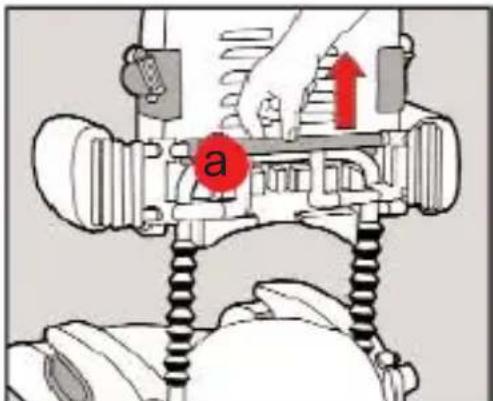
Open the cover on the reverse of the back rest. Pull the locking device (a) upwards from the shoulder support frame.
text_image
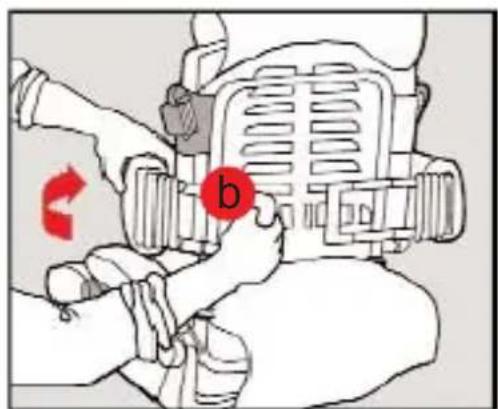
Diagram showing mechanical assembly with labeled component 'b' and red directional arrow indicating rotation or movementFig. 2
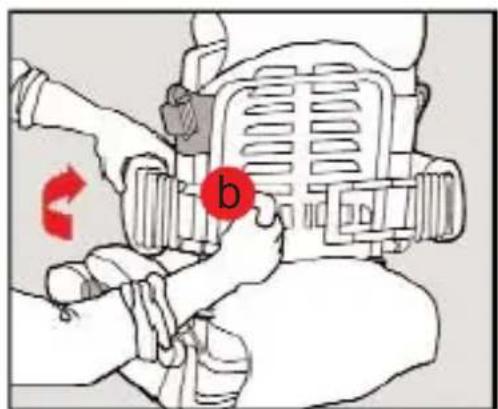
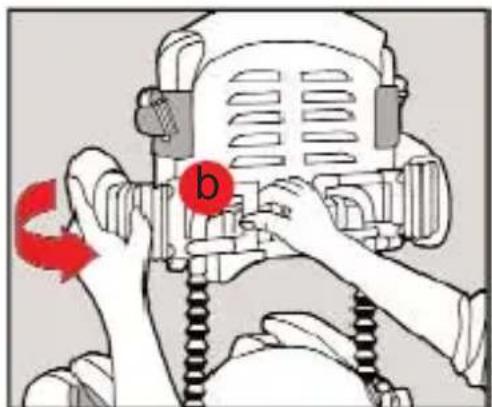
Pull the shoulder supports (b) from the fastenings in the back rest.
text_image
dFig. 3
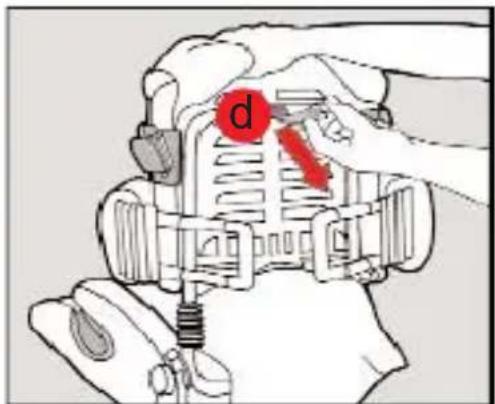
By using the straps pull the back rest frame (d) out of the fastening in the rest part.
natural_image
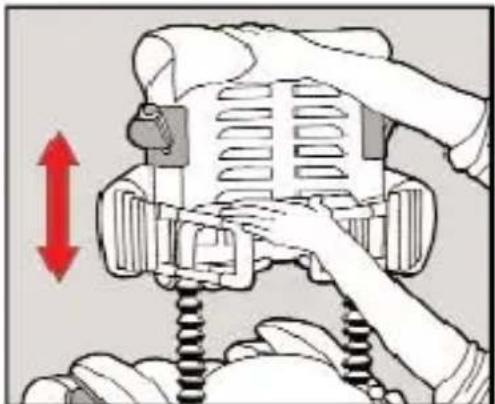
Illustration of a mechanical device with red directional arrows indicating movement or force (no text or symbols present)Fig. 4
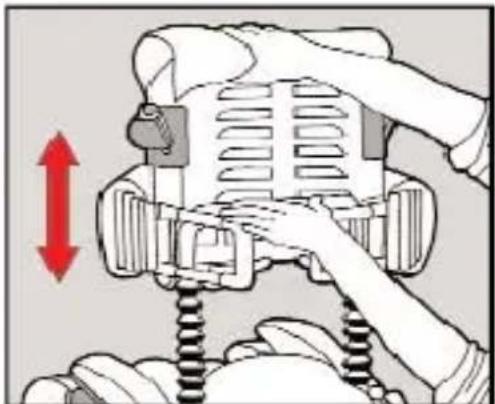
Position the height of the back rest according to the size of the child. Press the frame into the next fastening.
text_image
Diagram showing hands operating a device with labeled component 'b' and directional arrow indicating rotation or movement.Fig. 5
Now set the shoulder rests according to the shoulder width of your child. Push in the shoulder rest frame (b) in the next fastening.
text_image
a dFig. 6
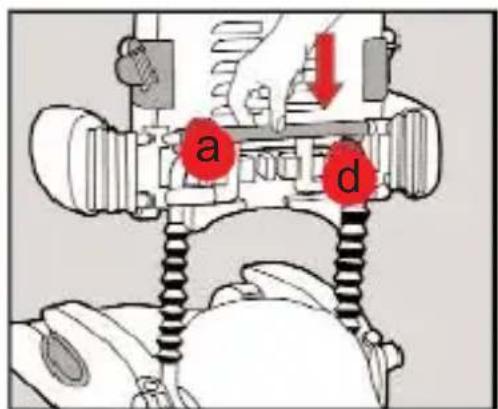
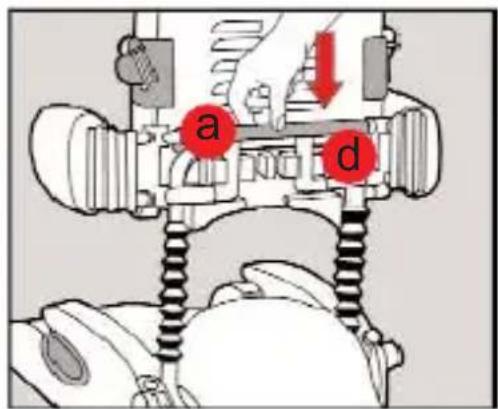
Press down the locking device (a) on the shoulder support frame (d).
Close the back cover again.

Note that the frame is completely locked in place in the rest part.
4.2.2 Setting the seat surface length (thigh rest)
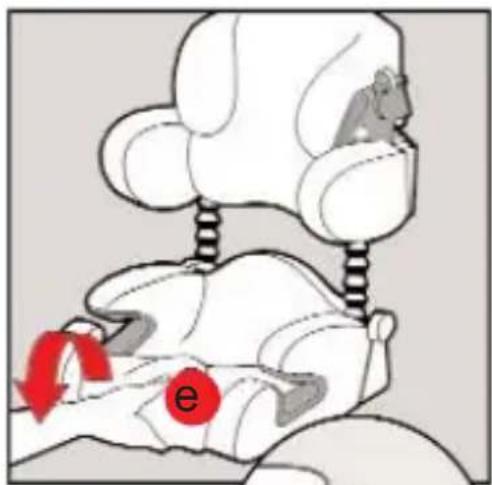
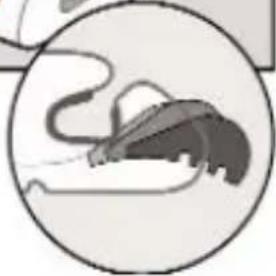
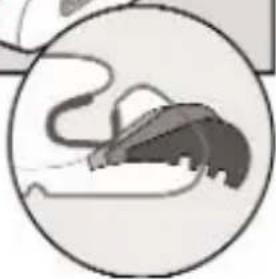
Bigger children will have significantly more seating comfort by pulling out the seat ramp (fig. 7). Under the seat ramp there are three ramp settings in the seat.
text_image
Medical diagram showing a hand performing a procedure with labeled point 'e' and red arrow indicating directionFig. 7
natural_image
Abstract circular diagram with curved lines and shaded regions, no text or symbols present-
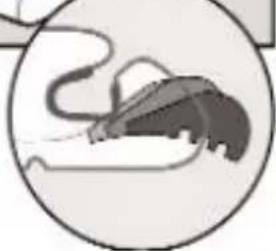
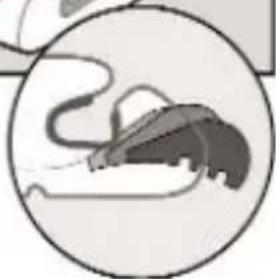
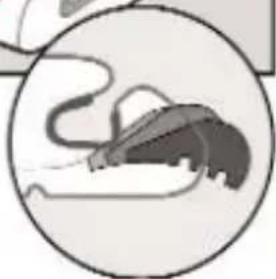
Tilt the seat ramp (e) approx. 3 – 5 cm upwards and pull forwards. The seat ramp can break where there is too much pressure! The seat ramp should not be removed.
-
Once you have your required seat length, press ramp (e) into the appropriate snap-on device. There are three positions possible.
4.2.3 Setting the lying down position
The lying down position should only be used for children with a body weight of up to 18 kg or for children up to 4 years of age.
- Pull the seat forwards.
- Turn the support frame as far backwards as possible so that it is on the back rest of the vehicle seat. It prevents the child restraint system from slipping back.
- To secure the child in the lying down position, please proceed as in item 5.1.
natural_image
Illustration of a car interior with a red circle highlighting a specific seat area (no text or symbols present)Fig. 8
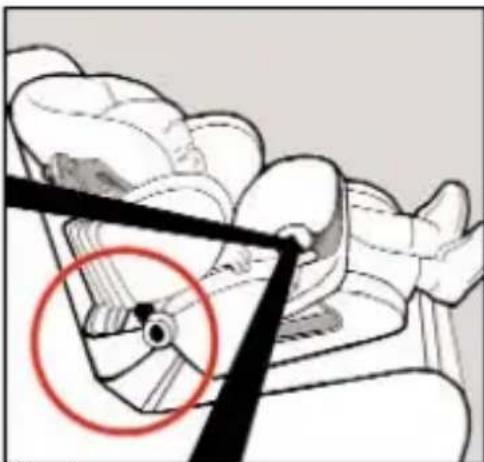
If during the journey the lying down position is set, the vehicle must be stopped and the child secured again.
5. Securing the child in the restraint system
5.1. Securing the child with the impact shield and vehicle's own 3-point belt
natural_image
Illustration of a car seatbelt with a hand inserting a key (no text or symbols)Fig. 9
The impact shield should only be used for children with a body weight of approx. 9 – 18 kg or from approx. 9 months to 4 years.
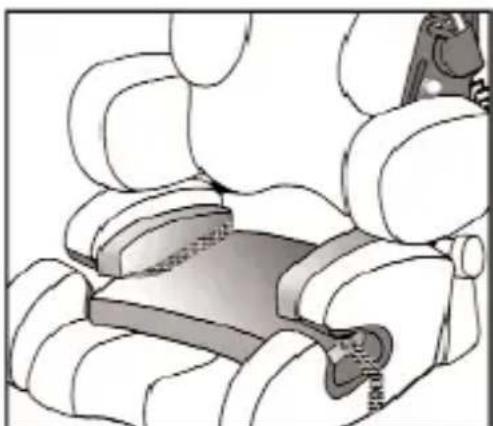
We recommend using the seat cushion for children with a body weight of 9 – 13 kg (approx. 9-18 months). The seat cushion is fastened with the rubber band on the child seat (fig. 9).
natural_image
Illustration of a person's seatbelt being lifted (no text or symbols)Fig. 10
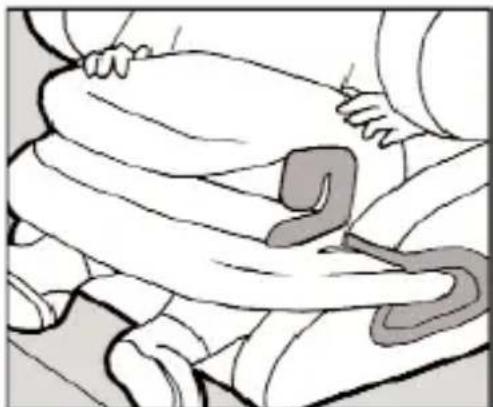
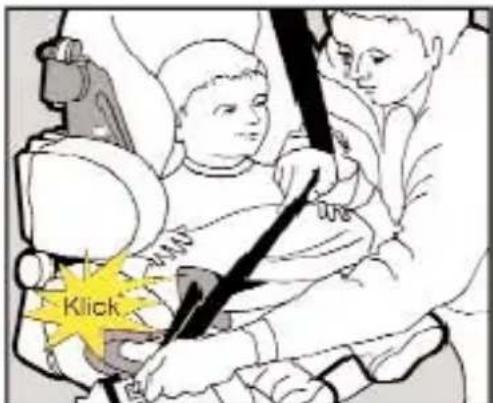
To enable the child better freedom of movement the shoulder rests should be brought into centre position (see item 4.2.1). Once the child is seated, insert the impact shield from both sides into the lap belt guide and push it up to the child.
text_image
KlickFig. 11
Pull the 3-point safety belt out and allow it to lock in place. The buckle will make a clickin noise. Feed the lap belt through the slots of both outer, red guides of the impact shield. Tighten the belt in the direction of the automatic roll-up.
natural_image
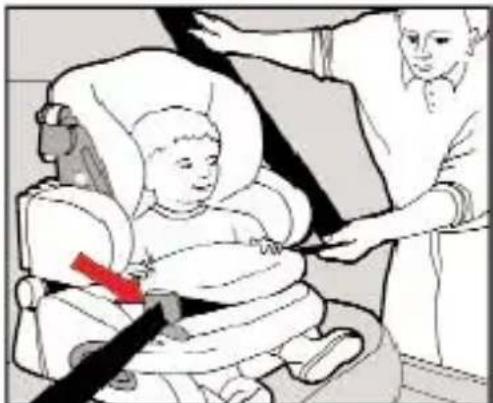
Illustration of a baby in a car seat being assisted by an adult, with a red arrow indicating the baby's seatbelt (no text or symbols present)Fig.12
Then feed the shoulder belt through the guides on the impact shield so that both belts lay on top of each other in the impact shield guides. Tighten the belt again.

When using the impact shield the diagonal belt is not fed through the belt guide channel into the head rest (see fig. A page 4)!
5.2. Securing the child with vehicle's own 3-point belt

Usage without the impact shield is not allowed until children have a body weight of at least 15-36 kg or are 4-12 years.
The red belt fastener on the headrest has to be opened.
Place your child in the child restraint system, pull the belt out and allow it to lock in place in the buckle so that you hear a clicking noise.
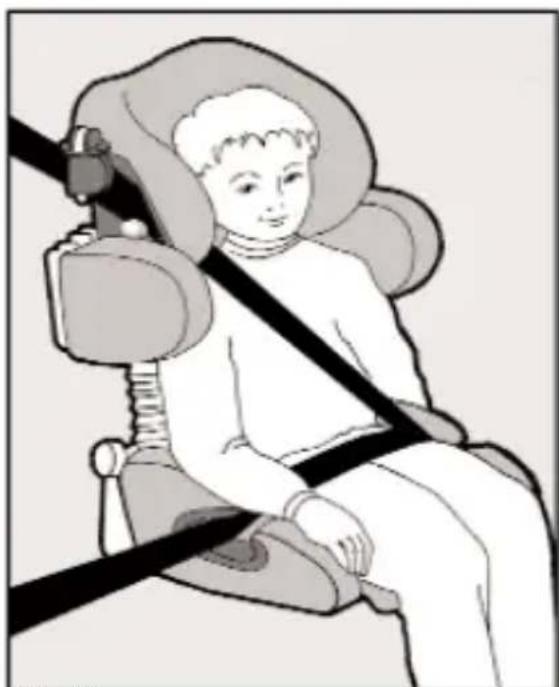
Place the lap belt in the bottom belt guides (marked red) of the seat and tighten them. The lap belt must lay flat over the thighs of your child. (fig. 13)!
Then place the shoulder belt in the red lap belt guide on the vehicle's buckle side.
Feed the shoulder belt diagonally over your child and insert it into the black belt guide channel and into the opened belt fastener located on the head rest.
natural_image
Illustration of a child seated in a car seat using a seatbelt device (no text or symbols visible)Fig. 13
Note that the shoulder belt is always over the metal button so that the belt cannot slip down.
The belts always have to be in the belt guides.
6. Care notes
6.1 Removing the cover
Great care is needed in removing the cover and replacing it. Please observe the following notes:
- Taking off the back rest cover: Loosen Velcro fasteners on the reverse of the back rest, pull the bottom cover part through the bottom of the back rest and forwards, then carefully remove the cover under the red belt guides up and forward.
- Taking off the seat cover: Open the loops in front and below the seat part, pull out the cover around the red belt guides, take the cover off.
- Take off the cover for seat extension: Carefully pull the cover of the seat surface extension from bottom to top.
- Take off the cover for shoulder supports: Loosen Velcro fasteners, peel back covers.
6.2 Replacing the cover
- Rest cover: Put the cover over the head supports, then pull over the rest, carefully push the cover underneath the red belt guides, close the Velcro fasteners on the back of the rest.
- Seat cover: Pull the cover over the seat and push underneath the read belt guides, pull the bands under the seat surface extension and tie up.
- Seat surface extension: Cover carefully
- Shoulder supports: Pull the cover over the shoulder supports, close Velcro fasteners.
6.3 Cleaning the cover
The covers are an essential part of the safety concept. Only use the original covers from the manufacturer. If you require replacement covers, you can order these from your dealer.
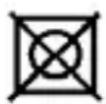
The cover is removable and washable at 30 degrees mild washing. Spin-drying and tumble-drying are not recommended.
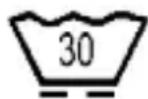
6.4 Cleaning the plastic parts
The plastic parts can be cleaned with a damp cloth. Do not use harsh cleaning products (e.g. solvent).
7. Procedure after an accident
After an accident resulting from a speed of over 10km, the child restraint system must be checked by the manufacturer for possible damage and if required, replaced.
8. Guarantee
For this child restraint system we offer a 2 year guarantee for manufacturing or material defects. The guarantee period commences on the day of purchase.
A sales receipt will be required for complaint.
The guarantee is limited to a child restraint system which has been handled appropriately and returned in clean and sound condition.
The guarantee shall not extend to:
- natural occurrences of wear and tear and damages caused by excessive strain.
- Damages through inappropriate or improper use.
Materials: All of our materials meet high standards regarding colour resistance against sunlight. Nevertheless all materials discolour when they are exposed to UV light. This will not be considered as a material defect, but normal wear and tear. No guarantee can be assumed in this case.
In the case of guarantee please contact your dealer directly.
Inhoud
text_image
Diagram showing a mechanical assembly with labeled component 'b' and directional arrow indicating rotation or movement.Afb. 2
natural_image
Illustration of hands adjusting a mechanical component with red directional arrows (no text or symbols)Afb. 4
natural_image
Illustration of a person lying on the floor with a red circle highlighting a specific area (no text or symbols present)Afb. 8
natural_image
Illustration of a car seat with a passenger seat and seatbelt, no text or symbols presentAfb. 9
natural_image
Illustration of a person's seatbelt being adjusted, showing bandage and grip (no text or symbols)Afb. 10
natural_image
Illustration of a baby in a baby car seat being assisted by an adult, with a red arrow indicating the baby's seatbelt (no text or symbols present)Afb.12
natural_image
Illustration of a child seated in a car seat using a seatbelt device (no text or symbols visible)Afb. 13
text_image
Diagram showing mechanical assembly with labeled component 'b' and red directional arrow indicating rotation or movementFig. 2
natural_image
Illustration of a mechanical device with red directional arrows indicating movement or force (no text or symbols present)Fig. 4
text_image
Diagram showing hands operating a device with labeled component 'b' and directional arrow indicating rotation or movement.Fig. 5
text_image
Medical diagram showing a surgical procedure with labeled anatomical point 'e' and red directional arrow indicating motion or force.Fig. 7
natural_image
Simple line drawing of a printer with a paper airplane inside a circle (no text or symbols)natural_image
Illustration of a car interior with a red circle highlighting a specific area, no text or symbols present.natural_image
Illustration of a car seatbelt with a passenger seat and passenger, no text or symbols presentFig. 9
natural_image
Illustration of a person adjusting a seatbelt (no text or symbols visible)Fig. 10
natural_image
Illustration of a baby in a car seat being assisted by an adult, with a red arrow indicating the baby's seatbelt (no text or symbols present)Fig.12
natural_image
Illustration of a child seated in a car seat using a seatbelt device (no text or symbols visible)Fig. 13
6.1 Retirez la housse
text_image
Technical diagram showing mechanical assembly with labeled component 'a' and directional arrows indicating movement or forceSkica 1
Postopek: Odpnite prevleko na zadnji strani opore za hrbet. Iz okvirja opore za ramena potegnite navzgor varovalo (a).
text_image
Diagram showing mechanical assembly with labeled component 'b' and red directional arrow indicating rotation or movementSkica 2
text_image
Diagram showing hands operating a mechanical component with labeled parts 'd' and directional arrows indicating movement or force.Skica 3
S pomočjo pasov potegnite okvir opore za hrbet (d) iz zaponke v opori.
natural_image
Illustration of a mechanical device with red directional arrows indicating movement or force (no text or symbols)Skica 4
text_image
Diagram showing hands operating a device with labeled component 'b' and directional arrow indicating rotation or movement.Skica 5
Nato ramenski opori prilagodite širini ramen vašega otroka.in okvir ramenskih opor (b) potisnite v naslednjo zaponko.
text_image
a dSkica 6
Pritisnite varovalo (a) na okvirju ramenske opore. Zapnite prevleko.

Pazite, da bo okvir popolnoma zataknjen v oporo.
text_image
Diagram illustrating a medical procedure with labeled anatomical features and directional arrows, including a red circle marked 'e'.Skica 7
natural_image
Illustration of a fish inside a circular frame (no text or symbols)natural_image
Illustration of a person lying on the floor with a magnified inset showing a red circle (no text or symbols)Skica 8
Če morate sedež poleči med vožnjo, potem obvezno ustavite vozilo in otroka ponovno pripnite.
natural_image
Illustration of a car seat with seats and a hand valve, no text or symbols presentSkica 9
natural_image
Illustration of a person adjusting a seatbelt (no text or symbols visible)Skica 10
natural_image
Illustration of a baby in a car seat being assisted by an adult, with a red arrow indicating the baby's seatbelt (no text or symbols present)Skica12
natural_image
Illustration of a child seated in a car seat using a seatbelt device (no text or symbols visible)Skica 13
text_image
Diagram showing a mechanical assembly with labeled component 'b' and directional arrow indicating rotation or movement.Afbildning 2
natural_image
Illustration of hands adjusting a mechanical component with red directional arrows (no text or symbols)Afbildning 4
text_image
Diagram illustrating a medical procedure with labeled components and directional arrows, including a red 'e' marker.Afbildning 7
natural_image
Simple line drawing of a fish inside a circular frame (no text or symbols)natural_image
Illustration of a car interior with a red circle highlighting a specific seat area (no text or symbols present)natural_image
Illustration of a car seatbelt with a hand inserting a plug into the seat (no text or symbols)Afbildning 9
natural_image
Illustration of a person adjusting a seatbelt, no text or symbols presentAfbildning 10
natural_image
Illustration of a baby in a car seat being assisted by an adult, with a red arrow indicating the baby's seatbelt (no text or symbols present)Afbildning12
natural_image
Illustration of a child seated in a car seat using a seatbelt device (no text or symbols visible)text_image
Technical diagram showing mechanical assembly with labeled component 'a' and directional arrows indicating movement or forceFig. 1
text_image
Diagram showing mechanical assembly with labeled component 'b' and red directional arrow indicating rotation or movementFig. 2
natural_image
Illustration of a mechanical device with red directional arrows indicating movement or force (no text or symbols present)Fig. 4
text_image
Diagram showing hands operating a device with labeled component 'b' and directional arrow indicating rotation or movement.Fig. 5
text_image
Diagram illustrating a medical procedure with labeled components and directional arrows, including a red 'e' marker.Fig. 7
natural_image
Simple line drawing of a fish inside a circular frame (no text or symbols)natural_image
Illustration of a person in a car seatbelt with a red circle highlighting the seat area (no text or symbols present)natural_image
Illustration of a car seatbelt with a passenger seat and seatbelt, no text or symbols presentFig. 9
natural_image
Illustration of a person adjusting a seatbelt (no text or symbols visible)Fig. 10
natural_image
Illustration of a baby in a car seat being assisted by an adult, with a red arrow indicating the baby's seatbelt (no text or symbols present)Fig.12
natural_image
Illustration of a child seated in a car seat using a seatbelt device (no text or symbols visible)Fig. 13
text_image
Diagram showing a mechanical assembly with labeled component 'b' and red circular arrow indicating rotation or movement.Rys. 2
natural_image
Illustration of hands adjusting a mechanical component with red directional arrows indicating movement (no text or symbols)Rys. 4
natural_image
Mechanical assembly diagram showing spring-loaded components and a hand holding a motor (no text or labels)Rys. 6
text_image
Diagram illustrating a medical procedure with labeled anatomical features and directional arrows, including a red circle marked 'e'.Rys. 7
natural_image
Simple line drawing of a bird perched on a branch inside a circular frame (no text or symbols)natural_image
Illustration of a car interior with a red circle highlighting a specific area, no text or symbols present.Rys. 8
natural_image
Illustration of a car seatbelt with a passenger seat and passenger inside (no text or symbols)Rys. 9
natural_image
Illustration of a person's seatbelt with hands adjusting the seat (no text or symbols)Rys. 10
natural_image
Illustration of a baby in a car seat being assisted by an adult, with a red arrow indicating the baby's seatbelt (no text or symbols present)Rys.12