
Squod SU - Electric scooter Vermeiren - Free user manual and instructions
Find the device manual for free Squod SU Vermeiren in PDF.

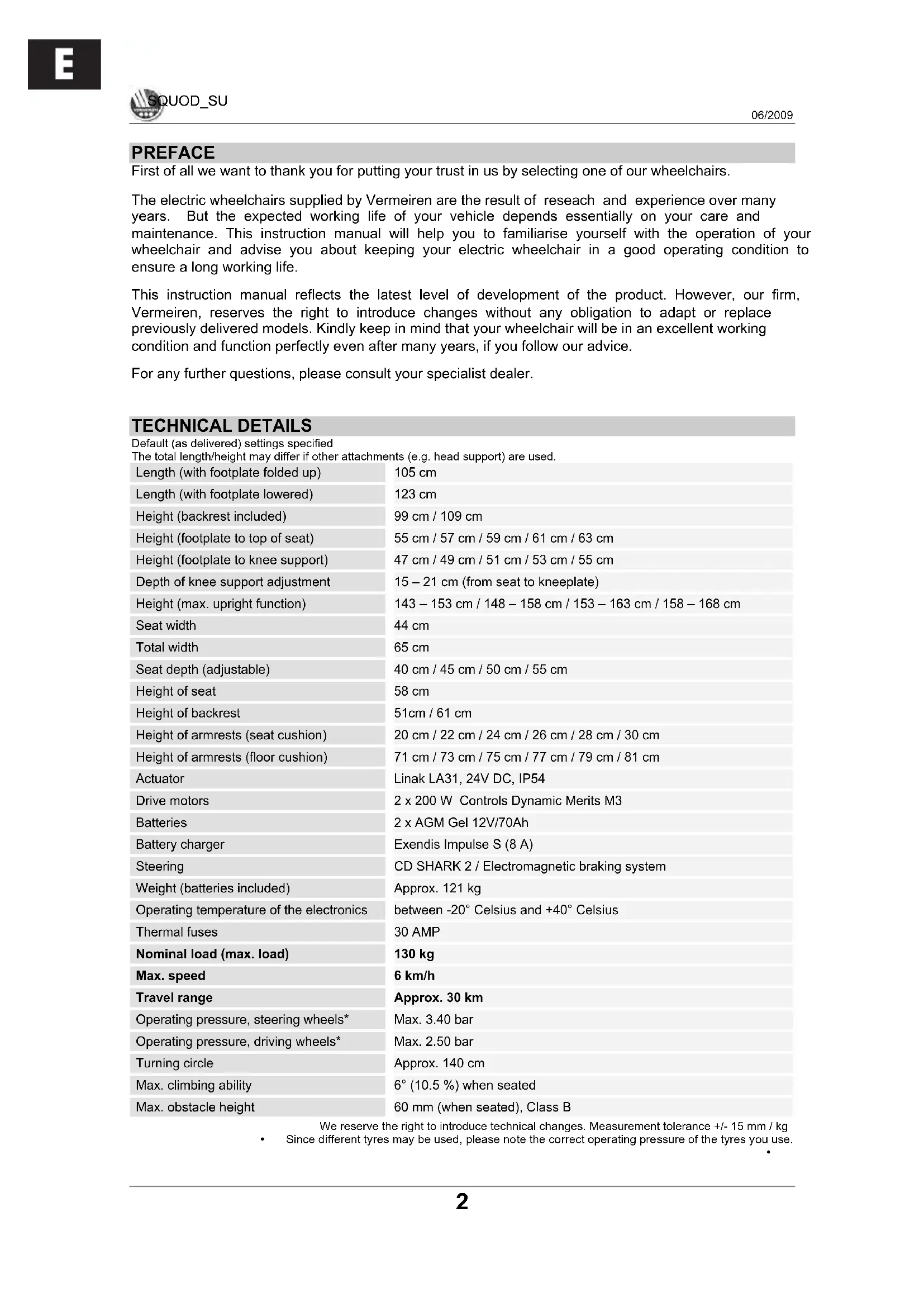


| Product type | Electric scooter with standing/raising function |
| Brand / Model | Vermeiren Squod SU |
| Length (footrest raised/lowered) | 105 cm / 123 cm |
| Backrest height (adjustable) | 99 cm / 109 cm |
| Seat width | 44 cm |
| Total width | 65 cm |
| Seat depth (adjustable) | 40 - 55 cm (4 positions) |
| Seat height | 58 cm |
| Total weight (including batteries) | approx. 121 kg |
| Maximum payload | 130 kg |
| Maximum speed | 6 km/h |
| Range | approx. 30 km |
| Maximum gradient (seated) | 10.5 % |
| Maximum obstacle height (seated) | 60 mm (class B) |
| Turning radius | approx. 140 cm |
| Motors | 2 x 200 W (Controls Dynamic Merits M3) |
| Batteries | 2 x AGM Gel 12 V / 70 Ah |
| Charger | Exendis Impulse S (8 A) |
| Control | CD SHARK 2 with joystick |
| Brakes | Electromagnetic + mechanical parking brakes |
| Steering / drive tires | 260x85 (pneumatic) / 3.00-8 (pneumatic) |
| Steering / drive tire pressure | max. 3.40 bar / max. 2.50 bar |
| Standing/raising function | Yes, electric, indoors only and with assistance |
| Safety equipment | Anti-tilt protection, chest strap, knee support, optional belt |
| Operating temperature | -20 °C to +40 °C |
| Warranty | 24 months (except normal wear) |
| Standards | 93/42/EEC, EN 12182, EN12184 |
Frequently Asked Questions - Squod SU Vermeiren
User questions about Squod SU Vermeiren
0 question about this device. Answer the ones you know or ask your own.
Ask a new question about this device
Download the instructions for your Electric scooter in PDF format for free! Find your manual Squod SU - Vermeiren and take your electronic device back in hand. On this page are published all the documents necessary for the use of your device. Squod SU by Vermeiren.
USER MANUAL Squod SU Vermeiren
This instruction manual is part and parcel of the product and it should accompany each product delivered.
Last updated: 06/2009
All rights reserved, including translation.
No part of this manual may be reproduced in any form whatsoever (print, photocopy, microfilm or any other process) without written permission of the publisher, or processed, duplicated, or distributed by using electronic systems.
N.V. Vermeiren N.V., 2009
Contents of the consignment 3
Explanation of symbols 4
Operating elements 4
SHARK 2 controls 4
Adjusting the steering unit. 5
Back 6
Adjusting the depth of the seat 6
Leg support 7
Knee protector 7
Armrests 8
Chest belt 8
Standing/upright function 9
Battery charger 10
Charging the batteries 10
Batteries 11
Connecting the batteries 11
Battery storage 12
Connecting the system 12
Thermal fuses 12
Parking brakes 12
Tyres 13
Changing the tyres 14
Pushing the wheelchair 16
Transporting the wheelchair 17
Using ramps 17
Accessories 17
- Individual headrest (L55) 17
Supporting system for persons (B58) 18
Prevention of tipping over (B78) 18
Torso supports (L04) 18
For your safety 19
Making regular checks 20
Inspection 20
Tools 21
Care 21
Storage 21
Disinfection 22
Guarantee 23
Conformity 24
Disposal 24
SHARK 2 displays. 24
Error codes 24
PREFACE
First of all we want to thank you for putting your trust in us by selecting one of our wheelchairs.
The electric wheelchairs supplied by Vermeiren are the result of research and experience over many years. But the expected working life of your vehicle depends essentially on your care and maintenance. This instruction manual will help you to familiarise yourself with the operation of your wheelchair and advise you about keeping your electric wheelchair in a good operating condition to ensure a long working life.
This instruction manual reflects the latest level of development of the product. However, our firm, Vermeiren, reserves the right to introduce changes without any obligation to adapt or replace previously delivered models. Kindly keep in mind that your wheelchair will be in an excellent working condition and function perfectly even after many years, if you follow our advice.
For any further questions, please consult your specialist dealer.
TECHNICAL DETAILS
Default (as delivered) settings specified
The total length/height may differ if other attachments (e.g. head support) are used.
| Length (with footplate folded up) | 105 cm |
| Length (with footplate lowered) | 123 cm |
| Height (backrest included) | 99 cm / 109 cm |
| Height (footplate to top of seat) | 55 cm / 57 cm / 59 cm / 61 cm / 63 cm |
| Height (footplate to knee support) | 47 cm / 49 cm / 51 cm / 53 cm / 55 cm |
| Depth of knee support adjustment | 15 – 21 cm (from seat to kneeplate) |
| Height (max. upright function) | 143 – 153 cm / 148 – 158 cm / 153 – 163 cm / 158 – 168 cm |
| Seat width | 44 cm |
| Total width | 65 cm |
| Seat depth (adjustable) | 40 cm / 45 cm / 50 cm / 55 cm |
| Height of seat | 58 cm |
| Height of backrest | 51cm / 61 cm |
| Height of armrests (seat cushion) | 20 cm / 22 cm / 24 cm / 26 cm / 28 cm / 30 cm |
| Height of armrests (floor cushion) | 71 cm / 73 cm / 75 cm / 77 cm / 79 cm / 81 cm |
| Actuator | Linak LA31, 24V DC, IP54 |
| Drive motors | 2 x 200 W Controls Dynamic Merits M3 |
| Batteries | 2 x AGM Gel 12V/70Ah |
| Battery charger | Exendis Impulse S (8 A) |
| Steering | CD SHARK 2 / Electromagnetic braking system |
| Weight (batteries included) | Approx. 121 kg |
| Operating temperature of the electronics | between -20° Celsius and +40° Celsius |
| Thermal fuses | 30 AMP |
| Nominal load (max. load) | 130 kg |
| Max. speed | 6 km/h |
| Travel range | Approx. 30 km |
| Operating pressure, steering wheels* | Max. 3.40 bar |
| Operating pressure, driving wheels* | Max. 2.50 bar |
| Turning circle | Approx. 140 cm |
| Max. climbing ability | 6° (10.5 %) when seated |
| Max. obstacle height | 60 mm (when seated), Class B |
We reserve the right to introduce technical changes. Measurement tolerance +/- 15 mm / kg
Since different tyres may be used, please note the correct operating pressure of the tyres you use.
GENERAL NOTES
The SQUOD SU electric wheelchair is equipped with two 200 watt motors. It has been designed for mixed usage, both inside and outside, and its standing/upright function makes it ideal for use on indoor, level flooring.
When using your electric wheelchair on footpaths, you should comply with any applicable laws. It may not be used on the public highway. Since the SQUOD SU has a top speed of six km/h, you do not require a driving licence and neither is vehicle insurance necessary. However, we recommend that you take out voluntary third-party insurance. Kindly contact your insurer.
The electronics must be switched off immediately after use of the wheelchair. To charge the batteries, you should only use the battery charger supplied.
We wish to point out that electromagnetic sources (e.g. mobile phones, etc.) can cause interference and that the wheelchair's electronics can also affect other electric appliances.
Even if you have been instructed by your dealer about the operational elements of your electric wheelchair and their use, we recommend that you read the following pages carefully.
APPLICABILITY
The equipment and accessories enable usage in cases where walking is impossible due to
- Paralysis
- Loss of limbs (leg amputation)
- Limb defects / deformation
- Stiff or damaged joints
- Heart problems, poor circulation, balance disorders or cachexia, and old age.
When considering individual requirements
- body size and weight
- physical and psychological condition
- domestic and environmental conditions
should also be taken into consideration.
Your wheelchair should only be used when all four wheels are in contact with the surface. Specific training should be provided to cope with uneven surfaces (cobblestones, etc.), gradients and bends (swerving sideways, etc.). A particular risk is involved when crossing surfaces such as ice, grass, rubble, foliage, etc. The wheelchair should not be used as a seat in a motor vehicle.
The standing/upright function should only be used indoors for therapeutic purposes and in the presence of a second person. The reduced mobility properties then only serve to straighten the product. The drive mode should not be used, either indoors or out, if the standing or upright function is selected. Obstacles cannot be surmounted if the standing/upright function is selected. If you nonetheless select drive mode when the standing/upright function is selected, it is at your own risk.
Guarantees can only be honoured when the product is used under the specified conditions and for the intended purposes.
CONTENTS OF THE CONSIGNMENT
- The frame structure including the motors, the seat, and the back unit (electrically adjustable standing function)
- Footplate (incl. knee/leg protector)
- 2 x batteries incl. 4 carry handles and charger
- Chest belt
Tip protector - Steering electronics
- Tools (Allen keys)
- Instruction manual
Please note that the basic configuration may differ in different European countries. Kindly contact your dealer.
EXPLANATION OF THE SYMBOLS

ave the safety instructions!

the instruction manual before use!

on: Parking brakes activated (electronic driving possible).

free running, be careful with slopes and inclinations

rate recovery and recycling of electric and electronic devices.
The electric wheelchair is delivered fully assembled. Your dealer delivers the wheelchair fully assembled and explains the various operating elements and their use. However, for your own safety we provide a further, detailed explanation of the different parts.
SHARK 2 CONTROLS
The control unit built into your electric wheelchair enables you to manage all the vehicle's driving, steering, braking and operating procedures. The wheelchair's electrical unit and electronics are constantly being monitored internally. Any fault in the electronics is indicated on the steering unit and, if necessary, the wheelchair is switched off for reasons of safety (see the "Error codes" section).
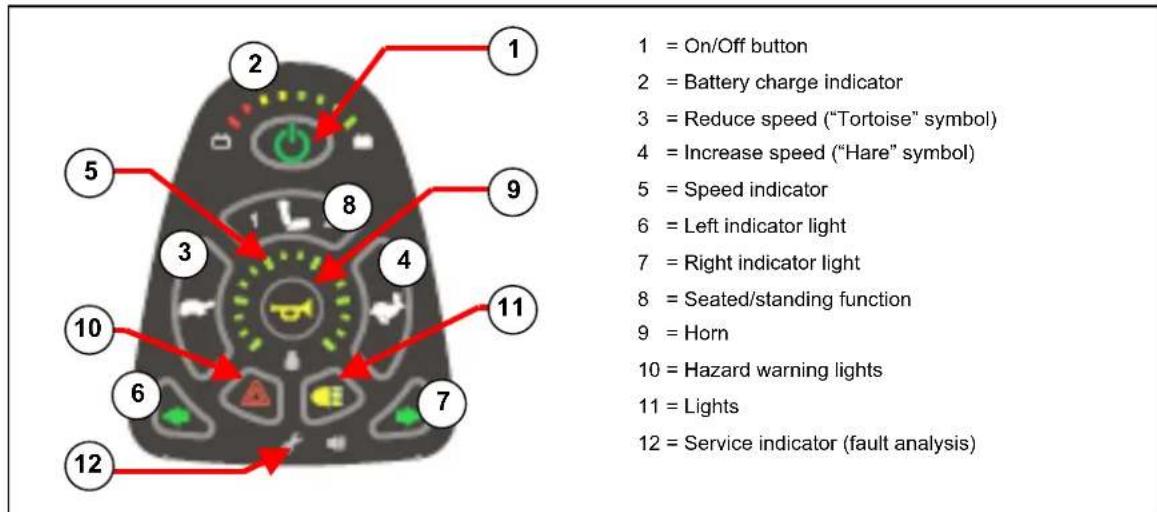
Press the "ON/OFF" button (1). The charge indicator (2), which also indicates the batteries' charge level, lights up for a moment. If all the lights come on, the batteries are sufficiently charged. If the lights do not all come on, you must adjust your driving activities to suit the low capacity of the batteries. If the battery charger display lights do not come on, check the plug connections of the electronic system.
Now select the driving program you want by pressing the "Tortoise" (3) or "Hare" (4) buttons.
The selected speed can be set on the 5-level speed indicator (5). If you have any special needs, you can ask your dealer to enter a personalised driving program.
To set the wheelchair in motion, push the joystick forwards slowly. The speed will increase when you push the joystick further forwards. If you want to turn left or right, simply push the joystick in the desired direction. To reverse, pull the joystick backwards from the central position.

Note that, when pressing the "ON/OFF" button, the joystick stays in the central position for at least two seconds. It is programmed this way for technical and safety reasons, to prevent the joystick being pushed at the same time as the wheelchair is being switched on. If both processes are activated at the same time, the steering unit locks itself and can only become operational again after being switched off completely.
Press the "Left indicator" (6) or "Right indicator" buttons to signal a change in your driving direction. The driving lights are switched on or off by pressing the "Lights" (11) button. You can sound an acoustic warning signal with the "Horn" (9) button. The hazard warning lights, used in critical situations, can be switched on or off by pressing the "Hazard warning lights" (10) button.
To brake while driving, simply push the joystick to its central position. Move the joystick slowly for gradual braking. Simply release the lever for a quick stop; the wheelchair will then stop as quickly as possible.
To work the actuator for the standing/upright function, select button 8 and you can use the joystick to move standing/upright function in the direction you want.

Only use the standing/upright function in the presence of another person.

Only use the standing/upright function if your legs and upper body have been secured beforehand (see the "Chest belt" and "Leg support" sections).
CONNECTIONS FOR CHARGER / PROGRAMMING UNIT
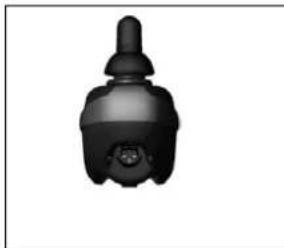
The socket for connecting the charger supplied is located on the front of the control unit. Here, too, is the connection for the programming unit, which should only be connected and used by authorised persons who have been trained to program it.

Altering the drive parameters can adversely affect the wheelchair's safety characteristics.

Make sure that all plugs (battery charger and programming unit) are removed before setting the wheelchair in motion.

Make sure that the steering lever is in the neutral (central) position when pressing the on/off button, otherwise the electronics will be blocked. This block can be lifted by switching the control unit off and then on again.

Always adapt your speed to the prevailing environmental conditions.
If you wish to protect your wheelchair from unauthorised access, press the ON/OFF button (1) for longer than two seconds when switching it off, and the control unit will lock. To unlock it, switch the control unit on. For 10 seconds a progress indicator will appear in the load indicator. If you press the horn (9) twice while this progress indicator is showing, the drive electronics will be unlocked and made operational.
ADJUSTING THE STEERING UNIT
The steering unit's horizontal position can be changed by loosening screw (1). The unit can then be adjusted as desired, or removed. Screw (1) must then be retightened properly. If screw (1) is pulled to the side, the steering unit can be turned to the side.
NOTE: Depending on the features of your wheelchair, screw (1) could also be located beneath the guide tube (2).
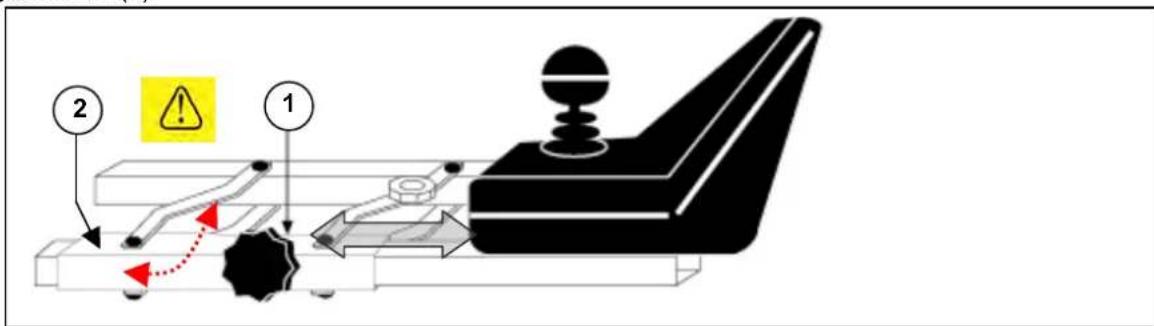

When moving the control unit to one side, ensure that no objects or body parts are within the range of adjustment, as there is risk that they could get caught!
BACK
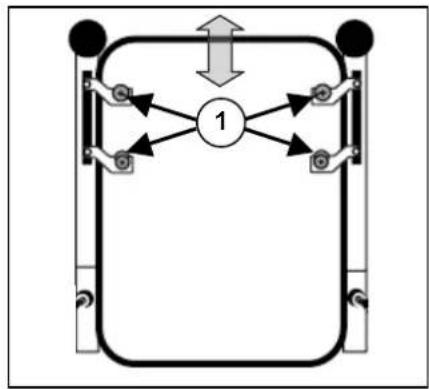
The fixed back section is designed to be detachable. Loosen the screws (1) and lift the cushioned back section up and out of the retainers. To put it back in, place the back section between the rear tubes in such a way that the back retainers (1) are replaced into the retainers. Tighten these retainers back up manually.
Before using, check that the back is properly fixed to the back tubing (1). If it is loose, retighten the safety screws (1) which secure the back to the back tubing.

Before using the wheelchair, check that the fixing screws (1) are properly tightened, otherwise the back might come loose, damage the chair and hurt the user.

Make sure that no extra loads are hung from the back (e.g. rucksack, etc.) which might increase the danger of tipping over backwards.
If the functioning of the back or some of its components has deteriorated because of wear and tear or other causes, kindly consult your dealer. He/she shall gladly assist you further.
ADJUSTING THE DEPTH OF THE SEAT
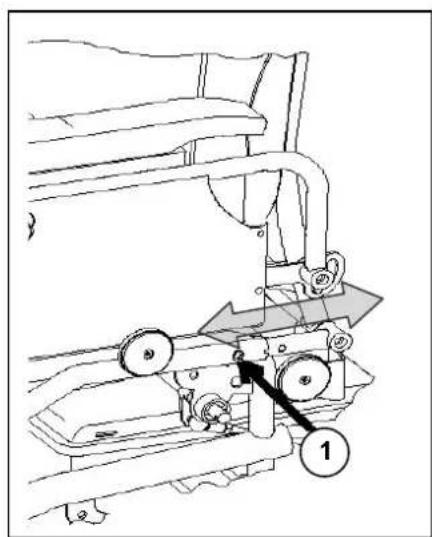
The seat depth is adjusted by pushing the rear frame into different positions. To do this, loosen the screw (1) on either side of the frame and pull the rear frame out or in until it is in the position you want, and until the relevant holes lie above one another so that the fixing screws (1) can be inserted through the frame. Hand-tighten the screws back up with the nuts you previously loosened.

The seat depth should never be changed when the user is sitting in the wheelchair.

Before using the wheelchair, check that the fixing screws (1) on either side of the frame are properly tightened, otherwise the back might come loose, damage the chair and hurt the user.
LEG SUPPORT
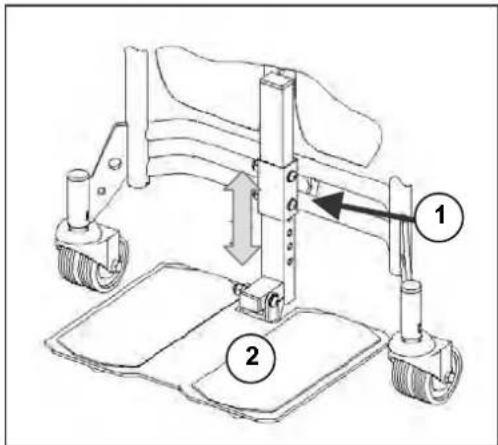
The leg support consists of a one-piece footplate whose height can be adjusted.
Loosen the screw connections (1) and pull the screws all the way out of the bracket. Move the footplate to the position you want and re-tighten it again with the screws (1).
Make sure that the leg support is tightly screwed before use.
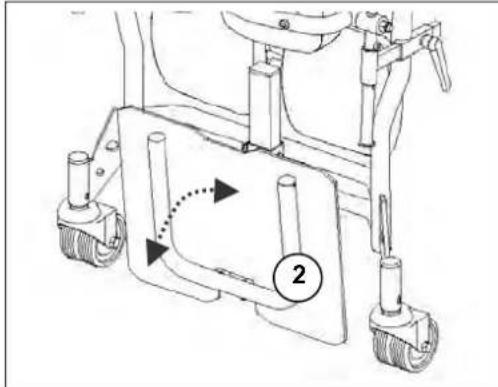
The footplate (2) can be folded upwards and downwards.
Never grasp the wheelchair by the leg support in order to move it. Only grasp fixed parts of the frame (see also the section "For your safety").
Make sure that the footplate is at least 6 cm above the ground to avoid scraping the ground when moving. This could damage the wheelchair and endanger its operational safety. The patient could also get hurt.

Get an authorised person to adjust the leg support.
KNEE PROTECTOR
The knee protector should always be used for the standing/upright function.
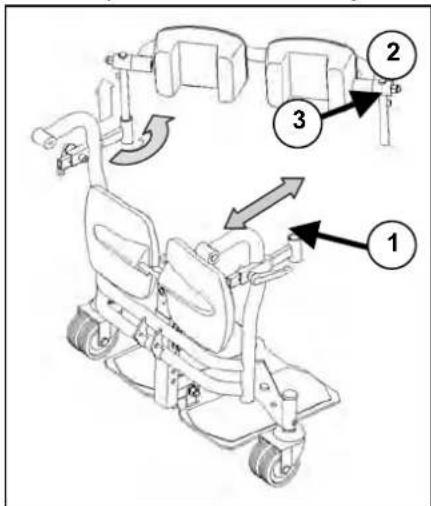
Loosen the T-screws (1) on either side of the leg support and pull out the retainer they secure as far as you can.
Put the leg bracket (2) with the knee pads with their vertical struts on either side into the retainers provided.

The mountings and knee pads are movable, and they only fix in place when they are screwed tight and there is counter-pressure on the legs/knees.
Now press the leg bracket (2) against the patient's legs in such a way that the knee pads are pressed beneath the kneecaps.

Do not restrict the knees' range of movement!
There are screws in the vertical mountings (3) that you can use to adjust the height of the leg bracket.
When the leg bracket is in the position you want, re-tighten the leg/knee bracket with the T-screws (1).
ARMRESTS
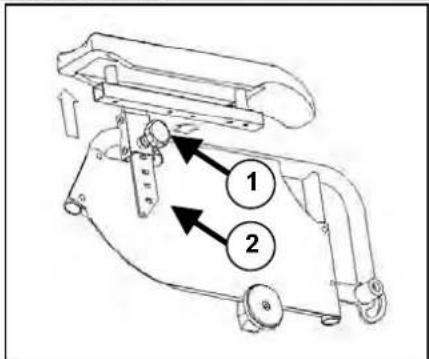
The height of the arm rests can be adjusted and they can also be detached (e.g. so that the patient can be moved sideways). Loosen the adjustable screw (1) a little and then pull it out. The armrest can now be put into the position you want. The adjustable screw (1) must then be replaced in one of the holes in the plate (2) and hand-tightened.
Make sure that all fixing screws are properly tightened before using the wheelchair, otherwise injury and/or damage can be caused.
The armrests can be folded back for therapeutic purposes and to move the patient from the wheelchair.
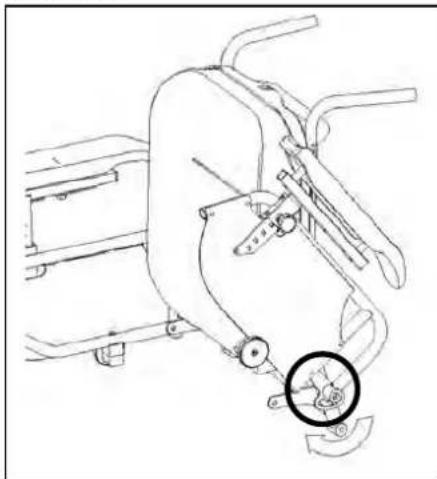
Raise the armrests and fold them back if they are not needed when the patient is being moved from the wheelchair or for therapeutic purposes.
The armrests may only be folded back when there is no chance of the wheelchair user falling out sideways.
The screws on the folding mechanism (see circle) must always be fastened tightly enough so that the armrest cannot fall back down accidentally.
To avoid endangering your safety, do not use the wheelchair if you see that the mountings have changed, been damaged, or have worn out.

If you make any changes to the armrests and/or the armrest retainers, you do so entirely at your own risk. Your guarantee will be voided.

When you are folding down the armrests, ensure that no objects or body parts come within the range that the armrest is swinging, as this could cause damage or injury.

If you notice changes, damage, or wear to the mountains, please contact your dealer, who can remedy these defects.
CHEST BELT
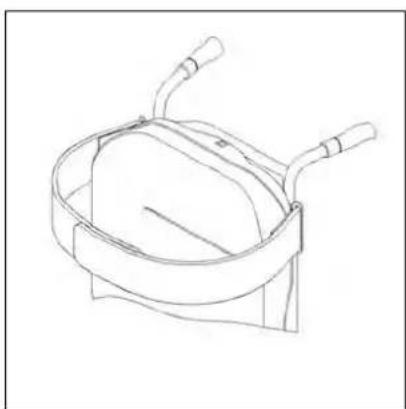
A chest belt is attached to the upper part of the back section to secure the user during the standing/upright function. Place the chest belt straps on top of one another and press them tightly. The chest belt is made secure by an adhesive system.

Attach the chest belt in such a way that the upper body is pressed against the back section so that the upper body cannot move involuntarily.

The chest belt should not restrain the user's arms.

As using the chest belt can restrict breathing, the patient must agree to the use of the chest belt.
STANDING/UPRIGHT FUNCTION
To use the standing/upright function, you must always ensure beforehand that the legs are made secure with the knee brackets and the upper body likewise with the chest belt (see descriptions in the relevant sections, "Leg support" and "Chest belt").
The standing/upright function must only ever be used when another person is supervising.
The standing/upright function may not be used without the chest belt and knee protector being secured - this would be done at your own risk.
The manufacturer accepts no liability for use of the standing/upright function without the chest belt and knee protector.
A
The standing/upright function may only be used if all four of the wheelchair's wheels are in contact with a level surface (and while being used on the two front wheels).
A
Make sure that no objects, persons or body parts are inside the movement range of the upright function, since this could cause damage or injury.
Ensure that the steering cables do not get caught during the upright function, as this could damage the product.
Follow this sequence when using the standing/upright function:
- Adjust to the position you want.
- Ensure that the wheelchair is stable. If necessary move it to the position you want.
- Switch off the drive electronics.
- Deploy the knee protector (or have it deployed for you).
- Check that the feet are resting flat on the footplate.
- Deploy the chest belt (or have it deployed for you).
- Check whether the arm rests are folded down.
- Switch on the drive electronics and select the adjust function for the upright function.
- Pull the joystick backwards or push it forwards to carry out the relevant function.
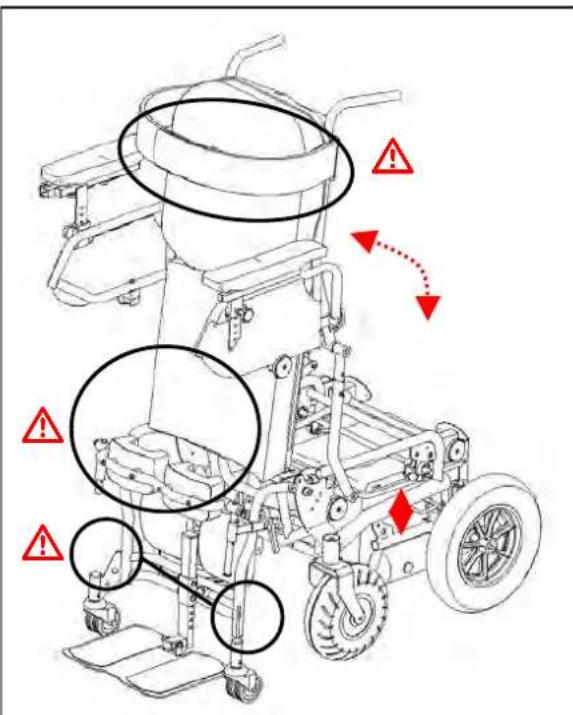
Bear in mind that, when the upright function is in use, the wheelchair rests on the front rollers beneath the footplate and the steering wheels (200x85) lift about 1 cm from the ground. To change direction, the wheelchair is then moved using the rollers and the drive wheels. There is only limited drive functionality.

Only loosen the chest belt and the knee protector again when the wheelchair has been returned to the seated position.

The standing/upright function must only ever be used when another person is supervising

The standing/upright function may not be used without the chest belt and knee protector being secured - this would be done at your own risk.
A
The manufacturer accepts no liability for use of the standing/upright function without the chest belt and knee protector.
A
The standing/upright function may only be used if all four of the wheelchair's wheels are in contact with a level surface (and while being used on the two front wheels).

Make sure that no objects, persons or body parts are inside the movement range of the upright function, since this could cause damage or injury.
BATTERY CHARGER
| To charge the batteries, only use the battery charger supplied - IMPULSE S (8 A). | |
| Primary voltage | 230 Vac – 50/60 Hz – single phase |
| Secondary nominal voltage | 24 V |
| Secondary maximum voltage | 35 V |
| Secondary power | max. 8 A |
| Battery type | Lead-sulphuric acid: gel |
| Battery capacity | 60 Ah – 85 Ah (80% capacity charged within 8 hours) |
| Safeguards | Protected against reverse polarisation, electrical surges and extreme temperature |
| Nominal output | 270 W |
| Efficiency | min. 80% (when fully loaded) |
| Ambient temperature | 0°C to +40°C |
| Unit dimensions | H 70 x W 150 x D 200 mm |
| Protection range | IP 21, Protection Class II |
| Total weight | Approx. 1.3 kg |
| Mains cable length | 1.9 m |
| Charge cable length | 2.4 m |
| Ambient storage temperature | -15°C to +50°C |
| Relative storage humidity | max. 95% (non-condensing) |
| Conformity | EMC Directive 89/336/EEC Low Voltage Directive 73/23/EEC |
We reserve the right to introduce technical changes.
CHARGING THE BATTERIES
As the IMPULSE S (8 A) charger aligns the charge curve with the AGM batteries' charge level, you can recharge your wheelchair after each use. This avoids any aggressive battery charging and the "memory effect".
Recharge the wheelchair, at the latest, when the charge indicator on the steering unit goes into the red zone. If, despite this, you continue driving, eventually only the last red diode lights up and flashes continually, indicating that the batteries are nearly flat. If you disregard this warning signal, too, an error message will shortly appear indicating that the batteries can no longer provide power for driving. The batteries should therefore be charged before these error messages appear, using the supplied battery charger IMPULSE S (8 A). Avoid the batteries becoming drained, in any case.
- SETTING UP THE CHARGER
When setting up the charger, ensure that it is well-ventilated on all sides. A minimum of 10cm space should be left free around the unit for this purpose. If the charger is insufficiently ventilated so that the unit heats up, the charging rate will fall which will extend the charging time. If the charger overheats (> +50^) , it will stop charging.
The charger should only be used from a wall socket with a voltage of 230V - 50 / 60Hz and in wellventilated, dry areas.
FIRSTUSE
First put the plug into the wall socket. After an LED combination has lit up, the charger switches to STANDBY. Both LEDs (green and yellow) are active.
Next, connect the charger cable with the three-pin plug to the loader socket on the electric wheelchair's steering unit. Once connected to the batteries, the charger automatically begins charging. Now only the yellow LED is active.
When charging is complete, the yellow LED goes out and the green LED comes on. Now remove the charger cable from the steering unit. The charger switches back to STAND-BY mode (yellow and green LEDs active).
If the charger cable is not removed, a tiny current will keep the batteries topped up (trickle charging).

When charging is complete, always remove the plug from the steering unit first and only then the mains plug from the wall socket.
- CHARGER DISPLAYS
| Yellow LED | Green LED | |
| Charger switched off (not plugged into the mains) | ○ | ○ |
| Charger has just been switched on and displays the charging characteristic that has been set | ◎ | ○ |
| ○ | ◎ | |
| Stand-by | ● | ● |
| Charging | ● | ○ |
| Full | ○ | ● |
| Fault | ◎ | ◎ |
O = Off = On (20 = Flashing

If the batteries are not used for an appreciable period, they discharge slowly by themselves (drainage). Then it becomes impossible to recharge them with the battery charger supplied. So charge the batteries at least once a month even if they are not being used.

Only use the battery charger supplied to charge the batteries.

The manufacturer accepts no liability for damage caused by improper charging.

Never interrupt the loading cycle. The charger shows when the charging cycle is finished. (green LED remains active).
For further information, please refer to the user instructions provided with the charger.
BATTERIES
The standard for your electric wheelchair is two closed, 12V/70Ah AGM batteries. The batteries used with your electric wheelchair are drive batteries which only attain full capacity after a few charging and use cycles.
If the batteries lose their power after long usage, or if they are damaged, get them both replaced by a specialist dealer only.

We accept no liability for damage caused through using other types of battery.

Do not use the batteries at temperatures below +5^ or above +50^ (the ideal is: +20^ ).

If the batteries are opened, all manufacturer liability and all claims will become void.
BATTERY CONNECTIONS
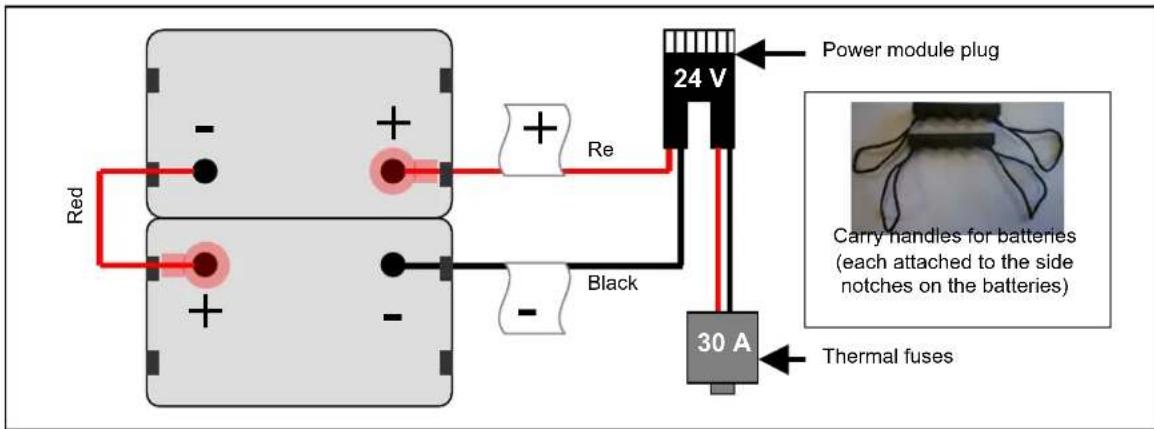
BATTERY STORAGE
If you no longer use your wheelchair, you can leave it connected to the battery charger. Charging is automatically controlled by the battery charger. If you remove and store the batteries, kindly note the following:
- Remove the cable clamps from the poles of the battery.
- The positive pole must be covered by at least one pole cap.
- Only grasp the batteries by two opposite sides of the unit.
Make sure that no objects make contact with both poles during storage (danger of short circuits!). - Batteries should only be stored in dry, well-ventilated spaces at a temperature between 0^ and +40^ .
- Keep the batteries in the battery boxes for protection against damp or other external influences.
- Protect the plugs and sockets of the battery boxes against corrosion.
- Protect the batteries against drainage (see "Charging the batteries" section).

If batteries are not used, they can completely drain.
If you have further questions, consult your dealer who will gladly advise you on storing and maintaining your batteries.
SYSTEM CONNECTION
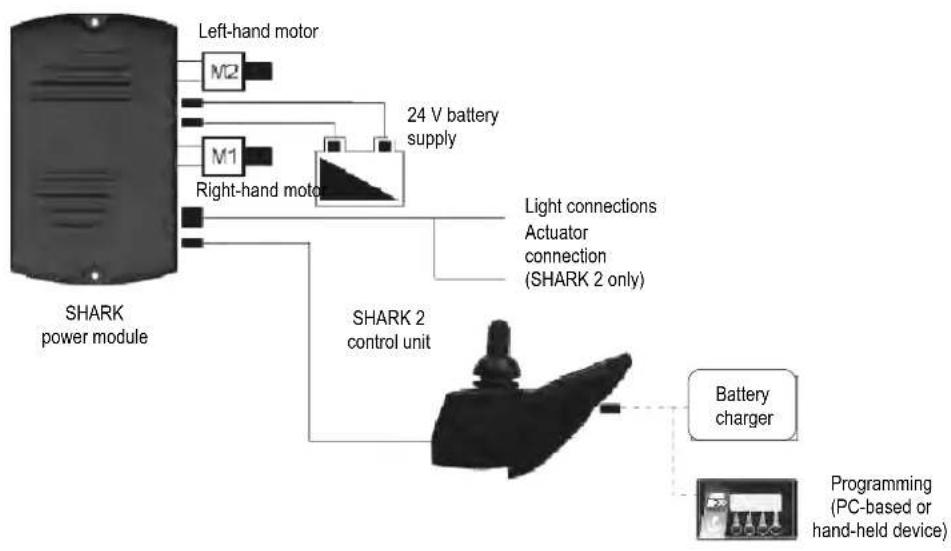
THERMAL SAFETY MECHANISM
To protect the motor against overload, on the right side of the seat frame there is a thermal safety mechanism (transition to the rear frame) that will automatically cut off the motor to prevent overheating and thus rapid wear and tear or breakdowns. This can occur if you go up or down slopes that exceed the maximum gradient indicated. Nominal loads exceeding the maximum could also trigger the safety mechanism. If you try to drive with the brakes on, it could also result in overload. The values to comply with are indicated in the "Technical Details" section. To be able to use the wheelchair again, remove the overload and wait till the motor has cooled off, and then gently press in the thermal safety mechanism again. The system is now ready for use again.
PARKING BRAKES
In addition to electromagnetic braking, your electric wheelchair could also be equipped with fixed braking for each driving wheel. These must then be set for the wheels.
When pneumatic tyres are used, the parking brake can only function when the tyres are inflated hard enough (see the section "Technical details").

Note that the tyre pressure should always correspond to the values given in the section "Technical details", otherwise the action of the parking brakes would be reduced or even be zero.

Note that the parking brakes are not supposed to be used for braking while driving. The real function of the parking brakes is to prevent the wheelchair from rolling away after it has stopped. If it is used for reducing the speed while driving, injury and/or damage could result.
If the brakes lose their function through wear and tear and/or the covers and hoses have been damaged, we advise you to consult your specialist dealer who has the tools and the knowledge for repairing / replacing the defective parts.

When unsuitable tools are used or through improper maintenance damage and/or loss of function could result.
If you wish to adjust the parking brakes yourself, use a suitable Allen key to loosen the two screws which hold the brake suspension on the rail. Then push the brake unit to the desired position and retighten the two Allen screws and check whether the braking action is correct.

Brake adjustments not complying with the manufacturer's instructions are done at your own risk (only in the case of built-in parking brakes). No liability is applicable.

Rather let your dealer adjust the parking brakes; he is trained on our products and will comply with all relevant prescribed safety measures.

Note that the parking brakes are not supposed to be used for braking while driving. The real function of the parking brakes is to prevent the wheelchair from rolling away after it has stopped. If it is used for reducing the driving speed, injuries could follow.
If you are not satisfied with the braking behaviour of your wheelchair, consult your specialist dealer immediately; he will then adjust the brakes properly.

If water, oil, or other kinds of dirt have soiled the wheels of the wheelchair, then the braking action of the parking brakes would be impaired. Check the condition of the wheels every time before using the wheelchair.

If the brakes lose their effectiveness because of wear and tear and/or damage to the tyres/inner tubes, kindly consult your specialist dealer, since special machines are required for changing the tyres. The end user should not change the wheels themselves.
TYRES
The SQUOD SU electric wheelchair is fitted with 3.00-8 driving wheels (pneumatic) and 260x85 steering wheels (pneumatic). Consult your specialist dealer about other wheel combinations. He will advise you as to which combinations are suitable for your individual requirements.

Make sure that the wheels are always inflated correctly, otherwise the driving behaviour might be affected. The correct pressures for the tyres are given in the chapter "Technical details". In addition, you should always check the pressure values appearing on the tyres themselves.

We do not provide any guarantee for wheels not supplied by the manufacturer.
TYRE CHANGING
If you want to change the tyres or inner tubes, you should note the following:
STEERING WHEELS
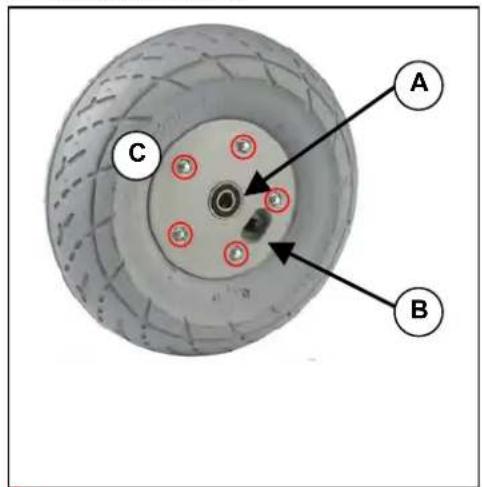
A. Loosen the screw on the steering wheel axle and remove it from the steering wheel fork.
B. Let the air out of the steering wheel by lightly pressing the pressure pin on the valve.
C. Loosen the 5 screws that hold the split rim together. Now separate the rim sides.
ASSEMBLY
Insert the partly-filled inner tube into the tyre.
C. Connect the two sides of the rim through the tyres and use the 5 connecting screws to screw the rim together.
B. Make sure that the valve juts out of the valve opening in the rim.
A. Put the wheel back into the front wheel fork and inflate the wheel.

Before taking the rim apart always let the air out of the tyres, or the sides of the rim could come apart explosively and cause injury!

Make sure that the inner tube does not get caught in the sides of the rim

Only inflate the wheels to the max. tyre pressure (see "Technical details")

Check to see that all the screws on the wheels are firmly tightened before using the wheelchair.
DRIVE WHEELS
The drive wheels can be detached from the drive motor.
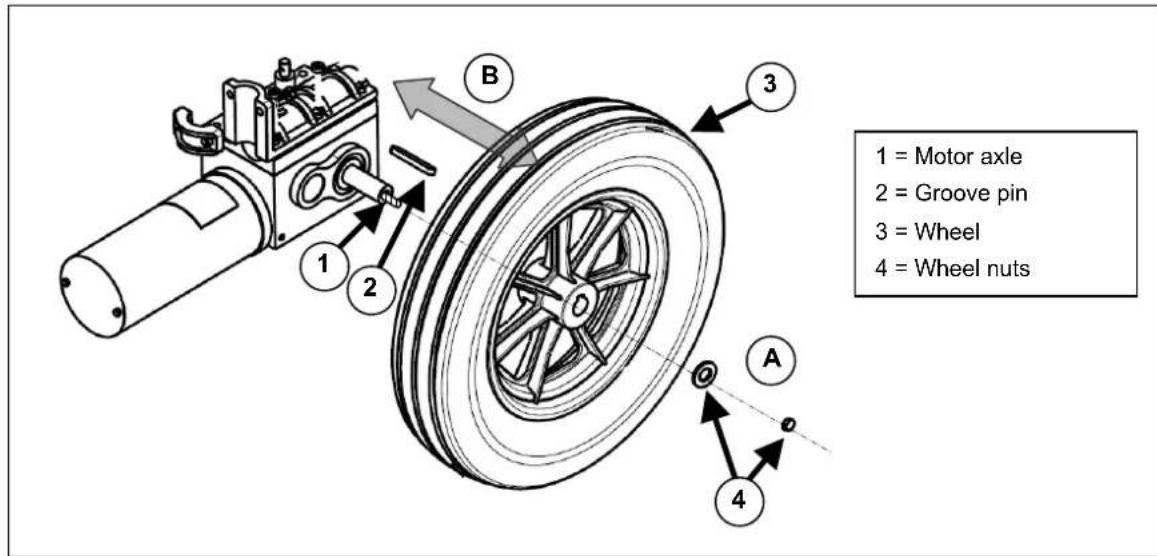

then and remove the wheel nuts (4).

bletely detach the wheel (3) from the motor axle (1).
The groove pin (2) that rests on the motor axle can get jammed in the rim.
WHEEL ASSEMBLY

Remove dirt from the thread and axle of the wheel mount on the motor and degrease the thread.
2 Place the groove pin into the motor axle recess (1).
3 Pull the wheel over the motor axle (1) to the stopping point (avoid poor alignment). In doing this, ensure that the recess on the rim hub fits over the groove pin (2).
4 Hand-tighten the washer and screw (thread locker can be used to secure it).
Before you can remove a tyre, you must let all the air out of the tube, and insert a tyre lever between the tyre and the rim. Then slowly and carefully push the lever downwards. This will pull the tyre over the edge of the rim. If you then move the lever along the rim, the tyre will jump out. Now carefully remove the tyre from the rim and then remove the tube.
There must be no air in the tube before it can be removed.
If handled improperly, the rim might be damaged. These procedures should only be undertaken by authorised individuals.
Note the following before inserting the new inner tube:
Check the rim bed and the inside wall of the tyre for foreign matter and clean these properly if necessary. Check the condition of the rim bed, especially around the position of the air valve. Please use only genuine original replacement parts. We do not accept any liability for damage caused by non-genuine parts. Kindly contact your specialist dealer.
Assembly:
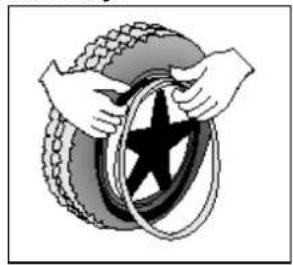
Place the rim belt in position over the air valve before inserting it into the rim. Then the rim belt can be pulled over easily. Check whether all spoke heads are covered (in the case of a plastic rim a rim belt is not required).
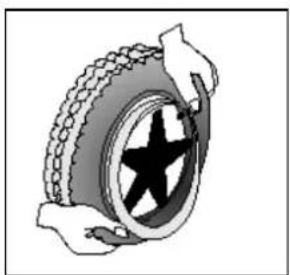
Push the tyre over the edge of the rim, starting behind the air valve. Inflate the tube slightly until it is round, and place it inside the tyre.
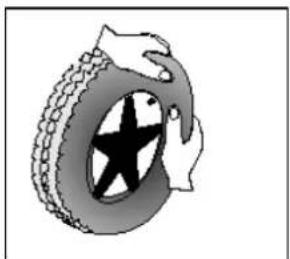
If the inner tube fits snugly inside the tyre without any folds (if there are folds, let some air out), then you can push the upper side of the tyre gently onto the rim with both hands, beginning behind the airvalve.
Check all around on both sides that the tube is not pinched between the rim and the edge of the tyre. Lightly push the air valve inwards and pull it out again to make sure that the tyre is positioned properly in the region of the air valve.
To ensure that the wheel is inflated correctly, admit only so much air initially that the tyre can still be easily pushed inwards by using your thumbs. If the check-lines are equidistant from the edge of the
rim on both sides of the tyre, then the tyre is centered properly. If not - let out the air and position the tyre afresh.
Now the tyre can be inflated to its full operating pressure (note the maximum) and the valve cap should be replaced.
If changing the wheel, ensure that the motor's axle thread has been cleaned before it is tightened with the wheel screw. If the nut is being replaced, a new, self-locking, original nut should be used.

Check that no objects or body parts are caught between the tyre and the edge of the rim, since it could cause damage or injury.

Improper assembly voids any warranty claim.

When inflating the tyres, always check that the pressure is correct. The correct pressure is given on the tyre walls (also refer to "Technical details").

Use only inflating equipment which complies with regulations and indicates the pressure in bar, or use the supplied air pump. We do not accept any liability for damage caused by using inflation equipment not supplied by the manufacturer.
PUSHING THE WHEELCHAIR
The wheelchair can be pushed by an attendant.
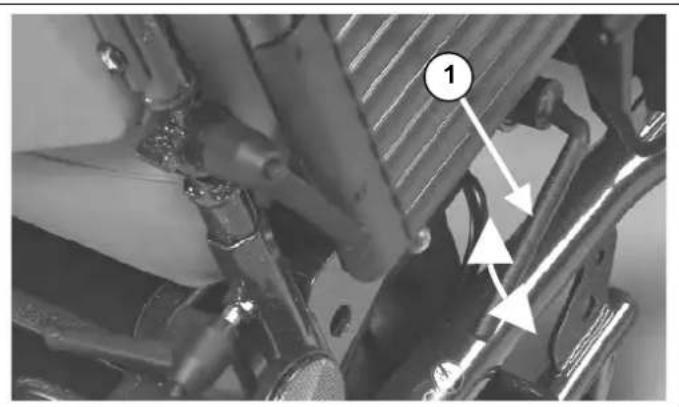
When pushed, the operating equipment is switched off, and the wheelchair can only be pushed on level terrain. Without the braking action of the motors the occupant is exposed to considerable danger when the wheelchair is pushed along on a gradient. This must be avoided.
On the right hand side of the wheelchair, there is a tilt lever (1) that ends the manual free running mode and enables electronic driving.
NEUTRAL
Gently pull the lever (1) outwards and then push it down. This separates the motor from the gears and allows manual pushing of the wheelchair.

In free running mode, the electronic brake is deactivated and the wheelchair will no longer be held back. Do not activate free running mode on slopes. Activate the parking brakes.


ELECTRONIC DRIVING
Pull up the lever (1) to link the gears to the motor.

This activates the electromagnetic parking brakes. Release the mechanical parking brakes to enable electronic driving.

If your wheelchair performs involuntary movements in free running mode, pull up the tilting lever for an EMERGENCY STOP.

TRANSPORTING THE WHEELCHAIR
If your SQUOD SU is to be transported, please note the following:
Before lifting up the wheelchair, all moveable parts must be dismantled.
Before moving the wheelchair, the seat/back unit should be moved to the seated position.
When raising the wheelchair, it should only be grasped by fixed parts of the frame.
To avoid damage, remove the steering unit and knee protector before transporting it.
When assembling, make sure that all screws are retightened properly.
To prevent the wheelchair from moving about, switch the locking mechanism to electronic driving (activation of the electromagnetic parking brakes). In addition, engage the parking brakes if present in your model. If you require further belt securing systems, make sure that they are only attached to solid parts of the frame.
At least two persons are required for moving it up or down on a staircase or over single steps.
When being transported, no persons or objects should be below the wheelchair, to prevent personal injury or damage to the wheelchair.
The wheelchair should not be transported while the patient is seated in it.
USING RAMPS
If you are considering ramps for overcoming obstacles, kindly note the following:
The seat/back system must be moved to the seated position beforehand. The drive program should not be used during the standing/upright function. For your safety you should drive at the slowest possible speed on ramps.
If another person is pushing you, note that the large weight of the electric wheelchair exerts appreciable reverse forces.
If your helper does not have the strength to push the wheelchair up the ramp, you must immediately secure it by engaging the electronic parking brakes (EMERGENCY STOP).
Observe the instructions on the maximum load of the ramps used.
Use a restraining safety belt to secure yourself in your wheelchair.
We do not accept any liability for injury or damage caused by an improper choice of ramps.
ACCESSORIES
- INDIVIDUAL HEADREST (L55)
The standard backrest can be enhanced by an individually adjustable head support supplied by us. This comprises a cushioned headrest which can be set in various positions by means of a gearwheel (see diagram).
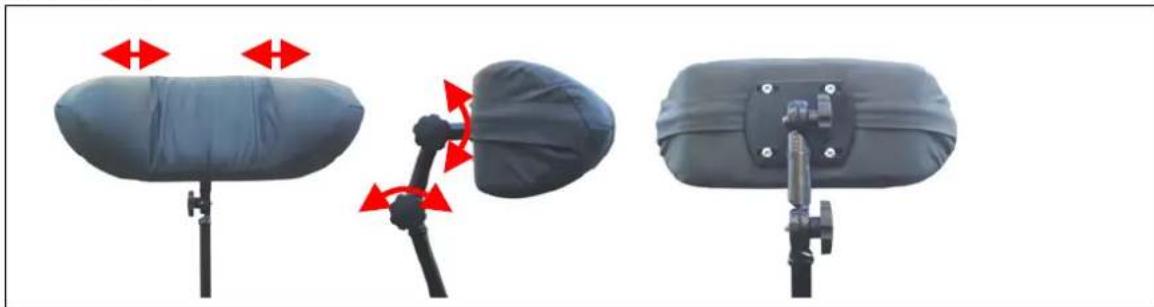
The receptacle screwed in the upper third of the back, can be fixed to the centre of the back for inserting the headrest. The height of the headrest can be adjusted and then tightened at the desired height. The holes required for fixing the headrest have already been drilled in the back unit.

Make sure that the headrest is inserted at least to the marked position to be fixed securely and reliably.
The depth of the headrest can be adjusted by slightly loosening the adjusting screws to allow movement of the sprocket gears. Then you can adjust the headrest to your needs and secure it by retightening the adjusting screws. If the adjusted position is not satisfactory, you can repeat this process.

Ensure that the back of your head is supported when relaxed in an upright sitting position.

Before using the headrest all fixing screws must be tightened properly, since injuries might result when it slips downwards unintentionally.
You can secure your head against tipping sideways by lightly pressing the side panels of the headrest inwards and to the front.

Do not exert too much pressure on the side panels otherwise bruising may result.

Do not clap the side panels together violently, otherwise they might break off, causing possible injury as well as loss of function.
Structural alterations of the headrest would void any warranty.
- PERSONAL SAFETY SYSTEM (B58)
For your safety we offer you a standardised safety belt which is equipped with a snap-on fastener, like those mounted in cars and vans. This can be fixed by means of bolts inserted in the bolt holes on both sides of the seat frame next to the backframe attachments. To ensure proper fixing, self-locking ("nylock") nuts should be used.
If the belt has been dismantled, only new genuine nuts provided by the manufacturer should be used for re-attachment.

To ensure the validity of the warranty, entrust this work to your specialist dealer.

Before using the seatbelt, make sure that all screws are properly tightened.
Please consult your specialist dealer if you require other safety belt systems. He/she shall gladly assist you further.
- ANTI-TIPPING DEVICE (B78)
For your safety your electric wheelchair is equipped with an anti-tipping device. Do not remove this or your wheelchair will no longer be secured against accidentally tipping over.

Before driving off, make sure that the anti-tipping device is inserted on both sides and securely fastened.

Always, before driving off, ascertain that the tipping protector is mounted in such a way that its rollers bear on the ground to prevent toppling further over backwards in the event of unintentional tipping.
BODY SUPPORTS (L04)
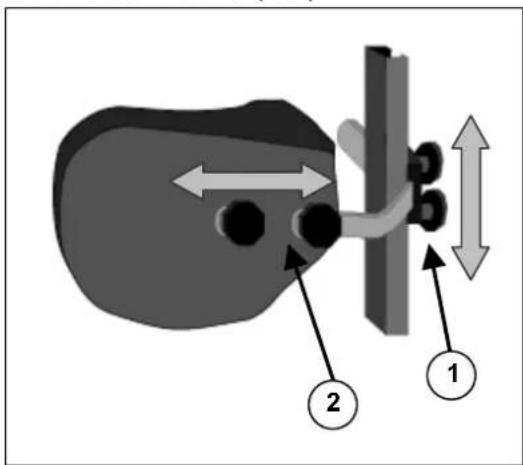
If your upper body requires stronger bracing than that provided by the standard backrest, we offer a lateral support system which can be mounted on the backrest. The guiding rail is mounted vertically about 6cm behind the backrest to one side. The screw threads set in the back are to be used for this purpose. The supporting rods are inserted from the rear and secured by the two Phillips screws. When adjusting the height and depth of the "pelotten", slightly loosen the Philips screws (1) and place the "pelotten" in the desired position. Then retighten the Philips screws (1).
To adjust the depth of the "pelotten", you can loosen screws (2) and set the "pelotten" to the desired depth.
Make sure that all screws are properly tightened after the assembly, otherwise the stability of the "pelotten" is endangered, and this may cause injury and/or damage.
Make sure that the rail system is properly mounted and that nothing obstructs its functional integrity.
If the wheelchair is not fully assembled when delivered, only your specialist dealer who has suitable tools and knowledge of the fittings, may perform the mounting procedure.
Improper assembly leading to damage voids any warranty claim.
While the body supports are fitted, you should sit quietly and naturally in your wheelchair to allow correct fitting.
A Make sure that no objects and/or body parts are located between the "pelotten" and the back of the "pelotten" when these are pulled tight, otherwise bruising and/or damage might occur.
If you have further questions about the indications and function of the "pelotten", kindly contact your specialist dealer. He would gladly answer your questions.
FOR YOUR SAFETY
Some safety tips are given below for your security:
To prevent injury and/or damage to your wheelchair, make sure that no objects and/or body parts are caught in the spokes of the driving wheels.
Do not step on the footplate when entering or leaving the wheelchair. The footplate should be folded up beforehand.
You should investigate the effects of shifting the centre of gravity on the behaviour of the wheelchair for example on gradients, on laterally sloping ground, or when overcoming obstacles, only when a helper is present to secure and support you.
If you want to pick up something (lying in front of, on the side, or to the rear of the wheelchair), you should not lean too far out to avoid tipping over because of the displacement of the centre of gravity.
Only use your wheelchair according to regulations. Avoid for example driving without brakes against an obstacle (step, edge of the curb) or driving down from ledges.
If devices and furnishings like ramps or lifts are available, use them.
Driving should only take place in the seated position. The drive program should not be used during the standing/upright function. Reduced drive should be deployed only for altering position during the standing/upright function.
Only carry out the standing/upright function under supervision from another person, as the risk of tipping increases when weight shifts in the wheelchair.
The standing/upright function should only be used if the chest belt and leg/knee protector are properly attached and deployed.
Check that the profile depth of the tyres is adequate.
Obey traffic regulations when driving on public roads.
When driving your wheelchair, you should not be under the influence of alcohol or medicine as in the case of driving other vehicles. This also applies to indoor driving.
When travelling outdoors, adapt your driving to weather and traffic conditions.
Check that the rear reflectors of your wheelchair are not covered by dirt and/or other objects.
When driving in the dark, wear bright clothing to be more visible, or clothing with reflectors, and make sure that the reflectors of the wheelchair are clearly visible.
A Be careful when using sources of fire such as cigarettes, since they can set the seat and back covers alight.

Make sure that the maximum load (130kg) is not exceeded.
MAKING REGULAR CHECKS
As with any technical product, your wheelchair, too, requires regular checks if it is to be kept fully-functional. The steps to be taken to fully enjoy the advantages of your wheelchair even after protracted use, are described below.
BEFORE DRIVING
- Check the tyres for visible damage and/or soiling. Remove any dirt as it could impair the motion and road-holding capacity of the tyres. When a tyre is damaged, please go see an authorized workshop for repair.
- Use the drive electronics' display to check that the driving, braking and adjustment features are fully-functional. If these functions are impaired, contact your dealer.
- Check the pressure of the tyres and inflate them if necessary (see section "Technical details").
- Make sure that all screws are tightened properly (particularly: the folding armrest mechanism so that they do not accidentally drop down forwards and cause injury.)
APPROX.EVERY8 WEEKS
Depending on the frequency of use check the following:
- That the armrests are working
- Movable parts of the footrests
- The condition of the covers and cushioning materials.
- The tread depth of the wheels
APPROX.EVERY 6 MONTHS
Depending on the frequency of use check the following:
- Cleanliness
- General condition
- That the charger is working
- Operation of the steering wheels If the rotation resistance is too large, clean the bearings of the steering wheels. If this is insufficient, kindly consult your specialist dealer.

In cases of lost functionality, repairs and inspections, consult your dealer. Only authorised persons should do repairs.
INSPECTION
In principle we recommend annual inspections, but at least before usage is resumed. The following checks must at least be performed and documented by authorized persons:
- Check the cabling (especially for: crushing, abrasion, cuts, visible insulation of the inner conductor, visible metallic veins, kinks, lumpiness, color changes of the outer sleeve, brittle spots)
- Visual inspection of the frame parts to check for plastic deformation and/or wear and tear (basic frame, seat frame, back frame, side parts, leg supports, motor suspensions)
Electric leads to be securely placed to avoid shearing, crushing and other mechanical stresses and strains. - Visually check all housings for damage, screws must be securely fixed, seals and gaskets should not exhibit visible damage.
Review the charger's residual diversion current (A) based on VDE 0702
Review the charger's insulation resistance (MO) based on VDE 0702 - Check the functioning of the armrests and leg supports (locking, load, deformation, wear and tear caused by loads)
- Check the functioning of the drives (during a test drive noises, speed, free running, etc.), if necessary: Measure the performance, first with no load, and then with the nominal load ("SWL") to investigate the wear and tear of the motors by comparing the values of the electric current with the values at delivery, condition and function of the carbon rod.
- Check the condition of the batteries, covers, tubes, and tyres.
Checking measurements may only be carried out by skilled persons trained on the wheelchair at least and at least under the supervision of an electrician who knows the checking instruments and
processes. Only an electrician is able to release the electric wheelchair for use after successful checking measurements or servicing. The service must be confirmed in the service plan when at least the above-mentioned aspects have been checked.

The manufacturer is not liable for damage caused by lacking or improper service.
TOOLS
To repair individual components and accessory attachments, and to carry out inspections, the following tools are the minimum required:
- Allen keys (sizes 3, 4, 5 and 6mm )
- Fixed spanners/ring spanners (sizes 8, 10, 12, 13, 17 and 19 mm )
- Phillips screwdrivers (PH1, PH2)

Any activities requiring these tools should only be carried out by authorised persons.
CARE
Your electric wheelchair requires regular care to keep it in a pleasant condition. To do this, note the following:

Steam or high-pressure cleaning is forbidden!
COVERS
Clean the covers with hot water. You can remove stubborn dirt by washing with a mild commercial detergent. Stains can be removed by using a sponge or a soft brush.

Do not use strong cleaning liquids like solvents, nor use hard brushes.

We shall decline all liability for damage caused by the use of improper cleaning agents.

Take care that you do not soak the covers.
- PLASTIC PARTS
Clean all plastic parts of your wheelchair with commercial plastic cleaners. Read the specific product information and only use soft sponges or cloths.
- SURFACE LAYERS
The high quality of the surface layer guarantees optimal protection against corrosion. If the outside of the frame has been damaged by scratches or otherwise, you can protect the area by applying varnish obtainable from your specialist dealer.
ELECTRONICS CASING
Only wipe the steering unit with a cloth moistened by a few drops of a commercial domestic cleaner. Do not use any abrasives or sharp-edged polishing equipment like a metal scrubber or brush, since these can scratch the surface of the steering unit and destroy its water repelling property.

Regularly check the plug connectors for corrosion or damage, since it could affect the efficiency of the electronics.

Before any maintenance work, disconnect the batteries to prevent any unwanted current flow.

The manufacturer accepts no liability for damage caused by poor maintenance.
STORAGE
- Store in a dry place (between +5^ and +45^ ).
The relative humidity of the air should be between 30% and 70% .
Air pressure between 700 hPa and 1060 hPa. - Disconnect the power plug of the battery charger.
- For the batteries, see the chapter on "Battery Storage".
- Check internal cables for squashing and the prevention of kinks.
- Store all removed parts together in one place (or mark them if necessary) to avoid mixing up with other products when re-assembling (e.g. the charger).
- Components must be stored without being subjected to any load. Grasp the wheelchair by solid frame parts only.
DISINFECTION
Only a hygiene technician or someone appointed by him can disinfect your wheelchair and this should be done every time before its use is resumed or before it is provided to a different person. All parts of the wheelchair can be treated with a disinfectant cloth. In principle all surfaces of a system or a product have to be disinfected before passing it on to another user, or when it is known that the user carries an infective vector. In these cases the measures of the federal law on epidemics have to be considered.

Wear suitable protective clothing because the disinfectants can irritate the skin on contact. For this purpose you should also take note of the product information for the solutions concerned.

You employ unauthorized persons at your own risk.

No liability is accepted by the manufacturer of the wheelchair for damage and injury caused by the improper handling of disinfectants.
We recommend the following disinfectants for scrubbing (based on the list of the Robert Koch Institute, RKI):
| Active substance | Name | Washing-disinfection | Surface disinfection (scrub-washing disinfectio) | Disinfecting excretions 1 part sputum or stool + 2 parts diluted solution or 1 part urine + 1 part diluted solution | Effectiv e range | Manufacturer or Supplier | |||||||
| Sputum | Stools | Urine | |||||||||||
| Diluted solution | Time to take effect | Diluted solution | Time to take effect | Diluted solution | Time to take effect | Diluted solution | Time to take effect | Diluted solution | Time to take effect | ||||
| % | Hrs. | % | Hrs. | % | Hrs. | % | Hrs. | % | Hrs. | ||||
| Phenol or phenol derivatives | Amocid | 1 | 12 | 5 | 6 | 5 | 4 | 5 | 6 | 5 | 2 | A | Lysoform |
| Gevisol | 0,5 | 12 | 5 | 4 | 5 | 4 | 5 | 6 | 5 | 2 | A | Schülke & Mayr | |
| Helipur | 6 | 4 | 6 | 4 | 6 | 6 | 6 | 2 | A | B.Braun | |||
| m-cresol soap solution DAB 6 | 1 | 12 | 5 | 4 | A | ||||||||
| Mucocit-F 2000 | 1 | 12 | A | Merz | |||||||||
| Chlorine, organic or inorganic substances with active chlorine | Chloramine-T DAB 9 | 1,5 | 12 | 2,5 | 2 | 5 | 4 | A'B | |||||
| Clorina | 1,5 | 12 | 2,5 | 2 | 5 | 4 | A'B | Lysoform | |||||
| Trichlorol | 2 | 12 | 3 | 2 | 6 | 4 | A'B | Lysoform | |||||
| Percompounds | Apesin AP1002 | 4 | 4 | AB | Tana Professional | ||||||||
| Pure Dismozon2 | 4 | 1 | AB | Bode Chemie | |||||||||
| Perform2 | 3 | 4 | AB | Schülke & Mayr | |||||||||
| Wofesteril2 | 2 | 4 | AB | Kesla Pharma | |||||||||
| Formaldehyde and/or other aldehydes or derivatives | Aldasan 2000 | 4 | 4 | AB | Lysoform | ||||||||
| Antifect FD 10 | 3 | 4 | AB | Schülke & Mayr | |||||||||
| Antiseptica | AB | Antiseptica | |||||||||||
| Surface Disinfection 7 | 3 | 6 | |||||||||||
| Apesin AP30 | 5 | 4 | A | Tana Professional | |||||||||
| Bacillocid Spezial | 6 | 4 | AB | Bode Chemie | |||||||||
| Buraton 10F | 3 | 4 | AB | Schülke & Mayr | |||||||||
| Desomed A 2000 | 3 | 6 | AB | Desomed | |||||||||
| Hospital dis-infection cleaner | 8 | 6 | AB | Dreiturm | |||||||||
| Desomed Perfekt | 7 | 4 | A | Desomed | |||||||||
| Formaldehyde solution DAB 10 (formalin) | 1,5 | 12 | 3 | 4 | AB | ||||||||
| Incidin perfekt | 1 | 12 | 3 | 4 | AB | Ecolab | |||||||
| Incidin Plus | 8 | 6 | A | Ecolab | |||||||||
| Kohrsolin | 2 | 12 | 3 | 4 | AB | Bode Chemie | |||||||
| Lysoform | 4 | 12 | 5 | 6 | AB | Lysoform | |||||||
| Lysoformin | 3 | 12 | 5 | 6 | AB | Lysoform | |||||
| Lysoformin 2000 | 4 | 6 | AB | Lysoform | |||||||
| Melsept | 2 | 12 | 4 | 6 | AB | B.Braun | |||||
| Melsitt | 4 | 12 | 10 | 4 | AB | B.Braun | |||||
| Minutil | 2 | 12 | 6 | 4 | AB | Ecolab | |||||
| Multidor | 3 | 6 | AB | Ecolab | |||||||
| Nüscosept | 5 | 4 | AB | Dr.Nusken Chemie | |||||||
| Optisept | 7 | 4 | A | Dr.Schumacher | |||||||
| Pursept-FD | 7 | 4 | AB* | Merz | |||||||
| Ultrasol F | 3 | 12 | 5 | 4 | AB | Fresenius | |||||
| Amphotensid | Tensodur 103 | 2 | 12 | A | MFH Marienfelde | ||||||
| Alkaline solution | Lime-wash3 | 20 | 6 | A' B |
Insufficiently effective against myco-bacteria when disinfecting surfaces, especially in the presence of blood. 2Not suitable for disinfecting blood-contaminated or porous surfaces (e.g. raw wood). 3Useless for tuberculosis; preparation of lime-wash: 1 part dissolved lime (calcium hydroxide) + 3 parts water. *Virus effectiveness tested in compliance with the RKI test method [German Federal Health Circular 38 (1995) 242]. A: suitable for killing vegetative bacterial germs including myco-bacteria as well as fungi, including fungal spores. B: suitable for deactivating viruses.
Disinfective substances may only be applied by authorised professional staff trained in the functioning and application of disinfectives.
The current state of the disinfectants included in the RKI list can be ascertained at the Robert Koch Institute (Home page: www.rki.de).
All steps taken for disinfecting rehabilitation equipment and their components or other accessory parts, are recorded in a disinfection report which contains at least the following information with product documentation appended:
Table 2 - Example of a disinfection book
| Date of the disinfection | Reason | Specification | Substance and concentration | Signature |
Abbreviations used in column 2 (reason): V = suspected infection IF = infection case W = repetition I = inspection
Kindly consult your specialist dealer if you have further queries about disinfection; he will gladly assist you.
GUARANTEE
Excerpt from the "General business conditions":
(…)
- The guarantee period for warranty claims is 24 months.
(...)
Claims are invalid when:
- the agreed condition is only minimally deviated from
- usability is only minimally impaired
- wear and tear is normal
- faults are due to improper assembly or neglected maintenance
- faults are due to improper use
- errors are due to improper handling by customers or their contractual partners or service centres
- damage that arises after the transfer of risk as a result of faulty or negligent handling, excessive demands, unsuitable equipment, faulty assembly or that are due to particular external factors that are not assumed under the contract.
(…)
The terms of the guarantee may differ from country to country. Please contact your dealer for further information.
CONFORMITY
The SQUOD SU electric wheelchair complies with the requirements of the European directive:
-93/42/EEC (Medical Products Directive)
and the product norms:
-EN 12182:1999
-(DIN)EN12184:1999
DISPOSAL

The manufacturer is responsible for taking back and recycling the electric wheelchair and shall meet the requirements of European Directive 2002/96/EC on Waste Electrical and Electronic Equipment. You can find out from your local waste disposal company where you can take the electrical wheelchair to be recycled free of charge. It may not be disposed of with domestic waste.
Your dealer will also be able to advise you should you have any queries.
SHARK 2 DISPLAYS
| Display Unit | Description | Meaning | Remarks |
| All LEDs dark. | System off. | ||
| All LEDs are lit. | System on. | LEDs show the charge level. | |
| Left red LED flickering. | Low battery level. | Charge battery immediately. | |
| Progre | Progress indicator from "right to left" / "green to red" | Shark system blocked. | To unlock, press the horn button twice within 10 seconds after switching the steering unit on. |
| Progress indicator | Progress indicator from "left to right" / "red to green" with subsequent charge level display. | Shark is being programmed, is connected to the charger and/or is busy charging. | The flickering LEDs indicate the present loading status. |
| All LEDs flickering slowly. | After starting the system, the joystick is not in the neutral position. | Put the joystick in the neutral position (let it go). |
ERROR CODES

Symbol flickering fast at intervals. The number of flashes per interval provides the information below (the following actions and checks should only be carried out by authorised individuals).
| Number | Problem/Fault | Checks |
| 0 | There is no indication of the charge level of the batteries after the steering unit is switched on. | 1. Check whether the battery plug is inserted fully and correctly connected to the socket of the steering unit. 2. Check whether the two batteries are connected correctly. 3. Check whether the batteries are charged. 4. Check whether the fuses of the steering unit and the batteries are defective or have burnt out. |
| 1 | Operating error | 1. Possible safety shut down or operating error (joystick) 2. Put the joystick in neutral position and restart the system. |
| 2 | Battery error | 1. Check batteries and cabling; if necessary charge. 2. If necessary, replace batteries. |
| 3 | Left motor (or its connection) is defective. | 1. Check whether the plugs of both motors have been inserted properly. 2. Check the plug contacts of both motors for corrosion or damage. 3. Check both motors. Unplug the motors and measure the plug connection with an Ohm meter. If you obtain readings of more than 1 Ohm or less than 100 milliOhms, the motor is defective. 4. Check the voltage difference between the motor and its housing. Measure every contact between the motor and its housing by means of an Ohm meter. If the resistance is less than 1 MegOhm, the motor is defective. 5. Check the condition and function of the carbon rods of both motors. N.B: If a fault is indicated in one motor, the other one could also be defective. |
| 4 | Right motor (or its connection) is defective | As described above. |
(…)
| Number | Problem/Fault | Checks |
| 5 | Left parking brake (or its connection) is defective | 1. Check whether the plugs of the motors have been inserted. 2. Check the plugs for corrosion or damage. 3. Check the parking brakes. Measure the resistance of the connections by means of an Ohm meter. If the resistance is larger than 100 Ohms or less than 20 Ohms, the parking brake is probably defective. |
| 6 | Right parking brake (or its connection) is defective | As described above. |
| 7 | Shark control is defective | 1. Unplug both motors. Switch the steering off and then on again, while leaving the joystick in the neutral position. If this flashing sequence appears again, the steering is defective. 2. Unplug both motors. Again switch the steering off and on while leaving the joystick in the neutral position. Then briefly push the joystick in any arbitrary direction. If the steering relay then clicks twice and a fault is indicated in the left motor, the steering is in order. If any other fault is indicated and the steering relay does not click twice, the steering is defective. 3. Check the motors as described above in 3. and 4. N.B: If a fault is shown in one motor while driving, it could be indicated as a steering fault. |
| 8 | Shark - PM defective | 1. Check the cables and plugs for corrosion and damage. 2. Check the BUS connecting cable (resistance). 3. Replace the PM. |
| 9 | Shark communication error | 1. Check the cables and plugs for corrosion and damage. 2. Check the BUS connecting cable (resistance). 3. Replace the PM. 4. Replace the shark control. |
| 10 | Unknown error | 1. Check the cables and plugs for corrosion and damage. 2. Check the BUS connecting cable (resistance). 3. See the manufacturer. |
| 11 | Incompatible steering unit | 1. Incorrectly programmed and incompatible steering (depending on system). 2. Check whether the programming of the PM and steering unit agree with each other. |
TABLE DES MATIÈRES
Chapitre Page
Table des matieres 1
Avant-propos. 2
-(DIN) EN 12184: 1999
AFVALVERWERKING

- EN 12182: 1999
-(DIN)EN12184:1999
ENTSORGUNG

website: www.realtime.it
e-mail: info@realtime.it
Poland
Vermeiren Polska Sp. z o.o
ul. Laczna 1
PL-55-100 Trzebnica
Tel: +48(0)713874200
Fax:+48(0)713870574
website: www.rehapola.pl
e-mail: info@vermeiren.pl
Spain
Vermeiren Iberica, S.L.
Trens Petits, 6. - Pol. Ind. Mas Xirgu.
17005 Girona
Tel: +34 902 48 72 72
Fax:+34972405054
website: www.vermeiren.es
e-mail: info@vermeiren.es
Germany
Tel: +43(0)732 37 13 66
Fax: +43(0)732 37 13 69
website: www.vermeiren.at
e-mail: info@vermeiren.at
Switzerland
Vermeiren Suisse S.A.

- PREFACE
- TECHNICAL DETAILS
- GENERAL NOTES
- APPLICABILITY
- CONTENTS OF THE CONSIGNMENT
- EXPLANATION OF THE SYMBOLS
- SHARK 2 CONTROLS
- CONNECTIONS FOR CHARGER / PROGRAMMING UNIT
- ADJUSTING THE STEERING UNIT
- BACK
- ADJUSTING THE DEPTH OF THE SEAT
- LEG SUPPORT
- KNEE PROTECTOR
- ARMRESTS
- CHEST BELT
- STANDING/UPRIGHT FUNCTION
- BATTERY CHARGER
- CHARGING THE BATTERIES
- - SETTING UP THE CHARGER
- FIRSTUSE
- BATTERIES
- BATTERY CONNECTIONS
- BATTERY STORAGE
- SYSTEM CONNECTION
- THERMAL SAFETY MECHANISM
- PARKING BRAKES
- TYRES
- TYRE CHANGING
- STEERING WHEELS
- ASSEMBLY
- DRIVE WHEELS
- WHEEL ASSEMBLY
- Assembly:
- PUSHING THE WHEELCHAIR
- NEUTRAL
- ELECTRONIC DRIVING
- TRANSPORTING THE WHEELCHAIR
- USING RAMPS
- ACCESSORIES
- - INDIVIDUAL HEADREST (L55)
- Structural alterations of the headrest would void any warranty.
- - PERSONAL SAFETY SYSTEM (B58)
- - ANTI-TIPPING DEVICE (B78)
- BODY SUPPORTS (L04)
- FOR YOUR SAFETY
- MAKING REGULAR CHECKS
- BEFORE DRIVING
- APPROX.EVERY8 WEEKS
- APPROX.EVERY 6 MONTHS
- INSPECTION
- TOOLS
- CARE
- COVERS
- - PLASTIC PARTS
- - SURFACE LAYERS
- ELECTRONICS CASING
- STORAGE
- DISINFECTION
- Disinfective substances may only be applied by authorised professional staff trained in the functioning and application of disinfectives.
- Kindly consult your specialist dealer if you have further queries about disinfection; he will gladly assist you.
- GUARANTEE
- CONFORMITY
- DISPOSAL
- SHARK 2 DISPLAYS
- ERROR CODES
- TABLE DES MATIÈRES
- Chapitre Page
- AFVALVERWERKING
- ENTSORGUNG
- Poland
- Spain
- Germany
- Switzerland
Brand : Vermeiren
Model : Squod SU
Category : Electric scooter