MCR718 - Car radio Marquant - Free user manual and instructions
Find the device manual for free MCR718 Marquant in PDF.



| Brand | Marquant |
| Model | MCR718 |
| Product type | Car stereo with CD/MP3 player, FM/AM tuner, SD/MMC card reader |
| Dimensions (W x H x D) | 178 x 50 x 165 mm |
| Weight | Approximately 1 kg |
| Power supply | DC 13.8 V, max consumption 10 A |
| Output power | 4 x 25 W |
| FM frequency range | 87.5 MHz - 108.0 MHz |
| AM frequency range | 522 kHz - 1620 kHz |
| Supported audio formats | CD, CD-R, CD-RW, MP3 (bitrates 32-320 kbps) |
| Radio functions | RDS, PTY, EON, AF, TA, automatic memory, 30 presets (FM1/FM2/FM3/AM) |
| CD functions | Random play, repeat, intro, alphabetical search, folder selection |
| Connections | ISO connectors, RCA output (front), antenna jack, SD/MMC input |
| Detachable faceplate | Yes, with protective case |
| Equalizer | DSP presets: FLAT, POP, CLASSICS, ROCK, or custom |
| Loudness function | Yes, can be enabled/disabled |
| Sound adjustments | Volume, bass, treble, balance, fader |
| Operating temperature | Avoid prolonged exposure to sunlight; allow cooling if interior temperature is very high |
| Maintenance and cleaning | Soft, dry cloth; do not use solvents, petrol or thinner |
| Safety | Class 1 laser for CD; do not short-circuit safety devices; follow installation and wiring instructions; road safety is paramount |
| General information | Manual available in several languages; online support possible |
Frequently Asked Questions - MCR718 Marquant
User questions about MCR718 Marquant
0 question about this device. Answer the ones you know or ask your own.
Ask a new question about this device
Download the instructions for your Car radio in PDF format for free! Find your manual MCR718 - Marquant and take your electronic device back in hand. On this page are published all the documents necessary for the use of your device. MCR718 by Marquant.
USER MANUAL MCR718 Marquant
Use the device only for the intended purpose.
The device should be installed in such a way that existing ventilation holes are not covered.
Never open the housing of the device. Incorrect repairs can constitute a considerable risk for the user. If the device is damaged it should not be used, but repaired by a specialist.

The symbol with an exclamation mark should advise the user of important operation or maintenance instructions in the accompanying documentation.

Devices bearing this symbol work with a „class 1 laser“ for tracing the CD. The built-in safety switches should prevent the user being exposed to dangerous laser light, which is invisible to the human eye, when the CD compartment is opened.
Under no circumstances should these safety switches be bypassed or manipulated, as this could result in a danger of exposure to the laser light.
Road Safety
- Road safety is of paramount importance. You should therefore use your car radio at all times in such a way that you are able to cope with the current traffic situation.
- Please remember that at a speed of 30 mph (50 kph) you travel 15 yards (14 metres) in one second.
• We advise you not to operate the radio in critical situations. - It must be possible to hear the sirens of police and fire brigade vehicles etc. from inside the vehicle in good time.
- When driving you should therefore not turn the radio volume up excessively.
When installing and connecting the radio please note the following safety information.
- First disconnect the minus pole and then the plus pole of the battery. (connection in the reverse order.)
Please note: Once the battery has been disconnected the information is lost from all volatile memory. Please note the safety information provided by the vehicle manufacturer.
- The main fuse must be installed as closely as possible (not more than 30 cm away) to the plus pole of the battery so that the car is protected from any cable fi re caused, for example, by an accident. If the above is not complied with the insurance protection no longer applies.
- The cross-section of the plus and minus cable must not exceed 1.5 ~mm^2 .
- When drilling holes please ensure that none of the vehicle components are damaged.
Installation Tips:
- Cable protection sleeves protect cables against fraying on sharp body parts.
- The insulation of the cables must not be damaged during installation.
- It is essential to use the correct tools when installing car hi-fi.
Depending on the model, your vehicle may deviate from the above description. We do not accept any liability for damage caused by installation or connection errors or for consequential damage.
Installation
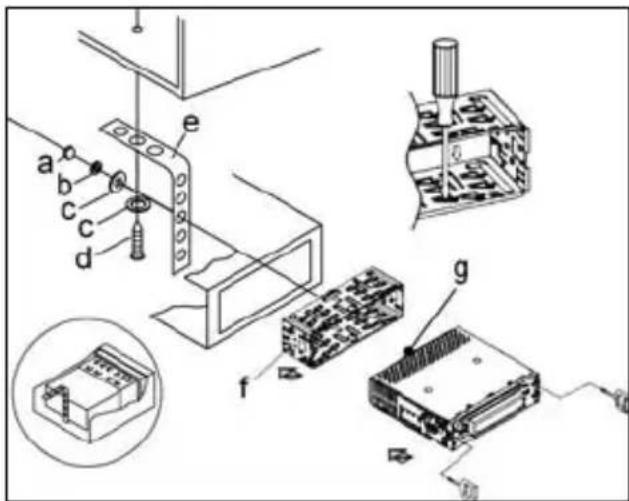
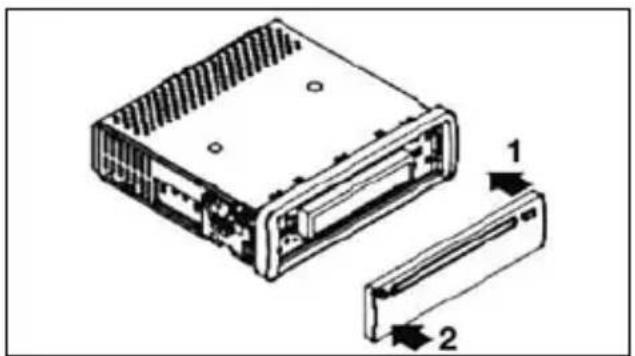
Please install the car radio as shown below
a Nut
b Spring washer
c Plain washer
d Screw
e Mounting bracket
f Slide-in housing
g Threaded bolt
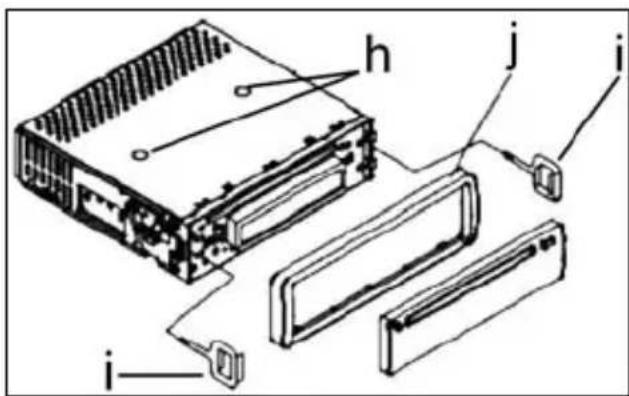
Note:
h Retaining screws during transport (please remove before installation)
I Extraction tool (spanner for dismantling)
j Frame
natural_image
Technical illustration of an electronic device showing a front panel and internal structure with two labeled parts (1 and 2), no text or symbols present.First place the operating panel in position on the right-hand side and then lock it into place on the left.
Connection
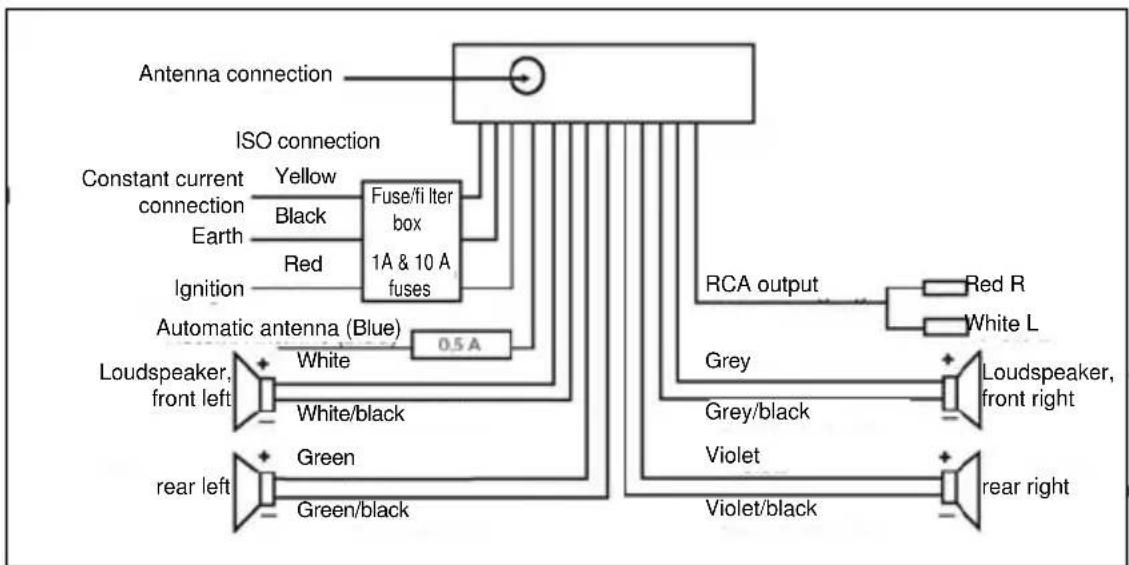
Connect the device as shown in the diagram.
flowchart
graph TD
    A["Antenna connection"] --> B["Fuse/fiber box"]
    C["ISO connection"] --> B
    D["Constant current connection"] --> E["Yellow"]
    D --> F["Black"]
    D --> G["Earth"]
    D --> H["Red"]
    I["Ignition"] --> J["Fuse/fiber box"]
    K["Automatic antenna (Blue)"] --> L["White/Black"]
    M["Loudspeaker, front left"] --> N["White"]
    O["rear left"] --> P["Green/Black"]
    Q["RCA output"] --> R["Red R"]
    Q --> S["White L"]
    T["Grey"] --> U["Loudspeaker, front right"]
    V["Grey/black"] --> U
    W["Violet"] --> X["rear right"]
    Y["Violet/black"] --> X
    B --> Z["1A & 10A fuses"]
    Z --> AA["0.5 A"]
Note:
- Do not attach the removable control panel until after connection of the cables.
- Please use loudspeakers with an impedance of 4 ohm.
Important Information for installing your carradio!
- The screws (h) of the transport locking device should be removed before installation, as otherwise the CD cannot be inserted.
- The device is designed for the minus pole of the battery, which must be connected to the body of the vehicle. Please check this before installation.
- When installing/connecting your device please note that not every vehicle is equipped with an "ISO connection". In this case we recommend the use of an ISO adapter specifically designed for your vehicle.
Adapters are available from car accessory shops and/or from your vehicle workshop.
- Depending on the specific car type, different wiring connection of the "Duration +" wire (Constant current connection) are available. (However, this is necessary for storing the radio stations).
In order to guarantee all functions, installation in line with these instructions is essential. In cases of doubt please contact an authorised car workshop.
-
The angle of inclination when a car radio is installed must not exceed 20^ , as in the case of greater angles of inclination the function of the car radio (CD Player) can no longer be guaranteed.
-
Depending on the specific car type, interferences can be possibly arise during radio/CD operation. These interferences can avoid easily with an additional Interferences filter. Your car radio is originally prepared with an Interference Filter already.
In these case, please contact your authorized car dealer.
-
When installing your radio please ensure that there is enough space at the rear of the radio to ensure sufficient cooling.
-
For the antenna connection there are two different norms. The first of these is the old (50 ohm) version with a long protruding round contact on the vehicle and a round socket on the radio end. The second is the ISO-standardised antenna plug (150 ohm). Adapters for both formats are available from accessory manufacturers and/or your car workshop.
Important information for VW/Audi vehicles: The active antenna requires voltage on the shielding of the antenna coaxial cable, without which reception is unsatisfactory. An antenna adapter with phantom power supply will solve this problem.
Operating Instructions
-
If the front control panel is removed while the radio or CD is on, the device is automatically switched off.
-
Error. After the front panel has been reinserted an error message (ERROR) appears in the display. Use a piece of wire or similar item to press the RESET button (28) in order to return the electronics to its original state. With the control panel removed this button is located in the lower right-hand corner.
-
If the interior of the vehicle becomes very hot, for example after standing in direct sunlight for a prolonged period, do not switch on the player until the inside of the vehicle has cooled down a little after you have been driving for a few minutes.
-
In order to keep the removable control panel in a safe place you should always use the protective case provided.
-
Playback of CDs produced by the user cannot be guaranteed due to the large variety of software and CD media available.
Operation
1. REL Button
Press the REL button to remove the front operating panel.
2. SEL Button (Select)
a) Press the SEL button briefly to access the sound mode selection menu. The letters „VOL“ appear in the display for setting the volume. By repeatedly pressing the SEL button you can now select the individual menu items such as VOL (Volume), BAS (Bass), TRE (Treble), BAL L - - R (Balance) and FAD F - - R (Fade). The settings of the individual menu items are changed by turning the multifunction button VOL (2).
Note: If equaliser settings such as POP and ROCK have been selected under DSP it is not possible to adjust the BASS and TREBLE.
b) Press the SEL button for a longer time to access the selection menu:
• TA SEEK / TA ALARM
• PI MUTE / PI SOUND
• RETUNE L / RETUNE S
- MASK DPI / MASK ALL
• BEEP 2ND / BEEP ALL / BEEP OFF
- SEEK 1 / SEEK 2
- DSP OFF / FLAT / POP M / CLASSICS / ROCK
- LOUD ON / OFF
• STEREO / MONO
- LOCAL / DX
• VOL LAST / ADJ
The letters „TA SEEK“ appear in the display.
Repeatedly pressing of the SEL button now brings up the individual menu items. The settings of the individual menu items are changed by turning the multifunction button VOL.
• TA SEEK Menu (Traffi c Announcement Station Search)
Select TA SEEK if you would like the radio to automatically search for a traffic announcement station when you select the TA function.
Select TA ALARM to bring up a warning message in the display as soon as you have set a station under the TA function which does not transmit traffic announcements.
- PI MUTE/PI SOUND (only for radio operation)
If you are in an area where two programme identifi cations (PI) overlap, you can select the option PI SOUND and PI MUTE for playback of the sound. Alternate switching of the programme identifi cation should be avoided.
PI SOUND: If switching nevertheless occurs the sound of another station is heard for less than one second.
PI MUTE: The sound of another station is suppressed.
- RETUNE L/RETUNE S (only for radio operation)
If no TA Information (traffi c announcements) are received for a selected period, the radio automatically looks for the nearest station with an identical PI code (programme identifi cation).
RETUNE L = 90 seconds. RETUNE S = 60 seconds.
- MASK DPI/ALL
This hides alternative frequencies (AF) during the search for a programme identification (PI).
MASK DPI: When the device is searching for the programme identifi cation (PI) of a station the alternative frequencies with a different programme identifi cation remain hidden.
MASK ALL: In the search for a programme identifi cation (PI) alternative frequencies with a different programme identifi cation and stations with a strong signal level without an RDS signal remain hidden.
• BEEP 2ND/BEEP ALL/BEEP OFF (Confir rmation Beep)
You can select three different types of confirmation beep when a key is pressed.
BEEP 2ND: The confirmation beep is heard when a key is held down.
BEEP ALL: The confirmation beep is heard whenever a button is pressed.
BEEP OFF: The confirmation beep is switched off.
- SEEK 1, SEEK 2 (only available during radio operation)
Seek function with the I ◀◀/▶▶I buttons during radio operation.
SEEK 1: Keep ▶▶I buttons pressed down and the radio will stop at the next station that is reached.
SEEK 2: As long as the I buttons are pressed down the search function will continue in the frequency band.
- DSP (Equalizer)
In DSP mode you can select the equaliser settings FLAT, POP M, CLAS-SICS and ROCK. Select DSP OFF to carry out your own adjustments. See also section 3a.
- LOUD ON/LOUD OFF
Switching the LOUDNESS function on and off.
When the volume is low the LOUDNESS function (LOUD) expands the sound characteristics by increasing the treble and bass sounds.
• STEREO/MONO switching (only possible during radio operation).
- LOCAL/DX (EON) (only available during radio operation)
Your radio can receive RDS EON data. The term „EON“ signifies the transmission of additional station information within a station chain, e.g. WDR. If a traffic announcement (TA) is made within a station chain, the radio switches from a station which does not transmit traffic announcements to one that does within the same station chain. Reception of this station data is shown in the display by the EON symbol. You can choose between the EONTA LOCAL and EONTA DISTANCE mode for local or long-distance traffic news. The purpose of this function is to prevent the radio switching unnecessarily to an EON-TA traffic news item. If an EON station is a long distance away, it may be that in some cases EON TA information can still be received from the station. The radio then switches to this EON station and tries to receive the traffic announcements. The signal is too weak, however, and reception is poor as this EON station is too far away. Therefore the radio switches back to the station that was set previously.
During the type of operation described above the listener hears the wrong programme for a short time or nothing at all.
EONTA LOCAL: This function prevents switching to an EON station whose signal is too weak. The radio does not switch to this station and the listener does not hear any interference.
EON TA-
DISTANCE Mode: In this mode the EONTA circuitry tries to receive the EONTA information from any available transmitter and thus improve reception quality.
• VOL LAST/VOL ADJ
VOL LAST: The radio switches on at the actual volume it had when it was last switched off
VOL ADJ: Press the SEL button again: A - - VOL appears in the display. With the VOL multifunction button you can select the desired switch-on volume.
3. LCD (liquid crystal display)
4. BND button
Press the BND button briefly to switch between the 3 FM bands. The designation of the corresponding level - FM1, FM2, FM3 - is shown in the LCD. In CD mode the FOLDER, TITEL, ARTIST and ALBUM are displayed (only if the medium contains ID3-tag information).
5. |◀◀ / ▶▶ | Buttons TUNE, SEEK, TRACK, SKIP UP/DOWN
a) In radio mode: Press the ◀◀ or ▶▶ I button briefl y to tune into a radio station manually. Keep the ◀◀◀ or ▶▶▶ I button pressed down in order to start searching for a radio station.
See also the function SEEK 1 / SEEK 2.
b) In CD mode: Press the I◀◀ or ▶▶I button briefly to jump forwards or backwards. If you would like to scroll the titles of the tracks keep the I◀◀ or ▶▶I arrow button pressed.
6. MOD Button
Press this button to select the CD player, radio mode etc.
7. MU Button (Mute)
Press the MU button to switch off the loudspeakers for a short period. The word MUTE fl ashes in the display. Press this button again to cancel the mute function. This function can also be cancelled by pressing the MOD, BND, SEL button and the VOL multifunction button.
8. A.P Button (Autostore - Automatic Station Storage)
In radio mode:
a) Memory function :
Press the A.P button for longer than one second to activate automatic station storage. The radio searches within the current frequency band, e.g. FM 1, for the strongest signal level until the search cycle has finished. The six strongest stations are then allocated to the corresponding storage locations.
The stations that have now been stored are played for approximately 5 seconds each and then the station of the first storage location is set. If you would like to search for more stations in the FM band, press the BND button in order to change to the FM 2 or FM 3 band. Press the A.P button again for more than one second in order to start the continued search.
b) Scan Function:
After the A.P button has been pressed briefly the radio plays all the pre-set stations in the current frequency band for a short time.
Note: The scan function ends automatically when it reaches the storage location from which it started.
A.P button as a search function during MP3 playback: If the corresponding data were created when a CD was made in MP3 format, these can be searched for using the following functions.
a) Direct input of the track number for CDs in MP3 format:
- Press the A.P button once. The letters „MP3 T000“ appear in the display. The hundreds column flashes.
- By turning the VOL multifunction button it is now possible to enter a track number from 0 to 9 in the hundreds column.
- Press the SEL button once. The tens column fl ashes. Please continue as described under section 2.
- Press the SEL button again briefl y in order to enter a fi gure in the units column.
- Press the SEL button for 1 second to complete entry of the track numbers. Immediately after this the selected track is played.
b) Keyword search function for CDs in MP3 format:
- Press the A.P button twice. The letters „A --“ appear in the display. If a track or a folder with this letter is found, the track is shown in the right of the display (if the CD contains ID3 tag information).
- By turning the VOL multifunction button you can now enter a letter from A to Z or a number from 0 to 9.
2a. Within an initial letter you can also use the SKIP buttons 5 to search through all tracks which begin with this letter (depending on the medium). - Press the SEL button briefl y. The corresponding track/folder is played back briefl y.
c) Folder selection for CDs in MP3 format:
- Press the A.P button three times. The word "ROOT" for main directory appears in the display.
- If subfolders are present you can now select these by turning the VOL multifunction button.
- Confir rm the selected folder by pressing the SEL button. The fi rst track of the selected folder is played back.
3a. With the SKIP buttons 5 you can also select a track within a folder. Confir rm the selection by pressing the SEL button.
Note: It is not possible to guarantee that CDs created by the user can be played back due to the large variety of software and CD media available. During the normal playback of CDs in MP3 format the I◀◀ and ▶▶1 buttons can be used to move up or down one track. Station buttons 5 and 6 can be pressed to move up and down 10 tracks at a time.
- Station buttons (1-6) of preselected stations and as
1▶II, 2INT, 3RPT and 4RDM buttons during CD operation
a) Radio Operation
Pressing these buttons briefly directly selects a preset radio station. If these buttons are pressed for more than one second, the station currently being listened to is stored under the selected station button.
b) CD/MP3 Operation
- Press the 1▶II button to interrupt playback of the CD (pause function). Press this button again to continue listening to the CD/MP3.
- Press the 2INT button. Each track on the CD is played for 10 seconds. Press this button again to stop searching. The currently selected track is played.
- Press the 3RPT button. The track currently being played is repeated. Press this button again to cancel this function.
- Press the 4RDM button. The CD tracks are played at random. Press this button again to cancel this function.
10. TA Traffic Announcement (Priority for Traffic Information)
The TA function is activated by pressing the TA button briefly. The TA symbol appears in the display. During radio operation in one FM frequency band the search for a traffic announcement station is started automatically (TA SEEK). If an UKW/FM station is being received which transmits the latest traffic announcements from time to time, the TP display lights up.
When the TA function is switched on, the FM traffic c announcements automatically interrupt CD operation (The word TRAFFIC appears in the display). The volume level is increased to the minimum value for the transmission of traffic c announcements.
After the traffic announcement has finished, the programme that was previously running is resumed.
Interruption of the TA Function:
If you would like to interrupt the current traffic c announcement, press the TA button briefl y. This does not switch off the TA mode.
11. PTY Button - Selection of the Programme Type
Besides the station name, some FM stations also transmit information on the type of programme. This information can be displayed by your car radio.
Examples of such types of programme are:
SPORT
NEWS
POP
CLASSICS
With the PTY function you can specifically select stations transmitting a particular type of programme. Press the PTY button once to access the PTY music group. The symbol „PTY“ appears in the display.
Using the station buttons 1-6 you can now make a selection as follows.
| Press once Press twice | ||
| Station button 1 | POP M ROCK M | |
| Station button 2 | EASY M LIGHT M | |
| Station button 3 | CLASSICS OTHER M | |
| Station button 4 | JAZZ COUNTRY | |
| Station button 5 | NATION M OLDIES | |
| Station button 6 | FOLK M | |
Press the PTY button twice to access the PTY language group. Using the station buttons 1-6 you can now make a selection as follows.
| Press once Press twice Press three times | ||
| Station button 1 | NEWS AFFAIRS INFO | |
| Station button 2 | SPORT EDUCATE DRAMA | |
| Station button 3 | CULTURE SCIENCE VARIED | |
| Station button 4 | WEATHER FINANCE CHILDREN | |
| Station button 5 | SOCIAL RELIGION PHONE IN | |
| Station button 6 | TRAVEL LEISURE DOCUMENT | |
Press the PTY button three times to switch this function off again.
When PTY has been selected the radio starts searching for corresponding
PTY information and stops when the PTY information has been found.
If the programme type being searched for is not found, „PTY NONE“ appears in the display.
If the PTY information being searched for no longer exists, the PTY function automatically switches to normal mode.
- AF (Alternative Frequencies) REG Function
a) AF is a function that works with the help of RDS (Radio Data System) and can only be used with FM stations. The radio searches in the background for the best frequency reception of the station that has been tuned into. If the AF function has been switched on, the radio continuously tests the signal strength of the AF frequency. The test interval for each AF frequency depends on the signal strength of the current station and varies from a few minutes in the case of a strong signal to a few seconds in the case of weak signals. Whenever the new AF frequency is stronger than the station that is currently tuned in, the radio switches to this frequency for a short time and the message „NEW FREQUENCY“ is displayed for one to two seconds. As the mute time during the frequency change and the test time is very short, this is almost inaudible during the normal programme.
The AF function is activated by briefly pressing the A.F button and the status of the AF function is shown in the display by an AF symbol.
- If the AF symbol appears in the display, the AF function is switched on and RDS transmission data is being received.
- If the AF symbol fl ashes in the display, the AF function is selected but no RDS signal can be received at the moment.
- Press the A.F button again to switch off this function. The AF symbol in the display goes off.
b) REG Function
At certain times some stations divide up their programmes into regional programmes with varying content.
REG ON: If the A.F button is pressed for a longer time the regional mode is switched on. The message „REG ON“ appears in the display for a few seconds.
Note: The display capacity is limited. It is possible that in the double display mode some segments of the display are deleted.
The function REG ON prevents the radio from switching to alternative frequencies which have a different regional programme content.
REG OFF: Pressing the A.F button again for a longer time switches off the regional mode. The message „REG OFF“ appears in the display for a few seconds.
The programme identifi cation (PI) of the regional programme is ignored during the search for an alternative frequency (AF) or a programme identifi cation (PI).
13. ▲ Eject Button
Press this button to eject the CD.
14. POWER BUTTON
Press any button except the EJECT and RELEASE button to turn on the unit. It also can turn on the unit to insert disc into the disc compartment. press PWR button hold for more than 0.5 seconds to turn off the unit.
24. CLK Button (Time)
a) Radio mode:
- When RDS data is being received, press this button several times briefly in order to bring up the following display:
$$ \text { PS Name } \rightarrow \text { Time } \rightarrow \text { Frequency } \rightarrow \text { PTY } $$
• If no RDS data is being received, the following is shown:
$$ \text { Frequency } \rightarrow \text { Time } \rightarrow \text { PTY } $$
b) CD/USB/MMC/SD Mode
- If this button is pressed briefly several times, the following appears in the display:
$$ \text { Time } \rightarrow \text { Station tuned into in the background } \rightarrow \text { Frequency } \rightarrow \text { PTY } $$
- The display remains visible for approx. 5 seconds before the device returns to the original display.
25. USB Connection
If you would like to play back data contained on a USB stick, please insert the stick into the opening provided. Push the cover to the right of the display towards the outside and insert your USB stick into the opening provided. The word FLASH appears in the display. To play back the data on the stick, select the USB stick with the help of the MOD button. The data is played back automatically.
Technical data
General
Power consumption.... 10 A max.
Power 4 x 25 W
FM band
Frequency range 87,5 MHz to 108,0 MHz
Effective sensitivity ....3 μV.
I.F. frequency.... 10,7 MHz
AM band
Frequency range 522 kHz to 1620 kHz
Effective sensitivity 40 dB
I.F. frequency 450 kHz
(Line Out)
Output.... max. 1200mV
CD player
System.... MP3 Audio System
Suitable CDs....CD/CD-R/CD-RW/MP3 disks
playable bit rates ....32 - 320kBit/s
Number of quantising bits....1 bit.
Signal format ....Sampling frequency 44,1 KHz
Frequency characteristics ....20 - 100Hz ≤ 5dB .... 10 - 20KHz ≤ 5dB
Signal-to-noise ratio....50 dB (1KHz)
Number of channels 2 stereo channels
Housing dimensions 178 x 50 x 165 (W x H x D)
Troubleshooting
Before going through the checklist please make all the connections fi rst. If you still have questions after going through the checklist, please consult your local customer service representative.
| Fault Symptoms Cause Solution | ||
| CDs are drawn only half way into the CD tray. | The transport screws have not been removed. | Remove the transport screws. |
| ERROR 2 is shown in the display. | The CD is inserted the wrong way round. | Insert the CD right way round. |
| CD cannot be selected using the MOD button. | There is no CD inserted. Insert a CD. | |
| After being inserted into the device the CD or cassette does not turn. | The volume control is set too low. | Turn up the volume. |
| The device has not been correctly connected. | Check the +12V and earth connection. | |
| CD works intermittently (dropouts). | The surface of the road is uneven. | Wait until the road becomes smoother before playing the CD. |
| The device is not firmly installed. | Install the device firmly. Ensure that the rear attachment is used if the vehicle does not have any suitable retainer for the rear section of the device. | |
| The CD is damaged. | Try another CD. If this works correctly, the first CD is probably damaged. | |
| The CD is dirty. Clean the CD. | ||
| The device may have been installed in the vehicle at the wrong angle. | Please note that a maximum inclination of 20^ degrees should not be exceeded! | |
| No function. | The ignition is switched off. | Turn the ignition key to „ON“ or „ACC“. |
| One or more fuses have blown. | Replace the fuse by another 10A /0,5A/1A fuse. | |
| Device cannot be switched on or off via the ignition. | Incorrect connection (each car manufacturer wires the ISO connection in the vehicle differently). | Please contact your car workshop or a vehicle specialist for connection adapters may specifically for your model. |
| The device does not work correctly (EJECT, LOAD, PLAY). | The microcomputer has been interfered with by electromagnetic fi elds. | Remove the CD or cassette and reinsert it. |
| Switch the device off and on again. | ||
| The device cannot be operated, but „hangs up“. | The control processor of the device may have been blocked by overvoltage or undervoltage in the vehicle electrical system. | Press the RESET button.(In most cases behind the removable control panel.) |
| No radio reception. | The antenna cable is not connected. | Insert the antenna cable firmly into the antenna socket of the device. |
| Poor radio reception. | It is possible that your vehicle has a special antenna (phantom-powered antenna.) | Please contact your car work-shop or a vehicle specialist. (For other manufacturers there are specifi c phantom power supply adapters and voltage adapters available.) |
| In automatic search mode the radio does not stop at a transmitting station. | The transmission signals are too weak. | Tune in to a radio station manually. |
| SD/MMC card is not played back or cannot be selected. | The SD/MMC card has been inserted the wrong way round. | Insert the SD/MMC card the right way round (The word FLASH then appears in the display.) |
| The SD/MMC card is not correctly inserted. | Please ensure that the SD/MMC card clicks into place (the word FLASH then appears in the display.) | |
| There is no SD/MMC card in the device. | Insert an SD/MMC card. | |
natural_image
Diagram showing a hand pressing down on a piece of paper with circular arrows indicating rotation (no text or symbols)Handling a CD
Cleaning the CD
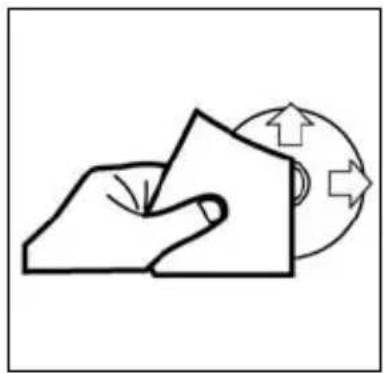
Before playing a CD, wipe it off with a clean, dust-free cleaning cloth. Pull out the CD in the direction of the arrow.
Note: Do not use any solvents such as petrol or thinning agents. Commercially available cleaning substances or antistatic sprays will damage the device.
natural_image
Line drawing of a hand holding a circular object with a rectangular frame above it (no text or symbols)Inserting the CD
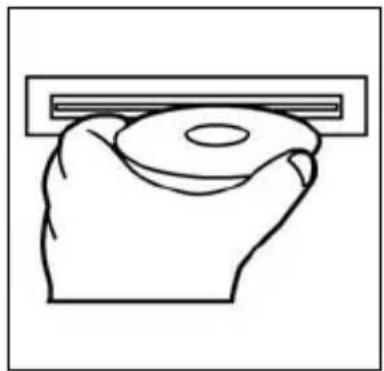
If the CD is inserted with the printed side facing downwards, the device may be damaged.
Always insert the CD with the label facing upwards.
Note: If there is already a CD in the CD slit, do not try to insert a second CD. This may damage the device.
natural_image
Simple line drawing of a hand pressing a circular button (no text or symbols)Touching the CD
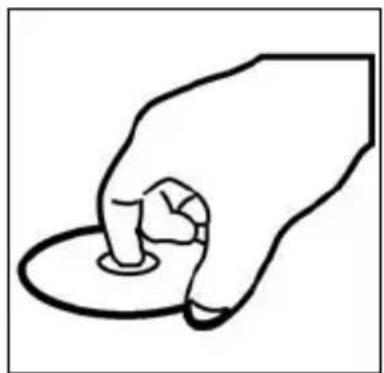
Always hold CDs by the edge. In order to keep the CD clean do not touch the surface.
- Do not attach any stickers or adhesive tape to the CD.
- Do not expose the CD to direct sunlight or sources of heat such as heating pipes. Do not leave CDs in the car if it is parked in direct sunlight as this will lead to a considerable rise in the temperature inside the car.
- Check all CDs for cracks, scratches and warping before you play them. It is possible that CDs that are damaged in this way cannot be played back correctly. Such CDs should not be used.
- Use only standard commercially available circular CDs with a 12 cm diameter! CDs with an 8 cm diameter or CDs with contours, e.g. of a butterfly or heart, are not suitable. It is possible that such CDs may not only be destroyed themselves, but may also destroy the drive of the CD player. We cannot accept liability for damage caused by the use of unsuitable CDs.

Sicherheitshinweise
natural_image
Technical illustration of an electronic device showing a housing and internal components with numbered arrows indicating assembly or movement (no text or symbols present)natural_image
Diagram showing a folded paper or sheet with motion arrows indicating rotation (no text or symbols)Reinigen der CD
natural_image
Line drawing of a hand holding a rectangular object with a circular hole, resembling a stylus or abstract form (no text or symbols)Einlegen der CD
natural_image
Simple line drawing of a hand holding a circular object (no text or symbols)Anfassen der CD
natural_image
Technical line drawing of an electronic device housing with two labeled components (1 and 2), showing internal structure and mounting points (no text or symbols beyond labels)• BEEP 2ND/BEEP ALL/BEEP OFF (Bip de confi rmation)
5. Touches I ◀◀ / ▶▶ I TUNE, SEEK, TRACK, SKIP UP/DOWN
| Appuyer 1X Appuyer 2X | |
| Touche station 1 | POP M ROCK M |
| Touche station 2 | EASY M LIGHT M |
| Touche station 3 | CLASSICS OTHER M |
| Touche station 4 | JAZZ COUNTRY |
| Touche station 5 | NATION M OLDIES |
| Touche station 6 | FOLK M |
| Appuyer | 1X Appuyer | 2X Ap | |
| Touche station 1 | NEWS AFFAIRS INFO | ||
| Touche station 2 | SPORT EDUCATE DRAMA | ||
| Touche station 3 | CULTURE | SCIENCE VARIED | |
| Touche station 4 | WEATHER | FINANCE | CHILDREN |
| Touche station 5 | SOCIAL | RELIGION | PHONE IN |
| Touche station 6 | TRAVEL LEISURE | DOCUMENT | |
buyer
3X
natural_image
Diagram showing a folded paper or sheet with motion arrows indicating rotation (no text or symbols)Nettoyage des CD
natural_image
Line drawing of a hand holding a rectangular object with a circular hole, no text or symbols presentChargement des CD
natural_image
Simple line drawing of a hand pressing down on a circular object (no text or symbols)Manipulation des CD
natural_image
Technical line drawing of a device housing with two labeled components (1 and 2), showing internal structure and mounting points (no text or symbols beyond labels)10. TA Traffic Annonouncement
natural_image
Diagram showing a folded paper or sheet with motion arrows indicating rotation (no text or symbols)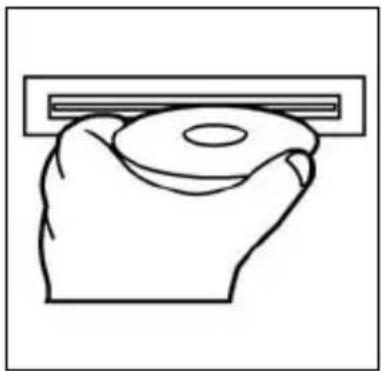
natural_image
Line drawing of a hand holding a rectangular object with a circular hole, resembling a stylus or abstract form (no text or symbols)Inserimento CD
natural_image
Simple line drawing of a hand pressing down on a circular object (no text or symbols)Toccare il CD
natural_image
Technical illustration of an electronic device showing a front panel and internal components with numbered arrows (no text or symbols)Aantal kwantificeringsbits ....1 bit.
Signaalformaat ......Monsterfrequentie 44,1 KHz
Frequentiekarakteristiek ....20 - 100Hz ≤ 5dB .... 10 - 20KHz ≤ 5dB
Signaal-ruis-verhouding....50 dB (1KHz)
Aantal kanalen.... 2 stereokanalen
Apparaatbehuizing.... 178 B x 50 H x 165 D
natural_image
Diagram showing a folded paper or sheet with motion arrows indicating rotation (no text or symbols)Reinigen van de CD
natural_image
Line drawing of a hand holding a rectangular object with a circular hole, resembling a stylus or abstract form (no text or symbols)Plaatsen van de CD
natural_image
Simple line drawing of a hand pressing down on a circular object (no text or symbols)

- Road Safety
- When installing and connecting the radio please note the following safety information.
- Installation Tips:
- Installation
- Note:
- Connection
- Important Information for installing your carradio!
- Operating Instructions
- Operation
- REL Button
- SEL Button (Select)
- - LOUD ON/LOUD OFF
- • VOL LAST/VOL ADJ
- LCD (liquid crystal display)
- BND button
- |◀◀ / ▶▶ | Buttons TUNE, SEEK, TRACK, SKIP UP/DOWN
- MOD Button
- MU Button (Mute)
- A.P Button (Autostore - Automatic Station Storage)
- b) CD/MP3 Operation
- TA Traffic Announcement (Priority for Traffic Information)
- PTY Button - Selection of the Programme Type
- ▲ Eject Button
- POWER BUTTON
- CLK Button (Time)
- USB Connection
- Technical data
- General
- FM band
- AM band
- (Line Out)
- CD player
- Troubleshooting
- Handling a CD
- Cleaning the CD
- Inserting the CD
- Touching the CD
- Sicherheitshinweise
- Reinigen der CD
- Einlegen der CD
- Anfassen der CD
- • BEEP 2ND/BEEP ALL/BEEP OFF (Bip de confi rmation)
- Touches I ◀◀ / ▶▶ I TUNE, SEEK, TRACK, SKIP UP/DOWN
- Nettoyage des CD
- Chargement des CD
- Manipulation des CD
- TA Traffic Annonouncement
- Inserimento CD
- Toccare il CD
- Reinigen van de CD
- Plaatsen van de CD
Brand : Marquant
Model : MCR718
Category : Car radio