NS236 - Speakers YAMAHA - Free user manual and instructions
Find the device manual for free NS236 YAMAHA in PDF.


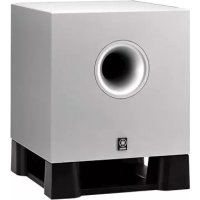
| Product Type | Active Subwoofer |
| Brand | YAMAHA |
| Model | NS236 (YST-SW005) |
| Dimensions (W x H x D) | 200 mm x 365 mm x 375 mm |
| Weight | 8.5 kg |
| Output Power | 55 W (USA/Canada) / 50 W (other models) at 5 Ω |
| Frequency Response | 30 Hz to 200 Hz |
| Speaker | 16 cm cone woofer |
| Power Supply | AC 110-120/220-240 V, 50/60 Hz (depending on model) |
| Power Consumption | 60 W (Standby: 0.8 W) |
| Technology | Advanced YAMAHA Active Servo Technology |
| Inputs | INPUT1 (Speaker terminals) / INPUT2 (RCA line level) |
| Outputs | OUTPUT to main speakers |
| Special Features | Auto standby mode (AUTO STANDBY), voltage selector |
| Installation | Leave 20 cm clearance around, avoid heat sources and humidity |
| Maintenance | Clean with a dry cloth, do not use chemical solvents |
| Safety | Do not expose to rain or moisture, unplug during storms |
| Repairability | Contact an authorized YAMAHA service center, do not open the cabinet |
| Supplied Accessories | Non-skid pads, speaker cables (depending on kit) |
Frequently Asked Questions - NS236 YAMAHA
User questions about NS236 YAMAHA
0 question about this device. Answer the ones you know or ask your own.
Ask a new question about this device
Download the instructions for your Speakers in PDF format for free! Find your manual NS236 - YAMAHA and take your electronic device back in hand. On this page are published all the documents necessary for the use of your device. NS236 by YAMAHA.
USER MANUAL NS236 YAMAHA
UNPACKING After unpacking, check that the following items are contained.
CAUTION: Read this before operating your unit.
● To assure the finest performance, please read this manual carefully. Keep it in a safe place for future reference.
- Install the speakers in a cool, dry, clean place – away from windows, heat sources, sources of excessive vibration, dust, moisture and cold. Avoid sources of humming (transformers, motors). To prevent fire or electric shock, do not expose the speakers to rain or water.
- To prevent the enclosure from warping or discoloring, do not place the speakers where they will be exposed to direct sunlight or excessive humidity.
- Avoid installing the speakers where foreign objects may fall onto them and/or where they may be exposed to liquid dripping or splashing.
Do not place the following objects on top of the speakers:
- Other components, as they might cause damage and/or discoloration on the surface of the speakers.
- Burning objects (i.e. candles), as they might cause fire, damage to the speakers and/or personal injury.
-
Containers with liquid in them, as they might cause electric shock to the user and/or damage to the speakers.
-
Do not place the speakers where they are liable to be knocked over or struck by falling objects. Stable placement will also ensure better sound performance.
- Placing the speakers on the same shelf or rack as the turntable can result in feedback.
- Secure placement or installation is the owner's responsibility. YAMAHA shall not be liable for any accident caused by improper placement or installation of speakers.
- Any time you note distortion, reduce the volume control on your amplifier to a lower setting. Never allow your amplifier to be driven into "clipping". Otherwise the speakers may be damaged.
- When using an amplifier with a rated output power higher than the nominal input power of the speakers, care should be taken never to exceed the speakers' maximum input.
- Do not attempt to clean the speakers with chemical solvents as this might damage the finish. Use a clean, dry cloth.
- Do not attempt to modify or fix the speakers. Contact qualified YAMAHA service personnel when any service is needed. The cabinet should never be opened for any reason.
- Be sure to read the "TROUBLESHOOTING" section regarding common operating errors before concluding that the speakers are faulty.
For YST-SW005
- Do not operate this unit upside down. It may overheat, possibly causing damage.
- Do not use excessive force on switches, controls or connection wires. When moving this unit, first disconnect the power plug and the wires connected to other equipments. Never pull the wires themselves.
- Since this unit has a built-in power amplifier, heat will radiate from the rear panel. Place the unit apart from the walls, allowing enough spaces above, behind and on both sides of the unit to prevent fire or damage. Furthermore, do not position with the rear panel facing down on the floor or other surfaces.
Be sure to allow spaces of at least 20 cm above, behind and on both sides of the unit.
- When using a humidifier, be sure to avoid condensation inside this unit by allowing enough spaces around this unit or avoiding excess humidification. Condensation might cause a fire, damage to this unit, and/or electric shock.
- Do not cover the rear panel of this unit with a newspaper, a tablecloth, a curtain, etc. in order not to obstruct heat radiation. If the temperature inside this unit rises, it may cause fire, damage to this unit and/or personal injury.
- Do not plug in this unit to a wall outlet until all connections are completed.
- The voltage to be used must be the same as that specified on the rear panel. Using this unit with a higher voltage than specified is dangerous and may cause fire, damage to this unit, and/or personal injury. YAMAHA will not be held responsible for any damage resulting from use of this unit with a voltage other than specified.
● To prevent lightning damage, disconnect the AC power plug when there is an electric storm.
● Super-bass frequencies reproduced by this unit may cause a turntable to generate a howling sound. In such a case, move this unit away from the turntable. - This unit may be damaged if certain sounds are continuously outputted at high volume level. For example, if 20 Hz–50 Hz sine waves from a test disc, bass sounds from electronic instruments, etc. are continuously outputted, or when the stylus of a turntable touches the surface of a disc, reduce the volume level to prevent this unit from being damaged.
- If you hear distorted noise (i.e. unnatural, intermittent "rapping" or "hammering" sounds) coming from this unit, reduce the volume level. Extremely loud playing of a movie soundtrack's low frequency, bass-heavy sounds or similarly loud popular music passages can damage this speaker system.
- Vibration generated by super-bass frequencies may distort images on a TV. In such a case, move this unit away from the TV set.
- When disconnecting the power cord from the wall outlet, grasp the plug; do not pull the cord.
- When not planning to use this unit for a long period (i.e. vacation, etc.), disconnect the AC power plug from the wall outlet.
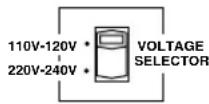
● VOLTAGE SELECTOR (For China, Korean and General models)
The voltage selector switch on
the rear panel of this unit must
be set for your local main
voltage BEFORE plugging this unit into the AC main supply.
Voltages are 110-120/220-240 V AC, 50/60 Hz.
Standby mode
If the POWER switch is set to the ON position and the AUTO STANDBY switch is set to the HIGH or LOW position, this unit turns into the standby mode when no signal is received by this unit for 7 to 8 minutes.
In this state, this unit is designed to consume a very small quantity of power.
WARNING
TO REDUCE THE RISK OF FIRE OR ELECTRIC SHOCK, DO NOT EXPOSE THIS UNIT TO RAIN OR MOISTURE.
For Canadian Customers
To prevent electric shock, match wide blade of plug to wide slot and fully insert.
This Class B digital apparatus complies with Canadian ICES-003.
For U.K. customers
If the socket outlets in the home are not suitable for the plug supplied with this appliance, it should be cut off and an appropriate 3 pin plug fitted. For details, refer to the instructions described below.
Note: The plug severed from the mains lead must be destroyed, as a plug with bared flexible cord is hazardous if engaged in a live socket outlet.
SPECIAL INSTRUCTIONS FOR U.K. MODEL
IMPORTANT:
THE WIRES IN MAINS LEAD ARE COLOURED IN ACCORDANCE WITH THE FOLLOWING CODE:
Blue: NEUTRAL
Brown: LIVE
As the colours of the wires in the mains lead of this apparatus may not correspond with the coloured markings identifying the terminals in your plug, proceed as follows: The wire which is coloured BLUE must be connected to the terminal which is marked with the letter N or coloured BLACK. The wire which is coloured BROWN must be connected to the terminal which is marked with the letter L or coloured RED. Making sure that neither core is connected to the earth terminal of the three pin plug.
COMPONENTS OF THE PACKAGE
The speaker package "NS-P230 and NS-P236" is designed for use in a multi-channel audio system such as a home theater system.
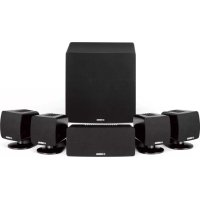
NS-P230 includes four NX-230P speaker systems, one NX-C230 speaker system and one YST-SW005 subwoofer system.
NS-P236 includes five NX-230P speaker systems, one NX-C230 speaker system and one YST-SW005 subwoofer system.
Full range acoustic-suspension speaker system used for the main and rear speakers (and rear center speaker for NS-P236)
Full range acoustic-suspension speaker system used for the center speaker
Active Servo Processing Subwoofer System with a built-in power amplifier
- This subwoofer system employs Advanced YAMAHA Active Servo Technology which YAMAHA has developed for reproducing higher quality super-bass sound. (Refer to page 14 for details on Advanced YAMAHA Active Servo Technology.) This super-bass sound adds a more realistic, theater-in-the-home effect to your stereo system.
- This subwoofer can be easily added to your existing audio system by connecting to either the speaker terminals or the line output (pin jack) terminals of the amplifier.
●The AUTO STANDBY switch saves you the trouble of setting the POWER switch to the ON or OFF position.
CONTENTS
UNPACKING ...... Inside of Front Cover
CAUTION 1
COMPONENTS OF THE PACKAGE ...... 2
SETTING UP THE SPEAKERS 3
Placing the subwoofer 4
Placing the center speaker 4
Mounting the rear speakers (and rear center speaker for NS-P236) 5
Placing the main/rear speakers (and rear center speaker for NS-P236).... 6
CONNECTIONS....7
An example of basic connections .... 7
How to connect speaker cables to the input and output terminals of the speakers....9
Connecting the subwoofer to speaker output terminals of the amplifier 10
USING THE SUBWOOFER (YST-SW005) ... 11
Controls and their functions 11
Adjusting the subwoofer before use 12
Frequency characteristics.... 13
ADVANCED YAMAHA ACTIVE SERVO
TECHNOLOGY (for YST-SW005) 14
TROUBLESHOOTING 15
SPECIFICATIONS 16
SETTING UP THE SPEAKERS
Before making connections, place all speakers in their respective positions. The positioning of the speakers is important because it controls the whole sound quality of this system.
Place the speakers depending on your listening position by following the instructions below.
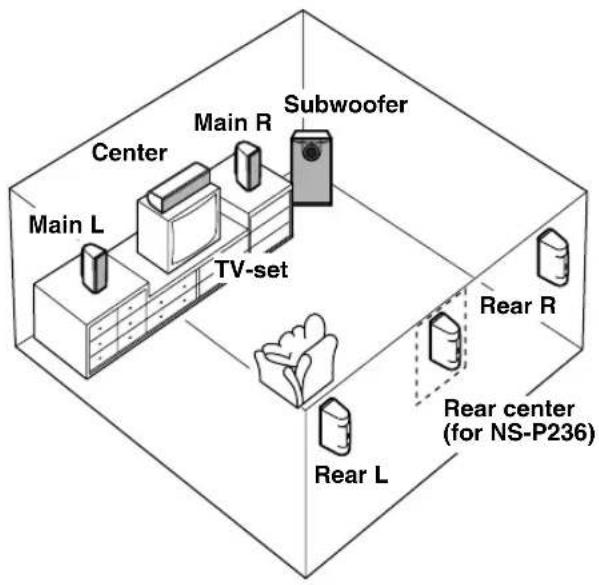
Speaker configuration
This speaker package employs a 6 speaker configuration: 2 main speakers, 2 rear speakers, a center speaker and a subwoofer.
The main speakers emit main source sound. The rear speakers emit surround sounds, and the center speaker emits center sounds (dialog etc.). The subwoofer emits reinforcing low frequencies on your audio system.
This speaker package employs a 7 speaker configuration: 2 main speakers, 2 rear speakers, a center speaker, a rear center speaker and a subwoofer.
The main speakers emit main source sound. The rear and rear center speakers emit surround sounds, and the center speaker emits center sounds (dialog etc.). The subwoofer emits reinforcing low frequencies on your audio system.
Note
In this speaker package, the same speakers (NX-230P) are used for the main and rear speakers (and rear center speaker for NS-P236).
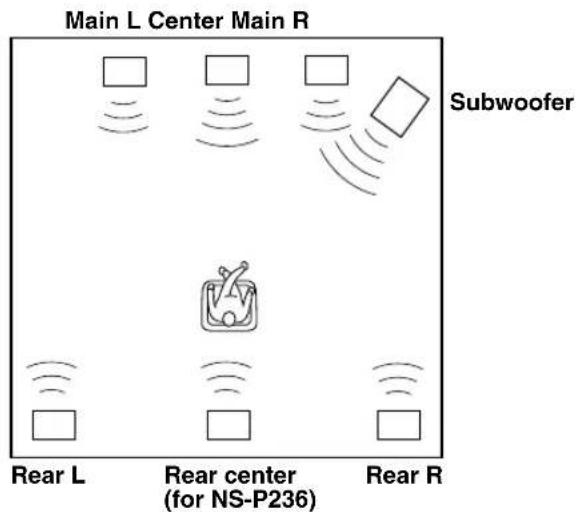
Placing speakers
Main speakers: On both sides of and at approximately the same height as the TV set.
Rear speakers: Behind your listening position, facing slightly inward. About 1.8 m (approx. 6 feet) from the floor.
Center speaker: Precisely between the main speakers.
Rear center speaker (for NS-P236):
Precisely between the rear speakers.
Subwoofer: The position of the subwoofer is not so critical because low bass tones are not highly directional. Refer to "Placing the subwoofer" below for a recommended positioning of the subwoofer.
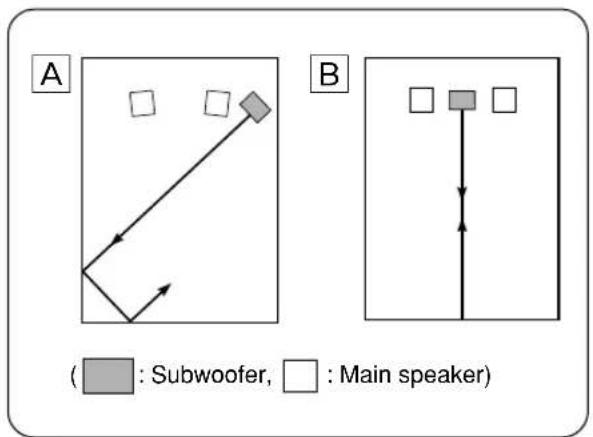
■ Placing the subwoofer
flowchart
graph TD
    subgraph_A["Scenario A"]
        direction LR
        A1["□"] --> A2["◇"]
        A2 --> A3["□"]
        A3 --> A4["□"]
        A4 --> A5["□"]
        A5 --> A6["◇"]
        A6 --> A7["□"]
        A7 --> A8["◇"]
        A8 --> A9["□"]
        A9 --> A10["◇"]
    end
    subgraph_B["Scenario B"]
        direction LR
        B1["□"] --> B2["◇"]
        B2 --> B3["□"]
        B3 --> B4["□"]
        B4 --> B5["□"]
        B5 --> B6["◇"]
        B6 --> B7["□"]
        B7 --> B8["◇"]
        B8 --> B9["□"]
        B9 --> B10["◇"]
    end
    style A fill:#f9f,stroke:#333
    style B fill:#ccf,stroke:#333
natural_image
Diagram showing a container with four circular holes and a magnified inset of the same container (no text or symbols)It is recommended to place the subwoofer on the outside of either the right or the left main speaker. (See fig. A.) The placement shown in fig. B is also possible, however, if the subwoofer system is placed directly facing the wall, the bass effect may die because the sound from it and the sound reflected by the wall may cancel out each other. To prevent this from happening, face the subwoofer system at an angle as shown in fig. A.
Note
There may be a case that you cannot obtain enough superbass sounds from the subwoofer when listening in the center of the room. This is because "standing waves" have been developed between two parallel walls and they cancel the bass sounds.
In such a case, face the subwoofer obliquely to the wall. It also may be necessary to break up the parallel surfaces by placing bookshelves etc. along the walls.
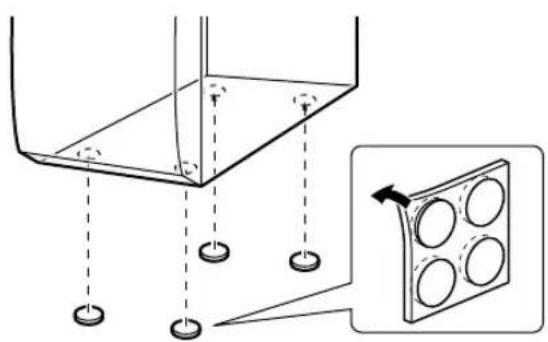
Use the nonskid pads
Put the provided nonskid pads at the four corners on the bottom of the subwoofer to prevent the subwoofer from moving by vibrations etc.
■Placing the center speaker
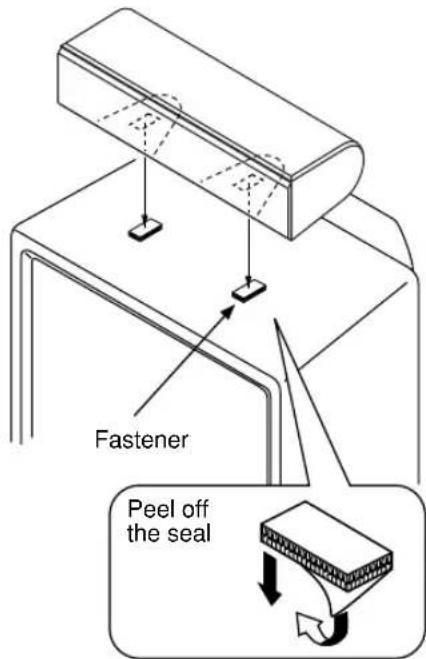
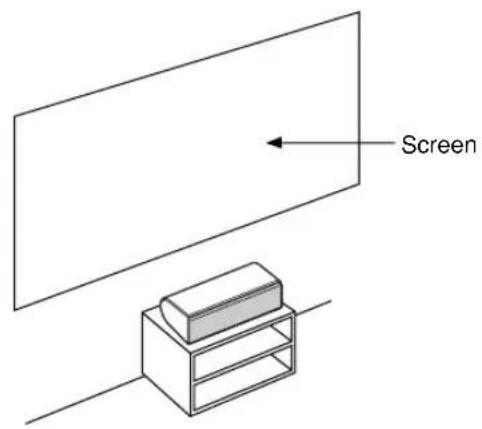
You can place the speaker on top of the TV if the top is flat, on the floor under the TV, or inside the TV rack. Be sure to place the speaker in a stable position.
When placing the speaker on top of the TV, to prevent the speaker from falling, attach the provided fasteners at two points on the bottom of the speaker and on the top of the TV.
Notes
- Do not place the speaker on top of a TV whose area is smaller than the bottom of the speaker. If placed, the speaker may fall and cause injury.
- Do not place the speaker on top of a TV if the top is inclined.
- Do not touch the adhesive surface after peeling off the seal as this will weaken its adhesive strength.
●Thoroughly wipe clean the surface where the fastener is to be applied. Note that adhesive strength is weakened if the surface is dirty, oily or wet and that this may cause the center speaker to fall.
■Mounting the rear speakers (and rear center speaker for NS-P236)
1
Tapping screw (Available at the hardware store)
2

Using the Yamaha Speaker Stand SPS-80 (option)
By using the Yamaha Speaker Stand SPS-80, speakers can be placed on the floor.
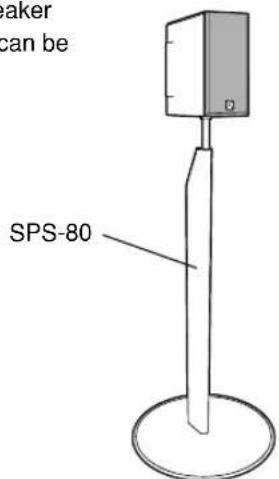
* The SPS-80 is not available in some areas.
Mount the rear speakers (and rear center speaker for NS-P236) on a shelf, rack or directly on the floor, or hang them on the wall.
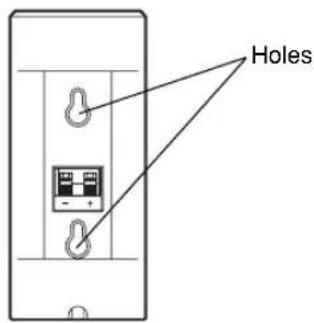
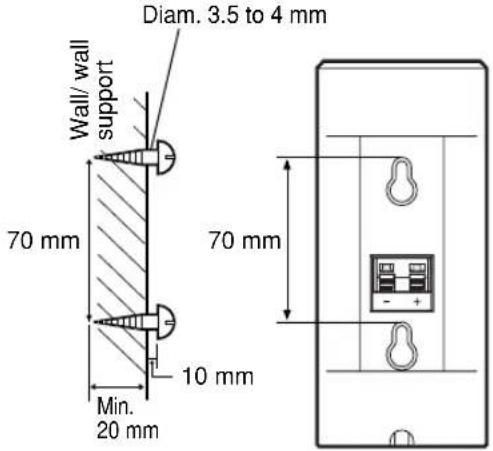
To mount the speakers on a wall by using the holes on the speakers' back panels
1 Fasten screws into a firm wall or wall support as shown in the figure.
2 Hang the speaker by mounting the holes on the protruding screws.
* Make sure that the screws are securely affixed by the narrow parts of the holes.
WARNING
●Each speaker weighs 0.9 kg (2 lbs.). Do not mount them on thin plywood or a wall composed of a soft surface material. If mounted, the screws may pull out of the flimsy surface and the speakers may fall. This may damage the speakers or cause personal injury.
- Do not affix the speakers to a wall using nails, adhesives, or any other unstable hardware. Long-term use and vibrations may cause the speakers to fall.
- To avoid accidents resulting from tripping over loose speaker cables, fix the cables to the wall.
- Select an appropriate position on the wall to mount the speaker so that no one will injure his/her head or face.
■Placing the the main/rear speakers (and rear center speaker for NS-P236)
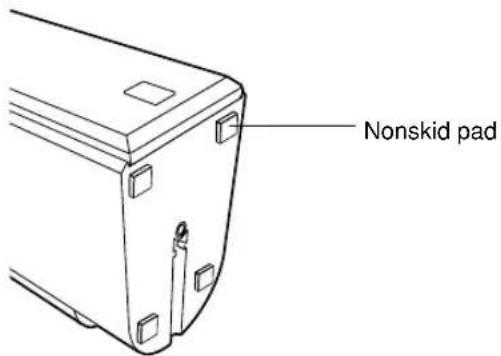
When placing the speakers on a flat surface, attach the included nonskid pads to the corners on the bottom of the speakers as shown on the left. This prevents the speakers from sliding around.
* For NS-P236, the nonskid pads include four spare ones.
If you want to mount a speaker on a commercially available speaker stand for the main/rear speakers (and rear center speaker for NS-P236)
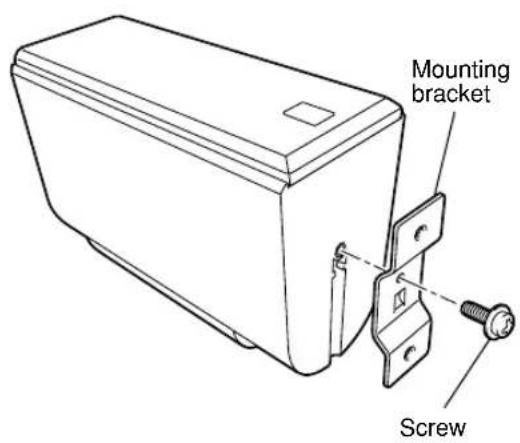
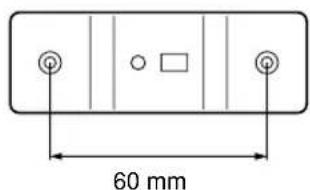
The provided mounting bracket with 1 pair of screw holes (at an interval of 60 mm) can be used to mount the speaker on a speaker stand.
* Those screw holes can be used with M4 screws only.
1 Attach the bracket to the bottom of the speaker by using the provided screw so that the convex part of the bracket fits in the grooved part on the bottom of the speaker as shown on the left.
2 Mount the speaker on the speaker stand by using the screw holes on the bracket.
Note
The mounting bracket is provided for each speaker.
CONNECTIONS
Caution: Plug in the subwoofer and other audio/video components after all connections are completed.
■An example of basic connections
flowchart
graph TD
    A["Main speakers"] --> B["Front R"]
    A --> C["Front L"]
    D["Center speaker"] --> E["CENTER"]
    F["Amplifier"] --> G["Central Speaker"]
    H["Subwoofer"] --> I["Subwoofer"]
    I --> J["INPUT2 /MOND"]
    J --> K["INPUT1 FROM AMPILER"]
    K --> L["OUTPUT TO SPEAKERS"]
    L --> M["To AC outlet"]
    N["Rear speaker Right"] --> O["Central Speaker"]
    P["Rear center speaker (for NS-P236)"] --> Q["Central Speaker"]
    R["Rear speaker Left"] --> S["Central Speaker"]
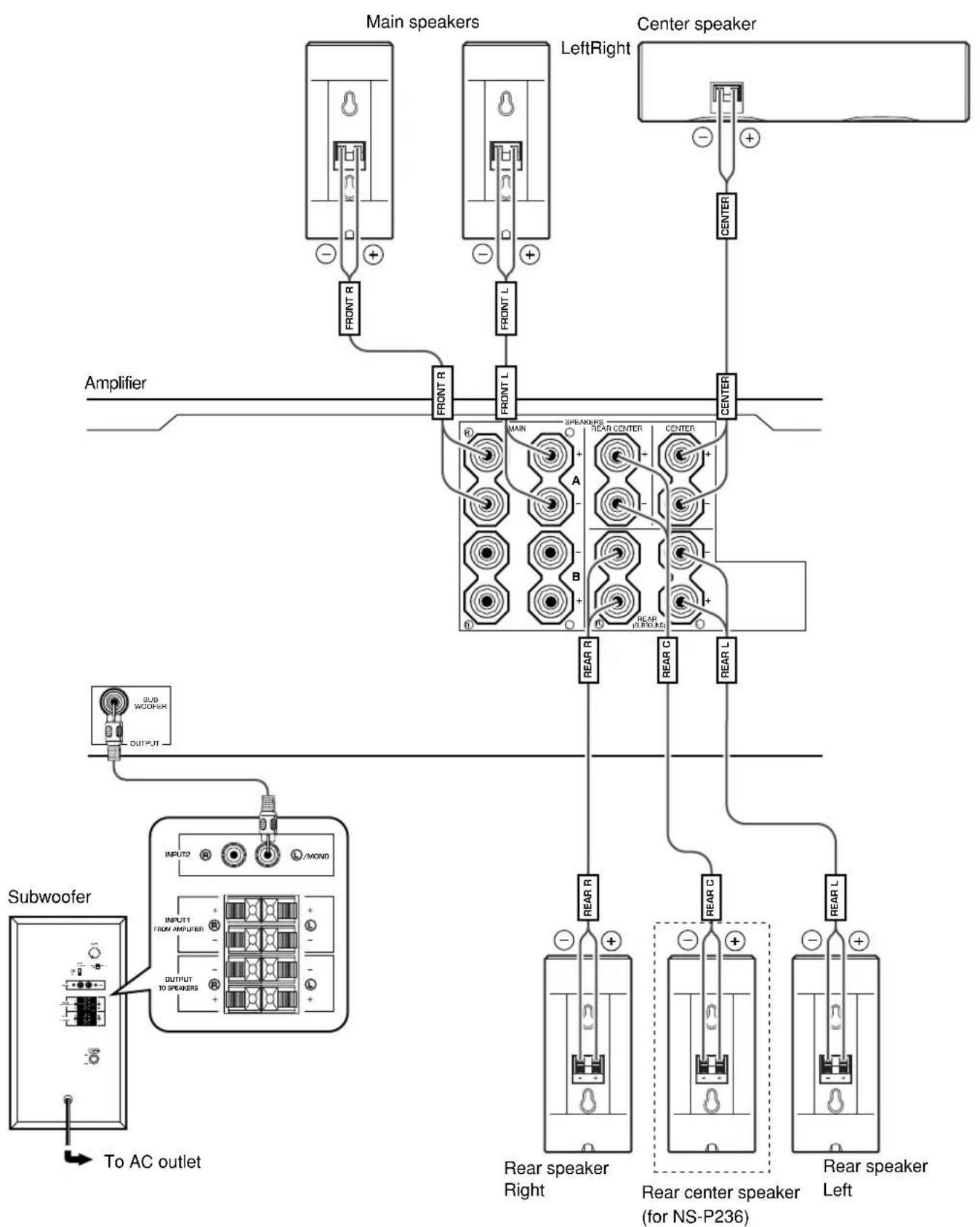
- Connect the main, center and rear speakers (and rear center speaker for NS-P236) to the speaker output terminals of your amplifier with the provided speaker cables.
* The provided speaker cables have labels marked FRONT L, FRONT R, CENTER, REAR L, REAR R (and REAR C for NS-P236). Connect each speaker cord to the corresponding speaker by following the figure on page 7.
* Connect each speaker making sure not to reverse the polarity (+, -). If the speaker is connected with reversed polarity, the sound will be unnatural and lack bass.
* For the main and rear speakers only, connect one speaker to the left (marked L) terminals of your amplifier, and another speaker to the right (marked R) terminals.
- Basically, connect the subwoofer to the line output (pin jack) terminal(s) of the amplifier. If your amplifier does not have any line output terminal, connect the subwoofer to the speaker output terminals of the amplifier. (Refer to page 9 for details.)
* To connect with a YAMAHA DSP amplifier (or AV receiver), connect the SUBWOOFER (or LOW PASS etc.) terminal on the rear of the DSP amplifier (or AV receiver) to the ①/MONO INPUT2 terminal of the subwoofer.
* To connect the subwoofer to the SPLIT SUBWOOFER terminals on the rear of the DSP amplifier, connect them to both the left Ⓛ and right Ⓡ INPUT2 terminals of the subwoofer.
Note
When connecting to a monaural line output terminal of the amplifier, connect to the Ⓛ/MONO INPUT2 terminal.
■How to connect speaker cables to the input and output terminals of the speakers
For connections, keep the speaker cables as short as possible. Do not bundle or roll up the excess part of the cables. If the connections are faulty, no sound will be heard from the speakers.
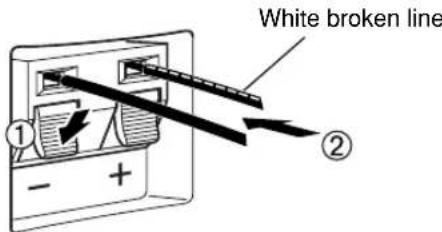
Main/center/rear speakers Rear center speaker (for NS-P236)
One side of the provided speaker cable has a white broken line and the other side has no line.
Connect the (+) terminals on both the speaker and the amplifier using the side with a white broken line. Connect the (−) terminals on both components using the side with no line.
Red: positive (+)
Black: negative (−)
Subwoofer (INPUT1/OUTPUT terminals)
Connect the (+) terminals on both the subwoofer and the amplifier using one side of the cable. Connect the (−) terminals on both components using the other side of the cable.
Red: positive (+)
Black: negative (−)
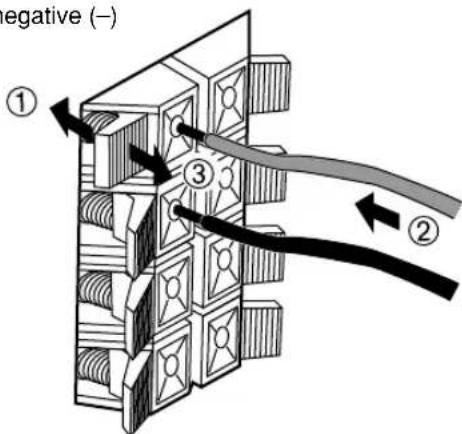
Before connecting
Remove the insulation coating at the extremity of each speaker cable by twisting the coating off.
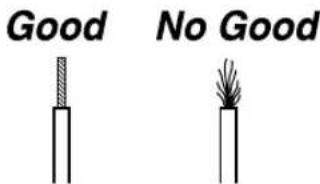
How to Connect:
①Press and hold the terminal's tab, as shown in the figure.
②Insert the bare wire.
③ Release your finger from the tab to allow it to lock securely on the cable's wire end.
④Test the firmness of the connection by pulling lightly on the cable at the terminal.
Note
Do not let the bare speaker wires touch each other as this could damage the speaker or the amplifier, or both of them.
■ Connecting the subwoofer to speaker output terminals of the amplifier
If your amplifier has two sets of speaker output terminals
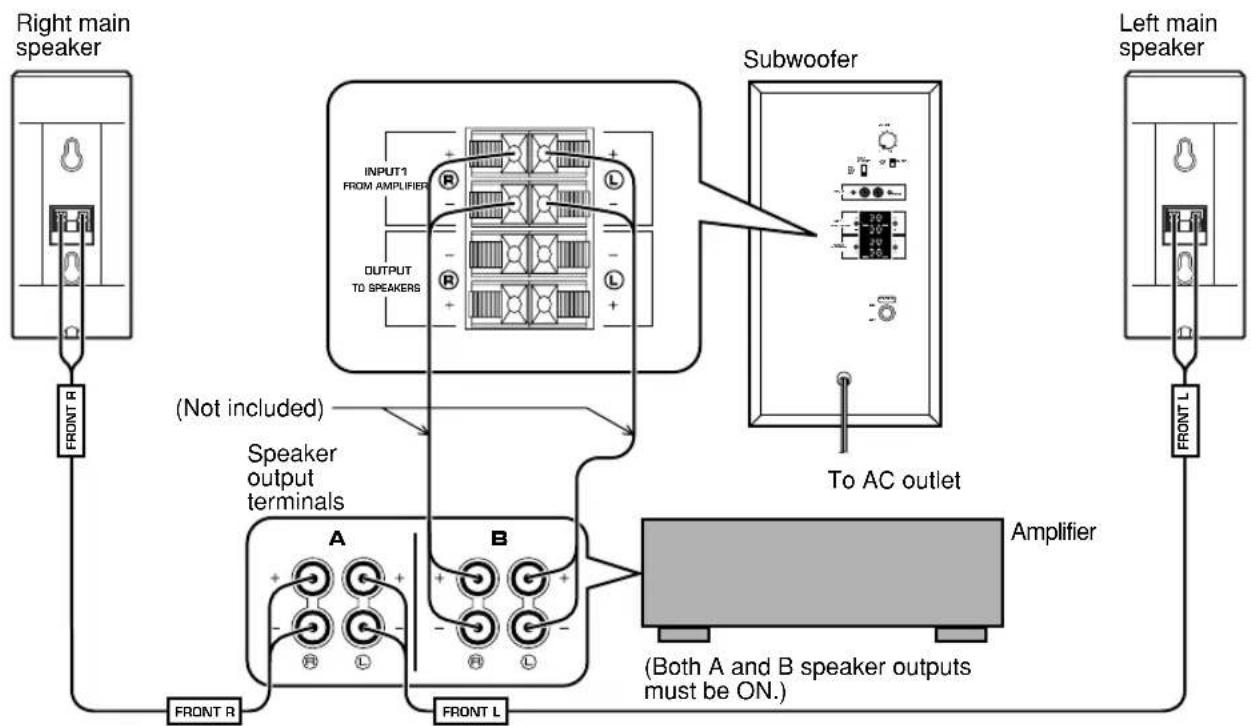
flowchart
graph TD
    A["Right main speaker"] --> B["FRONT R"]
    B --> C["Speaker output terminals A and B"]
    C --> D["Subwoofer"]
    D --> E["To AC outlet"]
    E --> F["Left main speaker"]
    F --> G["FRONT L"]
    G --> H["Speaker outputs must be ON."]
    C --> I["INPUT1 FROM AMPLIFIER"]
    C --> J["OUTPUT TO SPEAKERS"]
    style A fill:#f9f,stroke:#333
    style F fill:#f9f,stroke:#333
    style G fill:#ccf,stroke:#333
If your amplifier has only one set of main speaker output terminals
Connect the speaker output terminals of the amplifier to the INPUT1 terminals of the subwoofer, and connect the OUTPUT terminals of the subwoofer to the main speakers.

flowchart
graph TD
    A["Right main speaker"] --> B["FRONT R"]
    B --> C["Subwoofer"]
    C --> D["To AC outlet"]
    D --> E["INPUT1 FROM AMPLIFIER"]
    D --> F["OUTPUT TO SPEAKERS"]
    E --> G["Speaker output terminals"]
    F --> G
    G --> H["Left main speaker"]
    H --> I["FRONT L"]
    I --> J["Amplifier"]
    J --> K["(Not included)"]
USING THE SUBWOOFER (YST-SW005)
■ Controls and their functions
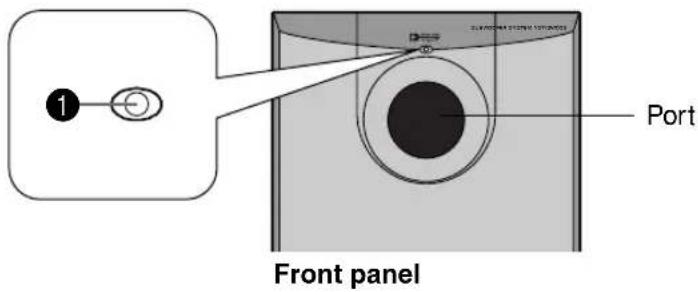
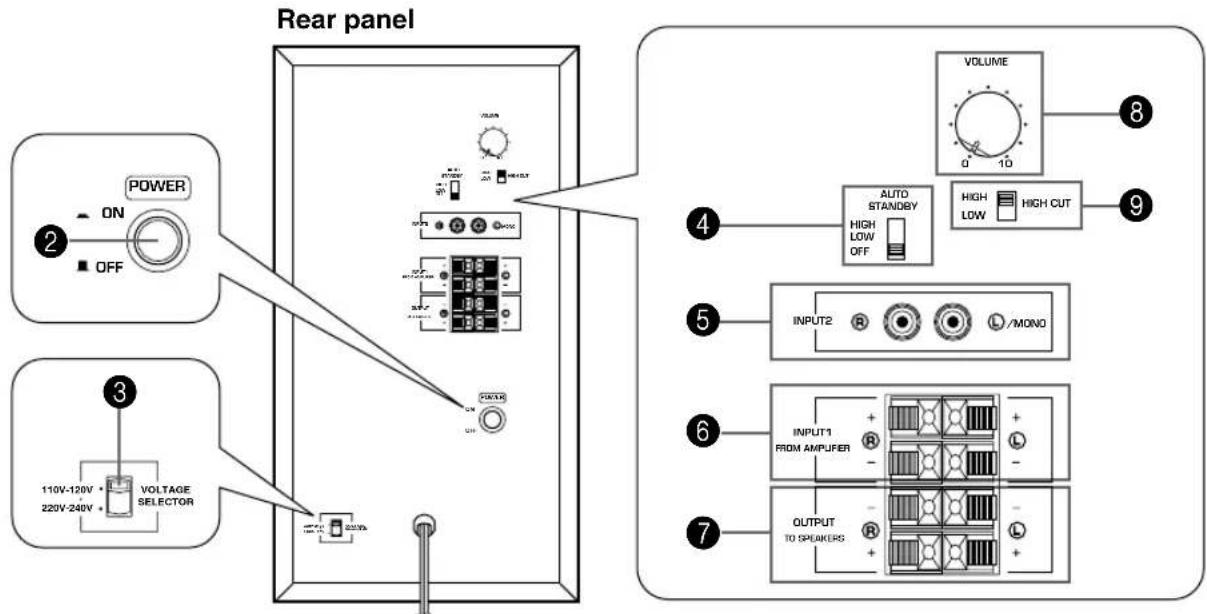
① Power indicator
Lights up GREEN when the POWER switch (2) is pressed in to the ON position and goes off when set to the OFF position.
* Standby mode
If the POWER switch (②) is pressed in to the ON position and the AUTO STANDBY switch (④) is set to the HIGH or LOW position, this indicator lights up RED when no signal is received by the subwoofer.
2 POWER switch
Press this switch to the ON position to turn on the power of the subwoofer. When the power of the subwoofer is on, the power indicator (1) on the front panel lights up GREEN. Press this switch again to set to the OFF position to turn off the power of the subwoofer.
③ VOLTAGE SELECTOR switch
(For China, Korean and General models)
If the preset setting of the switch is incorrect, set the switch to the proper voltage range (220V-240V or 110V-120V) of your area.
Consult your dealer if you are unsure of the correct setting.
WARNING
Be sure to unplug the subwoofer before setting the VOLTAGE SELECTOR switch correctly.
4 AUTO STANDBY (HIGH/LOW/OFF) switch
This switch is originally set to the OFF position. By setting this switch to the HIGH or LOW position, the subwoofer's automatic power-switching function operates as explained on page 9. If you do not need this function, set to the OFF position.
* Make sure to change the setting of this switch only when the POWER switch (2) is in the OFF position.
5 INPUT2 terminals
Used to input line level signals from the amplifier.
6 INPUT1 (FROM AMPLIFIER) terminals
Used to connect the subwoofer with the speaker terminals of the amplifier.
7 OUTPUT (TO SPEAKERS) terminals
Can be used for connecting to the main speakers. Signals from the INPUT1 terminals (6) are sent to these terminals.
8 VOLUME control
Adjusts the volume level. Turn the control clockwise to increase the volume, and counterclockwise to decrease the volume.
9 HIGH CUT (HIGH/LOW) switch
Selects the high frequency cut off point. Normally, it is set to LOW, however, you may set to HIGH if necessary. Refer to page 12–13.
Automatic power-switching function
If the source being played is stopped and the input signal is cut off for 7 to 8 minutes, the subwoofer automatically switches to the standby mode. (When the subwoofer switches to the standby mode by the automatic power-switching function, the power indicator lights up in red.) When you play a source again, the power of the subwoofer turns on automatically by sensing audio signals input to the subwoofer.
This function will operate by sensing a certain level of low frequency input signal. Usually set the AUTO STANDBY switch to the LOW position. However, if the power is not switched to ON or STANDBY smoothly, set the switch to the HIGH position. In the HIGH position, the power will turn on even with a low level of input signal. But please be aware that the subwoofer may not switch to the standby mode when there is an extremely low input signal.
* The power might turn on unexpectedly by sensing noise from other appliances. If that occurs, set the AUTO STANDBY switch to the OFF position and use the POWER switch to switch the power between ON and OFF manually.
* This function detects the low-frequency components below 200 Hz of the input signals (i.e., the explosion in the action movie, the sound of the bass guitar or the bass drum, etc.).
* The minutes required to switch the subwoofer to the standby mode might change by sensing noise from other appliances.
This function is available only when the power of the subwoofer is on (by pressing the POWER switch).
■ Adjusting the subwoofer before use
Before using the subwoofer, adjust the subwoofer to obtain the optimum volume and tone balance between the subwoofer and the main speakers by following the procedures described below.
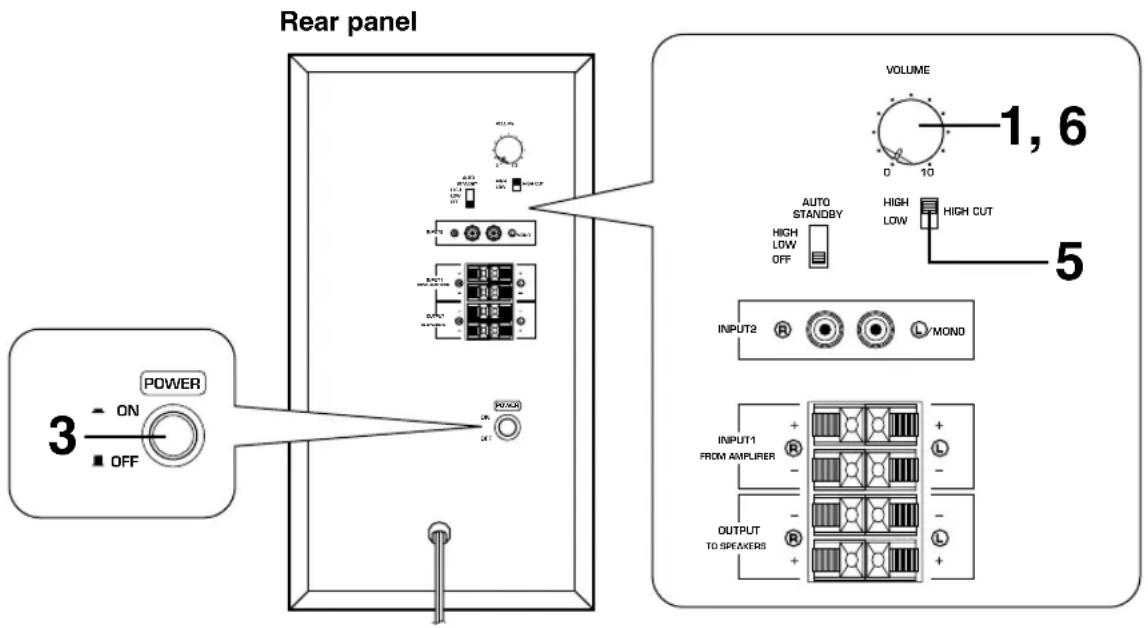
1 Set the VOLUME control to minimum (0).
2 Turn on the power of all the other components.
3 Press the POWER switch to the ON position.
* The power indicator on the front panel lights up in green.
4 Play a source containing low-frequency components and adjust the amplifier's volume control to the desired listening level.
5 Set the HIGH CUT switch to the LOW or HIGH position.
This subwoofer is designed so that the optimum tone balance between the subwoofer and the main speakers is obtained when this switch is set to the LOW position. The tone balance may change, however, depending on the room size, the distance from the subwoofer to the main speakers, and so on. If necessary, switch it to the HIGH position.
6 Increase the volume gradually to adjust the volume balance between the subwoofer and the main speakers.
Normally, set the control to the level where you can obtain a little more bass effect than when this unit is not used. If the desired response cannot be obtained, adjust the HIGH CUT switch and the VOLUME control again.
- Once the volume balance between the subwoofer and the main speakers is adjusted, you can adjust the volume of your whole sound system by using the amplifier's volume control.
However, if you change the main speakers (NX-230P) to others, you must make this adjustment again.
- For adjusting the VOLUME control and the HIGH CUT switch, refer to "Frequency characteristics" below.
■ Frequency characteristics
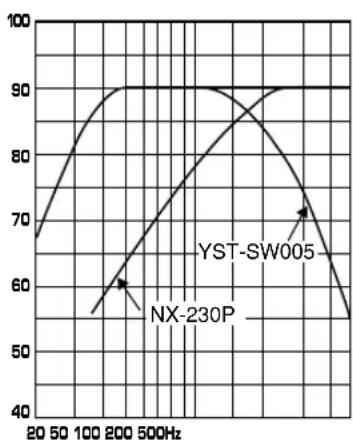
Fig. 1 shows the frequency characteristics of the subwoofer with each position (HIGH/LOW) of the HIGH CUT switch.
Fig. 2 shows the optimum volume level with the HIGH CUT switch at the HIGH position, and the frequency characteristics when the subwoofer is combined with NX-230P.
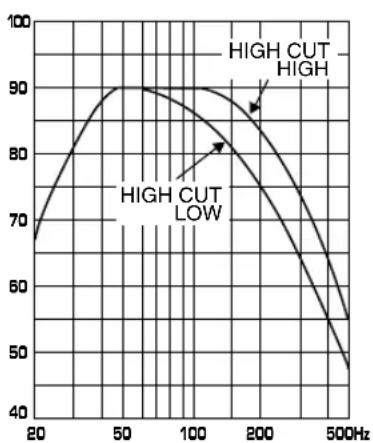
line
| Frequency | HIGH CUT LOW | HIGH CUT HIGH | | --------- | ------------ | ------------- | | 20 | 68 | - | | 50 | 90 | - | | 100 | 85 | - | | 200 | - | 85 | | 500 | - | 48 |Fig. 1
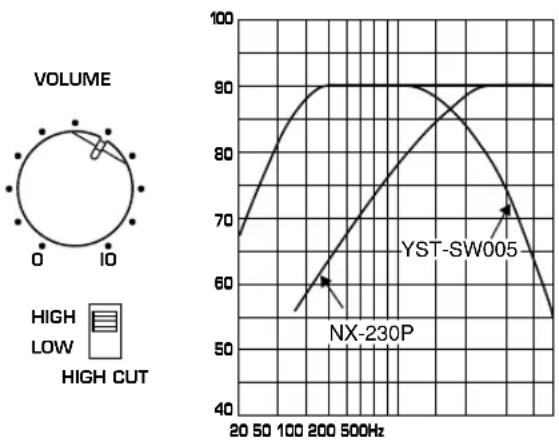
line
| Frequency | Volume | High Cut | | --------- | ------ | -------- | | 200 Hz | 60 | Low | | 500 Hz | 90 | High |Fig. 2
ADVANCED YAMAHA ACTIVE SERVO TECHNOLOGY (for YST-SW005)
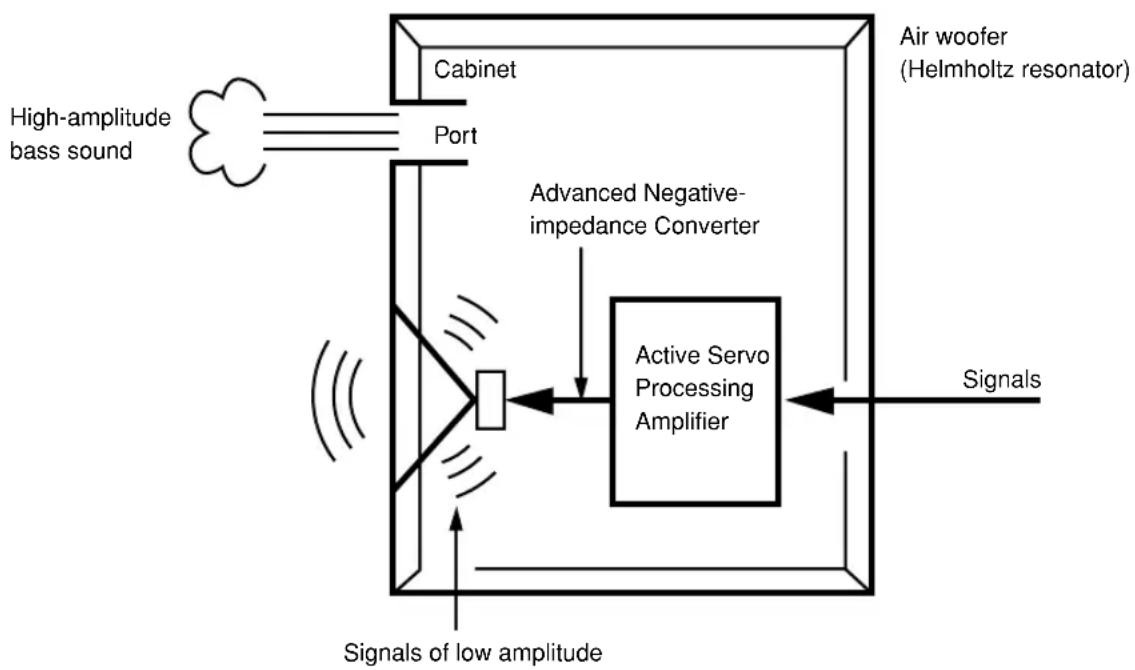
The theory of Yamaha Active Servo Technology has been based upon two major factors, the Helmholtz resonator and negative-impedance drive. Active Servo Processing speakers reproduce the bass frequencies through an “air woofer”, which is a port or opening in the speaker’s cabinet. This opening is used instead of, and performs the functions of, a woofer in a conventionally designed speaker system. Thus, signals of low amplitude within the cabinet can, according to the Helmholtz resonance theory, be outputted from this opening as waves of great amplitude if the size of the opening and the volume of the cabinet are in the correct proportion to satisfy a certain ratio.
In order to accomplish this, moreover, the amplitudes within the cabinet must be both precise and of sufficient power because these amplitudes must overcome the "load" presented by the air that exists within the cabinet.
Thus it is this problem that is resolved through the employment of a new design in which the amplifier supplies special signals. If the electrical resistance of the voice coil could be reduced to zero, the movement of the speaker unit would become linear with respect to signal voltage. To accomplish this, a special negative-impedance output-drive amplifier for subtracting output impedance of the amplifier is used.
By employing negative-impedance drive circuits, the amplifier is able to generate precise, low-amplitude, low-frequency waves with superior damping characteristics.
These waves are then radiated from the cabinet opening as high-amplitude signals. The system can, therefore, by employing the negative-impedance output drive amplifier and a speaker cabinet with the Helmholtz resonator, reproduce an extremely wide range of frequencies with amazing sound quality and less distortion.
The features described above, then, are combined to be the fundamental structure of the conventional Yamaha Active Servo Technology.
Our new Active Servo Technology — Advanced Yamaha Active Servo Technology — adopted Advanced Negative Impedance Converter (ANIC) circuits, which allows the conventional negative impedance converter to dynamically vary in order to select an optimum value for speaker impedance variation. With this new ANIC circuits, Advanced Yamaha Active Servo Technology can provide more stable performance and improved sound pressure compared with the conventional Yamaha Active Servo Technology, resulting in more natural and dynamic bass reproduction.
flowchart
graph TD
    A["High-amplitude bass sound"] --> B["Cabinet"]
    B --> C["Port"]
    C --> D["Active Servo Processing Amplifier"]
    D --> E["Air woofer (Helmholtz resonator)"]
    E --> F["Signals"]
    D --> G["Advanced Negative-impedance Converter"]
    G --> D
    D --> H["Signals of low amplitude"]
Refer to the chart below when this unit does not function properly. If the problem you are experiencing is not listed below or if the instructions given below do not help, disconnect the power cord and contact your authorized YAMAHA dealer or service center.
| Problem | Cause | What to Do |
| No sound. | Speaker cables are not connected securely. | Connect them securely. |
| Sound level is too low. | Speaker cables are not connected correctly. | Connect them correctly, that is L (left) to L, R (right) to R, “+” to “+” and “-” to “-”. |
For YST-SW005
| Problem | Cause | What to Do |
| Power is not supplied even though the POWER switch is set to the ON position. | The power plug is not securely connected. | Connect it securely. |
| No sound. | The VOLUME control is set to 0. | Turn the VOLUME control to the right (clockwise). |
| Speaker cables are not connected securely. | Connect them securely. | |
| Sound level is too low. | Speaker cables are not connected correctly. | Connect them correctly, that is L (left) to L, R (right) to R, “+” to “+” and “-” to “-”. |
| A source sound with few bass frequencies is played. | Play a source sound with bass frequencies.Set the HIGH CUT switch to the “HIGH” position. | |
| It is influenced by standing waves. | Reposition the subwoofer or break up the parallel surface by placing bookshelves etc. along the walls. | |
| The subwoofer does not turn on automatically. | The POWER switch is set to the OFF position. | Set the POWER switch to the ON position. |
| The AUTO STANDBY switch is set to the OFF position. | Set the AUTO STANDBY switch to the “HIGH” or “LOW” position. | |
| The level of input signal is too low. | Set the AUTO STANDBY switch to the “HIGH” position. | |
| The subwoofer does not turn into the standby mode automatically. | There is an influence of noise generated from external appliances etc. | Move the subwoofer farther away from such appliances and/or reposition the connected speaker cables.Otherwise, set the AUTO STANDBY switch to the “OFF” position. |
| The AUTO STANDBY switch is set to the OFF position. | Set the AUTO STANDBY switch to the “HIGH” position. | |
| The subwoofer turns into the standby mode unexpectedly. | The level of input signal is too low. | Set the AUTO STANDBY switch to the “HIGH” position. |
| The subwoofer turns on unexpectedly. | There is an influence of noise generated from external appliances etc. | Move the subwoofer farther away from such appliances and/or reposition the connected speaker cables.Otherwise, set the AUTO STANDBY switch to the “OFF” position. |
NX-230P, NX-C230
Type ...... Full range acoustic-suspension speaker system Magnetic shielding type
Driver .... 5 cm (2") full range cone speaker x 2
Nominal Input Power 30W
Maximum Input Power 100W
Impedance 6Ω
Frequency Response
Sensitivity 86 dB/2.83V/m
Dimensions (W x H x D)
(2-13/16" x 6-7/16" x 4-3/8")
(11-13/16"×2-13/16"x4-5/16")
Weight
■ YST-SW005
Type ...... Advanced Yamaha Active Servo Technology Magnetic shielding type
Driver 16 cm (6-1/2") cone woofer
Amplifier Output
U.S.A. and Canada models 55 W/5Ω
Other models 50 W/5Ω
Frequency Response 30 Hz to 200 Hz
Power Supply
U.S.A. and Canada models ...... AC 120V, 60 Hz
U.K. and Europe models ...... AC 230V, 50 Hz
Australia model..... AC 240V, 50 Hz
China, Korean and General models
AC 110-120/220-240V, 50/60 Hz
Power Consumption 60 W
(In the standby mode: 0.8 W)
Dimensions (W x H x D) ..... 200 mm x 365 mm x 375 mm
(7-7/8" x 14-7/20" x 14-3/4")
Weight 8.5 kg (18 lbs. 11 oz.)
natural_image
Diagram showing a container with four circular holes and a magnified inset of the same container (no text or symbols)Subwoofer (bornes INPUT1/OUTPUT)
line
| Frequency | Value | | --------- | ----- | | 20 | 60 | | 50 | 70 | | 100 | 80 | | 200 | 90 | | 500 | 80 | | 1000 | 70 | | 2000 | 60 | | 5000 | 50 |Fig. 2
ADVANCED YAMAHA ACTIVE SERVO TECHNOLOGY (pour YST-SW005)
Dimensions (L x H x P)
Poids
■ YST-SW005
Type .... Advanced Yamaha Active Servo Technology Type à blindage magnétique
natural_image
Diagram showing a container with four circular holes and a magnified inset of the same object (no text or symbols)PLACERING AV HÖGTALARNA 3
PLACERING AV HÖGTALARNA
natural_image
Diagram showing a structural component with four circular holes and dashed lines indicating alignment, alongside an inset of a multi-cylinder display (no text or symbols)COMPONENTI INCLUSI NEL PACCHETTO....2
INSTALLAZIONE DEGLI ALTOPARLANTI.....3
Pozisionamento del subwoofer 4
natural_image
Diagram showing a container with four circular holes and a magnified inset of the same container (no text or symbols)USO DEL SUBWOOFER (YST-SW005)
line
| Frequency | Volume | High Cut | | --------- | ------ | -------- | | 200 | 60 | Low | | 500 | 90 | High |Fig. 2
ADVANCED YAMAHA ACTIVE SERVO TECHNOLOGY (per I'YST-SW005)
Dimensioni (L x A x P)
Peso
■ YST-SW005
Tipo ...... Advanced Yamaha Active Servo Technology tipo con schermatura magnetica
natural_image
Diagram showing a container with four circular holes and a magnified inset of the same container (no text or symbols)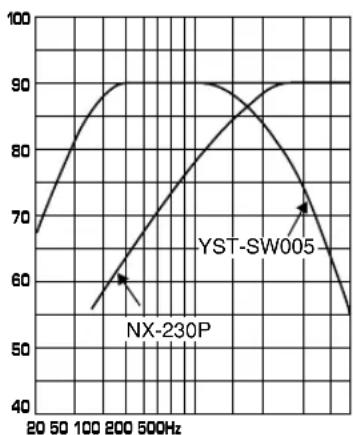
line
| Frequency | YST-SW005 | | --------- | --------- | | 200 Hz | 60 |Fig. 2
ADVANCED YAMAHA ACTIVE SERVO TECHNOLOGY (para YST-SW005)
Driver 16 cm konus-woofer