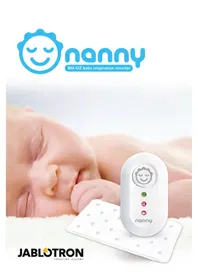
BM02 Nanny - Baby monitors Joblotron - Free user manual and instructions
Find the device manual for free BM02 Nanny Joblotron in PDF.


User questions about BM02 Nanny Joblotron
0 question about this device. Answer the ones you know or ask your own.
Ask a new question about this device
Download the instructions for your Baby monitors in PDF format for free! Find your manual BM02 Nanny - Joblotron and take your electronic device back in hand. On this page are published all the documents necessary for the use of your device. BM02 Nanny by Joblotron.
USER MANUAL BM02 Nanny Joblotron
natural_image
Blue icon of a smiling face with closed eyes and wavy hair (no text or symbols)nanny BM 02 baby respiration monitor
BM-02 baby respiration monitor
OBSAH
CS
MONITOR DÝCHÁNÍ DÍTĚTE BM-02 NANNY 3
ZÁKLADNÍ POSTUPY NEODKLADNÉ PÉČE U DĚTÍ......12
EN
BM-02 NANNY BABY BREATH MONITOR 13
GENERAL PROCEDURES FOR CHILD EMERGENCY CARE 22
DE
ATMUNGSMONITOR FÜR KINDER BM-02 NANNY 23
natural_image
Purple stylized smiley face icon with wavy hair and closed eyes (no text or symbols)tiny video monitor
video monitor
I can see and hear more

Early warning

Easy to operate

Quality video and range
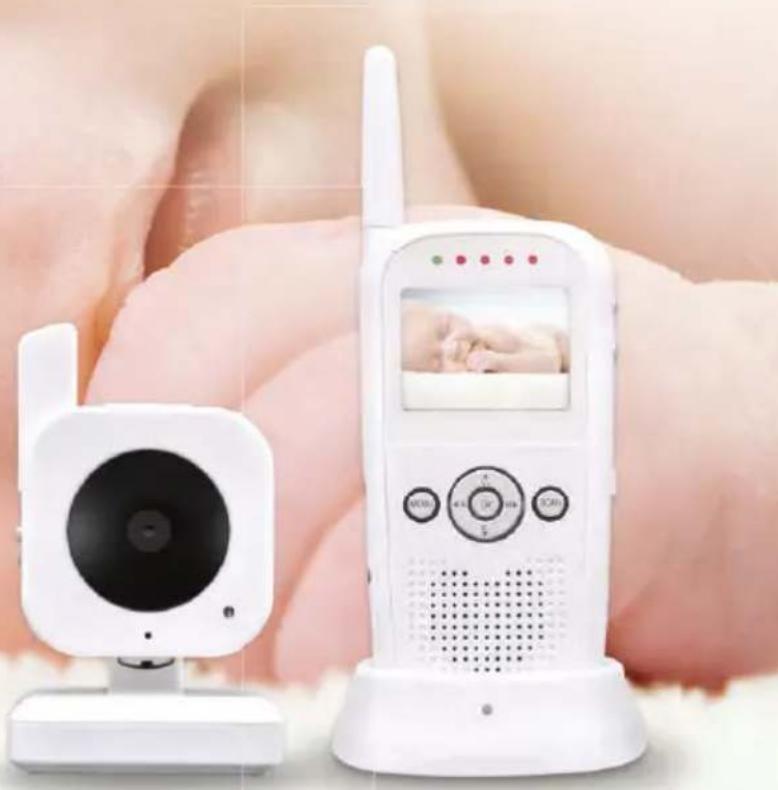
natural_image
Close-up of a hand holding two white wireless devices: a remote camera and a Wi-Fi recording device (no visible text or symbols)JABLOTRON CREATING ALARMS
MONITOR DÝCHÁNÍ DÍTĚTE BM-02 NANNY
natural_image
Illustration of a baby lying inside a wire cage with a medical device on the right side (no text or symbols)URČENÍ VÝROBKU
MONITOR DÝCHÁNÍ DÍTĚTE BM-02
natural_image
Illustration of a cage containing abstract geometric shapes (no text or symbols)natural_image
Diagram of a cage-like structure with a hanging weight and diagonal floor, no text or symbols presentnatural_image
Illustration of a baby CPR on the infant's side, showing hand placement and posture (no text or symbols)Obr. 1
2. UVOLNĚTE DÝCHACÍ CESTY
natural_image
Illustration of a baby receiving a gentle abdominal massage (no text or symbols present)Obr. 2
natural_image
Illustration of a person holding a small object, possibly a medical or robotic device (no text or symbols visible)Obr. 3
natural_image
Illustration of a person performing CPR on a baby (no text or symbols present)Obr. 4
3. ZAJISTĚTE DÝCHÁNÍ
natural_image
Illustration of a person performing CPR on a baby (no text or symbols present)Obr. 5
natural_image
Illustration of a person performing CPR on another person's head (no text or symbols visible)Obr. 6
4. ZAJISTĚTE KREVNÍ OBĚH
natural_image
Illustration of hands performing a massage or pressure technique on a patient's head (no text or symbols visible)Obr. 7
natural_image
Illustration of a baby performing CPR on the shoulder (no text or symbols present)Obr. 8
5. ULOŽTE DÍTĚ DO STABILIZOVANÉ POLOHY
natural_image
Illustration of a person performing a medical or therapeutic procedure on a patient's head (no text or symbols present)Obr. 9
- ERC Guidelines for resuscitation 2010.
JABLOTRON ALARMS a.s.
Pod Skalkou 4567/33
466 01 Jablonec nad Nisou
tel: 483 559 881, 483 559 811
e-mail: servis@jablotron.cz
prostřednictvím:
VÝHRADNÍ DISTRIBUTOR PRO ČR:
fi rma Petr Fráňa, Jožky Jabůrkové 1
779 00 Olomouc
tel.: 777 345 845
We would like to congratulate you on the birth of your child and thank you for buying our product. With this monitor you can be at ease while your baby is asleep.
natural_image
Illustration of a fetus inside a wire cage with a medical device on the right side (no text or symbols)PRODUCT DESIGNATION
BM-02 NANNY BABY BREATH MONITOR
The BM-02 is a certified medical device that monitors a baby's breathing. Its purpose is to give a timely optical and acoustic warning of any decrease in a baby's breathing frequency which may threaten her life (so-called Sudden Infant Death Syndrome). The breathing of babies younger than one year is irregular and reasons that have not yet been clarified sometimes make a baby 'forget' to take a breath. However, respiratory arrest of breath or apnea can be due to other causes as well (vomit, symptoms of certain diseases, etc.).
The device consists of a sensor pad with a sensitive detector that is placed under the baby's mattress and of an acoustic alarm (evaluation unit). The device has a very simple control. It is battery operated and runs its proper function auto-test upon startup. It does not affect or restrict the baby's movement.
The product is not designed for an oxygen-enriched environment (except for the sensor pad).
RECOMMENDED MEASURES TO REDUCE THE RISK OF SIDS
Do not put the baby to sleep on her tummy but on her back or side. Concerns about inhaling food in the latter positions have not been proven and are groundless.
Do not smoke during pregnancy and after childbirth in the presence of the baby, not even within residential premises. Nicotine has a proven inhibitory effect on the baby's respiratory center. Its presence was repeatedly detected in the blood of dead babies. When in contact with her baby a mother-smoker exhales cigarette smoke and nicotine residues even 30 minutes after finishing her last cigarette!
Make sure the baby is neither too warm nor too cold during sleep. Hyperthermia may boost bacteria growth in the airways. Their presence may trigger a complex immunologic response that may even lead even to a respiratory center arrest.
Leave the baby's head uncovered. Do not place any soft covers and pillows in the crib of a baby that is not at least 12 months old and that could pull such covers or pillows over her head.
Do not use any straps in the crib, make sure the baby's toys are free of strings or tapes longer than 30 cm. Never place plastic bags in the crib.
Warning:
The Nanny does not prevent the occurrence of sleep apnea in an infant! If operated and used in accordance with this manual, the monitor is unlikely to fail.
INSTALLATION INSTRUCTIONS
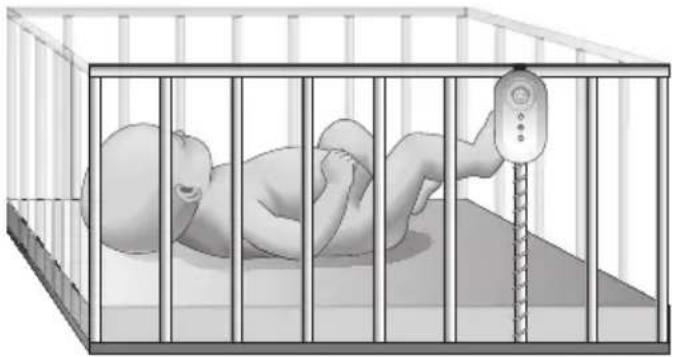
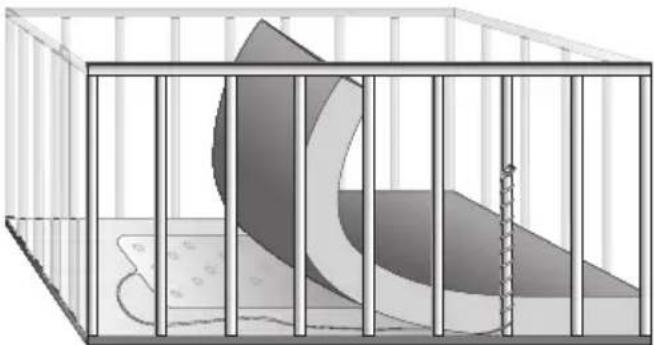
- Place the sensor pad into the crib (pram, Moses basket, etc.) under the mattress (or cushion) underneath the area where the baby will be sleeping – see the figure.
The center of the sensor pad should be approximately where the baby's chest is.
The pad should be placed on an even firm surface with the printed side facing up - It must not be bent!
If there is only a bed frame in the crib, place a firm board under the sensor pad; e. g. hardboard, plywood, etc. The base board should not cover the whole crib surface so as not to prevent air circulati-
natural_image
Illustration of a cage containing abstract geometric shapes (no text or symbols)on - its satisfactory size overhangs the sensor pad by approx. 3 cm on each side.
For further installation advice and instructions read page 18, Frequently Asked Questions.
Note:
When using the BM-02 Nanny for twins it is absolutely necessary that each baby has its own crib provided with an independent baby monitor. To ensure correct signal evaluation the cribs must not touch each other.
- Insert batteries into the device (the battery compartment cover is on the back of the device).
To remove the battery compartment cover, push its straight edge gently and move it towards the round edge - see Fig A.
Use only new alkaline batteries - AA type (do not use rechargeable batteries).
The polarity of batteries is clearly marked in the battery compartment.
Seal the battery compartment cover and turn the switch to position I.
If the batteries are in good condition, all 3 indicators will flash one after another and you will hear a beep.
If there is no beep after turning the unit ON, check the batteries.
Wait approx. 3 seconds before turning the unit on again - after turning the unit on its electronic system checks the batteries and functions.
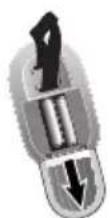
Fig A Fig B
natural_image
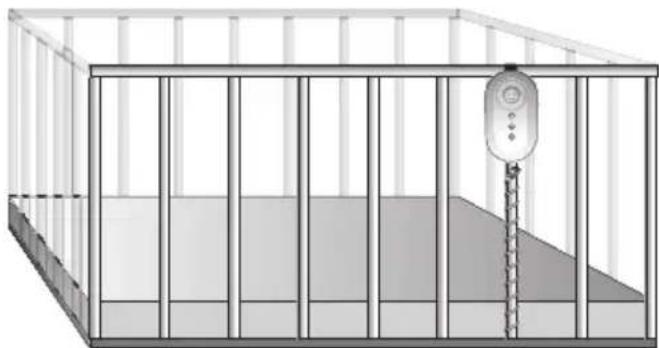
Diagram of a cage-like structure with vertical supports and a hanging device (no text or symbols)3. Attach the evaluation unit to the crib (pram, etc.) with a fastening tape.
The unit must be clearly visible and must not be covered by anything – see Fig B.
If the evaluation unit has to be mounted outside the crib, extend its cable by means of the splitting connector and the 5 m long cable (both are included in the supply).
When used for a bigger baby, mount the unit outside her reach.
It is also possible to attach the unit on the wall by means of a plastic holder (included in the supplied items).
4. Connect the sensor pad's cable to the evaluation unit. When connected properly, the connector clicks and is firmly attached.
Lead the cable so that it cannot be pulled by a bigger child and so that it is stretched properly and does not create loops.
If the whole length of the cable is not used, wind the excess cable and tighten it firmly with the binding wire supplied with the cable (keep the wound cable outside the reach of children).
To disconnect the cable from the evaluation unit push the connector lever towards the cable.
Caution:
The acoustic indicator of the breath monitoring unit must not be aimed at the baby and must be placed at least 0.5 m from her head to protect her hearing from possible damage.
THE NANNY'S SIGNALING AND CONTROL ELEMENTS
switch - position O = OFF, I = ON
green indicator – it flickers briefly to confirm the baby's breath (movement).
red indicator – it flickers to indicate a warning alarm.
red indicator – it flickers to indicate a low battery.
USING THE BM-02 NANNY MONITOR
Before using the BM-02 Nanny read this manual carefully, especially paying close attention to the chapter "First Aid – General Procedures of Emergency Child Care"!
- Put the baby in the crib.
- Turn on the evaluation unit (activation is confirmed by a beep and flickering indicators).
- The green indicator flickers in response to the baby's breathing or movements. The flickering may be irregular – its frequency corresponds to the baby's breathing or movements.
- Before taking the baby out of the crib make sure to turn the evaluation unit off.
- If the device does not detect any breathing or movement of the baby, the green indicator does not flicker, a red indicator begins to flicker after approx. 20 seconds and then the alarm goes off. Moreover, the alarm is activated when the baby's breathing frequency drops below 8 breaths per minute.
Warning:
The product should be used for babies weighing from 2 kg up to 15 kg.
ALARM STATUS
If the evaluation unit detects that the baby has not taken a breath for longer than about 20 seconds, the following type of alarm goes off: firstly, there is a short acoustic pre-alarm followed by intensive acoustic alarm accompanied with the flickering red indicator. If the child is breathing too slowly – less than 8 intakes per minute, the following type of alarm goes off: there is an immediate acoustic alarm and the green light is on constantly (it shows that there is a breathing activity) and the red light is flickering.
Check the baby. If she isn't breathing, try to wake her up. If she does not wake up, start administering first aid immediately (release her airways, start mouth-to-mouth resuscitation, etc.). We recommend contacting a doctor depending on the circumstances. In some cases the alarm signal itself rouses the baby strongly enough to make her take a breath. To turn the alarm off, press the switch on the evaluation unit. Exceptionally, a false alarm may occur, which is the case especially when the sensor pad is not fitted properly (see the Installation Instructions and the Frequently Asked Questions) or when the baby can crawl and moves outside the reach of the sensor pad inside the crib.
We hope you hear the alarm signal only once: when testing our product.
SENSOR PAD
A sensor pad can be bought as a separate item. It is available under item No. BM-02D.
It is extremely handy when the device is used in several places; e.g. in another crib, at grandma's, etc. In this case the evaluation unit is the only thing you have to remember to take along.
FUNCTION TEST
Check the operation of the device as follows (recommended testing frequency is once a week):
- When the baby is in the crib and the Nanny is on, the green indicator must flicker with the rhythm of the baby's breath.
- Leave the Nanny on and take the baby out of the crib. The indicator usually keeps flickering for a while until the crib stops shaking. Do not hold on to the crib because the Nanny could detect your breath and movements.
- When the crib has been still for about 20 seconds the evaluation unit gives off a warning beep and then an alarm signal is activated. While the alarm is on, the red indicator keeps flickering. The alarm can be turned off with the switch.
If the Nanny does not work check whether:
- The evaluation unit confirms the activation of the Nanny by a low beep and flickering. If it does not, check the batteries.
- The green indicator stops flickering after taking the baby out of the crib. If it does not, the Nanny detects disturbing vibrations – see the following information.
Important information:
The device uses a highly sensitive sensor to detect breathing. Its operation can be affected by shakes of the crib, floor or the whole building. This is why the crib must not touch a bed in which somebody is sle-
EN
eping or other equipment that vibrates. Interfering shocks can also be caused by intensive air circulation (fans, air conditioning, etc.), people walking near the crib and other factors. If you move the crib to a new place or if you turn on a new appliance that generates mechanical vibrations in your home (interfering vibrations preventing the device from monitoring the baby's breathing), we recommend that you test the function of the BM-02 Nanny.
You should avoid using mattresses made of hard materials (foam polystyrene, etc.) that absorb disturbing vibrations caused by the movement of the ambient air.
Bear in mind that the device can only warn you in the case of an emergency but that it does not prevent the risk of a breathing stoppage! If the baby has any physical problem, it is up to you or your doctor to provide appropriate help. Do not stay too far from your baby to make sure that you hear the alarm, should it go off, and that you are able to respond.
The manufacturer is responsible for the functionality of the BM-02 Nanny provided it is installed and used in accordance with this manual. The manufacturer waives any responsibility for the proper functionality of the product in the event that it is mechanically or otherwise damaged or for battery defects. Moreover, the manufacturer waives any responsibility in the event that the product has been used in contradiction to this user manual.
The manufacturer urges you not to purchase a used product or to get it from a rental store. Rough handling may reduce the sensitivity of the sensor, which may have its consequences. Should this be the case the manufacturer waives all responsibility for the functionality of the product.
BATTERY REPLACEMENT
The device checks its battery status. When the batteries are running low, necessary replacement is signaled by the indicator flickering red. Also, the device does not confirm the activation of the switch when the batteries are discharged. Turn off the device before replacing the batteries. Remove the battery compartment cover (see the Installation Instructions – page 14) and take out the original batteries. Always use only new, branded alkaline AA batteries (the polarity is clearly marked in the battery compartment). Once you have replaced the batteries, turn the device on briefly – its activation must be confirmed by a beep. Do not use rechargeable batteries. When finished using the device, take the batteries out.
CLEANING AND MAINTENANCE
Besides battery replacement, the Nanny does not require any special maintenance. We recommend that you occasionally check the sensor pad in the crib to make sure that no moisture precipitates in the area where the pad touches the mattress. You should turn the pad inside the crib by 180° once in a while, or turn it over and air it. Clean the pad with a slightly moist cloth. (Do not use aggressive detergents.). Contact with water can cause damage to the Nanny. The Nanny is supplied with an antibacterial tissue for disinfecting the pad, if necessary. The frequency of cleaning does not affect the service life of the product. Protect the sensor pad, supply cable and connector from mechanical damage (shocks, sagging, tensile stress, etc.). If you detect any damage, contact the vendor or the manufacturer's service department directly (page 22).
FREQUENTLY ASKED QUESTIONS
1. Why does the BM-02 Nanny trigger an alarm when the baby is breathing regularly?
Cause:
There is not sufficient contact between the sensor pad and the movement of the baby's body while the baby is breathing.
Solution:
Babies up to 3 months are small in weight and do not change their position in the crib; therefore, you should place the sensor pad directly under the sheet, towel or blanket on which the baby is lying. This minimizes the possible occurrence of false alarms. As soon as the baby starts to move around the crib, install the sensor pad under the mattress.
If the baby is lying with her head supported (when a doctor suggests that her head be higher than her body), good mechanical contact between the baby, the mattress and the sensor pad must be maintained. Underlay the bed frame (not only the mattress) to comply with the condition in the previous sentence. Alternatively, support the back legs of the crib.
Make sure that the mattress applies its entire weight on the sensor pad. The mattress must not be fitted between the crib walls too tightly so that it does not get caught above the bed frame.
2. Why doesn't the alarm go off after the baby's been taken out of the crib?
Cause:
The sensor pad can detect various vibrations, for instance:
▶ People walking around the crib which stands on a parquet or laminate floor. The crib legs must be supported with an anti-vibration underlay – e.g. carpet pieces.
An open window nearby the crib in windy weather. These interferences must be eliminated to ensure the Nanny's proper operation.
The crib leans on a fridge or another source of vibrations. Move the crib.
3. How should the BM-02 Nanny be used when monitoring twins?
Solution:
Each twin must have her own crib and the cribs must not touch each other. Each baby must have its own Nanny; i.e. an independent monitor. Do not connect two separate pads to one evaluation unit as this would jeopardize the babies' lives.
4. Can the Nanny be used in a pram, cradle or Moses basket?
Solution:
Yes, but only on the condition that the pram is not moving and that nobody touches it. It must be parked in a quiet windless place – i.e. not outside, on a porch, etc. The wind can have a negative impact on the Nanny and may prevent the alarm from being activated should the baby stop breathing. The same applies to cradles and Moses baskets.
5. Why does the device give a low battery warning immediately after being switched on?
Solution:
Make sure you haven't used so-called rechargeable batteries (Their voltage is lower and the device evaluates this condition as low batteries.). Only alkaline batteries can be used.
6. Why doesn't the device react to the baby's movement properly anymore?
Cause:
Make sure that the supply cable or its connector is not damaged. If the cable is not attached to the crib as described in this manual it can be pulled by the baby and damaged. Another possible cause is the careless handling of the sensor pad (it being dropped on the floor, etc.).
Solution:
Contact our Service Department.
7. Can a liquid leak from the pad?
Answer:
That is absolutely impossible. The pad does not contain any liquid. Please follow the information on page 17 - Cleaning and Maintenance:
8. What should I do in the case of defects?
Solution:
If you experience any difficulties with the device, please contact our distributor's customer line before you contact your retailer. Difficulties are not always caused by a defect. In most cases they follow from wrong device installation, misunderstanding the user manual, etc. We will be happy to help you solve any problems so that the Nanny can keep a reliable eye on your baby. However, if a technical defect occurs, we will find the best solution for you as soon as possible so that your baby is not left unmonitored.
Thank you.
TECHNICAL DATA
| Power 3 V 2×1.5 V AA size alkaline batteries | |
| Standby current <0.2 mA | |
| Alarm current <120 mA | |
| Battery low indication level 2.38 V ± 0.15 V | |
| Monitored breathing frequency <8 breaths/minute (i.e.<0.13 Hz) | |
| Average battery life 6 months (gets reduced by frequent alarm testing) | |
| Sensor pad type BM-02D, max. size | 305×500×15 mm, |
| weight: 1000 g, material: PVC-P | |
| Acoustic alarm level 75 dB/m | |
| Control unit max. size 140×80×35 mm | m, weight 123 g, material ABS |
| Operating conditions | +5 °C to +35 °C at 30 % to 75 % relative humidity |
| Transport and storage | 0 °C to +40 °C, relative humidity 10 % to 85 %, |
| Product characteristics | type BF applied part  |
Accessories:
sensor pad, control unit, 5 m long extension cable, plastic wall attachment, splitting connector, 2 antibacterial tissues, 2 alkaline batteries type AA 1.5 V. Product service life: 2 years (from the date of purchase).
Certification was carried out by the following notified body: EZÚ Prague, No. 1014. CE1014 The product underwent clinical testing and was registered by the Health Ministry of the Czech Republic as a medical instrument of the 2nd category.
JABLOTRON ALARMS a.s. hereby declares that the BM-02 complies with the essential requirements and other respective provisions of Directives 93/42/EC and 2007/47/EC and 2011/65/EU (RoHS). The original compliance certifi cate can be found at www.jablotron.com.
Note: Discharged batteries should not be disposed of as household waste but returned to a designated collecting point. Even though the product is free of harmful materials, it should not be disposed of with other waste but returned to a vendor or the manufacturer.

GENERAL PROCEDURES FOR CHILD EMERGENCY CARE
First aid – steps designed to save someone's life in the case of arrested breathing or blood circulation. Warning: First aid should be administered by an experienced fi rst-aider!
The basic procedures of child emergency care include a sequence of steps designed to restore sufficient breathing and blood circulation in children who have suffered breathing or blood circulation arrest. The following procedure applies to babies – newborns and infants:
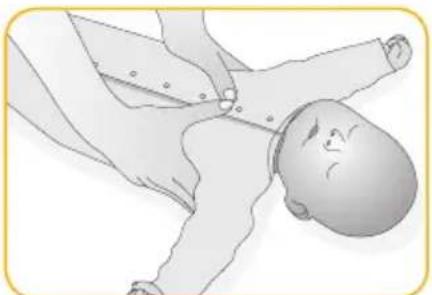
1. CHECK THE BABY'S CONSCIOUSNESS
▶ Call the baby distinctly and loudly.
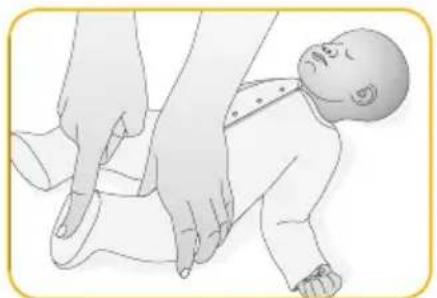
If the baby does not respond, tap or scratch its sole to elicit the baby's response (fi g. 1).
Alternatively, rub the baby's back with your hand for several seconds.
If the baby is lifeless and unresponsive, she is unconscious.
▶ Call your local UK emergency rescue service on 999 or dial the European emergency telephone number 112.
natural_image
Illustration of a baby CPR on the infant's abdomen, showing hand placement and posture (no text or symbols)Fig. 1
2. OPEN YOUR BABY'S AIRWAY
Check the baby's mouth. Remove obvious obstacles and objects with your fi ngertips.
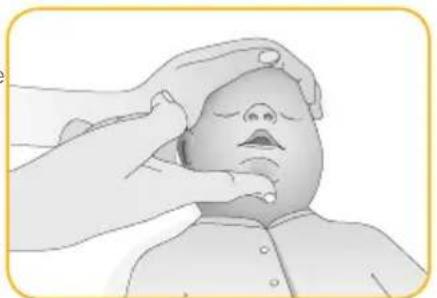
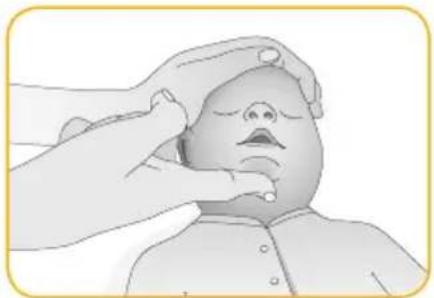
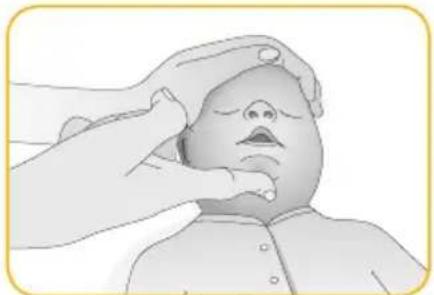
Put one hand on the baby's forehead and tilt its head a little, while gently lifting the chin with the fingers of your other hand (fig. 2).
Keep the airway clear by placing some support under the baby's shoulders.
If you suspect that the baby has inhaled a foreign object (i.e. the breathing problem occurred suddenly – for instance, while eating, playing with a tiny toy; or the baby is coughing, wheezing, has audible diffi culty breathing, its face is reddish and neck and face are swollen meanwhile the skin may turn blue or grayish). Try to remove the object from the airways as follows:
natural_image
Illustration of a baby receiving a gentle abdominal massage (no text or symbols present)Fig. 2
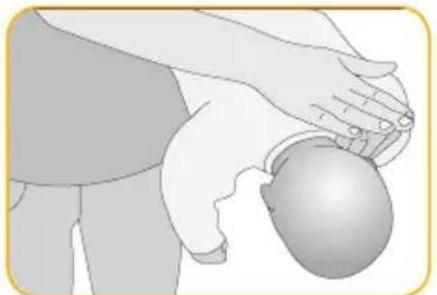
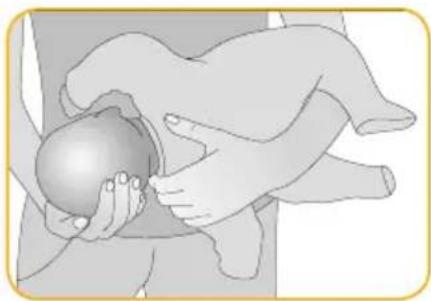
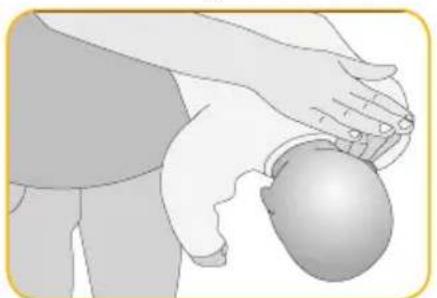
Give 3-5 backslaps
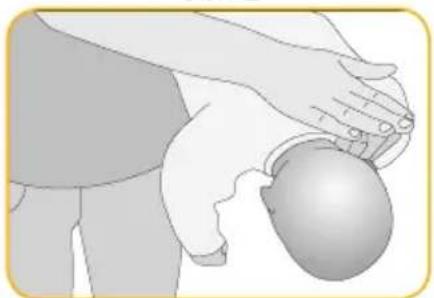
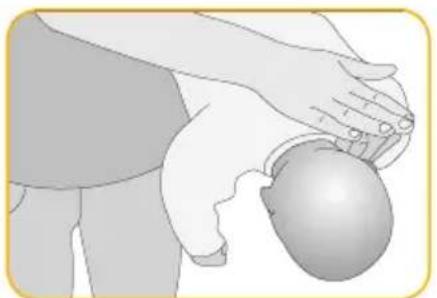
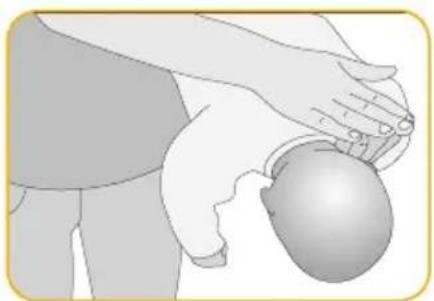
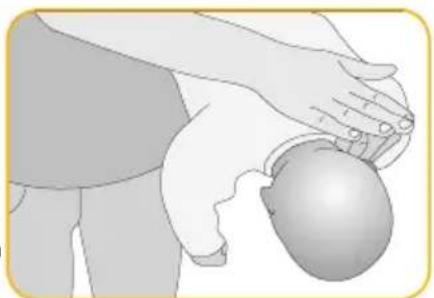
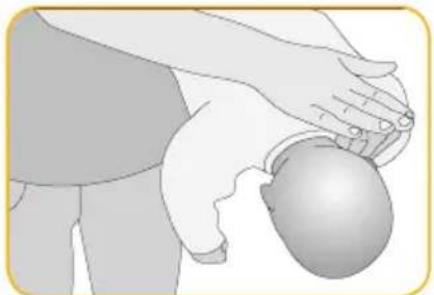
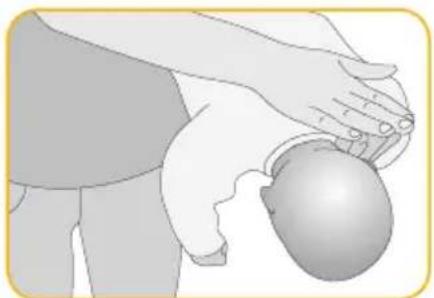
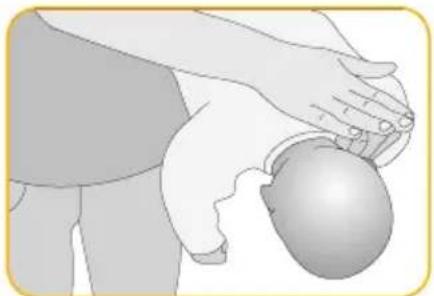
Position the baby with her face down on your forearm. Her head must be lower than the rest of her body. Support her head and body with your hands all the time (fi g. 3).
Give her 3-5 slaps between her shoulder blades with 2-3 of your fingers or possibly with your hand; your hand must be oriented away from the airways.
Alternatively, hold the baby by its ankles, (the ankle area must not be covered with clothes), turn her with her head facing down and perform the same maneuver. If the maneuver is not successful do the following:
natural_image
Illustration of a person holding a medical device (no text or symbols visible)Fig. 3
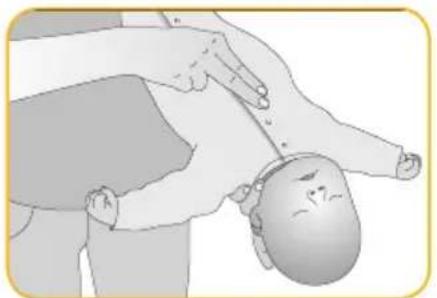
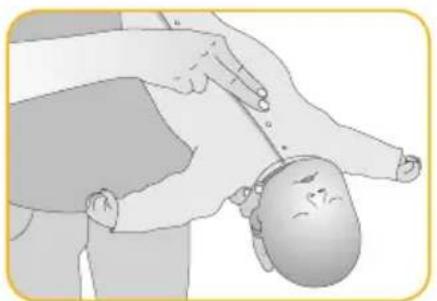
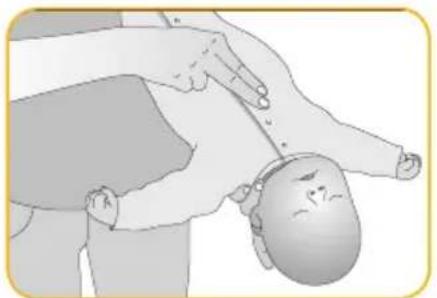
Give 3-5 chest thrusts
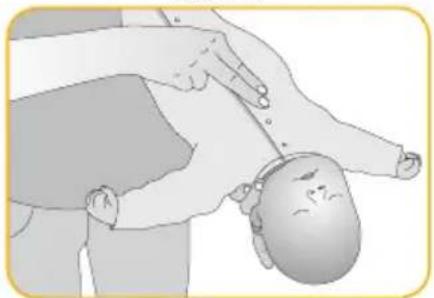
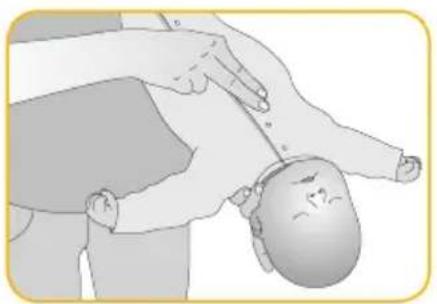
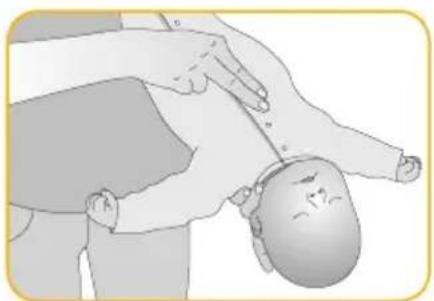
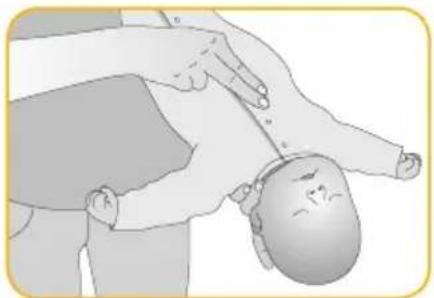
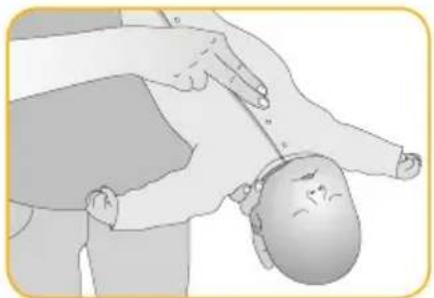
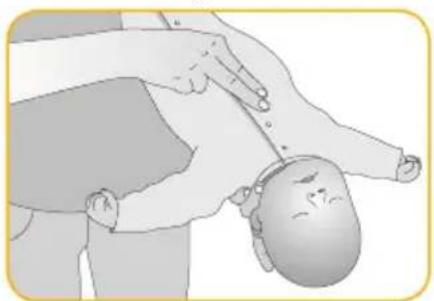
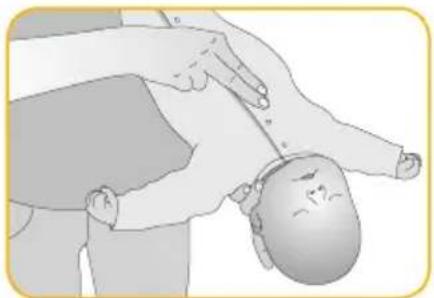
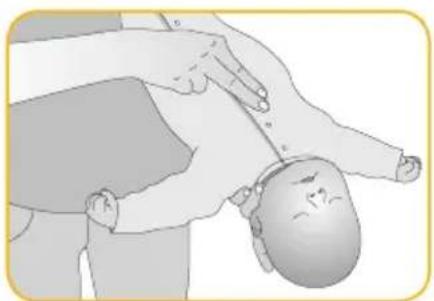
▶ Position the baby with her face up on your forearm, tilting her head gently (fi g. 4).
Press the lower half of the chest bone 3-5 times with two fingers. Give her about 1 thrust in 3 seconds.
At the end of each step, check the baby's mouth to see if a foreign object has been dislodged.
If the respiration problem continues, repeat the individual steps 1-3 times and call - or have somebody call - your local emergency telephone number 999 or 112.
natural_image
Illustration of a person performing CPR on a child's neck (no text or symbols present)Fig. 4
3. RESTORE BREATHING
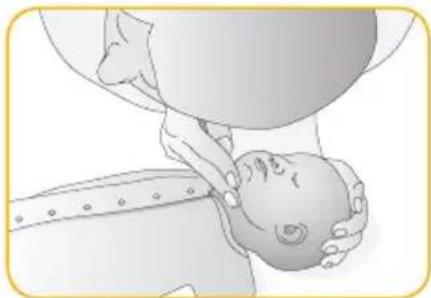
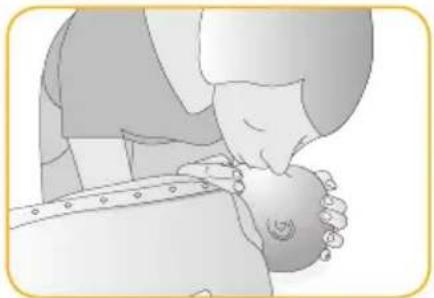
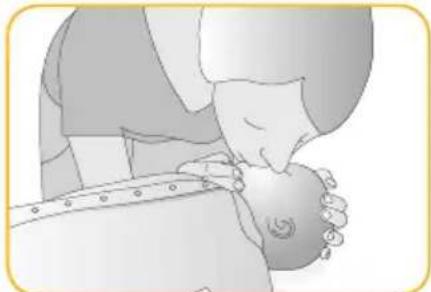
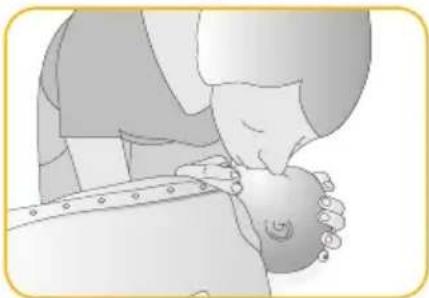
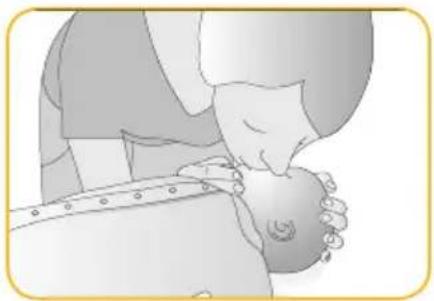
Listen and look to check whether the baby is breathing (fi g. 5).
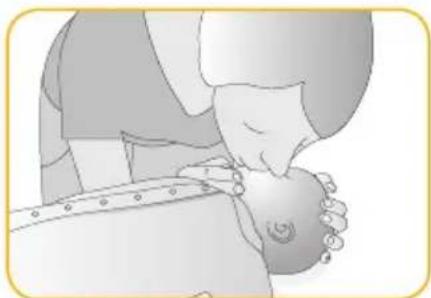
If the baby does not breathe, start rescue breathing immediately; simultaneously call – or have somebody call – your local emergency telephone number 999 or 112.
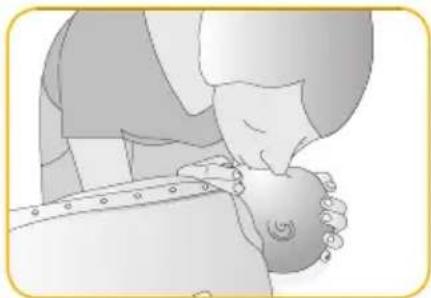
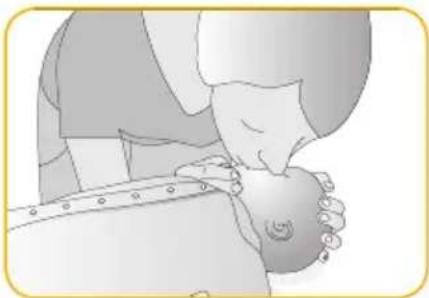
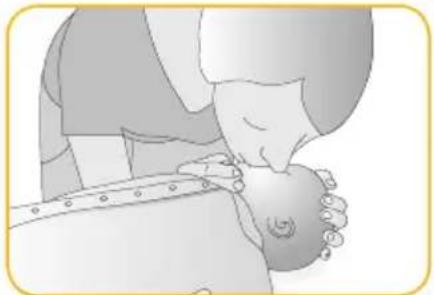
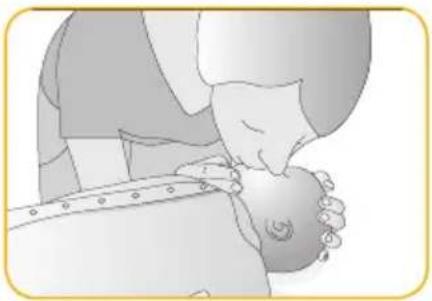
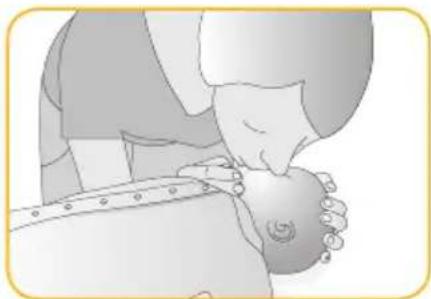
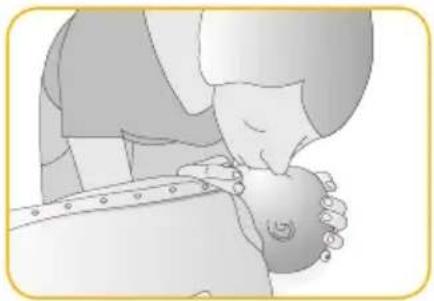
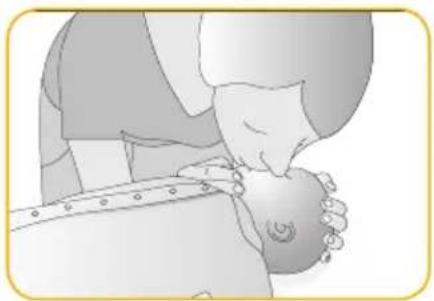
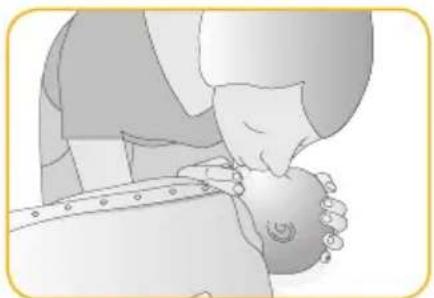
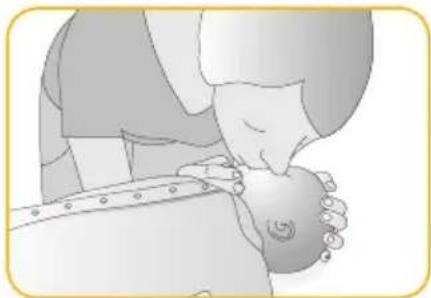
Place one hand on the baby's forehead and keep her head tilted a little. Lift her chin with your other hand and seal your mouth around the baby's mouth and nose (fi g. 6).
Initiate rescue breathing with 2–5 breaths so that at least 2 breaths are efficient enough.
Check the effi ciency of breaths by watching the bay's chest – the chest should rise visibly upon breathing in and fall upon breathing out.
Watch the volume of the inhaled air. It must be neither too small (the chest does not rise or fall), nor too big. Inappropriate air volume would cause damage to the baby's lungs and airways and its overall condition would get even worse. The baby's chest should rise and fall approximately as if the baby was breathing on its own. Never give breaths if you feel obvious resistance!
Give 30 breaths in 1 minute to a newborn (i.e. 1 breaths in 2 seconds), and 20 breaths in 1 minute to an infant (i.e. 1 breath in 3 seconds).
natural_image
Illustration of a person performing CPR on a patient's head (no text or symbols present)Fig. 5
natural_image
Illustration of a person performing CPR on another individual (no text or symbols visible)Fig. 6
4. CHECK BLOOD CIRCULATION
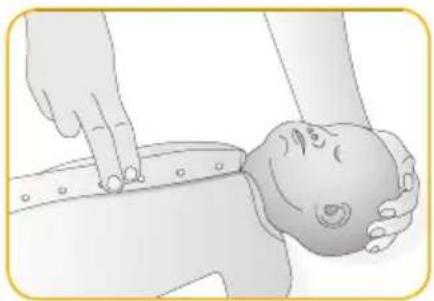
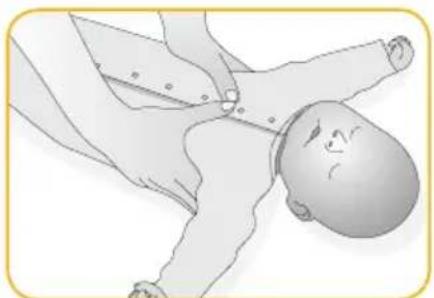
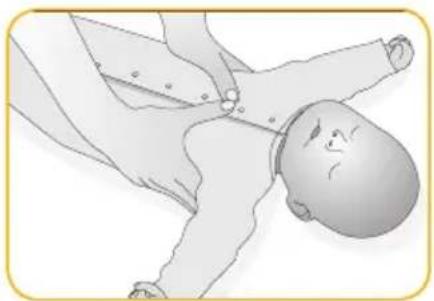
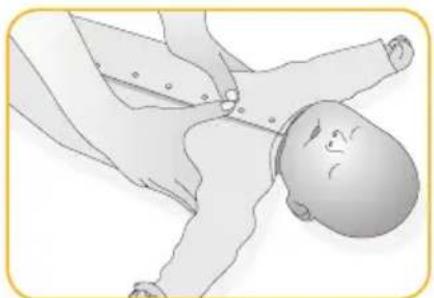
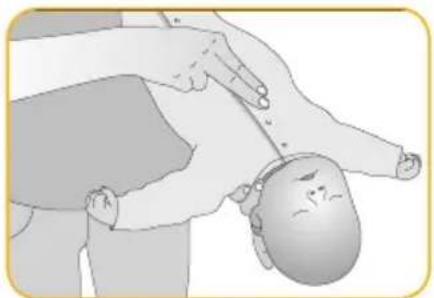
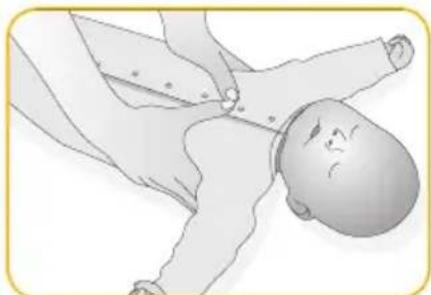
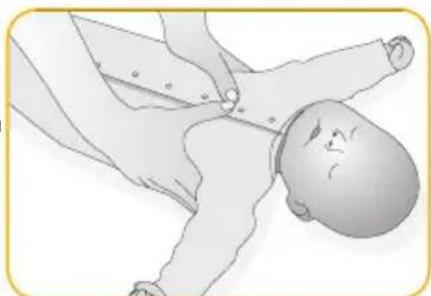
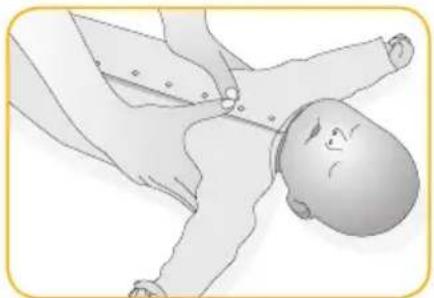
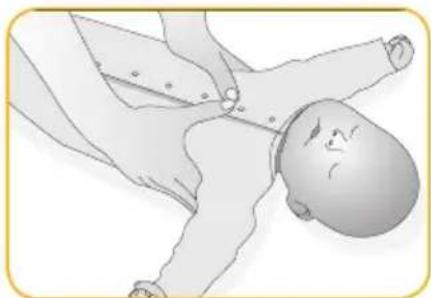
If the baby does not show any signs of proper blood circulation (i.e. she is unable to move, cough or breathe), start cardiac massage (chest compressions) immediately.
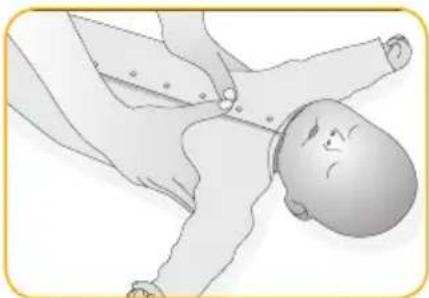
Put the baby on her back on a firm surface.
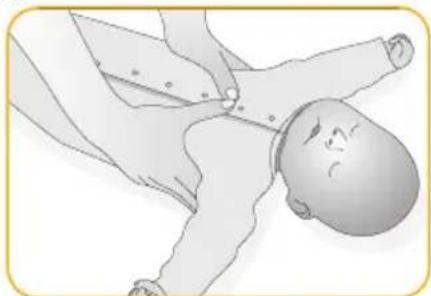
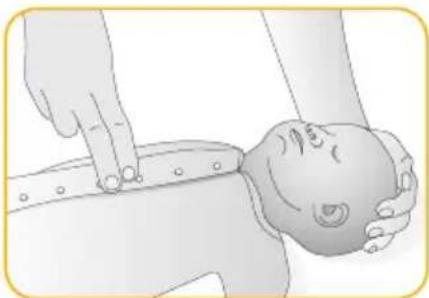
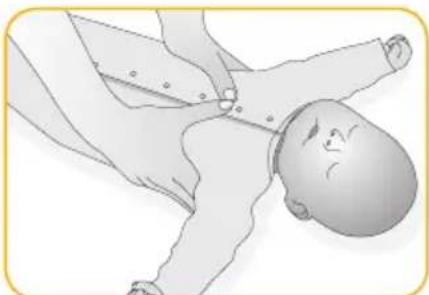
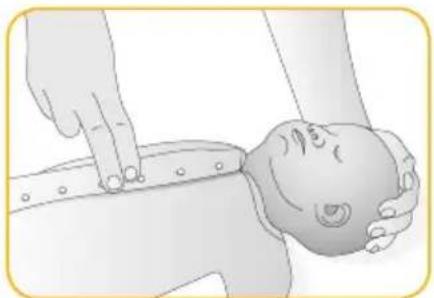
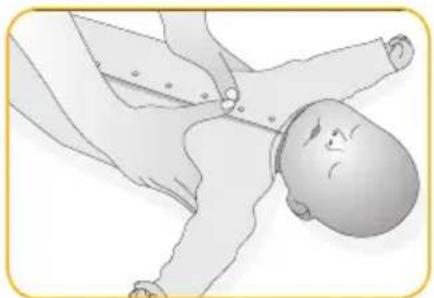
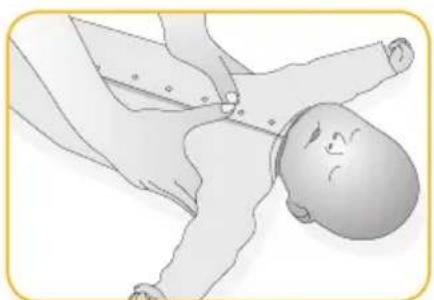
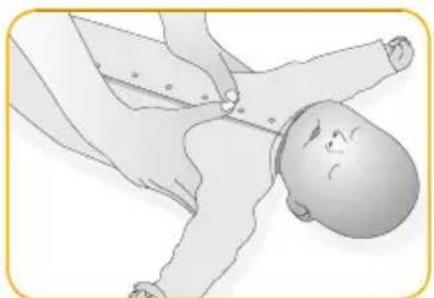
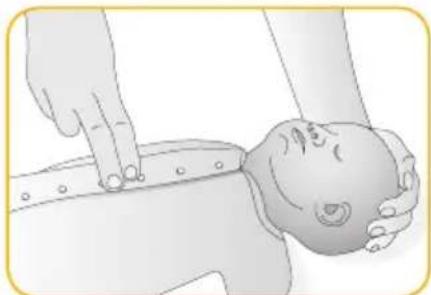
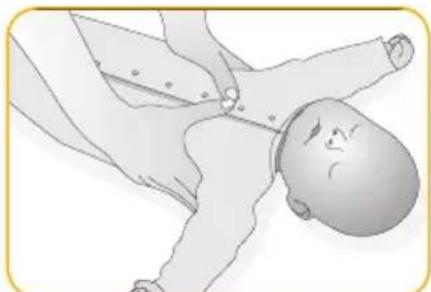
Place your index finger and middle finger on the lower third of the chest bone - about 1.5 cm (1-fi nger-width) under the imaginary line between her nipples (fi g. 7). Alternatively, you can hold the baby's torso firmly in your hands while pressing her chest bone with your thumbs being crossed (fi g. 8) or with two fingers.
Compress the baby's chest by about 2-3 cm (approx. by 1/3 of her torso diameter).
Frequency of compressions: 120/min in newborns and 100/min in infants.
Resuscitate newborns at a ratio of 1 breath to 3 chest compressions and infants at a ratio of 2 breaths to 30 chest compressions provided there is only one first-aider. If there are two first-aiders, they give 2 breaths per 15 chest compressions.
Take a short break after each sequence of compressions to catch your breath.
After completing every 3rd to 5th cycle check whether respiration and blood circulation have been restored.
natural_image
Illustration of hands performing a medical procedure on a patient's abdomen (no text or symbols present)Fig. 7
natural_image
Illustration of a baby performing CPR on the shoulder (no text or symbols present)Fig. 8
5. PUTTING THE BABY IN THE RECOVERY POSITION
If your resuscitation efforts are successful and the baby's respiration and blood circulation are restored, put her in the recovery position.
Hold the infant in your arms with her face facing yours and her head slightly tilted to the side.
This position provides prevention against suffocation with a swallowed tongue or vomit (fi g. 9).
Keep monitoring the baby at all times, especially focusing on her breathing and on the signs of uninterrupted blood circulation. Watch the color of her skin. NOTE: If her skin begins to turn blue or gray, it may be a sign of a relapsing breathing or blood circulation failure.
Make sure that the baby's proper body temperature is maintained. Above all, protect her against hypothermia.
natural_image
Illustration of a person performing a medical or therapeutic procedure on a patient's head (no text or symbols visible)Fig. 9
When should you call the emergency services on the emergency number 999 or on the European emergency number 112?
If there are several first-aiders at the site, one calls the emergency immediately after a respiration or cardiac arrest has been detected. The other first-aider starts resuscitation immediately.
If you are alone, start resuscitating according to the emergency care for children rules. Resuscitate a child for about 1 minute then call the emergency services. If you do not have a phone at hand and have to run to another place to seek help (be it an adjacent room), it is advised to take the resuscitated child with you as that will prevent the time loss that would be unavoidable if you had to run back to the child after calling for help.
WHEN TO END RESUSCITATION:
Keep resuscitating until the baby begins to show signs of life (spontaneous breathing, pulse, movements), until a qualified paramedic arrives or until you are absolutely exhausted.
Note: A newborn is less then 1 month old. An infant is 1 month to 1 year old.
Reference materials:
- ERC Guidelines for resuscitation 2010,
JABLOTRON ALARMS a.s.
Pod Skalkou 4567/33
466 01 Jablonec nad Nisou
tel: (+420) 483 559 881, (+420) 483 559 811
e-mail: servis@jablotron.cz
CZECH REPUBLIC
ATMUNGSMONITOR FÜR KINDER BM-02 NANNY
natural_image
Illustration of a fetus inside a cage with a medical device on the right side (no text or symbols)natural_image
3D illustration of a cage containing abstract geometric shapes (no text or symbols)Zur Beachtung:
natural_image
Diagram of a cage-like structure with a hanging device and a shaded interior (no text or symbols)natural_image
Illustration of a baby CPR on the infant's side, showing hands and posture (no text or symbols)Abb. 1
natural_image
Illustration of a baby receiving a gentle abdominal massage (no text or symbols)Abb. 2

natural_image
Illustration of a person holding a small object, possibly a medical or ergonomic device (no text or symbols visible)Abb. 3
natural_image
Illustration of a person performing CPR on a baby (no text or symbols present)Abb. 4
natural_image
Illustration of a person performing CPR on a patient's abdomen (no text or symbols)Abb. 5
natural_image
Illustration of a person performing CPR on another individual (no text or symbols visible)Abb. 6
natural_image
Illustration of a person performing a medical procedure on a patient's arm, with no visible text or symbols.Abb. 7
natural_image
Illustration of a baby performing CPR on the shoulder (no text or symbols present)Abb. 8
natural_image
Illustration of a person performing a medical or therapeutic procedure on a patient's head (no text or symbols present)Abb. 9
JABLOTRON ALARMS a.s.
Pod Skalkou 4567/33
466 01 Jablonec nad Nisou
tel: (+420) 483 559 881, (+420) 483 559 811
e-mail: servis@jablotron.cz
CZECH REPUBLIC
DE BM-02 NANNY, ADEMHALING- EN BEWEGINGSMONITOR VOOR KINDEREN
natural_image
Illustration of a baby lying inside a wire cage with a handheld device (no text or symbols)OMSCHRIJVING VAN HET PRODUCT
ADEMHALING- EN BEWEGINGSMONITOR VOOR KINDEREN BM-02
natural_image
Illustration of a cage containing abstract geometric shapes (no text or symbols)natural_image
Diagram of a cage-like structure with vertical supports and a hanging control panel (no text or symbols)natural_image
Illustration of a baby CPR on the infant's side, showing hand placement and posture (no text or symbols)Afb. 1
2. MAAK DE LUCHTWEGEN VRIJ
natural_image
Illustration of a baby receiving a gentle abdominal massage (no text or symbols present)Afb. 2
natural_image
Illustration of a person holding a helmet and wrist, no text or symbols presentAfb. 3
natural_image
Illustration of a person performing CPR on another person's head (no text or symbols present)Afb. 4
3. ZORG VOOR DE ADEMHALING
natural_image
Illustration of a person performing CPR on a mannequin (no text or symbols present)Afb. 5
natural_image
Illustration of a person performing CPR on another individual (no text or symbols present)Afb. 6
4. ZORG VOOR DE BLOEDSOMLOOP
natural_image
Illustration of hands performing a medical procedure on a patient's abdomen (no text or symbols visible)Afb. 7
natural_image
Illustration of a baby performing CPR on the back (no text or symbols present)Afb. 8
5. PLAATS HET KIND IN EEN STABIELE ZIJLIGGING
natural_image
Illustration of a person performing a medical or therapeutic procedure on a sphere (no text or symbols visible)Afb. 9
- ERC Guidelines for resuscitation 2010
SERVICE WORDT VERLEEND DOOR:
JABLOTRON ALARMS a.s.
Pod Skalkou 4567/33
466 01 Jablonec nad Nisou
tel: (+420) 483 559 881, (+420) 483 559 811
e-mail: servis@jablotron.cz
CZECH REPUBLIC
MONITEUR RESPIRATOIRE POUR ENFANT BM-02 NANNY
natural_image
Illustration of a fetus inside a cage with a medical device on the right side (no text or symbols)DESTINATION DU PRODUIT
MONITEUR RESPIRATOIRE POUR ENFANT BM-02
natural_image
3D illustration of a cage containing abstract geometric shapes (no text or symbols)ATTENTION :
natural_image
Diagram of a cage-like structure with a hanging weight and a diagonal support, no text or symbols presentREPLACEMENT DES PILES
natural_image
Illustration of a baby CPR on the infant's abdomen, showing hand placement and posture (no text or symbols)Fig. 1
2. LIBÉREZ LES VOIES RESPIRATOIRES
natural_image
Illustration of a baby receiving a gentle abdominal massage (no text or symbols present)Fig. 2
natural_image
Illustration of a person holding a small object, possibly a medical or robotic device (no text or symbols visible)Fig. 3
natural_image
Illustration of a person performing CPR on a baby (no text or symbols present)Fig. 4
natural_image
Illustration of a person performing CPR on a patient's head (no text or symbols present)Fig. 5
natural_image
Illustration of a person performing CPR on another person's head (no text or symbols present)Fig. 6
4. ASSUREZ LA CIRCULATION SANGUINE
natural_image
Illustration of hands performing a medical procedure on a patient's arm (no text or symbols visible)Fig. 7
natural_image
Illustration of a baby lying on the back with hands performing a medical or physical procedure (no text or symbols present)Fig. 8
5. METTEZ L'ENFANT DANS UNE POSITION STABILISÉE
natural_image
Illustration of a person performing a medical or therapeutic procedure on a patient's head (no text or symbols present)Fig. 9
- ERC Guidelines for resuscitation 2010,
JABLOTRON ALARMS a.s.
Pod Skalkou 4567/33
466 01 Jablonec nad Nisou
tel: (+420) 483 559 881, (+420) 483 559 811
e-mail: servis@jablotron.cz
CZECH REPUBLIC
natural_image
Illustration of a baby lying inside a wire cage with a medical device on the right side (no text or symbols)FINALIDAD DEL PRODUCTO
natural_image
Illustration of a cage containing abstract geometric shapes (no text or symbols)ADVERTENCIA:
natural_image
Diagram of a cage-like structure with a hanging device and a sensor, no text or symbols presentES
natural_image
Illustration of a baby CPR on a mannequin, showing hand placement and posture (no text or symbols)llustración 1
2. DESBLOQUEE LAS VÍAS RESPIRATORIAS
natural_image
Illustration of a baby receiving a gentle abdominal massage (no text or symbols present)llustración 2
natural_image
Illustration of a person holding a helmet and wrist, no text or symbols presentllustración 3
natural_image
Illustration of a person performing CPR on a child's head (no text or symbols present)llustración 4
natural_image
Illustration of a person performing CPR on a patient's head (no text or symbols present)llustración 5
natural_image
Illustration of a person performing a medical procedure on another person's arm (no text or symbols visible)Ilustración 6
natural_image
Illustration of hands performing a medical or therapeutic procedure on a patient's abdomen (no text or symbols visible)llustración 7
natural_image
Illustration of a baby performing CPR on the chest (no text or symbols present)Ilustración 8
natural_image
Illustration of a person performing a medical or therapeutic procedure on a patient's head (no text or symbols present)llustración 9
JABLOTRON ALARMS a.s.
Pod Skalkou 4567/33
466 01 Jablonec nad Nisou
tel: (+420) 483 559 881, (+420) 483 559 811
e-mail: servis@jablotron.cz
CZECH REPUBLIC
DISPOSITIVO DI MONITORAGGIO DELLA RESPIRAZIONE DEL BAMBINO BM - 02 NANNY
natural_image
Illustration of a baby lying inside a wire cage with a handheld device (no text or symbols)natural_image
Illustration of a cage containing abstract geometric shapes (no text or symbols)Istruzioni:
natural_image
Illustration of a wire cage containing a container with a hanging device (no text or symbols)IT
natural_image
Illustration of a baby CPR on a mannequin, showing hand placement and posture (no text or symbols)fi g. 1
2. LIBERARE LE VIE RESPIRATORIE
natural_image
Illustration of a baby receiving a gentle abdominal massage (no text or symbols present)fig 2
natural_image
Illustration of a person holding a small object, possibly a medical or robotic device (no text or symbols visible)fig.3
natural_image
Illustration of a person performing CPR on a child's head (no text or symbols present)fi g. 4
IT
natural_image
Illustration of a person performing CPR on a patient's head (no text or symbols present)fig. 5
natural_image
Illustration of a person performing CPR on another person's arm (no text or symbols present)fig.6
natural_image
Illustration of a person performing CPR on a mannequin (no text or symbols present)fi g. 7
natural_image
Illustration of a baby performing CPR on the shoulder (no text or symbols present)fig. 8
natural_image
Illustration of a person performing a medical or therapeutic procedure on a patient's head (no text or symbols present)fig. 9
JABLOTRON ALARMS a.s.
Pod Skalkou, 4567/33
466 01 Jablonec nad Nisou
tel. (+420) 483 559 881, (+420) 483 559 811
e-mail: servis@jablotron.cz
REPUBBLICA CECA
natural_image
Illustration of a baby lying inside a wire cage with a medical device on the right side (no text or symbols)natural_image
Illustration of a cage containing abstract geometric shapes (no text or symbols)ADVERTÊNCIA:
natural_image
Diagram of a cage-like structure with vertical supports and a hanging device (no text or symbols)natural_image
Illustration of a baby CPR on the infant's side, showing hands and posture (no text or symbols)Imagem 1
natural_image
Illustration of a baby receiving a gentle abdominal massage (no text or symbols present)Imagem 2
natural_image
Illustration of a person holding a small object, possibly a medical or fitness device (no text or symbols visible)Imagem 3
natural_image
Illustration of a person performing CPR on another person's head (no text or symbols present)Imagem 4
natural_image
Illustration of a person performing a medical or therapeutic procedure on a patient's abdomen (no text or symbols visible)Imagem 5
natural_image
Illustration of a person performing CPR on another person's arm (no text or symbols present)Imagem 6
natural_image
Illustration of a person performing CPR on a mannequin (no text or symbols present)Imagem 7
natural_image
Illustration of a baby lying on the back with hands performing a medical or physical procedure (no text or symbols present)Imagem 8
5. DEITE A CRIANÇA NA POSIÇÃO ESTABILIZADORA
natural_image
Illustration of a person performing a medical or therapeutic procedure on a patient's head (no text or symbols present)Imagem 9
JABLOTRON ALARMS a.s.
Pod Skalkou 4567/33
466 01 Jablonec nad Nisou
tel: (+420) 483 559 881, (+420) 483 559 811
e-mail: servis@jablotron.cz
CZECH REPUBLIC
MONITOR AV BARNAANDNING BM-02 NANNY
natural_image
Illustration of a baby lying inside a wire cage with a medical device on the right side (no text or symbols)PRODUKTENS SYFTE
BARNAANDNINGSMONITOR BM-02
natural_image
Illustration of a cage containing abstract geometric shapes (no text or symbols)OBSERVERA:
natural_image
Diagram of a cage-like structure with a hanging device attached, showing no text or symbols.natural_image
Illustration of a baby CPR on a mannequin, showing hand placement and posture (no text or symbols)Bild 1
natural_image
Illustration of a baby receiving a gentle abdominal massage (no text or symbols present)Bild 2
natural_image
Illustration of a person holding a medical device (no text or symbols visible)Bild 3
natural_image
Illustration of a person performing CPR on another person's head (no text or symbols present)Bild 4
3. ÅTERSTÄLL ANDNINGEN
natural_image
Illustration of a person performing CPR on a baby (no text or symbols present)Bild 5
natural_image
Illustration of a person performing CPR on another person's arm (no text or symbols present)Bild 6
4. ÅTERSTÄLL BLODCIRKULATIONEN
natural_image
Illustration of a person performing a medical or therapeutic procedure on a patient's arm (no text or symbols visible)Bild 7
natural_image
Illustration of a baby performing CPR on the chest (no text or symbols present)Bild 8
5. LÄGG BARNET I ETT STABILT LÄGE
natural_image
Illustration of a person performing a medical or therapeutic procedure on a patient's head (no text or symbols visible)Bild 9
JABLOTRON ALARMS a.s.
Pod Skalkou 4567/33
466 01 Jablonec nad Nisou
tel: (+420) 483 559 881. (+420) 483 559 811
e-mail: servis@iablotron.cz
CZFCH REPUBLIC
BM-02 NANNY ÅNDEDRAETSALARM
natural_image
Illustration of a fetus inside a cage with a bird, no text or symbols presentPRODUKTBESKRIVELSE
BM-02 NANNY ANDEDRAETSALARM
natural_image
Illustration of a cage containing abstract geometric shapes (no text or symbols)Bemærk:
natural_image
Diagram of a cage-like structure with vertical supports and a hanging device (no text or symbols)OFTE STILLEDE SP∅RGSMÅL
natural_image
Illustration of a baby CPR on a mannequin, showing hand placement and posture (no text or symbols)Fig. 1
2. FRIG∅R LUFTVEJENE
natural_image
Illustration of a person receiving a medical or therapeutic procedure, no text or symbols presentFig. 2
natural_image
Illustration of a person holding a small object, possibly a medical or fitness device (no text or symbols visible)Fig. 3
natural_image
Illustration of a person performing CPR on another person's head (no text or symbols present)Fig. 4
3. GENOPRET VEJRTRÆKNINGEN
natural_image
Illustration of a person performing CPR on a patient's head (no text or symbols present)Fig. 5
natural_image
Illustration of a person performing a medical or therapeutic procedure on another person's abdomen (no text or symbols visible)Fig. 6
4. TJEK BLODCIRKULATION
natural_image
Illustration of a person performing a medical or therapeutic procedure on a patient's arm, with no visible text or symbols.Fig. 7
natural_image
Illustration of a baby lying on the back with hands performing a medical or physical procedure (no text or symbols present)Fig. 8
5. AT LÆGGE BARNET I AFLÅST SIDELEJE
natural_image
Illustration of a person performing a medical or therapeutic procedure on a patient's head (no text or symbols present)Fig. 9
Vær sikker på at barnets korrekte kropstemperatur opretholdes. Frem for alt, beskyt ham/hende mod at kropstemperaturen falder
JABLOTRON ALARMS a.s.
Pod Skalkou 4567/33
466 01 Jablonec nad Nisou
tel: (+420) 483 559 881, (+420) 483 559 811
e-mail: servis@jablotron.cz
CZECH REPUBLIC
BM-02 NANNY VAUVAN HENGITYSMONITORI
natural_image
Illustration of a baby lying inside a wire cage with a handheld device (no text or symbols)TUOTEKUVAUS
BM-02 VAUVAN HENGITYSMONITORI
natural_image
Illustration of a cage containing abstract geometric shapes (no text or symbols)Huom:
natural_image
Diagram of a cage-like structure with vertical supports and a hanging control unit (no text or symbols)FI
NANNYN SIGNAALIT JA MERKKIVALOT
natural_image
Illustration of a baby CPR on a mannequin, showing hand placement and posture (no text or symbols)Kuva 1
2. AVAA VAUVAN HENGITYSTIET
natural_image
Illustration of a baby receiving a gentle abdominal massage (no text or symbols present)Kuva 2
natural_image
Illustration of a person holding a small object, possibly a medical or robotic device (no text or symbols visible)Kuva 3
natural_image
Illustration of a person performing CPR on a baby (no text or symbols present)Kuva 4
FI
natural_image
Illustration of a person performing a medical procedure on a patient's abdomen (no text or symbols visible)Kuva 5

natural_image
Illustration of a person performing CPR on another person's arm (no text or symbols present)Kuva 6
4. TARKISTA VERENKIERO
natural_image
Illustration of a person performing a medical procedure on a patient's abdomen (no text or symbols visible)Kuva 7
natural_image
Illustration of a baby lying on the back with hands performing a medical or physical procedure (no text or symbols present)Kuva 8
5. VAUVAN ASETTAMINEN KYLKIASENTOON
natural_image
Illustration of a person performing a medical or therapeutic procedure on a patient's head (no text or symbols present)Kuva 9
JABLOTRON ALARMS a.s.
Pod Skalkou 4567/33
466 01 Jablonec nad Nisou
tel: (+420) 483 559 881, (+420) 483 559 811
e-mail: servis@jablotron.cz
TŠEKIN TASAVALTA
MONITOR DÝCHANIA DIĚTÁŤA BM-02 NANNY
natural_image
Illustration of a baby lying inside a wire cage with a medical device on the right side (no text or symbols)URČENIE VÝROBKU
MONITOR DÝCHANIA DIĚTÁŤA BM-02
natural_image
Illustration of a cage containing abstract geometric shapes (no text or symbols)natural_image
Diagram of a cage-like structure with a hanging device and a horizontal beam, no text or symbols present3. Vyhodnocovaciu jednotku pripevnite pomocou pásky na postiel'ku (kočík a pod.).
natural_image
Illustration of a baby CPR on the infant's abdomen, showing hand placement and posture (no text or symbols)Obr. 1
2. UVOL'NITE DÝCHACIE CESTY
Prehliadnite diet'a'tu ústa, špičkami prstov odstránte zjavné prekážky a cudzie telesá.
Jednu ruku diet'a'u položte na čelo, urobte len mierny záklon hlavy, prstami druhej ruky jemne zdvihnite bradu (obr. 2)
Uvol'nené dýchacie cesty udržíte podložením diet'at'a pod ramienkami.
Ak máte podozrenie, že diet'a aspirovalo – vdýchlo cudzí predmet (stav dýchavičnosti vznikol nápadne náhle – napríklad pri jedle, pri hraní s malou hračkou, diet'a kašle, chrčí, hlasno a namáhavo dýcha, má začervenanú a napuchnutú tvár a krk, neskôr je farba kože modravá až bledá), pokúste sa odstránit' prekážku z dýchacích ciest nasledujúcimi úkonmi:
Vykonajte 3–5 úderov do chrbta
natural_image
Illustration of a person receiving a medical or therapeutic procedure on a baby's face (no text or symbols present)Obr. 2
natural_image
Illustration of a person holding a small object, possibly a medical or robotic device (no text or symbols visible)Obr. 3
natural_image
Illustration of a person performing CPR on another person's head (no text or symbols present)Obr. 4
3. ZAISTITE DÝCHANIE
natural_image
Illustration of a person performing CPR on a patient's head (no text or symbols present)Obr. 5
natural_image
Illustration of a person performing CPR on another person's abdomen (no text or symbols present)Obr. 6
4. ZAISTITE KRVNÝ OBEH
natural_image
Illustration of hands performing a medical procedure on a patient's arm (no text or symbols visible)Obr. 7
natural_image
Illustration of a baby lying on the back with hands performing a medical or physical procedure (no text or symbols present)Obr. 8
5. ULOŽTE DIĚTĚ DO STABILIZOVANEJ POLOHY
natural_image
Illustration of a person performing a medical or therapeutic procedure on a baby's head (no text or symbols present)Obr. 9
- ERC Guidelines for resuscitation 2010,
JABLOTRON ALARMS a.s.
Pod Skalkou 4567/33
466 01 Jablonec nad Nisou
tel: (+420) 483 559 881, (+420) 483 559 811
e-mail: servis@jablotron.cz
ČESKÁ REPUBLIKA
MONITOR ODDYCHANIA DZIECKA BM-02 NANNY
natural_image
Illustration of a fetus inside a cage with a medical device on the right side (no text or symbols)natural_image
Illustration of a cage containing abstract geometric shapes (no text or symbols)natural_image
Diagram of a cage-like structure with a hanging weight and a diagonal support, no text or symbols presentnatural_image
Illustration of a baby CPR on the infant's side, showing hand placement and posture (no text or symbols)Rys. 1
2. UDROŻNIJ DROGI ODDECHOWE
natural_image
Illustration of a baby receiving a gentle abdominal massage (no text or symbols present)Rys. 2
natural_image
Illustration of a person holding a small object, possibly a medical or robotic device (no text or symbols visible)Rys. 3
natural_image
Illustration of a person performing CPR on a baby (no text or symbols present)Rys. 4
3. ZAPEWNIJ ODDYCHANIE
natural_image
Illustration of a person performing CPR on a baby (no text or symbols present)Rys. 5
natural_image
Illustration of a person performing a medical or therapeutic procedure on another person's arm (no text or symbols visible)Rys. 6
4. ZAPEWNIJ KRAŻENIE KRWI
natural_image
Illustration of hands performing a medical procedure on a patient's abdomen (no text or symbols visible)Rys. 7
natural_image
Illustration of a baby performing CPR on the back (no text or symbols present)Rys. 8
5. POŁÓŻ DZIECKO DO USTABILIZOWANEJ POZYCJI
natural_image
Illustration of a person performing a medical or therapeutic procedure on a patient's head (no text or symbols present)Rys. 9
JABLOTRON ALARMS a.s.
Pod Skalkou 4567/33
466 01 Jablonec nad Nisou
tel: (+420) 483 559 881, (+420) 483 559 811
e-mail: servis@jablotron.cz
CZECH REPUBLIC
natural_image
Illustration of a baby lying inside a wire cage with a bird-like device on top (no text or symbols)НАЗНАЧЕНИЕ ИЗДЕЛИЯ
natural_image
Illustration of a cage containing abstract geometric shapes (no text or symbols)Предупреждение:
natural_image
Diagram of a cage-like structure with vertical supports and a hanging device, no text or symbols presentnatural_image
Illustration of a baby CPR on the infant's side, showing hand placement and posture (no text or symbols)Рис. 1
natural_image
Illustration of a person performing CPR on a baby (no text or symbols present)Рис. 2
natural_image
Illustration of a person holding a small object, possibly a medical or laboratory device (no text or symbols visible)Рис. 3
natural_image
Illustration of a person performing CPR on another person's head (no text or symbols present)Рис. 4
natural_image
Illustration of a person performing a medical procedure on a patient's head (no text or symbols visible)Рис. 5
natural_image
Illustration of a person performing CPR on another person's arm (no text or symbols present)Рис. 6
natural_image
Illustration of hands performing a medical or therapeutic procedure on a patient's abdomen (no text or symbols visible)Рис. 7
natural_image
Illustration of a baby lying on the back with hands performing a medical or physical maneuver (no text or symbols)Рис. 8
natural_image
Illustration of a person performing a medical or therapeutic procedure on a patient's head (no text or symbols present)Рис. 9
- ERC Guidelines for resuscitation 2010,
natural_image
Illustration of a baby lying inside a wire cage with a medical device on the right side (no text or symbols)ПРИЗНАЧЕННЯ ВИРОБУ
natural_image
Illustration of a cage containing abstract geometric shapes (no text or symbols)natural_image
Diagram of a cage-like structure with vertical supports and a hanging control panel (no text or symbols)natural_image
Illustration of a baby being held by adult hands, no text or symbols presentМал. 1
natural_image
Illustration of a person performing CPR on a baby (no text or symbols present)Мал. 2

natural_image
Illustration of a person holding a helmet and wrist, no text or symbols presentМал. 3
natural_image
Illustration of a person performing CPR on another person (no text or symbols present)Мал. 4
natural_image
Illustration of a person performing CPR on a baby (no text or symbols present)Мал. 5
natural_image
Illustration of a person performing CPR on another person's head (no text or symbols present)Мал. 6
natural_image
Illustration of hands performing a massage or pressure technique on a person's head (no text or symbols visible)Мал. 7
natural_image
Illustration of a baby lying on the back with hands placed on the head (no text or symbols)Мал. 8
natural_image
Illustration of a person performing a medical or therapeutic procedure on a patient's head (no text or symbols present)Мал. 9
- ERC Guidelines for resuscitation 2010,