CompactCare GC6470 - Iron PHILIPS - Free user manual and instructions
Find the device manual for free CompactCare GC6470 PHILIPS in PDF.



User questions about CompactCare GC6470 PHILIPS
0 question about this device. Answer the ones you know or ask your own.
Ask a new question about this device
Download the instructions for your Iron in PDF format for free! Find your manual CompactCare GC6470 - PHILIPS and take your electronic device back in hand. On this page are published all the documents necessary for the use of your device. CompactCare GC6470 by PHILIPS.
USER MANUAL CompactCare GC6470 PHILIPS
Always here to help you
Register your product and get support at
www.philips.com/welcome

text_image
Question? Contact PhilipsGC6500
GC6400
series
natural_image
Exterior view of a Philips Compact Air conditioner (no signage or text overlays)User manual
PHILIPS
natural_image
Diagram of three open panels with grid patterns and curved arrows indicating rotation or movement (no text or symbols)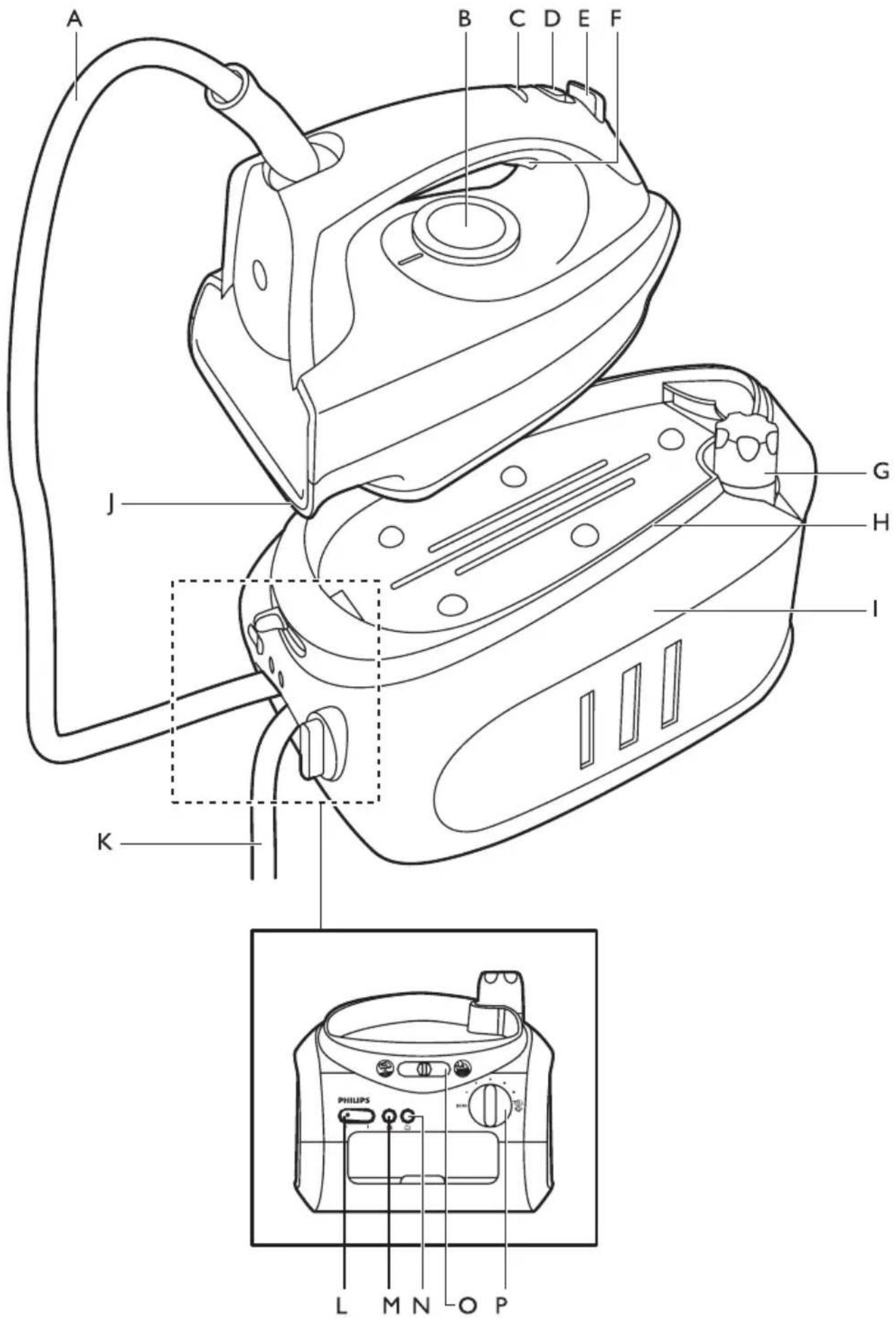
text_image
A B C D E F J G H I K L M N O P PHIUPSENGLISH 6
DANSK 14
DEUTSCH 22
ΕΛΛΗΝΙΚΑ 31
ESPAÑOL 40
SUOMI 49
FRANÇAIS 57
ITALIANO 66
NEDERLANDS 75
NORSK 83
PORTUGUÊS 91
SVENSKA 100
TÜRKÇE 108
Introduction
Congratulations on your purchase and welcome to Philips! To fully benefit from the support that Philips offers, register your product at www.philips.com/welcome.
General description (Fig. 1)
A Supply hose
B Temperature dial
C Temperature light
D Steam lock
E Steam boost button (GC6540/GC6490/GC6480/GC6470)
F Steam trigger
G Steam tank cap
H Iron stand
I Steam tank
J Soleplate
K Mains cord
L On/off switch with power-on light
M 'Steam ready' light (GC6540 only)
N 'Steam tank empty' light (GC6540 only)
O Iron lock slide (GC6540/GC6530 only)
P Steam control (GC6540 only)
Important
Read this user manual carefully before you use the appliance and save it for future reference.
Danger
- Never immerse the iron or the steam tank in water.
Warning
- Check if the voltage indicated on the type plate corresponds to the local mains voltage before you connect the appliance.
- Do not use the appliance if the plug, the mains cord, the supply hose or the appliance itself shows visible damage, or if the appliance has been dropped or leaks.
- If the mains cord or the supply hose is damaged, you must have it replaced by Philips, a service centre authorised by Philips or similarly qualified persons in order to avoid a hazard.
- Never leave the appliance unattended when it is connected to the mains.
- This appliance is not intended for use by persons (including children) with reduced physical, sensory or mental capabilities, or lack of experience and knowledge, unless they have been given supervision or instruction concerning use of the appliance by a person responsible for their safety.
- Children should be supervised to ensure that they do not play with the appliance.
- Do not let the mains cord and supply hose come into contact with the hot soleplate of the iron.
- If steam escapes from under the steam tank cap when the appliance heats up, switch off the appliance and tighten the steam tank cap. If steam continues to escape when the appliance heats up, switch off the appliance and contact a service centre authorised by Philips.
- Do not remove the steam tank cap from the steam tank when the steam tank is still under pressure, as this could cause scalding by hot water or steam.
- Do not use any other cap on the steam tank than the cap that has been supplied with the appliance, as the steam tank cap also functions as a safety valve.
Caution
- Only connect the appliance to an earthed wall socket.
- Check the mains cord and the supply hose regularly for possible damage.
- Always place and use the iron and the steam tank on a stable, level and horizontal surface.
- The iron stand and the soleplate of the iron can become extremely hot and may cause burns if touched. If you want to move the steam tank, do not touch the stand.
- When you have finished ironing, when you clean the appliance, when you fill or empty the steam tank and also when you leave the iron even for a short while: put the iron on the iron stand, set the on/off switch to 'O' and remove the mains plug from the wall socket.
- Rinse the steam tank regularly according to the instructions in chapter ‘Cleaning and maintenance’.
- This appliance is intended for household use only.
Electromagnetic fields (EMF)
This Philips appliance complies with all standards regarding electromagnetic fields (EMF). If handled properly and according to the instructions in this user manual, the appliance is safe to use based on scientific evidence available today.
Before first use
1 Remove any sticker or protective foil from the soleplate and clean the soleplate with a soft cloth.
2 Fully unwind the mains cord and supply hose.
3 Place the steam tank on a stable, level surface.
4 Place the iron on the iron stand.
Preparing for use
Filling the steam tank
Never immerse the steam tank in water.
Do not open the steam tank cap when the iron and the steam tank are still hot.
1 Remove the mains plug from the wall socket.
2 Slowly unscrew the steam tank cap (Fig. 2).
You may hear a sound when you remove the cap. This sound is caused by the vacuum or residual pressure inside the steam tank and is perfectly normal.
3 Pour water into the steam tank (max. 800ml) (Fig. 3).
Your appliance has been designed to be used with tap water. If you live in an area with very hard water, fast scale build-up will occur. Therefore it is recommended to fill the water tank with 50% distilled water and 50% tap water to prolong the lifetime of your appliance.
Do not put perfume, vinegar, starch, descaling agents, ironing aids or other chemicals in the steam tank, as your appliance is not designed to work with these chemicals. Also, do not put hot water in the steam tank.
4 Screw the steam tank cap tightly onto the filling opening of the steam tank.
Fast refill
If the steam tank becomes empty during ironing, follow the procedure below to quickly refill the steam tank.
1 Keep the appliance plugged into the mains and make sure the on/off switch is set to 'l' (Fig. 4).
2 Press the steam trigger until you no longer hear any steam escaping from the appliance (Fig. 5).
3 To depressurise the steam tank, keep the steam trigger pressed in and slowly unscrew the steam tank cap anticlockwise.
Place a piece of cloth over the cap when you unscrew it. Make sure there is no steam left in the steam tank.
4 Remove the mains plug from the wall socket and wait approximately 15 minutes for the appliance to cool down.
5 Fill the steam tank as described in section 'Filling the steam tank' and let the appliance heat up again.
Setting the temperature
Always place the steam tank on a stable, level and horizontal surface. Do not put the steam tank on the soft part of the ironing board.
1 Put the iron on the iron stand.
Do not put the hot iron on the supply hose or the mains cord. Make sure the cord does not come into contact with the hot soleplate.
2 To set the required ironing temperature, turn the temperature dial to the appropriate position (Fig. 6).
Check the laundry care label for the required ironing temperature:
Laundry care table
| Symbol on laundry care label | Type of fabric Temperature setting | Steam setting (GC6540 only) |
| Synthetic fabrics (e.g. acetate, acrylic, viscose, polyamide, polyester) and silk | ● - | |
| Wool ●●ECO | ||
| Cotton, linen ●●● to Max | ECO to 📋 | |
| Please note that on the label means that the article cannot be ironed. | - | - |
If you do not know what kind or kinds of fabric an article is made of, determine the right ironing temperature by ironing a part that is not visible when you wear or use the article.
Silk, woollen and synthetic materials: iron the reverse side of the fabric to prevent shiny patches. Start ironing the articles that require the lowest ironing temperature, such as those made of synthetic fibres.
3 Put the mains plug in an earthed wall socket and set the on/off switch to 'I'.
The steam tank and the soleplate heat up.
When the temperature light goes out, the iron has reached the set temperature. As soon as the water in the steam tank is ready for steam ironing:
- GC6540: the 'steam ready' light goes on.
- GC6530/GC6520/GC6516/GC6515/GC6511/GC6510/GC6505/GC6490/GC6480/GC6470: the power-on light in the on/off switch goes out.
Note: During steam ironing, the temperature light goes on from time to time. This indicates that the iron is heating up to the set temperature.
Note: If you have been ironing at a high temperature and then set the temperature dial to a lower setting, wait until the temperature light goes on and goes out again before you continue ironing. This prevents damage to your fabrics.
Tips
- If the fabric consists of various kinds of fibres, always select the temperature required by the most delicate fibre, i.e. the lowest temperature. For example: if an article consists of 60% polyester and 40% cotton, it should be ironed at the temperature indicated for polyester ( ●) and without steam.
- When you steam iron woollen fabrics, shiny patches may occur. To prevent this, use a dry pressing cloth or turn the article inside out and iron the reverse side.
- Iron velvet and other fabrics that tend to acquire shiny patches in one direction only (along with the nap) while you apply very little pressure.
- Do not use steam when you iron coloured silk. This could cause stains.
Using the appliance
Steam ironing
1 Make sure that there is enough water in the steam tank.
2 Set the required ironing temperature (see chapter 'Preparing for use').
Note: Steam ironing is only possible at higher ironing temperatures (temperature settings ●● to MAX).
ENGLISH10
3 Put the mains plug in an earthed wall socket and set the on/off switch to 'I'.
- The power-on light in the on/off switch and the temperature light on the iron go on to indicate that the steam tank and the iron start to heat up.
4 GC6540: Select a steam setting suitable for the selected ironing temperature: (Fig. 7)
- Select steam setting ECO for temperature setting ●●.
- Select a steam setting between ECO and 📋 for temperature settings ●●● to MAX.
5 The steam tank and the soleplate heat up.
- Cold start: the soleplate takes approximately 2 minutes to heat up and the steam tank takes approximately 6 minutes to heat up.
- Quick reheat: if you refill the steam tank during the ironing process, the water in the steam tank takes approximately 6 minutes to heat up.
When the iron has reached the set temperature, the temperature light goes out.
As soon as the water in the steam tank is ready for steam ironing:
- GC6540: the 'steam ready' light goes on (Fig. 8).
Note: During steam ironing, the 'steam ready' light goes out from time to time. This indicates that the steam tank is heating up to the right temperature.
- GC6530/GC6520/GC6516/GC6515/GC6511/GC6510/GC6505/GC6490/GC6480/GC6470: the power-on light in the on/off switch goes out.
6 Press the steam trigger and keep it pressed while you steam iron (Fig. 5).
Tip: When you put down the iron during ironing, put it on its heel.
Note: If you have not used the steam function for some time, the steam that was still present in the supply hose has condensed into water. When you start steam ironing again, this may cause some spluttering in the appliance and a few droplets of water may escape from the soleplate.
Note: To prevent droplets from falling onto your garments, hold the iron over an old cloth and press the steam trigger until the steam production has normalised before you start steam ironing again.
Steam lock function
The steam lock allows you to steam iron non-stop without having to press the steam trigger continuously.
1 To steam iron non-stop, slide the steam lock to position 'ON' (Fig. 9).
- To stop steam ironing, slide the steam lock to position 'OFF', the iron now only produces steam when you press the steam trigger.
Ironing without steam
1 Set the required ironing temperature (see chapter 'Preparing for use').
2 Iron without pressing the steam trigger.
Some steam escapes if you press the steam trigger by accident while you iron.
If the steam tank is empty or has not heated up yet, you hear a clicking sound inside the steam tank. This happens when the steam valve opens and is perfectly harmless.
Features
Vertical steam ironing
You can also steam iron when you hold the iron in vertical position. This is useful for removing creases from hanging clothes (e.g. jackets, suits and coats), curtains etc.
1 Hold the iron in vertical position and press the steam trigger (Fig. 10).
Never direct the steam at people.
Steam boost (GC6540/GC6470 only)
During steam ironing, you can use the steam boost function to remove stubborn creases.
1 Set the temperature dial to a setting between ●●● and MAX.
2 Press the steam boost button. (Fig. 11)
Note: Use the steam boost function intermittently. If water droplets come out of the soleplate, let the iron heat up for at least one minute before you use the steam boost function again.
Never direct the steam at people.
Variable steam (GC6540 only)
The steam control is continuously adjustable and can be set to any position between ECO and 📋 (see chapter 'Preparing for use').
'Steam tank empty' light (GC6540 only)
When the water in the steam tank runs out during use, the 'steam tank empty' light goes on.
1 Refill the steam tank with water (see chapter 'Preparing for use', section 'Fast refill').
'Steam ready' light (GC6540 only)
When the steam tank is ready for steam ironing, the 'steam ready' light goes on.
Cleaning and maintenance
After ironing
1 Set the on/off switch to 'O' (Fig. 4).
2 Remove the mains plug from the wall socket.
3 Put the iron on the iron stand, set the steam control to ECO (GC6540 only) and let the appliance cool down.
Iron
1 Clean the iron with a damp cloth.
2 Wipe scale and any other deposits off the soleplate with a damp cloth and a non-abrasive (liquid) cleaner.
Never immerse the iron in water nor rinse it under the tap.
Steam tank
Rinse the steam tank once a month or after you have used the appliance approximately 10 times.
1 Carefully remove the steam tank cap (Fig. 2).
Let the appliance cool down sufficiently before you remove the steam tank cap.
2 Rinse the steam tank with 500ml of fresh water.
3 Hold the steam tank upside down over the sink and pour out the water (Fig. 12).
4 Screw the steam tank cap back onto the steam tank.
Storage
1 Remove the mains plug from the wall socket and let the appliance cool down.
Make sure the appliance has cooled down sufficiently before you put it away.
2 Empty the steam tank.
3 Regularly check if the mains cord and the supply hose are still undamaged and safe.
4 GC6540/GC6530 only: For safe storage, lock the iron onto the stand with the iron lock slide. First put down the tip (1) and then put down the heel (2) (Fig. 13).
5 Wind up the hose and cord separately.
6 Insert the hose and cord neatly in the cord storage compartment (Fig. 14).
Environment
- Do not throw away the appliance with the normal household waste at the end of its life, but hand it in at an official collection point for recycling. By doing this, you help to preserve the environment (Fig. 15).
Guarantee and service
If you need service or information or if you have a problem, please visit the Philips website at www.philips.com/service or contact the Philips Consumer Care Centre in your country. You find its phone number in the worldwide guarantee leaflet. If there is no Consumer Care Centre in your country, go to your local Philips dealer.
Troubleshooting
This chapter summarises the most common problems you could encounter with the appliance. If you are unable to solve the problem with the information below, visit www.philips.com/support for a list of frequently asked question or contact the Consumer Care Centre in your country.
Problem Cause Solution
| Some smoke comes out of the appliance after it has been switched on for the first time. | This is normal. Some parts of the appliance have been greased lightly in the factory. | This phenomenon ceases after a short while. |
| Dirt particles come out of the soleplate of the new iron. | This is normal with a new iron. These particles are harmless and stop coming out of the soleplate after you have used the iron a few times. | |
| Droplets of water escape from the soleplate. | The temperature dial has been set to a temperature that is too low for steam ironing. | Set an ironing temperature that is suitable for steam ironing (temperature settings ●● to MAX). |
The appliance is not switched on. Set the on/off switch to 'l'.
The steam tank has been placed on an unstable and/or uneven surface. Put the steam tank on a stable and even surface.
| Problem Cause Solution | ||
| When you start steam ironing, the hose is cold. Steam condenses in the hose, causing droplets of water to escape from the soleplate. | This is normal. Hold the iron over an old cloth and press the steam trigger. The cloth absorbs the drops. After a few seconds, the steam production becomes normal. | |
| The appliance does not produce any steam. | The appliance is not switched on. Set the on/off switch to 'I' | |
| The steam tank is not hot enough to produce steam. | Wait 6 minutes for the steam tank to heat up. | |
| You are not pressing the steam trigger. Press the steam trigger and keep it pressed while you steam iron. | ||
| There is not enough water in the steam tank. | Fill the steam tank. See chapter 'Preparing for use - Filling the Steam tank'. | |
| No steam comes out of the soleplate. | Superheated (i.e. high-quality) steam is hardly visible, especially when the temperature dial is set to maximum position and even less so when the ambient temperature is relatively high. | To check if the iron really produces steam, hold a (cold) mirror in front of the soleplate vents. |
| The soleplate is dirty. | Impurities or chemicals present in the water have deposited on the soleplate. | Clean the soleplate with a damp cloth. |
| You have been ironing at too high temperatures. | Clean the soleplate with a damp cloth. Set the iron to the required ironing temperature (see chapter 'Preparing for use', section 'Setting the temperature'). | |
| Steam escapes from the filling hole area during ironing. | You may not have tightened the steam tank cap properly or you have spilled some water around the filling hole | Switch off the appliance and let it cool down. Remove the steam tank cap, wipe away the water round the filling hole and tighten the steam tank cap again. Then switch on the appliance again. |
| Wet spots appear on the garment during ironing | The wet spots that appear on your garment after you have steam ironed for some time may be caused by steam that has condensed onto the ironing board. Iron the wet spots without steam for some time to dry them. If the underside of the ironing board is wet, wipe it dry with a piece of dry cloth. | To prevent steam from condensing onto the ironing board, use an ironing board with a wire mesh top. |
Introduktion
natural_image
Diagram showing three open panels with grid patterns and curved arrows indicating rotation or movement (no text or symbols)