USER MANUAL 7FF2FPA PHILIPS
- Welcome to Photo Manager
- Photo Manager Features
- Getting Started 3
3.1 System Requirements 3
3.2 Installation 3
3.3 Start Philips Photo Manager 3
- Philips Photo Manager Overview 4
- Using the Photo Manager 5
5.1 Setting up Photo Manager 5
5.2 Crop Photos 7
5.3 Cutting, Copying and Pasting Photos 8
5.4 Create New Albums 9
5.5 Renaming Albums 9
5.6 Deleting Albums and Photos 9
1. Welcome to Photo Manager
Philips Photo Manager for PhotoFrame is a Windows application for users to manage photos between the Philips PhotoFrame and a PC. It provides an easy to use user interface. It enables you to:
- Browse and preview the photos in both PC directories and PhotoFrame albums.
- Perform operations such as copying, moving and deleting photo(s).
2. Photo Manager Features
Philips Photo Manager for PhotoFrame has the following features for your convenience:
- Share photos between PC and the Philips PhotoFrame.
- Automatically resize the photos to match PhotoFrame's resolution.
- Use drag and drop to copy photos between a PC and the Philips PhotoFrame.
- Retrieve removed photos from Auto Run Recycle Bin.
- Automatically detect Philips PhotoFrame.
3. Getting Started
3.1 System Requirements
- Computer Hardware Basic Requirements: Minimum: Pentium III 500MHz processor or equivalent or above, 128MB RAM, 100MB free HDD space, 16-bit High Color display adapter. Supported PC Operating System: MS Windows XP, and MS Windows 2000. Supported Languages: Chinese Simplified, Chinese Traditional, English, French, German, Italian, Japanese, and Spanish.
3.2 Installation
Follow the instructions below to install the Photo Manager Software on your computer:
1 Insert the CD into the CD-ROM of your computer and the CD will Auto play. 2 Follow the on screen instructions. 3 Click Finish to complete installation and launch Photo Manager.
3.3 Start Philips Photo Manager
Photo Manager automatically starts when you connect your PhotoFrame to your PC with the USB-cable. To start Philips Auto Run manually:
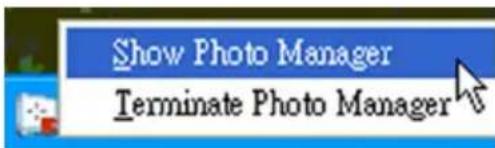
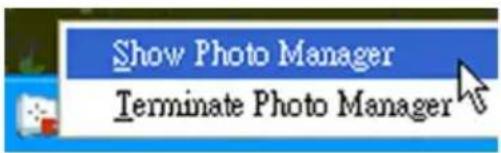
1 Right-click the Auto Run icon in the Windows taskbar.

2 Select Show Photo Manager. The main window appears. To start using Photo Manager, refer to Section 5 Using Philips Photo Manager.
To terminate the program, select Terminate Photo Manager.
Photo Manager will automatically launch when the PhotoFrame is connected to your PC through a USB cable. You may also double click the desktop shortcut to bring up this application. See Section 4 for further details.
4. Philips Photo Manager Overview
The screen below is the first one you will see when launching the Photo Manager. From here you control the functionality of the software. The screen is divided into the sections described below:
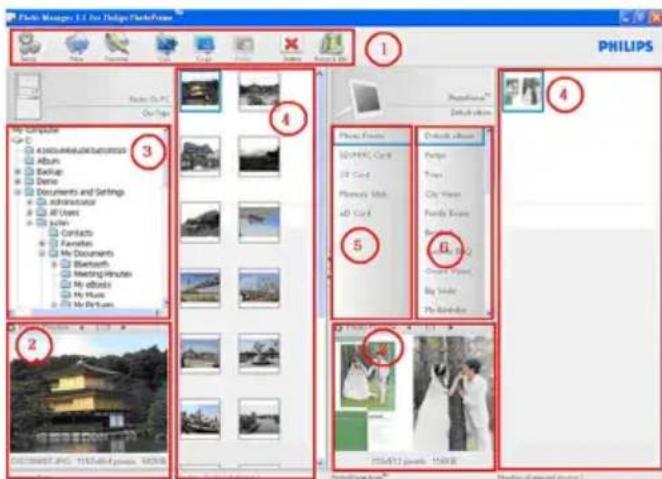
1 Photo Manager Toolbar Command Key Pane is just beneath PC/ PhotoFrame Panes and contains the functional button for Photo Copy, Cut, Past and Delete operations. Within the Command Key Pane, you may click the setup button to set the desired language, and use the recycle bin button to undelete photos.
Setup: The Setup button allows you to change such features as Photo Manager automatically running when the PC starts, and the language of the application.
New Album: The New Album button allows you to create new albums on a memory card or the PhotoFrame.
Rename Album: Click the Rename Album button to bring up a Keyboard Input Window.
Cut: You should select photos first and then click on the Cut button to cut the selected photos.
Copy: Select photos first and then click on the Copy button to copy the selected photos.
Paste: Immediately after you click on the Copy or Cut buttons, the Paste button will become available. You can select the target folder from the previous selected photos into the target folder (album).
Delete: Select the photos or album that you want to remove and click on the Delete button to remove them.
Recycle Bin: Click the Recycle Bin button to switch the target folder to the recycle bin folder. You may browse those removed photos and move them back to desired folders.
Close: Clicking the Close button minimizes the application, which will be shown as a tray icon in the taskbar.
You can always bring back this application by right-clicking on this tray icon and selecting the "Show Photo Manager" option. Alternatively, you may terminate this application by selecting "Terminate Photo Manager".
2 Photo Preview
Display the user selected picture with detail information, such as file name, file size and photo resolution.
3 The PC Frame
The PC Frame displays a folder tree structure similar to Windows Explorer, with photos shown as thumbnails. If no JPEG images are available, "No Photo" will be displayed.
Warning:
Even if this view displays the "No Photo" message, this folder may contain other files and may not be empty.
Folder Tree View:
Displays all folders and the recycle bin in a tree structure similar to Windows Explorer. If the user clicks the desired folder, all photos in the folder will be shown in Photo Thumbnail View.
4 Thumbnail Previews
Display all photos in thumbnail view based on the user-selected folder from the folder tree view.
5 PhotoFrame Storage
Displays all of the storage devices on the PhotoFrame. The available devices are highlighted.
Note:
If the Philips PhotoFrame is not connected to your PC, the "Disconnected" message will be shown.
Between the PhotoFrame storage (5) and the PC thumbnail Preview (4) is the Slide Bar: Click to move the Slide Bar left and increase the PhotoFrameTM Storage area and vice versa (you may click to increase the PC Thumbnail preview).
6 Album View
Displays the albums in the storage device.
5. Using the Photo Manager
5.1 Setting up Photo Manager
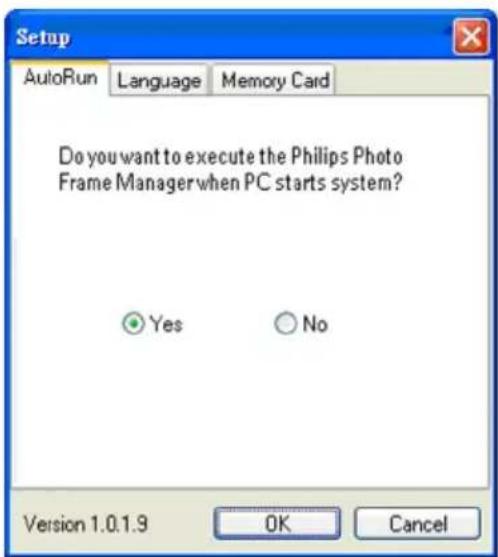
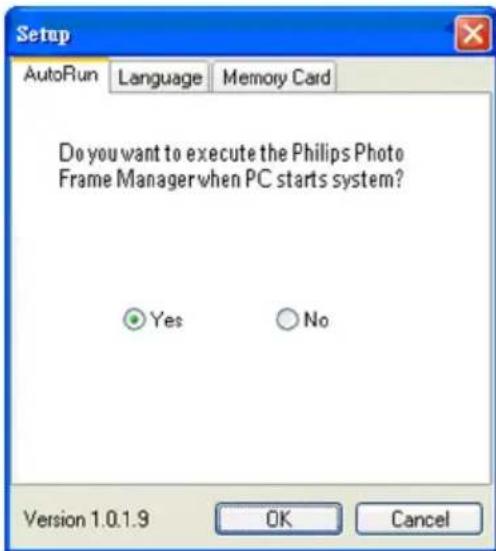
Setup Tool: You may set up application execution and language preferences from this window.
AutoRun Tab:
1. Select the "Yes" radio button to execute the Philips PhotoFrame Manager automatically, or select "No" to execute the Philips PhotoFrame Manager manually.
2. Click "OK" to confirm the change you have just made.
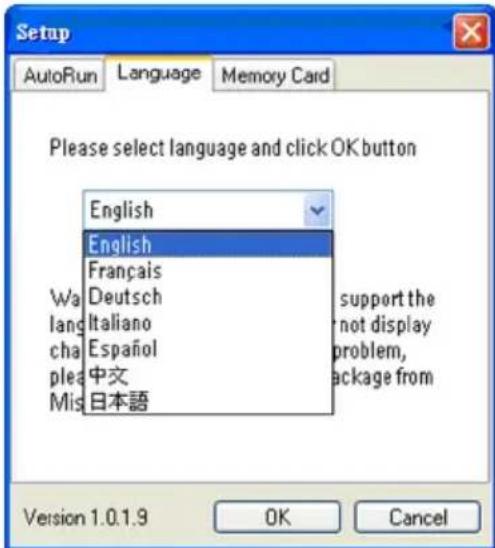
Language Tab:
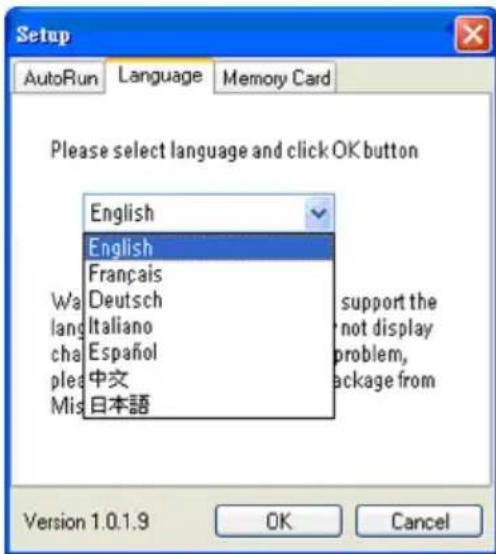
1. Select the required application language from the list. 2. Click "OK" to confirm the change.
Warning:
If your computer doesn't support the selected language, the characters may not be displayed correctly. To solve this problem, update the language service packs from the Microsoft Website.
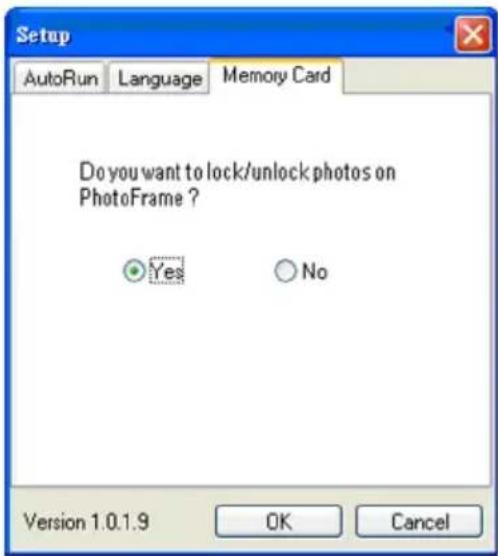
Memory Card Tab:
1. Select the "Yes" radio button to prevent users from deleting or making changes to photos in the PhotoFrame, or select "No" to allow users to perform those operations on photos in the PhotoFrame. 2. Click "OK" to confirm the change you have just made.
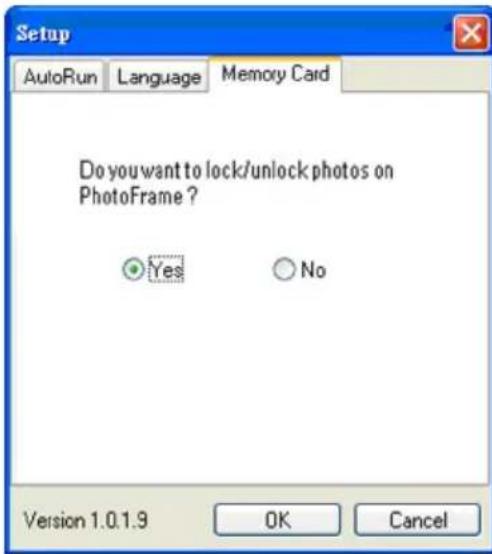
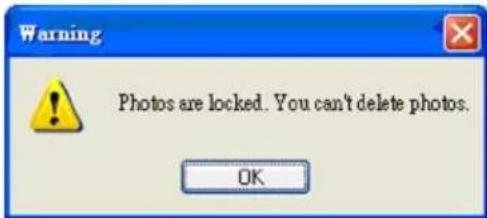
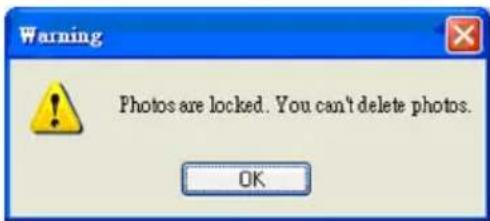
3. If users try to delete photos when the PhotoFrame has been locked, the following warning message will be displayed.
5.2 Crop Photos
- Photo Manager will automatically resize all photos copied to the PhotoFrame.
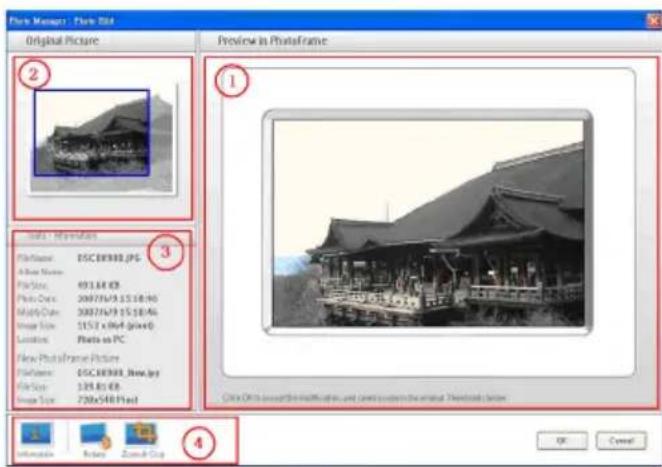
- Photos larger than 540 x 720 or 720 x 540 pixels can be manually cropped by double-clicking the photos in the thumbnail view as shown below.
Preview in PhotoFrame
In this preview area, the cropped photo results are shown as they will be displayed in PhotoFrame.
2 Original Picture
- Displays the original photo in the thumbnail view and the area to be cropped in a blue rectangle, which presents the cropping area with 540x720 or 720x540 pixels.
- Use the mouse to drag this rectangle area to your desired area.
- Displays the Album Name, Date Time, and Photo Description information of the selected photo.
- Displays the submenu icons based on the selected command keys.
The Tools Pane is located at the bottom of the Photo Edit Window and contains the buttons for photo editing.
The Information button shows the Album Name, Date Time, and Photo Description information of the selected photo.
| Tools - Information |
| File Name: | Phi_0001.JPG |
| Album Name: | Trips |
| File Size: | 98.11 KB |
| Photo Date: | 2007/1/12 14:18:04 |
| Modify Date: | 2007/1/12 14:18:04 |
| Image Size: | 720 x 424 (pixel) |
| Location: | Photo on PC |
| New PhotoFrame Picture |
| File Name: | Phi_0001_New.jpg |
| File Size: | 100 KB |
| Image Size: | 720x540 Pixel |
Rotate:
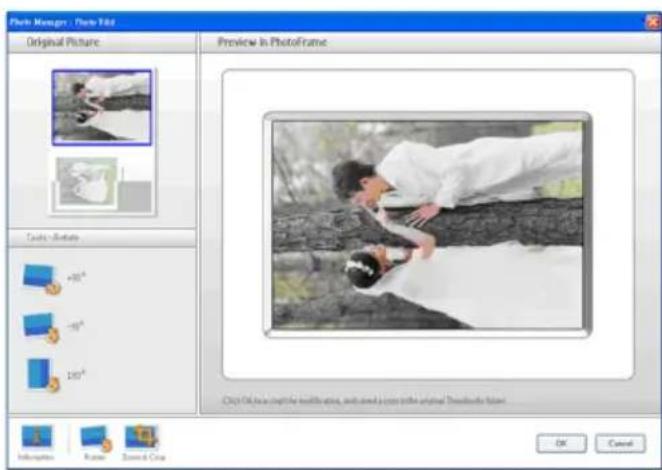
The Rotate button allows you to rotate the angle of the selected photo. Available angles are +90°, -90°, and 180°. Once the desired angle has been selected, both images in Original Picture and Preview in PhotoFrame will be automatically adjusted to the new angle.
Zoom & Crop:
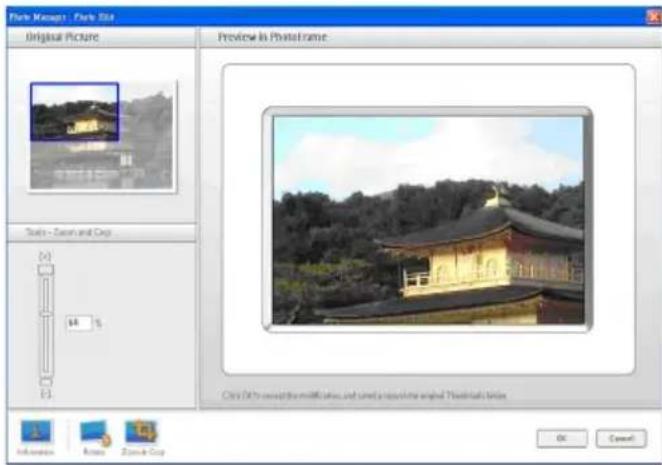
Click the Zoom & Crop button to bring up the scaling control bar into the Tools information Area. Users can zoom in to the photo by dragging the control bar up, or zoom out by dragging it down.
To confirm the crop operation, simply click the OK button. It will save the cropped file in the same folder. The saved file will carry the same filename plus an index number. For example, if the original filename is original.jpg, the saved file will be original(1).jpg.
Note:
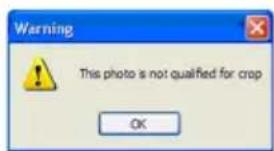
If the photo size is less than 540x720 or 720x540 pixels, it will display the following warning message.
5.3 Cutting, Copying and Pasting Photos
Copy:
Select the photos first, and then click the Copy button to copy the selected photos. Copying leaves the selected photos in their original folder.
Cut:
Select the photos first, and then click the Cut button to cut the selected photos. Cutting removes the selected photos from their original folder.
Warning:
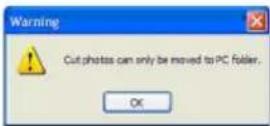
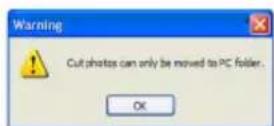
Photos can be cut from a memory card to a PC, but cannot be cut from a PC to a storage device.
Warning:
Do not disconnect the USB connection between the PC and the PhotoFrame when copying, moving, or deleting photos in PhotoFrame, as this may cause the loss of data or the photo.
Paste:
Once the photo has been cut or copied, it needs to be pasted into the chosen folder.
1 Select the folder to paste into. Either click the Paste icon or right click for the secondary menu and click Paste.
5.4 Create New Albums
To create a new album
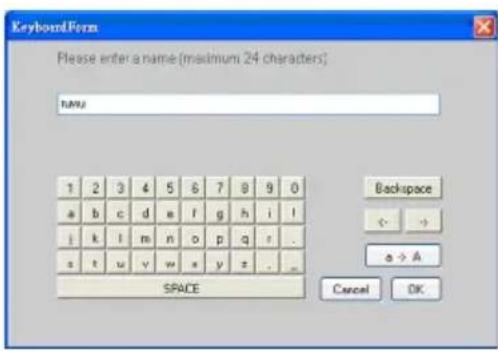
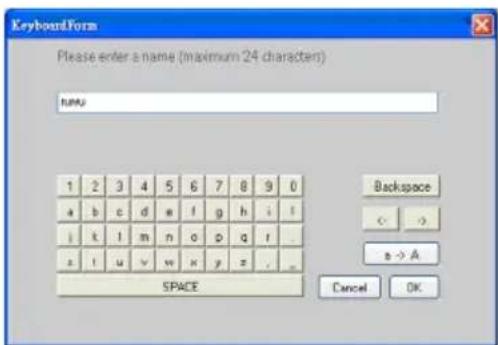
1 Select the PhotoFrame or target memory card. 2 Click on the New Album icon to bring up the Keyboard Form window. 3 Input the name for the album using either the computer keyboard or by clicking on the keyboard buttons. 4 Click OK to add the new name.
5.5 Renaming Albums
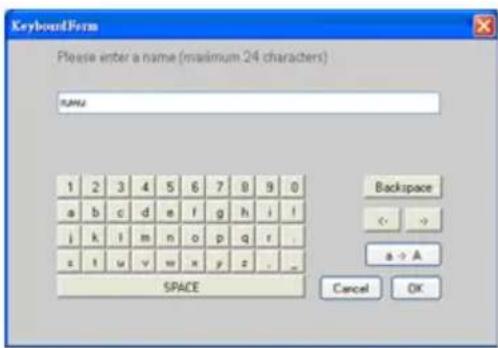
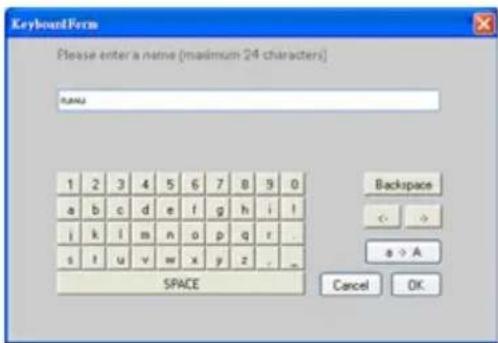
1 Select the album to rename. Either click the rename icon or right click the album to bring up the secondary menu and click Rename. 3 Input the name for the album using either the computer keyboard or by clicking on the keyboard buttons. 4 Click OK to add the new name.
5.6 Deleting Albums and Photos
Albums and files are deleted in the same way:
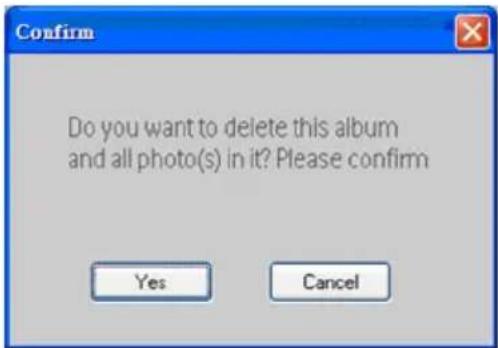
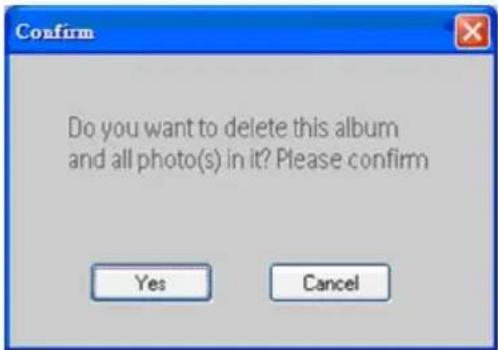
1 Select albums / photos that you want to be removed. Either click the Delete icon or right click for the secondary menu and click Delete Album/Delete. 3 A confirmation window similar to the one below will pop up and ask you to double confirm. Click Yes.

Note:
All deleted files will be moved into the Recycle Bin.
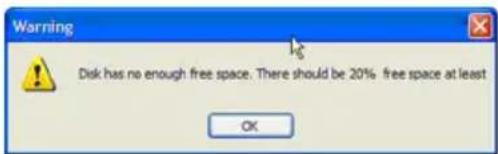
Warning:
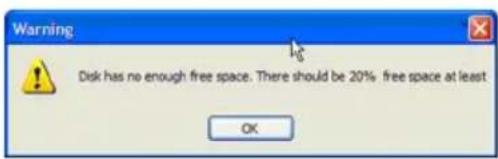
If the HDD has minimum free memory space, it does not allow backup.
Displays the albums in the storage device.
5. Using Photo Manager
To start Philips Auto Run manually:
1. Preview in PhotoFrame
1. Welcome to Photo Manager
The Philips Photo Manager for PhotoFrame program provides the following options for working with photos:
- Transferring photos from the PC to the Philips PhotoFrame and vice versa.
- Automatic resizing of photos according to the resolution of the PhotoFrame.
- Copying by dragging and dropping for transferring
- photo files from the PC to the PhotoFrame
- Philips PhotoFrame or from the PhotoFrame to the
- computer. Restoring deleted files from the Recycle Bin.
- Automatic detection of the Philips PhotoFrame.
3. Getting to work
3.1 System requirements
Basic requirements for hardware: Minimum configuration: Pentium III processor with a clock speed of 500 MHz or more powerful; 128 MB RAM; 100 MB of free space on the hard disk; video controller supporting 16-bit color palette High Color. - Supported operating systems for PC: MS Windows XP and MS Windows 2000. - Supported languages: Simplified Chinese, Traditional Chinese, English, French, German, Italian, Japanese, and Spanish.
3.2 Installation
2 Select the command "Open Photo Manager" (Show Photo Manager).
The main program window will open. The procedure for working with the Photo Manager program is described in Section 5 "Working with the Philips Photo Manager program".
To close the program, select the command Close Photo Manager (Terminate Photo Manager).
The Photo Manager program starts automatically when the PhotoFrame photo frame is connected to the computer via a USB cable. You can also start this program by double-clicking the icon on the desktop. For additional information, see Section 4.
4. Brief description of the Philips Photo Manager program
The figure below shows the screen that opens when you start the Photo Manager program. This screen contains all the necessary program controls. The screen is divided into panels, which are described below:
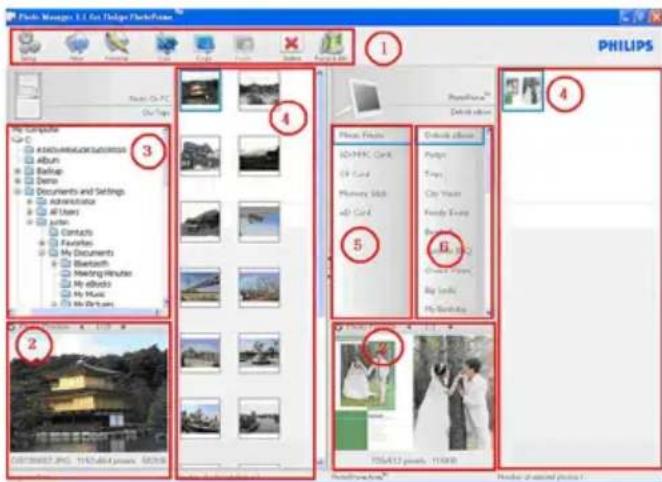
1 Toolbar of the Photo Manager program
A panel of control buttons, located directly on the panels of the photo frame, contains buttons for performing actions with photo frames, such as Copy, Cut, Paste, and Delete. By pressing the Setup button on the control button panel, you can set the desired language, and by pressing the Recycle Bin button, you can restore deleted photos.
Create Album (New Album): button
The Create Album (New Album) button allows you to create new albums on the memory card in the PhotoFrame photo frame.
Rename Album: after pressing the Rename Album button, the Keyboard Form window opens.
Cut: First select the photos, then press the Cut button to cut them.
Copy: First select the photos, then press the Copy button to copy them.
Paste: Immediately after pressing Copy or Cut, the Paste button is activated. Specify the target folder (album) into which the previously selected photos should be pasted.
Delete: Select the photos or albums you want to delete, then press the Delete button.
Recycle Bin: Press the Recycle Bin button to move the selected photos from the target folder to the Recycle Bin folder. Here you can view the deleted photos and, if necessary, restore them by moving them back to the folder from which they were deleted.
Close: Pressing the Close button minimizes the program window to an icon in the system tray of the taskbar.
To expand the program window again, right-click the icon in the system tray of the taskbar and select "Show Photo Manager" from the context menu. You can also completely close the program by selecting "Terminate Photo Manager".
2 Photo Viewer
Displays the photo selected by the user along with information such as file name, file size, and image resolution.
Photo Album
In the Photo panel, the folder structure is shown as a tree (similar to Windows Explorer), and photos are shown as thumbnails. If there are no JPEG image files, the message "No Photo" is displayed.
Warning:
Even if the message "No Photo" is displayed, the folder may not be empty; it may contain files of other formats.
Tree structure of folders:
All folders, including the Recycle Bin folder, are displayed as a tree - just like in Windows Explorer. If you click on a folder or album, all photos contained in it will be shown as thumbnails.
All photos in the folder selected by the user in the tree structure are displayed as thumbnails.
5 PhotoFrame panel
This panel shows all storage devices that can be used in the PhotoFrame. Connected storage devices are highlighted.
Notes:
If the Philips PhotoFrame is not connected to the PC, the message "Disconnected" is displayed.
The PhotoFrame panel (5) and thumbnails (4) are separated by a vertical line. Press the button to move the vertical line to the left to enlarge the PhotoFrame panel, or press the button to enlarge the thumbnail panel.
6 Album
This panel displays albums on the storage device.
5. Working with Photo Manager software
5.1 Configuring Photo Manager software
Setup tool: In this window you can configure the program launch mode and the user interface language.
AutoRun tab:
1 If you want the Philips PhotoFrame Manager program to start automatically when the computer starts, press the "Yes" button; if you want to start the Philips PhotoFrame Manager program manually, press the "No" button. 2 To confirm the selected choice, press "OK".
Language tab:
1. Now you can select the language of interest for the program. 2. To confirm the selection, press "OK".
Warning:
If your computer does not support the selected language, the characters may be displayed incorrectly. To resolve this problem, download the update packages for your language from the Microsoft website.
Tab "Memory Card":
1. Press the "Yes" button to prohibit deletion or modification of pictures in the PhotoFrame gallery, or press the "No" button to allow the user to perform these actions on pictures in the PhotoFrame gallery. 2. To confirm the selected choice, press "OK".
3. When attempting to delete photos in the locked PhotoFrame gallery, the following warning message will appear.
5.2 Cropping Photos
- The Photo Manager program automatically changes the size of all pictures copied to the PhotoFrame gallery. Photos with a size larger than 540x720 or 720x540 pixels can be cropped manually; for this, double-click on the picture in the thumbnail panel, as shown in the figure below.
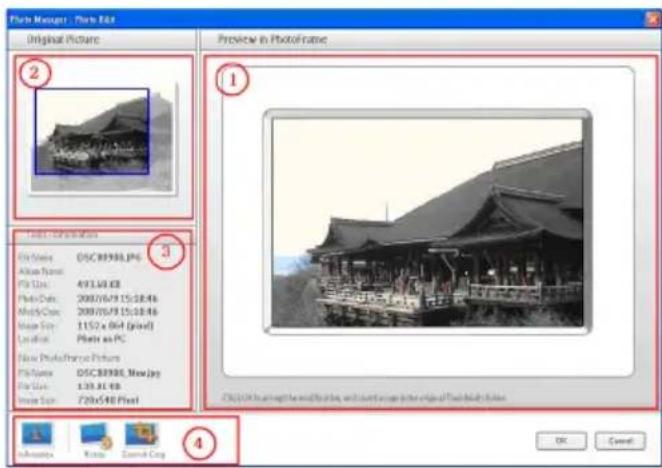
On the toolbar located at the bottom of the "Photo Edit" window, there are commands for editing photos.
When you press the Information button, the album name, date and time, and descriptive information about the selected photo are displayed.
| Tools - Information |
| File Name: | Phi_0001.JPG |
| Album Name: | Trips |
| File Size: | 98.11 KB |
| Photo Date: | 2007/1/12 14:18:04 |
| Modify Date: | 2007/1/12 14:18:04 |
| Image Size: | 720 x 424 (pixel) |
| Location: | Photo on PC |
| New PhotoFrame Picture |
| File Name: | Phi_0001_New.jpg |
| File Size: | 100 KB |
| Image Size: | 720x540 Pixel |
Rotate:
The Rotate button allows you to rotate the selected photo. You can rotate by +90°, -90°, and 180°. After selecting the rotation angle, both images will automatically rotate by this angle in the Original Picture window and in the Preview in PhotoFrame window.
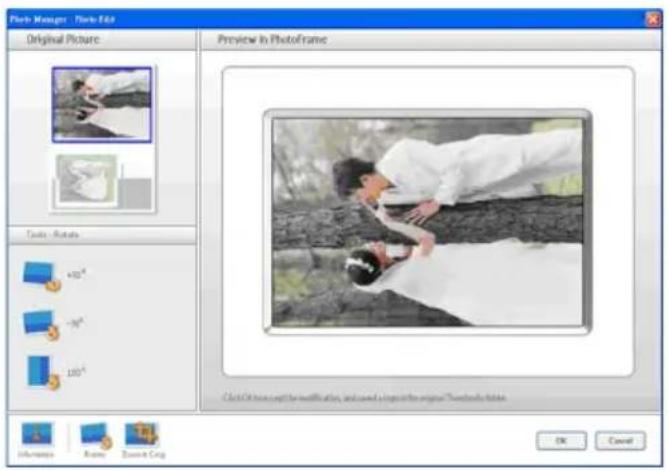
Zoom & Crop:
Press the Zoom & Crop button to show a zoom scale with a slider in the Tools information field. By moving the slider up the scale, you can make the picture larger, and by moving the slider down, smaller.
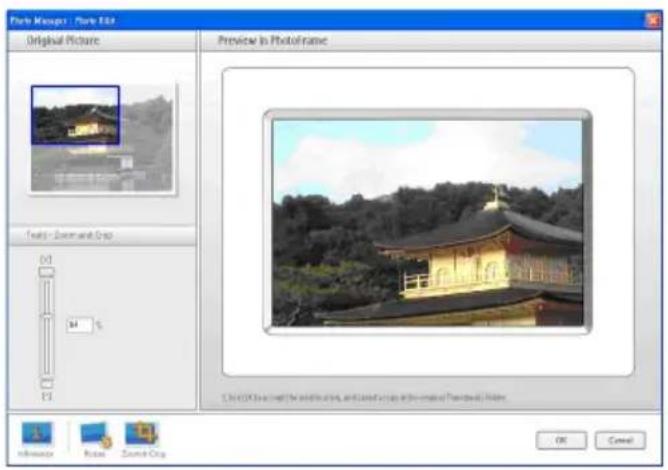
After cropping, press the OK button. The cropped image will be saved in the same folder. The cropped image will be saved under the same name as the original image, but with a numeric index. For example, if the original image was named original.jpg, the cropped image will be saved as original(1).jpg

Note:
If the image size is less than 540x720 or 720x540 pixels, the following warning message will appear.
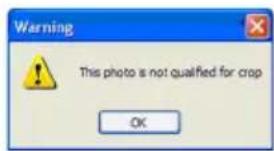
5.3 Cutting, copying, and pasting photos
Copy:
First select the desired photos, then press the Copy button to copy them. When copying, the selected photos will remain in their original folder.
Cut:
First select the desired photos, then press the Cut button to cut them. When cutting, the selected photos will be removed from their original folder.
Warning:
You can cut photos from the memory card and paste them onto the frame, but you cannot cut them from the frame and paste them onto storage devices.
Warning:
While copying, moving, or deleting photos in the PhotoFrame software, do not disconnect the USB connection between the frame and the PhotoFrame software, as this may result in data loss of the photos.
Paste:
After copying or cutting a photo, you need to paste it into the selected folder.
1 Select the folder where you want to paste the image. 2 Press the Paste command icon or right-click to open the context menu and select the Paste command.
5.4 Creating New Albums
Procedure for creating a new album
1 Select the photo frame or memory card where you want to create the album. 2 Press the New Album command icon to open the Keyboard Form. 3 Using the computer keyboard or by pressing the on-screen keyboard buttons, enter the album name. 4 After entering the name, press OK.
5.5 Renaming Albums
1 Select the album you want to rename. 2 Press the Rename command icon or right-click on the album and select Rename from the context menu. 3 Using the computer keyboard or by pressing the on-screen keyboard buttons, enter the album name. 4 After entering the new name, press OK.
Note: All deleted files will be placed in the Recycle Bin.
Warning:
If the free space on the hard disk is at a minimum, recovery of deleted files is impossible.
5.6 Deleting Albums and Photos
Deleting albums and files is done in the same way:
1 Select the albums/photos you want to delete. 2 Press the Delete command icon or right-click to open the context menu and select Delete Album/Delete. 3 A confirmation dialog will appear at the bottom. Press Yes.
- General view of Phillips Photo 54
Manager
2 Original Picture
1 Photo Manager Taskbar
4 Thumbnail Previews
Preview in PhotoFrame
5.4 Create new albums.
4. Phillips Photo Manager Overview
Philips Photo Manager for PhotoFrame
3.3 Starting Philips Photo Manager
2 Select Show Photo Manager
Photo Manager (Show Photo Manager)
4. Phillips Photo Manager
Overview
Using the Photo Manager