WWS-SST60 - Soldering iron ROTHENBERGER - Free user manual and instructions
Find the device manual for free WWS-SST60 ROTHENBERGER in PDF.



| Brand | ROTHENBERGER |
| Model | WWS-SST60 |
| Type | Digital soldering station |
| Nominal power | 60 W |
| Nominal voltage | 230 V~ / 50 Hz |
| Temperature range | 200 - 450 °C |
| Display | Digital temperature display |
| Temperature presets | 200 °C (Standby), 300 °C, 400 °C |
| Standby mode | Automatic after 30 minutes of inactivity |
| Included tips | 1x pointed (pre-installed), 1x flat spare |
| Included solder wire | S-Sn99Cu1 (lead-free) Ø 1 mm and 1.5 mm |
| Cleaning sponge | Yes, with holder |
| Soldering iron holder | Yes, with retaining spring |
| Protection class | I |
| Safety | Disconnect before maintenance; do not use without tip; do not touch hot tip |
| Maintenance | Clean with a slightly damp soft cloth; replace worn tip |
| Cleaning | Moisten the sponge; do not use solvents or abrasives |
| Storage | In a dry and cool place (10 - 30 °C) |
| Transport | In the original packaging, protected from shocks |
| Recommended use | Fine soldering on cables and circuit boards |
Frequently Asked Questions - WWS-SST60 ROTHENBERGER
User questions about WWS-SST60 ROTHENBERGER
0 question about this device. Answer the ones you know or ask your own.
Ask a new question about this device
Download the instructions for your Soldering iron in PDF format for free! Find your manual WWS-SST60 - ROTHENBERGER and take your electronic device back in hand. On this page are published all the documents necessary for the use of your device. WWS-SST60 by ROTHENBERGER.
USER MANUAL WWS-SST60 ROTHENBERGER
Read carefully and keep safe for future reference
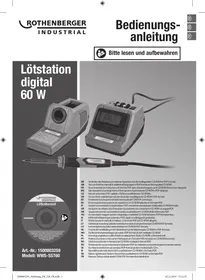
Digital soldering station 60 W
Art.no.:1500003259
Model: WWS-SST60
Table of contents
Scope of delivery / parts list 19
General 20
Read the user manual and keep it safely for future reference 20
Symbols used in this manual 21
Safety 21
Appropriate use 21
Before Use 24
Check the soldering station and scope of delivery 24
Mounting / replacing the soldering tip 24
Placing the cleaning sponge 25
Mains Voltage 26
Usage 26
Switching on and off 26
Setting the operating temperature 27
Soldering / desoldering 28
Maintenance, cleaning, storage and transport 29
Maintenance 29
Cleaning 30
Storage 30
Transport 30
Troubleshooting 31
Technical data 31
Disposal 32
Disposal of packaging 32
Disposal of the soldering station 32
Disposal of the solder wire 32
Scope of delivery / parts list
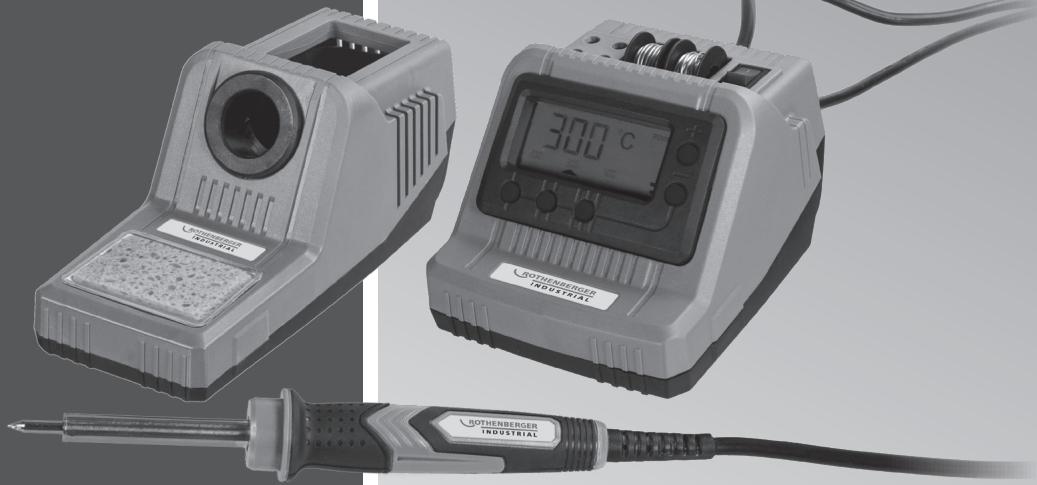
- Control unit
- Mains cable with plug
- ON/OFF switch
- Connection cable between soldering iron and control unit
- Soldering iron
-
Solder wire S-Sn99Cu1 (lead-free solder) (1x 1mm,1x 1.5mm)
-
Replacement soldering tip (1 pointed, 1 flat)
- Cleaning sponge
- Soldering tip (pre-assembled)
- Pad for cleaning sponge
- Soldering iron holder
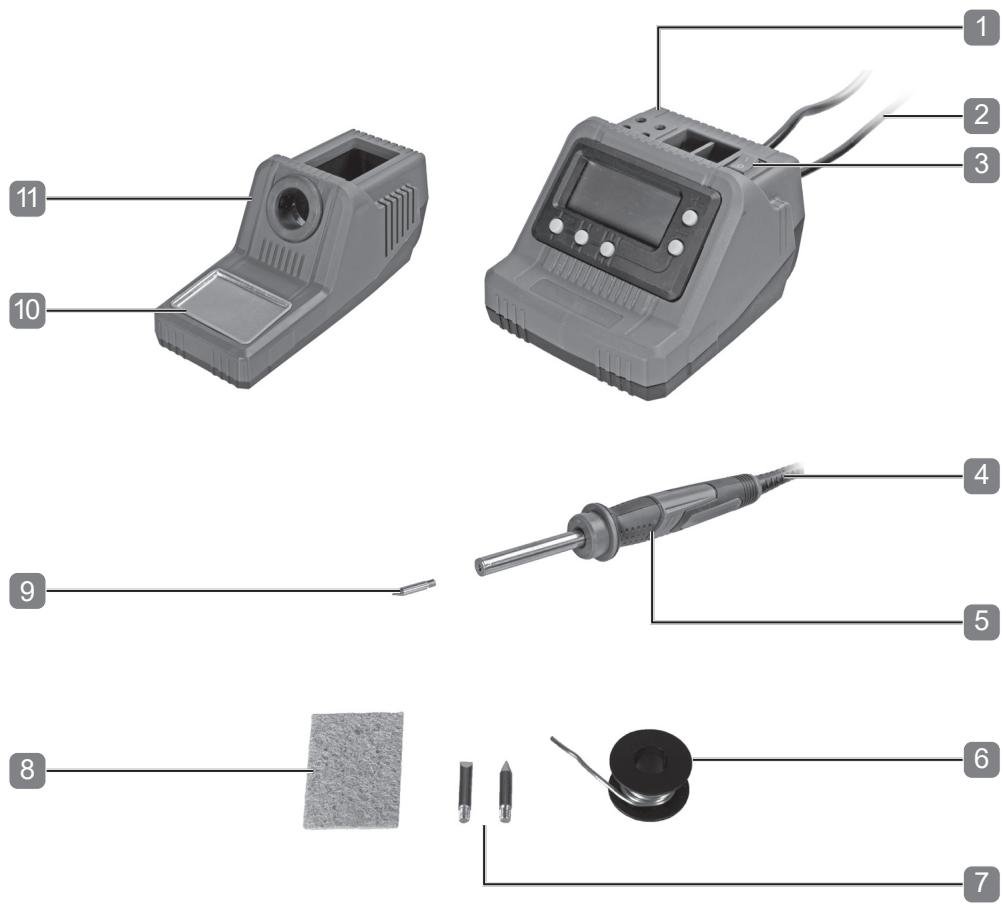
-
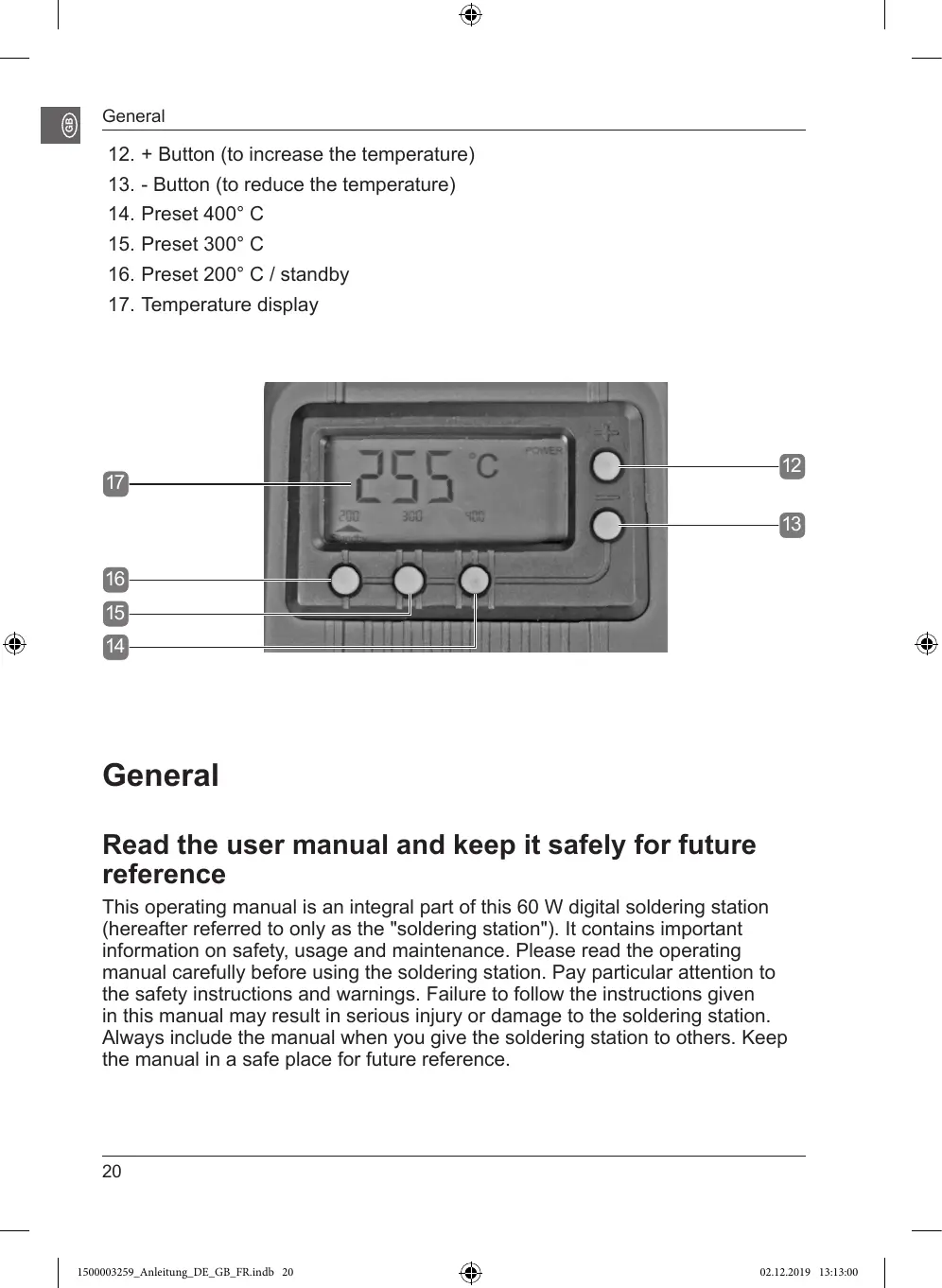
- Button (to increase the temperature)
-
- Button (to reduce the temperature)
- Preset 400^ C
- Preset 300^
- Preset 200^ / standby
- Temperature display

General
Read the user manual and keep it safely for future reference
This operating manual is an integral part of this 60 W digital soldering station (hereafter referred to only as the "soldering station"). It contains important information on safety, usage and maintenance. Please read the operating manual carefully before using the soldering station. Pay particular attention to the safety instructions and warnings. Failure to follow the instructions given in this manual may result in serious injury or damage to the soldering station. Always include the manual when you give the soldering station to others. Keep the manual in a safe place for future reference.
Symbols used in this manual
The following symbols and key words will be used in this manual, on the soldering station or the packaging.
| WARNING! | Indicates a hazard that, if not avoided, could result in death or serious injury. |
| CAUTION! | Indicates a hazard that can cause minor or moderate injuries when ignored. |
| i | This symbol provides you with useful additional information on assembly or operation. |
| CE | Products marked with this symbol meet all the applicable regulations of the European Economic Area. |
| Read the user manual. |
Safety
Appropriate use
This soldering station is exclusively designed for private use and for hobby and DIY projects for the following purposes:
- for fine soldering work on, for example, wires and PCBs
The soldering station should only be used in accordance with the instructions and safety information given in this operating manual. It should not be used for any other purpose. Neither the manufacturer nor the dealer accepts responsibility for any damage, loss or injury resulting from improper use of the soldering station. Examples of misuse are given in the following non-exhaustive list:
- Any use beyond the specified intended use.
- Failure to follow the safety and handling instructions, as well as the assembly, operation, cleaning and maintenance instructions given in this manual.
-
Using accessories and spare parts which are not suitable for this soldering station.
-
Changes made to the soldering station or to the accessories.
- Excessive use.
Anyone using or maintaining this soldering station has to be familiar with these instructions and be aware of potential hazards. This soldering station should only be used by a skilled person - if in doubt ask an expert for advice.
Non-observance of the safety, assembly and operating instructions while operating the appliance counts as misuse. All the applicable health and safety regulations have to be followed. All other applicable local and national laws have to be complied with. The soldering iron should not be modified. Any unauthorised modification increases the risk of injury or damage to property.
General safety instructions

WARNING!
Read the warnings and safety instructions carefully. Failure to follow the warnings and safety instructions may result in electric shock, fire and/or serious injuries.
Retain all the warnings and safety instructions for future reference.
a) This device can be operated by children from 8 years of age and above, as well as by people with reduced physical, sensory or mental capacities or who lack knowledge or experience, if they have been supervised or instructed regarding safe use of the device, and understand the resultant dangers. The device is not intended as a toy for children. Cleaning and user maintenance shall not be performed by children without supervision.
b) To prevent the risk of injury, damaged mains cables may only be replaced by the manufacturer, by customer service or by a similarly qualified person.
c) Allow the soldering station to cool down completely in air after use before you put it away. WARNING! The soldering iron must be stored in the soldering stand when not in use.
d) Do not use the soldering station if the handle, the mains cable or the plug are damaged. Never open the device!
e) Do not expose the soldering station to moisture or rain.
f) Work close to the power socket so that you can disconnect the plug in an emergency.
g) Check the tightness of the soldering tip before heating it. The soldering tip has to be screwed in as far as it goes and tightened by hand.
h) Never heat the soldering iron without attaching a soldering tip.
i) Remove or change the soldering tip only when the soldering station is switched off and the soldering tip has cooled down.
j) Do not touch the hot soldering tip, the melted solder or hot components while soldering. The soldering stand can become hot when the soldering iron is placed on it. Danger of burns!
k) Do not bring flammable or heat-sensitive objects close to the hot soldering iron.
I) Avoid contact between the hot parts of the soldering iron and the plastic parts of the soldering iron stand.
m) Do not leave the soldering station unattended while it is switched on.
n) Do not carry out any soldering work on live parts.
o) Always use in a well-ventilated space. Toxic fumes can be produced when soldering, which can lead to damage to the mucous membranes and/or chronic respiratory illness..
p) Wear eye protection.
q) The supplied solder wire contains resin. May give rise to allergic reactions.
r) Solder can contain lead. Do not eat, drink or smoke while soldering. Always wash your hands thoroughly after finishing work.
s) Do not cool the soldering iron using water.
t) Switch off the device when not in use.
u) Always switch off the device after completing the work.
v) Avoid contact between the hot soldering tip and the plastic parts of the soldering station.
Before Use
Check the soldering station and scope of delivery
- Remove the soldering station from its packaging.
- Check whether the delivery is complete (see chapter: "Scope of delivery / Description of parts")
- Check the soldering station and accessories for damages.
- If this is the case, do not use the soldering station. Contact the manufacturer at the service address indicated on the warranty card.
Mounting / replacing the soldering tip

WARNING!
Disconnect the machine from the mains before performing any maintenance or adjustments

CAUTION!
Allow the soldering station to cool down completely before you change the soldering tip.
Some soldering tips are very sharp. Always wear protective gloves and / or use pliers when changing the soldering tips.
Select a suitable soldering tip for your application.
The pointed soldering tip 7 / 9 is particularly suitable for spot welding and for thin cables. The flat soldering tip 7 is particularly suitable for light electrical work.
Proceed as follows to change the soldering tip:
- Remove the existing tip by turning it counterclockwise out of the soldering iron.
- Screw the new soldering tip by hand clockwise as far as it goes into the soldering iron.
- Do not over tighten the thread.
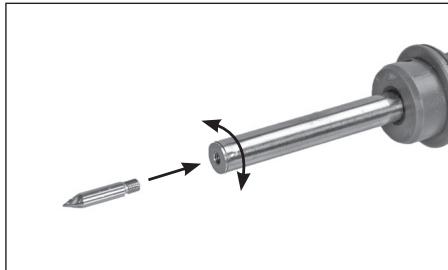
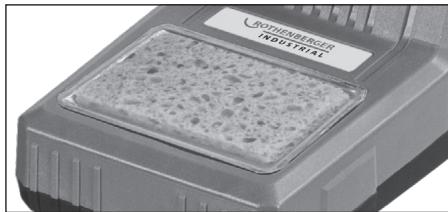
Placing the cleaning sponge
Place the cleaning sponge 8 in the space provided for the cleaning sponge 10 and wet it slightly before use.
Mains Voltage
The mains voltage has to match the specifications on the type plate of the machine. The device is designed for use with single phase alternating current 230V AC / 50 Hz and is double-insulated.
Usage
Switching on and off
Starting the machine
- Connect the mains plug to a suitable mains socket.
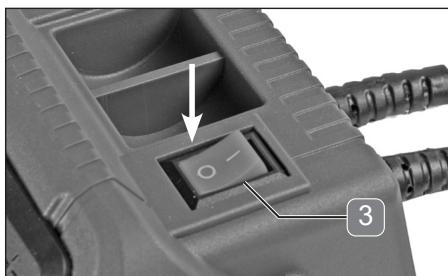
- Place the ON/OFF switch 3 in the 'I' position.
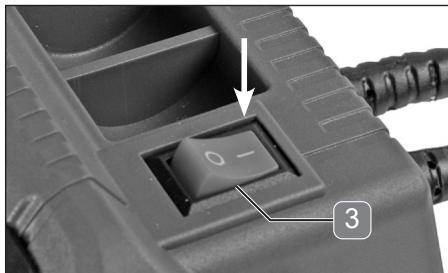
- The display 17 shows the set target temperature for a few seconds, followed by the current temperature of the soldering tip 9.
Switching off
- Place the ON/OFF switch 3 in the 'O' position.
Setting the operating temperature
- Select the desired operating temperature by pressing one of the preset buttons (14, 15, 16) or by pressing the "+" 12 or the "-" 13 button for increasing or decreasing the temperature in steps of 10^ C .
- The display shows when the soldering tip reaches the correct operating temperature.
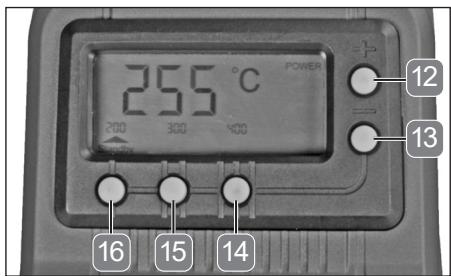
The operating temperature can be adjusted from 200 to 450^ and depends on several factors:
the solder used;
- the size and thickness of the workpiece;
- the material and the conductivity of the workpiece.
When soldering, start with a low operating temperature (max. 300^ ) and increase the temperature if necessary. The appropriate operating temperature is reached when the solder begins to melt as soon as it comes into contact with the soldering tip.
Use a higher temperature (400 - 450^) for desoldering, depending on the strength of the solder joint to be desoldered.
Proceed as follows to set the operating temperature:
- Switch off the soldering station (see chapter "Switching on and off").
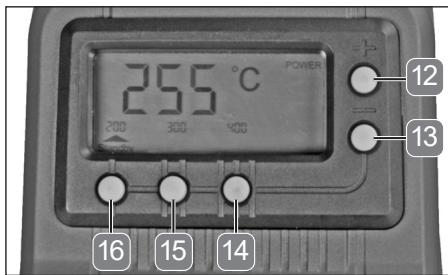
- Select the desired operating temperature by pressing one of the preset buttons (14, 15, 16) or by pressing the "+" or the "-" button for increasing or decreasing the temperature in steps of 10^ .
- The display shows when the soldering tip reaches the correct operating temperature.
Soldering / desoldering

CAUTION!
The soldering iron and the soldering tip remain hot for some time after switching off / disconnecting!
- Switch on the soldering station (see chapter "Switching on and off").
- Set the operating temperature required for your work ( see chapter "Setting the operating temperature").
- The soldering tip used 7 / 9 has to be tinned before you start soldering. To do this, heat up a new or a soldering tip that has been cleaned using the cleaning sponge 8 and coat it by making contact with the solder wire.
- Before starting work on the a particular workpiece and/or type of material, check for suitability by testing the soldering iron on a similar piece of (scrap) material.
- Clean the parts to be joined before soldering.
- Touch the edge of the appropriate flux-cored solder wire to the end of the soldering tip, to melt the solder wire. The workpiece is coated with the flux, which flows out of the solder wire, allowing the solder to join the metal.
- If the soldering iron is used for longer periods we recommend that you clean the tip occasionally with the cleaning sponge and re-tin the tip if necessary.
- Switch off the soldering station (see chapter "Switching on and off").
- Place the soldering iron in the soldering iron stand 11 to cool it down completely
Use a de-soldering braid or a de-soldering pump (not included with the supply) to clean the joint, to de-solder and to remove excess solder from the joint.
Desoldering braid:
- Place the de-soldering braid over the solder to be removed and heat it with the soldering tip 9. The melting solder is soaked up by the de-soldering braid.
Desoldering pump:
- Heat the solder to be removed with the soldering tip. Once the solder melts, activate the de-soldering pump. The suction force removes the solder.

The soldering iron changes to standby mode after 30 minutes of inactivity. In this mode, the display shows "200°C" and flashes.
- Press any button to cancel the standby mode.
Maintenance, cleaning, storage and transport
WARNING!
Disconnect the machine from the mains before performing any maintenance or adjustments
Maintenance
The soldering station is basically maintenance-free, but soot can get deposited on the soldering tip over time. Remove this with a fine sandpaper to ensure clean work.
Only use spare parts / accessories from the manufacturer. Repairs should only be carried out by qualified technicians or by an authorised service centre. Qualified technicians must have relevant training and experience, be familiar with the design and construction requirements of the soldering station and understand and follow the safety regulations.
The tip 7 / 9 wears out after some time and needs be replaced from time to time.
Cleaning

CAUTION!
- Allow the soldering station to cool down completely before cleaning.
Make sure that liquids do not get inside the soldering station.
- Clean the soldering station with a slightly dampened cloth. Do not use aggressive cleaning agents, solvents or petroleum spirit.
Storage
- Clean the soldering station before storage.
- Keep the soldering station in its original packaging in a safe, cool, dry and well-ventilated place, out of the reach of children when not in use.
- The ideal storage temperature is between 10^ and 30^ .
Transport
- Use the original packaging and secure the soldering iron in place during transport.
Troubleshooting
| Problem | Cause | Resolving the problem |
| Soldering iron does not heat up. | No power supply. | Check that the mains supply (socket) functions correctly. Ask a qualified person for advice if necessary. |
| Mains cable or plug defective. | Have the mains cable replaced by the manufacturer or the manufacturer's representative. | |
| The solder does not run smoothly on the soldering iron. | The operating temperature is too low. | Select a higher operating temperature. |
| Soldering tip is loose. | Turn the soldering station off, allow it to cool down and tighten the soldering tip. | |
| The temperature of the soldering tip is too low. | Soldering tip is loose. | Unplug the power cord from the mains outlet. Allow the soldering iron to cool down. Tighten the fixing screw of the soldering tip |
Technical data
| Model No. | WWS-SST60 |
| Rated voltage | 230 V ~ 50 Hz |
| Rated power | 60 W |
| Temperature range | 200-450°C |
| Protection class | I |
Disposal
Disposal of packaging

Dispose of packaging separately. Recycle cardboard and carton along with waste paper, foils and plastic.
Disposal of the soldering station

This symbol indicates that this product should not be disposed along with domestic waste (WEEE) in compliance with the directive pertaining to used electrical and electronic devices (2012/19/EC) and national laws. This product should be handed over at an designated collection point. This can be done, for example, by returning the product when purchasing a similar product or by handing it over to an authorised collection point for recycling used electrical and electronic equipment. Improper handling of used equipment may have negative effects on the environment and human health due to potentially dangerous substances, which are often contained in electrical and electronic equipment. By disposing of this product correctly, you are also contributing towards an efficient use of natural resources. Information on collection points for used equipment can be obtained from your local authority, the public waste disposal authority, an authorised institution for the disposal of used electrical and electronic equipment or the waste collection services.
Disposal of the solder wire

Do not dispose it along with the household waste. Should not be allowed to get into the drainage system. Dispose of any solder wire residue in accordance with the local regulations applicable in your area.
Copyright Rothenberger Industrial GmbH 2015 - 2020. All rights reserved.