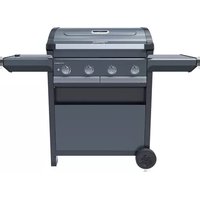
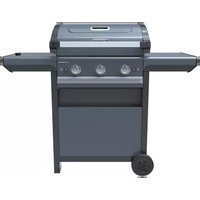
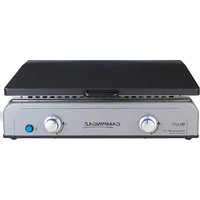
USER MANUAL 4 SERIES CLASSIC WLD CAMPINGAZ
T. RECOMMANDATIONS PILES

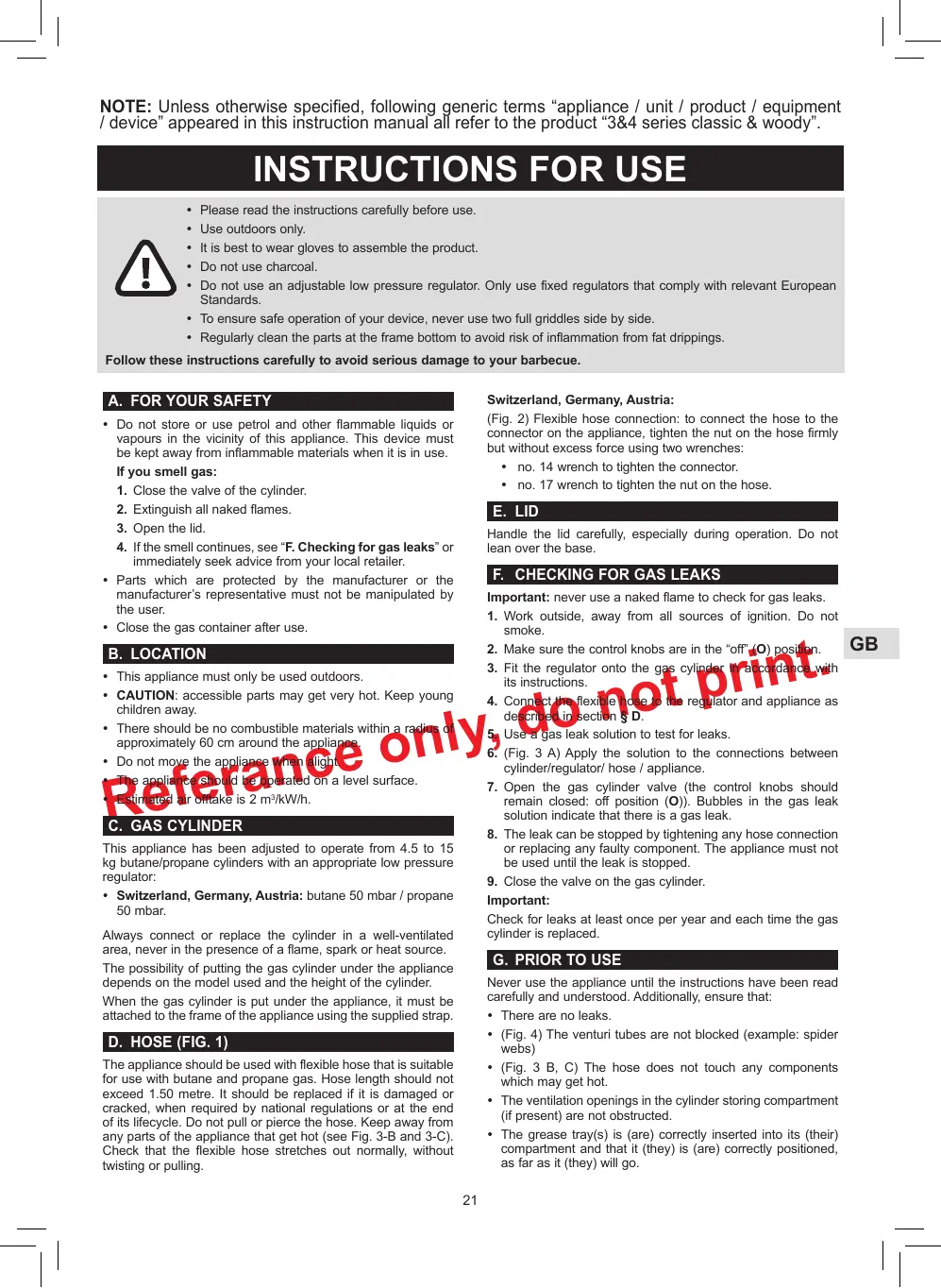
- Please read the instructions carefully before use.
- Use outdoors only.
- It is best to wear gloves to assemble the product.
- Do not use charcoal.
- Do not use an adjustable low pressure regulator. Only use fixed regulators that comply with relevant European Standards.
- To ensure safe operation of your device, never use two full griddles side by side.
- Regularly clean the parts at the frame bottom to avoid risk of inflammation from fat drippings.
Follow these instructions carefully to avoid serious damage to your barbecue.
A. FOR YOUR SAFETY
- Do not store or use petrol and other flammable liquids or vapours in the vicinity of this appliance. This device must be kept away from inflammable materials when it is in use.
If you smell gas:
- Close the valve of the cylinder.
- Extinguish all naked flames.
- Open the lid.
-
If the smell continues, see "F. Checking for gas leaks" or immediately seek advice from your local retailer.
-
Parts which are protected by the manufacturer or the manufacturer's representative must not be manipulated by the user.
- Close the gas container after use.
B. LOCATION
- This appliance must only be used outdoors.
- CAUTION: accessible parts may get very hot. Keep young children away.
- There should be no combustible materials within a radius of approximately 60~cm around the appliances.
- Do not move the appliance when alight
The appliance should be operated on a level surface.
Estimated air offtake is 2m^3 /kW / h
C. GAS CYLINDER
This appliance has been adjusted to operate from 4.5 to 15 kg butane/propane cylinders with an appropriate low pressure regulator:
- Switzerland, Germany, Austria: butane 50 mbar / propane 50 mbar.
Always connect or replace the cylinder in a well-ventilated area, never in the presence of a flame, spark or heat source.
The possibility of putting the gas cylinder under the appliance depends on the model used and the height of the cylinder.
When the gas cylinder is put under the appliance, it must be attached to the frame of the appliance using the supplied strap.
D. HOSE (FIG. 1)
The appliance should be used with flexible hose that is suitable for use with butane and propane gas. Hose length should not exceed 1.50 metre. It should be replaced if it is damaged or cracked, when required by national regulations or at the end of its lifecycle. Do not pull or pierce the hose. Keep away from any parts of the appliance that get hot (see Fig. 3-B and 3-C). Check that the flexible hose stretches out normally, without twisting or pulling.
Switzerland, Germany, Austria:
(Fig. 2) Flexible hose connection: to connect the hose to the connector on the appliance, tighten the nut on the hose firmly but without excess force using two wrenches:
- no. 14 wrench to tighten the connector.
- no. 17 wrench to tighten the nut on the hose.
E. LID
Handle the lid carefully, especially during operation. Do not lean over the base.
F. CHECKING FOR GAS LEAKS
Important: never use a naked flame to check for gas leaks.
- Work outside, away from all sources of ignition. Do not smoke.
- Make sure the control knobs are in the "off" (O) position.
- Fit the regulator onto the gas cylinder in accordance with its instructions.
-
Connect the flexible nose to the regulator and appliance as described in section § D.
-
Use a gas leak solution to test for leaks.
- (Fig. 3 A) Apply the solution to the connections between cylinder/regulator/ hose / appliance.
- Open the gas cylinder valve (the control knobs should remain closed: off position (0) ). Bubbles in the gas leak solution indicate that there is a gas leak.
- The leak can be stopped by tightening any hose connection or replacing any faulty component. The appliance must not be used until the leak is stopped.
- Close the valve on the gas cylinder.
Important:
Check for leaks at least once per year and each time the gas cylinder is replaced.
G. PRIOR TO USE
Never use the appliance until the instructions have been read carefully and understood. Additionally, ensure that:
There are no leaks.
- (Fig. 4) The venturi tubes are not blocked (example: spider webs)
- (Fig. 3 B, C) The hose does not touch any components which may get hot.
- The ventilation openings in the cylinder storing compartment (if present) are not obstructed.
- The grease tray(s) is (are) correctly inserted into its (their) compartment and that it (they) is (are) correctly positioned, as far as it (they) will go.
A. FOR YOUR SAFETY
- Do not store or use petrol and other flammable liquids or vapours in the vicinity of this appliance. This device must be kept away from inflammable materials when it is in use.
If you smell gas:
- Close the valve of the cylinder.
- Extinguish all naked flames.
- Open the lid.
-
If the smell continues, see "F. Checking for gas leaks" or immediately seek advice from your local retailer.
-
Parts which are protected by the manufacturer or the manufacturer's representative must not be manipulated by the user.
- Close the gas container after use.
B. LOCATION
- This appliance must only be used outdoors.
- CAUTION: accessible parts may get very hot. Keep young children away.
- There should be no combustible materials within a radius of approximately 60~cm around the appliance.
- Do not move the appliance when alight.
- The appliance should be operated on a level surface.
Estimated air offtake is 2m^3 /kW / h
C. GAS CYLINDER
This appliance has been adjusted to operate from 4.5 to 15 kg butane/propane cylinders with an appropriate low pressure regulator:
- Switzerland, Germany, Austria: butane 50 mbar / propane 50 mbar.
GB
Always connect or replace the cylinder in a well-ventilated area, never in the presence of a flame, spark or heat source.
The possibility of putting the gas cylinder under the appliance depends on the model used and the height of the cylinder.
When the gas cylinder is put under the appliance, it must be attached to the frame of the appliance using the supplied strap.
D. HOSE (FIG. 1)
The appliance should be used with flexible hose that is suitable for use with butane and propane gas. Hose length should not exceed 1.50 metre. It should be replaced if it is damaged or cracked, when required by national regulations or at the end of its lifecycle. Do not pull or pierce the hose. Keep away from any parts of the appliance that get hot (see Fig. 3-B and 3-C). Check that the flexible hose stretches out normally, without twisting or pulling.
Switzerland, Germany, Austria:
(Fig. 2) Flexible hose connection: to connect the hose to the connector on the appliance, tighten the nut on the hose firmly but without excess force using two wrenches:
- no. 14 wrench to tighten the connector.
- no. 17 wrench to tighten the nut on the hose.
E. LID
Handle the lid carefully, especially during operation. Do not lean over the base.
F. CHECKING FOR GAS LEAKS
Important: never use a naked flame to check for gas leaks.
- Work outside, away from all sources of ignition. Do not smoke.
- Make sure the control knobs are in the "off" (O) position.
-
Fit the regulator onto the gas cylinder in accordance with its instructions.
-
Connect the flexible hose to the regulator and appliance as described in section D
- Use a gas leak solution to test for leaks.
- (Fig. 3 A) Apply the solution to the connections between cylinder/regulator/ hose / appliance.
- Open the gas cylinder valve (the control knobs should remain closed: off position (O) ). Bubbles in the gas leak solution indicate that there is a gas leak.
- The leak can be stopped by tightening any hose connection or replacing any faulty component. The appliance must not be used until the leak is stopped.
- Close the valve on the gas cylinder.
Important:
Check for leaks at least once per year and each time the gas cylinder is replaced.
G. PRIOR TO USE
Never use the appliance until the instructions have been read carefully and understood. Additionally, ensure that:
- There are no leaks.
- (Fig. 4) The venturi tubes are not blocked (example: spider webs)
- (Fig. 3 B, C) The hose does not touch any components which may get hot.
- The ventilation openings in the cylinder-storing compartment (if present) are not obstructed.
- The grease trail(s) is (are) correctly inserted into its (their) compartment and that it (they) is (are) correctly positioned, as far as it (they) will go.
- The 6 removable parts of the firebox enclosure are put back in place (see section § P. Cleaning and maintenance).
!
Check that the venturi tubes (VT) cover the injectors (IJ). (Fig. 5)
Never light the appliance with the lid closed, only with the lid opened.
- (Fig. 6 A) Open the cooking lid.
- (Fig. 6 B) Make sure that the control knobs are in the "OFF" position (O).
- (Fig. 7 A), Press and turn the adjustment lever counterclockwise and put it in a full flow position ( ) .
If your barbecue grill is equipped with a piezoelectric igniter:
- Press immediately on the igniter button (f) until it clicks.
- If the burner does not ignite after 4 or 5 attempts, wait 5 minutes and then repeat the operation.
If your barbecue grill is equipped with an electronic spark igniter:
- Press immediately on the switch (7). A burst of sparks occurs. Continue pressing for a few seconds until the burner is lit.
-
If the burner does not ignite after 4 or 5 attempts, wait 5 minutes and then repeat the operation.
-
Once the burner is lit, there are two ways of lighting another burner:
- Firstly, repeat the lighting operation described above;
Secondly, light the burner to the right or left of the first burner lit, then the other burners in turn by turning the adjustment button to the full flow position (4).
- If the piezoelectric ignition or the electronic ignition doesn't work, use the manual ignition (following paragraph).
- (Fig. 6-A) Open the cooking lid.
- (Fig. 6-B) Make sure that the control knobs are in the "OFF" position (O).
- (Fig. 7-B) Light a match and then bring it from the back of the barbecue toward the burner.
- (Fig. 7-A) Push the control knob and turn it counterclockwise until it is in the full flow position (A).
(Fig. 6-B) Return the control knobs to the "OFF" position (O), then close the cylinder valve.
The side burner may operate independently or in conjunction with the barbecue burner. Before igniting the side burner, be sure that the lid is open and then tucked away (Fig. 8-A, B).
Lighting:
- Open the gas cylinder valve.
- Check that there is no gas leak between the gas cylinder and the side burner (see section §F).
- (Fig. 3-A) Check the condition of the hose connecting the grill burner to the side burner. If there are signs of cracks, call our after sales service to have it replaced.
- Open the valve of the camping stove (+ direction).
-
If your barbecue grill is equipped with a piezoelectric igniter:
-
(Fig. 8-C) Press on the igniter button located to the right of the control panel and identified in the pictogram (1) until it clicks. Press 3 or 4 times if necessary.
-
If your barbecue grill is equipped with an electronic spark igniter:
(Fig. 4-C) Press immediately on the switch (7). A burst of sparks occurs. Continue pressing for a few seconds until the burner is lit.
- Should the stove fail to light, present a match to the edge of the burner.
- Adjust the size of the flame to the dimensions of the container you are using by opening the valve to various extents. Do not use a container smaller than 12cm or larger than 24cm .
Close the side burner valve ( towards "O") and close the valve of the gas cylinder if the grill burner is not in use.
M. LIGHTING OF THE CONSOLE
(DEPENDING ON THE MODEL)
The lighting system of the console is powered by 4 type AA (LR06) batteries provided with the barbecue grill. The battery holder box is located on the front left support, behind the left door. Remove the cover of the battery holder box by sliding it upwards. Insert the batteries while respecting the polarities indicated and then replace the cover.
(Fig. 10) To turn the lighting on or off, press on the stopstart button located to the left of the console and identified by this pictogram (①).
N. REPLACING THE GAS CYLINDER
- Always work in a well ventilated area and never in the presence of a flame, spark or heat source.
- (Fig. 6-B) Return the control knobs to the "off" position (O) then close the cylinder valve.
-
Remove the regulator, check that the sealing joint is in good condition.
-
Put the full cylinder in place, refit the regulator, taking care not to apply stress to the hose. Check for gas leaks.
O. OPERATION
It's recommended that protective gloves be worn to handle components which may be very hot.
When used for the first time, heat up the barbecue with its burners in full on position ( 12 ) (with the lid closed), for approximately 30 minutes in order to eliminate any odors resulting from the paint on the new parts.
In normal operation, preheat the barbecue for a few minutes to reach a good cooking temperature.
Cooking speed can be regulated via the control knobs: between the full flow position ( ) and medium flow position ( ).
In order to reduce food from sticking to the grilles, brush the grilles lightly with cooking oil prior to placing any food to be grilled.
To cook fatty meats while avoiding rising flames, you must generally cook at a reduced rate, even turning off one or more burners for a few minutes if necessary.
In order to reduce the amount of grease catching fire while cooking, remove any surplus fat from the meet prior to placing it on the grille. Clean the barbecue after each use to prevent the accumulation of grease and the risk of it catching fire.
Depending on the models your barbecue grill may be equipped with a cast iron cooking plate. This plate has a double cooking face, one ribbed face permitting the searing of meats and one smooth face for the cooking of fish, shellfish, vegetables, etc...
Important: If one or several burners go out whilst you are using the appliance, turn the control knobs to OFF immediately (O). Wait five minutes to allow the unburned gas to escape. Only carry out the lighting steps after this time.
P. CLEANING AND MAINTENANCE
Never modify the appliance: any modification may prove dangerous.
- In order to maintain your appliance in perfect operating condition, it is recommended to clean it periodically (after 4 or 5 uses).
- Wait until the appliance has cooled down before cleaning.
- Close the gas cylinder and remove the regulator.
- (Fig. 9) Clean the top of the burner, as well as the sides and base, using a moist sponge (water with dish washing liquid). If necessary, use a damp steel brush.
- (Fig. 9) Check that all burner outlets (OH) are clear and dry before using again. If necessary, use a wire brush to unclog the burner outlets.
- (Fig. 9) Clean the orifices on the Venturi jet (VO) or the burner if necessary.
- The grill burner must be cleaned and checked every 3 months. Remove the entire burner (Fig. 9) and check that no dirt or spider webs are blocking the venturi tube openings (Fig. 4), which may cause the burner to be less efficient or cause a dangerous gas fire outside the burner.
- Refit the grill burner correctly.
N.B.: Frequent cleaning of the burner maintains it in good condition for many uses and prevents premature oxidation, notably due to acid residue from cooking. Oxidation of the grill burner is, however, normal.
Control panel
Clean the control panel from time to time using a sponge damped with dish washing liquid. Do not use abrasive products.
Firebox wall
To facilitate the cleaning of the firebox wall, Campingaz® has invented Campingaz InstaClean®, the concept of the removable firebox. Thanks to Campingaz InstaClean®, all the parts of the firebox are removable in under one minute without a need for a tool. These parts are dishwasher safe.
Depending on the degree of dirtiness of these parts, it may be necessary to brush the parts before putting them into the dishwasher for a more complete cleaning.
For the assembly and removal of these parts, refer to the assembly manual.
For reassembly after cleaning, put in the two walls numbered "1-2" first, and then the walls numbered "2-3", and finally the two side walls numbered "3-1" (Fig. 11).
Grease collection tray
Depending on the model, your barbecue grill is equipped with one or two grease collection trays. It is recommended that you clean it (them) after each use. It (they) can be washed in the dishwasher.
To ease the cleaning, the width of the grease collecting trays are sized to permit covering them with a piece of aluminium foil, able to be purchased in stores, before putting the barbecue grill into operation. After use of the barbecue grill, discard the aluminium foil.
It is also possible to put a bit of sand in the bottom of the grease collection tray, which will absorb the cooking grease. Discard the sand after each cooking period.
Cooking plate and grill
Your cooking plate and grill are enamelled.
Wait for them to cool before any cleaning operation. Use a Campingaz® BBQ Cleaner Spray cleaning product and brushes for barbecue grills.
You may clean your cooking plate and grill in the dishwasher. Before putting them into the dishwasher, it is often necessary to scrape them with a sponge or a metallic brush to remove residue that sticks to the cooking surface.
(Fig. 12) To remove the metal cooking plate and grill and the cast iron plate, slide your finger into the indicated holes, lift them and take hold of them with the other hand.
(Fig. 13) To remove the cast iron grill made of up 2 parts (see paragraph r) below), first remove the central portion with the help of the indicated tab, and then remove the contour.
Wood (depending on the model)
In the concern of keeping its natural appearance while protecting it, the wood of the barbecue grills is covered with protective oil. It is however a living material which remains sensitive to exposure to the rays of the sun, humidity and changes in temperature.
To keep your barbecue looking as new, we recommend you cover it with a Campingaz® protective cover available as an accessory. Important: wait for the barbecue to cool down completely before putting on its protective cover.
At the beginning of the season, apply a coat of lazure for exterior wood on the wooden parts with a rag or brush to give it a shinier appearance and keep it protected.
Important:
At the beginning of the season, apply a coat of linseed oil or teak oil onto the wood parts with a rag or brush in order to give it a more brilliant appearance and to maintain its protection.
Q. STORAGE
- Close the gas cylinder valve after use.
- If you store your barbecue indoors, disconnect the gas cylinder and store the cylinder outdoors.
- If you store your barbecue outdoors, it is recommended that a protective cover be used.
- When not used for a long period of time, it is recommended
that the barbecue be stored in a dry, sheltered place (eg: garage).
- Environment conducive to corrosion: particular care must be taken with the product if used by the sea; it must not be stored outside without protection, and must be kept sheltered in a dry environment.
R. ACCESSORIES
Depending on the model, your barbecue may be equipped with a Campingaz® Culinary Modular grid.
The Campingaz® Culinary Modular cooking grid is made up of 2 parts:
the contour
the centre
(Fig. 13) The centre is removable and may be replaced by one of the accessories sold separately by Campingaz®, for example:
- Pizza stone
Wok
Paella plate
The Campingaz® Culinary Modular concept therefore allows you to transform your barbecue into a true outdoor kitchen and to use a specific cooking support depending on what you are preparing.
If your model of barbecue is not equipped with a Campingaz® Culinary Modular grid, you may purchase one separately.
ADG advises that its gas barbecues should systematically be used with accessories and replacement parts from Campingaz®. ADG accepts no responsibility for any damage or malfunction due to the use of accessories and/or replacement parts from other brands.
S. PROTECTING THE ENVIRONMENT
Think about protecting the environment! Your equipment contains materials which can be recovered or recycled. Hand them in to the waste collection service in your municipality and sort the packing materials.
T. BATTERY RECOMMENDATIONS

This symbol found on the batteries means that at the end of their lives, the batteries must be removed from the unit, and then recycled or properly disposed of.
The batteries should not be thrown into the trash, but should be brought to a collection point (dump...). Check with your local authorities. Never dispose of in nature, do not incinerate: the presence of certain substances (Hg, Pb, Cd, Zn, Ni) in used batteries may be hazardous to the environment and human health.
U. ELECTRICAL AND ELECTRONIC WASTE

This symbol means that the appliance's electrical system must be disposed of selectively. At the end of its life, the appliance's electrical system must be scrapped correctly. The electrical system must not be disposed of with unsorted municipal waste. Selective
collection of waste promotes reuse, recycling or other forms of recovery of recyclable materials contained in this waste. Take the appliance's electrical system to a waste recovery centre designed for the purpose (waste collection point). Check with your local authorities. Never dispose of in nature, do not incinerate: the presence of certain hazardous substances in electrical and electronic equipment can be harmful to the environment, and have a potential effect on human health.
| Problems | Probable causes / remedies |
| The burner will not light | • Lack of gas supply.
• Regulator does not work.
• Hose, valve, Venturi tube or burner openings are blocked.
• Venturi tube not seated over jet. |
| Burner 'pops' or blows itself out | • Check gas supply.
• Check hose connections.
• Contact the After Sales Service. |
| Sputtering unsteady flames | • New bottle may contain air. Continue use and the problem will disappear.
• Contact the After Sales Service. |
| Large flames on surface of burner | • Jet nozzle badly connected to Venturi tube. Adjust the Venturi tube.
• The Venturi tube is clogged (e.g.: cobwebs). Clean Venturi tube.
• Contact the After Sales Service. |
| Flame low on jet | • The bottle is almost empty. Change bottle and the problem will disappear.
• Contact the After Sales Service. |
| Excessive grease flare-up | • Clean the protective plate above the burner.
• Grill temperature too high: Lower flame.
• Clean the grease drip tray. |
| Burners light with a match, but not with the "PIEZO" igniter | • Faulty igniter button, wire or electrode. Check igniter cable connections.
• Check condition of electrode and connection wire.
• Contact the After Sales Service. |
| Fire at any connection | Leaking connection.
Turn off gas supply immediately.
• Contact the After Sales Service. |
| Lack of heat | • Clogged jet or Venturi tube.
• Contact the After Sales Service. |
| Fire behind control knob | • Defective tap unit.
• Turn off appliance.
• Contact the After Sales Service. |
| Fire under control panel | • Turn off appliance.
• Close gas cylinder.
• Contact the After Sales Service. |
GB