ECH4SE - Robot de cuisine CUISINART - Free user manual and instructions

Find the device manual for free ECH4SE CUISINART in PDF.

Page 17
Manual assistant
Powered by ChatGPT
Waiting for your message
Product information

Brand : CUISINART

Model : ECH4SE

Category : Robot de cuisine

Download the instructions for your Robot de cuisine in PDF format for free! Find your manual ECH4SE - CUISINART and take your electronic device back in hand. On this page are published all the documents necessary for the use of your device. ECH4SE by CUISINART.

USER MANUAL ECH4SE CUISINART

F IB-19/024A ECH4PE-SE MINI PREP PRO ECH4 Series

Q158A SOMMAIRE INHOUD TABLE OF CONTENTS CONTENUTO

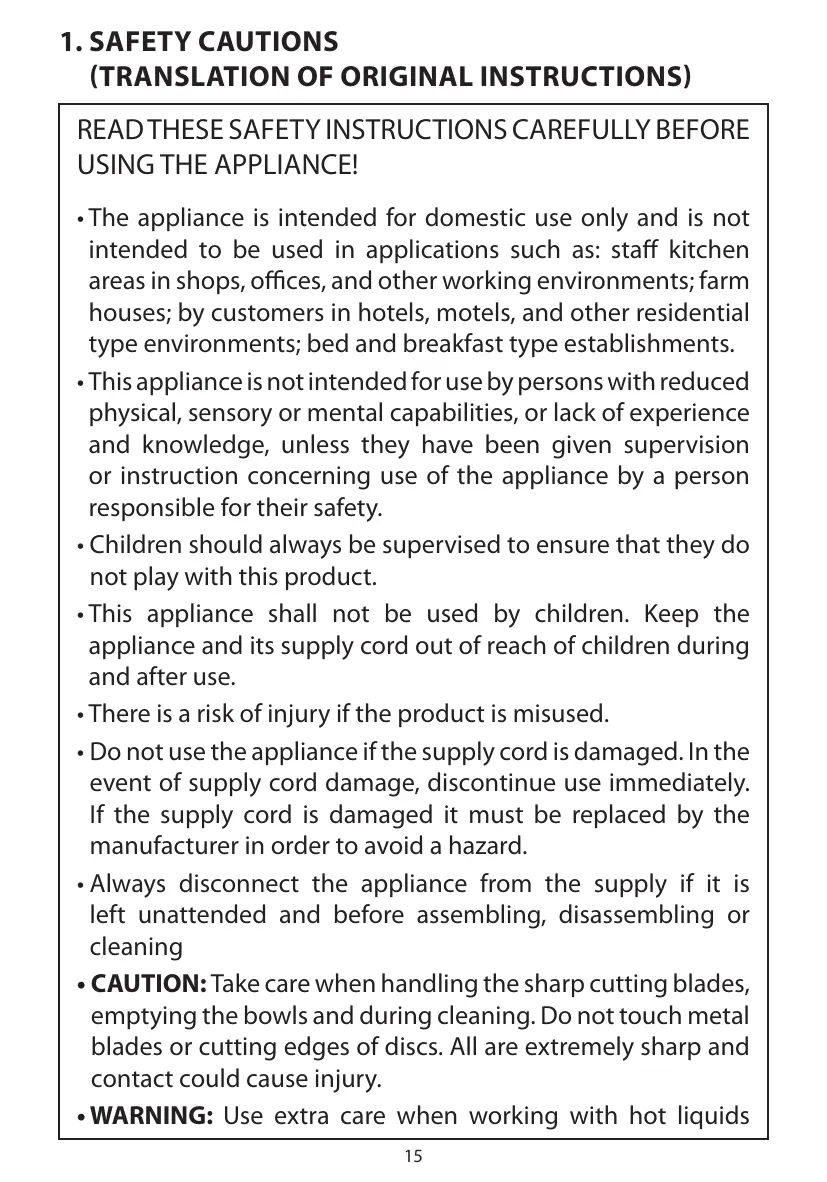
(TRANSLATION OF ORIGINAL INSTRUCTIONS) READ THESE SAFETY INSTRUCTIONS CAREFULLY BEFORE USING THE APPLIANCE! • The appliance is intended for domestic use only and is not intended to be used in applications such as: staff kitchen areas in shops, offices, and other working environments; farm houses; by customers in hotels, motels, and other residential type environments; bed and breakfast type establishments. • This appliance is not intended for use by persons with reduced physical, sensory or mental capabilities, or lack of experience and knowledge, unless they have been given supervision or instruction concerning use of the appliance by a person responsible for their safety. • Children should always be supervised to ensure that they do not play with this product. • This appliance shall not be used by children. Keep the appliance and its supply cord out of reach of children during and after use. • There is a risk of injury if the product is misused. • Do not use the appliance if the supply cord is damaged. In the event of supply cord damage, discontinue use immediately. If the supply cord is damaged it must be replaced by the manufacturer in order to avoid a hazard. • Always disconnect the appliance from the supply if it is left unattended and before assembling, disassembling or cleaning • CAUTION: Take care when handling the sharp cutting blades, emptying the bowls and during cleaning. Do not touch metal blades or cutting edges of discs. All are extremely sharp and contact could cause injury. • WARNING: Use extra care when working with hot liquids 15

to avoid injury from overflowing, sudden steaming and splattering. In order to avoid scalds from steam it may be advisable to process smaller quantities on a low speed.

• Always inspect the appliance and appliance accessories before use for noticeable signs of damage. Do not use if damaged, or if the appliance has been dropped. • Never pull the plug out of the mains socket by the supply cord. • Do not wrap the supply cord around the main body of the appliance during or after use. • Always ensure the voltage to be used corresponds with the voltage on the appliance; this is indicated on the bottom of the housing. • Do not leave the supply cord hanging over the edge of a kitchen table or worktop. • Avoid contact between the supply cord and hot surfaces. • Always ensure that your hands are dry before removing the plug from the mains outlet. • Never place the blade or disc directly on the motor of the housing base. Always ensure the correctly associated work bowl is in place. • Always carefully insert the blade before adding the ingredients. • Keep hands, spatulas and other utensils away from moving blades or discs whilst the appliance is in operation. A plastic spatula may be used, but only when the food processor motor is stopped. • Never push food down by hand when slicing or shredding. Always use a pusher. • Make sure the motor has completely stopped before removing the lid. • Always remove the bowl from the motor base very carefully before removing the blade. 16

• Never leave the appliance unattended when switched on or plugged in.

• Always ensure the blades and bowl have been thoroughly cleaned after each use and have dried completely before storing. • Never store any blade or disc on motor shaft. To reduce the risk of injury, no blade or disc should be placed on the shaft except when the bowl is properly locked in place and the processor is in use. Store blades and discs out of reach of children. • All parts except the housing base are dishwasher safe, and we recommend washing them in the dishwasher on the top rack only. If you wash the blades, discs, dicing and spiral accessories by hand, do it carefully. When handling, use the plastic hubs. Avoid leaving them in soapy water where they may disappear from sight. To clean the blades, hold the blade by its plastic center and use the cleaning brush provided to clean the inside of the hub. • Do not immerse the housing base in water or any other liquid or put it in a dishwasher. • Before switching on the processor, ensure that the blade is locked into place on the the motor spindle (taking care to avoid the sharp edges), and that the lid is correctly fitted. Do not force or block the lid mechanism. WARNING: The polyethylene bags over the product or its packaging may be dangerous. Keep these bags out of the reach of babies and children. Never use them in cribs, children’s beds, pushchairs or playpens. The thin film may cling to the nose and mouth and prevent breathing. A bag is not a toy.

WEEE - END-OF-LIFE ELECTRICAL AND ELECTRONIC EQUIPMENTS In everybody’s interest and to actively participate in protecting the environment and human health:

• Do not discard your products with your unsorted household wastes. • The WEEE (wastes of electrical and electronic equipments) must be collected separately. • Use the return and collection systems dedicated to the WEEE available in your area. In this way, some materials can be recycled, re-used or recovered. • By ensuring this product is disposed of properly, you will help prevent potential negative consequences for the environment and human health due to possible content of hazardous substances. For more detailed information about the disposal of this product, please contact your local household waste disposal service.

2. INTRODUCTION Congratulations on the purchase of your new Cuisinart Mini Prep Pro!

For over 30 years Cuisinart’s aim has been to produce the very finest kitchen equipment. All Cuisinart products are engineered for exceptionally long life, and designed to be easy to use as well as to give excellent performance day after day. To learn more about our products and for recipe ideas visit our website www.cuisinart.eu.

3. PRODUCT FEATURES (refer to cover)

1. Lid 2. Work bowl with handle 3. Blade (curved sharp blade, flat blunt blade) with BladeLock system 4. Control switches 5. Housing base 6. Spatula (not shown)

4. INSTRUCTIONS FOR USE SAFETY DURING USE

• Handle the blade with extreme care, it is very sharp. • Never place the blade directly on the motor of the housing base. Always ensure the bowl is in place. • Always carefully insert the blade before adding the ingredients. • Take extra care if using the appliance to process hot liquids. A build up of steam could cause liquid to be ejected from the appliance. • Always wait for the blade to stop before removing the lid. • Always remove the bowl from the motor base very carefully before removing the blade. • Never leave the appliance unattended when switched on or plugged in. • Keep hands, spatulas and other utensils away from moving blades whilst appliance is in operation. Only use the spatula once the processor motor has stopped. • Unplug the unit before cleaning it or removing the blades. • Always ensure the blades and bowl have been thoroughly cleaned after each use and have dried completely before storing. A. FITTING & REMOVING THE PARTS 1. Place the housing base on a flat, dry, stable surface. 2. Place the work bowl over the motor base with the handle facing forward and positioned slightly to the left of the control panel (the bowl will slot onto the base). 3. Turn the bowl in an anticlockwise direction until it locks into position on the housing base. N.B. The work bowl must be securely locked into position. The bowl will be in the correct position once the handle is central to the control panel. 4. Carefully lift the blade assembly, holding the central plastic stem and place over the motor spindle. Push the blade down until it clicks into place. The lower part of the blade assembly should almost touch the bottom of the work bowl. N.B. Always hold the blade assembly from the plastic stem. Never touch the blade as it is very sharp. N.B. Never place the blade on the motor shaft until the work bowl is locked into place. N.B. Always insert the blade in the work bowl before adding ingredients. 5. Add the food you wish to process. 6. Place the lid on the work bowl with the small tab to the left of the work bowl handle. Turn the cover anticlockwise (toward handle) to securely lock. N.B. The work bowl and lid must be tightly locked into the interlock device. Once securely fitted a loud click is heard. If both the work bowl and the lid are not fitted securely the processor may work intermittently. 7. To remove the lid, hold the housing base with your left hand, securely grip the handle on the top of the lid and rotate it in a clockwise direction. N.B. Make sure the motor has completely stopped and the blade has stopped moving before removing the lid. ATTENTION: The lid must always be removed before fitting or removing the work bowl from the base.

8. To remove the blade, gently pull up to disengage blade lock away from the motor spindle holding the plastic stem.

9. To remove the work bowl, firstly ensure the lid has been removed. Hold the housing base with your left hand, then hold the work bowl handle with your right hand and turn in a clockwise direction to unlock and lift away from the housing base. B. THE DUAL BLADE (Fig.1) (refer to cover) This appliance processes using a dual blade with a sharp, curved edge (A) for chopping/mixing and a flat, blunter edge (B) for grinding. C. CONTROL SWITCHES To start operation, simply press one of the two switches and hold down for the desired length of time. Use the ‘Chop’ speed switch for chopping, puréeing and mixing food with the sharp edge of the blade. Use the ‘Grind’ speed switch for grinding and for chopping hard food with the blunt edge of the blade. A ‘pulse’ action is best when you are using the sharp edge of the blade. Two or three pulses are often enough. Ensure you check the food frequently to prevent over processing. Over processing will result in a watery paste instead of a fine chop. N.B. Due to the powerful motor provided with this unit, we recommend using one hand to support the appliance during operation. Continuous hold action is best when you are using the grind function. When you operate the unit for more than 10 seconds, use a pulse action every 10 seconds or so to allow food to drop to the bottom of the work bowl. This provides more consistent results. IMPORTANT: Never operate the Mini Prep Pro continuously for longer than 20 seconds at a time. D. PROCESSING 1. Fit the work bowl and blade (refer A). 2. Place food in the work bowl. Ensure food is cut into small evenly sized pieces and the work bowl is not overloaded. 3. Lock the lid into position. 4. Press the appropriate control switch i.e. ‘Chop’ or ‘Grind’, depending on the food you are processing, for the required amount of time (refer to ‘Processing Techniques’ for further details). 5. Wait for the blade to stop moving. Unplug the appliance and remove the lid & work bowl. N.B. The lid must always be removed before fitting or removing the work bowl from the base. 6. To remove liquids and sauces from bowl, simply pour ingredients out of work bowl. The BladeLock System keeps blade safely in place. 7. To remove thicker ingredients from bowl, carefully remove the blade assembly, holding it by the top of the plastic central stem. Gently pull up to disengage blade lock and remove blade from the work bowl. Remove food with a spatula. Occasionally food will stick to the sides of the work bowl as you process. If this happens, stop the appliance. After the blade has stopped moving, remove the lid and use the spatula to scrape the food from the sides of the work bowl back into the centre. Do not use your hand.

You can also reverse the motor by alternating between ‘Chop’ and ‘Grind’. This will help to combine the ingredients and clean the sides of the work bowl.

N.B. Do not operate without food contents in the work bowl. Processing Techniques The following section includes useful hints and tips on how to use the Mini Prep Pro to achieve a number of processing results. We recommend that you practice using these techniques before processing food to eat. N.B. Do not process frozen food in the processor. Ingredients

Drain first. Cut in half.

Cut into 1.5cm pieces.

Best at room temperature.

Cut into 1.5cm long pieces.

Cheese – Soft Chilled

Cheese – Semi Soft Cheese – Firm Chilled Cheese – Hard

Cut into 1.5cm pieces. Process 50g at a time.

Max 25g at a time, cut into 1.5cm pieces.

Break into 1.5cm pieces.

Garlic Process 316g max at a time. Should be very cold but not frozen. Choose firm, fresh mushrooms. Cut into even pieces no larger than 1.5cm. Pulse approximately 5 times to break apart, and then run continuously.

Either operation can be used depending on the desired consistency (see next page for more details).

Cut into 1.5cm pieces.

Seeds (e.g. cumin) Vegetables, cooked

Should be cooked until soft.

• Always cut large pieces of food into smaller pieces of even size of approximately 1.5cm to achieve even results. • Use the sharp edge for chopping, puréeing and mixing. It is ideal for chopping softer food such as herbs, celery, onions, garlic and most cheese. It is also useful for puréeing cooked vegetables, making mayonnaise and mixing salad dressing. • Use the blunt edge for grinding coffee beans and spices, and for chopping hard food such as peppercorns, seeds, chocolate and nuts. ATTENTION: Do not overload the work bowl. Overloading causes inconsistent results and strains the motor. After being processed, food should not reach more than 2/3 of the way up the central plastic stem of the blade assembly. N.B. Please note that although the air capacity of the Mini Prep Pro is 900ml the following maximum fill capacities apply for optimum use of the product: • 700ml - mixture capacity • 400ml - thin liquid capacity Chopping fresh herbs The herbs, work bowl and blade must all be thoroughly cleaned and dried. Remove the stems from herbs. Add the leaves to work bowl and process, using the ‘Chop’ switch and a ‘pulse’ action until they are chopped to the desired consistency. Chopping meat, poultry, fish & shellfish The food should be very cold but not frozen. Cut into 1.5cm pieces and place in the work bowl. Use the ‘Chop’ switch and a ‘pulse’ action until the food is evenly chopped. Use a continuous processing action for a few seconds for a finer chop if required. Use a spatula to scrape food down from the sides of the work bowl as necessary.

You can use either the ‘Chop’ or ‘Grind’ function depending on the consistency you require. For roughly chopped nuts, process continuously using the ‘Chop’ switch until chopped to the desired consistency. Check frequently to avoid nuts clumping together. If necessary, use the spatula to redistribute the nuts evenly in the work bowl. If you require more of a powder consistency use the ‘Grind’ function continuously until the desired consistency is achieved. Producing a purée Cut the food into 1.5cm pieces and place in the work bowl. Use the ‘Chop’ switch and a ‘pulse’ action to chop coarsely, then process continuously until food is puréed. N.B. Cooked potatoes are an exception to this procedure. They develop a gluey texture when processed with the metal blade. Grinding coffee beans and hard foods Add coffee or hard food to the work bowl. Use the ‘Grind’ switch and process using a continuous action until desired consistency is reached. Coffee beans may take slightly longer to process, so use a pulse action every 10 seconds or so to allow the beans to drop to the bottom of the work bowl. Adding liquid You can add liquids such as water, oil or flavouring while the appliance is running. Pour the liquid through one of the two openings in the lid. N.B. Add liquid through only one opening at a time. The other opening must be left free for air to circulate.

5. TROUBLESHOOTING Motor does not start or blade does not rotate:

Check that the plug is securely inserted into the mains. Check that the work bowl and lid are securely locked into place (see section A for more information). Ensure only one control switch is being pressed at a time. Food is unevenly chopped: Either you are chopping too much food at one time, or the pieces are too large. Try cutting food into smaller pieces of an even size and processing a smaller amount per batch. Food is chopped too fine or is watery: The food has been over-processed. Use brief pulses or process for a shorter period of time. Food collects on lid or sides of work bowl: You may be processing too much food. Turn the appliance off. When the blade stops moving remove the lid and clean the work bowl and lid with the spatula. You can also reverse the motor by alternating between ‘Chop’ and ‘Grind’. This will help to combine the ingredients and clean the sides of the work bowl. Food gets stuck on blade: You may be processing too much food. Turn the appliance off. When the blade stops moving, carefully remove it. Remove food from the blade and work bowl using a spatula, and start again.

6. CLEANING & MAINTENANCE

• When not in use, leave the appliance unplugged. • All parts except the housing base are dishwasher safe. We recommend washing them in the dishwasher on the top rack. Due to intense water heat, washing the work bowl, lid and accessories on the bottom rack may cause damage over time. Insert the work bowl upside down. • If you wash the blade by hand, wash with extreme care, the blade is very sharp. Do not leave it in soapy water where it may disappear from sight. • Take extra care when loading and unloading the blade in the dishwasher. • To simplify cleaning, rinse the work bowl, lid and blade immediately after use so food won’t dry on them. • Chopping certain foods may scratch, cloud or discolour the work bowl. • Do not use abrasive cleaners on the housing base. Simply wipe with a damp cloth and dry thoroughly. • Apply any cleaning agent to the cloth, not the housing base. • Always ensure the blades have been thoroughly cleaned after each use and have dried completely before storing.

7. RECIPES Here are a few recipe ideas to help you get started with your Mini Prep Pro. For more recipe ideas and inspiration, visit www.cuisinart.eu

CLASSIC MAYONNAISE Serves 4 2 egg yolks 1 tbsp Dijon mustard 100ml groundnut oil 25ml extra virgin olive oil 1 tbsp white wine vinegar Juice of ½ a lemon Salt & pepper • Place the egg yolks and Dijon mustard into the processor bowl, season well with salt and pepper and process continuously using the ‘Chop’ function until well combined. • Mix the oils together in a separate container for pouring. Using the ‘Chop’ function, slowly pulse whilst gradually adding the mixed oils a little at a time through one hole of the lid. Be careful not to add the oil too quickly as this will cause the egg yolks to curdle. Process slowly, adding the oil until the mayonnaise thickens. • Once thickened pour the white wine vinegar and lemon juice through the hole of the lid, pulsing to combine. Variations: Try adding crushed garlic for Aioli, finely chopped herbs or anchovy essence.

75g chickpeas 5g flat leaf parsley ½ tsp lemon zest 1 garlic clove, peeled Juice of 1 lemon ½ tsp ground cumin 1 tbsp olive oil • Place the chickpeas, parsley, lemon zest, garlic, lemon juice and the ground cumin into the work bowl and process using the ‘Grind’ switch until combined. • Once combined, process the mixture using the ‘Chop’ switch, whilst adding the olive oil through the opening in the lid until well mixed and thickened. Serving Suggestion: Serve with pitta bread or as a dip for crudités. MONKFISH SKEWERS WITH KACHUMBER SALAD Serves 4 Skewers 750g Monkfish tail 50ml Olive oil Juice of 1 lemon 1 chilli 1 garlic clove Salt and pepper 8 bamboo skewers Mango & Walnut Chutney 2 ripe mangoes, peeled & diced 100g walnuts 1 chilli 40ml cider vinegar 40g brown sugar Juice of 1 lemon 2cm piece of ginger, finely grated 2 cloves of garlic 1 tbsp mustard seeds 1 tbsp coriander seeds 4 green cardamon pods, crushed

2 cloves Pinch of salt 80ml water Mint Raita 250ml greek yogurt 3 tbsp lemon oil Zest of 2 lemons Small handful of mint leaves Kachumber 150g cucumber 1 small red onion Small handful of mint leaves Small handful of flat parsley leaves Small handful of coriander leaves 3 medium tomatoes 80g pomegranate seeds 50ml olive oil Juice of 1 lemon Salt & pepper to taste Mango & Walnut Chutney (This can be made in advance to improve the flavour) • Toast the mustard seeds, coriander and crushed cardamom pods in a saucepan for a minute. • Place the garlic and chilli in the processor and press ‘Chop’ until there are no large pieces remaining, scraping down the sides if necessary. • Place all the ingredients (except for the walnuts) into the saucepan with the toasted spices and cook over a low heat for around 30 to 40 minutes until most of the liquid has evaporated. • Allow to cool to room temperature. • Place the walnuts in the processor and press ‘Grind’ until well ground. • Mix the processed walnuts into the cooled chutney. • Refrigerate until required. Mint and lemon raita • Place all the ingredients together in the processor. • Press ‘Grind’ until all of the ingredients combine together to make a very smooth sauce. • Reserve and refrigerate. Kachumber • Cut the cucumber length ways into quarters and remove the core with a teaspoon. Discard the pips and roughly chop the cucumber. Process using the ‘Chop’ function until there are no large pieces remaining. Transfer to a bowl. • Peel the red onion and cut into quarters. Process using the ‘Chop’ until there are no large pieces

remaining. Transfer into the bowl with the cucumber.

• Place the herbs into the processor and press ‘Chop’ until there are no large pieces remaining. Transfer into the bowl with the cucumber and onions. • Cut the tomatoes into quarters removing the core. Place into the processor and quickly blitz using the ‘Chop’ function. Mix in with the other chopped ingredients. • Add the remaining ingredients to the salad and season to taste. Skewers • Cut the monkfish into 24 long strips. • Place the remaining ingredients into the bowl of the processor. Secure the lid, then press ‘Grind’ until the marinade is completely combined. • Pour the marinade over the monkfish strips, ensuring all the fish are well coated. Allow to marinate for 20 minutes. • Skewer the marinated fish, using 3 monkfish strips per skewer. • Using a very hot grill pan, grill for 4 min on each side. • Serve warm. CINNAMON AND PEAR COMPOTE 75g brown sugar 1 stick cinnamon, broken into 1.5cm pieces 25g butter 2 pears, peeled and cut into 1.5cm cubes • Place the sugar and cinnamon into the work bowl. Process using the ‘Grind’ switch and a pulse action until broken, and then use a continuous action, until powdered. Remove the powder, sieve and keep to one side. • Melt the butter in a saucepan, add the powdered cinnamon mix and pear then simmer for 10 minutes. • Return to the work bowl and process until puréed. Variations: Try replacing the pears with other fruits e.g. apples, peaches.

Version no.: ECH4PE IB-19/024A IB Size: 140mm(W) x 200mm(H)

Die Cut: NEW Material: Cover:157gsm gloss art paper Inside:105gsm gloss art paper Coating: waterbase varnishing for whole book Colors(Cover): 1C(black) (Inside): 1C(black)

6 pages gate-fold cover + 128 pages inside page