
1588 - ARI-1588-GB - 1588/03 - Kitchen appliance ARIETE - Free user manual and instructions
Find the device manual for free 1588 - ARI-1588-GB - 1588/03 ARIETE in PDF.



| Product type | Stand mixer |
| Brand | ARIETE |
| Model | 1588 (ARI-1588-GB) |
| Maximum capacity (preparations) | 1.7 kg |
| Maximum flour capacity | 1 kg |
| Number of speeds | 7 (positions 0 to 7) |
| Control type | Rotary dial |
| Included accessories | Whisk, dough hook, mixing paddle, splash guard |
| Beater material | Stainless steel |
| Bowl material | Stainless steel |
| Power supply | 220-240 V ~ 50/60 Hz |
| Cleaning of the bowl and whisk | Dishwasher safe |
| Cleaning of other accessories | Hand wash with hot water and mild soap |
| Cleaning of the body | Slightly damp cloth |
| Continuous use time (dough hook/mixing paddle) | 5 minutes maximum, then 20 minutes rest |
| Continuous use time (whisk) | 10 minutes maximum, then 20 minutes rest |
| Safety | Do not immerse the body, do not use metal utensils |
| Use | Household use only |
Frequently Asked Questions - 1588 - ARI-1588-GB - 1588/03 ARIETE
User questions about 1588 - ARI-1588-GB - 1588/03 ARIETE
0 question about this device. Answer the ones you know or ask your own.
Ask a new question about this device
Download the instructions for your Kitchen appliance in PDF format for free! Find your manual 1588 - ARI-1588-GB - 1588/03 - ARIETE and take your electronic device back in hand. On this page are published all the documents necessary for the use of your device. 1588 - ARI-1588-GB - 1588/03 by ARIETE.
USER MANUAL 1588 - ARI-1588-GB - 1588/03 ARIETE
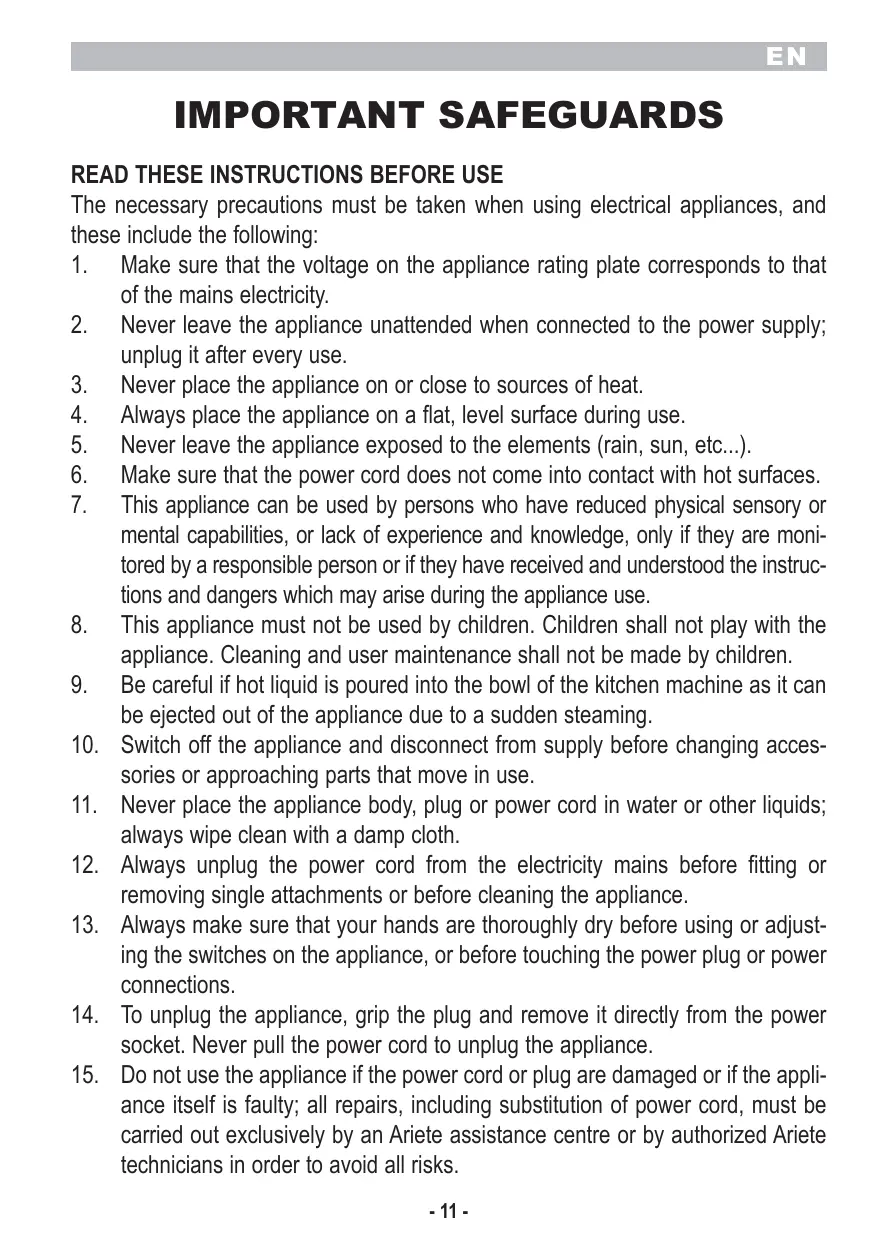
The necessary precautions must be taken when using electrical appliances, and these include the following:
- Make sure that the voltage on the appliance rating plate corresponds to that of the mains electricity.
- Never leave the appliance unattended when connected to the power supply; unplug it after every use.
- Never place the appliance on or close to sources of heat.
- Always place the appliance on a flat, level surface during use.
- Never leave the appliance exposed to the elements (rain, sun, etc...).
- Make sure that the power cord does not come into contact with hot surfaces.
- This appliance can be used by persons who have reduced physical sensory or mental capabilities, or lack of experience and knowledge, only if they are monitored by a responsible person or if they have received and understood the instructions and dangers which may arise during the appliance use.
- This appliance must not be used by children. Children shall not play with the appliance. Cleaning and user maintenance shall not be made by children.
- Be careful if hot liquid is poured into the bowl of the kitchen machine as it can be ejected out of the appliance due to a sudden steaming.
- Switch off the appliance and disconnect from supply before changing accessories or approaching parts that move in use.
- Never place the appliance body, plug or power cord in water or other liquids; always wipe clean with a damp cloth.
- Always unplug the power cord from the electricity mains before fitting or removing single attachments or before cleaning the appliance.
- Always make sure that your hands are thoroughly dry before using or adjusting the switches on the appliance, or before touching the power plug or power connections.
- To unplug the appliance, grip the plug and remove it directly from the power socket. Never pull the power cord to unplug the appliance.
-
Do not use the appliance if the power cord or plug are damaged or if the appliance itself is faulty; all repairs, including substitution of power cord, must be carried out exclusively by an Ariete assistance centre or by authorized Ariete technicians in order to avoid all risks.
-
In case of using extension leads, these must be suitable for the appliance power to avoid danger to the operator and for the safety of the environment in which the appliance is being used. Extension leads, if not suitable, can cause operating anomalies.
- Keep the appliance and its cord out of the reach of children.
- Do not threaten the safety of the appliance by using parts that are not original or which have not been approved by the manufacturer.
- This appliance is designed for HOME USE ONLY and may not be used for commercial or industrial purposes.
- This appliance conforms to the directives (EC) No. 1935/2004 of 27/10/2004 regarding material in contact with foods.
- Any changes to this product that have not been expressly authorised by the manufacturer may lead to the user's guarantee being rendered null and void.
- In the event that you decide to dispose of the appliance, we advise you to make it inoperative by cutting off the power cord. We also recommend that any parts that could be dangerous be rendered harmless, especially for children, who may play with the appliance or its parts.
- Packaging must never be left within the reach of children since it is potentially dangerous.
- Never touch moving parts.
- Never operate the appliance when empty.
- To avoid injury and damage to appliance, always keep hands and kitchen utensils out of reach of moving parts.
- Never use hands to insert food while the appliance is working; always insert food through the relevant openings.
- Never remove foods from the sides of the bowl while the appliance is operating. Switch off the appliance, unplug it from the mains power, and always use the spatula supplied.

To dispose of product correctly according to European Directive 2012/19/CE, e refer to and read the provided leaflet enclosed with the product.
DO NOT THROW AWAY THESE INSTRUCTIONS
DESCRIPTION OF THE APPLIANCE (Fig. 1)
A Arm
B Tilt-back head lever
C Speed regulation dial
D Appliance body
E Bowl
F Whisk
G Dough hook
H Beater
I Splash guard lid
INSTRUCTIONS FOR USE
MAXIMUM ALLOWED AMOUNTS AND SPEED
| Maximum amount of flour which must not be exceeded in any case | 1 Kg |
| Maximum absolute amount which must not be exceeded in any case (for further details, refer to the paragraph RECIPES) | 1,7 Kg |
| Maximum allowed speed with the dough hook (G) | 2 |
| Maximum allowed speed with the beater (F) | 3 |
| Maximum allowed speed with the whisk (H) | 4 |
WARNING: After removing appliance from packaging and before using appliance for the first time, wash thoroughly all those appliance parts that will come into contact with food using water and mild detergent.
- Lower lever (B) towards symbol in order to raise tilt-back head (A) until fastened (Fig. 2).
- Insert bowl (E) onto appliance base (D) so that the slots located on the bowl completely fit into the settings provided on the body of the appliance. Turn clockwise to fasten the bowl (E) (Fig. 3).
- Insert the appropriate splash guard lid (I) that prevents liquid food from spilling out on the arm (A) by turning it till the end. (Fig. 4).
- According to the type of ingredient to be processed, insert beater onto motor base located on appliance body (D) (Fig. 5), turning it counter clockwise to fasten it so that the shaft located on the motor base fits into seat located on the beater (Fig. 6).
The appliance has three types of mixing attachment:
Whisk (F): to whisk egg whites, cream, instant puddings and ready mixes for cakes and desserts; to cream butter or margarine with sugar (use butter or margarine at room temperature); to mix eggs, for sponge cakes and other light cakes.
Dough hook (G): for all types of mix (pizza, bread, pastry, etc.).
Beater (H): for soft cake mixes.
- Raise tilt-back head (A) to pour ingredients into bowl (E).
-
Lower lever (B) again and lower head (A) at the same time (Fig. 7).
-
Connect plug to mains outlet and turn appliance on by turning dial (C) and setting on speed "1". Increase speed according to need or according to recipe.
- For smoother results, switch appliance off, disconnect plug from mains outlet and raise head (A) as described above. Using a spatula, mix ingredients off the sides of the bowl and towards the centre of the bowl (E).
- At the end of processing, or to change the type of whisk, switch off the appliance by turning the dial (C) to "O" and unplugging it from the power socket; lift the arm (A) as described above and remove the whisk by pulling it out with care, after first releasing it by turning it clockwise.
- To remove bowl (E) turn counter-clockwise.
WARNING:
Before using appliance, ensure that all accessories have been assembled properly.
When using the dough hook (G) and the beater (H), do not operate the appliance for more than 5 consecutive minutes; subsequently, allow to cool down for at least 20 minutes.
When using the whisk (F), do not operate the appliance for more than 10 consecutive minutes; subsequently, allow to cool down for at least 20 minutes.
The failure to comply with these rules may damage the product not covered by the warranty.
If more ingredients have to be added to bowl (E) during use, first turn dial (C) to position "0" to switch appliance off and then pour ingredients into bowl.
To avoid injury and damage to appliance, always keep hands and kitchen utensils out of reach of moving parts.
Do not remove food from bowl sides (E) while the appliance is operating. Switch the appliance off and then unplug it.
USEFUL TIPS
- For the best results, always whisk eggs at room temperature.
- Before whisking egg whites, make sure that there is no grease or egg yolk on the whisk attachment or in the bowl.
- Always use cold ingredients for short crust pastry, unless otherwise specified in the recipe.
- If appliance seems to be over-working, switch off, disconnect plug from mains outlet and reduce quantity of ingredients to process.
- For optimum mixing, always add liquids first.
CLEANING AND MAINTENANCE
- Remove all of the attachments used, working in the opposite order to the way they were fitted.
- The bowl (E) and the whisk (F) are machine washable; the beater (H), the dough hook (G) and the lid (I) must be washed by hand in hot water with mild detergent.
- To clean the appliance body (D) use a slightly damp cloth.
WARNING:
After cleaning, dry all parts thoroughly and refit them.
RECIPES
BASIC BREAD DOUGH - 1.6 KG
600 ml lukewarm water
30 g fresh yeast or 14 g dried yeast
2 teaspoons sugar
1 teaspoon salt
30 g oil
450g00flour
450 g reground durum wheat semolina
- Mix the yeast with in the bowl with the water and sugar. Leave to rest for 15 minutes.
- Add the salt and oil to the mix.
- Use the dough hooks at speed "1" and gradually adding flour.
- Proceed at speed "1", 2 minutes from the start of mixing.
- Pass on to speed "2" and mix for 4 more minutes.
- Transfer the mix to a lightly greased bowl and cover with lightly greased cooking film.
- Leave the dough to prove at room temperature and away from draughts for 1 hour or until it is twice its original size.
- On a floured top, shape the dough as required.
- Place the dough shapes on baking sheets, either lightly greased or covered with greaseproof paper; cover the dough with a cloth and leave to rise for 30 minutes.
- Bake in an oven preheated to 220^ for 25-35, according to the shape and size and until knocking on the base of the bread produces a hollow sound.
BASIC RECIPE FOR FRESH EGG PASTA - 800 GR
500 g "00" flour
4 eggs (65/70 g each)
50 ml cold water
5 g oil
- Add the ingredients to the bowl.
- Use the hook to mix at speed "2" for 5 minutes.
- Transfer the mix to a floured bowl and cover with cling film. Leave to rest in a warm place for 30 minutes.
- Roll out the sheets of pasta by hand or machine, and cut as required by the recipe.
- Cook in boiling salted water for 5-8 minutes according to shape and size.
BASIC RECIPE FOR SHORTCRUST PASTRY - 1.6 KG
800 g "00" flour
400 g cold butter, cut into pieces
240 g sugar
4 egg yolks
100 ml cold water
Pinch of salt
Flavourings (vanilla, lemon or orange zest, etc...)
- Add all of the ingredients to the bowl.
- Use the dough hook (G), and mix at speed "2" for 5 minutes.
- Transfer the mix to a work surface and roll it quickly into a ball.
- Wrap the pastry in cling film and place in the refrigerator for at least 20 minutes or until it has slightly hardened.
- Roll out the pastry to the required size and thickness on a floured board.
- Cook in a preheated oven at 170 / 180^ C for 15 to 25 minutes according to the recipe
BASIC CAKE RECIPE (SPONGE) - 1.6 KG
350g butter at room temperature
350 g sugar
4 eggs (65/70 g each)
10 yolks (approx. 200 g)
250 g 0 flour
150 g potato starch
1 sachet powdered raising agent for cakes
1 pinch salt
Flavourings (vanilla or almond essence or lemon or orange zest, etc...)
- Add the butter, sugar, salt and flavourings to the bowl.
- Use the wire whisk to beat at speed "3" for 5 minutes.
- Pass to speed "4" and beat for 5 minutes more.
- Continue to beat the mix, adding one whole egg or 2 yolks at a time, at intervals of one minute or until each egg is thoroughly incorporated into the mix.
- Add the flour, potato starch and raising agent, and mix at speed "2" for 2 minutes.
- Pour the mix into greased and lightly floured baking tins.
- Bake in an oven preheated to 170^ for 35/45 minutes.
- Remove from the oven and leave in the tin for 5 minutes.
- Turn out onto a wire rack and leave to cool thoroughly before use.
BASIC MERINGUE RECIPE - 900 G (8 EGG WHITES)
300 g egg whites (7/8)
300 g granulated sugar
300 g icing sugar
1 pinch salt
- Add the whites (room temperature) and the salt to the bowl.
- Use the whisk to beat the whites at speed "6" for 5 minutes.
- Pass to speed "7" and add the granulated sugar a little at a time.
- Continue to beat the egg whites for 5 more minutes.
- Switch off the appliance and take out the bowl.
- Using a spatula, incorporate the previously sifted icing sugar with a folding movement from bottom to top.
- Use an icing bag or two spoons to form meringues onto baking sheets covered with lightly greased baking paper.
- Bake in an oven preheated to 40 / 50^ for a few hours, leaving the oven door slightly open (a couple of centimetres) to allow the moisture to escape and the meringues to dry thoroughly.
- Smaller meringues may need 3-4 hours and larger ones, up to 8-10 hours.
AVENTISSEMENTS IMPORTANTES
LIRE CES INSTRUCTIONS AVANT L'EMPLOI
BESCHRIJVING VAN HET APPARAAT (Fig. 1)
AIABA T E AYTE OAH I E PIN TH XPH
O'art xpnoiotoiie tne nektpikec ouakeuec ivai avaykaio va laubavete Tc katalnlaes Tpoquuaeic, eTaTuW otioiwv:
ONHC PPNJADy (Pnc. 1)
A BaxiNb
B Puyka haxiny Baxkela
C Puyka peryIIOBAnHs WbNIOKcTi
D Kopnyc npnilaNy
E Yawa
F BiHnK nIa 36BaHnHa
G Tgakdny3amiyBaHnTicTa
H Binhui nI nepeMiuyBaHHa
3axncha kpiuka BiD 6pni3OK
IHCTPYKl2I 3 BnKOpNCTAHH
MAKcIMAlbHI IOnyCTnMI 3HaueHHr OB'EMY I WBnKOCTI
y = 11
yie 1 yie yie yie yie yie yie yie yie yie yie yie yie yie yie yie yie yie yie yie
JLAAJI! JS 2y JJJILJE A
.3jrl jll jlaa 1
Jiaowu 1iuiabuaio gaiyiaobuao jiaoi yao
.0
Aiaiaw 1aiwuyiyjy
aulll y jll jll 105 jnsjssy Jusil Jn jgll lJauwul jay .V
j 1
jbi 1i jie iie jie jie jie jie jie jie jie jie jie jie jie jie jie jie
jIgai liangxi
j全球性全球性
Jiluill luo 15
.1
i j 1 i j 1 i j 1 i j 1 i j 1 i j 1 i j 1 i j 1 i j 1 i j 1 i j 1 i j 1 i j 1 i j 1 i j
a5^3 + a6^3 + a7^3 + a8^3 = 8
1
11
aaii i 1ii
jia 1i jao jia jia jie jia jia jia jia jia jia jia jia jia jia jia jia
Jn nn Jn Jn Jn Jn Jn Jn Jn Jn Jn Jn Jn Jn Jn Jn Jn Jn Jn Jn Jn
.
a gli li g 5 ji pi la lla jibai jbi jbi jbi jbi jbi jbi jbi jbi jbi jbi jbi jbi jbi jbi jbi jbi jbi jbi jbi jbi jbi jbi jbi jbi jbi jbi jbi jbi jbi jbi jbi jbi jbi jbi jbi jbi jbi jbi jbi jbi jbi jbi jbi jbi jbi jbi jbi jbi jbi jbi j bi j bi j bi j bi j bi j bi j bi j bi j bi j bi j bi j bi j bi j bi j bi j bi j bi j bi j bi j bi j bi j bi j bi j bi j bi j bi j bi j bi j bi j bi j bi j bi j bi j bi j bi j bi j bi j bi j bi j bi j bi j bi j bi j bi j bi j bi j bi
.
. 它可以写
j 1
is jaiil 1. j = 21
aaii iiaii laiipai iai jieai jaiyai aai y
juaa jiaol jiaol jaii jiai jiai jiai jia i jia jia
c1 = 12,c2 = - 12

CE/19/17 2000
aaiy aalil aolil juiill selj
i
(1)
1
A
1jll 1ai jai
B
aull buaa
C
jglsl
D
E
1,2,3
F
j = 1 d_1 = 1
G
c all
H
j2q1 即 c1 = c1b_2
1
132311
Lagc gannall gannll is mullg aennll
jglll gaaagaaagall aalilgslal
(1) (2) (3) (4)
pui kui i jaiie (A) 1jll (I) jn aiae
(2)
(0 1) (D) jgeall g aalrnnn rnrnnn nne
j 1
(1) (Kull) jaii 1000000000000000000000000000000000000000000
i 1
aaii i 1
Jaaa aaaa aaa aaa aaa aa aaa aaa aaa
$$ \therefore \mathrm {a b a l l} \subseteq \mathrm {b a l l} \cup \because \mathrm {a i n d} $$
..(.)
$$ \therefore \mathrm {a} _ {\mathrm {j}} \text {j} \text {j} \text {j} \text {j} \text {j} \text {j} \text {j} \text {j} \text {j} \text {j} \text {j} \text {j} \text {j} \text {j} \text {j} \text {j} \text {j} \text {j} \text {j} \text {j} \text {j}, (H) C J A l o l $$
$$ . \varepsilon \dot {s} \dot {s} s (A) \varepsilon 1 \dot {s} \dot {s} s \cdot (E) e l e g u l a l d i s c l u s k a l l s y s t e d $$
$$ . (V \text {d} \text {J k k}) \text {d i f f} _ {\text {d}} (\mathrm {A}) \varepsilon_ {1} \text {d} \text {j} _ {\text {d}} (\mathrm {B}) \text {a d} _ {\text {d}} \text {j} _ {\text {d}} \text {a d} _ {\text {d}} - $$
C) 1
$$ \therefore \text {a l l} a \text {a l l} g \text {g} \text {g} \text {g} \text {g} \text {g} \text {g} \text {g} \text {g} \text {g} \text {g} \text {g} \text {g} \text {g} \text {g} \text {g} \text {g} \text {g} \text {g} \text {g} \text {g} \text {g}. $$
1 1 1 1 1 1 1 1 1 1 1 1 1 1 1 1 1 1 1 1 1 1 1
alldlyleellbawg(E)eleeallwglaleallpaleall
$$ \therefore a b w a l l \text {a d} $$
(C) 1
aA (A) aaaal aayy y ayy yll llll 1n no yall
$$ \begin{array}{l} \therefore \text {a c l a l l} \cup \text {j i e} \cup \text {s c} \quad \text {l a g l y} \quad \text {A s} \quad \text {p a l l} \quad \text {d} \quad \text {c l a l l} \quad \text {a l l} \quad \text {j i e} \quad \text {j i e} \quad \text {j i e} \quad \text {j i e} \quad \text {j i e} \quad \text {j i e} \ \therefore \text {a c l a l l} \cup \text {j e a l} \cup \text {s l a n d} \cup \text {o b j e c t i o n} \cup \text {g a r g e} (E) \cup \text {e l e c u l l} \quad \text {d} - \ \end{array} $$
= a1 + 12a2 + ·s + a_n + 1
$$ \therefore \text {a} = \text {a} _ {\text {i}} \text {i} _ {\text {i}} \text {i} _ {\text {i}} \text {i} _ {\text {i}} \text {i} _ {\text {i}} \text {i} _ {\text {i}} \text {i} _ {\text {i}} \text {i} _ {\text {i}} \text {i} _ {\text {i}} \text {i} _ {\text {i}} \text {i}. $$
a 1
$$ \therefore \lim _ {x \to 1} \frac {\log_ {2} x}{x ^ {3}} = \frac {\log_ {2} x}{x ^ {2}} $$
- 2.
$$ \therefore \mathrm {J} _ {\mathrm {i}} = \mathrm {G} _ {\mathrm {i}} \cdot \mathrm {a} _ {\mathrm {i}} \cdot \mathrm {d} _ {\mathrm {i}} $$
$$ \therefore \text {j i a n d} \quad \text {a b s i l o n} \quad \text {g a l l j u g a l l} \quad \text {g a l l} \quad \text {g a l l} \quad \text {a d} \quad \text {j i a n d} \quad \text {a d} $$
jai jie jie (E) 1e gll jie g iia aiai iiaia iiaia
$$ \Delta \text {a d} \left[ \begin{array}{l l l l l l l l l l l l} \end{array} \right] = \left[ \begin{array}{l l l l l l l l l l l l} \end{array} \right] $$
j 1
$$ i s $$
jll jll jll jll jll jll (E) jll jll jll jll jll jll
$$ A C = \sqrt {1 0} $$
$$ \therefore \text {i} _ {\text {i}} \text {i} _ {\text {i}} \text {i} _ {\text {i}} \text {i} _ {\text {i}} \text {i} _ {\text {i}} \text {i} _ {\text {i}} \text {i} _ {\text {i}} \text {i} _ {\text {i}} \text {i} _ {\text {i}} \text {i} _ {\text {i}} $$
$$ . \left(\sum_ {j = 1} ^ {n} a _ {i j} + \sum_ {j = 1} ^ {n} b _ {i j}\right) = \sum_ {j = 1} ^ {n} a _ {i j} + \sum_ {j = 1} ^ {n} b _ {i j} $$
$$ \begin{array}{l} \text {p i} \quad \text {l o c i c} \quad j \quad J L \quad \text {s h i d e} \quad \text {L a b g} \quad \text {a t} \quad r _ {0} - r _ {0} \quad \text {o t h e r w i s e} \quad r _ {1} \cdot \text {o t h e r w i s e} \quad \text {j y l o w} \quad \text {j y l o w} \quad \text {j y l o w} \quad \text {j y l o w} \quad \text {j y l o w} \quad \text {j y l o w} \quad \text {j y l o w} \quad \text {j y l o w} \quad \text {j y l o w} \quad \text {j y l o w}. \end{array} $$
$$ \dot {G} \vdash j a l l \quad G \vdash s a s L o g i k a \quad G \vdash a l l d i g j s i l l o x e l a \quad G \vdash j r b l l $$
$$ \therefore \wedge \dots - \text {i s u b j e c t i o n} \quad \text {i s l a w} \quad \text {i s w a l l} \quad \text {i s a l l} $$
$$ “ \cdot ” \text {E g i l l} \quad \text {如} \quad \text {如} \quad \text {如} \quad \text {如} \quad \text {如} \quad \text {如} $$
$$ p a \cdot v - 7 0 p a = c l i s h e $$
$$ \Delta \mathrm {j} _ {\mathrm {i}} \mathrm {j} _ {\mathrm {i}} \mathrm {j} _ {\mathrm {i}} \mathrm {j} _ {\mathrm {i}} \mathrm {j} _ {\mathrm {i}} \mathrm {j} _ {\mathrm {o}} 0. $$
$$ \therefore j l l j o \approx 0 $$
$$ \therefore \mathrm {i} \mathrm {s} \mathrm {a l l} \mathrm {e} \mathrm {a} \mathrm {c} \mathrm {d} \mathrm {e} \mathrm {c} \mathrm {e} \mathrm {c} \mathrm {d} \mathrm {e} \mathrm {e} \mathrm {e} \mathrm {e} $$
$$ . g i l a = 0 s 2 d Y a c y u l l g i c g i b a l y j u n d a l p l a s s i w l y j u n d a l $$
$$ \left. \right.\left. \right.\left. \right.\left. \right.\left.\left.\left.\left.\left.\left.\left.\left.\left.\left.\left.\left.\left.\left.\left.\left.\left.\left.\left.\left.\left.\left.\left.\left.\left.\left.\left.\left.\left.\left.\right.\right.\right.\right.\right.\right.\right.\right.\right.\right.\right.\right.\right.\right.\right.\right.\right.\right.\right.\right.\right.\right.\right.\right.\right.\right.\right.\right.\right.\right. $$
$$ \therefore \left(S _ {1} - 1\right) \left(S _ {2} - 1\right) = 4 \times 2 + 2 \times 2 $$
$$ \therefore \text {a} a _ {\omega} \text {g l l} _ {\omega} \text {a} _ {\omega} \text {s l l} _ {\omega} \text {a} _ {\omega} \text {g} _ {\omega} \text {g} _ {\omega} \text {g} _ {\omega} \text {g} _ {\omega} \text {g} _ {\omega} \text {g} _ {\omega} \text {g} _ {\omega} \text {g} _ {\omega} \text {g} _ {\omega} $$
$$ \therefore K \text {l l} L a s \text {j i d} \Delta \sim 0 \sim c l a s \text {j i d} c l a s \text {o} \text {s} \text {g e t b l y} $$
$$ \cos 1, 7 - \sin \alpha \text {g a l d} \overrightarrow {a} \cdot \overrightarrow {a} = \frac {1}{2} $$
$$ “ \cdot ” \text {E g i l l} \quad \mathrm {j u a n d} \quad \mathrm {j u a n d} \quad \mathrm {j u a n d} \quad \mathrm {j u a n d} \quad \mathrm {j u a n d} \quad \mathrm {j u a n d} \quad \mathrm {j u a n d} \quad \mathrm {j u a n d} $$
$$ \left[ \begin{array}{l l l l l l} c b & a & b & c & d & e \ f & g & h & i & j & k \end{array} \right] = 0 $$
$$ \mathrm {s w i l l} \quad \mathrm {j o p a} \neq \mathrm {Y} \xi . $$
$$ \mathrm {j} \mathrm {i} \mathrm {i} \mathrm {i} \mathrm {i} \mathrm {i} $$
$$ \Delta \mathrm {j} \mathrm {l l l} \mathrm {c l l} \mathrm {j} \mathrm {o} \mathrm {j} \mathrm {o} 1 \dots $$
$$ \mathrm {c l a l l} \mathrm {d i s t r i b u t i o n} $$
$$ (\rho \text {d} \mathrm {g} + \left\langle \right\rangle \text {d} \text {i} \text {j} \text {r} \text {s} \text {d} \text {s} \left\langle \right. \text {n g a l} \text {l} \text {s} \text {d} \text {l} \text {s} \text {d} \text {l}) \quad \text {c l} \leqslant $$
$$ \therefore \mathrm {L i} = \mathrm {S a l l} \quad \mathrm {a c l} = \mathrm {S a l l} \quad \mathrm {g} = \mathrm {G a l l} $$
$$ \therefore \text {g i d} = 0. 5 0 9 4 \text {a c r o w l l g e j u e a l l} (G) \because \text {g i d} \text {a l l} $$
$$ \therefore a _ {1} = 0, b _ {2} = \frac {1}{2}, c _ {3} = \frac {1}{2}, d _ {4} = \frac {1}{2}, e _ {5} = \frac {1}{2}, f _ {6} = \frac {1}{2}, g _ {7} = \frac {1}{2}, h _ {8} = \frac {1}{2}. $$
$$ \Delta l i a \Delta a b w \Delta l i a \Delta y i \Delta l i a \Delta y i \Delta l i a \Delta y i \Delta l i a \Delta y i \Delta l i a \Delta y i \Delta l i a \Delta y i \Delta l i a $$
$$ \therefore \text {a g e} \text {r a l l} \text {a l l} \text {a l l} \text {a l l} \text {a l l} \text {a l l} \text {a l l} \text {a l l} \text {a l l} \text {a l l} \text {a l l} \text {a l l} \text {a l l} \text {a l l} \text {a l l} \text {a l} $$
$$ \text {a} \text {a} \text {a} \text {a} \text {a} \text {a} \text {a} \text {a} \text {a} \text {a} \text {a} \text {a} \text {a} \text {a} \text {a} \text {a} \text {a} \text {a} \text {a} \text {a} \text {a} $$
$$ \therefore \lim _ {x \to 0} \frac {1}{x + 2} $$
$$ \therefore \omega_ {1} = \omega_ {2} = 0 $$
$$ \mathrm {c l a l l} \mathrm {j u} \mathrm {d i s c} \mathrm {d i s c} $$
$$ \begin{array}{c} c \text {l a l l} \ \text {g o} \end{array} \text {j a l l} \text {j a l l} \text {j a l l} \text {j a l l} \text {j a l l} \text {j a l l} \text {j a l l} \text {j a l l} \text {j a l l} \text {j a l l} \text {j a l l} \text {j a l l} \text {j a l l} $$
$$ g i l a = 0 \text {a d} 7 \text {i s w i l l l o s i z i n g e} $$
$$ \therefore \text {a l a s i a} \text {c u l o g e r r o w s o w} \text {a d} \text {v a c u u l y} \text {g l i t} - $$
$$ \therefore \text {a l i a l} \text {i} \text {o r} \text {j} \text {i} \text {j} \text {o} \text {g} \text {i} \text {j} \text {d} \text {o} \text {s} \text {d} \text {a l l} \text {g} \text {a l l} \text {g} \text {a l l} - $$
$$ \therefore \mathrm {e l e} \mathrm {g} \mathrm {l l} \mathrm {c} \mathrm {j} \mathrm {d} \mathrm {i} \mathrm {j} \mathrm {k} \mathrm {l l} (\mathrm {e} \mathrm {a b i}) $$
$$ J _ {i} \text {a l l} \dot {s} o r \text {j a r} \text {d} \text {e} \text {o} \text {r} \text {o} \text {j} \text {l l} \text {s w} \text {s i g h t e d} \text {j a w} \text {s i g h t e d} \text {j o s l y} \text {r a l l} \text {g e b u n o f a b u w l} $$
$$ j \cup j _ {i} \cup j _ {i} \cup j _ {i} \cup j _ {i} \cup j _ {i} \cup j _ {i} \cup j _ {i} \cup j _ {i} \cup j _ {i} \cup j _ {i} \cup j _ {i} \cup j _ {i} \cup j _ {i} \cup j _ {i} \cup j _ {i} \dots $$
$$ \therefore \mathrm {j} \mathrm {j} \mathrm {j} \mathrm {j} \mathrm {j} \mathrm {j} \mathrm {j} \mathrm {j} \mathrm {j} \mathrm {j} \mathrm {j} \mathrm {j} \mathrm {j} \mathrm {j} \mathrm {j} \mathrm {j} \mathrm {j} \mathrm {j} \mathrm {j} \mathrm {j} \mathrm j j j j j j j j j j j j j j j j j j j j j j j j j j j j j j j j j j j j j j j j j j j j j j j j j j j j j j j j j j j j j j j j j j j j j j $$
$$ \rho \left(\frac {1}{2} + \frac {1}{2}\right) = \frac {1}{2} + \frac {1}{2} = \frac {1}{2} + \frac {1}{2} = \frac {1}{2} $$
$$ \therefore \mathrm {K i n} \mathrm {A l l} \mathrm {C u s t a r g a m m a} \mathrm {G} \mathrm {g} \mathrm {a l l} \mathrm {G} \mathrm {g} \mathrm {a l l} \mathrm {G} \mathrm {g} \mathrm {a l l} \mathrm {G} \mathrm {g} \mathrm {a l l} \mathrm {G} \mathrm {g} \mathrm {a l l} \mathrm {G} \mathrm {g} \mathrm {a l l} $$
$$ \therefore \text {l a g} \left(\frac {\partial f}{\partial x}\right) = \text {l a g} \left(\frac {\partial f}{\partial y}\right) = \dots = \text {l a g} \left(\frac {\partial f}{\partial z}\right) = \dots = \text {l a g} \left(\frac {\partial f}{\partial t}\right) = \dots = \text {l a g} \left(\frac {\partial f}{\partial u}\right) = \dots = \text {l a g} \left(\frac {\partial f}{\partial v}\right) = \dots = \text {l a g} \left(\frac {\partial f}{\partial w}\right) = \dots = $$