USER MANUAL DIAMANTE FALMEC
INSTRUCTIONS BOOKLET
Dear Sir/Madam, congratulations!
You have purchased a prestigious range hood of guaranteed quality. For best results, we suggest that you carefully follow the operating and maintenance instructions provided in this booklet; in addition, to order spare charcoal filters, use the special coupon on the cover.
This instruction booklet must be kept together with the appliance for future reference. If the appliance is sold or consigned to other parties, check that the booklet is supplied with it, to ensure that the new user has the correct information on the operation of the range hood and is aware of the warnings. These warnings have been provided for your safety and the safety of others. As a result, please read them carefully before installing and operating the appliance.
This appliance is not intended for use by young children or infirm persons unless they have been adequately supervised by a responsible person to ensure that they can use the appliance safely. Young children should be supervised to ensure they do not play with the appliance.
The appliance must be installed by qualified personnel, in accordance with the standards in force. If the supply cord is damaged, it must be replaced by the manufacturer, its service agent or similarly qualified persons in order to avoid a hazard. Any modifications that may be required to the electrical system for the installation of the range hood must only be made by qualified electricians.
It is dangerous to modify or attempt to modify the characteristics of this system. In the event of malfunctions or if repairs are required to the appliance, do not attempt to solve the problems directly.
Repairs performed by unqualified persons may cause damage. For all repair and other work on the appliance, contact an authorized service/spare parts center.
Always check that all the electrical parts (lights, exhaust device) are off when the appliance is not being used. Read the entire instruction booklet before performing any operations on the range hood.
The range hood must only be used for the exhaust of cooking fumes in home kitchens. The manufacturer disclaims all liability for any other use of the appliance.
The maximum weight of any object placed above the hood, or hung to it (if possible) must not exceed 1.5 kilos. After installing the stainless steel hood, clean it in order to remove any residue of the protective glue, and stains of grease or oil. The manufacturer recommends its cleaning cloth available for purchase. The manufacturer accepts no liability in case of damage caused by the use of different detergent types.
SAFETY WARNINGS
CE

The electrical system features an earth connection in compliance with international safety standards; furthermore, it is compliant with the European standard for electromagnetic compatibility.
Do not connect the appliance to flues (from boilers, fireplaces, etc.). Make sure the mains voltage corresponds to the values on the rating plate located inside the range hood. The minimum safety distance between the cooktop and the range hood must be at least 65 cm.
Never cook on "open" flames under the range hood.
Check deep-fryers during use: superheated oil may be flammable.
- Ensure there is adequate ventilation of the room when the rangehood is used at the same time as appliances burning gas or other fuels.
- Do not flambe under the rangehood.
- The exhaust air must not be discharged into a flue which is used for exhausting fumes from appliances burning gas or other fuels.
- Ensure that all regulations concerning the discharge of exhaust air have been fulfilled before you use the appliance.

Before performing any cleaning or maintenance operations, disconnect the appliance by unplugging it or using the main switch. The manufacturer disclaims all liability for any damage that may be directly or indirectly caused to people, things and animals due to the failure to follow all the instructions provided in this booklet and above all the warnings relating to the installation, operation and maintenance of the appliance.
- There is a fire risk if cleaning is not carried out in accordance with the instructions. CAUTION: Accessible parts may become hot when used with cooking appliances.
- Max. length screw for fixing the chimney is 10 mm (provided by the manufacturer).
WARNING: Failure to install the screws or fixing device in accordance with these instructions may result in electrical hazards.
Warning only for Australia: hood width less than 90 cm: use max. 4 hobs.

TECHNICAL SPECIFICATIONS
The technical data pertaining to the electric appliance. The technical specifications of the appliance are shown on the rating plates located inside the range hood.

INSTALLATION
(Section reserved for qualified installers of the range hood)
Minimum distance between the higher part of the cooker and the lower part of the hood: usually, when a hood is fitted on a gas appliance, this distance must be at least 65 cm (25.6") see Fig. 01.
However, on the basis of EN60335-2-31 of 11-07-2002 from TC61 (sub-clause 7.12.1 meeting 15 agenda item 10.11), in the case of a Diamante/Gleam hood the distance can be reduced to 53 cm but any instructions to the contrary for the cooker must be taken into consideration. In the extractor version the whole pipe must have a diameter similar or bigger than the one linked to the hood. In the horizontal parts the pipe must be inclined slightly (about 10%) to the top in order to better channel the fumes outside.
Avoid using angled pipes, make sure that the pipes are at least of the minimum length.
Comply with the current regulations on air discharge into the atmosphere.
If a boiler, stove, fireplace, etc. that uses gas or other fuels is being used at the same time, make sure the room where the fumes are extracted is well ventilated, in compliance with the current regulations.
Mounting instruction: see section "0" of the booklet.

ELECTRICAL CONNECTIONS
(Section reserved for qualified installers)
WARNING!
Before doing any work inside the range hood, disconnect the appliance from the mains power supply.
Check that the wires inside the range hood are not disconnected or cut; if this is the case, contact your nearest service centre. The electrical connections must be performed by qualified personnel.
The connections must be performed in compliance with the legal standards in force. Check that the relief valve and the electrical system are able to support the load of the appliance (see the technical specifications in point B).
Some types of appliance are supplied with a cable without plug; in this case, "standardised" plugs must be used, keeping in mind that:
- the yellow-green wire must be used for the earth,
- the blue wire must be used for the neutral,
- the brown wire must be used for the phase; the cable must not come into contact with hot parts (over 70°C ).
- fit a plug that is suitable for the load to the power cable, and connect it to a suitable power outlet.
For appliances that come supplied with cable and plug please ensure they are plugged into a circuit suitable for this appliance.
Please refer to a qualified person. (See technical specifications in point B).
The manufacturer declines all liability if the safety standards are not observed.

RANGE HOOD WITH OUTSIDE DISCHARGE (exhaust)
In this version, the fumes and steam from the kitchen are conveyed outside through an exhaust duct.
The exhaust conveyor that protrudes from the upper part of the range hood must be connected to a duct that carries the fumes and steam outside. In this version, the charcoal filters, if fitted, should be removed; to do this, see the instructions in point F. There must be adequate ventilation of the room when the range hood is used at the same time as appliances burning gas or other fuels, according to the standard.
Deviation for Germany:
When the range hood and appliances supplied with energy other than electricity are simultaneously in operation, the negative pressure in the room must not exceed 4 Pa (4x10 E-5 bar).

RECIRCULATING RANGE HOOD (with filter)
In this version, the air passes through charcoal filters for purification, and is then recirculated back into the kitchen.
Check that the charcoal filters are fitted to the motor, and if not, install them as described in the instructions in point H.
If the hood is of filtering type, remove the non-return valve fitted at the motor's outlet.

For maximum efficiency, the third speed should be used when there are strong odours or a lot of steam, the second speed in normal conditions, and the first speed for keeping the air clean with minimum energy consumption. The range hood should be switched on when starting to cook, and left on until the odours disappear.

OPERATION
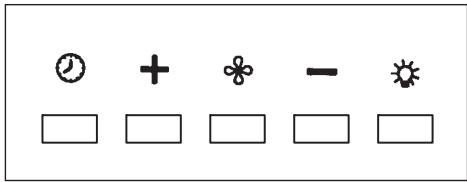
1. ELECTRONIC CONTROL PANEL

- ON: light on (the pushbutton is lit);
- OFF: light off;
Press to reduce motor speed
Speed 1, 2 and 3 are indicated by the number of LEDs that light up (excluding the light and the timer LEDs).
Press to increase motor speed
Speed 1, 2 and 3 are indicated by the number of LEDs that light up (excluding the light and the timer LEDs).
(In the 4-speed version the pushbutton + blinks. The fourth speed remains on for a set duration of time. After 15 minutes the motor returns to the third speed).
Function: it turns hood motor on and off.
The function "desired speed" enables to start the motor at the speed that was selected before the hood was last turned off.
Optional: version with remote control (some versions only).
WARNING:
Install the hood away from sources of electromagnetic waves, as these could affect the correct operation of the electronic system.
Maximum operating distance: 5 metres. The maximum operating distance could be less than 5 metres in case of electromagnetic interference by other equipment.
Light pushbutton on remote control: light on/off.
- and + pushbutton: increase/decrease speed (to start the motor press either the + or the - pushbutton).
Timer pushbutton: see instructions below.
- This function allows the automatic turning off of the hood after running for 15 minutes at the speed previously set (the pushbutton shows a flickering light).
- After about 30 hours of running the pushbutton indicates the need for washing the metal filters (the pushbutton shows a solid red light). To disable the alarm press the pushbutton for a few seconds until the red light turns off. Then turn the hood off and on again to check that the alarm has disappeared.

FILTERS REMOVING AND REPLACING'S INSTRUCTIONS
To reach the metal filters one must remove the three frontal panels (see fig A1 and A2). To remove the metal filters use the handle.
2. CHARCOAL FILTERS
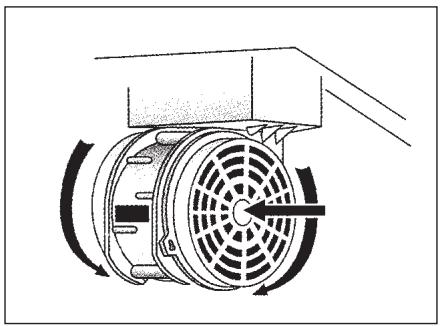
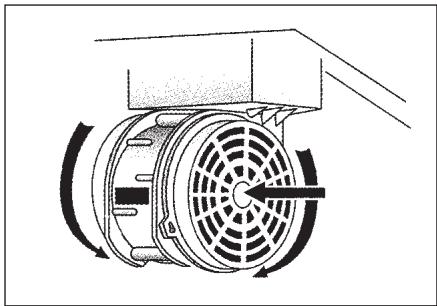
To replace the charcoal filters, proceed as follows: remove the metal filters as described
above. The two filters located at the ends of the motor can now be easily accessed.
To install the new filters see picture.
In case of hood with the motor box the filter is located on the bottom part of the motor box.
To install the new filters see picture.
To order new charcoal filters contact the distributor/retailer.
VALID ONLY FOR ITALY: download the appropriate order form from: www.falmec.com (access the assistance drop-down menu).

LIGHTING ASSEMBLY AND REPLACEMENT
1. FLUORESCENT TUBE (DIAMANTE)
Fluorescent tube replacement:
a) Disconnect the appliance from the mains. b) Remove the steel panel and the metal filters (see H 1). Undo the 2 + 2 knurled fixing studs in the steel support. c) Remove the neon tube by rotating it by 90 degrees and replace it with an identical one (13W tube T5). d) Repeat point B in reverse. e) Reconnect the appliance to the mains
In this case the hood is equipped with high efficiency, low power LED spotlights with extremely high durability under normal use conditions. LED spotlight replacement should only be carried out by qualified technicians using only original spare parts.

MAINTENANCE AND CLEANING
Constant maintenance ensures the correct operation and efficiency of the appliance over time. Special attention should be paid to the metal grease-trapping filters and the charcoal filters. Frequent cleaning of the filters and their supports will ensure that fats and grease do not accumulate on the range hood, with the consequent risk of fire.
These trap the fat and grease particles suspended in the air, and therefore should be washed every month in hot water and detergent, without bending them. Wait until they are completely dry before repositioning them. To remove and replace these filters, see the instructions in point H1. This operation should be performed at regular intervals.
2. CHARCOAL FILTERS
These trap the odours present in the stream of air that passes through them. The air
is purified by passing a number of times through the filters and being recirculated into the kitchen. The charcoal filters cannot be cleaned, and should be replaced on average every 3-4 months (according to use). To replace the charcoal filters, see the instructions in point H2.
3. CLEANING THE OUTSIDE OF THE APPLIANCE
It is advised to clean the external hood surfaces at least every 15 days in order to avoid that oily or greasy substances affect the steel surfaces.
The outside of the range hood should be cleaned using a damp cloth and neutral liquid detergent or denatured alcohol.
In case of fingerprint-less finish (fasteel) clean only with water and neutral soap using clean with a soft cloth, rinse and wipe dry thoroughly. Do not use products that contain abrasive substances, rough cloths or cloths specifically designed for cleaning steel. Using abrasive substances or rough cloths will inevitably damage the finish of steel. The steel surface will be irrevocably damaged if the instructions above are not complied with.
Keep these instructions together with the instructions for use of your hood.
The manufacturer accepts no liability for any damage caused by non-compliance with the instructions above.
4. CLEANING THE INSIDE OF THE APPLIANCE
The electrical parts or parts of the motor assembly inside the range hood must not be cleaned using liquids or solvents.

Do not use abrasive products.
All the above operations must be performed after having disconnected the appliance from the mains power supply.

WARRANTY
The new equipment is covered by warranty.
The warranty conditions are provided by the distributor.

The manufacturer is not liable for any inaccuracies in this booklet resulting from printing or transcription errors. The manufacturer reserves the right to modify its products as it considers necessary or in the interest of the user, without compromising their essential safety and operating characteristics.

MOUNTING INSTRUCTIONS, RANGE HOODS
Phase 1
- Lean the propping bar against the wall A (fig. 01), away from the cooking surface by a height calculated by the total sum of the numbers: X + 525 mm (where X can vary between 530 and 650 mm).
- Should there be a rear flue, see fig. A.
- Check with a spirit level the horizontal alignment and mark two fixing points at the ends of the bar.
- Drill a hole, insert 2 x 8 mm wall anchors and fix the bar with the screw provided.
Phase 2
- Hook the hood to the propping bar (fig. 02).
- Check the hood's alignment using the fixing screws (fig. 02). The upper screw (B) sets the distance from the wall, the lower (C) the vertical slide.
Phase 3
To avoid any unhooking of the hood, fix it to the wall with the screws and wall anchors supplied as follows:
- through the holes on the back of the hood and any strap on the cover.
- Insert pipe E into pipe union D (fig. 3).
- Should the fixing include a rear flue, see fig. A.
Phase 4 (optional)
- Position chimney (G) and extension (H) as shown in fig. 04.
- Insert extension H into G, making it slip until the required height is reached.
- When happy with the location, lean bar L against the wall, check with a spirit level the horizontal alignment and mark two fixing points at the ends of the bar.
- Drill a hole, insert 2 x 4 mm wall anchors and fix bar L with the screw provided.
- Screw extension H to bar L using screws M.


NOTES
1. ELECTRONIC CONTROL PANEL
Light button

TECHNICAL SPECIFICATIONS
The technical data of the appliance are given on the rating plate located inside the appliance.

INSTALLATION
IMPORTANT NOTES
(paragraph intended for qualified installers of the extraction unit)
Minimum distance: the distance between the highest part of the hob and the lowest part of the hood. As a rule, when the hood is placed above a gas hob, this distance must be no less than 65 cm (25.6") (see figure 01). However, based on the interpretation of standard EN60335-2-31 of 11-07-2002 by TC61 (sub-clause 7.12.1, see item 15 of advice 10.11), in the case of the Diamante/Gleam hood, this minimum distance between the hob surface and the lower part of the hood can be reduced to 53 cm. If the instructions for the gas hob specify a greater distance, this must be taken into account.
The exhaust duct connected to the hood must have a diameter no smaller than the diameter of the hood's connection pipe. On horizontal sections, the pipe must have a slight upward slope (approx. 10%) towards the external air outlet.
Minimize bends; check that the pipe length is sufficient for the connections. Comply with current regulations regarding the discharge of air to the outside. In the case of using other appliances (boilers, stoves, fireplaces, etc.) with combustion
gas or other types of fuel, provide adequate ventilation for the room where the extraction takes place, in accordance with current regulations. Installation instructions: see section "O" of this manual.

ELECTRICAL CONNECTION
(paragraph intended only for qualified electricians connecting the extraction unit)
WARNING!
Before performing any operation on the extraction unit, disconnect the appliance from the electrical supply.
Make sure that the internal wiring of the extraction unit is in good condition and that the electrical connections are secure; in the event of such situations, contact the nearest service center. For electrical connections, contact qualified electricians.
Connections must be made in accordance with current legislation. Make sure that the protective devices and the electrical equipment can withstand the load of the appliance (see the plate with technical characteristics, according to item B). Some appliances may be equipped with a plug of 63 V; in this case, the plug must be of the "standard" type, taking into account that:
- the yellow-green wire must be used for grounding,
- the blue wire must be used for the neutral wire, - the brown wire must be used for the phase, and it must not come into contact with hot parts, which can reach temperatures above 70°C
- Install the hood at the recommended height above the cooking surface, and insert it into the rear slot.
If necessary, adjust the height by placing spacers between the hood and the wall, using the minimum gap of 3 mm, calculated for the load and meeting the standards. The electrical cable must be grounded and must be routed accordingly.
When connecting the appliance to the electrical supply, ensure that:
- The supply voltage matches the value indicated on the rating plate. The grounding is effective and correctly performed.
- The electrical supply line is equipped with effective grounding in accordance with current standards.
- The socket used for the multi-pole connection is easily accessible after installation of the appliance.
The manufacturer declines all responsibility in case of failure to comply with safety standards.

The fumes and vapors from cooking are expelled outside through a pipe.
The exhaust pipe, which protrudes from the upper part of the hood, must be connected to a pipe that vents the fumes and vapors outside, see fig.
In this configuration, the activated charcoal filters are removed, if installed; how to remove them, see section F. If the kitchen hood is used simultaneously with other appliances operating on gas or other fuels, the room must have adequate ventilation.
In this configuration, the air passes through the activated charcoal filters and is then recirculated back into the kitchen.
Ensure that the charcoal filters are installed on the motor, fig. 6; in the opposite case, install them as indicated in section F of the instructions.
It is recommended to use the first speed for normal cooking odors, the second speed for stronger odors or larger quantities of fumes, and the third speed for cleaning the air at low energy consumption.
It is recommended to turn on the hood when you start cooking and to leave it running for a few minutes after cooking to eliminate residual odors.

WORK
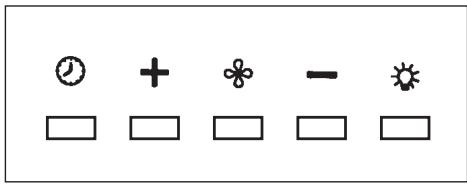
1. CONTROL WITH ELECTRONIC CONTROL
Light button

- ON: lighting is on (button lights up);
- OFF: lighting is off;
Button -
Pressing this button decreases the motor speed.
Speeds 1, 2 and 3 are indicated by the number of lit LEDs, not counting the timer backlight LEDs.
Button +
Pressing this button increases the motor speed.
Speeds 1, 2 and 3 are indicated by the number of lit LEDs, not counting the timer backlight LEDs. (In the 4-speed version, the + button gives the 4th speed with a limited operating time, and after 15 minutes the motor automatically switches to 3rd speed).
Mode button
Function: turning the exhaust motor on and off.
The button is lit when the light is on/off.
The - and + buttons decrease/increase the speed (to start the motor, you can press either the + button or the - button).
Key timer: see instructions below.
Key timer and saturation filters

- This function allows the hood to automatically switch off after 15 minutes of operation at the previously set speed (key with flashing light).
- After approximately 30 hours of operation, the key "blinks" to indicate that the metal filters need cleaning (the key lights up red). To turn off the indicator, press and hold the timer key for a few seconds until the red light goes off. Then turn off the hood and turn it back on to make sure the indicator has disappeared.

FILTERS: INSTRUCTIONS FOR REMOVAL AND REPLACEMENT
To gain access to the metal filters, remove the three front panels (see fig. A1 - A2). To remove the metal anti-grease filters, act on the handle.
2. ACTIVATED CARBON FILTERS
Replacement of the activated carbon filters must be carried out in the following order. Remove the metal filters as indicated above, after which access is gained to the two filters attached to the right and left side of the motor. For installation/replacement, see the extractor with motor compartment; the filter is located in the lower part of this compartment. For installation/replacement, contact your distributor/dealer for the charcoal filters.
ONLY FOR ITALY: download the special filter order form at: www.falmec.com (from the after-sales service menu).

LIGHTING: INSTALLATION AND REPLACEMENT
1. FLUORESCENT LAMP (DIAMANTE)
Replacement of the fluorescent tube:
a) Disconnect the device from the network; b) Remove the steel pins and metal filters (see point H1). Remove 2+2 threaded mounting studs, six steel uncoated supports.
c) Remove the fluorescent tube, turning it 90°, and replace it with a tube with similar characteristics (tube T5 for 13W); d) Repeat the operations in reverse order. e) Reconnect the device to the electrical network.
The warranty conditions are fully stated on the last page of this manual.

The manufacturer is not liable for possible errors in this manual that may arise during printing or binding. The manufacturer reserves the right to make modifications to its own products that it deems necessary or useful, as well as in the interests of the user, without affecting the main functional characteristics and safety.

1. FLUORESCENT LAMP (DIAMOND)