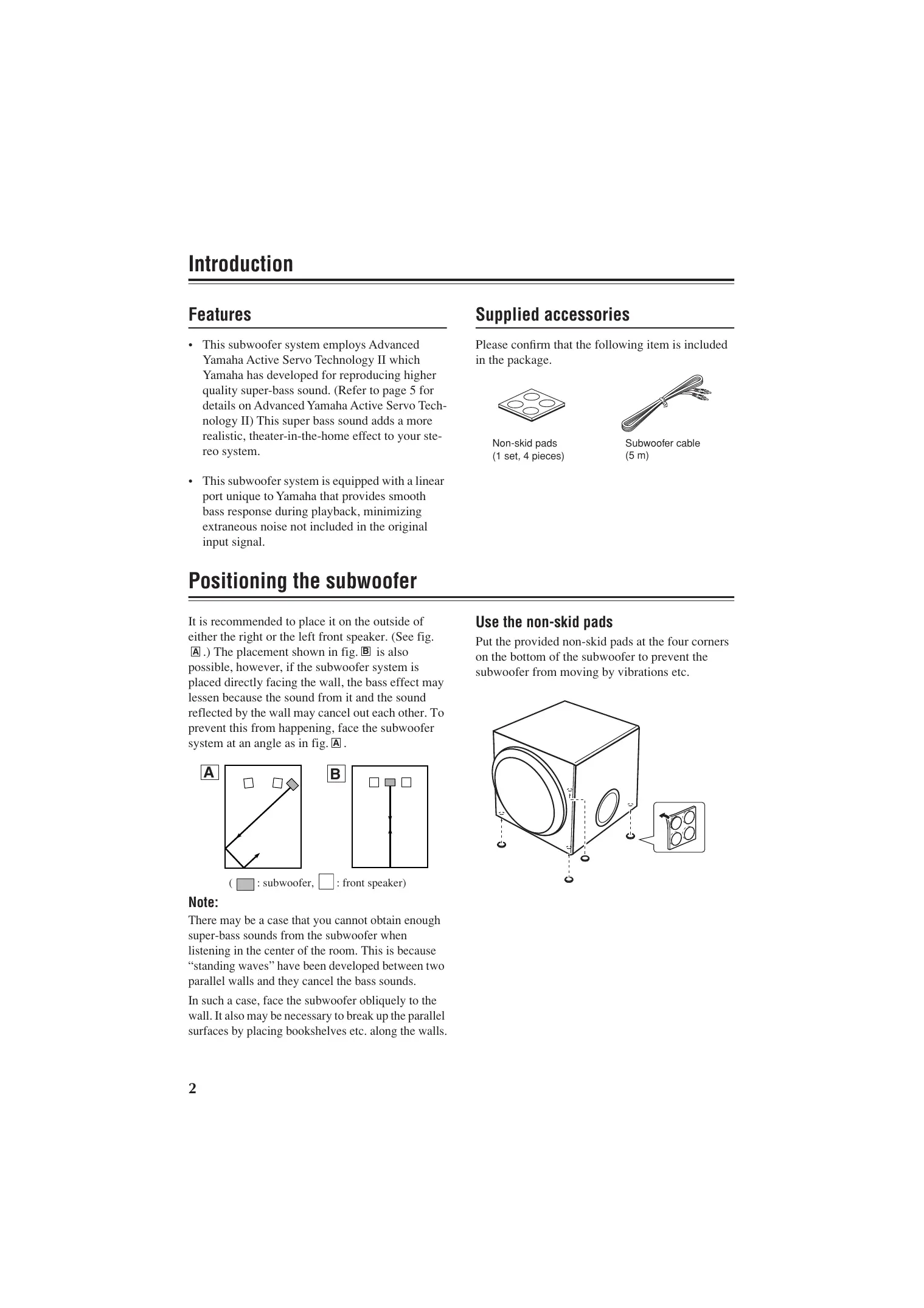
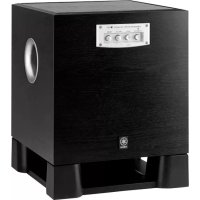
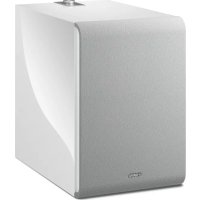
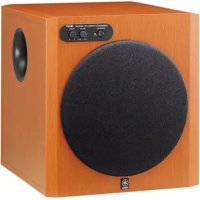
USER MANUAL YST-SW150 YAMAHA
Precautions: Read this before operating this unit
- To assure the finest performance, please read this manual carefully. Keep it in a safe place for future reference.
- Install this unit in a cool, dry, clean place - away from windows, heat sources, sources of excessive vibration, dust, moisture and cold. Avoid sources of humming (transformers, motors). To prevent fire or electrical shock, do not expose this unit to rain or water.
- Never open the cabinet. If any foreign objects drop into the set, contact your dealer.
- The voltage to be used must be the same as that specified on the rear panel. Using this unit with a higher voltage than specified is dangerous and may cause a fire and/or electric shock.
- To reduce the risk of fire or electric shock, do not expose this unit to rain or moisture.
- Do not use force on switches, controls, or connection wires. When moving the unit, first disconnect the power plug and the wires connected to other equipments. Never pull the wires themselves.
- When not planning to use this unit for a long period (i.e., vacation, etc.), disconnect the AC power plug from the wall outlet.
- Since this unit has a built-in power amplifier, heat will radiate from the rear panel. Place the unit apart from the walls, allowing at least 20cm of space above, behind and on both sides of the unit to prevent fire or damage. Furthermore, do not position with the rear panel facing down on the floor or other surfaces.
- Do not cover the rear panel of this unit with a newspaper, a tablecloth, a curtain, etc. in order not to obstruct heat radiation. If the temperature inside the unit rises, it may cause fire, damage to the unit and/or personal injury.
- Do not place the following objects on this unit: Glass, china, small metallic etc.
If glass etc. falls by vibrations and breaks, it may cause bodily injury.
A burning candle etc.
If the candle falls by vibrations, it may cause fire and bodily injury.
A vessel with water in it
If the vessel falls by vibrations and water spills, it may cause damage to the speaker, and/or you may get an electric shock.
- Do not place this unit where foreign objects such as water drips might fall. It might cause a fire, damage to this unit, and/or personal injury.
- Never put a hand or a foreign object into the YST port located on the right side of this unit. When moving this unit, do not hold the port as it might cause personal injury and/or damage to this unit.
-
Never place a fragile object near the YST port of this unit. If the object falls or drops by the air pressure, it may cause damage to the unit and/or personal injury.
-
Never open the cabinet. It might cause an electric shock since this unit uses a high voltage. It might also cause personal injury and/or damage to this unit.
- When using a humidifier, be sure to avoid condensation inside this unit by allowing enough spaces around this unit or avoiding excess humidification. Condensation might cause a fire, damage to this unit, and/or electric shock.
- Super-bass frequencies reproduced by this unit may cause a turntable to generate a howling sound. In such a case, move this unit away from the turntable.
- This unit may be damaged if certain sounds are continuously outputted at high volume level. For example, if 20Hz - 50Hz sine waves from a test disc, bass sounds from electronic instruments, etc. are continuously outputted, or when the stylus of a turntable touches the surface of a disc, reduce the volume level to prevent this unit from being damaged.
- If you hear distorted noise (i.e., unnatural, intermittent "rapping" or "hammering" sounds) coming from this unit, reduce the volume level. Extremely loud playing of a movie soundtrack's low frequency, bass-heavy sounds or similarly loud popular music passages can damage this subwoofer system.
- Vibration generated by super-bass frequencies may distort images on a TV. In such a case, move this unit away from the TV set.
- Do not attempt to clean this unit with chemical solvents as this might damage the finish. Use a clean, dry cloth.
- Be sure to read the "TROUBLESHOOTING" section regarding common operating errors before concluding that the unit is faulty.
- Install this unit near the wall outlet and where the AC power plug can be reached easily.
- Secure placement or installation is the owner's responsibility. YAMAHA shall not be liable for any accident caused by improper placement or installation of the subwoofer.
WARNING
TO REDUCE THE RISK OF FIRE OR ELECTRIC SHOCK, DO NOT EXPOSE THIS UNIT TO RAIN OR MOISTURE.
As long as this unit is connected to the AC wall outlet, it is not disconnected from the AC power source even if you turn off this unit by POWER.
This unit features a magnetically shielded design, but there is still a chance that placing it too close to a TV set might impair picture color. Should this happen, move this unit away from the TV set.
For U.K. customers
If the socket outlets in the home are not suitable for the plug supplied with this appliance, it should be cut off and an appropriate 3 pin plug fitted. For details, refer to the following instructions.
Note: The plug severed from the mains lead must be destroyed, as a plug with bared flexible cord is hazardous if engaged in a live socket outlet.
SPECIAL INSTRUCTIONS FOR U.K. MODEL
IMPORTANT:
THE WIRES IN MAINS LEAD ARE COLOURED IN ACCORDANCE WITH THE FOLLOWING CODE: Blue: NEUTRAL
Brown: LIVE
As the colours of the wires in the mains lead of this apparatus may not correspond with the coloured markings identifying the terminals in your plug, proceed as follows: The wire which is coloured BLUE must be connected to the terminal which is marked with the letter N or coloured BLACK. The wire which is coloured BROWN must be connected to the terminal which is marked with the letter L or coloured RED. Making sure that neither core is connected to the earth terminal of the three pin plug.
VOLTAGE SELECTOR
(For China, Korea, Asia and General models)
The voltage selector switch on the rear panel of this unit must be set for your local main voltage BEFORE plugging this unit into the AC main supply. Voltages are 110-120/220-240 V AC, 50/60 Hz.
Table of contents
Precautions: Read this before operating this unit
Introduction 2
Features 2
Supplied accessories 2
Positioning the subwoofer 2
Connections 3
Basic connection example 3
Connecting components and the subwoofer to AC power 3
Using the subwoofer 4
Pre-adjusting the subwoofer volume 4
Advanced Yamaha Active Servo Technology II 5
Troubleshooting 6
Specifications 7
Frequency response 7
Features
- This subwoofer system employs Advanced Yamaha Active Servo Technology II which Yamaha has developed for reproducing higher quality super-bass sound. (Refer to page 5 for details on Advanced Yamaha Active Servo Technology II) This super bass sound adds a more realistic, theater-in-the-home effect to your stereo system.
- This subwoofer system is equipped with a linear port unique to Yamaha that provides smooth bass response during playback, minimizing extraneous noise not included in the original input signal.
Positioning the subwoofer
It is recommended to place it on the outside of either the right or the left front speaker. (See fig. A.) The placement shown in fig. B is also possible, however, if the subwoofer system is placed directly facing the wall, the bass effect may lessen because the sound from it and the sound reflected by the wall may cancel out each other. To prevent this from happening, face the subwoofer system at an angle as in fig. A.
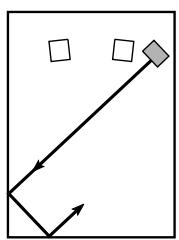
A
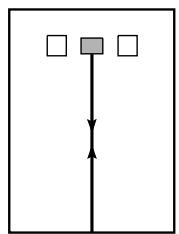
B


: subwoofer,
: front speaker)
Note:
There may be a case that you cannot obtain enough super-bass sounds from the subwoofer when listening in the center of the room. This is because "standing waves" have been developed between two parallel walls and they cancel the bass sounds.
In such a case, face the subwoofer obliquely to the wall. It also may be necessary to break up the parallel surfaces by placing bookshelves etc. along the walls.
Supplied accessories
Please confirm that the following item is included in the package.
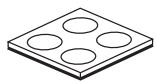
Non-skid pads (1 set, 4 pieces)
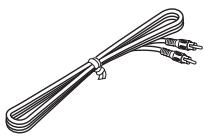
Subwoofer cable (5 m)
Use the non-skid pads
Put the provided non-skid pads at the four corners on the bottom of the subwoofer to prevent the subwoofer from moving by vibrations etc.
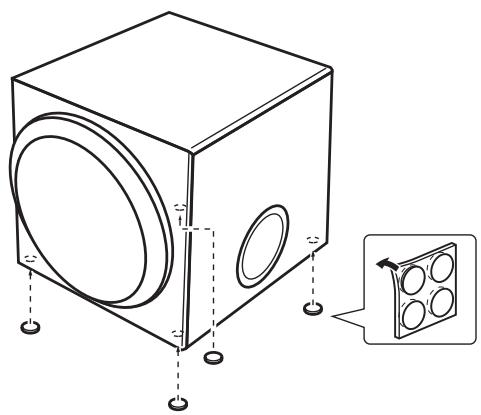
Caution: Plug the power cables for the subwoofer and other audio/video components into an AC outlet only after you complete all other connections.
Basic connection example
Connect a subwoofer cable to the output jack of your AV amplifier and to the INPUT jack of the subwoofer.
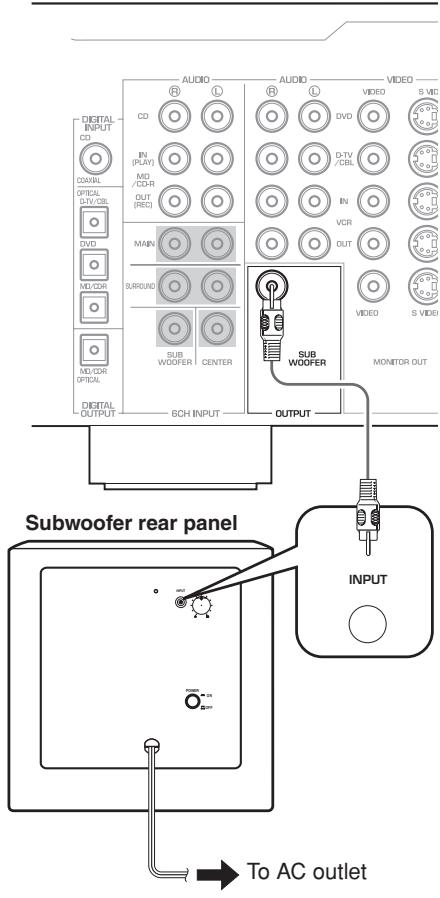
Amplifier (The rear panel of various amplifiers may differ in appearance.)
Connecting components and the subwoofer to AC power
After you complete a subwoofer connection, plug the amplifier, other audio/video component, and the subwoofer into an AC outlet of appropriate voltage.
VOLTAGE SELECTOR
(For China, Korea, Asia and General models) The voltage selector switch on the rear panel of this unit must be set for your local main voltage BEFORE plugging this unit into the AC main supply. Voltages are 110 - 120 / 220 - 240V AC, 50 / 60Hz .
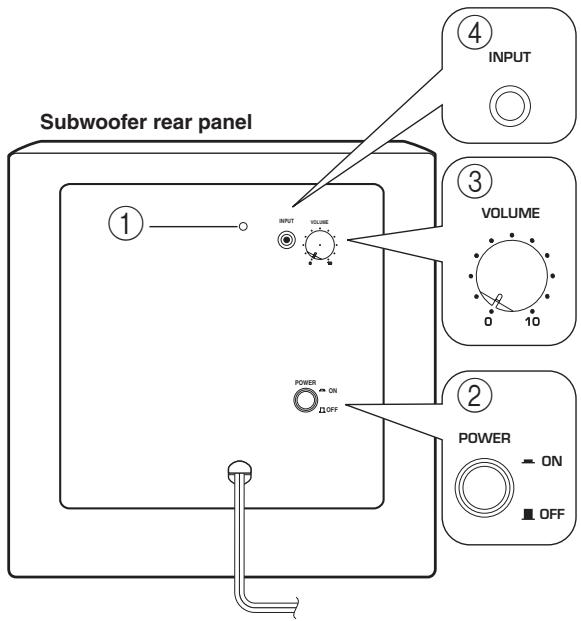
①Power indicator
Lights up in GREEN when the POWER switch (②) is turned ON; turns off when the POWER switch is turned OFF.
② POWER switch
Press this switch to the ON position to turn on the power to the subwoofer. When the power of the subwoofer is on, the power indicator (①) on the rear panel lights up in green. Press this switch again to set it to the OFF position to turn off the power of the subwoofer.
③ VOLUME control
Adjusts the volume level. Turn the control clockwise to increase the volume, and counterclockwise to decrease the volume.
Input terminal for line level signals from the amplifier.
Pre-adjusting the subwoofer volume
Before you use the subwoofer, first adjust the volume balance between the subwoofer and the front speakers by following the procedure below.
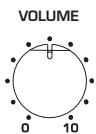
- Set the VOLUME control to minimum (0).
- Turn on the power to all other components.
- Press the POWER switch to the ON position. The power indicator on the rear panel lights up in green.
- Play a source that contains bass signal. Adjust the amplifier's volume control to the desired listening level.
- Rotate the VOLUME control gradually to adjust the volume balance between the subwoofer and the other speakers. To enjoy natural bass sound, keep the subwoofer volume at a level where it is barely distinguishable from other speakers.
- Adjust the volume of the entire sound system using the amplifier's volume control.
Note: It is recommended to set the VOLUME control about in the middle position when using in a multi channel home theater system.
In 1998, Yamaha brought to the marketplace speaker systems utilizing YST (Yamaha Active Servo Technology) to give powerful, high quality bass reproduction. This technique uses a direct connection between the amplifier and speaker, allowing accurate signal transmission and precise speaker control.
As this technology uses speaker units controlled by the negative impedance drive of the amplifier and resonance generated between the speaker cabinet volume and port, it creates more resonant energy (the "air woofer" concept) than the standard bass
reflex method. This allows for bass reproduction from much smaller cabinets than was previously possible.
Yamaha's newly developed Advanced YST II adds many refinements to Yamaha Active Servo Technology, allowing better control of the forces driving the amplifier and speaker. From the amplifier's point of view, the speaker impedance changes depending on the sound frequency. Yamaha developed a new circuit design combining negative-impedance and constant-current drives, which provides a more stable performance and clear bass reproduction without any murkiness.
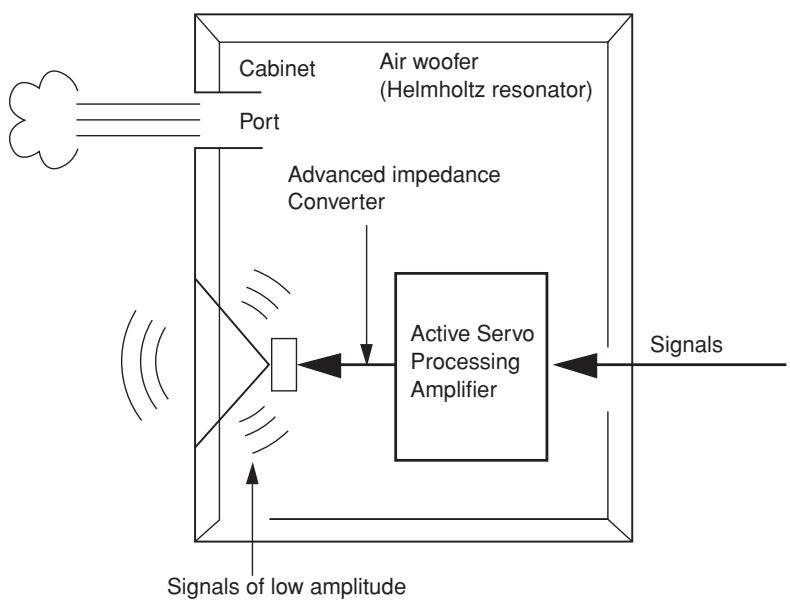
High-amplitude bass sound
Refer to the chart below if the unit does not function properly. If the problem you are experiencing is not listed, or if the instructions fail to help you resolve the problem, disconnect the power cord and contact your authorized Yamaha dealer or service center.
| Problem | Cause | Remedy |
| Power is not supplied even though the POWER switch is set to the ON position. | The power plug is not securely connected. | Turn the power switch OFF, then connect the power plug securely. |
| No sound. | The VOLUME control is set to 0. | Turn the VOLUME control to the right (clockwise). |
| A subwoofer cable is not connected securely. | Connect a subwoofer cable securely. |
| Sound level is too low. | You are playing a sound source that includes inadequate bass frequencies. | Play a sound source that includes more bass frequencies. |
| The sound level has been diminished by standing waves. | Reposition the subwoofer, or break up the parallel wall surface by placing bookshelves or other large objects along the wall. |
| The input signal is too small | Turn up the volume. |
Type.....Advanced Yamaha Active Servo Technology II
Driver 20 cm (8") cone woofer Magnetically shielded type
Output Power 50 W
Dynamic Power. 100 W, 5 Ω
Input Impedance 12 kΩ
Frequency Response 28 Hz - 200 Hz
Input Sensitivity. 50 mV (50 Hz, 50 W/5 Ω)
Power Supply
[U.S.A. and Canada models] .AC 120 V, 60 Hz
[Australia model]AC 240 V, 50 Hz
[U.K. and Europe models]AC 230 V, 50 Hz
[China, Korea, Asia and General models]
AC 110-120/220-240 V, 50/60 Hz
Power Consumption 45 W
Dimensions (W x H x D)
290 mm x 290 mm x 328 mm
(11-13/32" x 11-13/32" x 12-29/32")
Weight. 8.5 kg (18-3/4 lbs.)
Frequency response
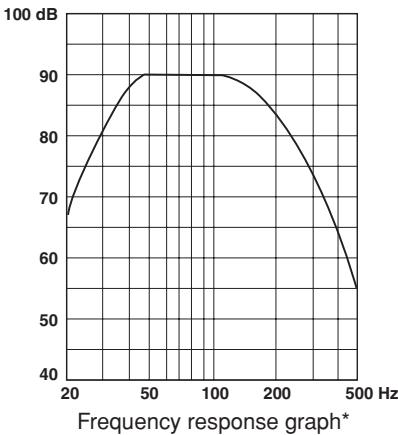
- This diagram does not depict actual frequency response characteristics accurately.
Specifications are subject to change without notice.
Advanced Yamaha Active Servo Technology II 5
Dépannage 6
Fiche technique 7
Advanced Yamaha Active Servo Technology II 5
Felsökning 6
Tekniska data. 7
Frekvenskarakteristik 7
Egenskaper
Advanced Yamaha Active Servo Technology II
Advanced Yamaha Active Servo Technology II 5
Advanced Yamaha Active Servo Technology II 5
Solutcionar problemas 6
Especificaciones. 7
7
Funciones
Advanced Yamaha Active Servo Technology II
Advanced Yamaha Active Servo Technology II 5
Problemen oplossen 6
Advanced Yamaha Active Servo Technology II
Type Advanced Yamaha Active Servo Technology II
Bezetting 20 cm conuswoofer Magnetisch afgeschermd
© 2006 YAMAHA CORPORATION All rights reserved.